Apple has officially rolled out iOS 27.2, marking one of the most substantial middle-cycle software releases of the year. Packed with long-awaited localization upgrades for Apple Intelligence, structural overhauls to personal health tracking, and practical day-to-day app polish, this update focuses heavily on refining how the iPhone interacts with daily routines. Whether you are looking […]
Apple has officially rolled out iOS 27.2, marking one of the most substantial middle-cycle software releases of the year. Packed with long-awaited localization upgrades for Apple Intelligence, structural overhauls to personal health tracking, and practical day-to-day app polish, this update focuses heavily on refining how the iPhone interacts with daily routines. Whether you are looking […]
Back in July 2026, Microsoft announced via Xbox Wire that games from the original Xbox would get achievements implemented on modern consoles and PC. However, it seems that this long-requested feature has already been sneaking onto Xbox Series X|S for certain games without any official fanfare.This has been confirmed by photographs taken by X users @xgramiliki and @PiquenoLoredo (via @CentralXBOX_) showing achievements for OG Xbox games like Destroy All Humans!, F
Back in July 2026, Microsoft announced via Xbox Wire that games from the original Xbox would get achievements implemented on modern consoles and PC. However, it seems that this long-requested feature has already been sneaking onto Xbox Series X|S for certain games without any official fanfare.
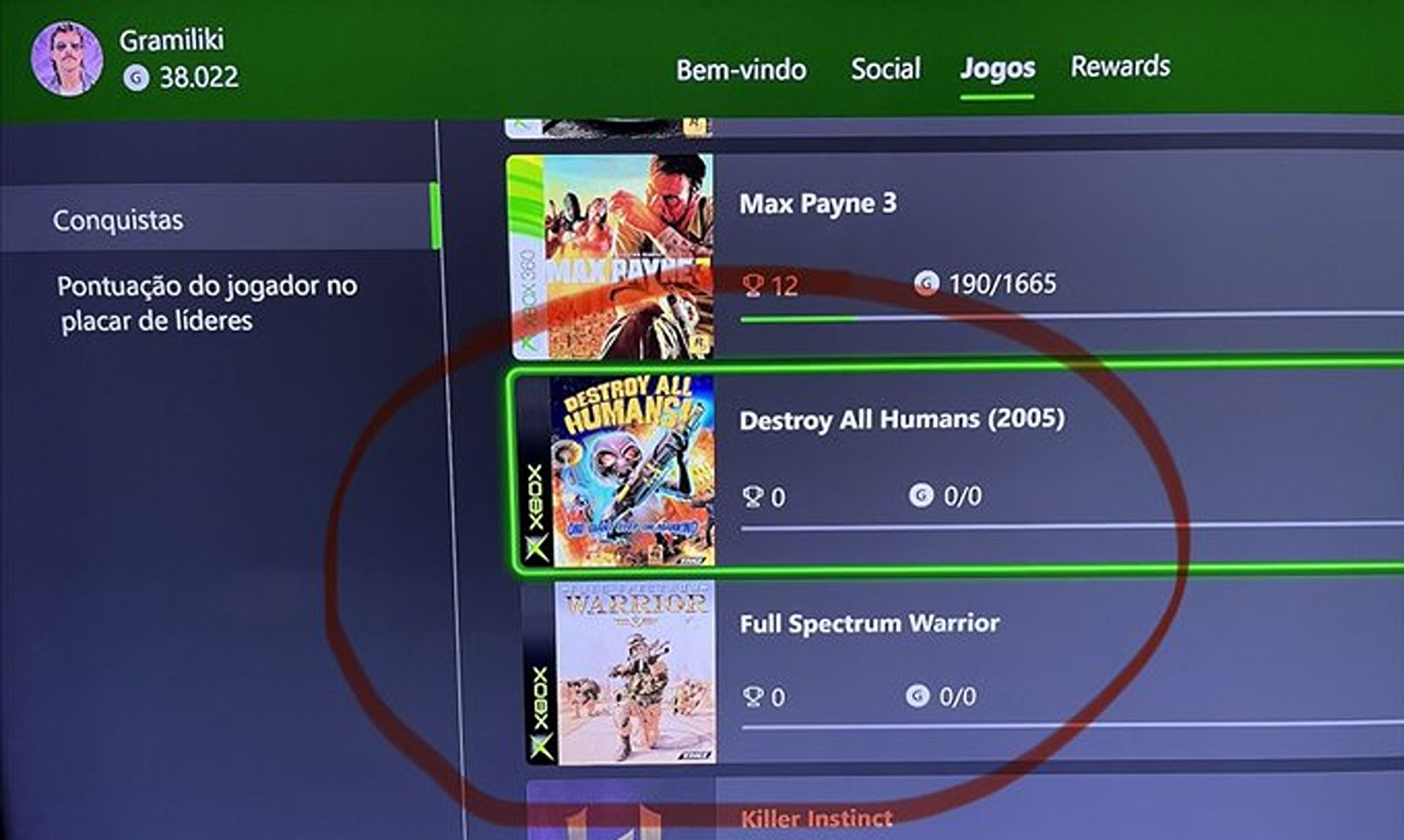
This has been confirmed by photographs taken by X users @xgramiliki and @PiquenoLoredo (via @CentralXBOX_) showing achievements for OG Xbox games like Destroy All Humans!, Full Spectrum Warrior, Star Wars: Republic Commando, Panzer Dragoon Orta, and KOF: Neowave.
🔥 BOMBA: ¡LOS LOGROS DE LOS JUEGOS DE XBOX ORIGINAL EMPIEZAN A APARECER EN LA LISTA DE JUEGOS!Los títulos de la XBOX original están dando un paso importante hacia una nueva etapa de retrocompatibilidad.Imágenes via @xgramiliki y @PiquenoLoredo https://t.co/6n1kmmPwzNOctober 26, 2026
However, it seems the update isn't finished, as each of the aforementioned games shows "0/0" achievements and zero Gamerscore earned. The possible explanation for this could be that these achievements have shown up on players' profiles by mistake due to a programming error before they were officially ready.
These achievements will probably be taken down shortly when Microsoft discovers this and brought back once they're fully ready so they can join the other OG Xbox titles that have achievements officially, like BLiNX: The Time Sweeper, Conker: Live and Reloaded, Crimson Skies: High Road to Revenge, Fuzion Frenzy.
Either way, this will be great news for Xbox Achievement hunters looking to get the prestige Xbox Mythic Achievement from their favorite OG Xbox titles and serve as the perfect excuse to replay them.
Join us on Reddit at r/WindowsCentral to share your insights and discuss our latest news, reviews, and more.
This is a breaking news story, and we will update it as more information becomes available.Microsoft is offering roughly 60,000 employees the option to participate in a voluntary exit program. The new program allows eligible employees to leave Microsoft with financial support and career planning resources.An internal memo from Chief People Officer Amy Coleman was sent yesterday. That memo has since been edited slightly and shared publicly by Microsoft. CNBC share
This is a breaking news story, and we will update it as more information becomes available.
Microsoft is offering roughly 60,000 employees the option to participate in a voluntary exit program. The new program allows eligible employees to leave Microsoft with financial support and career planning resources.
An internal memo from Chief People Officer Amy Coleman was sent yesterday. That memo has since been edited slightly and shared publicly by Microsoft. CNBC shared additional information on the program, including the fact that around 60,000 Microsoft employees are eligible.
The offer has been extended to eligible employees in Canada, India, the United States, and the United Kingdom. The offer applies to employees who are level 70 or below.
"This offer gives eligible employees who may be considering a future outside the company a new choice to make that transition now with support. It also gives participating organizations another way to adapt their workforce to changing needs," said Microsoft.
The offer comes just six months after Microsoft announced a voluntary retirement program.
As of June 30, Microsoft had roughly 223,000 employees (per the company's 10-K form for 2026). That figure means the offer has been extended to about 27% of the company's workforce. It is unlikely that all 60,000 eligible employees will take the offer, however.
While Microsoft did not mention layoffs in its post about the voluntary exit program, those could be on the way. Microsoft announced its early retirement program in April and then announced layoffs in July. It is common for companies the size of Microsoft to give employees a voluntary exit ramp before layoffs.
Full Microsoft statement
Today, we’re introducing a new Voluntary Exit Offer (VEO) to eligible employees within participating organizations. This offer gives eligible employees who may be considering a future outside the company a new choice to make that transition now with support. It also gives participating organizations another way to adapt their workforce to changing needs.
The Voluntary Exit Offer reflects an important part of how we’re evolving our approach to change: creating greater flexibility and, where possible, more ways for employees to shape their next chapter. This builds on what we learned earlier this year through the Voluntary Retirement Program.
What employees should know
This offer will be available to eligible employees in participating teams in Canada, India, the United Kingdom and the United States at level 70 and below. This is a time-limited, voluntary program that gives those who are eligible the opportunity to leave Microsoft with financial support and career planning resources. Some organizations are providing the Voluntary Exit Offer, and some are not. Participation varies based on each business’s priorities, customer commitments and workforce needs.
Eligible employees will receive an email with a link to their Voluntary Exit Offer details within the next few hours.
Looking ahead
The Voluntary Exit Offer is new for us. We’ll learn from it. At the same time, we’ll keep helping people focus on the work that matters most, build new skills and, where it makes sense, find new opportunities across Microsoft. There is no one-size-fits-all approach for every team or every employee. These are a few of the ways we’re trying to meet different business needs while continuing to create opportunities for our own people to grow and contribute.
My promise is to continue to provide clarity, listen and learn and keep improving.
Thank you for everything you continue to do for our customers, Microsoft and for one another.
Amy
Join us on Reddit at r/WindowsCentral to share your insights and discuss our latest news, reviews, and more.
It was only yesterday I was writing about how the #SaveMassEffect petition had hit over 170k signatures ahead of plans for a billboard outside EA headquarters. Today I am elated to report that not only has the petition surpassed 216K signatures, but a billboard has officially reached the glowing screens of New York City. Coordinated by the @WeAreMassEffect team and content creator Kala Elizabeth, the massive #SaveMassEffect billboard is now live in Times Square a
It was only yesterday I was writing about how the #SaveMassEffect petition had hit over 170k signatures ahead of plans for a billboard outside EA headquarters. Today I am elated to report that not only has the petition surpassed 216K signatures, but a billboard has officially reached the glowing screens of New York City.
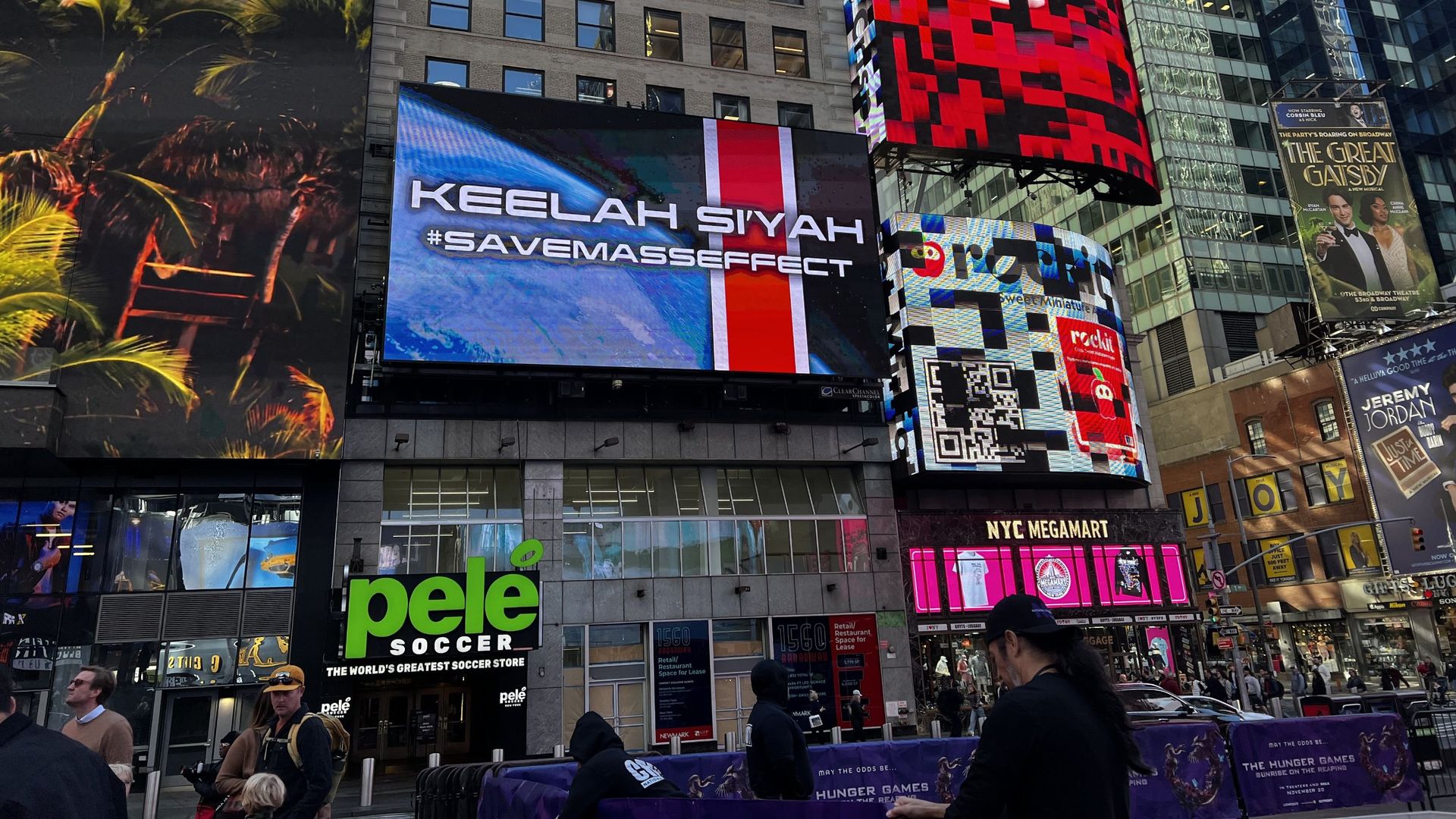
Coordinated by the @WeAreMassEffect team and content creator Kala Elizabeth, the massive #SaveMassEffect billboard is now live in Times Square all day today.
🚨 WE'RE IN TIMES SQUARE!Together with @kalaelizabeth, we've managed to get a #SaveMassEffect billboard up in Times Square, NYC, all day today!📍 1560 Broadway, above the Pelé store (Duffy Square)⏰ 15 seconds every hour at :35HOLD THE LINE! ❤️ https://t.co/wNP9Ak9Vh8October 26, 2026
The digital display is prominently located at 1560 Broadway, situated directly above the Pelé store in Duffy Square. Fans currently in the area can catch the advertisement running for 15 seconds at 35 minutes past every hour.
// This was the best footage & image I could get of the billboard from the city cam view in Times Square! #SaveMassEffect #HoldTheLine #MassEffect #EA #Bioware https://t.co/YhMIOEKbjjOctober 26, 2026
The words "Keelah Si'yah" is actually amusingly a typo. Kala has admitted on social media that this was supposed to be the iconic Quarian phrase "Keelah Se'lai" ("by the homeworld I hope to see one day")
Kala explained that their original billboard design was rejected over copyright issues, forcing a frantic redesign where she had to learn to animate in 10 minutes, leading to the accidental misspelling. Despite the rushed typo, it serves as a fitting tribute for a game and studio that fans are desperate to rescue.
Mer from the We Are Mass Effect team was out to get pictures live from NYC (Image credit: Provided by We Are Mass Effect)
With their message now broadcasting to one of the busiest pedestrian intersections in the world, fans voices just got even louder. The WeAreMassEffect team have a Discord where they are discussing extending the billboard by way of crowdfunding, and perhaps expanding to other locations. Organisers have urged the community to "HOLD THE LINE!" as the grassroots campaign continues to gain remarkable momentum across social media.
If you want to pledge your support to the #SaveMassEffect campaign, don't forget to head to the Change.org petition here.
Join us on Reddit at r/WindowsCentral to share your insights and discuss our latest news, reviews, and more.
Some would be surprised to hear that Microsoft Edge has been available on macOS for years. The browser receives regular updates and gives users an easy way to extend their browsing experience across platforms. Soon, organizations that rely on Edge on macOS will have another option for which version of the browser is installed.Selecting the Microsoft Edge Extended stable channel will soon be an option for organizations. That channel receives major feature updates
Some would be surprised to hear that Microsoft Edge has been available on macOS for years. The browser receives regular updates and gives users an easy way to extend their browsing experience across platforms. Soon, organizations that rely on Edge on macOS will have another option for which version of the browser is installed.
Selecting the Microsoft Edge Extended stable channel will soon be an option for organizations. That channel receives major feature updates every eight weeks, giving organizations more time to validate changes to the browser.
The Edge Extended stable channel is already available on Windows. Next year, it will roll out to macOS. An entry in the AI at Work Roadmap (previously known as the Microsoft 365 Roadmap), outlines Microsoft's plans:
"Organizations managing macOS devices will be able to select the Microsoft Edge Extended Stable channel, providing a slower 8-week major release cycle, compared to the two-week major release cycle for Stable."
Edge stable, which is commonly just referred to as "Edge," receives major feature updates every two weeks.
Notably, both Edge Stable and Edge Extended Stable receive security updates as needed. Organizations using the Extended Stable channel do not have to wait eight weeks to receive critical security fixes.
Join us on Reddit at r/WindowsCentral to share your insights and discuss our latest news, reviews, and more.
Xbox has officially announced that Game Pass is heading to eligible T-Mobile customers in the U.S. starting this November. Through T-Mobile's new "T-Mix" plan perks, eligible subscribers will be able to pick Xbox Game Pass Ultimate or Premium as an included benefit, granting access across Xbox consoles, PC, Smart TVs, and cloud devices.If you’re based in the UK, this announcement might seem like something of a nothing burger. EE has offered Game Pass Ultimate as
Xbox has officially announced that Game Pass is heading to eligible T-Mobile customers in the U.S. starting this November. Through T-Mobile's new "T-Mix" plan perks, eligible subscribers will be able to pick Xbox Game Pass Ultimate or Premium as an included benefit, granting access across Xbox consoles, PC, Smart TVs, and cloud devices.
If you’re based in the UK, this announcement might seem like something of a nothing burger. EE has offered Game Pass Ultimate as an "Inclusive Extra" or an easy mobile bill add-on over here for absolutely years now. But across the Atlantic, this is actually the very first time a major U.S. wireless carrier has integrated Xbox Game Pass directly into its mobile plans.
Here's how T-Mix works
(Image credit: T Mobile)
T-Mobile's new setup moves away from rigid pre-selected bundles and introduces a modular "Picks" system across three main plan tiers: Standard, More, and Loaded.
Depending on your plan tier and the number of lines on your account, you receive a bucket of monthly Picks to spend across partner streaming, tech, and gaming perks.
Xbox Game Pass Premium: Requires 2 Picks.
Xbox Game Pass Ultimate: Requires 3 Picks.
For single-line accounts, T-Mix More starts at $75/month and includes 2 Picks which is enough to cover Game Pass Premium. If you want full Game Pass Ultimate access, you'll need 3 Picks, which comes included with a single line on T-Mix Loaded starting at $95/month (or through multi-line account allotments).
T-Mobile is also letting subscribers "remix" and swap out their chosen partner perks four times a year, so you aren't permanently locked in if your gaming or streaming habits change.
Why is this a big deal? UK have had this for ages!
(Image credit: Windows Central | Jez Corden)
For years, U.S. mobile networks have thrown free Netflix, Disney+, Hulu, or Apple Music subscriptions at customers to push plan upgrades. Yet despite Xbox pushing cloud gaming so heavily on mobile devices, game subscription services haven't made it into the mix.
When I wrote earlier this year that the Xbox Game Pass problem could be fixed without dropping the price, my main argument was that Microsoft needed to tackle subscription fatigue by letting us consolidate our monthly bills. Bundling in with mobile contracts is a fantastic way to do that, but Xbox shouldn't stop there. Bringing that same modular approach to the subscription itself, by letting players swap out unused extras like Fortnite Crew or EA Play for perks they’ll actually use, would instantly soften the blow of that monthly fee. Yes the price hike was ultimately reversed, but my point still stands.
Either way, T-Mobile’s November rollout of T-Mix is a long overdue one for the US audience. If Microsoft wants Game Pass to keep expanding beyond traditional hardware, partnering with major telecom providers to absorb that out-of-pocket cost is easily one of the smartest moves they can make right now.
Join us on Reddit at r/WindowsCentral to share your insights and discuss our latest news, reviews, and more.
Monitors are a quintessential part of our lives as Windows users (and gamers), whether it's for achieving the best graphics and frame rates for our favorite titles or simply giving us better details and performance when going about our daily productivity tasks.See more deals at Dell.comDell's monitors fulfill this need with gusto, and several of them are now on sale if you need one to tackle the winter influx of games or workloads. That includes the productivity-
Monitors are a quintessential part of our lives as Windows users (and gamers), whether it's for achieving the best graphics and frame rates for our favorite titles or simply giving us better details and performance when going about our daily productivity tasks.
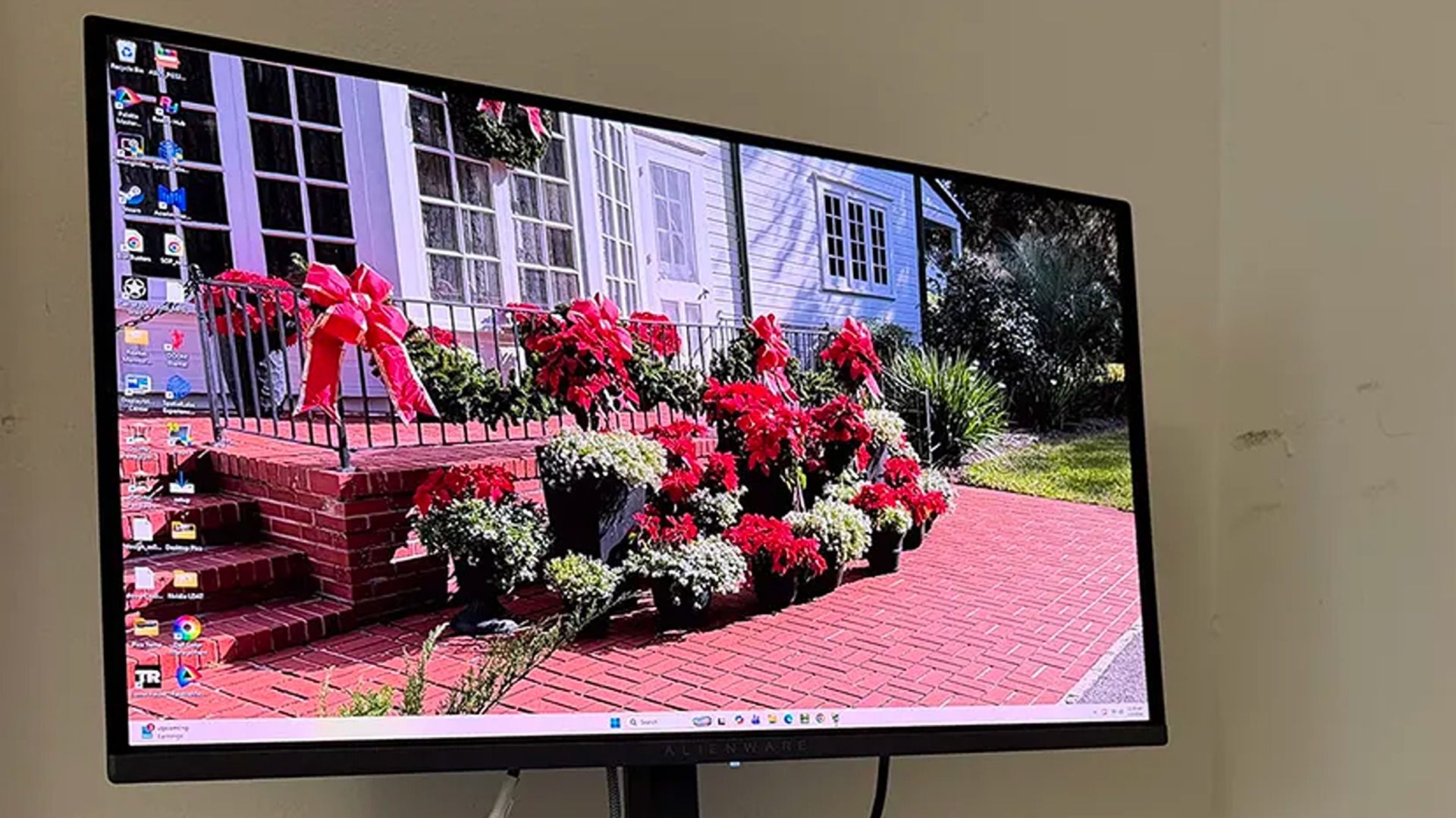
Dell's monitors fulfill this need with gusto, and several of them are now on sale if you need one to tackle the winter influx of games or workloads. That includes the productivity-focused Dell 32 Plus 4K S3225QS) for $329.99 at Dell (was $369.99), the gaming-focused Alienware 27 240Hz QD-OLED (AW2726DM) for $319.99 at Dell(was $349.99), and the budget-friendly Alienware 32 (AW3225DM) for $249.99(was $299.99).
"For around £300, the Dell 32 Plus S3225QS delivers a 4K VA panel with a 120Hz refresh rate and a typically smart, stylish design. If you're looking for a big, affordable screen to maximize your productivity, then this looks to be a very capable – and rather handsome-looking – option that won't break the bank." ~ Sasha Muller, freelancer journalist
"The Alienware AW2726DM doesn’t have USB ports or internal speakers, but it does have premium-level gaming performance and an image that goes toe-to-toe with any premium OLED, for a significantly lower admission price." ~ Christian Eberle, Contributing Editor
With its 32-inch Curved QD-OLED screen capable of rendering images and videos at 2560x1440 resolution and 180Hz refresh rates, the Alienware 32 (AW3225DM) is a great budget pick for gamers and content creators alike.View Deal
Which of these monitors is good for gaming?
Alienware's 27 240Hz QD-OLED (AW2726DM) and Alienware 32 (AW3225DM) are the best options for gaming in this round-up.
The Alienware 27 is a mid-range monitor great for gaming with its sharp and colorful images, low input lag for improved controller responsiveness, and a solid build for longer durability. Meanwhile, the Alienware 32 delivers decent frame rates and resolution at a much lower price and with a wider curved screen for greater cinematic immersion.
The Dell 32 Plus 4K (S3225QS) is the best choice for productivity among this monitor round-up.
It features a massive 32-inch display that render 4K resolutions, an sRGB mode to provide images, documents, and other digital assets with vibrant colors, built-in 10W speakers with decent sound quality, and a sideways HDMI port for quick and easy connections to laptops or PCs when swapping desktops.
Should I wait until Black Friday for better deals?
It depends on your situation. If you're willing to wait for Black Friday on November 27, 2026 for potentially greater discounts, then I'd recommend holding off until then.
However, if you're in desperate need of a new monitor or afraid these monitors will rise in price to the point that Black Friday deals won't be useful thanks to the RAM crisis, then I'd recommend taking advantage of Dell's discounts now.
Join us on Reddit at r/WindowsCentral to share your insights and discuss our latest news, reviews, and more.
Voting for the Golden Joystick Awards 2026 candidates for 21 categories closed on October 23, 2026. However, the Golden Joystick Awards Show has more in store, as it has announced the nominees for its "Ultimate Game of the Year" award.DEAL: Get Surfshark VPN 86% OFF with Windows Central 🦈You can vote for the winner of this coveted award right now at GamesRadar, and the ballot will remain open until October 30, 2026, 5:00 PM PT / 8:00 PM ET/ midnight GMT.Here are
You can vote for the winner of this coveted award right now at GamesRadar, and the ballot will remain open until October 30, 2026, 5:00 PM PT / 8:00 PM ET/ midnight GMT.
Here are the Golden Joystick Awards 2026 nominees for its Ultimate Game of the Year award:
Golden Joystick Awards — Ultimate Game of the Year nominees
Golden Joystick Awards — Where can we watch the show?
The winner of the Ultimate Game of the Year category and the winners of the 21 other categories will be announced at the Golden Joystick Awards ceremony on November 11, 2026, at Troxy, London, United Kingdom.
Viewers can tune in to watch the awards show (which will be hosted by actress Alix Wilton Regan and several guest presenters) live on YouTube, Twitch, X, Future Games Show, GamesRadar and PC Gamer.
Who do you want to win Ultimate Game of the Year?
My money's on Pragmata. (Image credit: Capcom)
The Golden Joystick has a pretty stacked selection of Ultimate Game of the Year contenders, from AAA titles like 007: First Light to viral indie hits like Big Walk.
Personally, I'm placing my vote on Pragmata to win. Its strange melding of fast-paced third-person gunplay with hacking puzzles to weaken enemies without pausing works surprisingly well, and its story is a heartwarming adventure that I'd dare not spoil for anyone who hasn't played it yet.
But will Pragmata manage to beat out the competition? Who are you personally voting for to win? Tune in on November 11, 2026, to find out when the Golden Joystick Awards reveal its Ultimate Game of the Year.
Join us on Reddit at r/WindowsCentral to share your insights and discuss our latest news, reviews, and more.
Microsoft has released its first firmware update for the new Surface Laptop Ultra that fixes a number of issues that users and reviewers have reported since launch day a few weeks ago. Namely, issues with the display and long reboot times are finally being addressed.According to the changelog, this firmware update was released on October 22, 6 days after the Surface Laptop Ultra launched. It appears under the name "Microsoft Corporation System Hardware Update (20
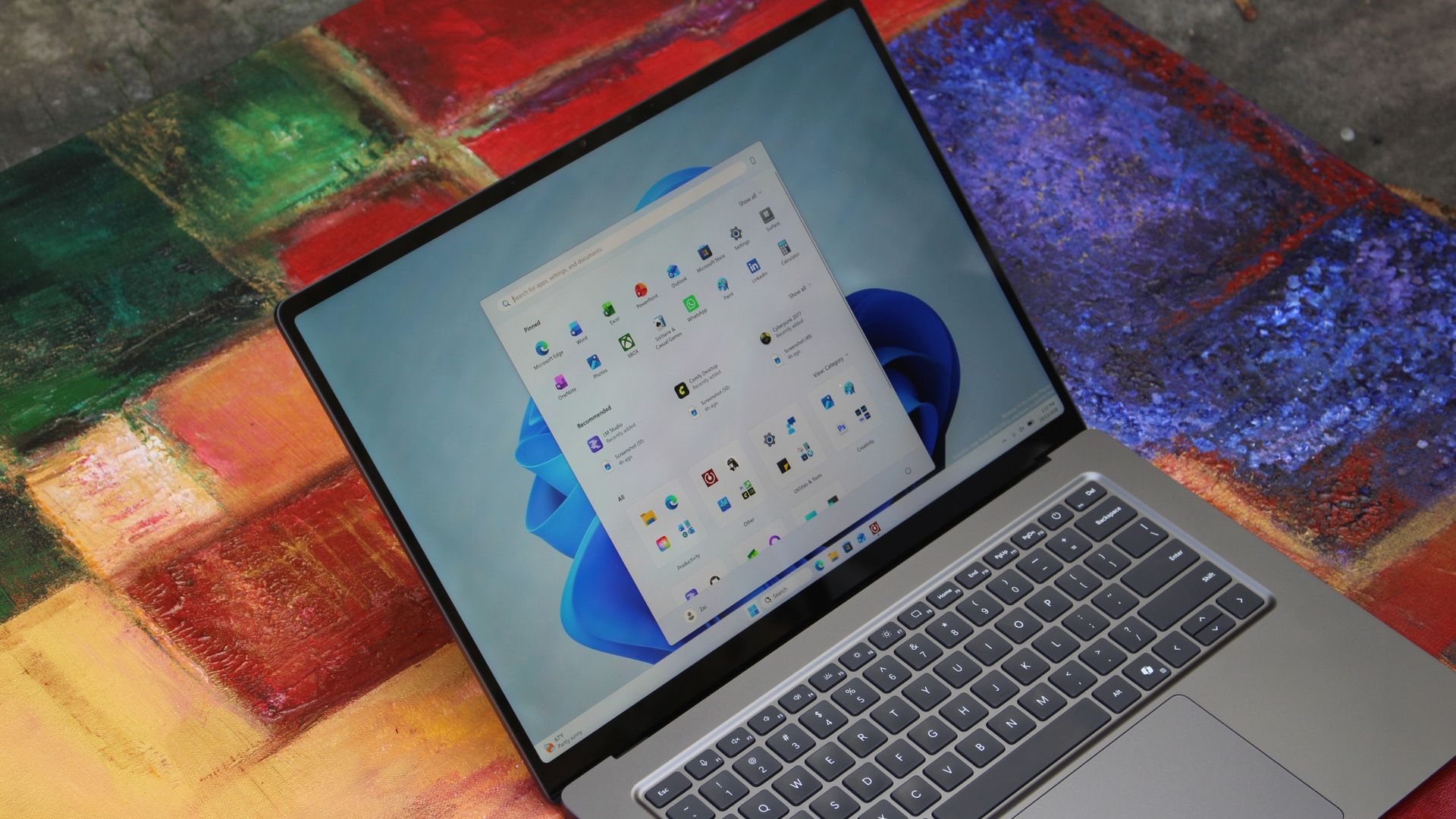
Microsoft has released its first firmware update for the new Surface Laptop Ultra that fixes a number of issues that users and reviewers have reported since launch day a few weeks ago. Namely, issues with the display and long reboot times are finally being addressed.
According to the changelog, this firmware update was released on October 22, 6 days after the Surface Laptop Ultra launched. It appears under the name "Microsoft Corporation System Hardware Update (200.0.7.0)" in Windows Update, and includes the following fixes:
Resolves an issue that could cause extended reboot times.
Resolves an issue that could cause screen flickering.
Resolves an issue that could cause unexpected restarts.
Includes additional bug fixes and general performance improvements.
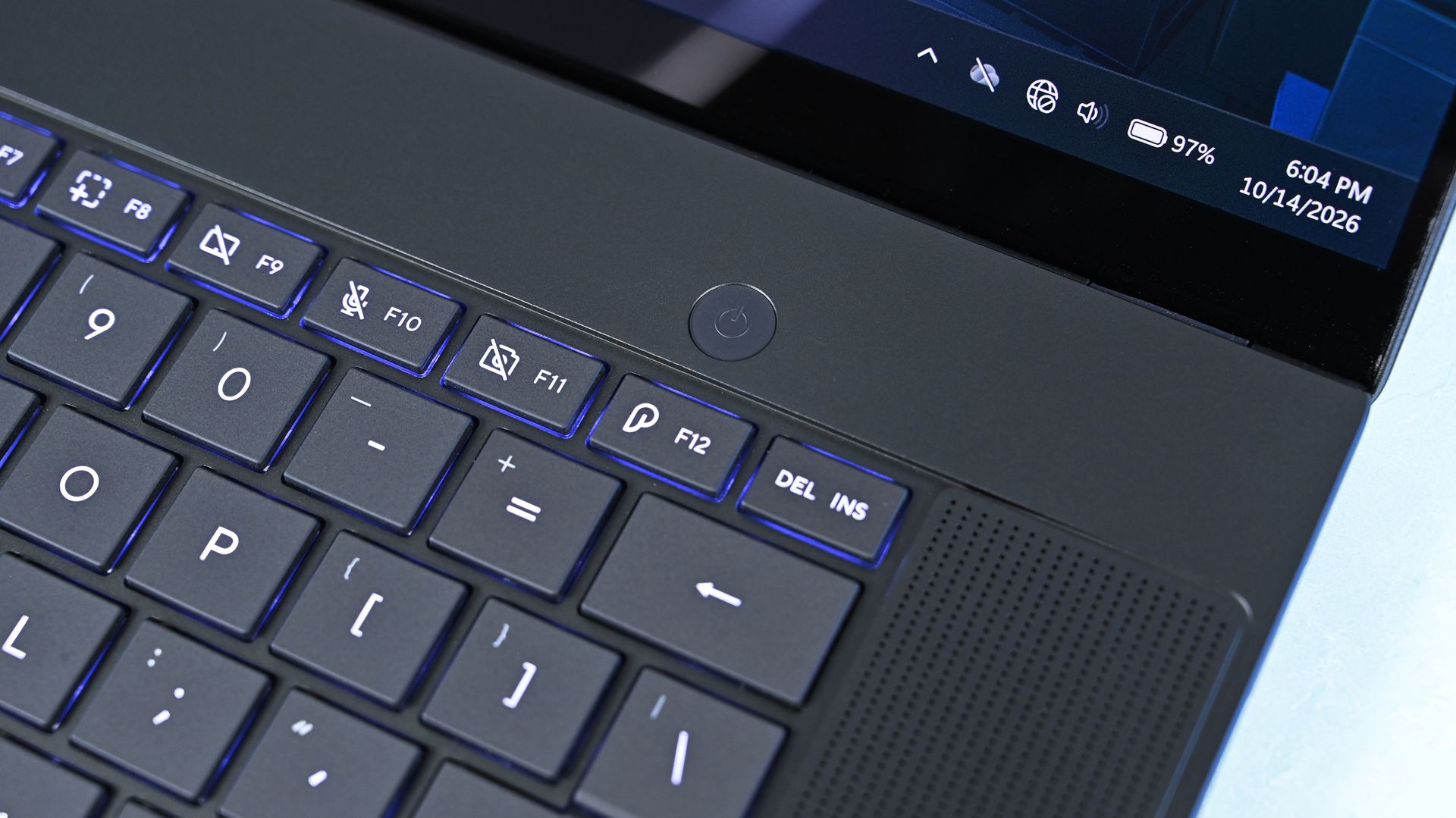
Reviewers (myself included) had noted that the Surface Laptop Ultra's Mini-LED screen was disappointing as the display suffered from ghosting and flickering. Microsoft says the flickering issue should now be fixed with this latest update, though the ghosting issue is still present.
I also mentioned in my review that the Surface Laptop Ultra suffered from really long reboot times, which made installing Windows updates and drivers a pain as it made the process take twice as long. That issue is now also fixed as of this latest firmware update.
Other fixes include performance improvements and a reduction in unexpected restarts (BSODs,) something I am yet to encounter on Surface Laptop Ultra anyway. It's good to see Microsoft moving so quickly to improve the Surface Laptop Ultra, which is expected to get firmware updates for 6 years, until 2032.
Surface Laptop Ultra is on sale now starting at $2,599. It's Microsoft's first RTX Spark powered Surface PC, which explains why there have been some teething problems with the platform. I expect Microsoft to issue more bug fixes and improvements via firmware updates over the coming weeks.
Join us on Reddit at r/WindowsCentral to share your insights and discuss our latest news, reviews, and more.
Windows 11's speed test tool that's in testing opens from Quick Settings rather than opening a browser session of Bing. (Image credit: Microsoft)Windows 11 will no longer bump you to Bing when you try to test your internet speed. Microsoft is testing a new built-in speed test tool that opens directly from Quick Settings rather than opening your web browser.The change just rolled out to Windows Insiders in the Experimental channel with Build 26340.9767. That was o
Windows 11's speed test tool that's in testing opens from Quick Settings rather than opening a browser session of Bing. (Image credit: Microsoft)
Windows 11 will no longer bump you to Bing when you try to test your internet speed. Microsoft is testing a new built-in speed test tool that opens directly from Quick Settings rather than opening your web browser.
The change just rolled out to Windows Insiders in the Experimental channel with Build 26340.9767. That was one of five builds to ship to Insiders recently. If you want to catch up on all the other changes, including the refreshed File Explorer context menu, check out my roundup of all the updates.
Microsoft first introduced a speed test to Quick Settings last year, but that feature was actually a shortcut to opening Bing. Even before that feature was announced, I said that it was a bad idea and that Microsoft should replace it with a built-in speed test tool within the taskbar.
Microsoft has since listened to feedback and designed a built-in speed test tool that opens directly from the Quick Settings.
The old speed test tool was actually a shortcut to open Bing in a browser. (Image credit: Mauro Huculak)
To access the speed test tool, you need to open the Wi-Fi or Cellular flyout within Quick Settings. Alternatively, you can right-click the network icon in the system tray and select "Test internet speed."
Microsoft is rebuilding several parts of Windows 11 as native or built-in tools. The new Start menu and the improved search experience are part of those efforts. While those larger elements make an immediate and sizeable impact on the Windows 11 experience, smaller changes like a built-in speed test tool help as well.
Internet Speed Test Release notes
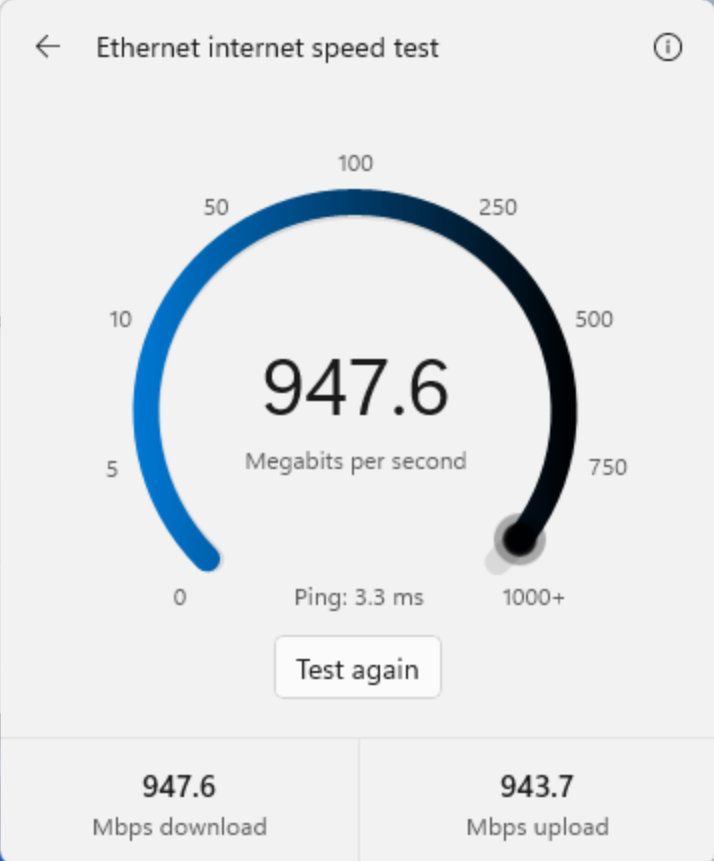
We're making it faster and easier to check the performance of your internet connection in Windows. Windows Insiders can now run an internet speed test and see the results directly in Quick Settings, without being redirected to a browser.
Start a test from the new Speed test Quick Setting, from the Wi-Fi or Cellular flyout, or by right-clicking the network icon in the system tray and selecting Test internet speed. While the test runs, Quick Settings shows its progress and results, including download speed, upload speed, and ping.
Because the test runs against your active internet connection, you can quickly understand how your current connection is performing without leaving your workflow. This updated experience builds on the internet speed test we previously introduced for Windows Insiders, bringing the test and its results directly into Windows.
Join us on Reddit at r/WindowsCentral to share your insights and discuss our latest news, reviews, and more.
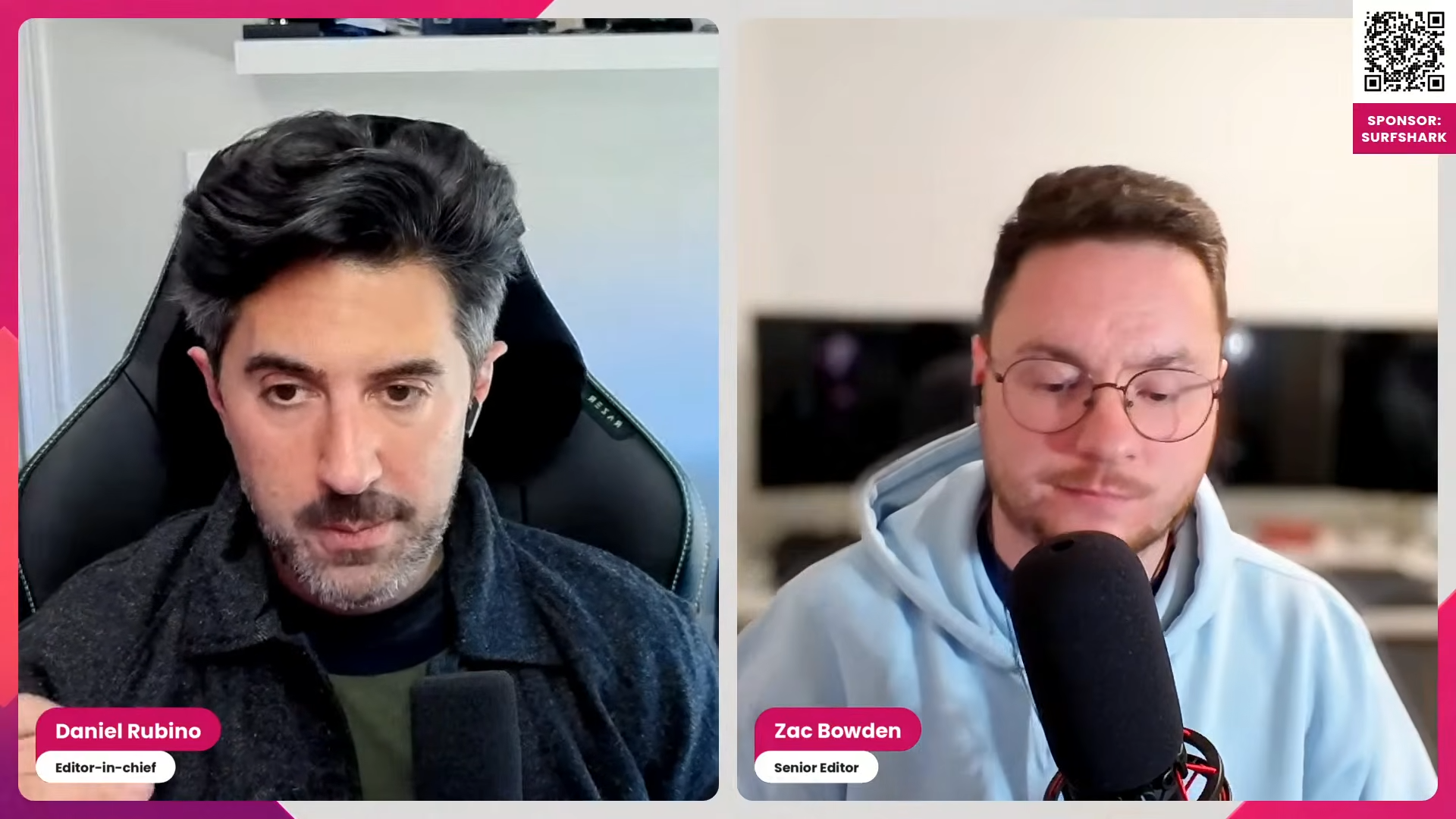
On this episode of the Windows Central Podcast, Daniel Rubino and Zac Bowden tackle behind-the-scenes reporting on internal tensions between Microsoft’s Windows and Xbox engineering divisions regarding the next-generation Project Helix hardware. Sparked by a detailed report in Fortune, we examine conflicting visions over whether future Xbox hardware—including a rumored 2027 handheld and 2028 home console—should run a streamlined desktop Windows build or iterate o
On this episode of the Windows Central Podcast, Daniel Rubino and Zac Bowden tackle behind-the-scenes reporting on internal tensions between Microsoft’s Windows and Xbox engineering divisions regarding the next-generation Project Helix hardware. Sparked by a detailed report in Fortune, we examine conflicting visions over whether future Xbox hardware—including a rumored 2027 handheld and 2028 home console—should run a streamlined desktop Windows build or iterate on the locked-down, hyper-optimized, containerized Xbox OS.
We also breaks down leaked Microsoft internal survey research investigating potential shifts in first-party exclusivity for blockbuster franchises like Fallout and Minecraft. Daniel then details his comprehensive review impressions of the ultralight 3.9 lb ASUS ProArt P16 and the HP OmniBook Ultra 16, followed by an overview of AMD FSR 4.1 rolling out to handhelds like the ROG Xbox Ally series to boost frame rates on constrained hardware.
This episode of the Windows Central Podcast is sponsored by Surfshark VPN. Unlimited devices, access your content from anywhere, and auto-block malware on Windows, Edge, and other platforms from $2.50/mo, with 3 months extra FREE. Sign up today!
[01:47] – Introduction & Episode Overview: Daniel and Zac kick off Episode 408, laying out the agenda: Windows vs. Xbox internal friction, Project Helix roadmaps, hardware reviews, and AMD FSR updates.
[04:35] – Project Helix & The Fortune Report: Analysis of reported tensions between Asha Sharma’s Xbox leadership and the Windows team over software architecture for next-gen hardware.
[06:49] – Updated Launch Timelines & Handheld Rumors: Dissecting expectations for a potential Xbox gaming handheld targeting late 2027 and the living room console shifting toward late 2028.
[08:20] – Xbox OS vs. Windows Desktop Shell: Comparing console-level security, sandboxing, and background stability against open PC desktop architecture, and examining official executive responses.
[15:08] – The Handheld Software Dilemma: Out-of-box user experience friction on Windows-based gaming handhelds (driver updates, launchers) compared to dedicated console environments.
[23:51] – Security, Containerization & Publishers: Why game publishers prefer isolated hypervisor environments over open desktop file systems to prevent tampering and day-one piracy.
[30:27] – Windows 12 & State Separation: History of Microsoft’s state-separated OS initiatives (Core OS, CorePC) and whether architectural isolation could arrive in future Windows releases.
[35:31] – Leaked Exclusivity Research Survey: Discussion of leaked internal questionnaires gauging consumer reaction if future releases in franchises like Fallout or Minecraft become Xbox console exclusives.
[46:00] – ASUS ProArt P16 In-Depth Review: Daniel breaks down the 3.9 lb RTX Spark laptop, evaluating 3K vs. 4K OLED panels, thermal cooling under 50 dB, and everyday 10-hour battery life.
[54:32] – HP OmniBook Ultra 16: Contrasting ASUS’s utility suite (OLED dimming, taskbar protection) with HP’s build weight and software support.
[55:55] – AMD FSR 4.1 Launch on Handhelds: What the new upscaling and frame generation driver update means for the ASUS ROG Xbox Ally family and constrained hardware.
[01:00:08] – Live Audience Q&A: Viewer questions addressing Windows on ARM anti-cheat progress, Xbox Play Anywhere adoption incentives, and high-end hardware expectations.
Have a question you want us to answer on the podcast? Send it to us at [email protected]
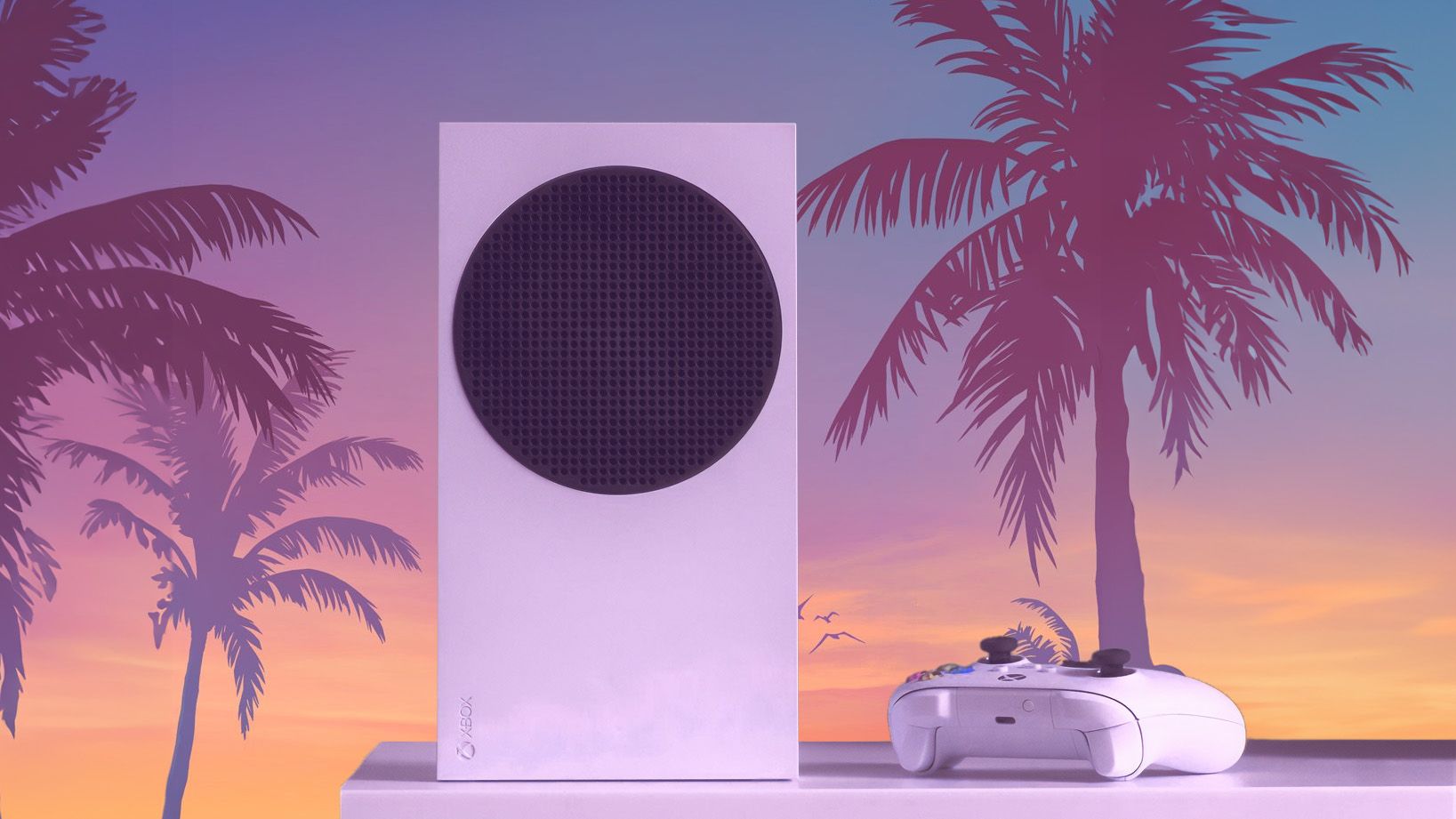
If you're still waiting for a reasonable price on next-gen consoles to upgrade for Grand Theft Auto 6, you'll be waiting a long time. That said, Argos have just made a surprise cut to the Xbox Series S 512GB model, taking it down to pre-RAMpocalypse prices of £299.99. I can't believe I'm calling this a deal but at this point in 2026 with the current climate, it actually is the cheapest way to upgrade to current gen right now and I can't see stocks lasting much lo
I can't believe I'm calling this a deal but at this point in 2026 with the current climate, it actually is the cheapest way to upgrade to current gen right now and I can't see stocks lasting much longer. In fact, I'd argue the even better deal is the 1TB model at £349.99, down from £519.99, as the extra storage is kind of essential nowadays.
Series S (512GB): was £429.99 now £299.99 If you are still gaming on older hardware and looking for the absolute most cost effective way to get ready for GTA6 and the next wave of current-gen exclusives, this is officially the lowest barrier to entry. The Xbox Series S is fully digital, so no disc drive, but does play all the same games as the Xbox Series X. There is also a 1TB model on sale, for those who will easily fill up a 512GB SSD.
The Xbox Series S has always been the easiest and cheapest way to get into Xbox's eco system, and launched in November 2020 for £249.99 as an alternative to the beefier Xbox Series X, but it plays all of the same current generation games. I wrote a full Xbox Series S review if you want to read further, but I still love and use mine daily (and at current prices it will be a family heirloom.)
Those prices are now a thing of the past, and £299.99 is a bargain by current standards, with the price being recently hiked to a whopping £519.99. Thanks to Argos, we are now at a reasonable price point again, but that will be entirely dependent on your postcode and whether there are any in stock, so go fast!
Join us on Reddit at r/WindowsCentral to share your insights and discuss our latest news, reviews, and more.
XBOX is rarely the focus of the Windows Wrap, but when reports claim clashes happened between the Windows and XBOX teams at Microsoft, gaming pushes itself to the front.Last week I discussed how Windows 11 is holding back the Surface Laptop Ultra. This week, we learned that a different hardware division from Microsoft expressed frustrations with Windows. Reportedly, things got so heated between the XBOX and Windows teams that an XBOX leader threatened to cancel a
XBOX is rarely the focus of the Windows Wrap, but when reports claim clashes happened between the Windows and XBOX teams at Microsoft, gaming pushes itself to the front.
Over the last few years, we've seen XBOX and Windows 11 grow closer together. The Windows 11 experience on gaming handhelds has improved drastically since day one, though it still has a ways to go. The XBOX app on Windows has been updated several times to align more with the console experience, which has a trickle-down effect on all gaming handhelds that run on Windows.
But despite the growth of Windows 11, the operating system still falls short of the requirements of the XBOX team, at least according to the latest reports.
Biggest News of the Week
There are some caveats to this entire discussion. Notably, Microsoft's Xbox CTO, Scott Van Vliet, refutes the claims made by Fortune.
@WinC_Gaming Helix OS is being built on Windows, and the XBOX and Windows teams are working closely together on the next generation of devices. The account cited here misrepresents both the technical work and the relationship between the teams.October 21, 2026
Van Vliet said that Helix OS is "being built on Windows." He did not say that Helix OS is Windows. For what it's worth, I don't think we'll ever see an operating system called "Helix OS." But his post makes it clear that the OS powering Project Helix is built on Windows. That's not the same as saying it is Windows. At minimum, it's highly unlikely the Xbox will run the traditional Windows desktop you see on laptops and desktops.
Microsoft has used a customized version of Windows for several generations of XBOX hardware. The Xbox One and Xbox Series X|S consoles already run an operating system that's built on Windows. Even the original XBOX ran an OS based on Windows, though the Xbox One ran an operating system much closer to Windows.
I asked Van Vliet if Project Helix is an evolution of the OS XBOX consoles already run or a freshly made custom OS, but he did not respond.
Microsoft has never specified that Project Helix will run Windows 11 and the Windows desktop, but several reports have suggested that was the plan for the console.
His post on X argues that the original report "misrepresents both the technical work and the relationship between the teams." For a moment, let's assume that's accurate and that the Windows and XBOX teams are working side-by-side in harmony. There's still a clear implication that Microsoft no longer views Windows 11 and the desktop as the right starting points for an operating system for Project Helix.
Earlier reports about Project Helix said the next generation of XBOX would run a customized version of Windows 11, much like the Xbox Ally and other gaming handhelds. It appears Microsoft has changed plans, though it's still not clear to what extent.
If you've used a gaming handheld running Windows 11, you may even agree with the sentiment that the OS is not the best starting point for a console gaming experience. Some of the best gaming handhelds are held back by Windows rather than boosted by it. For example, the out-of-the-box experience for the ROG XBOX Ally X20 is terrible because you have to go through three different sets of updates.
Shifting from Windows 11 powering XBOX consoles to those devices running an OS built on Windows is a massive change of plans. Though ironically, it's not much of a change from what Microsoft already does with XBOX.
Project Helix has reportedly slipped into 2028, so it may be a while before Microsoft explains exactly what changed.
Shopping with Sean
This week's biggest news may be about XBOX and gaming, but my top shopping recommendations of the week are laptops. Whether you want an Intel chip or a Snapdragon processor, there are great deals available.
"At a glance, it might feel like the Zenbook A14 didn't change at all, but upgrading to the Snapdragon X2 Elite gave it a massive CPU performance bump." — Ben Wilson, Senior Editor
"The Dell XPS 13 returns as an excellent Windows-based answer to the MacBook Neo. It’s an excellent option for students or mainstream users who don’t need more CPU or GPU muscle." — Matt Safford, Managing Editor, Tom's Hardware
On October 13, 2026, Microsoft made available its latest cumulative update (KB5127648) for Windows 11 with several new improvements, including an option to always launch apps maximized, the ability to remap the Copilot key with new options, a new "Tips" widget, and additional touchpad controls. However, the update also includes a smaller set of improvements that may have gone unnoticed.While this month's features have already received plenty of attention, some le
On October 13, 2026, Microsoft made available its latest cumulative update (KB5127648) for Windows 11 with several new improvements, including an option to always launch apps maximized, the ability to remap the Copilot key with new options, a new "Tips" widget, and additional touchpad controls. However, the update also includes a smaller set of improvements that may have gone unnoticed.
While this month's features have already received plenty of attention, some less prominent changes could still make a difference. The October update improves Bluetooth reliability, fixes mouse stuttering in some games, restores fingerprint sign-in on affected devices, and addresses printing and Always On VPN connection issues.
Here are six improvements and fixes worth knowing about after installing the October 2026 Security Update for Windows 11.
1. Windows 11 improves Bluetooth reliability
This monthly update includes eight Bluetooth improvements designed to make connecting to and using Bluetooth devices more reliable.
During voice calls, the system now shows the volume flyout when you adjust the volume using the controls on a compatible Bluetooth Classic Audio accessory, giving you visual feedback on the new volume level.
The update also improves how the operating system reports the connection status of disconnected Bluetooth accessories. It fixes an issue where the Bluetooth radio could be turned off even though its toggle in the Bluetooth and devices page in Settings still appeared to be on. Microsoft has also improved the stability of this Settings page when managing Bluetooth and audio devices.
For audio, the update improves microphone compatibility with certain Bluetooth Classic Audio accessories and makes shared audio more reliable.
It also fixes a crash (error code 0x139) that could happen while streaming Bluetooth audio and improves the reliability and performance of Bluetooth Low Energy (LE Audio) accessories.
2. Fingerprint sign-in works again after a cold boot
This release also fixes an issue that could prevent Windows Hello fingerprint sign-in from working after a cold boot on some computers.
Fingerprint authentication is convenient because it lets you sign in quickly without entering a password or PIN. However, a problem that appears after a full shutdown can make the feature unreliable.
If fingerprint sign-in fails after you power on your computer from a full shutdown, installing the update may resolve the problem.
3. Microsoft fixes mouse stuttering in some games
The October update (KB5127648) fixes an issue that could cause mouse input to stutter in some games. This problem can make aiming, camera movement, and other actions feel inconsistent, particularly in games that require precise input.
Since this fix targets an specific bug, it doesn't guarantee a solution for every mouse stuttering or performance issue.
4. Windows 11 fixes printing problems with certain drivers
Microsoft has also addressed a printing problem that could affect some apps and devices using RAW or Generic Text Only printer drivers after installing the August 2026 Security Update.
These driver configurations are used in certain printing environments, and the issue could prevent some print jobs from completing successfully.
Users affected by this problem should install KB5127648, then test their apps and printers again to confirm the problem has been resolved.
5. Always On VPN connections become more reliable
In addition, this rollout fixes an Always On VPN issue introduced by the earlier KB5124008 update.
On affected systems, automatic protocol selection or protocol fallback could leave a VPN connection stuck on Connecting or cause the initial connection attempt to fail. Subsequent attempts could also show the "The specified port is already in use" error message.
These problems can prevent users from establishing a reliable VPN connection, especially in managed business environments where remote access is essential.
6. File Explorer no longer crashes in certain multi-user environments
The update also fixes a File Explorer problem affecting some multi-user environments, including Azure Virtual Desktop deployments that use FSLogix.
On affected systems, "explorer.exe" could fail to start after sign-in or repeatedly crash, potentially leaving users with a black screen.
How to install the October 2026 update
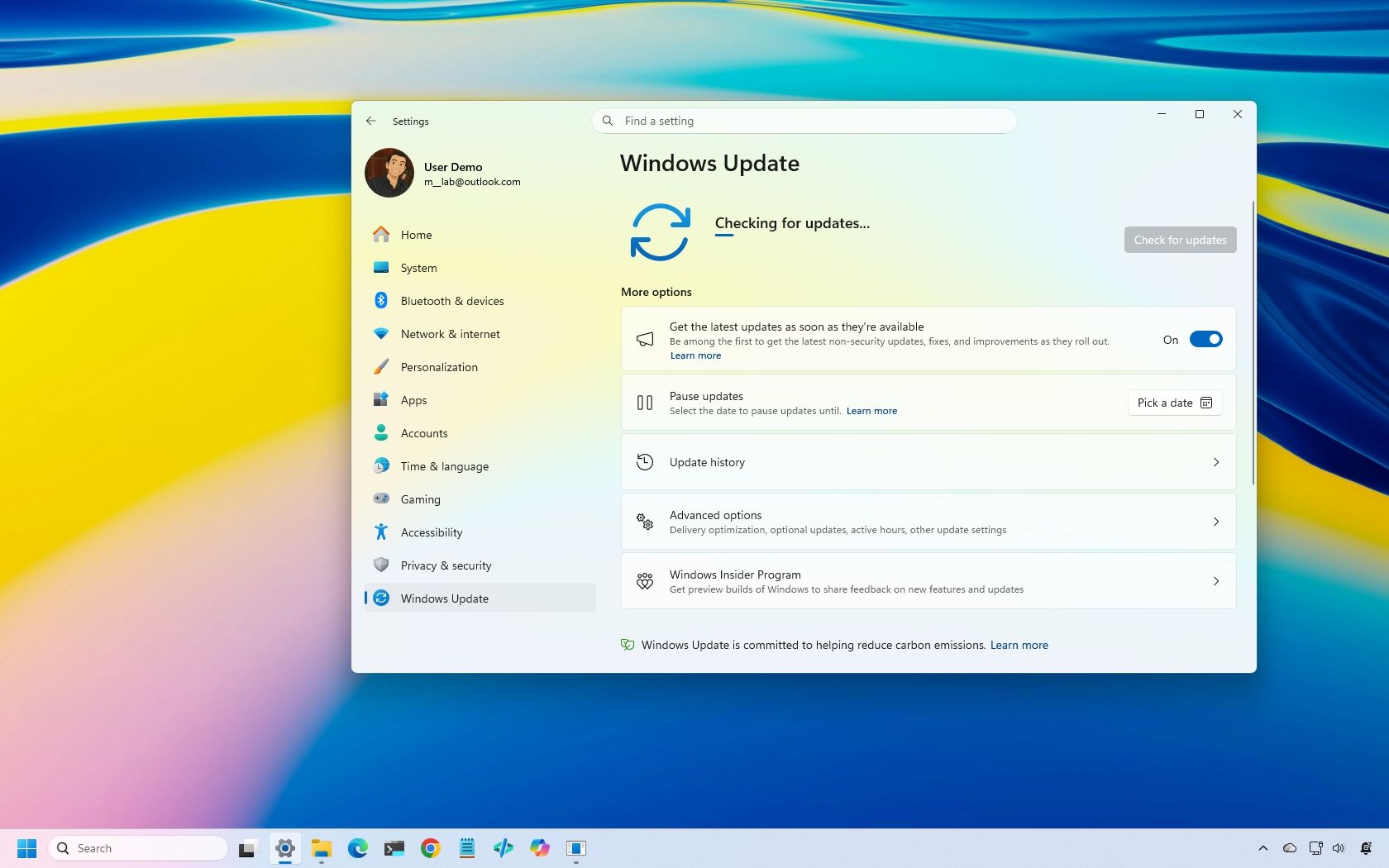
The October 2026 Security Update for Windows 11 should install automatically, but it can be installed from Settings > Windows Update by clicking the "Check for updates" button.
The update is available for versions 26H2, 25H2, and 24H2, with builds 26300.9711, 26200.9711, and 26100.9711, respectively.
However, keep in mind that Windows 11 24H2 Home and Pro reached the end of support with this security update released on October 13. This means that 24H2 will no longer receive security fixes and improvements, nor will the company continue offering support.
If you're still on version 24H2, I highly recommend upgrading to the latest version. Since versions 26H2, 25H2, and 24H2 share the same core system, switching versions only requires the latest updates for the current version and the enablement package, both of which should be available for download through Windows Update settings.
Windows Central's Take
Although the October update includes features and changes that are easier to notice, the smaller fixes can be just as useful when they address problems that disrupt your workflow. The Bluetooth improvements stand out because they cover several areas, from connection status and Settings reliability to audio compatibility and crashes.
The fixes for fingerprint sign-in, gaming, printing, and VPN connections are more specific, but they could make a difference to affected users. If you've experienced any of these problems, it's recommended to install this month's update as soon as possible.
Have you noticed any of these issues on your device? Let me know in the comments.
More resources
Explore more in-depth how-to guides, troubleshooting advice, and essential tips to get the most out of Windows 11 and 10. Start browsing here:
PowerToys, the "Swiss Army knife" of Windows 11, is now available in version 0.102, introducing several features designed to improve your desktop experience.This release adds Mouse Button Lock to make dragging and selecting items easier, while CursorHide automatically hides the mouse pointer under specific conditions. Command Palette also gets an update with quick access to frequently used commands. In addition, PowerToys expands its command-line and automation f
PowerToys, the "Swiss Army knife" of Windows 11, is now available in version 0.102, introducing several features designed to improve your desktop experience.
This release adds Mouse Button Lock to make dragging and selecting items easier, while CursorHide automatically hides the mouse pointer under specific conditions. Command Palette also gets an update with quick access to frequently used commands. In addition, PowerToys expands its command-line and automation features, and ZoomIt now lets you use voice input to set image descriptions.
In this guide, I'll highlight the five new features and improvements in PowerToys version 0.102 and explain how they can help you get more out of Windows 11.
1. Mouse Button Lock for easy dragging and selection
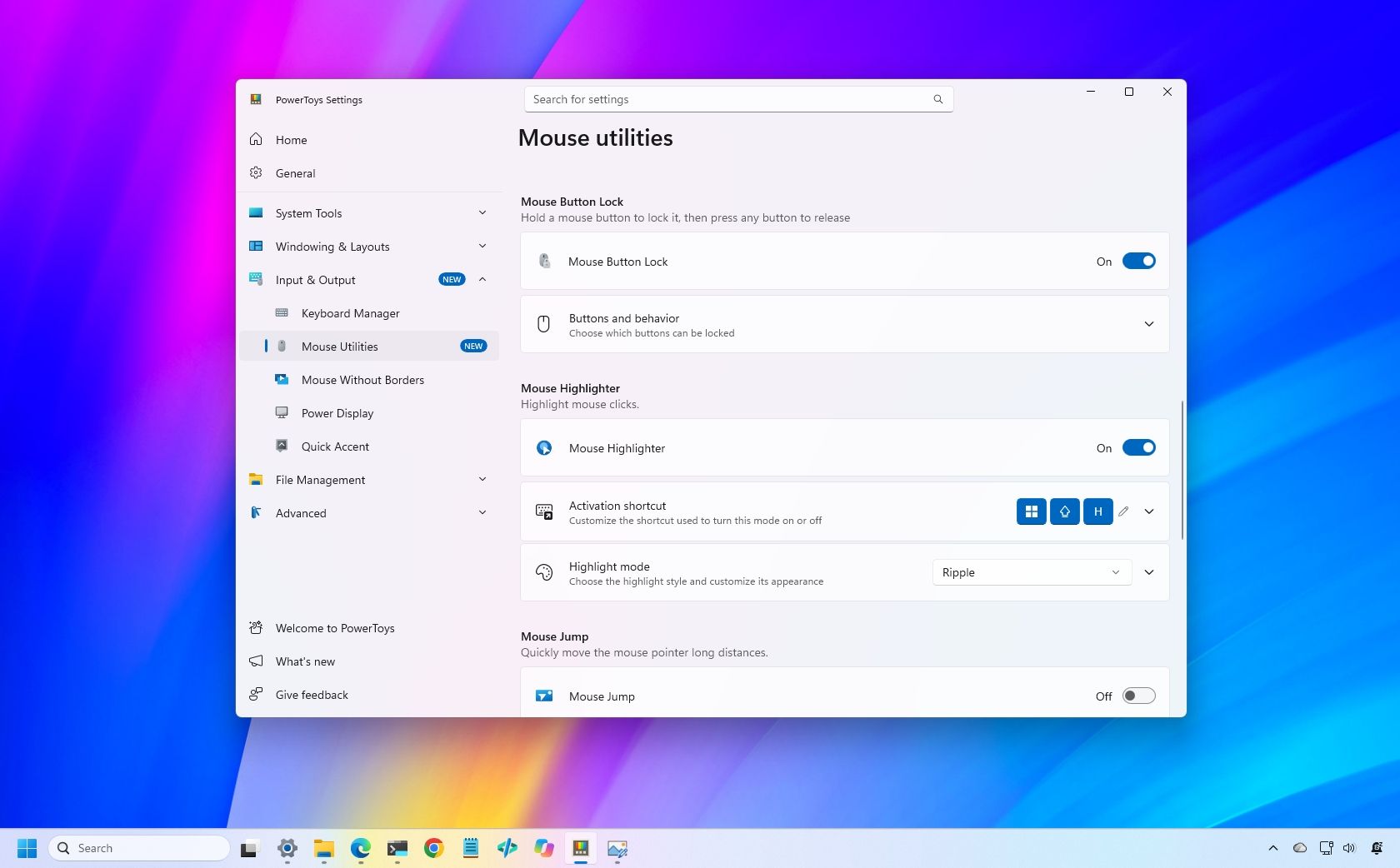
Selecting large groups of items or dragging files across the desktop can get tiring when you have to hold a mouse button down for an extended period. Starting with version 0.102, PowerToys introduced Mouse Button Lock to make these actions easier.
When this feature is enabled, you can press and hold a mouse button briefly, then release it. PowerToys keeps the button virtually held down, letting you keep selecting items or dragging files without physically holding the button. To release the hold, simply click any mouse button.
Mouse Button Lock can help when you're working with large file selections, moving items, or doing tasks that require extended dragging. It can also improve accessibility for people who have difficulty holding a mouse button down for long periods.
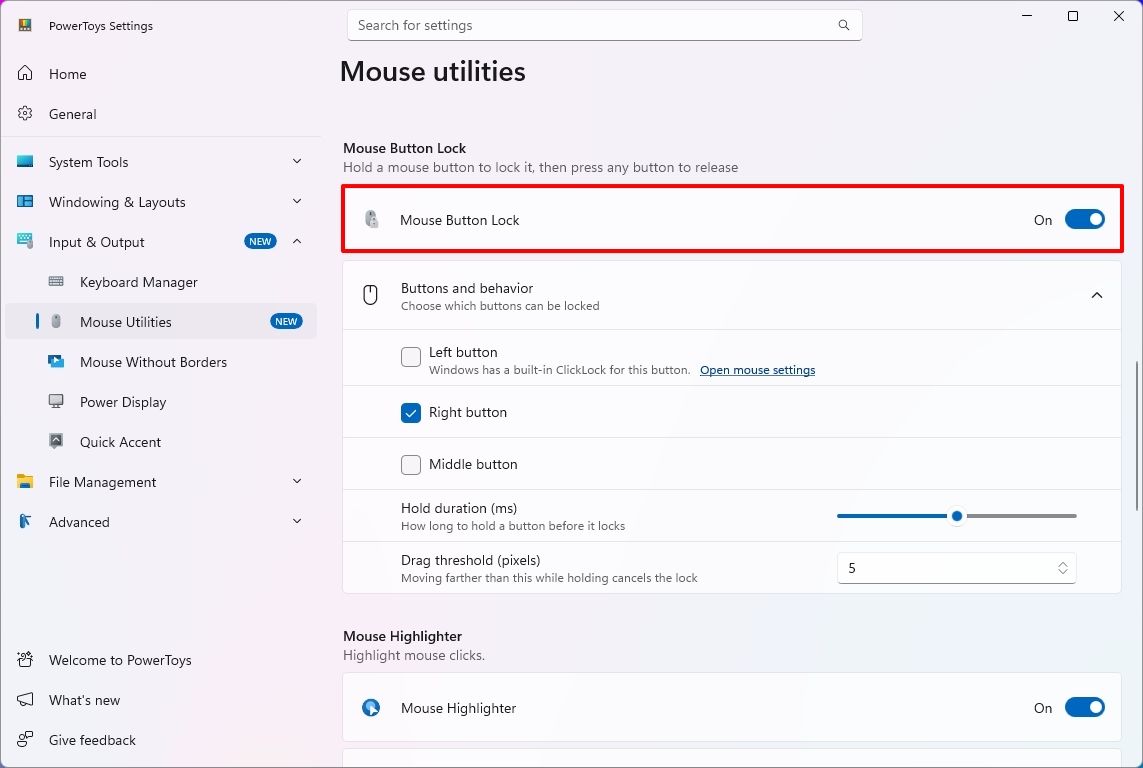
You can enable the feature in PowerToys > Input & Output > Mouse Utilities by turning on the "Mouse Button Lock" toggle switch.
(Image credit: Mauro Huculak)
From the "Buttons and behavior" settings, you can decide whether the left, middle, or right button should lock while pressed.
The settings also let you choose the hold duration before the button is locked as pressed, and the drag threshold allows you to specify how far you can move the mouse before PowerToys cancels the Mouse Button Lock.
2. CursorHide for fewer cursor interruptions
PowerToys also introduces a second mouse utility, CursorHide, which lets you hide the mouse pointer while you're typing, after a period of inactivity, or both.
CursorHide is useful when the mouse pointer gets in the way of what you're doing on the screen. For example, hiding the pointer while typing makes it easier to focus on text without the cursor covering words or other elements.
You can enable the feature in PowerToys > Input & Output > Mouse Utilities by turning on the "CursorHide" toggle switch.
(Image credit: Mauro Huculak)
In the "Activation and behavior" settings, you can choose to hide after keyboard input and set the cursor to hide after a period of inactivity.
3. Command Palette quick access to favorites
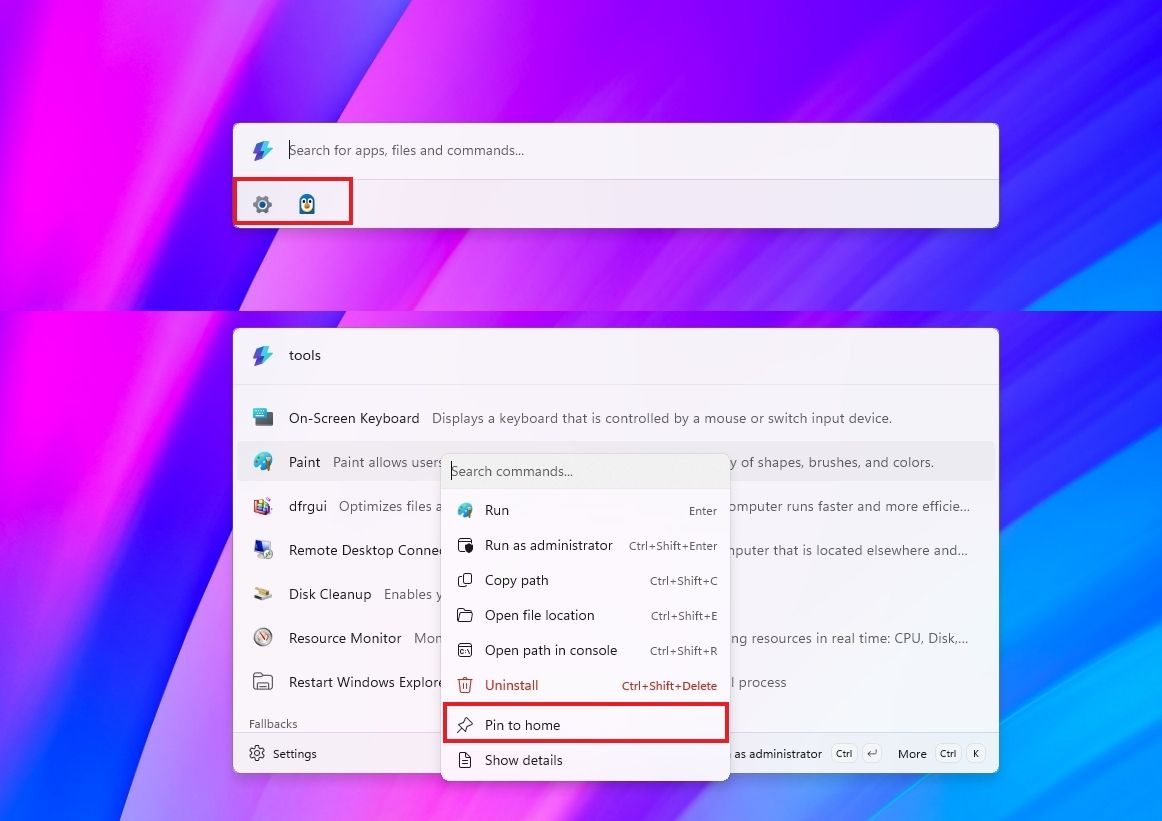
If you use Command Palette, this update rolls out an update to Compact mode that lets you pin frequently used commands under the search box.
Once you pin an item, you can launch it with the "Alt + 1" through "Alt + 9" shortcut or select it without running it with the "Alt + Shift + number" shortcut.
(Image credit: Mauro Huculak)
It's also possible to drag items to reorder them, right-click to access more options, and display recent apps and commands.
4. PowerToys expands command-line support
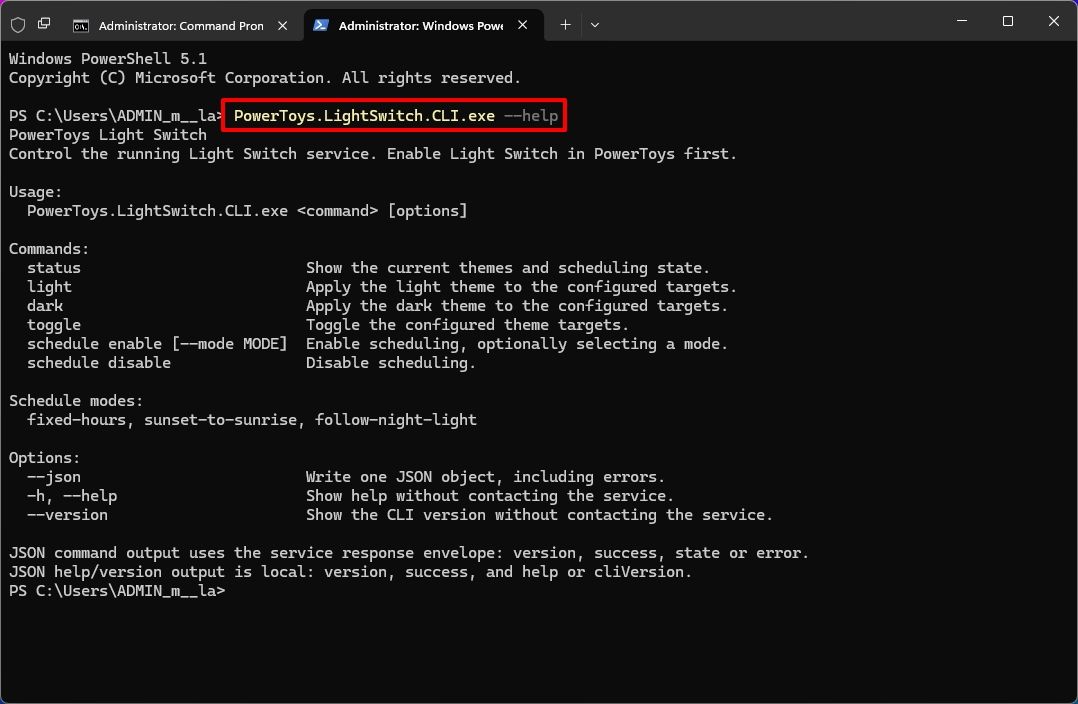
PowerToys version 0.102 expands its command-line capabilities, allowing you to control more utilities, automate tasks, and retrieve information directly from Command Prompt or PowerShell.
The update adds CLI commands for Advanced Paste, Light Switch, Settings, Peek, and PowerDisplay. These commands let you run actions, manage light and dark mode settings, turn utilities on or off, preview files and folders, and retrieve display information in script-friendly formats.
These additions are especially useful for automating repetitive tasks, creating scripts, or controlling PowerToys utilities without opening their graphical interfaces.
(Image credit: Mauro Huculak)
Here's a list of the new command-line support you can use with PowerShell:
Advanced Paste: PowerToys.AdvancedPaste.CLI.exe
Light Switch: PowerToys.LightSwitch.CLI.exe
Settings: PowerToys.Settings.CLI.exe
Peek: PowerToys.Peek.UI.exe
PowerDisplay: PowerToys.PowerDisplay.CLI.exe
To learn about the options for each command, use the "--help" command. For example, PowerToys.LightSwitch.CLI.exe -- help.
If, for example, LightSwitch is enabled, you can switch to dark mode with the PowerToys.LightSwitch.CLI.exe dark command.
You can use the command to manage it, but you must enable the utility in PowerToys settings first.
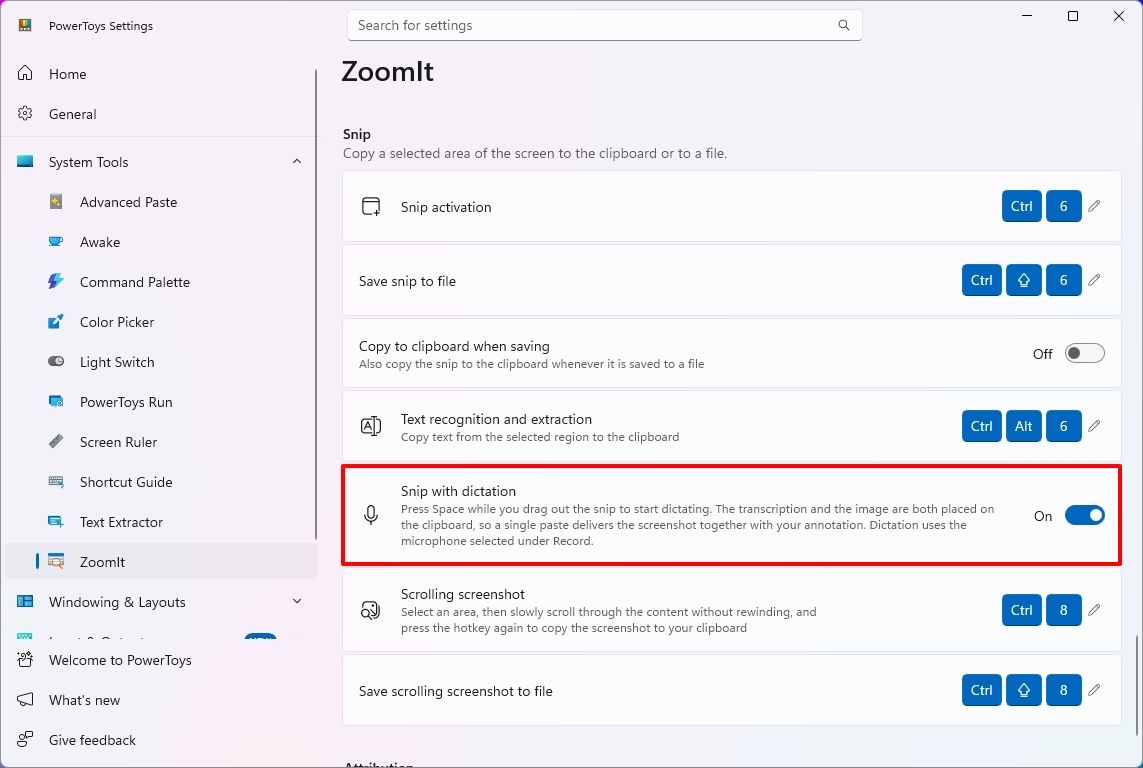
5. ZoomIt adds screenshot dictation
Finally, ZoomIt now lets you dictate a description while capturing a screenshot, making it easier to document what's on the screen without typing the text separately.
To use the feature, open PowerToys > System Tools > ZoomIt, turn on the feature, and then under the "Snip" section, turn on the "Snip with dictation" toggle.
(Image credit: Mauro Huculak)
Once you have done that, drag to select an area of the screen, press the "Space" key, and describe what you're capturing. ZoomIt transcribes your speech locally, allowing you to paste the screenshot and its accompanying text together.
The feature uses the microphone selected in the "Record" settings.
Wrap up
PowerToys 0.102 is a surprisingly and unusually interesting update, despite the simple version-number change. The popular app serves as a clear reminder of how much Windows 11 continues to evolve thanks to community-driven tools — these additions make everyday workflows smoother and show how Microsoft’s open‑source ecosystem continues to fill gaps the OS itself doesn’t yet cover.
Whether you’re a power user or just someone who loves small quality‑of‑life upgrades, this release proves that Windows can still surprise you with clever, genuinely useful features.
What’s the most interesting feature in this rollout? Let me know in the comments!
More resources
Explore more in-depth how-to guides, troubleshooting advice, and essential tips to get the most out of Windows 11 and 10. Start browsing here:
Original Article:On October 23, 2026, the official X account of Stellar Blade revealed that the game is going to have a collaboration with Overwatch titled "Overwatch X Eve Protocol".Like past collaborations with other franchises, Overwatch will no doubt create new cosmetic rewards based on Stellar Blade's main characters and pass them on to Overwatch's Heroes.The date for this collaboration and its content have not been specified at this time.You have my attenti
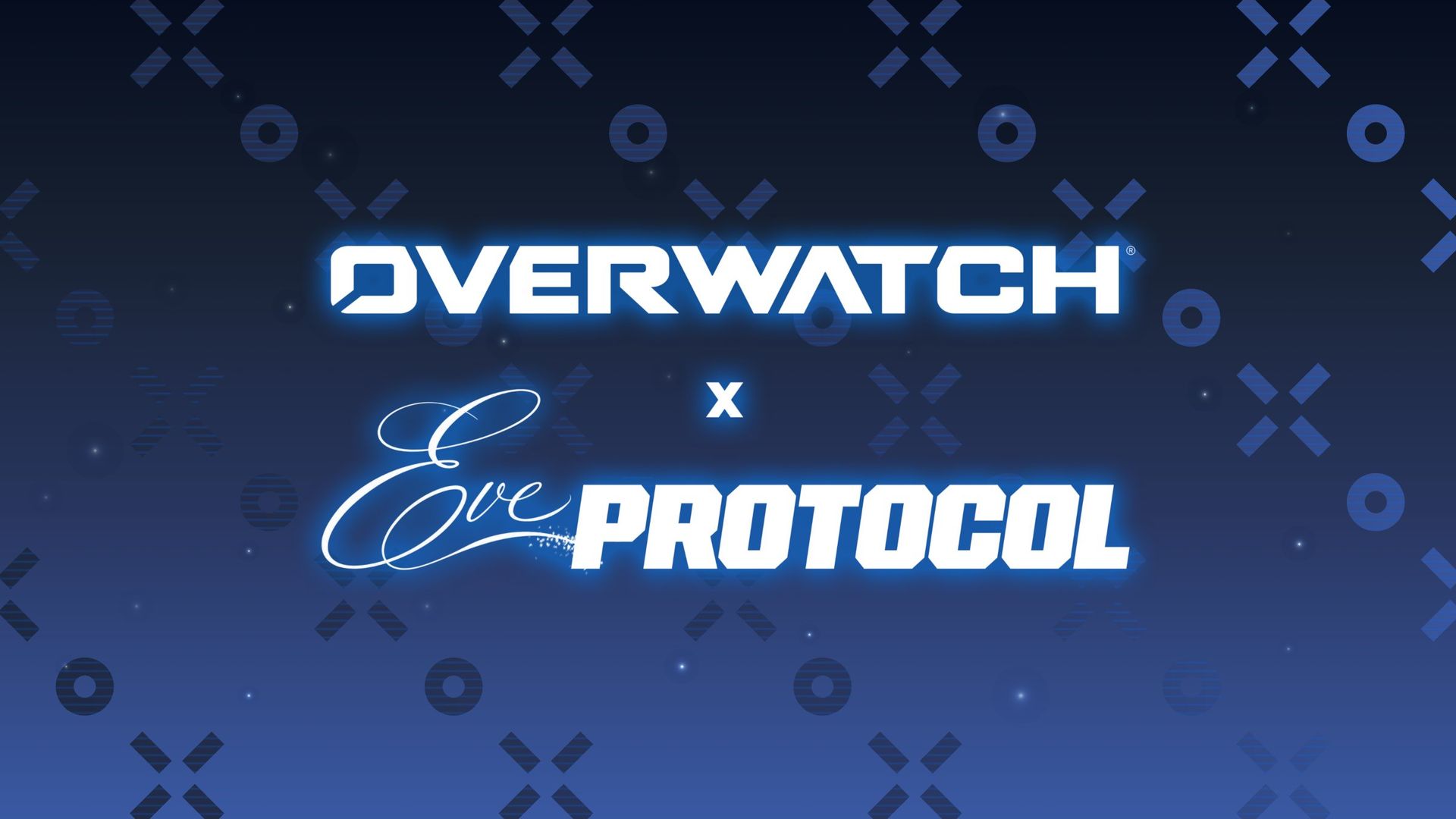
On October 23, 2026, the official X account of Stellar Blade revealed that the game is going to have a collaboration with Overwatch titled "Overwatch X Eve Protocol".
Like past collaborations with other franchises, Overwatch will no doubt create new cosmetic rewards based on Stellar Blade's main characters and pass them on to Overwatch's Heroes.
The date for this collaboration and its content have not been specified at this time.
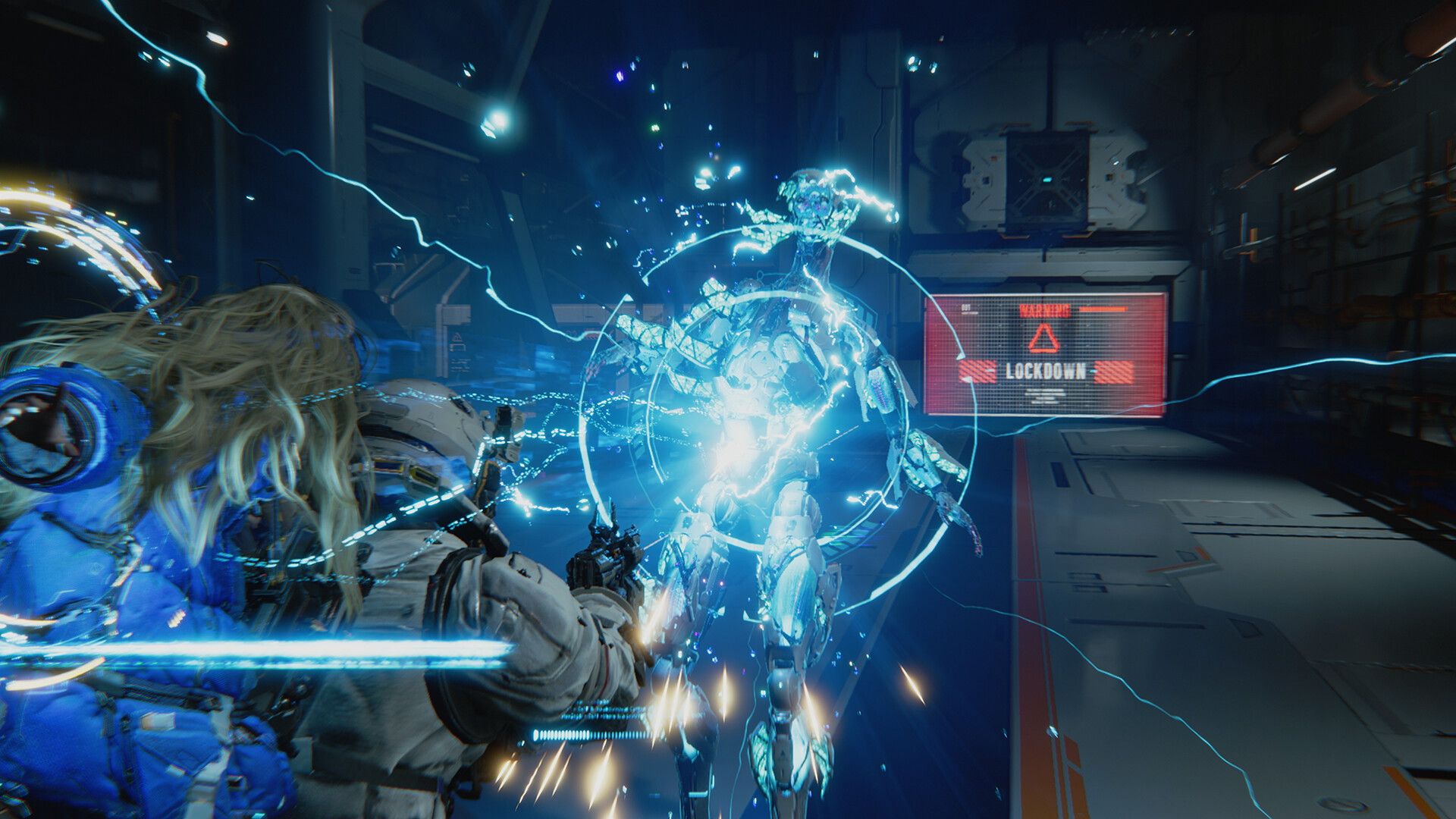
For those unaware, Stellar Blade is a character action game where you play as EVE, a soldier dispatched to Earth to liberate it from monstrous alien invaders called the Naytiba.
With this expected collaboration with Overwatch, a first-party Xbox franchise, there might be a chance we could get an Xbox version of Stellar Blade down the pipeline.
Would you like to play Stellar Blade on Xbox?
I wouldn't mind giving Stellar Blade a chance if it lands on Xbox Series X|S, especially with Xbox Play Anywhere so I can play it while travelling on holiday.
Its gameplay looks fun and gives off the same over-the-top feel as classic combat-heavy titles like Nier: Automata and Bayonetta (it's even getting a crossover Bayonetta skin for EVE when the game lands on Nintendo Switch 2).
But what do you think? Could this Overwatch collaboration be hinting at an Xbox Series X|S port of Stellar Blade? Would you play it if it landed on Xbox? Do you think Stellar Blade's sequel, Stellar Blade: Blood Rain, will come to Xbox as well?
If you have any thoughts on the matter, please let us know in the comments, poll, or Reddit.
Join us on Reddit at r/WindowsCentral to share your insights and discuss our latest news, reviews, and more.
The fallout from Electronic Arts' (EA) decision to shut down BioWare continues to rage on as more about the planned Mass Effect Universe game has come to light in the passing days. The #SaveMassEffect petition has now surged past 170,000 signatures, and fans are escalating their efforts to get EA's attention, including talk of taking the message right to the publisher's doorstep. Could fans manage to pitch a billboard outside EA HQ?(Image credit: Bioware)The push
The fallout from Electronic Arts' (EA) decision to shut down BioWare continues to rage on as more about the planned Mass Effect Universe game has come to light in the passing days. The #SaveMassEffect petition has now surged past 170,000 signatures, and fans are escalating their efforts to get EA's attention, including talk of taking the message right to the publisher's doorstep.
Could fans manage to pitch a billboard outside EA HQ?
(Image credit: Bioware)
The push to "Save Mass Effect" has reached fever pitch following a devastating reveal that showed players exactly what they lost with the studio closure, a former developer released a pre-production trailer and gameplay details for the cancelled Mass Effect Universe, revealing a highly ambitious future for the franchise that will never see the light of day.
Channelling the community's frustration, passionate Mass Effect fan and lore content creator Kala Elizabeth took to X/Twitter to propose a fundraiser for a potential billboard outside EA's California headquarters to promote the #SaveMassEffect movement. The idea has quickly gained traction, with many prominent industry figures responding in support.
Soooo how are we feeling about purchasing a billboard outside of EA HQ? To spread the #SaveMassEffect movement but also to try to #SaveBioware? What about a little fundraiser to pool our money? Is that ridiculous? Crazy? Would anyone be interested?October 23, 2026
The movement shares a hashtag with the massive Change.org petition created by Joe Smith, but the billboard plans and additional upcoming initiatives are being coordinated exclusively by Kala Elizabeth and the @WeAreMassEffect team, completely separate from the petition's creator.
Kala confirmed that a coordinated effort is in the works, stating they are "working on a plan with multiple things for next week" and "won't let Mass Effect, Dragon Age and BioWare go down without a fight!"
Could Xbox #SaveMassEffect? Our sources say no.
Dear XBOXBuy the Mass Effect IP, Hire the Best of BioWare and reform it.You already have RPGs, but nothing like this.It’s one of the best franchises in all of Sci-Fi, and there’s no games like that Trilogy The Return Of Mass Effect needs to happen https://t.co/khl6a7c1K5October 22, 2026
A somewhat sour note has been added to the community's rallying cry by an unconfirmed rumour about BioWare's final days. According to a post by user @baundiesel, BioWare developers allegedly attempted to buy out the studio and the Mass Effect IP before the closure, but EA "showed no interest in a deal". While this claim should be taken with a heavy grain of salt, it wouldn't surprise me at all if the development team believed in the project they were building this much.
Whether a billboard in California, or whatever else the community plans, will be enough to sway fatcat executives remains to be seen, but Mass Effect fans are making it clear they won't go quietly. As the campaign grows momentum, many are discussing if another publisher could step in and save the day, earning infinite brownie points with the gaming community in the process. Theories are heavily circulating that Xbox could step up to the plate. A hope not too out of the realm of possibility, given they recently swooped in to save Hideo Kojima's Physint after it was unceremoniously dropped by PlayStation. Brownie points aside, acquiring and funding a new AAA entry would be a considerable financial risk for Xbox, and I'm not convinced they have the appetite for risk right now. Our sources at Windows Central suggest that Microsoft is not going to make a bid for BioWare or Mass Effect.
Alternatively, CD Projekt Red is being touted as the perfect replacement to help, with fans hoping the RPG masters could give the Mass Effect universe the meticulous treatment and attention to detail it deserves.
If another studio were to swoop in and save Mass Effect, who do you think would be the best choice? Let me know in the comments below, and don't forget to visit #SaveMassEffect and pledge your support if you care at all about this legendary IP.
Join us on Reddit at r/WindowsCentral to share your insights and discuss our latest news, reviews, and more.
It has quickly become an open secret across developer forums and AI communities that the “28 Days of Codex” campaign is building toward a major crescendo: the official launch of a new AI model. However, as rumors begin to crystallize, anticipation is turning into growing frustration. Instead of getting the high-tier reasoning upgrades or ultra-efficient […]
It has quickly become an open secret across developer forums and AI communities that the “28 Days of Codex” campaign is building toward a major crescendo: the official launch of a new AI model. However, as rumors begin to crystallize, anticipation is turning into growing frustration. Instead of getting the high-tier reasoning upgrades or ultra-efficient […]
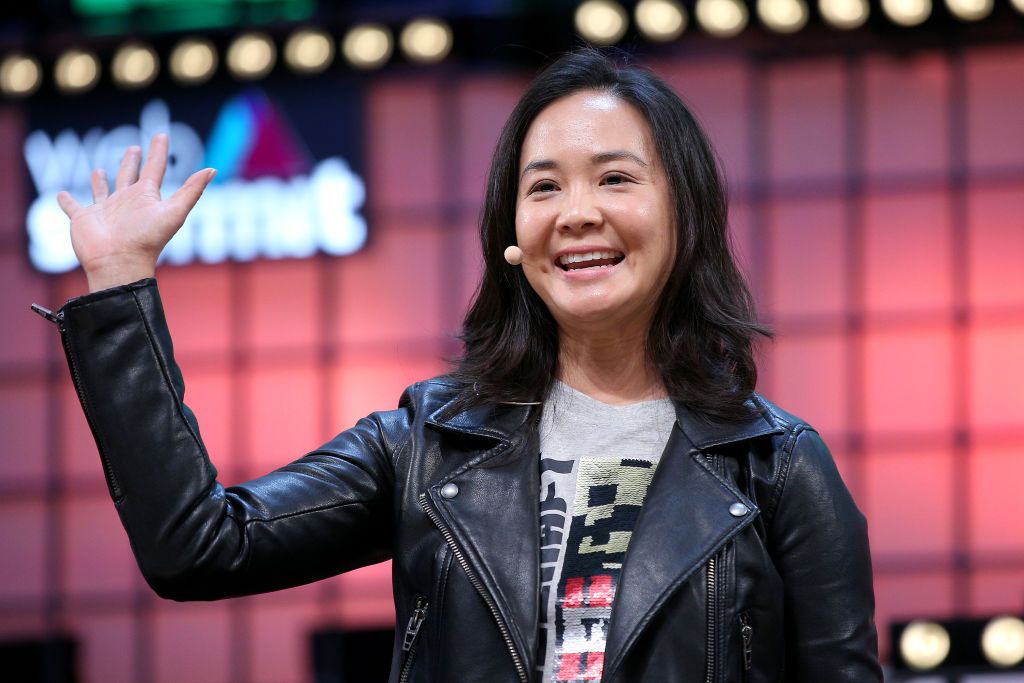
Late on Friday, it was revealed that former Minecraft lead Helen Chiang was leaving Microsoft, shared by CEO Asha Sharma in an internal email. Helen Chiang had been leading at Xbox as its first ever Chief Operations Officer, and had only been in the post for a few months. As such, the departure raised eyebrows immediately. "Helen Chiang is leaving Microsoft today. I’m grateful for her years of service and wish her well," Asha Sharma said in an internal email shar
"Helen Chiang is leaving Microsoft today. I’m grateful for her years of service and wish her well," Asha Sharma said in an internal email shared by The Verge. Sharma noted that an update on the COO post would arrive later. Indeed, it doesn't sound as though the COO post is going away, suggesting that this wasn't a redundancy departure. People immediately began to speculate that Chiang had been removed over a clash or disagreement of sorts.
In a statement to Windows Central, a Microsoft spokesperson said: "We don't discuss individual personnel matters. We are grateful for Helen's years of service and wish her well," echoing statements given to other outlets.
We now have more detail on what might've transpired from Eurogamer, who suggests that Chiang was "terminated for policy violations," via one of its sources, although it said it wasn't able to gain additional corroborative sources.
Helen Chiang was instrumental in growing Minecraft to the fiscal powerhouse it is today. (Image credit: Mojang Studios)
Chiang has had a large, storied career at Microsoft. She joined all the way back in 2005 working on mapping software, and then began rising through the ranks of Xbox back in 2007. She's been working on Minecraft since 2014, and led the game's expansion across consoles, mobile devices, education services, merchandising, and more recently, movies and other transmedia opportunities.
Chiang is incredibly well-liked and highly regarded within Microsoft by every employee I've spoken to. She's known as supportive and helpful, described to me as going above and beyond for employees at all levels.
She has been one of Xbox's longest-serving leaders and her promotion to COO was celebrated. Her purported termination immediately struck me as odd, and not exactly something that would've been done lightly.
I suspect this isn't the last we've heard of this story, and certainly not the last we've heard of Chiang, who by all accounts was excellent in her role.
Join us on Reddit at r/WindowsCentral to share your insights and discuss our latest news, reviews, and more.
We have all experienced that heart-stopping moment while browsing the web: suddenly, a loud alarm blares, your browser gets forced into full screen, and an intimidating pop-up appears warning that your PC is infected with dangerous viruses. It usually displays a fake system alert, urges you not to close the window, and provides a toll-free […]
We have all experienced that heart-stopping moment while browsing the web: suddenly, a loud alarm blares, your browser gets forced into full screen, and an intimidating pop-up appears warning that your PC is infected with dangerous viruses. It usually displays a fake system alert, urges you not to close the window, and provides a toll-free […]

 Connexion