Microsoft's October Windows 11 update left an Always On VPN issue unresolved. Here's the temporary workaround for affected enterprise connections.
The post Windows 11 VPN Issues Persist After October Update — Here’s Microsoft’s Workaround appeared first on TechRepublic.
Windows 11 is testing a browser-free internet speed test in Quick Settings. Here's how to use it, what it measures, and who can try it first.
The post Windows 11’s New Speed Test Skips the Browser — Here’s How It Works appeared first on TechRepublic.
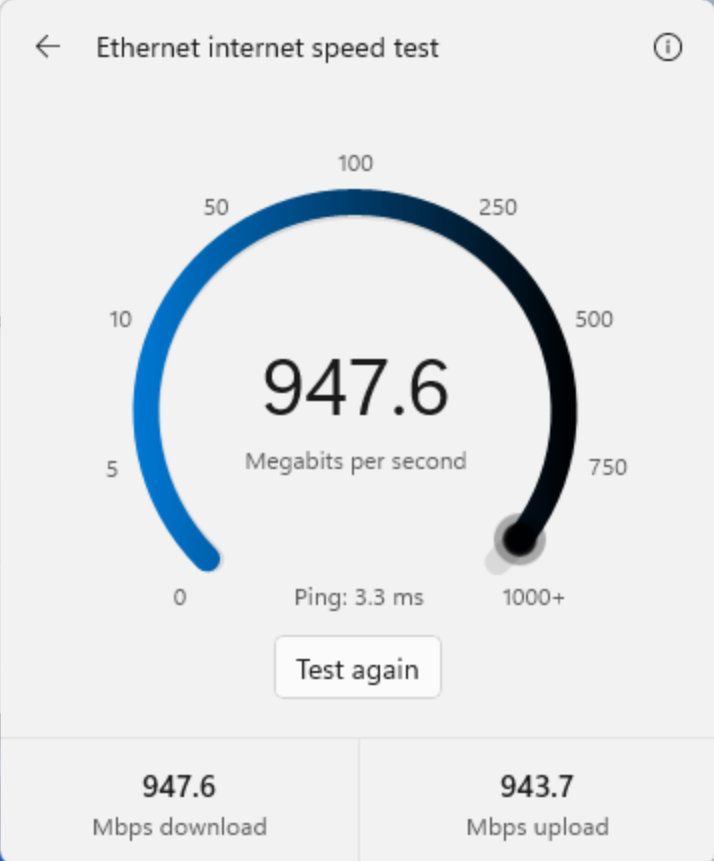
Windows 11's speed test tool that's in testing opens from Quick Settings rather than opening a browser session of Bing. (Image credit: Microsoft)Windows 11 will no longer bump you to Bing when you try to test your internet speed. Microsoft is testing a new built-in speed test tool that opens directly from Quick Settings rather than opening your web browser.The change just rolled out to Windows Insiders in the Experimental channel with Build 26340.9767. That was o
Windows 11's speed test tool that's in testing opens from Quick Settings rather than opening a browser session of Bing. (Image credit: Microsoft)
Windows 11 will no longer bump you to Bing when you try to test your internet speed. Microsoft is testing a new built-in speed test tool that opens directly from Quick Settings rather than opening your web browser.
The change just rolled out to Windows Insiders in the Experimental channel with Build 26340.9767. That was one of five builds to ship to Insiders recently. If you want to catch up on all the other changes, including the refreshed File Explorer context menu, check out my roundup of all the updates.
Microsoft first introduced a speed test to Quick Settings last year, but that feature was actually a shortcut to opening Bing. Even before that feature was announced, I said that it was a bad idea and that Microsoft should replace it with a built-in speed test tool within the taskbar.
Microsoft has since listened to feedback and designed a built-in speed test tool that opens directly from the Quick Settings.
The old speed test tool was actually a shortcut to open Bing in a browser. (Image credit: Mauro Huculak)
To access the speed test tool, you need to open the Wi-Fi or Cellular flyout within Quick Settings. Alternatively, you can right-click the network icon in the system tray and select "Test internet speed."
Microsoft is rebuilding several parts of Windows 11 as native or built-in tools. The new Start menu and the improved search experience are part of those efforts. While those larger elements make an immediate and sizeable impact on the Windows 11 experience, smaller changes like a built-in speed test tool help as well.
Internet Speed Test Release notes
We're making it faster and easier to check the performance of your internet connection in Windows. Windows Insiders can now run an internet speed test and see the results directly in Quick Settings, without being redirected to a browser.
Start a test from the new Speed test Quick Setting, from the Wi-Fi or Cellular flyout, or by right-clicking the network icon in the system tray and selecting Test internet speed. While the test runs, Quick Settings shows its progress and results, including download speed, upload speed, and ping.
Because the test runs against your active internet connection, you can quickly understand how your current connection is performing without leaving your workflow. This updated experience builds on the internet speed test we previously introduced for Windows Insiders, bringing the test and its results directly into Windows.
Join us on Reddit at r/WindowsCentral to share your insights and discuss our latest news, reviews, and more.
On this episode of the Windows Central Podcast, Daniel Rubino and Zac Bowden tackle behind-the-scenes reporting on internal tensions between Microsoft’s Windows and Xbox engineering divisions regarding the next-generation Project Helix hardware. Sparked by a detailed report in Fortune, we examine conflicting visions over whether future Xbox hardware—including a rumored 2027 handheld and 2028 home console—should run a streamlined desktop Windows build or iterate o
On this episode of the Windows Central Podcast, Daniel Rubino and Zac Bowden tackle behind-the-scenes reporting on internal tensions between Microsoft’s Windows and Xbox engineering divisions regarding the next-generation Project Helix hardware. Sparked by a detailed report in Fortune, we examine conflicting visions over whether future Xbox hardware—including a rumored 2027 handheld and 2028 home console—should run a streamlined desktop Windows build or iterate on the locked-down, hyper-optimized, containerized Xbox OS.
We also breaks down leaked Microsoft internal survey research investigating potential shifts in first-party exclusivity for blockbuster franchises like Fallout and Minecraft. Daniel then details his comprehensive review impressions of the ultralight 3.9 lb ASUS ProArt P16 and the HP OmniBook Ultra 16, followed by an overview of AMD FSR 4.1 rolling out to handhelds like the ROG Xbox Ally series to boost frame rates on constrained hardware.
This episode of the Windows Central Podcast is sponsored by Surfshark VPN. Unlimited devices, access your content from anywhere, and auto-block malware on Windows, Edge, and other platforms from $2.50/mo, with 3 months extra FREE. Sign up today!
[01:47] – Introduction & Episode Overview: Daniel and Zac kick off Episode 408, laying out the agenda: Windows vs. Xbox internal friction, Project Helix roadmaps, hardware reviews, and AMD FSR updates.
[04:35] – Project Helix & The Fortune Report: Analysis of reported tensions between Asha Sharma’s Xbox leadership and the Windows team over software architecture for next-gen hardware.
[06:49] – Updated Launch Timelines & Handheld Rumors: Dissecting expectations for a potential Xbox gaming handheld targeting late 2027 and the living room console shifting toward late 2028.
[08:20] – Xbox OS vs. Windows Desktop Shell: Comparing console-level security, sandboxing, and background stability against open PC desktop architecture, and examining official executive responses.
[15:08] – The Handheld Software Dilemma: Out-of-box user experience friction on Windows-based gaming handhelds (driver updates, launchers) compared to dedicated console environments.
[23:51] – Security, Containerization & Publishers: Why game publishers prefer isolated hypervisor environments over open desktop file systems to prevent tampering and day-one piracy.
[30:27] – Windows 12 & State Separation: History of Microsoft’s state-separated OS initiatives (Core OS, CorePC) and whether architectural isolation could arrive in future Windows releases.
[35:31] – Leaked Exclusivity Research Survey: Discussion of leaked internal questionnaires gauging consumer reaction if future releases in franchises like Fallout or Minecraft become Xbox console exclusives.
[46:00] – ASUS ProArt P16 In-Depth Review: Daniel breaks down the 3.9 lb RTX Spark laptop, evaluating 3K vs. 4K OLED panels, thermal cooling under 50 dB, and everyday 10-hour battery life.
[54:32] – HP OmniBook Ultra 16: Contrasting ASUS’s utility suite (OLED dimming, taskbar protection) with HP’s build weight and software support.
[55:55] – AMD FSR 4.1 Launch on Handhelds: What the new upscaling and frame generation driver update means for the ASUS ROG Xbox Ally family and constrained hardware.
[01:00:08] – Live Audience Q&A: Viewer questions addressing Windows on ARM anti-cheat progress, Xbox Play Anywhere adoption incentives, and high-end hardware expectations.
Have a question you want us to answer on the podcast? Send it to us at [email protected]
XBOX is rarely the focus of the Windows Wrap, but when reports claim clashes happened between the Windows and XBOX teams at Microsoft, gaming pushes itself to the front.Last week I discussed how Windows 11 is holding back the Surface Laptop Ultra. This week, we learned that a different hardware division from Microsoft expressed frustrations with Windows. Reportedly, things got so heated between the XBOX and Windows teams that an XBOX leader threatened to cancel a
XBOX is rarely the focus of the Windows Wrap, but when reports claim clashes happened between the Windows and XBOX teams at Microsoft, gaming pushes itself to the front.
Over the last few years, we've seen XBOX and Windows 11 grow closer together. The Windows 11 experience on gaming handhelds has improved drastically since day one, though it still has a ways to go. The XBOX app on Windows has been updated several times to align more with the console experience, which has a trickle-down effect on all gaming handhelds that run on Windows.
But despite the growth of Windows 11, the operating system still falls short of the requirements of the XBOX team, at least according to the latest reports.
Biggest News of the Week
There are some caveats to this entire discussion. Notably, Microsoft's Xbox CTO, Scott Van Vliet, refutes the claims made by Fortune.
@WinC_Gaming Helix OS is being built on Windows, and the XBOX and Windows teams are working closely together on the next generation of devices. The account cited here misrepresents both the technical work and the relationship between the teams.October 21, 2026
Van Vliet said that Helix OS is "being built on Windows." He did not say that Helix OS is Windows. For what it's worth, I don't think we'll ever see an operating system called "Helix OS." But his post makes it clear that the OS powering Project Helix is built on Windows. That's not the same as saying it is Windows. At minimum, it's highly unlikely the Xbox will run the traditional Windows desktop you see on laptops and desktops.
Microsoft has used a customized version of Windows for several generations of XBOX hardware. The Xbox One and Xbox Series X|S consoles already run an operating system that's built on Windows. Even the original XBOX ran an OS based on Windows, though the Xbox One ran an operating system much closer to Windows.
I asked Van Vliet if Project Helix is an evolution of the OS XBOX consoles already run or a freshly made custom OS, but he did not respond.
Microsoft has never specified that Project Helix will run Windows 11 and the Windows desktop, but several reports have suggested that was the plan for the console.
His post on X argues that the original report "misrepresents both the technical work and the relationship between the teams." For a moment, let's assume that's accurate and that the Windows and XBOX teams are working side-by-side in harmony. There's still a clear implication that Microsoft no longer views Windows 11 and the desktop as the right starting points for an operating system for Project Helix.
Earlier reports about Project Helix said the next generation of XBOX would run a customized version of Windows 11, much like the Xbox Ally and other gaming handhelds. It appears Microsoft has changed plans, though it's still not clear to what extent.
If you've used a gaming handheld running Windows 11, you may even agree with the sentiment that the OS is not the best starting point for a console gaming experience. Some of the best gaming handhelds are held back by Windows rather than boosted by it. For example, the out-of-the-box experience for the ROG XBOX Ally X20 is terrible because you have to go through three different sets of updates.
Shifting from Windows 11 powering XBOX consoles to those devices running an OS built on Windows is a massive change of plans. Though ironically, it's not much of a change from what Microsoft already does with XBOX.
Project Helix has reportedly slipped into 2028, so it may be a while before Microsoft explains exactly what changed.
Shopping with Sean
This week's biggest news may be about XBOX and gaming, but my top shopping recommendations of the week are laptops. Whether you want an Intel chip or a Snapdragon processor, there are great deals available.
"At a glance, it might feel like the Zenbook A14 didn't change at all, but upgrading to the Snapdragon X2 Elite gave it a massive CPU performance bump." — Ben Wilson, Senior Editor
"The Dell XPS 13 returns as an excellent Windows-based answer to the MacBook Neo. It’s an excellent option for students or mainstream users who don’t need more CPU or GPU muscle." — Matt Safford, Managing Editor, Tom's Hardware
On October 13, 2026, Microsoft made available its latest cumulative update (KB5127648) for Windows 11 with several new improvements, including an option to always launch apps maximized, the ability to remap the Copilot key with new options, a new "Tips" widget, and additional touchpad controls. However, the update also includes a smaller set of improvements that may have gone unnoticed.While this month's features have already received plenty of attention, some le
On October 13, 2026, Microsoft made available its latest cumulative update (KB5127648) for Windows 11 with several new improvements, including an option to always launch apps maximized, the ability to remap the Copilot key with new options, a new "Tips" widget, and additional touchpad controls. However, the update also includes a smaller set of improvements that may have gone unnoticed.
While this month's features have already received plenty of attention, some less prominent changes could still make a difference. The October update improves Bluetooth reliability, fixes mouse stuttering in some games, restores fingerprint sign-in on affected devices, and addresses printing and Always On VPN connection issues.
Here are six improvements and fixes worth knowing about after installing the October 2026 Security Update for Windows 11.
1. Windows 11 improves Bluetooth reliability
This monthly update includes eight Bluetooth improvements designed to make connecting to and using Bluetooth devices more reliable.
During voice calls, the system now shows the volume flyout when you adjust the volume using the controls on a compatible Bluetooth Classic Audio accessory, giving you visual feedback on the new volume level.
The update also improves how the operating system reports the connection status of disconnected Bluetooth accessories. It fixes an issue where the Bluetooth radio could be turned off even though its toggle in the Bluetooth and devices page in Settings still appeared to be on. Microsoft has also improved the stability of this Settings page when managing Bluetooth and audio devices.
For audio, the update improves microphone compatibility with certain Bluetooth Classic Audio accessories and makes shared audio more reliable.
It also fixes a crash (error code 0x139) that could happen while streaming Bluetooth audio and improves the reliability and performance of Bluetooth Low Energy (LE Audio) accessories.
2. Fingerprint sign-in works again after a cold boot
This release also fixes an issue that could prevent Windows Hello fingerprint sign-in from working after a cold boot on some computers.
Fingerprint authentication is convenient because it lets you sign in quickly without entering a password or PIN. However, a problem that appears after a full shutdown can make the feature unreliable.
If fingerprint sign-in fails after you power on your computer from a full shutdown, installing the update may resolve the problem.
3. Microsoft fixes mouse stuttering in some games
The October update (KB5127648) fixes an issue that could cause mouse input to stutter in some games. This problem can make aiming, camera movement, and other actions feel inconsistent, particularly in games that require precise input.
Since this fix targets an specific bug, it doesn't guarantee a solution for every mouse stuttering or performance issue.
4. Windows 11 fixes printing problems with certain drivers
Microsoft has also addressed a printing problem that could affect some apps and devices using RAW or Generic Text Only printer drivers after installing the August 2026 Security Update.
These driver configurations are used in certain printing environments, and the issue could prevent some print jobs from completing successfully.
Users affected by this problem should install KB5127648, then test their apps and printers again to confirm the problem has been resolved.
5. Always On VPN connections become more reliable
In addition, this rollout fixes an Always On VPN issue introduced by the earlier KB5124008 update.
On affected systems, automatic protocol selection or protocol fallback could leave a VPN connection stuck on Connecting or cause the initial connection attempt to fail. Subsequent attempts could also show the "The specified port is already in use" error message.
These problems can prevent users from establishing a reliable VPN connection, especially in managed business environments where remote access is essential.
6. File Explorer no longer crashes in certain multi-user environments
The update also fixes a File Explorer problem affecting some multi-user environments, including Azure Virtual Desktop deployments that use FSLogix.
On affected systems, "explorer.exe" could fail to start after sign-in or repeatedly crash, potentially leaving users with a black screen.
How to install the October 2026 update
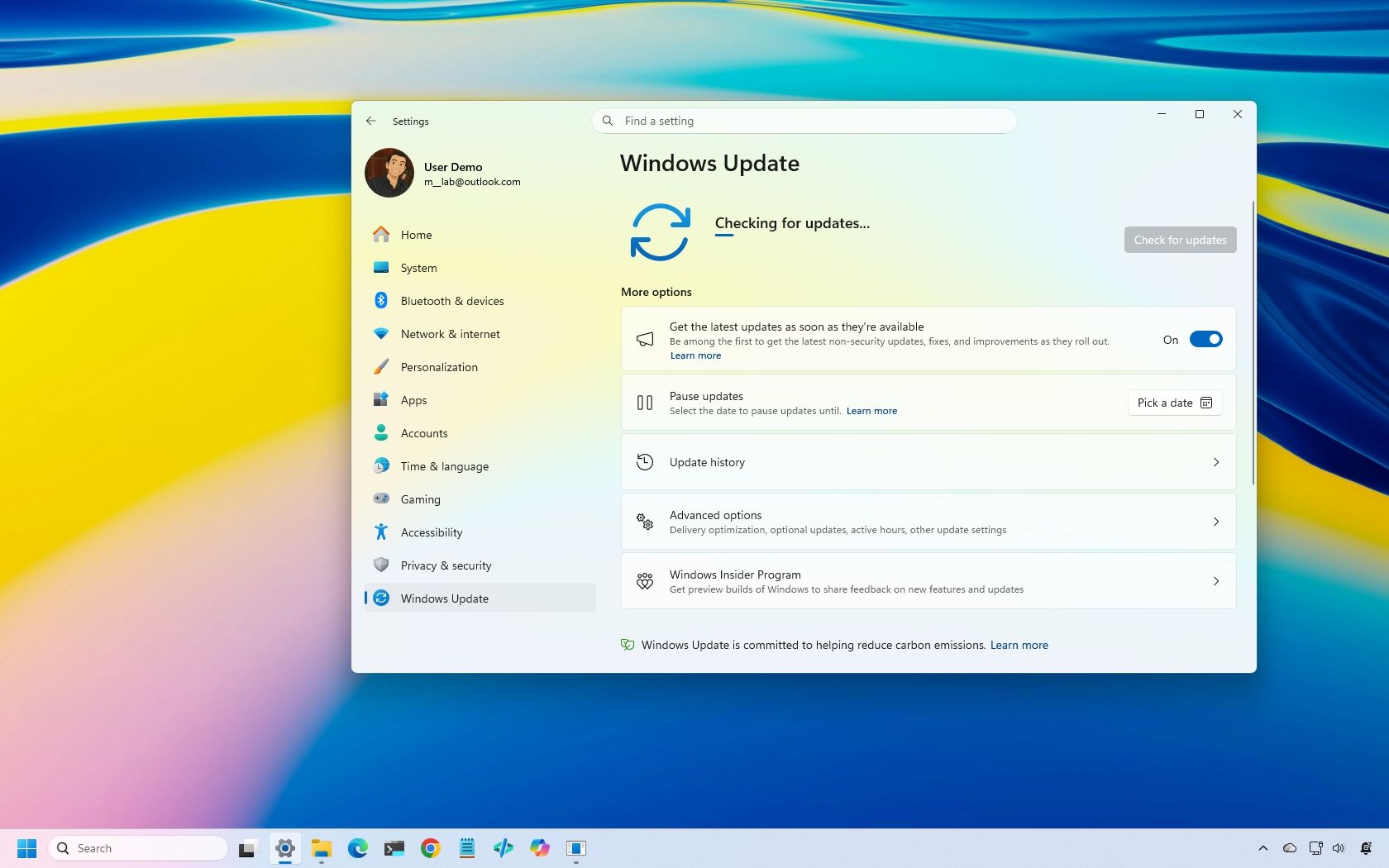
The October 2026 Security Update for Windows 11 should install automatically, but it can be installed from Settings > Windows Update by clicking the "Check for updates" button.
The update is available for versions 26H2, 25H2, and 24H2, with builds 26300.9711, 26200.9711, and 26100.9711, respectively.
However, keep in mind that Windows 11 24H2 Home and Pro reached the end of support with this security update released on October 13. This means that 24H2 will no longer receive security fixes and improvements, nor will the company continue offering support.
If you're still on version 24H2, I highly recommend upgrading to the latest version. Since versions 26H2, 25H2, and 24H2 share the same core system, switching versions only requires the latest updates for the current version and the enablement package, both of which should be available for download through Windows Update settings.
Windows Central's Take
Although the October update includes features and changes that are easier to notice, the smaller fixes can be just as useful when they address problems that disrupt your workflow. The Bluetooth improvements stand out because they cover several areas, from connection status and Settings reliability to audio compatibility and crashes.
The fixes for fingerprint sign-in, gaming, printing, and VPN connections are more specific, but they could make a difference to affected users. If you've experienced any of these problems, it's recommended to install this month's update as soon as possible.
Have you noticed any of these issues on your device? Let me know in the comments.
More resources
Explore more in-depth how-to guides, troubleshooting advice, and essential tips to get the most out of Windows 11 and 10. Start browsing here:
PowerToys, the "Swiss Army knife" of Windows 11, is now available in version 0.102, introducing several features designed to improve your desktop experience.This release adds Mouse Button Lock to make dragging and selecting items easier, while CursorHide automatically hides the mouse pointer under specific conditions. Command Palette also gets an update with quick access to frequently used commands. In addition, PowerToys expands its command-line and automation f
PowerToys, the "Swiss Army knife" of Windows 11, is now available in version 0.102, introducing several features designed to improve your desktop experience.
This release adds Mouse Button Lock to make dragging and selecting items easier, while CursorHide automatically hides the mouse pointer under specific conditions. Command Palette also gets an update with quick access to frequently used commands. In addition, PowerToys expands its command-line and automation features, and ZoomIt now lets you use voice input to set image descriptions.
In this guide, I'll highlight the five new features and improvements in PowerToys version 0.102 and explain how they can help you get more out of Windows 11.
1. Mouse Button Lock for easy dragging and selection
Selecting large groups of items or dragging files across the desktop can get tiring when you have to hold a mouse button down for an extended period. Starting with version 0.102, PowerToys introduced Mouse Button Lock to make these actions easier.
When this feature is enabled, you can press and hold a mouse button briefly, then release it. PowerToys keeps the button virtually held down, letting you keep selecting items or dragging files without physically holding the button. To release the hold, simply click any mouse button.
Mouse Button Lock can help when you're working with large file selections, moving items, or doing tasks that require extended dragging. It can also improve accessibility for people who have difficulty holding a mouse button down for long periods.
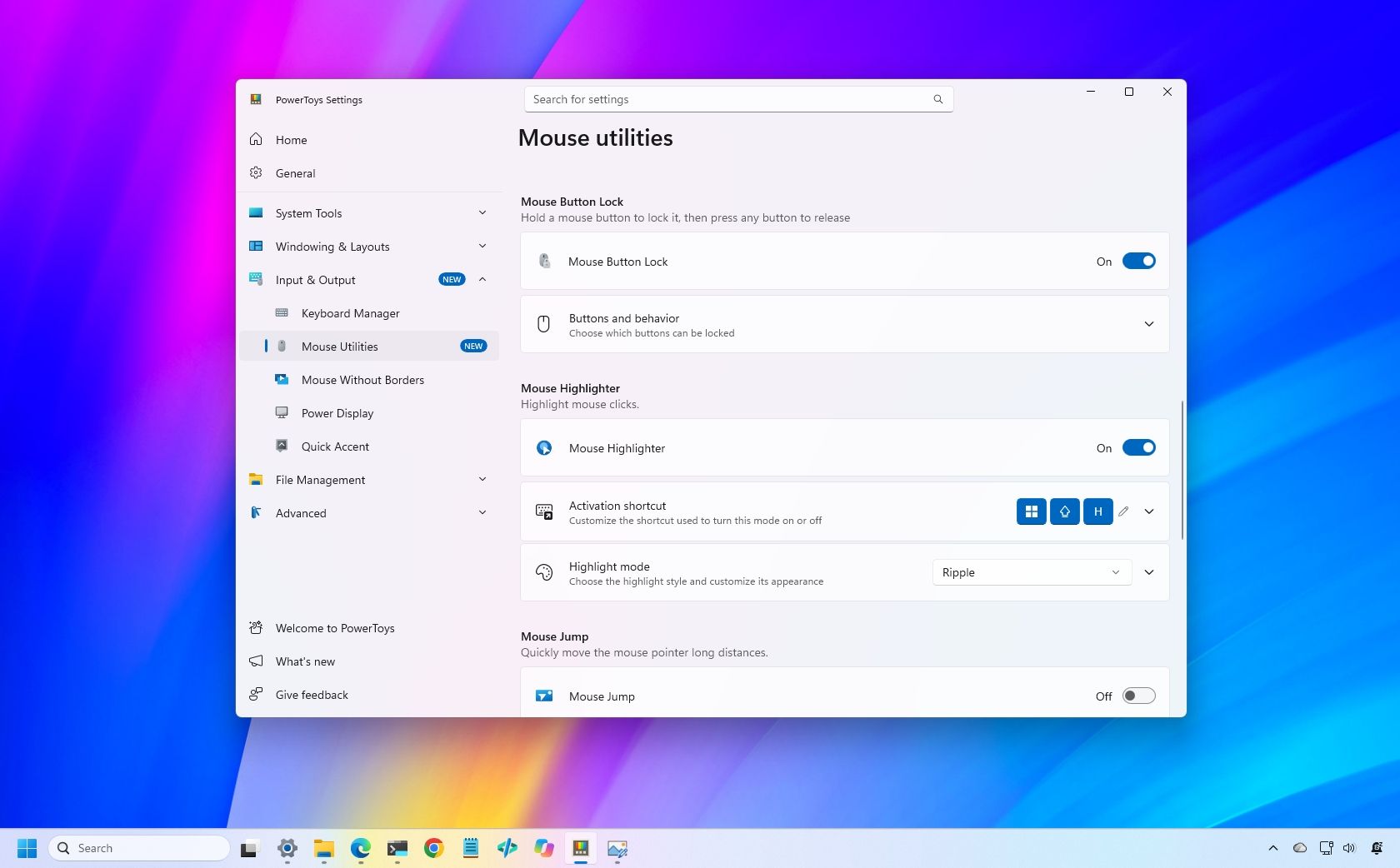
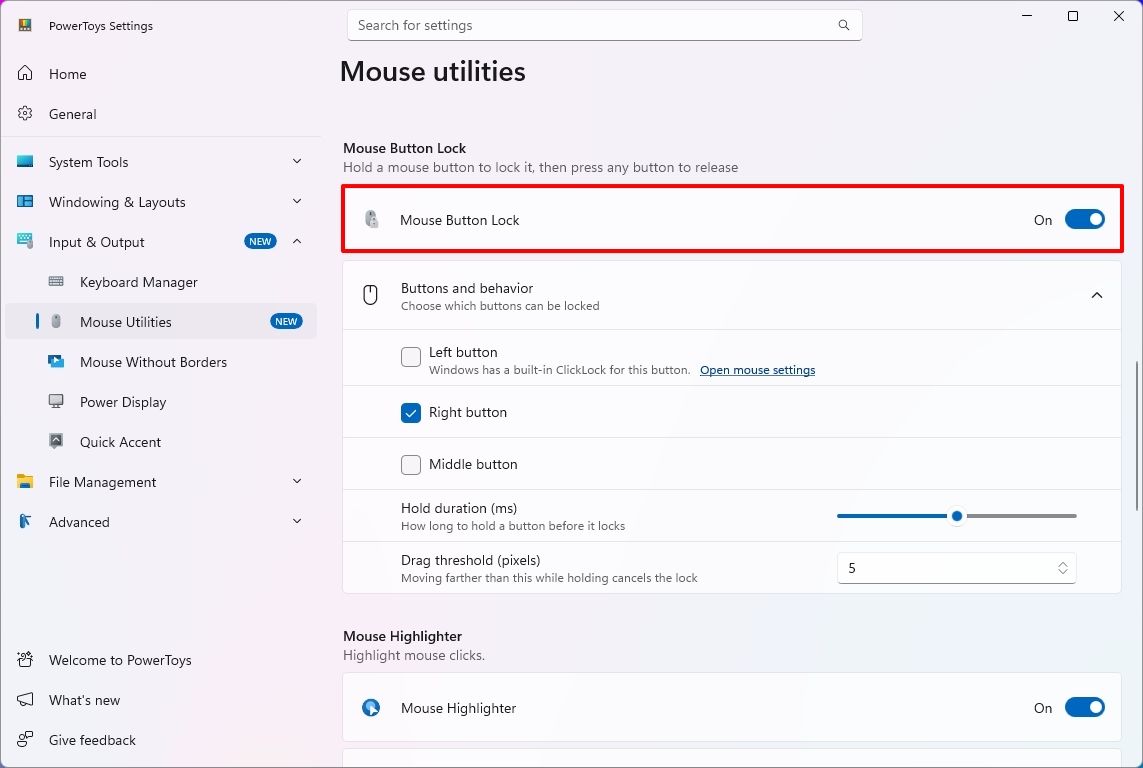
You can enable the feature in PowerToys > Input & Output > Mouse Utilities by turning on the "Mouse Button Lock" toggle switch.
(Image credit: Mauro Huculak)
From the "Buttons and behavior" settings, you can decide whether the left, middle, or right button should lock while pressed.
The settings also let you choose the hold duration before the button is locked as pressed, and the drag threshold allows you to specify how far you can move the mouse before PowerToys cancels the Mouse Button Lock.
2. CursorHide for fewer cursor interruptions
PowerToys also introduces a second mouse utility, CursorHide, which lets you hide the mouse pointer while you're typing, after a period of inactivity, or both.
CursorHide is useful when the mouse pointer gets in the way of what you're doing on the screen. For example, hiding the pointer while typing makes it easier to focus on text without the cursor covering words or other elements.
You can enable the feature in PowerToys > Input & Output > Mouse Utilities by turning on the "CursorHide" toggle switch.
(Image credit: Mauro Huculak)
In the "Activation and behavior" settings, you can choose to hide after keyboard input and set the cursor to hide after a period of inactivity.
3. Command Palette quick access to favorites
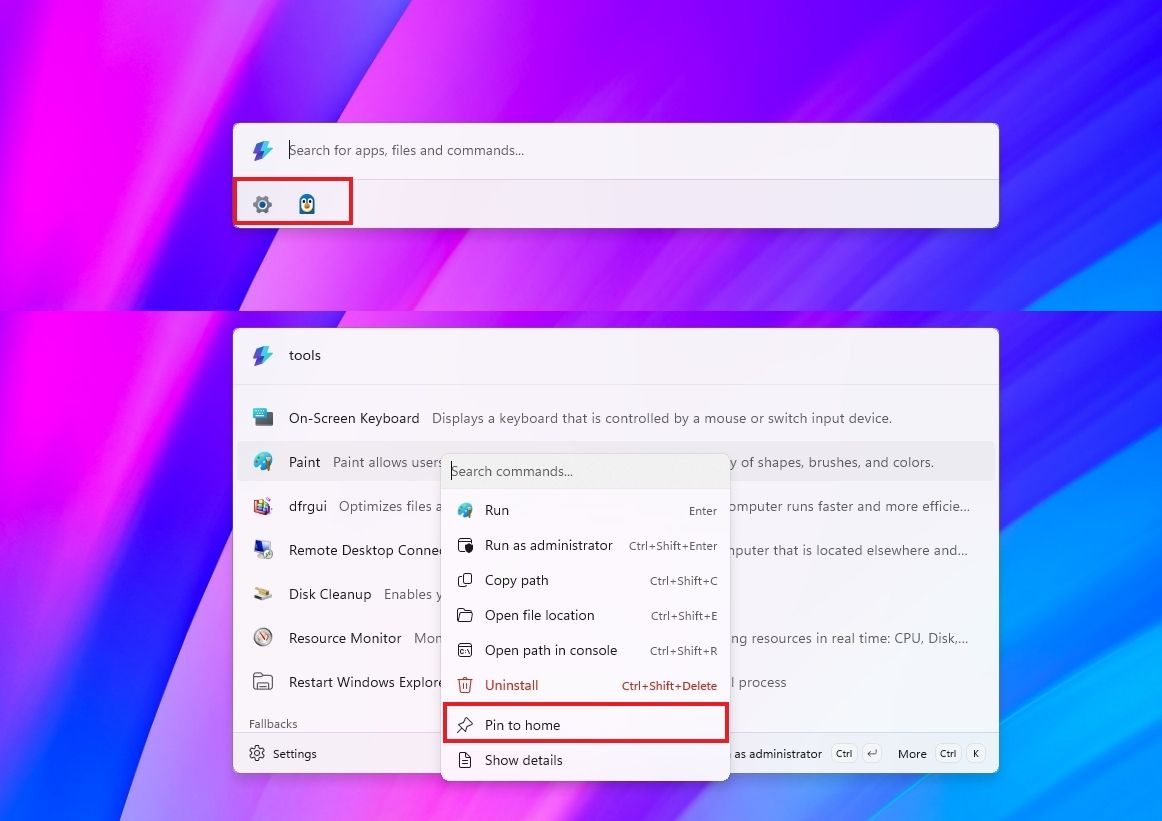
If you use Command Palette, this update rolls out an update to Compact mode that lets you pin frequently used commands under the search box.
Once you pin an item, you can launch it with the "Alt + 1" through "Alt + 9" shortcut or select it without running it with the "Alt + Shift + number" shortcut.
(Image credit: Mauro Huculak)
It's also possible to drag items to reorder them, right-click to access more options, and display recent apps and commands.
4. PowerToys expands command-line support
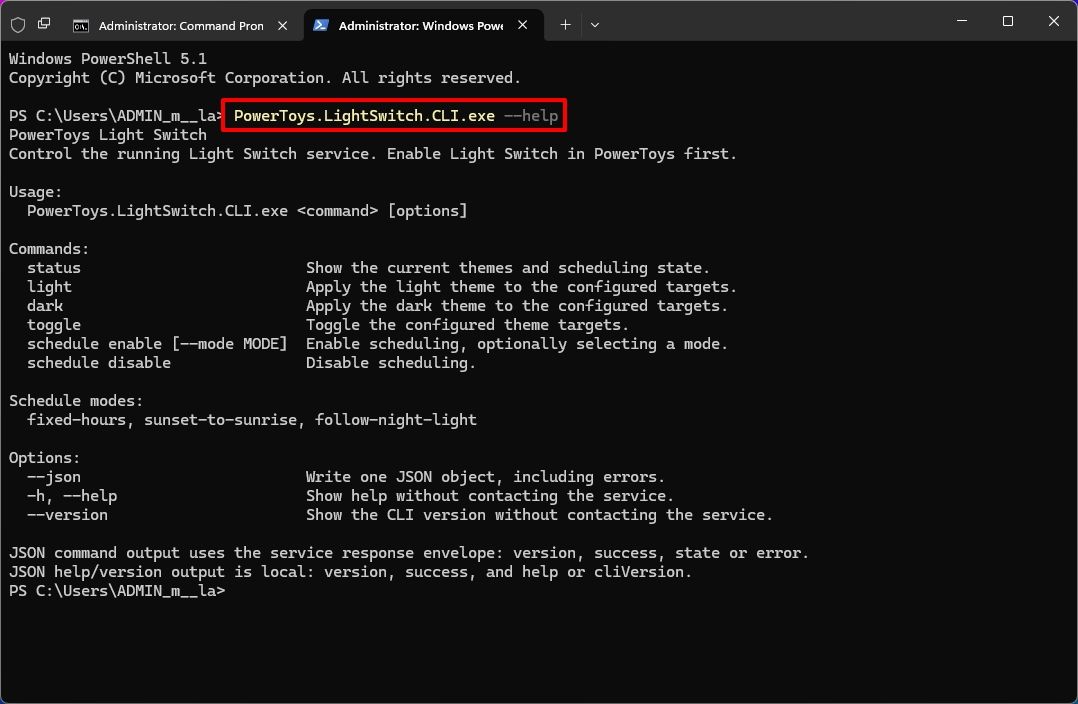
PowerToys version 0.102 expands its command-line capabilities, allowing you to control more utilities, automate tasks, and retrieve information directly from Command Prompt or PowerShell.
The update adds CLI commands for Advanced Paste, Light Switch, Settings, Peek, and PowerDisplay. These commands let you run actions, manage light and dark mode settings, turn utilities on or off, preview files and folders, and retrieve display information in script-friendly formats.
These additions are especially useful for automating repetitive tasks, creating scripts, or controlling PowerToys utilities without opening their graphical interfaces.
(Image credit: Mauro Huculak)
Here's a list of the new command-line support you can use with PowerShell:
Advanced Paste: PowerToys.AdvancedPaste.CLI.exe
Light Switch: PowerToys.LightSwitch.CLI.exe
Settings: PowerToys.Settings.CLI.exe
Peek: PowerToys.Peek.UI.exe
PowerDisplay: PowerToys.PowerDisplay.CLI.exe
To learn about the options for each command, use the "--help" command. For example, PowerToys.LightSwitch.CLI.exe -- help.
If, for example, LightSwitch is enabled, you can switch to dark mode with the PowerToys.LightSwitch.CLI.exe dark command.
You can use the command to manage it, but you must enable the utility in PowerToys settings first.
5. ZoomIt adds screenshot dictation
Finally, ZoomIt now lets you dictate a description while capturing a screenshot, making it easier to document what's on the screen without typing the text separately.
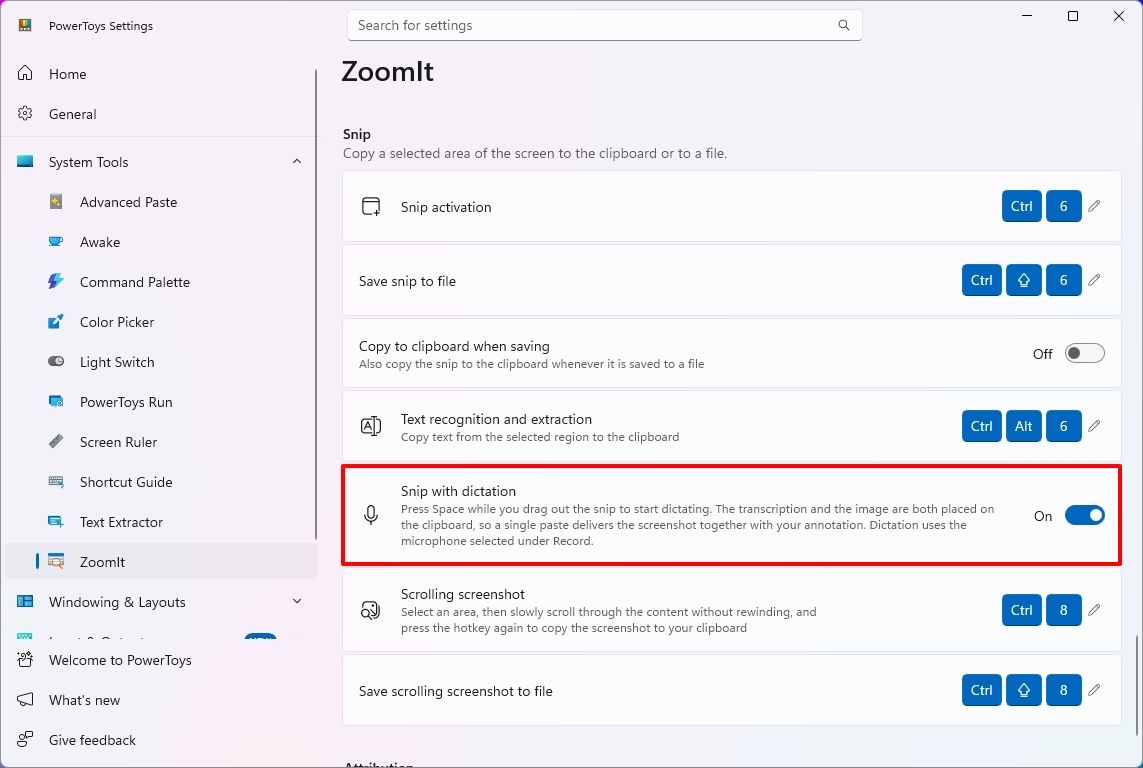
To use the feature, open PowerToys > System Tools > ZoomIt, turn on the feature, and then under the "Snip" section, turn on the "Snip with dictation" toggle.
(Image credit: Mauro Huculak)
Once you have done that, drag to select an area of the screen, press the "Space" key, and describe what you're capturing. ZoomIt transcribes your speech locally, allowing you to paste the screenshot and its accompanying text together.
The feature uses the microphone selected in the "Record" settings.
Wrap up
PowerToys 0.102 is a surprisingly and unusually interesting update, despite the simple version-number change. The popular app serves as a clear reminder of how much Windows 11 continues to evolve thanks to community-driven tools — these additions make everyday workflows smoother and show how Microsoft’s open‑source ecosystem continues to fill gaps the OS itself doesn’t yet cover.
Whether you’re a power user or just someone who loves small quality‑of‑life upgrades, this release proves that Windows can still surprise you with clever, genuinely useful features.
What’s the most interesting feature in this rollout? Let me know in the comments!
More resources
Explore more in-depth how-to guides, troubleshooting advice, and essential tips to get the most out of Windows 11 and 10. Start browsing here:
Microsoft is continuously refining the Windows 11 desktop experience, focusing on granular customization, accessibility enhancements, and seamless account management. The latest experimental update rolling out to Windows Insiders introduces thoughtful quality-of-life adjustments designed to give users more control over system shortcuts and streamline subscription management directly within the operating system. Whether you rely on assistive […]
Microsoft is continuously refining the Windows 11 desktop experience, focusing on granular customization, accessibility enhancements, and seamless account management. The latest experimental update rolling out to Windows Insiders introduces thoughtful quality-of-life adjustments designed to give users more control over system shortcuts and streamline subscription management directly within the operating system. Whether you rely on assistive […]
Microsoft continues to expand the capabilities of its modern operating system through the Windows Insider Experimental Preview Channel. Building upon recent major improvements seen across the ecosystem—such as smarter process grouping in Task Manager, file explorer tilde shortcuts, and streamlined update controls—Build 26340.9767 introduces targeted tools designed to eliminate unnecessary friction between desktop workflows and […]
Microsoft continues to expand the capabilities of its modern operating system through the Windows Insider Experimental Preview Channel. Building upon recent major improvements seen across the ecosystem—such as smarter process grouping in Task Manager, file explorer tilde shortcuts, and streamlined update controls—Build 26340.9767 introduces targeted tools designed to eliminate unnecessary friction between desktop workflows and […]
Full Release NotesBeta Preview Build 26220.9757Experimental Preview Build 26340.9767Beta (26H1) Preview Build 28020.3292Experimental (26H1) Preview Build 28120.3302Experimental (Future Platforms) Preview Build 29695.1001Microsoft's redesigned File Explorer context menu could make navigating Windows 11 feel faster and more personal. The company has started testing a new right-click menu that reduces clutter by moving less common options out of the way while keepin
Microsoft's redesigned File Explorer context menu could make navigating Windows 11 feel faster and more personal. The company has started testing a new right-click menu that reduces clutter by moving less common options out of the way while keeping frequently used actions easy to access.
That new context menu is available for Windows Insiders in the Beta channel. Microsoft also shipped four other Insider builds of Windows 11 today that includes
File Explorer (Beta)
Introducing the new, redesigned context menu in File Explorer
We're rolling out an updated context menu experience in File Explorer, designed to feel faster, cleaner, and easier to tailor to the way you work. The new design reduces top-level clutter, keeps commonly used actions easy to access, and adds a new Settings experience that gives you more control over what appears in the menu. As we continue refining this experience with Insider feedback, our goal is to make right-click feel more responsive, predictable, and personal.
We've also added a new teaching tip you might see as a first-time experience to help you learn about the customization options.
Settings (Beta)
We're making performance improvements to the Settings home page which should result in reduced loading times in certain scenarios.
Windows Insider Program (Experimental)
We've added the ability to filter Feature flags by enablement state.
Quick Settings (Experimental)
We're beginning to roll out a new Mobile devices experience in Quick Settings, making it easier to take quick phone actions (such as ring your phone) without breaking your flow on Windows.
With your supported Android phone connected, everyday actions are now just a click away. You can turn Do Not Disturb on before a meeting, change your phone's ringer mode, and play a sound to find your phone nearby.
It's a simpler, faster way to manage your phone from the place you already use for quick Windows actions, helping your PC and phone work better together throughout the day.
Capabilities can vary by phone platform and device configuration. The initial experience provides the most complete set of controls for Android phones, while iPhone support starts with a more limited status-focused experience.
Check your internet speed directly from Quick Settings
We're making it faster and easier to check the performance of your internet connection in Windows. Windows Insiders can now run an internet speed test and see the results directly in Quick Settings, without being redirected to a browser.
Start a test from the new Speed test Quick Setting, from the Wi-Fi or Cellular flyout, or by right-clicking the network icon in the system tray and selecting Test internet speed. While the test runs, Quick Settings shows its progress and results, including download speed, upload speed, and ping.
Because the test runs against your active internet connection, you can quickly understand how your current connection is performing without leaving your workflow. This updated experience builds on the internet speed test we previously introduced for Windows Insiders, bringing the test and its results directly into Windows.
Magnifier (Experimental)
We've added a Keyboard shortcut for Magnifier toggle in Settings > Accessibility > Magnifier. It lets you choose whether pressing Windows logo key + Plus (+) launches Magnifier.
The shortcut stays on by default, so nothing changes unless you want it to. If you find that Magnifier starts by accident, or the shortcut conflicts with another app or keyboard layout, turn the toggle off. You can still start Magnifier from Settings, and you can turn the shortcut back on at any time.
Microsoft 365 subscription in Windows (Experimental)
We're introducing a new inline experience that makes it easier for Microsoft 365 subscribers to manage their subscriptions in Windows. Subscribers who have recurring billing turned off can now turn it back on directly in Windows Settings, without leaving for a separate webpage. To get started, select Turn on recurring billing or Set up recurring billing from the Windows Settings Home page, the Accounts page, or the Start menu.
File Explorer (Experimental)
Improved progress indication when navigating to locations that take longer to load, such as network drives, making it easier to see that loading is underway.
Narrator (Experimental)
Narrator now supports additional languages for math reading, including Greek, Hungarian, Indonesian, Norwegian (Bokmål), Polish, Russian, Swedish, and Vietnamese.
Widgets (Experimental)
The Widgets picker now has a standard Windows dialog frame and supports light and dark title bars. It also removes the blank space previously left for an icon.
Taskbar (Experimental)
Fixed an issue with the previous update where explorer.exe wouldn't load after logging in, preventing the taskbar and other elements that rely on it from loading.
Unicode (Beta 26H1, (Experimental (26H1))
This update provides Windows text shaping support for Unicode 17.0, helping Windows correctly display and shape newly encoded characters and scripts. Unicode 17.0 added 4,803 characters, including support for four newly encoded scripts: Beria Erfe, Sidetic, Tai Yo, and Tolong Siki. These updates help keep Windows text support current as the Unicode Standard evolves and improve support for languages and writing systems used by people around the world.
Start menu (Experimental (26H1))
This update makes the Start menu more personal with several customizations.
You can choose between a small or large Start menu, in addition to the Automatic (default) option that's available today. To customize this setting, go to Settings > Personalization > Start > Start menu size.
The Recommended section is renamed Recent in the Start menu and on the Start settings page (Settings > Personalization > Start).
You can now hide your name and profile picture in Start by going to Settings > Personalization > Start > Hide your name and profile picture on Start.
The Start menu settings page is now redesigned with section-level toggles to independently show or hide Pinned, Recent, and All.
Manage camera, microphone, and location access for desktop apps (Experimental (26H1))
Windows Insiders can now manage camera, microphone, and location permissions for individual desktop apps. Previously, access for traditional desktop applications was managed through a single device-wide setting.
With this update, you can review and control access on an app-by-app basis, giving you greater visibility into which apps are requesting access to sensitive resources and more control over your privacy choices. Our goal is to make privacy permissions easier to understand and manage across the wide range of desktop apps people use every day.
Recovery (Experimental (26H1))
We're adding a new entry point for Cloud Rebuild under Settings > System > Recovery, making it easier to access the feature from Settings.
File Explorer (Experimental (26H1))
We've sharpened file thumbnails in the Recommended section on the Home page so they're crisper and easier to read.
A new contrast theme toggle for a lower-glare screen. If bright screens are uncomfortable, many people use color inversion to reduce glare. However, inversion changes everything on screen, including photos, charts, and videos. With this update, we're introducing a new contrast theme toggle in Magnifier.
Reduce glare with a single toggle. Turn on a contrast theme directly from the Magnifier toolbar for a more comfortable viewing experience.
Choose the contrast theme that works best for you. The dark theme is applied by default, and you can choose which contrast theme the toggle uses under Settings > Accessibility > Magnifier.
Photos, videos, and charts keep their original colors. Unlike color inversion, the contrast theme recolors the interface without touching your photos, charts, or videos, so they keep their real colors.
Color inversion is still here. This isn't a replacement. If you use inversion today, it works exactly as it always has. The contrast theme is a separate, purpose-built option to reduce glare when you want a darker interface without inverting colors.
Family Safety (Experimental (Future Platforms))
Improved family safety messaging when applications are blocked because of age-restricted parental controls.
Windows Setup (Experimental (Future Platforms))
The digital safety of users and supporting families is central to how we think about the Windows experience. We're improving information on parental controls and their availability during Windows setup, so families can more easily understand available protections and make informed choices from the very beginning.
Network (Experimental (Future Platforms))
Fixed an issue causing internet access to stop working for some Insiders after the last two flights.
Hyper-V (Experimental (Future Platforms))
Fixed an issue where some applications that used HCS-managed virtual machines experienced issues when sharing host folders with Linux VMs using Plan9. Folders shared from the Windows host using Plan9 didn't appear or couldn't be accessed in the guest environment.
Other (Experimental (Future Platforms))
Fixed an issue causing some Insiders to see an unexpectedly high volume of ESENT events after the latest flights.
Fixed an underlying issue in the latest flights causing Insiders using VMware to experience frequent green screen bugchecks with error PFN_SHARE_COUNT.
Microsoft has been hard at work decluttering Windows 11. While those efforts continue, it seems Microsoft is putting more emphasis on improving the built-in Windows 11 apps as well. Even the Camera app received some updates recently.
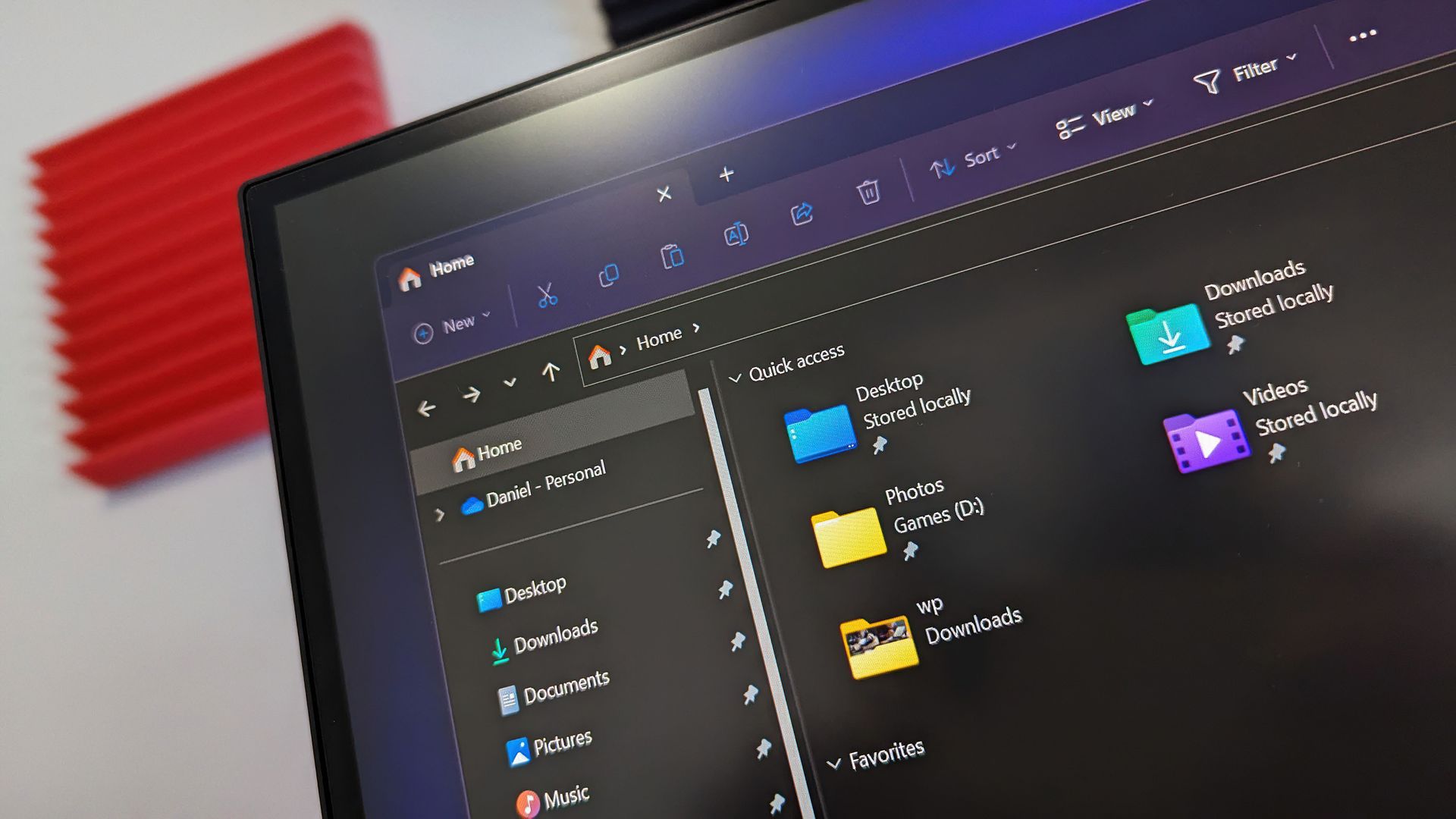
File Explorer is a core part of the Windows 11 experience, so it's nice to see it being upgraded as well.
Join us on Reddit at r/WindowsCentral to share your insights and discuss our latest news, reviews, and more.
When Microsoft announced the first wave of RTX Spark laptops, many were intrigued by the superchips inside the PCs. But I went a bit more surface-level, pun intended. During the Windows and Surface event, eagle-eyed viewers spotted a striking wallpaper across the new laptops.The wallpaper is reminiscent of Windows 11's Bloom wallpaper, but it stands out for having a single curve and contrasting colors. As much as I like the Bloom wallpaper, it's been remixed seve
When Microsoft announced the first wave of RTX Spark laptops, many were intrigued by the superchips inside the PCs. But I went a bit more surface-level, pun intended. During the Windows and Surface event, eagle-eyed viewers spotted a striking wallpaper across the new laptops.
The wallpaper is reminiscent of Windows 11's Bloom wallpaper, but it stands out for having a single curve and contrasting colors. As much as I like the Bloom wallpaper, it's been remixed several times by Microsoft and enthusiasts, so it's time for a new Windows wallpaper.
Sadly, Microsoft did not release the image after unveiling the new laptops. I waited with anticipation for the release of the RTX Spark laptops, but even when the Surface Laptop Ultra review went live, the new wallpaper was nowhere to be found. Microsoft even mocks us by having a blacked-out version of the wallpaper on the retail listing of the Surface Laptop Ultra.
(Image credit: Microsoft)
Desperate to get my hands on the new wallpaper, I scoured reviews of the ASUS ProArt P16, HP OmniBook Ultra 16, and Surface Laptop Ultra only to be disappointed.
But a hero emerged, saving me from settling for an AI recreation of the wallpaper. Discord user TechosaurusRex discovered the wallpaper in the app files for Microsoft's Retail Demo Experience. Seemingly, Microsoft's plan was to tease us by showing the wallpaper on display retail units but not include the image on purchased PCs.
Luckily, TechosaurusRex stepped up and shared the wallpaper, ending my quest. Sadly, the above version is compressed to ensure our site loads quickly. I'll share the full resolution version as soon as possible.
Join us on Reddit at r/WindowsCentral to share your insights and discuss our latest news, reviews, and more.
Nvidia's latest RTX driver adds shader stutter improvements. Here's which GPUs and games support the feature and what it means for PC performance.
The post Nvidia’s New Driver Targets Game Stutter — Which RTX GPUs and Games Benefit? appeared first on TechRepublic.
Microsoft has officially kicked off the rollout for its latest major annual feature update, Windows 11, version 26H2. Packed with intelligent system tools, deep hardware optimizations, and long-requested customization options, this release makes the Windows desktop experience feel smoother, smarter, and significantly more connected. Rather than overhauling the entire user interface, 26H2 focuses on refined […]
Microsoft has officially kicked off the rollout for its latest major annual feature update, Windows 11, version 26H2. Packed with intelligent system tools, deep hardware optimizations, and long-requested customization options, this release makes the Windows desktop experience feel smoother, smarter, and significantly more connected. Rather than overhauling the entire user interface, 26H2 focuses on refined […]
For years, Microsoft Edge has quietly built a reputation as the power-user’s browser when it comes to built-in accessibility features. While both Edge and Google Chrome share the same underlying Chromium rendering engine, Microsoft has consistently pushed ahead by adding native, granular customization tools that go well beyond basic browser extensions. One standout feature introduced […]
For years, Microsoft Edge has quietly built a reputation as the power-user’s browser when it comes to built-in accessibility features. While both Edge and Google Chrome share the same underlying Chromium rendering engine, Microsoft has consistently pushed ahead by adding native, granular customization tools that go well beyond basic browser extensions. One standout feature introduced […]
Every few months, the tech news cycle hits a dry spell, and like clockwork, breathless headlines begin popping up across tech blogs: “Secret Windows 11 Feature Revealed!” or “Microsoft is Finally Testing a Quick Right-Click Menu to Move Your Taskbar!” If you have spent any time on Windows forums or tech news aggregators recently, you […]
Every few months, the tech news cycle hits a dry spell, and like clockwork, breathless headlines begin popping up across tech blogs: “Secret Windows 11 Feature Revealed!” or “Microsoft is Finally Testing a Quick Right-Click Menu to Move Your Taskbar!” If you have spent any time on Windows forums or tech news aggregators recently, you […]
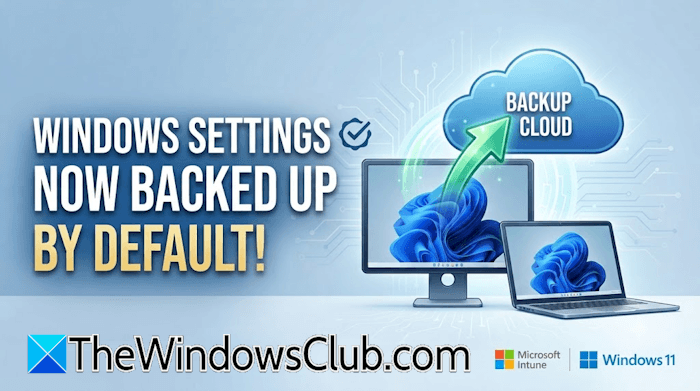
Microsoft officially released Windows 11 26H2 for all users. You can install it via Windows 11 Settings. With Windows 11 version 26H2, Windows Settings are now backed up by default on all eligible enterprise devices. This feature makes it easier to restore your settings and preferences when you move to a new computer. This article […]
The post Windows Settings are now backed up by default appeared first on TheWindowsClub News.
Microsoft officially released Windows 11 26H2 for all users. You can install it via Windows 11 Settings. With Windows 11 version 26H2, Windows Settings are now backed up by default on all eligible enterprise devices. This feature makes it easier to restore your settings and preferences when you move to a new computer. This article […]
Microsoft will remove eight OneDrive Copilot shortcuts from File Explorer starting in November 2026, changing how users access AI-powered file tools.
The post Microsoft Is Removing 8 Copilot Shortcuts From File Explorer — Here’s What Stays appeared first on TechRepublic.
Microsoft is working on a small yet meaningful change to the lock screen and sign-in experience on Windows 11 that will streamline the authentication process that users must go through to log into their desktop. The current Windows sign-in flow requires the user to manually select the method of authentication they wish to use to login. If you've set up a PIN, face unlock, and fingerprint unlock, the only method of authentication that is active is the one you manu
Microsoft is working on a small yet meaningful change to the lock screen and sign-in experience on Windows 11 that will streamline the authentication process that users must go through to log into their desktop.
The current Windows sign-in flow requires the user to manually select the method of authentication they wish to use to login. If you've set up a PIN, face unlock, and fingerprint unlock, the only method of authentication that is active is the one you manually click on to use on the lock screen.
This is a huge gripe of mine, and it's super frustrating when you want to login using your face, but Windows has selected PIN or fingerprint. It means your webcam isn't looking for you in that moment, and you have to manually switch to face unlock to force Windows into checking for your face and logging in.
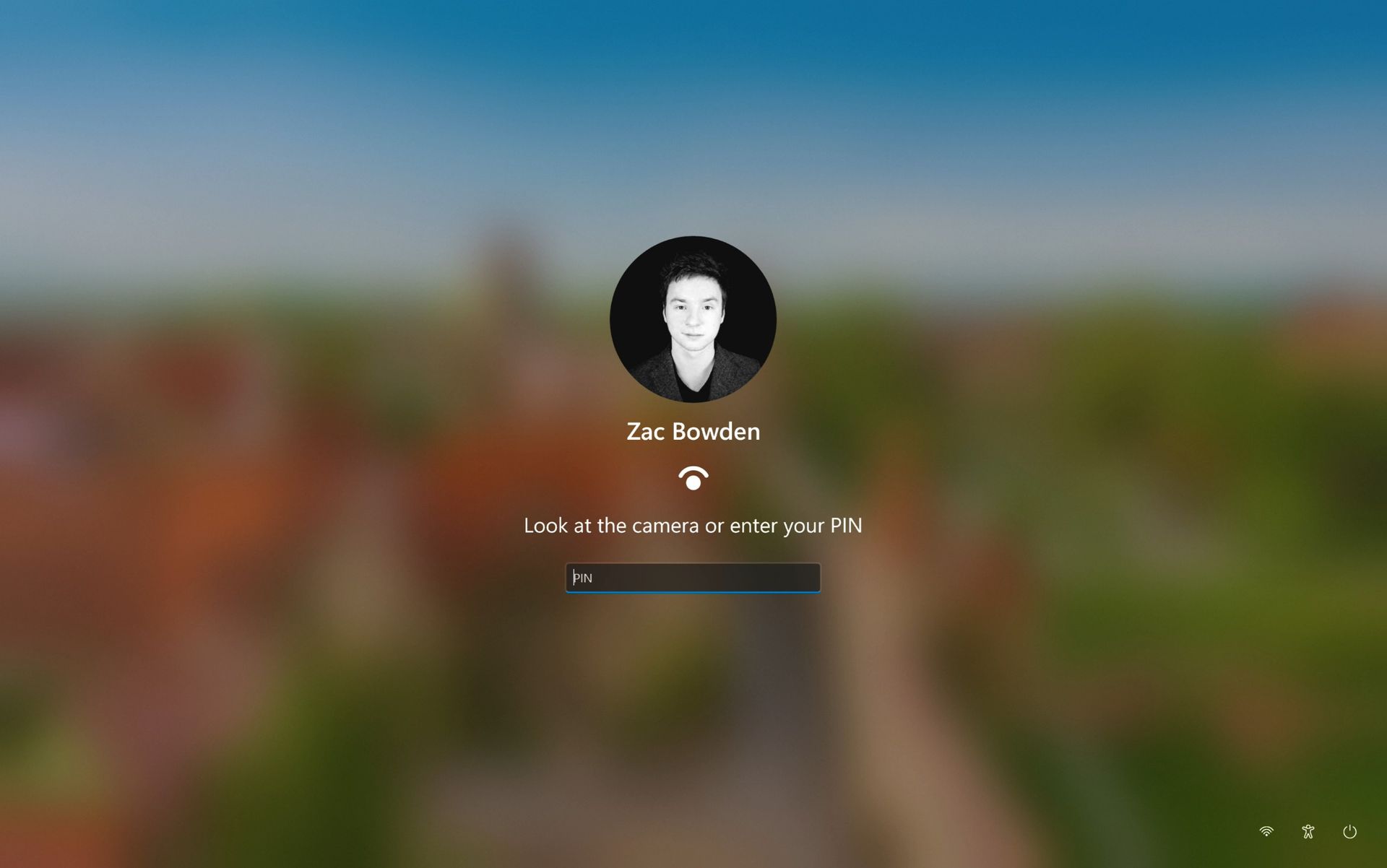
Well, it looks like this is finally changing. In the latest Windows 11 preview builds, a hidden feature ID enables a new experience that automates this. Now, by default, the PIN box is always on show, but face unlock and fingerprint unlock are also active and ready to authenticate at the same time.
No longer does the user need to manually choose their login method. (Image credit: Zac Bowden / Windows Central)
This means users no longer need to manually select the login method of their choice. Windows will automatically capture whichever biometric authentication method is set up, even when the PIN box is on screen. This also means the lock screen looks cleaner as a result, as the options to choose which authentication method you want to use is no longer displays as it's not necessary. It's also faster for those with biometric authentication enabled.
I really like this change, as it encourages Windows to keep trying my face unlock even if it fails the first time. Of course, there's an eventual timeout if it fails too many times, but I find it is able to log me in before it ever reaches that point. Also, being able to just type my PIN without having to manually select the PIN option first is also great.
Microsoft is yet to announce this new sign-in flow, but I suspect it won't be long until it's officially put into testing as it's already very polished and has been in the works for a number of months now. What do you think? Is this a good change for the Windows lock screen? Let us know in the comments.
Join us on Reddit at r/WindowsCentral to share your insights and discuss our latest news, reviews, and more.
Explore the Microsoft Surface Laptop Ultra's price, specs, Nvidia RTX Spark AI performance, battery life, and key features before buying.
The post Microsoft Surface Laptop Ultra Cheat Sheet: Price, Specs, Features, and More appeared first on TechRepublic.
Windows 11 offers controls for diagnostic data, location access, clipboard syncing, and personalized recommendations. Here's how to review seven privacy settings and understand their trade-offs.
The post 7 Windows 11 Privacy Settings You Should Check in 2026 appeared first on TechRepublic.
Windows 11 offers controls for diagnostic data, location access, clipboard syncing, and personalized recommendations. Here's how to review seven privacy settings and understand their trade-offs.

 Connexion