❌

Vue normale

  • ✇Yanko Design
  • LAYER’s Ripple Dining Table Uses a Wavy Plywood Core to Cut Weight
    Large dining tables are useful right up until you need to move one, when their reassuring weight becomes somebody else’s lifting problem. LAYER’s Ripple research table explores a lighter construction by giving thin plywood a corrugated profile instead of relying on a thick slab. That said, the project keeps a flat surface for everyday use while putting the waves underneath, mostly hidden from view. The original table was specified at approximately 8.2 feet long and 39.4 inches wide, weighing ab
     

LAYER’s Ripple Dining Table Uses a Wavy Plywood Core to Cut Weight

Par : JC Torres
14 octobre 2026 à 06:07

Large dining tables are useful right up until you need to move one, when their reassuring weight becomes somebody else’s lifting problem. LAYER’s Ripple research table explores a lighter construction by giving thin plywood a corrugated profile instead of relying on a thick slab. That said, the project keeps a flat surface for everyday use while putting the waves underneath, mostly hidden from view.

The original table was specified at approximately 8.2 feet long and 39.4 inches wide, weighing about 19.8 pounds. That’s a generous dining surface for something intended to be moved by one person. Bringing it across a room for guests or shifting it away from the wall could become less of a coordinated household event. Its footprint, however, doesn’t shrink along with its weight.

Designer: LAYER

The material comes from a collaboration with Canadian manufacturer Corelam, using pressure lamination to form the repeating curves. LAYER specifies plywood approximately 0.12 inches thick, although that isn’t the overall depth of the assembled tabletop. The distinction matters here: the design gets its structure from a shaped sheet and layered construction, rather than pretending a thin, flat board can do everything alone.

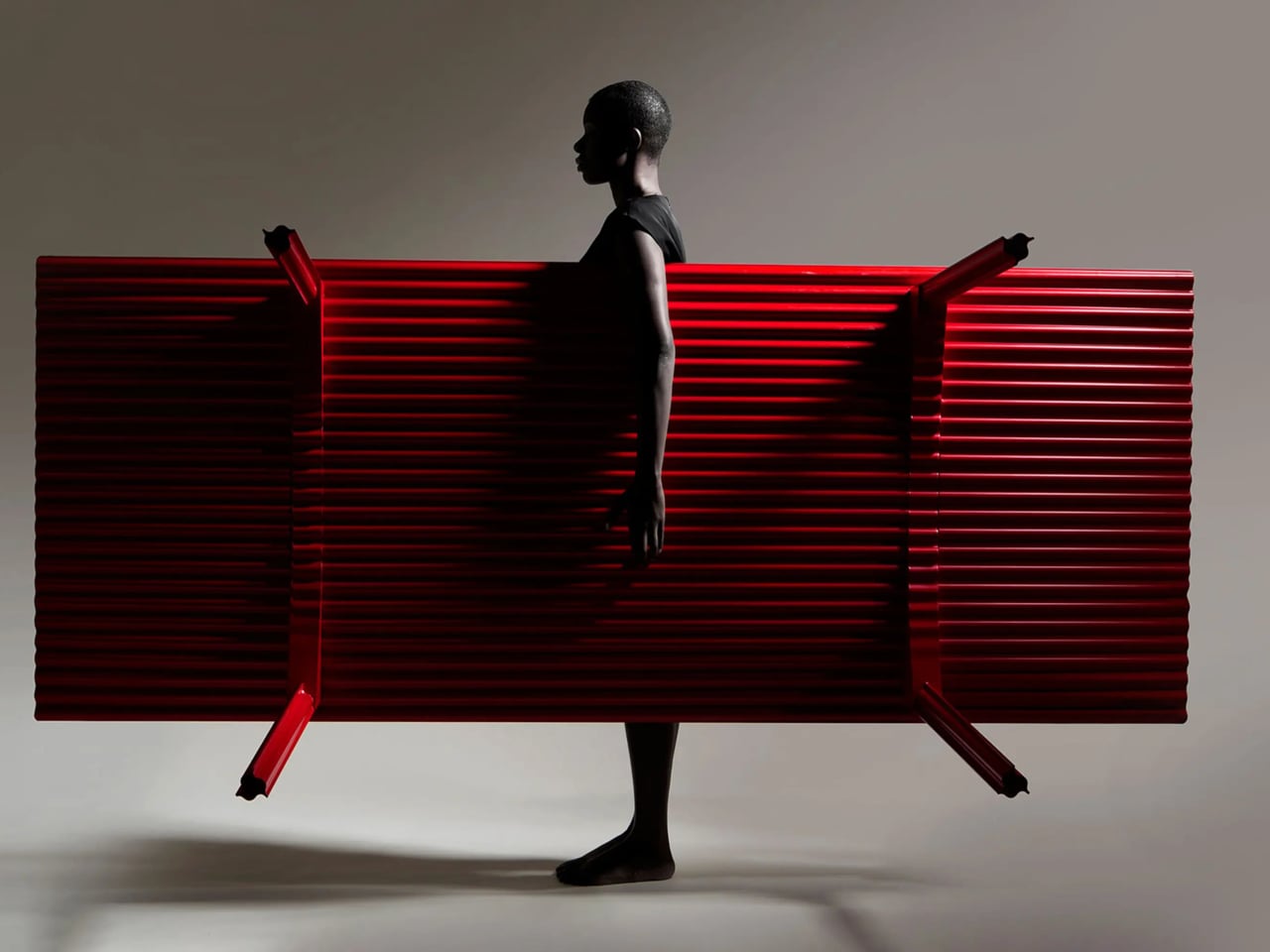
Of course, a wavy dining surface would be a fairly annoying place to balance your coffee. Ripple covers its corrugated structure with a flat plywood sheet, leaving the waves visible below and along the edge. Plates and laptops get the ordinary surface they need, while the underside carries the more unusual geometry. The useful part doesn’t have to look particularly experimental from above.

The legs follow the same preference for shape over bulk. A refined version uses hollow triangular profiles, designed to increase rigidity in two directions. The tabletop’s underside also curves gently across its length and width. Those changes address a fairly obvious concern with lightweight furniture: being easy to pick up is only useful if the table still supports what you put on it.

The red finish keeps Ripple from disappearing into the background, even with such a thin outline. From the side, the top appears almost like a sheet balanced on four narrow supports. Along the short edges, the repeating curves reveal why that impression is misleading. The structure supplies its own ornament, without adding a carved border or a heavier decorative frame.

Using less wood is part of the environmental argument, too. The project’s original documentation claims 70% to 80% less material than a standard timber table, but doesn’t establish a defined comparison for that figure. Less material isn’t automatically a complete environmental assessment, either. Adhesives, finishing, production, and working life still matter, even when the basic idea of doing more with less is appealing.

LAYER presents Ripple as a studio research project, without a current retail price or ordering details. The construction offers an answer for people whose furniture has to move with them, though size remains a constraint. You might no longer need help with the lifting, but you’d still need a clear route through the house before taking that tabletop around a corner.

The post LAYER’s Ripple Dining Table Uses a Wavy Plywood Core to Cut Weight first appeared on Yanko Design.
  • ✇Yanko Design
  • Colheita Coffee Table Concept Shapes Its Steel Legs With Ant-Inspired Cuts
    Ants aren’t usually welcome around a coffee table, especially when there are snacks involved. The Colheita Coffee Table concept, however, borrows something more useful from them: the curved cuts left by leafcutter ants. Its steel surface folds downward to become its own legs, while movable wooden supports provide places for drinks. The nature reference gives the table its construction logic, rather than simply decorating it. The body starts with a single steel sheet, cut by laser and bent so th
     

Colheita Coffee Table Concept Shapes Its Steel Legs With Ant-Inspired Cuts

Par : JC Torres
12 octobre 2026 à 13:20

Ants aren’t usually welcome around a coffee table, especially when there are snacks involved. The Colheita Coffee Table concept, however, borrows something more useful from them: the curved cuts left by leafcutter ants. Its steel surface folds downward to become its own legs, while movable wooden supports provide places for drinks. The nature reference gives the table its construction logic, rather than simply decorating it.

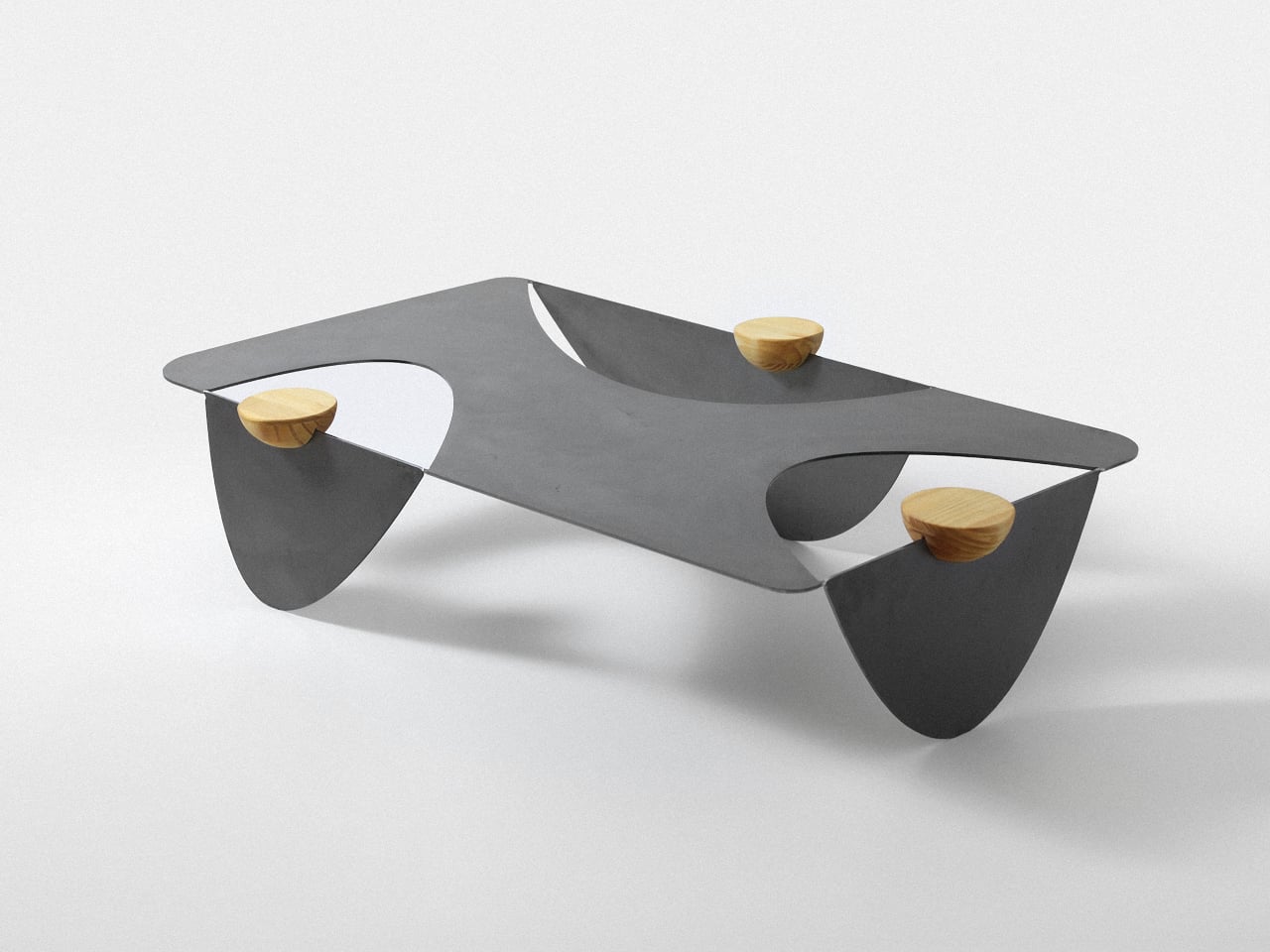
The body starts with a single steel sheet, cut by laser and bent so three broad sections reach the floor. Those sections remain attached, leaving openings where a conventional tabletop would be solid. Rather than adding separate legs underneath, Colheita carries the tabletop material through to its base. The relationship is easy to follow, even if the resulting silhouette is rather unusual.

Designer: Fabrício Auler

That approach is intended to reduce component count and material waste, although it isn’t a claim of waste-free manufacturing. A smaller detail helps explain how the sheet takes shape: enlarged, rounded ends on the cuts provide relief during bending. They’re there to ease stress where flat metal becomes a leg. The graceful curves have a fabrication purpose alongside their resemblance to a harvested leaf.

The wooden pieces might look like little bowls at first, but their flat tops serve as platforms rather than containers. Each hemisphere has a groove that slots onto the folded steel, allowing it to move along the edge. The wood adds a warmer color and visible grain to the dark metal, while giving a glass or small object its own resting place.

That means the arrangement doesn’t have to stay the same after you’ve chosen where the table goes. Move a wooden support closer to your seat, or spread them around when friends gather on different sides. The system is also intended to help stabilize the upper surface. These small additions therefore have a job beyond making the steel look a little less austere.

Of course, all those openings leave less uninterrupted space for whatever usually accumulates on a coffee table. A book or tray needs a solid patch beneath it, and a loose remote won’t forgive careless placement. The gaps do leave room for trailing plants and allow light through. Colheita invites you to arrange its contents more deliberately, which won’t appeal to everyone’s housekeeping habits.

The project also explores an unfinished carbon steel version, letting oxidation change the surface’s colors and patterns over time. That’s a different proposition from furniture meant to keep an immaculate, uniform finish. It gives the table a changing appearance rather than a permanent shade of gray. The project presentation doesn’t explain how to manage that aging around spilled drinks or routine household cleaning.

Colheita means “harvest” in Portuguese, a nod to the ants and to gathering around the table. It remains a concept project with fabrication work documented, rather than a verified retail offering. Dimensions and load capacity aren’t provided. Before trusting one of those platforms with hot coffee, you’d want to know how securely it stays put when someone nudges the table.

The post Colheita Coffee Table Concept Shapes Its Steel Legs With Ant-Inspired Cuts first appeared on Yanko Design.

  • ✇Korben
  • Un bug qui gèle l'écran des portables AMD sous Linux traîne depuis 2017, et c'est Claude qui a aidé à le corriger
    Si vous utilisez un ordinateur portable à puce graphique AMD Radeon sous Linux, vous avez peut-être déjà vu l'écran se figer d'un coup, sans raison apparente, à peu près une fois par semaine. Ce bug agace les utilisateurs depuis des années, et un correctif vient enfin de pointer le bout de son nez. Le coupable se cache dans AMDGPU, le pilote graphique libre qu'AMD maintient pour Linux. On parle ici du logiciel qui fait le lien entre la carte graphique et le système d'exploitation. Le problème ne
     

Un bug qui gèle l'écran des portables AMD sous Linux traîne depuis 2017, et c'est Claude qui a aidé à le corriger

19 juin 2026 à 05:47

Si vous utilisez un ordinateur portable à puce graphique AMD Radeon sous Linux, vous avez peut-être déjà vu l'écran se figer d'un coup, sans raison apparente, à peu près une fois par semaine. Ce bug agace les utilisateurs depuis des années, et un correctif vient enfin de pointer le bout de son nez.

Le coupable se cache dans AMDGPU, le pilote graphique libre qu'AMD maintient pour Linux. On parle ici du logiciel qui fait le lien entre la carte graphique et le système d'exploitation.

Le problème ne date pas d'hier. En fouillant l'historique du code, le développeur à l'origine du correctif a remonté la piste jusqu'à une modification introduite en 2017. Presque huit ans de gels d'écran.

Le symptôme typique, c'est une erreur "flip_done timed out" dans les journaux du système. Pour faire simple, l'ordinateur attend que l'écran affiche l'image suivante, ce signal n'arrive jamais. Et tout gèle.

Le souci touche plusieurs machines, bien connues du monde Linux, comme le Lenovo ThinkPad T14 Gen1 en version AMD ou le Framework Laptop 13 équipé d'un processeur Ryzen 7 7840U. Jusqu'ici, le seul remède consistait à désactiver le PSR, pour "Panel Self Refresh".

Cette fonction d'économie d'énergie laisse l'écran réafficher tout seul sa dernière image fixe sans réveiller la carte graphique, histoire d'économiser de la batterie. Pratique sur un portable, sauf que c'est précisément elle qui déclenchait les gels.

Le plus intéressant, c'est la méthode employée. Le correctif a été mis au point en "vibe debugging" avec Claude Code, l'assistant de programmation d'Anthropic, le concurrent direct d'OpenAI. Le développeur a décrit le bug à l'IA, qui l'a aidé à explorer le code et à affiner les correctifs, plutôt que de dérouler une procédure de débogage classique.

Concrètement, les patchs revoient la gestion du "vblank" et du "page-flip" dans le bloc d'affichage DCN, c'est-à-dire la mécanique interne qui synchronise le moment où une nouvelle image remplace l'ancienne à l'écran. D'autres tentatives avaient échoué par le passé, mais cette série semble enfin tenir la route.

Maintenant patience, rien n'est encore intégré dans le noyau Linux officiel. Les correctifs doivent passer par les tests et la validation des mainteneurs avant d'arriver chez tout le monde, ce qui peut quand même prendre plusieurs versions du kernel.

Bref, on est là devant un bug fantôme qui date d'lil y a huit ans, débusqué en discutant avec une IA, voilà qui résume assez bien l'année 2026 côté développement.

Source : Phoronix

❌