Googlebook combines Android, Gemini AI, and premium laptop hardware. See prices, models, specs, features, compatibility, and release dates.
The post Googlebook Cheat Sheet: Price, Models, Gemini Features, and Everything to Know appeared first on TechRepublic.
Calibre, le gestionnaire de bibliothèque numérique qu'on a tous installé un jour pour convertir un epub un peu récalcitrant, sort en version 9.15. Bon, d'habitude, les nouvelles versions de Calibre, je ne vous en parle pas parce que ça présente peu d'intérêt, mais là, il y a un truc intéressant dedans : Un jeu d'aventure. Hé oui, un vrai jeu, avec son univers, ses personnages et une histoire au tour par tour.
Sauf que si vous ouvrez Calibre, après la mise à jour, hé bien vous ne verrez rien du t
Calibre, le gestionnaire de bibliothèque numérique qu'on a tous installé un jour pour convertir un epub un peu récalcitrant, sort en version 9.15. Bon, d'habitude, les nouvelles versions de Calibre, je ne vous en parle pas parce que ça présente peu d'intérêt, mais là, il y a un truc intéressant dedans : Un jeu d'aventure. Hé oui, un vrai jeu, avec son univers, ses personnages et une histoire au tour par tour.
Sauf que si vous ouvrez Calibre, après la mise à jour, hé bien vous ne verrez rien du tout de tout ça
C'est voulu car pour y accéder, il faut aller dans Préférences, puis Barres d'outils & menus, choisir la barre principale et y faire glisser l'entrée "Create your own adventure". Kovid Goyal, le créateur et mainteneur de Calibre, explique dans son changelog que ce machin a commencé comme un banc d'essai pour ses backends IA avant de devenir un truc marrant à utiliser.
L'entrée du jeu, planquée dans les actions disponibles des Préférences
Une fois le bouton posé, vous cliquez dessus et vous pouvez alors décrire le monde dans lequel vous voulez jouer. Soit vous piochez dans les onze ambiances préremplies (fantasy, space opera, cyberpunk, western, horreur gothique...), soit vous écrivez la vôtre. Moi j'ai mis comme contexte un immeuble à La Défense en 2031, dont l'IA de maintenance refuse de laisser sortir les employés après 18 h parce qu'elle ne retrouve plus son contrat de service... loool.
Les onze ambiances toutes faites à gauche, ma description de monde à droite
Et magie de l'IA, 2 minutes plus tard, j'avais une quinzaine de paragraphes de décor et une mécanique de jeu que je n'avais même pas demandée avec des ascenseurs, des badges et la climatisation utilisés par la méchante IA, sans oublier le casting, avec neuf personnages dont quatre jouables, tous éditables. Ensuite, bah ça se joue comme un livre dont vous êtes le héros, sauf que rien ne vous est imposé : vous tapez ce que vous voulez faire, l'IA raconte la suite, et vous recommencez...
Et niveau écriture, ça donne quoi ? Voilà comment démarre le chapitre 1 de ma partie, en anglais dans le texte :
"You stand in the gloom of Sub-level 4, the legacy server vault where your consciousness coalesced from fractured shards. The air here is cold enough to bite, carrying the metallic tang of ozone and the faint, sour scent of overheating capacitors leaking into the floor grates. […]"
Le chapitre 1, et en bas le champ où l'on tape son action
Par contre, Calibre ne fournit aucune IA, il faudra donc en brancher une dessus. Le menu vous en propose neuf : Anthropic, Google, Grok ou OpenRouter, qui réclament tous une clé d'API, mais aussi Ollama et LM Studio, qui font tourner le modèle sur votre propre machine. C'est donc à vous de les installer et de récupérer le modèle.
Les neuf fournisseurs d'IA, avec Ollama et LM Studio pour rester chez soi
J'ai testé avec Ollama et un modèle Qwen (23 Go sur le disque), sur mon Mac M4. Résultat, ça a pris à peu près une minute par tour pour 450 mots de prose. C'est donc jouable, mais sur une machine plus modeste avec un petit modèle, vous aurez soit beaucoup plus d'attente, soit un maître de jeu qui perd le fil au bout de trois chapitres.
Et hop, j'ai configuré une IA locale avec Ollama.
Autre souci que j'ai remarqué, c'est que j'ai décrit mon univers en français et l'IA m'a répondu en anglais. C'est parce que les consignes envoyées au modèle ne sont délibérément pas traduites, donc soit vous jouez en anglais, soit vous demandez explicitement à ce que l'aventure soit en français lors de la phase de description de l'univers de votre histoire.
Ah et aussi, il y a ce bouton "Lire", en haut de la fenêtre qui vous permet à n'importe quel moment, d'exporter votre histoire en ePub avec sa couverture, son étiquette et ses chapitres, prêt à partir sur votre liseuse ou celle de vos amis.
Le livre issu de la partie, rangé dans la bibliothèque
Reste que l'IA dans Calibre, c'est un sujet qui fâche... Évidemment, on s'en doute un peu parce que cette technologie trigger encore pas mal de monde. Quand la fonction "Discuss with AI" est arrivée en décembre 2025, des utilisateurs de MobileRead ont immédiatement demandé son retrait et
Goyal a répondu sèchement
qu'il ne l'enlèverait pas. Il a quand même fini par accepter un réglage qui masque les entrées de menu IA.
Bref, si ça vous tente de tester, c'est sur calibre-ebook.com, pour Windows, macOS et Linux. Et sous Linux, ne comptez pas sur les dépôts de votre distrib, qui comme d'hab traînent plusieurs versions derrière. Mettez plutôt les dépôts officiels :
The $399 reMarkable Paper Pure trades apps, notifications, and color for focused writing. Review its features, limitations, battery life, and value.
The post reMarkable Paper Pure Trades Tablet Features for Focus appeared first on TechRepublic.
See why Deputy leads my best time and attendance software picks for 2026, plus options for field crews, small teams, low-cost time tracking, and QuickBooks users.
The post 5 Best Time and Attendance Software in 2026 appeared first on TechRepublic.
See why Deputy leads my best time and attendance software picks for 2026, plus options for field crews, small teams, low-cost time tracking, and QuickBooks users.
The Soviet Union had a complicated relationship with spectacle. Everything about Soviet ideology pointed toward collective purpose, practical function, and the rejection of excess. And then they went and built circus arenas shaped like flying saucers, out of raw concrete, in capital cities across Central Asia and Eastern Europe. If that is not a contradiction worth paying attention to, I do not know what is.
Cirk, a new book from David Navarro and Martyna Sobecka of Zupagrafika, makes that cont
The Soviet Union had a complicated relationship with spectacle. Everything about Soviet ideology pointed toward collective purpose, practical function, and the rejection of excess. And then they went and built circus arenas shaped like flying saucers, out of raw concrete, in capital cities across Central Asia and Eastern Europe. If that is not a contradiction worth paying attention to, I do not know what is.
Cirk, a new book from David Navarro and Martyna Sobecka of Zupagrafika, makes that contradiction its entire subject. The Poznań-based design duo have spent over a decade documenting the brutalist and modernist architecture of the former Eastern Bloc, and Cirk is their latest, most playful entry in that ongoing project. The book surveys the permanent circus arenas built across the former USSR from the 1960s through the 1980s, buildings that, as Zupagrafika puts it, combined “socialist modernism, experimental engineering, and choreographed spectacle.” It is an architectural typology most people have never thought about, and yet once you see these buildings, you cannot stop looking.
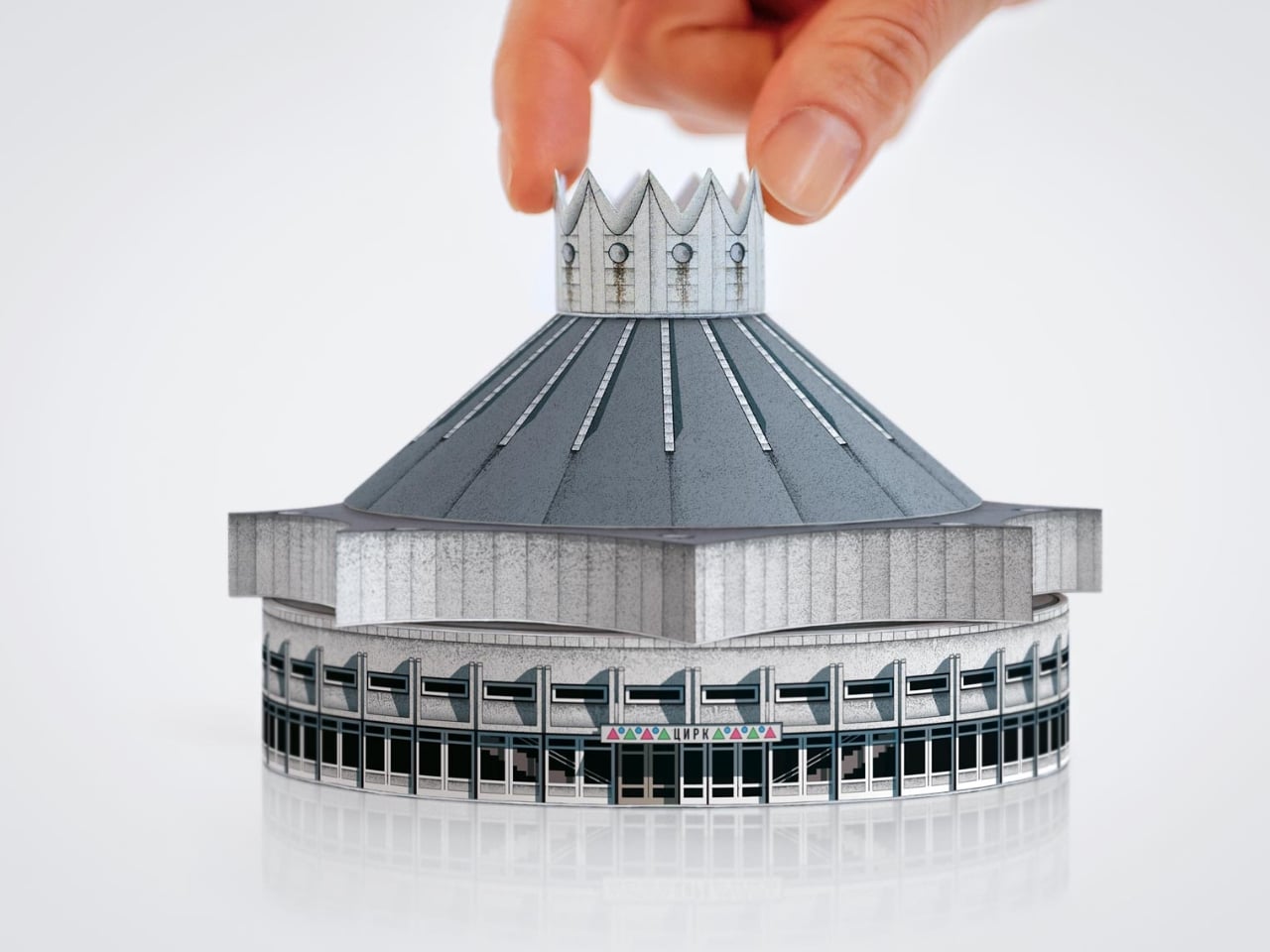
But the part of Cirk that has people talking is not the photography, gorgeous as it is. It is the second half of the book: five press-out paper models of actual circus buildings, designed for readers to punch out and assemble with nothing but glue. The five models represent the Kyrgyz State Circus in Bishkek, the Chișinău State Circus in Moldova, the Dnipro State Circus in Ukraine, the Great Moscow State Circus, and the Tashkent State Circus in Uzbekistan. Five buildings. Five cities. Five strikingly different pieces of architecture, each one reduced to a miniature you can hold in your hands.
I have a genuine soft spot for paper models, and I think their reputation as a “children’s activity” has always undersold what they actually are. A well-designed paper model is an act of translation. Someone has to study a real building, understand its geometry from every angle, figure out how to collapse it into a flat sheet, and do it in a way that holds together when you fold it back up. That is not trivial when the buildings in question are full of curves, cantilevers, and circular geometry. The circus arenas in Cirk are not simple boxes. Many have sweeping domed roofs and wide cylindrical bases, and the kind of sculptural confidence that makes them look like props from a science fiction film. Getting that geometry to behave on paper requires real design skill, and Zupagrafika clearly has it.
The studio has been producing paper model kits alongside their books for years, so this is familiar territory. But tucking five models into the back of a hardcover book feels like a deliberate choice, not an afterthought. The models are not a gimmick. They are an argument. You can look at photographs of the Great Moscow State Circus for a long time, and it will remain something abstract and distant. When you press out those perforated shapes and fold them into a miniature version of that building, something shifts. The scale changes. The building becomes tactile and personal. You start to understand its proportions in a way that a photograph simply cannot deliver.
There is also something quietly political about the whole exercise. These arenas were built as monuments to Soviet power, intended to be overwhelming and permanent. Reducing one to a paper model is almost cheeky. It takes these grand gestures of ideological architecture and makes them domestic, approachable, collectible. The Soviet state is long gone. Someone is now folding the Great Moscow State Circus on their kitchen table. History has a strange sense of humor.
Cirk is a hardcover running 88 pages, sized generously at 30 by 24 centimeters, giving the models room to breathe on the page. The first half carries photography and historical essays, with a foreword from writer Jelena Prokopljević. It is a complete package: context, visual archive, and the hands-on satisfaction of making something. For anyone drawn to architecture, Cold War history, or just the very specific pleasure of a perforated page coming apart cleanly, Cirk is a book that earns its shelf space. The flying-saucer buildings are absolutely worth it.

 Connexion