❌

Vue normale

  • ✇Korben
  • Test du Dangbei N3 Max, le projecteur au rapport qualité-prix imbattable
    - Contient des liens affiliés Amazon - Dangbei nous a envoyé il y a quelques semaines son N3 Max , un vidéoprojecteur LED Full HD affiché 499 euros au catalogue mais qu'on trouve à 399 euros sur Amazon en ce moment , et qui mise sur deux arguments assez rares à ce tarif, un pied rotatif intégré et un vrai Netflix certifié. On l'a promené quelques jours entre le salon, la chambre et la terrasse. Le boîtier de 3,6 kilos es
     

Test du Dangbei N3 Max, le projecteur au rapport qualité-prix imbattable

12 octobre 2026 à 11:15
- Contient des liens affiliés Amazon -

Dangbei nous a envoyé il y a quelques semaines son N3 Max , un vidéoprojecteur LED Full HD affiché 499 euros au catalogue mais qu'on trouve à 399 euros sur Amazon en ce moment , et qui mise sur deux arguments assez rares à ce tarif, un pied rotatif intégré et un vrai Netflix certifié. On l'a promené quelques jours entre le salon, la chambre et la terrasse.

Le boîtier de 3,6 kilos est monté d'origine sur un support qui pivote de -45 à +135 degrés, ce qui veut dire qu'on passe du mur au plafond d'un simple geste, sans trépied ni perceuse. Pour regarder un film allongé, c'est carrément agréable.

À chaque déplacement, la machine refait seule sa mise au point, corrige le trapèze, recadre l'image dans la zone libre et contourne même l'étagère qui dépasse. On pose, on attend, on regarde. Et ça fonctionne plutôt bien, même si on a eu quelques fois besoin d'ajuster un peu la mise au point avec la télécommande.

Côté image, on a du LCD Full HD en 1080p qui décode la 4K, une source LED donnée pour 1000 lumens ISO et une diagonale qui monte jusqu'à 150 pouces, même si la marque recommande elle-même de rester entre 80 et 120 pouces pour garder de la luminosité.

Dans une pièce sombre, justement, le résultat est très net, les couleurs sont agréables et on oublie vite le prix de la machine. Volets ouverts en pleine journée, l'image devient moins contrastée, les 1000 lumens ont leurs limites. Le HDR10 est bien là, mais il n'apporte pas grand-chose avec un contraste pareil. Quoi qu'il en soit, à ce niveau de prix, c'est très bon.

Le vrai truc qui fait la différence à ce prix, c'est le logiciel. Le N3 Max tourne sous VIDAA OS, le système d'exploitation des téléviseurs Hisense, avec Netflix, YouTube, Prime Video et Disney+ en versions officielles, sans la moindre clé HDMI à rajouter derrière. AirPlay est aussi de la partie pour envoyer l'écran de son iPhone. Plex fonctionne aussi parfaitement dessus, pour ceux qui ne jurent que par ça.

La télécommande embarque l'assistant vocal VIDAA Voice, qui lance une appli ou une recherche à la voix, sauf sur Netflix qui ne répond pas aux commandes vocales. Les enfants ont droit de leur côté à Kidoodle TV, avec des milliers de programmes gratuits avec contrôle du temps d'écran et heure du coucher paramétrable.

Sous le capot, une puce MediaTek MT9660 épaulée par 1 Go de mémoire et 8 Go de stockage fait tourner l'interface sans ralentissement, et la connectique aligne un port HDMI 2.0 compatible eARC pour renvoyer le son vers un ampli, deux prises USB, une sortie casque en jack 3,5 mm, du Wi-Fi 5 et du Bluetooth 5.0.

Les deux haut-parleurs de 6 watts compatibles Dolby Audio dépannent très bien pour un dessin animé ou un match de rugby (oui je regarde pas le foot, déso), avec des basses quand même un peu timides. Pour une vraie soirée cinéma, on branche une enceinte Bluetooth et tout va mieux.

Un mode jeu à faible latence permet de brancher une console en 1080p à 60 Hz, de quoi jouer tranquillement.

La télécommande n'est pas rétroéclairée, ce qui est agaçant dans une pièce plongée dans le noir, et c'est un problème récurent avec ce genre de produit hélas. Dommage.

Du coup, pour une chambre, un studio ou une toile tendue dans le jardin, le N3 Max fait très bien le job. Les cinéphiles suréquipés n'y trouveront rien, les autres peuvent y aller les yeux fermés, c'est un super rapport qualité-prix. Disponible par ici sur Amazon .
  • ✇Yanko Design
  • A Bamboo Music Center Spans Up to 49 Feet Without Columns
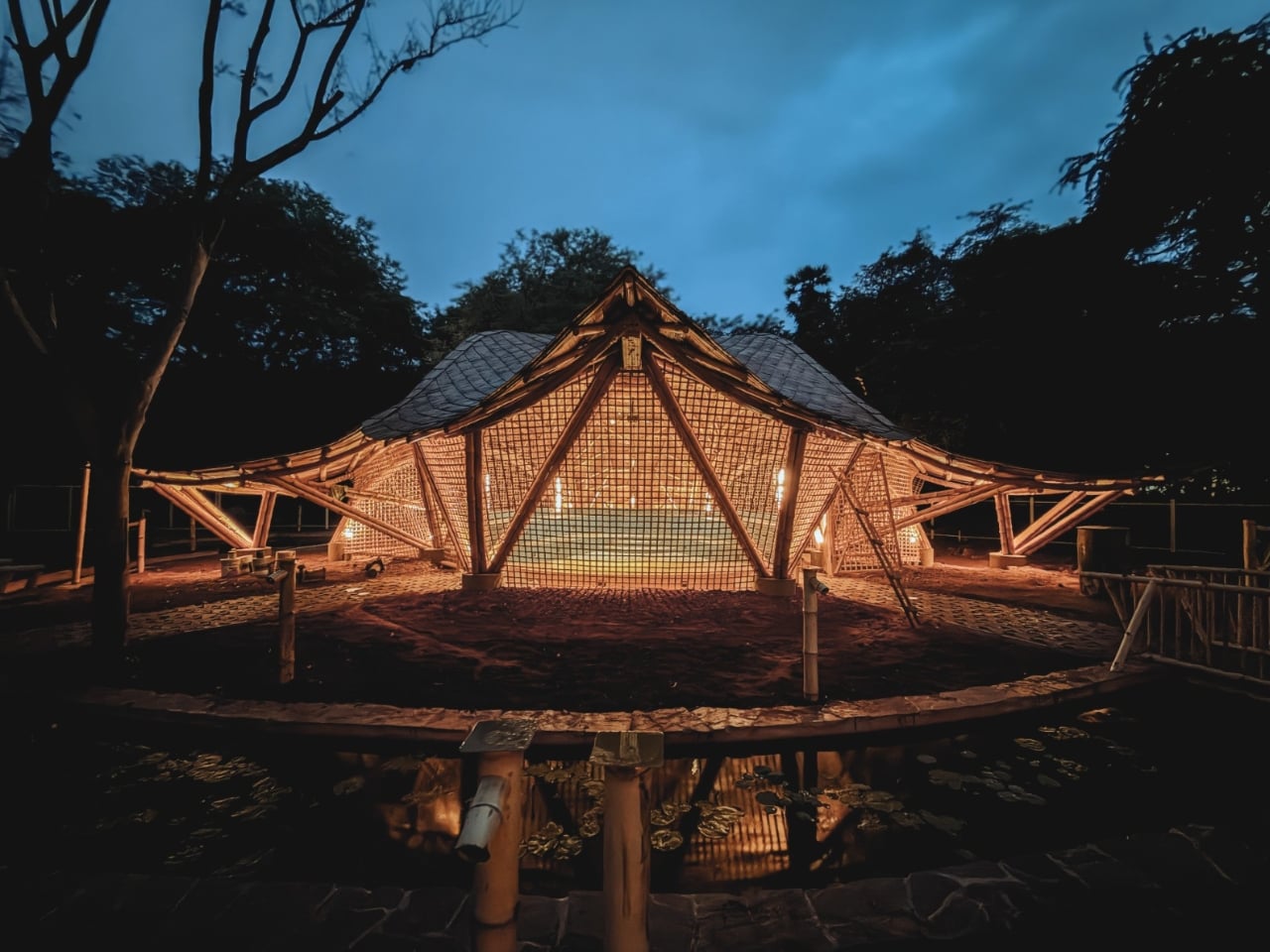
    A column in the middle of a music hall means someone has to look around it. That’s a practical problem to solve before worrying about how dramatic the ceiling looks. At the Maestro Ilaiyaraaja Centre for Music Learning and Research in Chennai, India, Ekarth Studio uses bamboo vaults to create spans of up to 49 feet without interior columns. The structure makes room for people to gather, while giving them a roof worth looking up at. The completed, 10,000-square-foot center at IIT Madras addresse
     

A Bamboo Music Center Spans Up to 49 Feet Without Columns

12 octobre 2026 à 10:20

A column in the middle of a music hall means someone has to look around it. That’s a practical problem to solve before worrying about how dramatic the ceiling looks. At the Maestro Ilaiyaraaja Centre for Music Learning and Research in Chennai, India, Ekarth Studio uses bamboo vaults to create spans of up to 49 feet without interior columns. The structure makes room for people to gather, while giving them a roof worth looking up at.

The completed, 10,000-square-foot center at IIT Madras addresses another challenge: bringing music education, research, rehearsal, and recording into one setting. Named for composer Ilaiyaraaja, it belongs to the university’s “Music for All” initiative, whose research interests include acoustics, artificial intelligence, sound synthesis, and instrument design. That’s an unusually broad assignment for a music building. It needs places for focused work, but also room for different disciplines to meet without every encounter becoming a scheduled appointment.

Designer: Ekarth Studio

The roofs give those activities a recognizable home. Ekarth Studio drew their geometry from Bel Patra, the three-part leaf associated with Lord Shiva. Interconnected vaults translate that reference into canopies that rise, dip, and extend over the spaces below. I like that the inspiration has a specific cultural origin. A music center with a curving roof could easily attract a vague explanation about sound waves, but this one has a more deliberate starting point.

Those curves also involve some serious assembly. The studio describes a structural system combining round bamboo culms, bundled splits, and bundled sticks. Flat bamboo splits are gathered together to form the primary spine beams, rather than relying on a single solid member. Arches reach nearly 30 feet high. The useful distinction is that bamboo carries the roof and establishes its shape. Calling it a decorative finish would miss the most interesting decision in the project.

Leaving that construction exposed gives the interiors their character. Ekarth’s material palette includes treated bamboo, lime-based finishes, earthen surfaces, natural-fiber roofing, and handcrafted bamboo weaving. The studio also leaves the bamboo’s connections visible. I’m drawn to buildings that let you follow how they were assembled. Here, the repetition of individual pieces gives the large roof forms a finer scale, so the architecture offers more to examine than its outline from a distance.

The exterior photographs show roof edges sweeping outward above bamboo lattice screens, with trees close to the pavilions. The small, regular openings in those screens contrast with the broad curves overhead. They make the enclosure look less abrupt than a blank wall would. Ekarth’s plan connects classrooms and other spaces with courtyards and shaded outdoor areas, giving the center an architectural relationship with its surroundings that goes beyond putting landscaping around a finished building.

The people who assembled it deserve attention, too. According to the studio’s account, artisans split, bent, bundled, and joined the bamboo primarily with basic carpentry tools, while structural engineering adapted those processes for an institutional building. Ekarth reports an 11-month construction period with limited use of heavy machinery. That timeline is noteworthy, but I’d give equal billing to the craft. Its contribution remains legible in the finished architecture rather than disappearing behind another surface.

A beautiful bamboo structure doesn’t, by itself, establish how well a recording room isolates sound or how comfortable the building stays throughout the year. Those are separate performance questions, and the published project descriptions don’t provide measurements that settle them. The same restraint applies to sustainability. Natural materials and a less machinery-intensive construction process are choices worth discussing, but they aren’t enough to calculate the building’s environmental footprint or long-term maintenance demands.

Even with those questions open, the design gives me a clear reason to pay attention. The central amphitheater-like gathering space puts rehearsal, performance, and collective learning beneath the same expressive structure. That feels like an appropriate investment for a music center: a memorable room whose defining gesture also keeps its floor open. The ceiling earns its visual complexity by leaving more usable space underneath, where the people and the music belong.

The post A Bamboo Music Center Spans Up to 49 Feet Without Columns first appeared on Yanko Design.

TIOBE Index for October 2026: Python Rises as Julia Rejoins the Top 20

12 octobre 2026 à 13:43

October 2026 TIOBE Index sees Python rebound, Java narrow the gap with C++, R pass SQL, Rust hold No. 10, and Julia return to the top 20 after three years.

The post TIOBE Index for October 2026: Python Rises as Julia Rejoins the Top 20 appeared first on TechRepublic.

Indonesia’s 640MW AI Campus Faces Water Supply Review After Construction Halt

12 octobre 2026 à 07:26

Indonesia is reviewing water requirements for BDx's 640MW AI campus in West Java after construction was halted over missing environmental and building approvals.

The post Indonesia’s 640MW AI Campus Faces Water Supply Review After Construction Halt appeared first on TechRepublic.

❌