❌

Vue lecture

Sunseeker Elite’s mower has LiDAR, vision, and a serious beef with leftover grass strips

They say AI will steal our jobs. Whoever trims that stubborn strip of grass along the lawn’s edge seems to have excellent job security. We’ve got robots driving around gardens, mapping their surroundings, and keeping the grass neatly cut, yet the border still has a habit of becoming someone’s weekend assignment. Personally, that’s a job I’d be delighted to hand over.

Sunseeker’s upcoming X8 Plus looks eager to apply. Its EdgeZero™ 2.0 trimming system targets a zero-inch edge gap, according to the company, putting that leftover strip squarely on the agenda. Set for a preview at Equip Expo 2026, the robotic mower also brings solid-state LiDAR, stereo vision, and network-assisted satellite positioning. An impressive résumé, although the edge-cutting hardware is what makes me want to schedule the interview.

Designer: Sunseeker Elite Team

Click Here to Know More: Equip Expo 2026.

The Last Few Inches Are a Hardware Problem
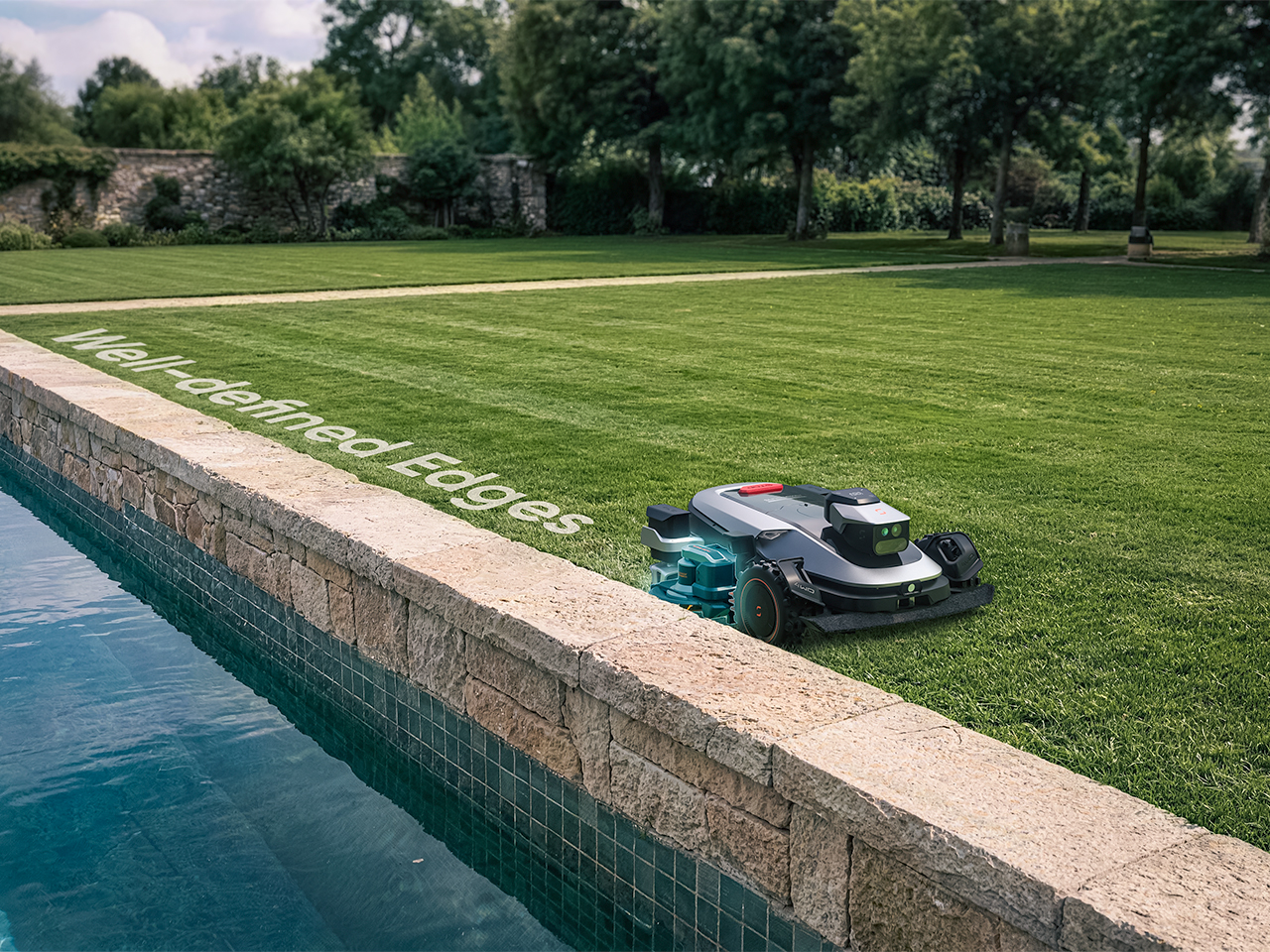
A mower can follow a boundary accurately and still leave grass behind if its blades cannot reach it. Knowing where the border is and cutting right up to it are separate assignments. Sunseeker describes EdgeZero™ 2.0 as its answer to the second one, though the announcement leaves the mechanism’s finer details unexplained. That’s the part I’d want a closer look at: how the trimming tool reaches the border while the mower’s body stays clear. A clean pass beside a raised edge would tell a useful story.

Getting into position is its own engineering task. The X8 Plus uses nRTK, a form of satellite positioning that draws correction data from a network of reference stations. In plain English, those corrections help tighten up the machine’s estimate of where it is. Sunseeker combines that positioning with solid-state LiDAR and stereo vision, giving the mower several sources of information as it navigates. Your garden may look peaceful from the patio; the robot has quite a bit to figure out down there.

Sharing the Lawn With the Locals
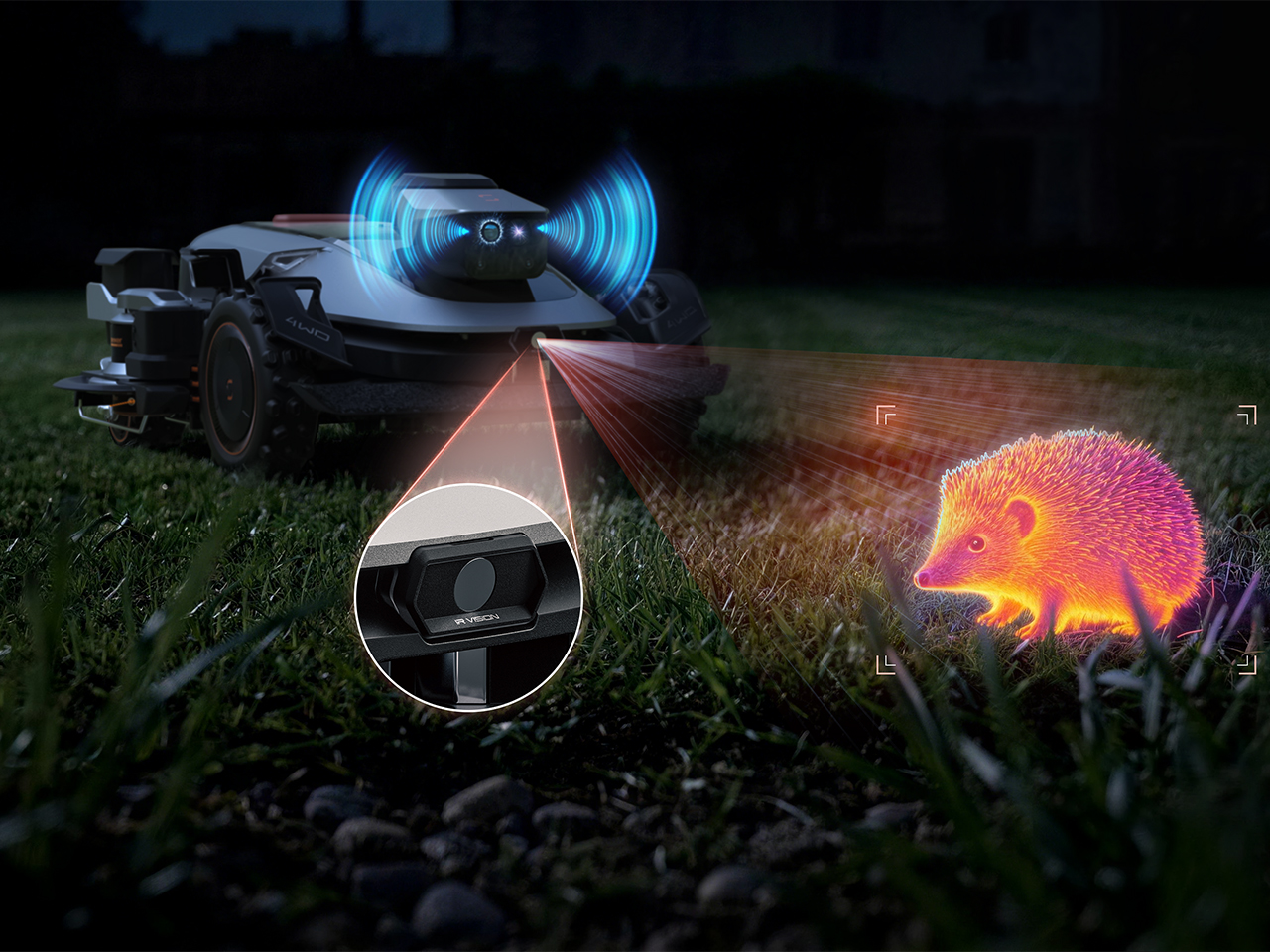
There’s an infrared camera in the mix, too, which Sunseeker says supports animal-friendly operation. That’s a worthwhile consideration for a machine sharing outdoor space with creatures that have never checked its mowing schedule. The announcement doesn’t establish exactly how the system identifies or responds to different animals, so I’d keep the promise modest for now. Still, accounting for the lawn’s other residents belongs in the design brief. The grass might stay put, but everything passing through it gets a vote in how smoothly an autonomous mower’s afternoon goes.

Sunseeker Elite already explores that relationship between sensing and physical movement in its existing X7 Gen 2 and X7 Plus Gen 2. Those models combine satellite positioning with visual mapping, while all-wheel drive and floating dual cutting discs address traction and uneven ground. That provides useful context for the X8 Plus: software has to work with wheels, blades, and the shape of the property. I like that the new preview brings attention back to the finishing work. A mower’s route can look beautifully organized on an app, but the result still gets judged from the garden chair.

A Closer Look at Equip Expo 2026

Equip Expo should provide a closer look at Sunseeker’s approach. The show runs October 20-23, 2026, at the Kentucky Exposition Center in Louisville, Kentucky, with Sunseeker at Indoor Booth #1190 and Outdoor Booth #7460D. The company plans an interactive mower-vision experience, letting visitors see imagery from a machine’s perspective, alongside outdoor slope demonstrations. Seeing what a mower perceives could make that long sensor list considerably easier to understand.

Pricing and retail availability for the X8 Plus aren’t specified in the announcement, so the zero-inch edge target remains a reason to watch its development rather than retire the trimmer immediately. For me, though, it’s a persuasive direction to pursue. Finishing the borders would remove a very specific reason for a person to follow the robot outside and pick up another tool. If Sunseeker can make that work reliably, I’m perfectly comfortable with this particular job disappearing. The person who used to do it can have Saturday morning back.

Click Here to Know More: Equip Expo 2026.

The post Sunseeker Elite’s mower has LiDAR, vision, and a serious beef with leftover grass strips first appeared on Yanko Design.


  •  

Hangzhou’s glowing glass museum takes its cues from 5,000-year-old jade

Most museums are designed like very expensive shoeboxes. Art hates sunlight, so architects seal the walls, bolt on some skylights, and call it a day. Aedas went the other direction in Hangzhou and wrapped an entire museum in glass, then twisted it into two interlocking rings for good measure. The Yohoo Museum sits on an island in an artificial lake, glowing like a piece of polished jade, which is exactly the point. The shape is borrowed from the ritual jade rings of the Liangzhu culture, a Neolithic civilization that thrived in this part of China around 5,000 years ago.

Ken Wai, Global Design Principal at Aedas, led the design of the 57,650-square-foot (5,356-square-meter) building, completed in 2024 inside Liangzhu Yohoo Park (that’s Yohoo, not Yahoo the search engine. I know, I made that mistake too). The glass is a translucent multilayer laminate Aedas calls “emerald glass,” and it filters daylight into a soft, even wash across the galleries. A steel frame lets the ends of the rings lift off the ground with no visible support, creating covered plazas underneath. The project won Architectural Design of the Year and a Gold in the Cultural category at the International Design Awards, a juried global competition for built work.

Designers: Aedas, Ken Wai

Liangzhu jade comes in two signature shapes, the bi and the cong. The bi is a flat disc with a hole in the center, while the cong is a chunky tube that’s square outside and round inside. Later Chinese tradition read the bi as heaven and the cong as earth, and archaeologists say both starred in royal ceremonies honoring the sky. Each of the museum’s rings wraps around an open void, and Aedas frames these circular light wells as a link between heaven and earth. From above, the voids read like the drilled centers of two bi discs, and the squared-off island underneath does a decent cong impression if you squint.

Aedas says the two interlocking rings stand for two separate heritages, Liangzhu culture and the Grand Canal. The lake around the island connects to that canal, a roughly 1,100-mile (1,776-kilometer) waterway whose oldest sections date back more than 2,500 years. Hangzhou sits at its southern end, and the canal is largely what turned the city from a sleepy town into a booming trade hub. UNESCO listed the canal in 2014 and the Liangzhu ruins in 2019, so the building is basically two World Heritage sites holding hands. That’s a lot of symbolism for one roofline, but the form carries it so gracefully that I’m happy to play along.

A single steel frame carries the whole building, and Aedas used it to peel both ends up off the ground like the corner of a sticker. Those lifted edges overhang the entrances and shelter a pair of public plazas, which in the photos are getting plenty of use. One shot shows a school group picnicking under the curved soffit while two kids sprint past the camera, presumably fleeing a teacher. The underside is wrapped in smooth white panels, and beneath it a diamond grid of glass slopes down to meet the pavement. The result is a shaded waterfront room open to anyone, whether or not they ever step inside the galleries.

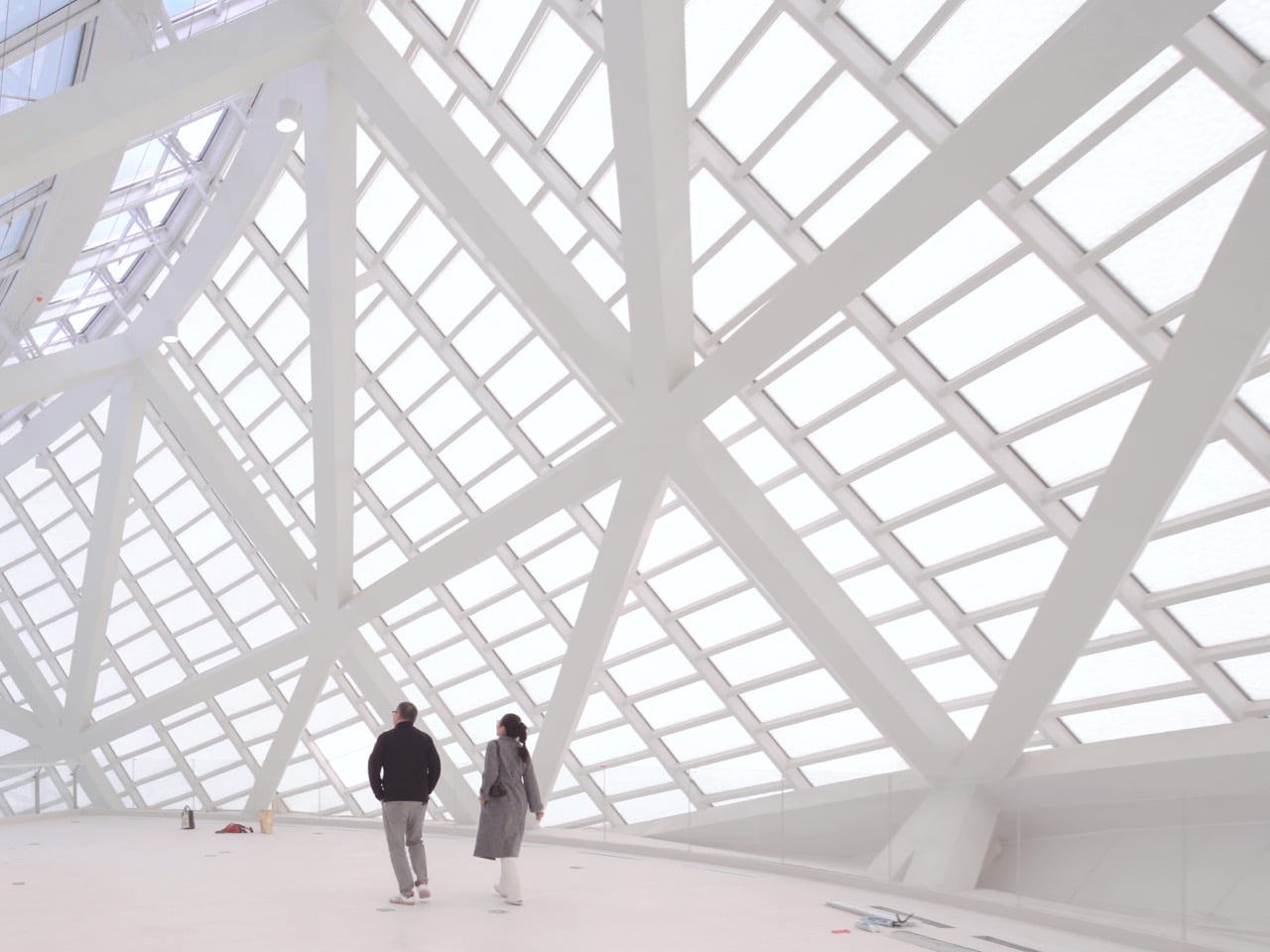
Up top, the galleries sit under a dense white steel diagrid, with translucent glass filling every gap in the structure. Interior photos show a bright, nearly shadowless hall where two visitors look like they’ve wandered into a cloud. The entrance volume uses greener, more jade-toned glass in horizontal bands, so the building’s color shifts depending on which face you’re looking at. American readers might recognize the strategy from Steven Holl’s Bloch Building at the Nelson-Atkins Museum in Kansas City, where translucent channel-glass volumes glow like lanterns. Aedas stretches the idea across a twisting, double-curved envelope, and the firm says parametric modeling kept that geometry efficient to build.

A white boardwalk zigzags across the lake to the museum, swelling into circular viewing pods that repeat the ring motif at walking scale. It’s a slow, wiggly approach, and it hands visitors plenty of different angles on the building before they arrive. A broader bridge links the island to the main park on the other side, where curving paths and a petal-shaped flower garden keep the theme going. Aerial shots also show the less poetic context, with apartment towers and older industrial blocks crowding the shoreline. That backdrop works in the museum’s favor, because a glowing glass knot reads even louder next to rows of identical high-rises.

Yuhang already has one famous lake-bound jade museum. David Chipperfield’s Liangzhu Museum opened in 2008 as four travertine bars set on a lake, linked to the park by bridges, with an exhibition island off to the south. Tadao Ando added a concrete cultural center nearby in 2016. Both architects treated Liangzhu’s heritage as something heavy and permanent, which makes sense for artifacts that spent 5,000 years underground. Aedas kept the same lake, island, and bridge recipe and swapped the stone for light. I keep wondering which version the original jade carvers would prefer, since their whole craft was coaxing a soft glow out of solid stone.


The post Hangzhou’s glowing glass museum takes its cues from 5,000-year-old jade first appeared on Yanko Design.
  •  

These Blink-powered Smart Glasses Could Change Wearables Forever

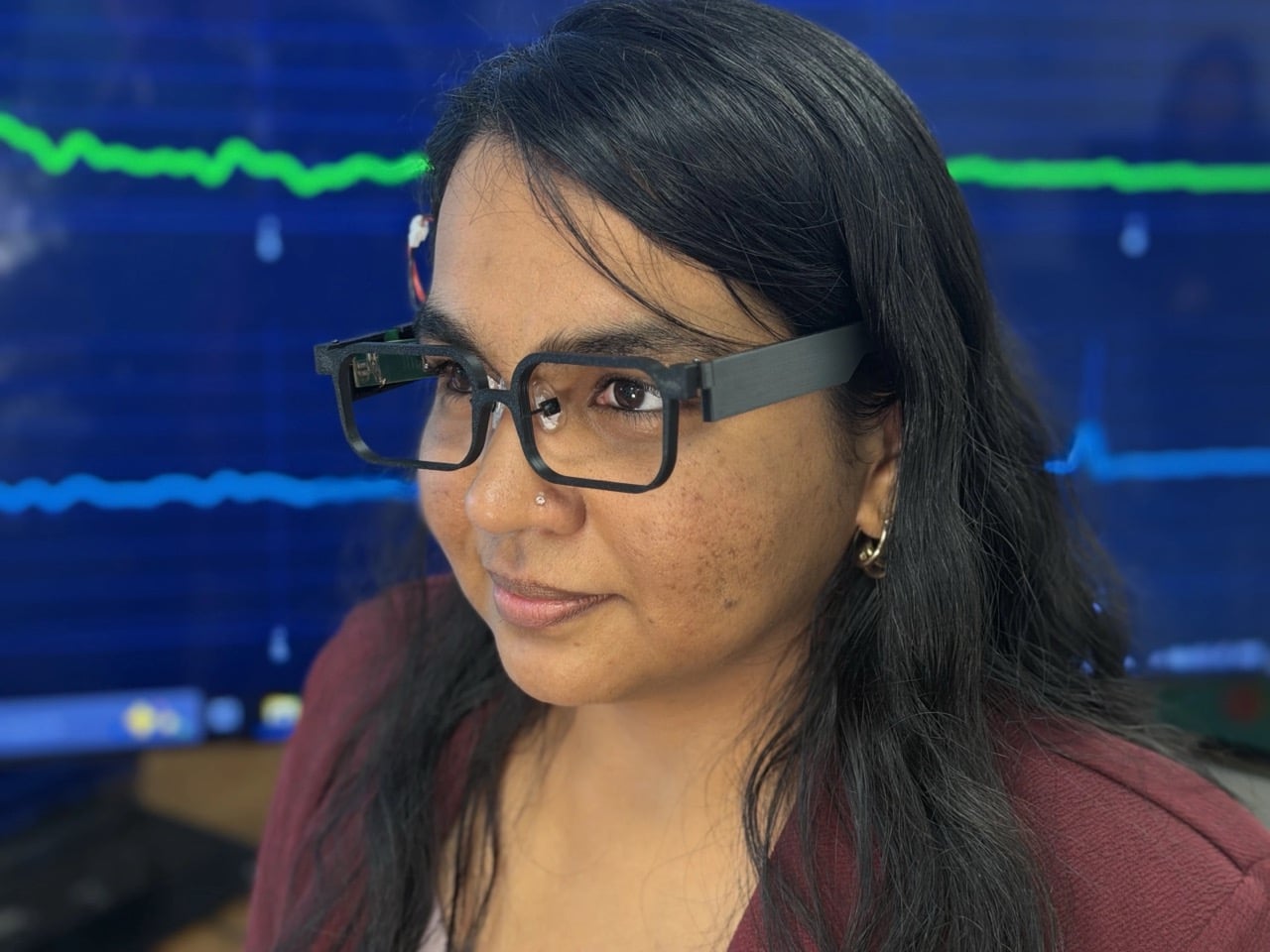
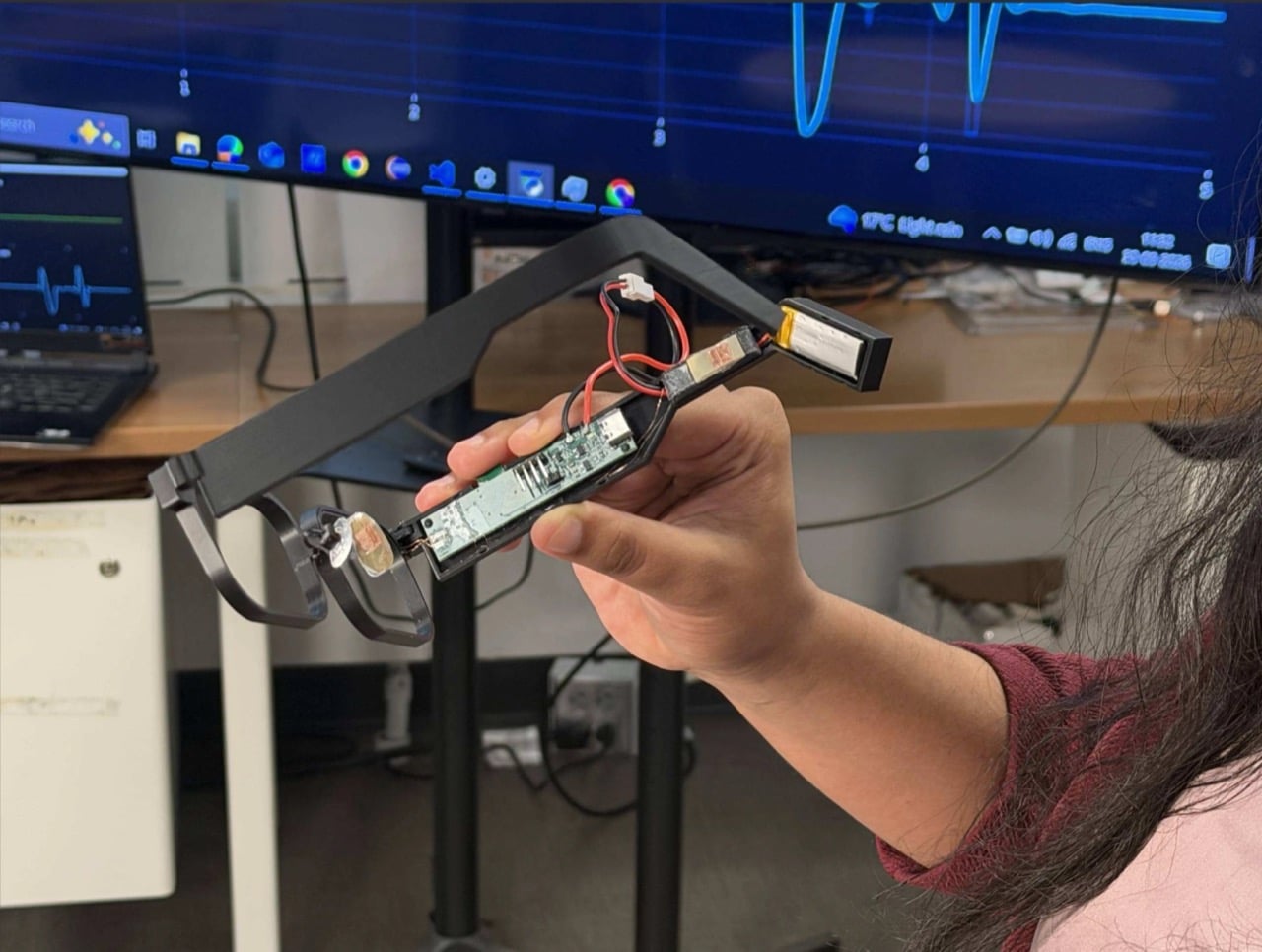
Your face is a power plant, and you’ve been running it for free your whole life. Every blink and jaw clench releases a tiny burst of mechanical energy that simply vanishes. A team at Northwestern University figured out how to catch it, using static electricity, the same stuff that makes a balloon stick to your hair. Their prototype glasses, GlassTENG, use that energy to run sensors tracking your pulse, blinks, and teeth clenching. As a feat of energy harvesting it’s fantastic, and I’d love to see it in everything from earbuds to shoe insoles.

Then the other shoe drops, because smart glasses are already the most side-eyed gadget around, with Meta’s Ray-Bans filming strangers in coffee shops and a battery that needs its case after a few hours serving as the only real limit. GlassTENG’s three sensors, built by Nivedita Arora’s VAK Embodied Systems Lab, draw just 4.1 microwatts combined, and the team wants to go fully battery-free next. That would remove the last speed bump on always-on face computers. Your pulse and jaw clenches are deeply personal data, and glasses like these could log them around the clock. Then again, if such glasses are coming anyway, I’d much rather they ran on blinks than on lithium-ion cells strapped to my head.

Designers: Nivedita Arora, Raj Dave, Jovanis Prodanich & Yung-ching Lai (Northwestern University)

A Silicone Sandwich That Turns Blinks Into Voltage

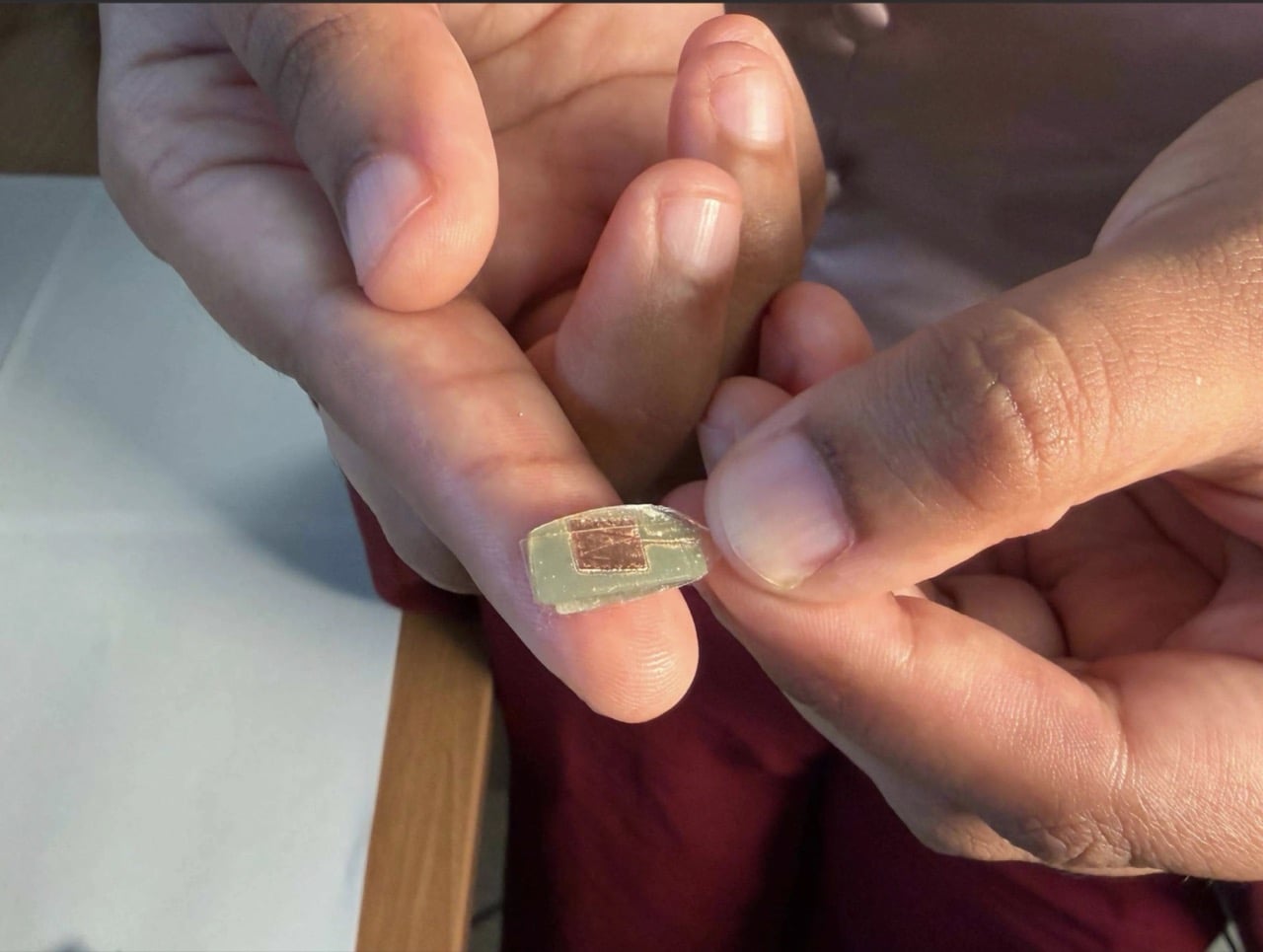
The sensor is a two-layer sandwich of PDMS, a soft silicone, and FEP, a slick fluoropolymer from the Teflon family. When the layers press together and spring apart, one hogs electrons from the other, which is the balloon-and-hair trick in a lab coat. Silver electrodes, each 150 nanometers thick, collect the resulting voltage. Pulse is the faintest signal, around 50 to 100 millivolts, while blinks and eyebrow raises land at 200 to 500 millivolts. A hard jaw clench climbs to about 1.5 volts, which is a wide enough range for one thin stack to tell a heartbeat from a chomp.

The silicone is Sylgard 184, mixed 10 to 1, degassed, spin-coated to roughly 490 microns (about 0.02 inches), and left to cure overnight. The FEP gets blasted with oxygen plasma on both sides, which roughens the surface so more of it touches the silicone. The team started by etching one side, then found that doing both measurably boosted the signal. Bare silicone faces your skin while the charge-trading interface stays sealed inside, so skin oils can’t muck up the readings. It’s baking show energy, just with a vacuum chamber instead of an oven.

Three Sensors, Three Spots, and Your Head Doing the Clamping

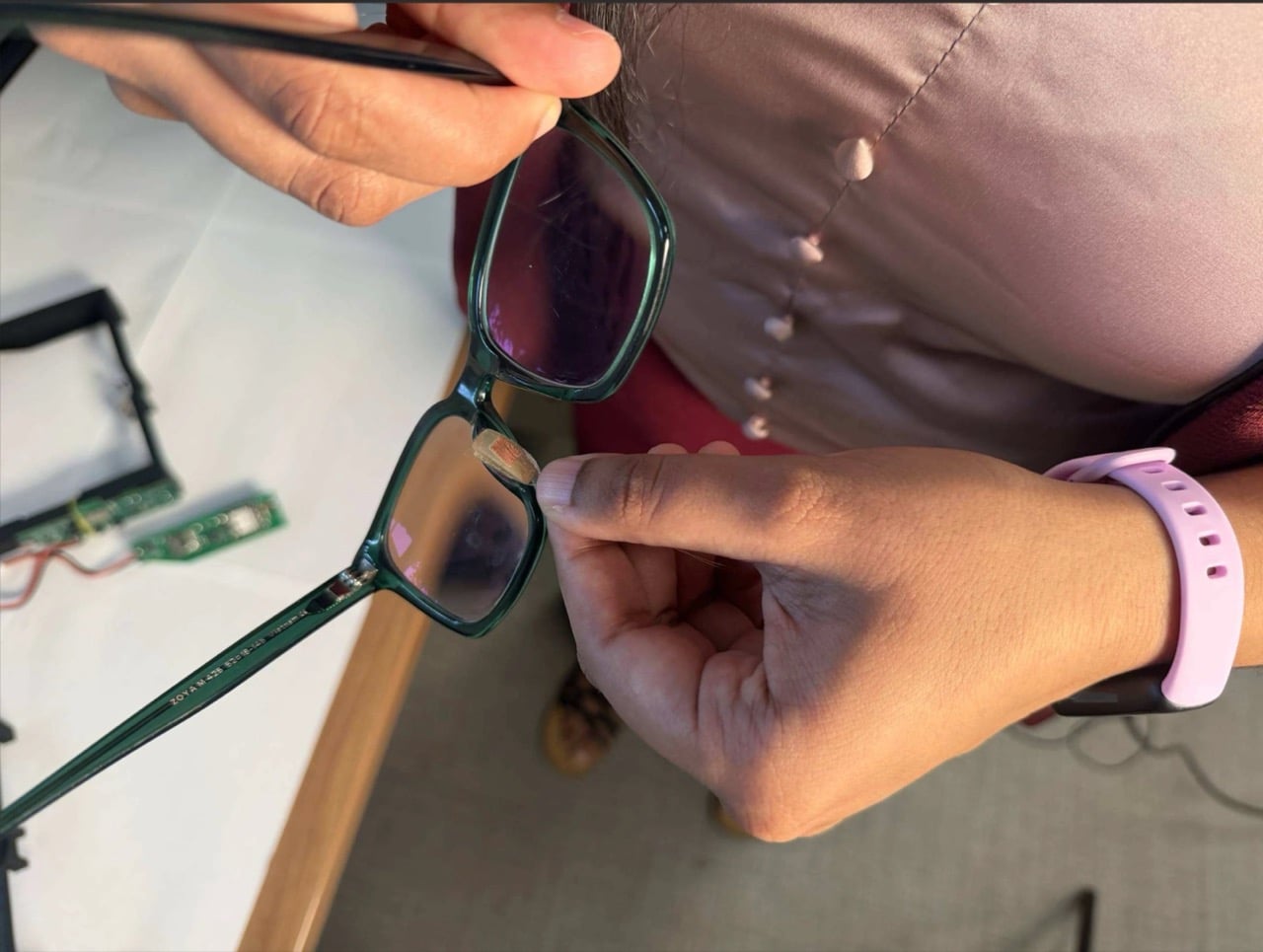
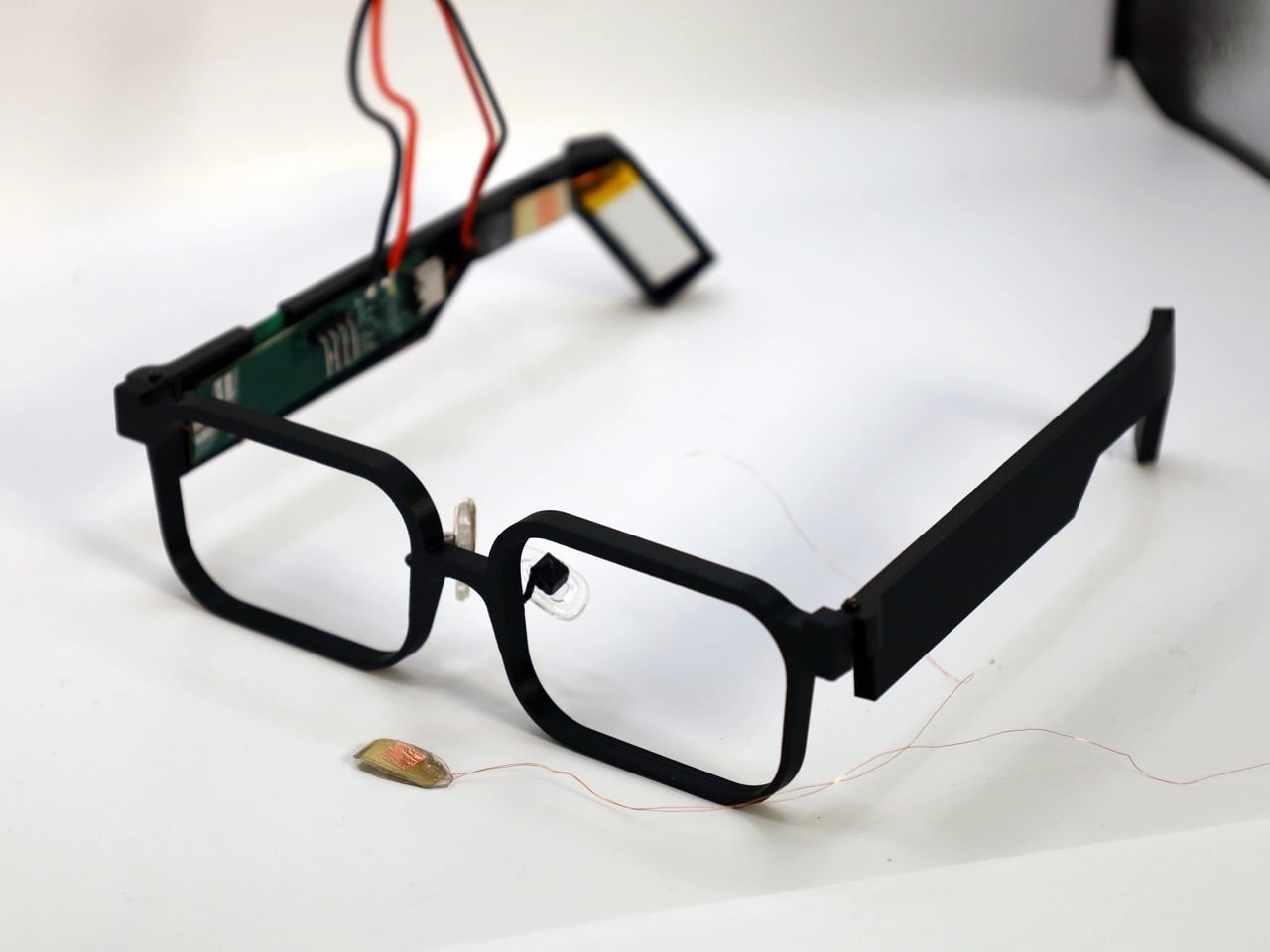
One sensor sits on the nose bridge over the angular artery, where it reads pulse, forceful blinks, and eyebrow raises. A second hangs off a small arm near the temple, aimed at the superficial temporal artery to catch clenching, tapping, and chewing. The third is embedded in the temple arm above the ear, and here the design gets clever, because the natural clamp of the frame on your head supplies the contact pressure for free. Early 3D-printed nose pads gave patchy contact, so the team swapped in adjustable off-the-shelf pads from regular eyewear. Decades of optician ergonomics beat the custom part, which is a humbling result for any designer.

In a study with 20 people, half of them daily glasses wearers, a Random Forest classifier (a machine-learning model that takes votes from many decision trees) sorted six activities with 93.8% accuracy. Forceful blinks and teeth tapping both hit 99%. Heart rate landed within 1.82 beats per minute of a Polar H10 chest strap, measured on 10 seated volunteers at rest. Talking was the weak spot at 55%, and the system mistook it for eating 37% of the time, since both work the same jaw muscle. For now, your glasses might assume you’re mid-sandwich when you’re just mid-rant, and honestly, I know people like that.

4.1 Microwatts: The Number Every Battery Spec Should Fear

Those 4.1 microwatts cover the sensing front-end, the circuitry that cleans up the sensor signal, and they look tiny next to the alternatives. The paper pegs optical pulse sensors (the glowing green lights on your smartwatch) at 1 to 10 milliwatts, and gel-based muscle sensors at 10 to 160 milliwatts. On a 100 mAh battery, the authors calculate that the GlassTENG front-end would cost less than half a minute of runtime, where an optical sensor would burn through hours. The prototype still uses a small battery for its microcontroller and Bluetooth, and fully battery-free operation is listed as future work. Even so, shrinking the sensing bill to almost nothing is what lets a frame stay a frame.

Ray-Ban Meta Gen 3 starts at $449 and rates nine hours per charge, while the Meta Ray-Ban Display runs $799, and that charging case remains the main limit on how long those glasses can watch the world. GlassTENG has no price or release date, so nobody is buying it this holiday season. I’d happily see self-powered sensing in earbuds, insoles, and medical patches. Glasses are the tricky one, because the cleverer the sensor gets, the fewer excuses a company has to leave it off. Still, if face computers are coming regardless, I’ll take the pair powered by my own twitchy eyelids over the one with a lithium cell parked next to my temple.

The post These Blink-powered Smart Glasses Could Change Wearables Forever first appeared on Yanko Design.
  •  
❌