Vue lecture

Il y a de nouveaux articles disponibles, cliquez pour rafraîchir la page.

2025 Lexus IS 500 F SPORT Performance Review: Designing Space for a V8 in an Electrified World
PROS:


  • Linear V8 response - Naturally aspirated powertrain delivers tactile throttle connection

  • Rear wheel drive architecture - Traditional chassis balance in an AWD-dominated segment

  • Cohesive visual identity - Flare Yellow package unifies exterior and interior design

  • Mechanical limited slip - Torsen differential enhances predictable corner exits

  • Daily performance tuning - Comfort-biased chassis suits real-world use

CONS:


  • Dated infotainment - Interface feels a generation behind modern rivals

  • Fuel economy penalty - Significant consumption costs for daily driving

RATINGS:

AESTHETICS
ERGONOMICS
PERFORMANCE
SUSTAINABILITY / REPAIRABILITY
VALUE FOR MONEY

EDITOR'S QUOTE:

An unapologetic design preserves mechanical joy while others chase efficiency.

Flare Yellow bodywork catches parking garage fluorescents like a warning flare. Quad exhaust tips broadcast displacement before you turn the key. The 2025 Lexus IS 500 F SPORT Performance Premium arrives unapologetic while most luxury sedans in 2025 spend their energy explaining away downsized engines and turbocharger compromises. In a market segment that has largely abandoned both of those choices, this combination reads less like a product strategy and more like a design philosophy made physical. The sedan occupies a strange position: compact luxury dimensions wrapped around powertrain architecture that most competitors retired years ago. That tension between contemporary shell and analog holdout defines every interaction with the car, from the first ignition cycle to the hundredth highway merge.
Designer: Lexus

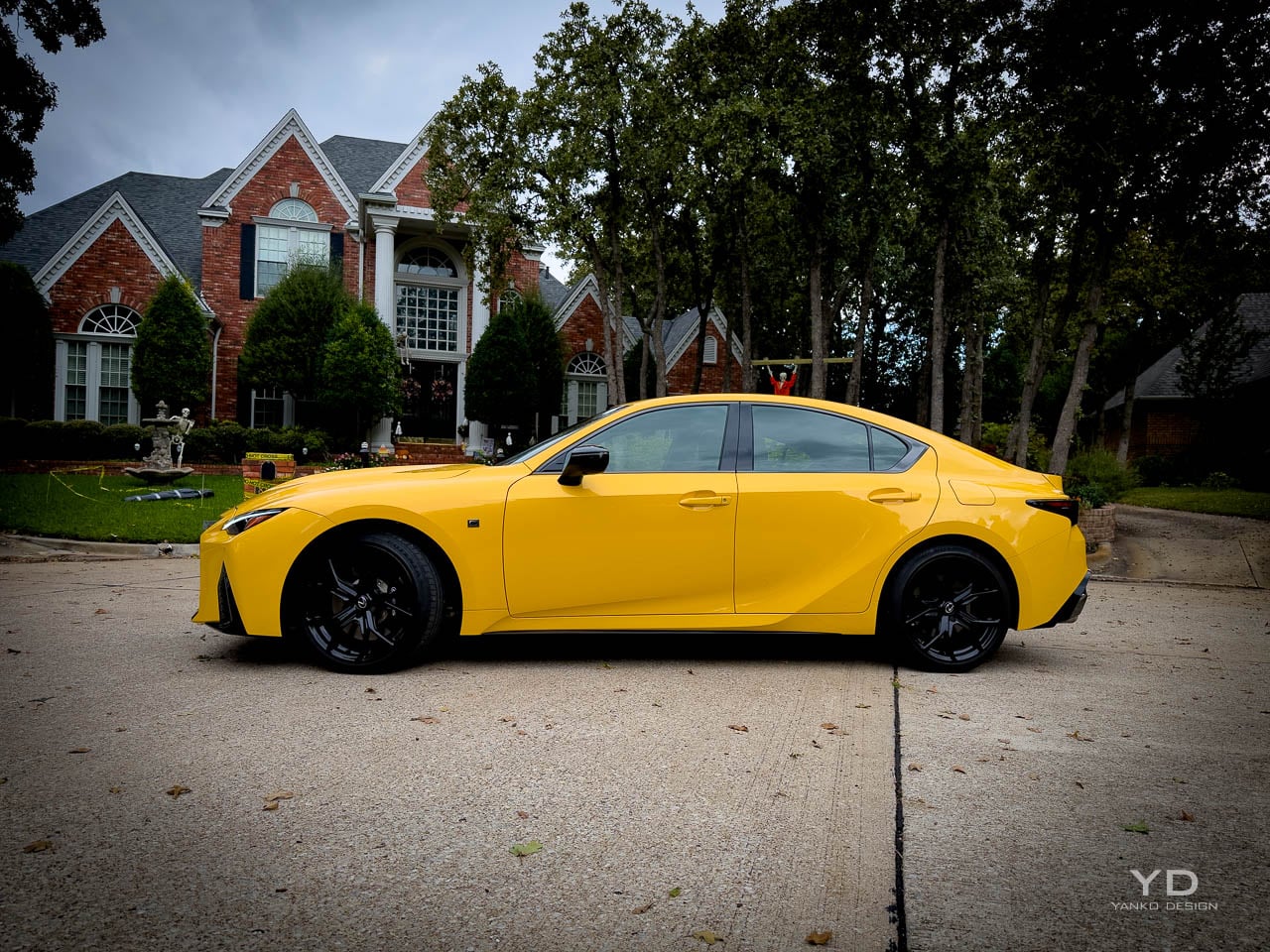
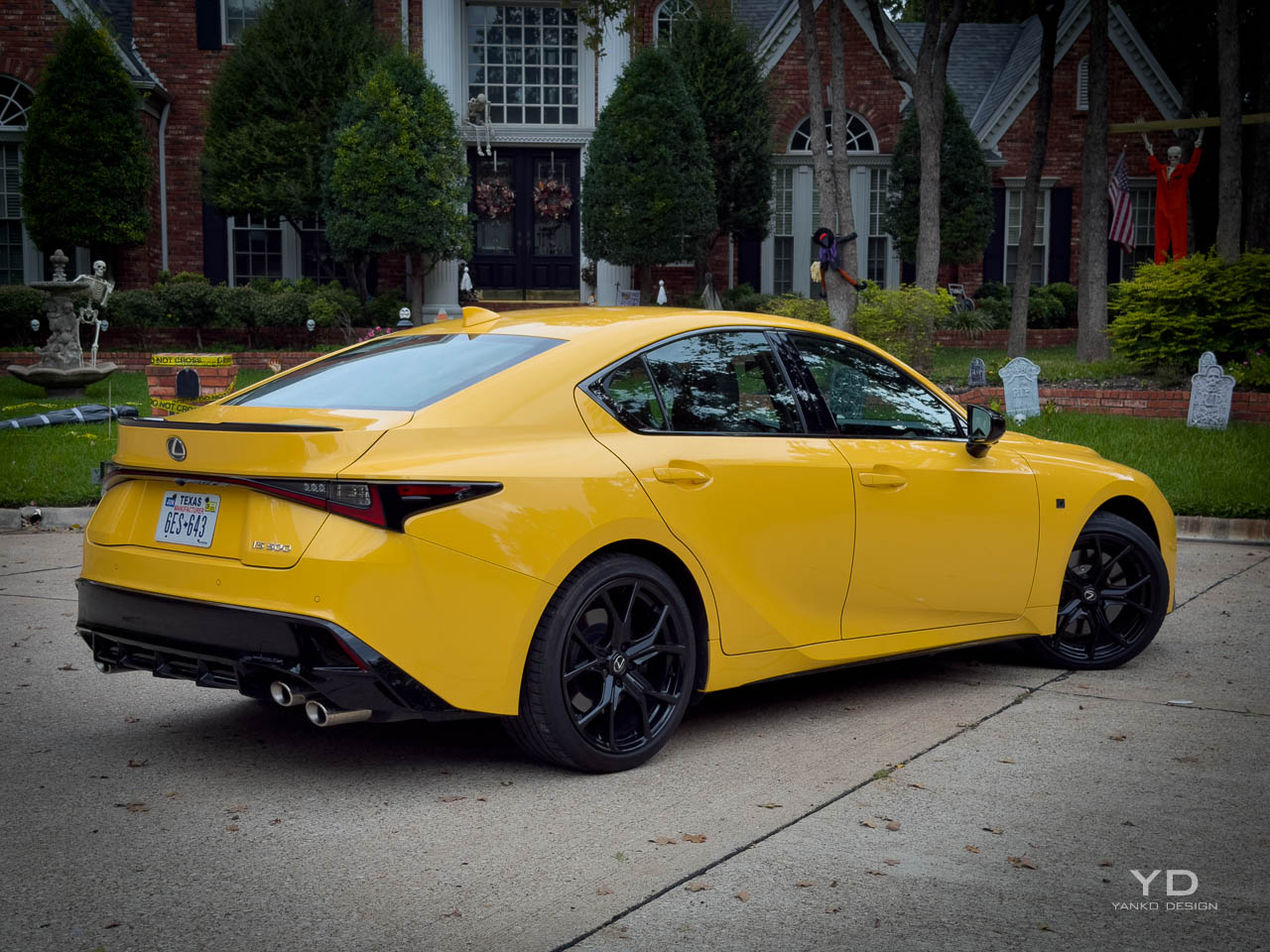
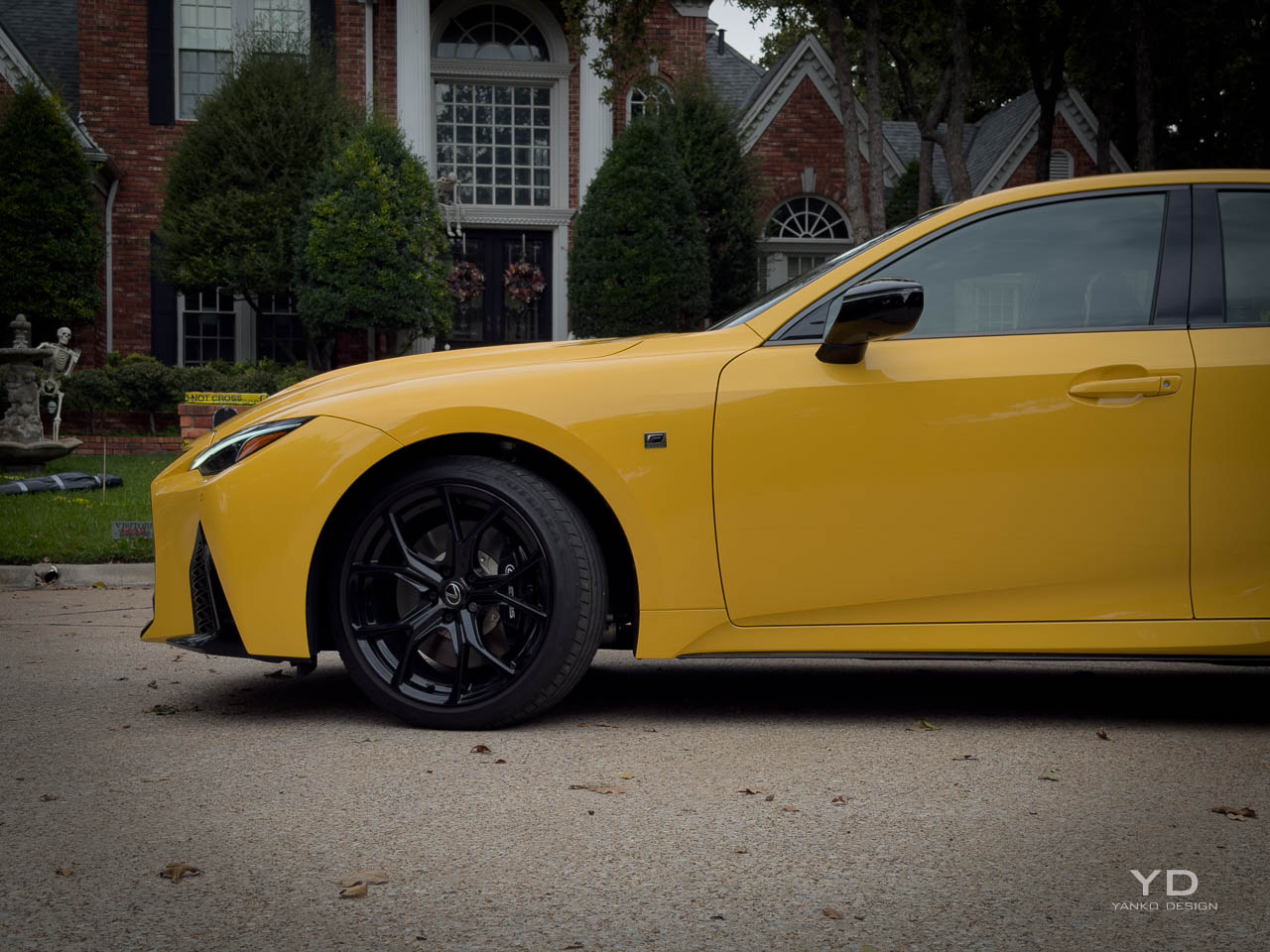
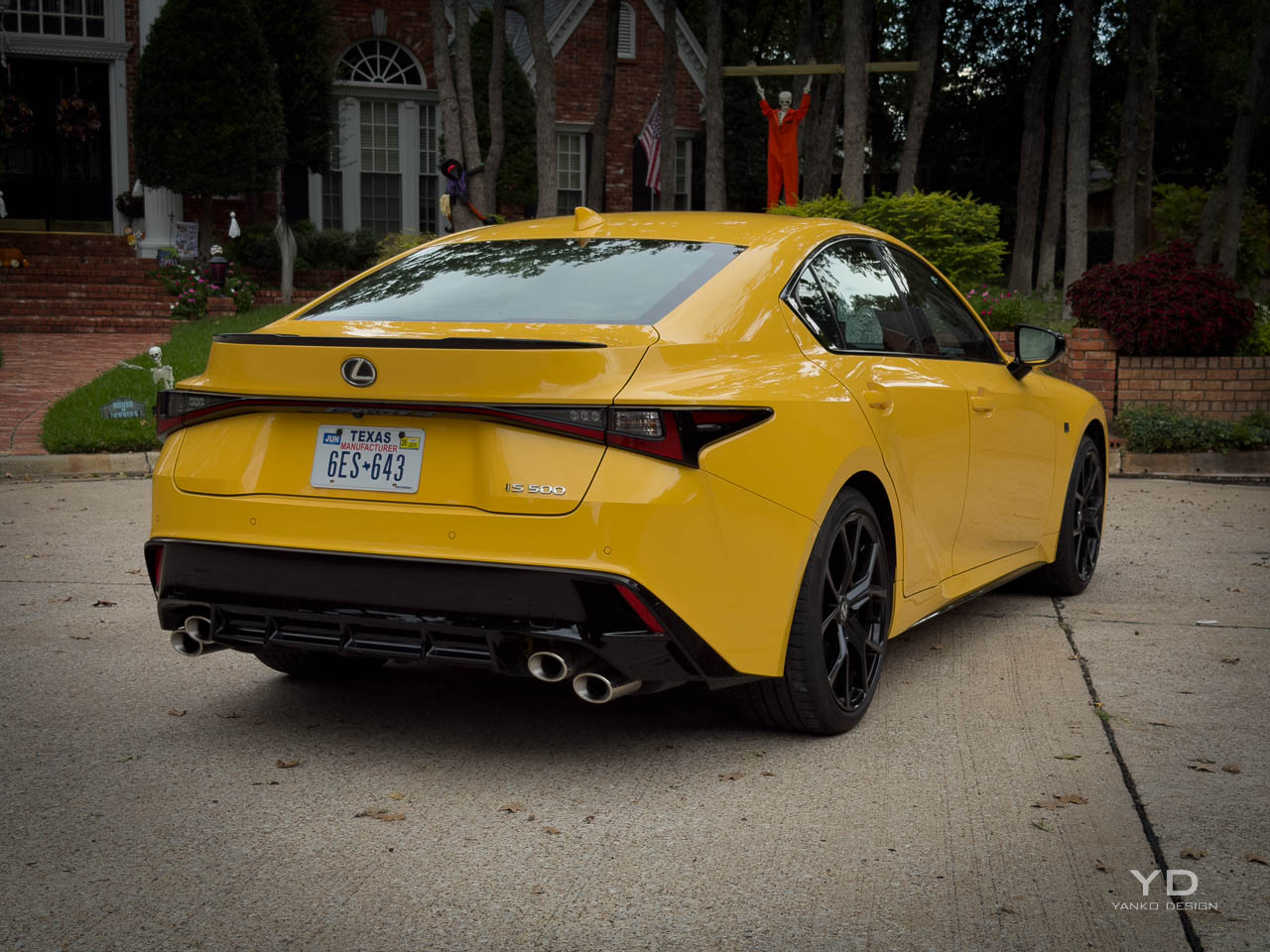
Flare Yellow is not simply a paint option here. Lexus positions it as a complete appearance system, bundling 19 inch black forged alloy wheels, Ultrasuede interior inserts with yellow stitching, matching seatbelts, illuminated door sills, and coordinated floor mats. The color becomes a unifying thread that connects exterior surfacing to cabin touchpoints, transforming what could be a single aesthetic choice into an integrated material language. At $4,050 for the package, the investment purchases coherence rather than mere visibility.

Exterior Form Language

Aggression arrives through geometry rather than applied decoration. The spindle grille dominates the frontal view, its lattice pattern creating depth and shadow that shifts with viewing angle and ambient light. Triple beam LED headlamps flank the grille, their layered optical elements suggesting technical complexity even at rest. The overall stance sits low and wide, with wheel arches that fill their openings without the exaggerated flaring that characterizes some performance variants.
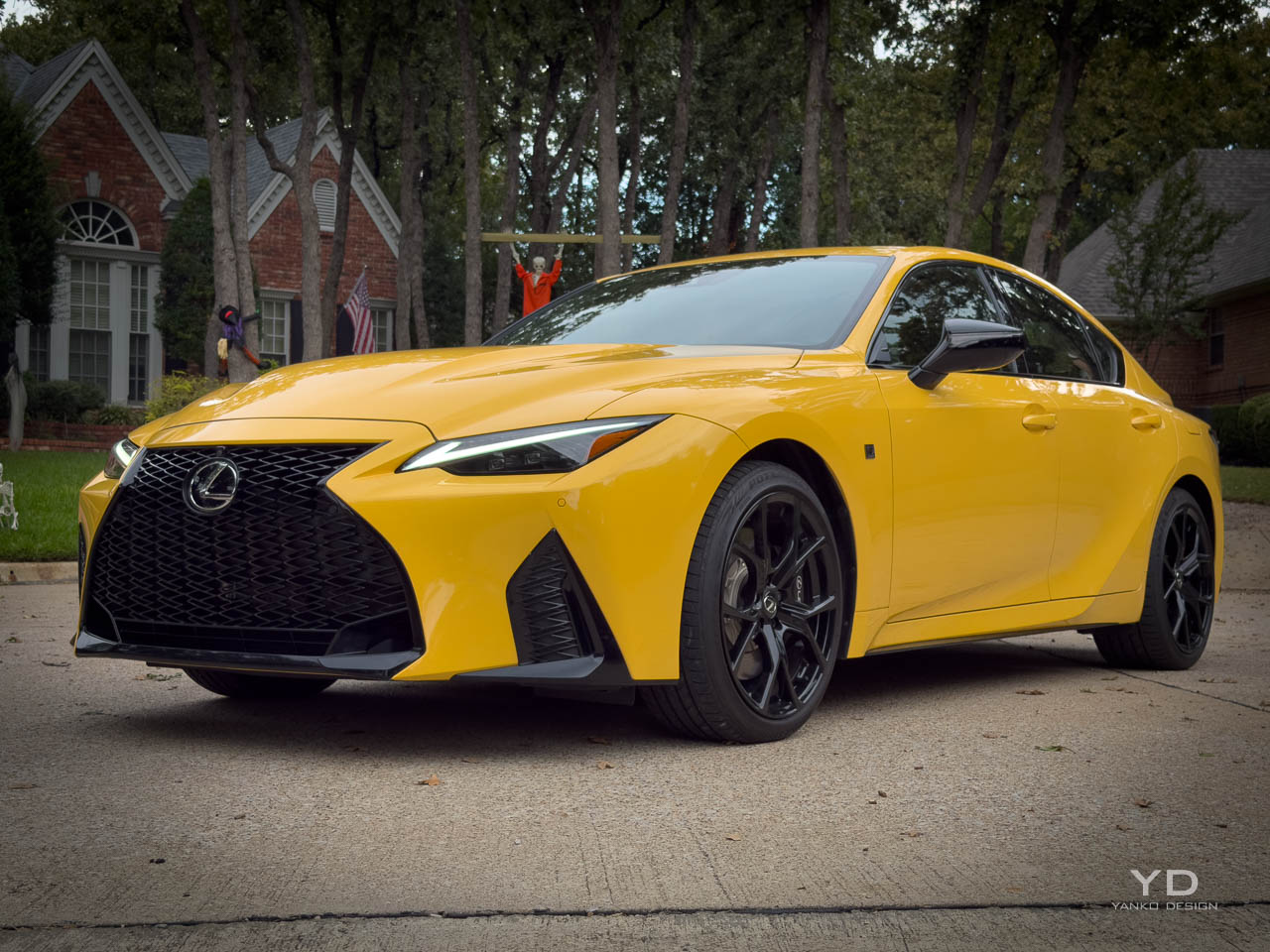
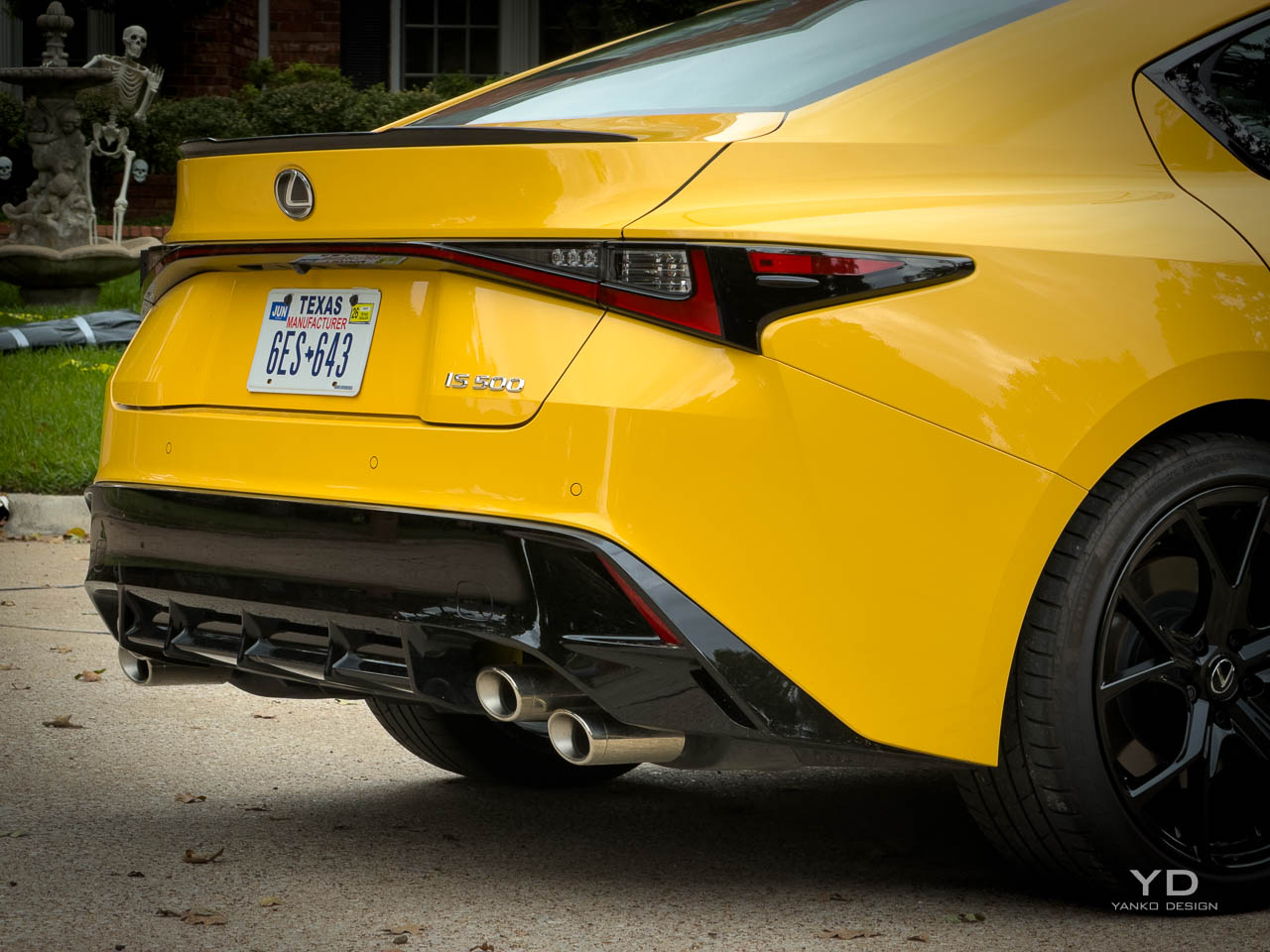
Moving rearward, the roofline descends in a continuous arc that terminates at a ducktail spoiler integrated into the trunk lid. Quad exhaust tips emerge from the rear diffuser, their stacked arrangement serving as the primary visual signal of the V8 beneath. The proportion relationship between greenhouse and body mass reads as deliberately compact, the cabin volume compressed relative to the sculptural surfaces surrounding it. This creates the impression of a machine built around its mechanical core rather than a passenger compartment with propulsion attached. The 19 inch wheels and aggressive fender surfacing work to visually manage nearly 4,000 pounds, making the car read lighter and wider than the scales suggest.
Interior Material Hierarchy

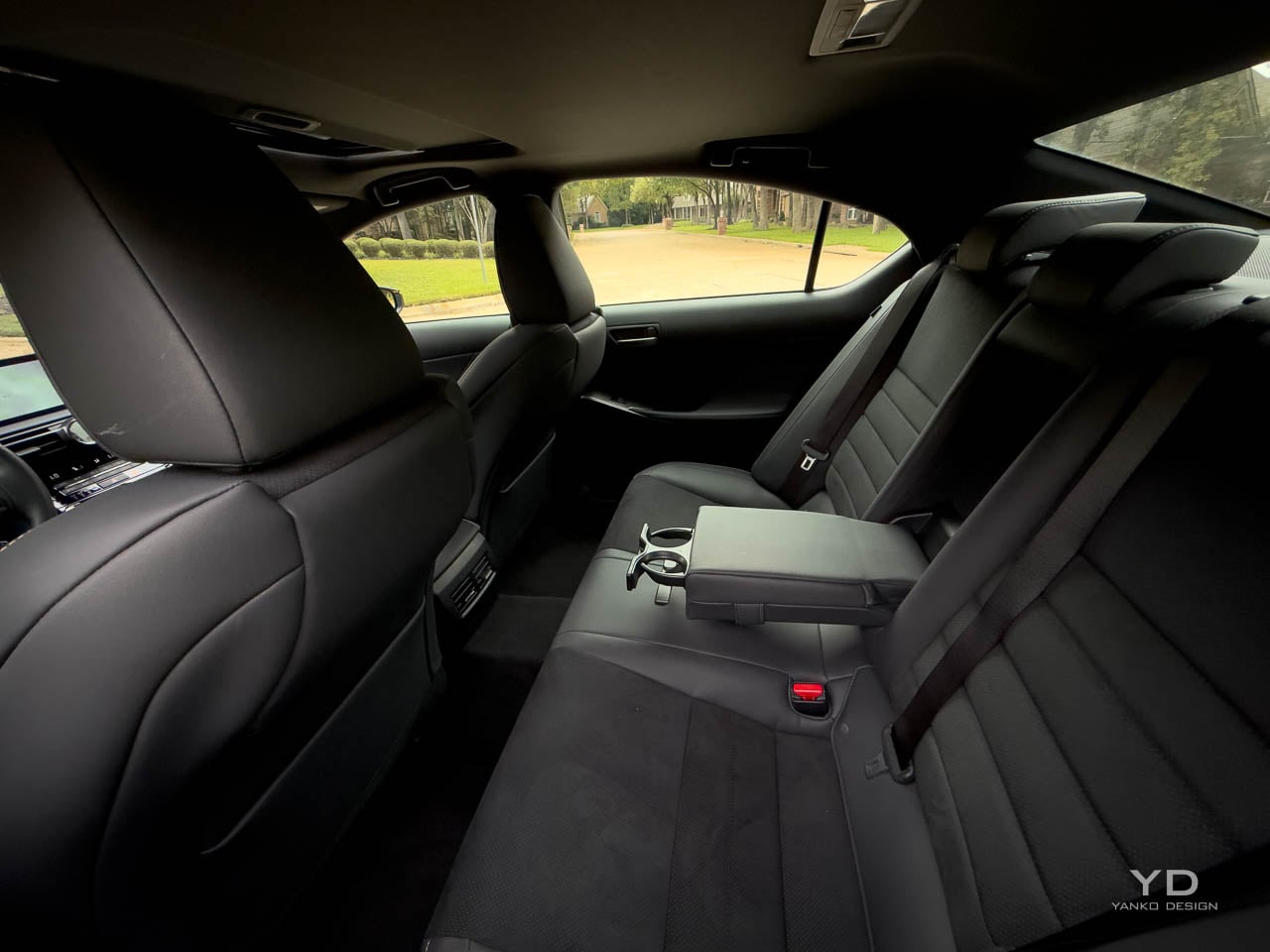
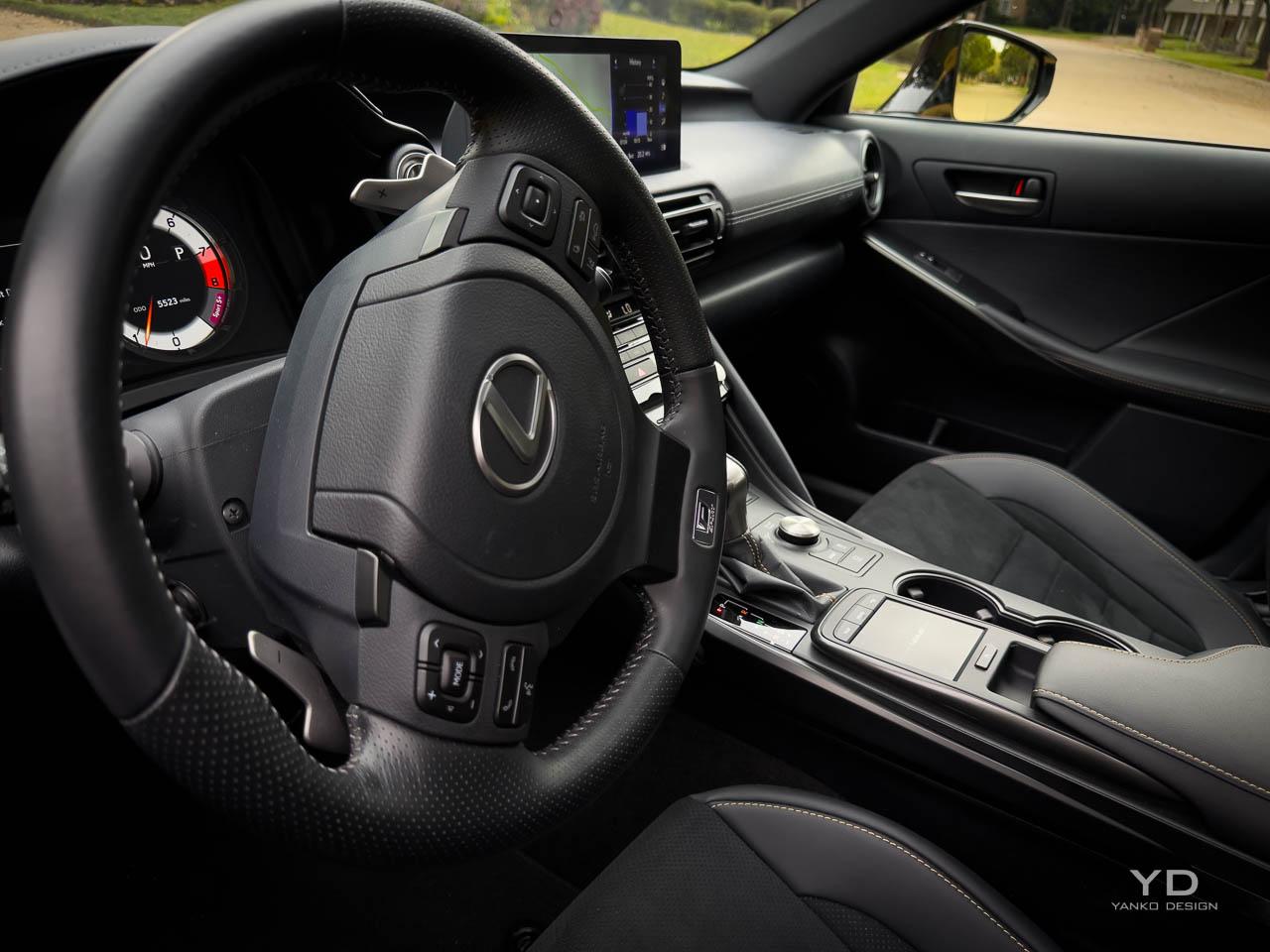
Inside, tactile engagement takes priority over digital spectacle. NuLuxe trimmed seats provide the primary contact surface, their bolstering firm enough to communicate sport intent without creating discomfort during extended use. The Ultrasuede inserts in the Flare Yellow package introduce texture variation that catches fingertips differently than the surrounding synthetic leather, establishing a sensory hierarchy across the seating surfaces.
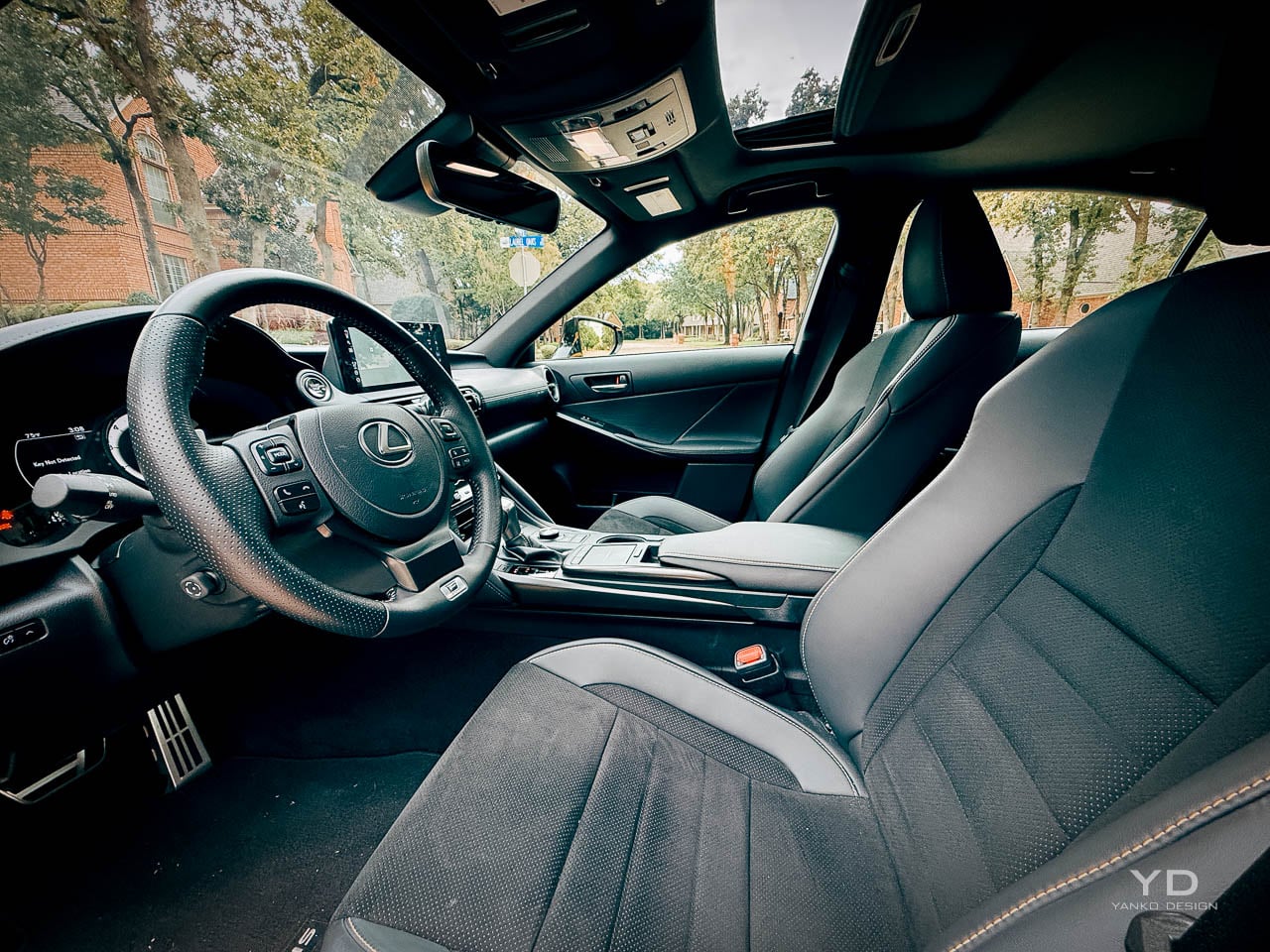
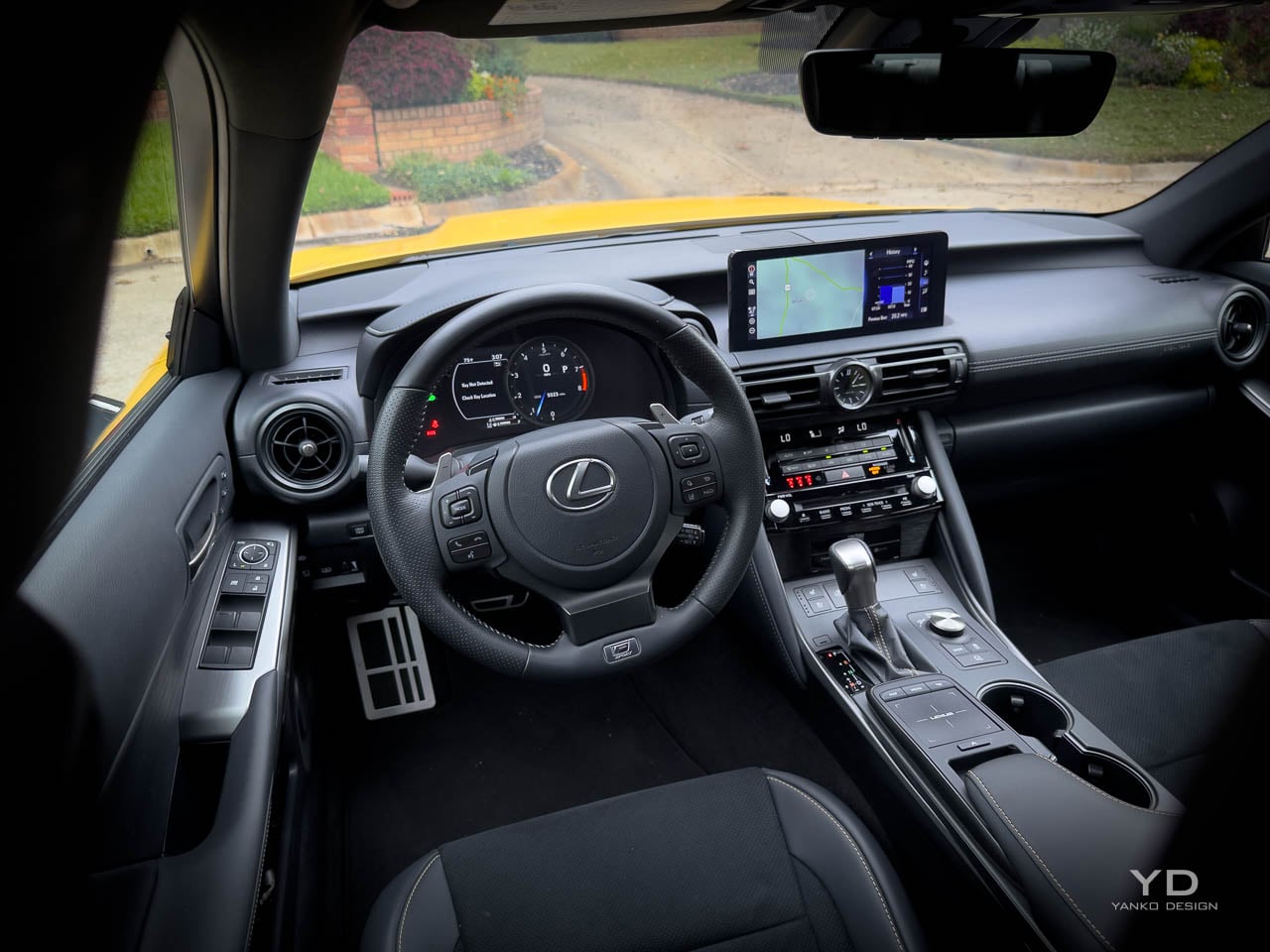
The steering wheel arrives wrapped in leather with a heated element, its rim diameter and grip circumference calibrated for hands that expect direct mechanical feedback. Aluminum pedals replace the standard rubber units, their knurled surfaces providing positive purchase under aggressive inputs. Satin trim accents break up the interior darkness, creating visual rhythm without the reflective distraction of polished chrome.
The Mark Levinson audio system occupies the acoustic environment with authority. Its 17 speakers deliver the kind of spatial imaging that justifies the premium trim designation, filling the cabin with presence that matches the V8’s mechanical drama.
 

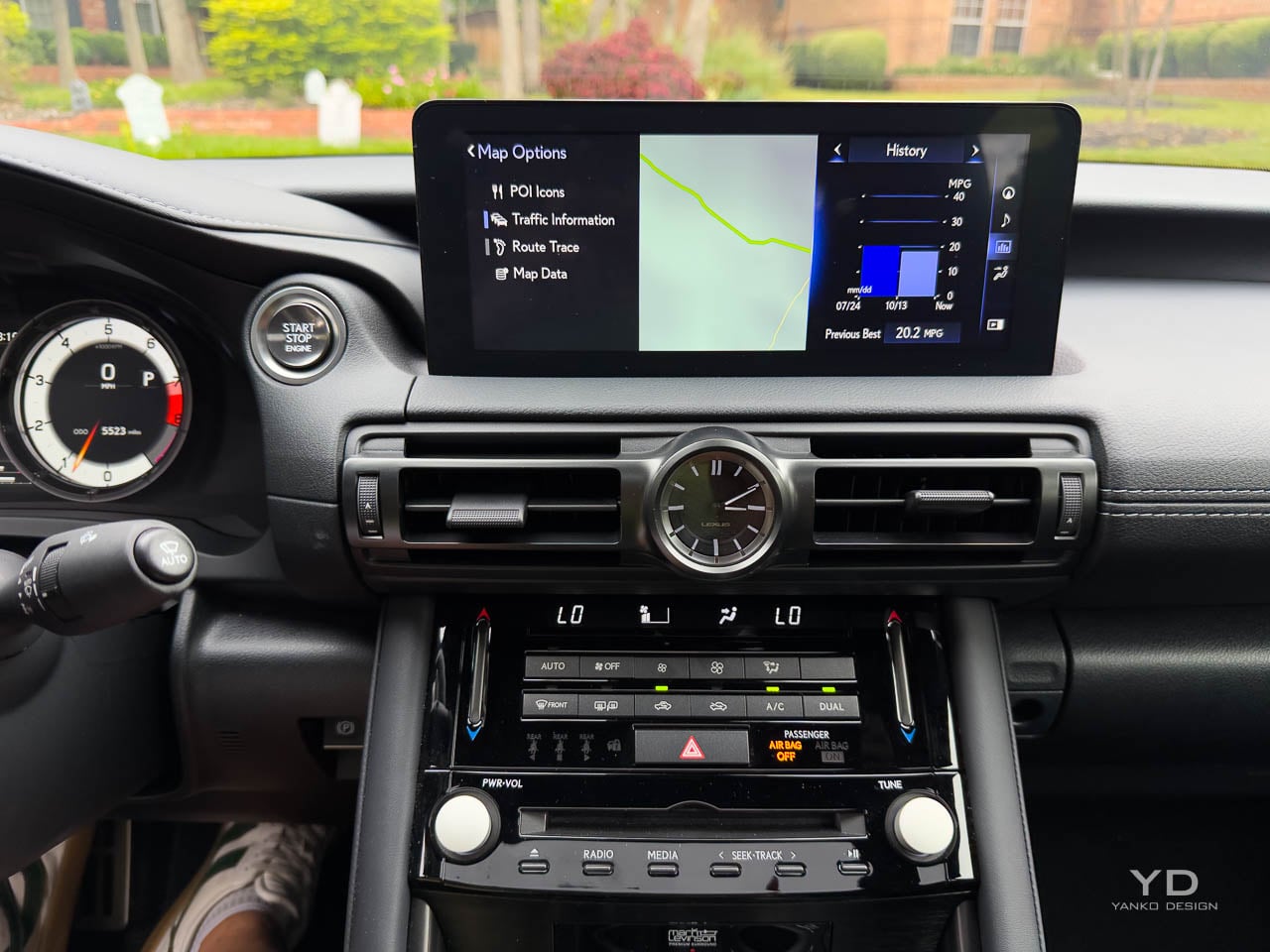
The interface through which that system operates represents the cabin’s most significant temporal artifact. A 10.3 inch touchscreen accepts finger input but also responds to a trackpad controller mounted on the center console, a legacy interface element that creates immediate friction. Reaching for the screen to tap a climate shortcut feels natural until you remember the trackpad exists; defaulting to the trackpad means dragging a cursor across a surface designed for touch. Two design eras compete on the same console, and neither fully wins.
Powertrain as Sensory Design

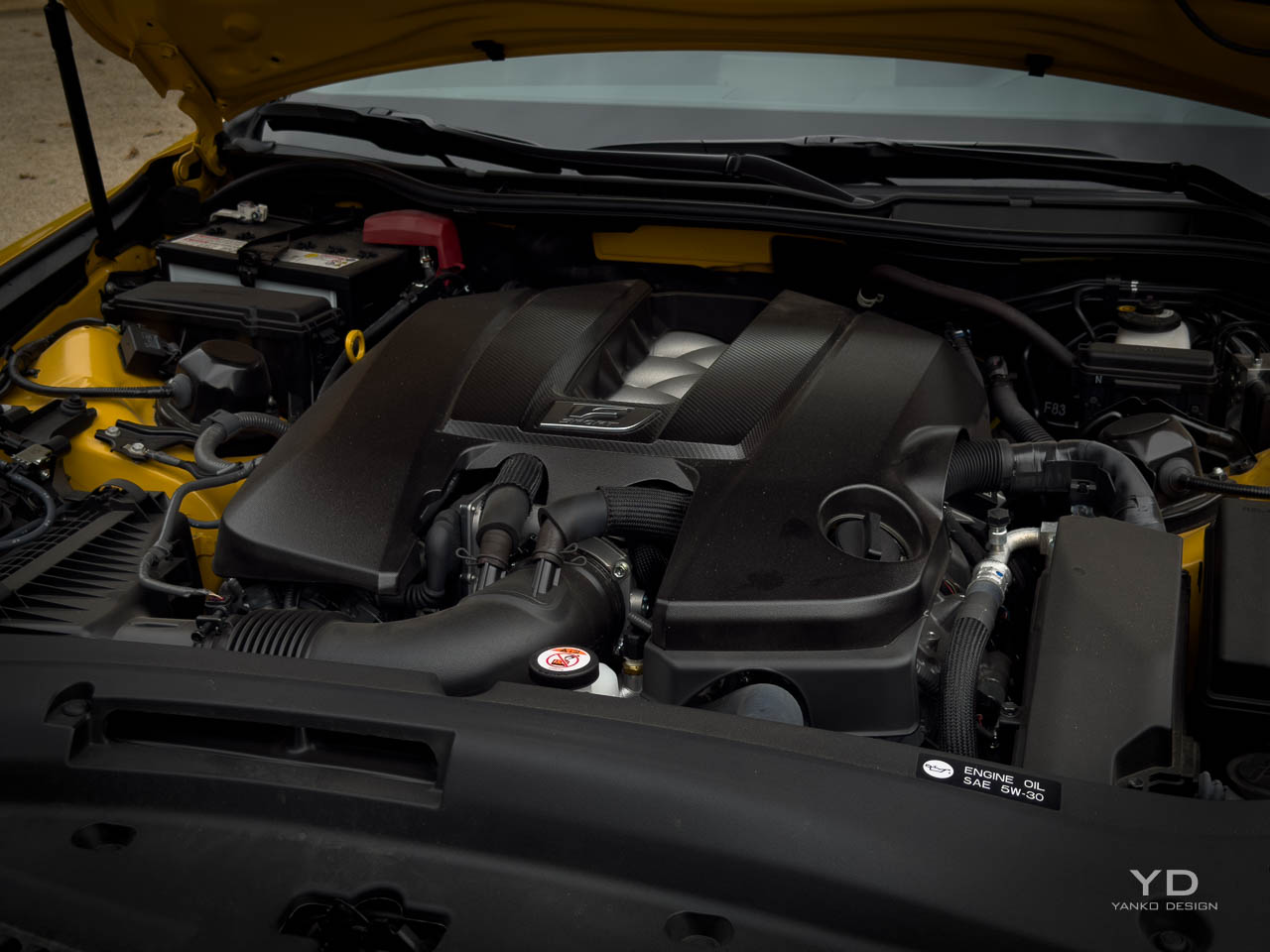
Numbers tell part of the story: 472 horsepower at 7,100 rpm from a 5.0 liter V8. What matters more is how that power arrives. Natural aspiration means throttle response arrives without the intervention of turbocharger spool, creating a direct relationship between pedal position and acoustic output. The engine announces its presence through a broadband exhaust note that builds intensity with engine speed, the quad tips providing the exit path for a sound that functions as the car’s primary experiential feature.
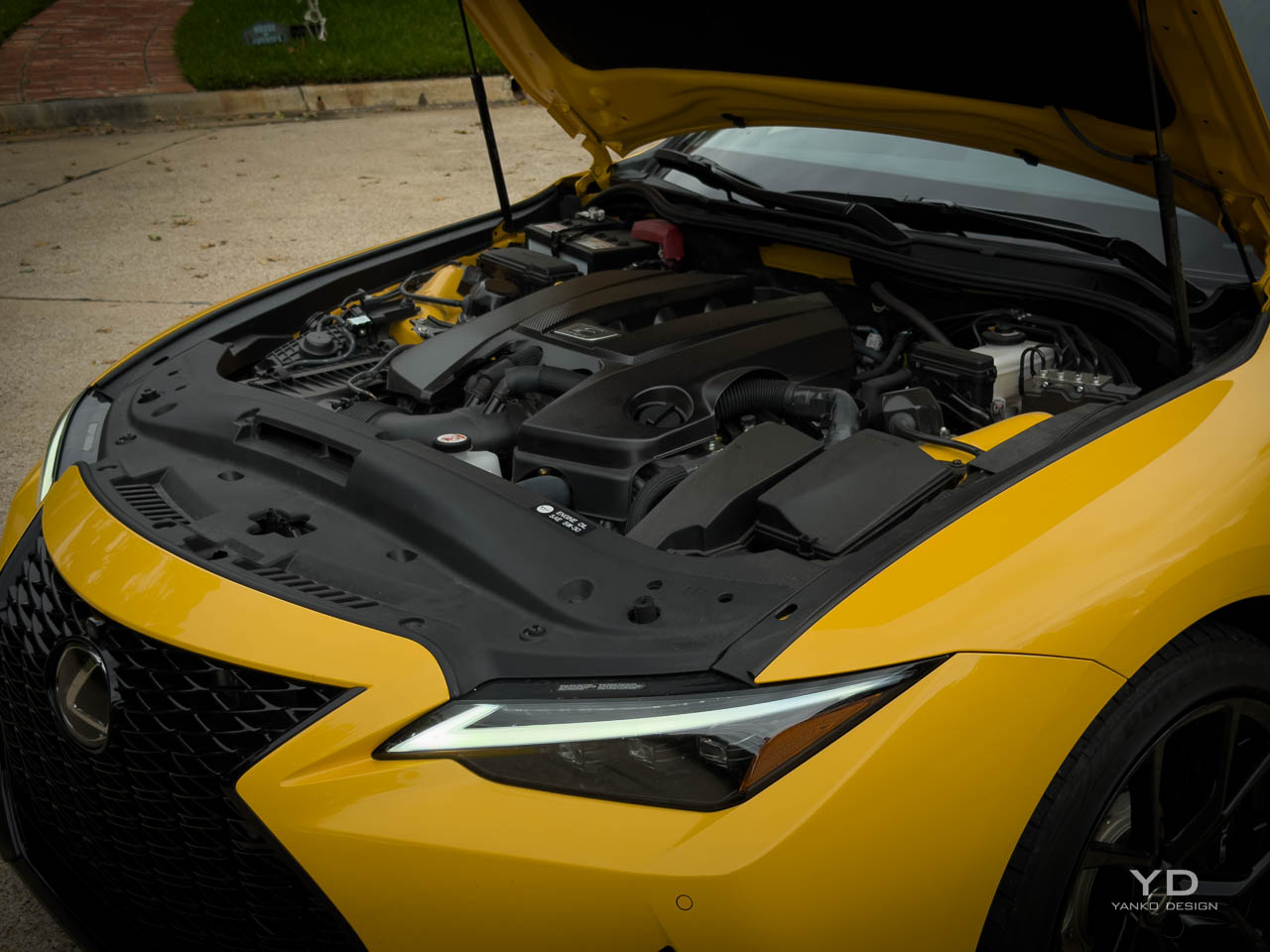
The sprint to 60 arrives in the mid four second range, figures that place the IS 500 behind several turbocharged competitors on paper. The gap narrows in lived experience because the V8 delivers its power in a linear curve rather than a turbocharged surge, allowing the driver to modulate output with precision that boost dependent systems struggle to match. The eight speed automatic transmission shifts cleanly in sport mode, though it lacks the dual clutch immediacy that defines the segment’s sharper offerings.
Rear wheel drive completes the mechanical architecture, a configuration increasingly rare in this segment where all wheel drive has become the default assumption. The Torsen limited slip differential, a helical gear system that transfers torque mechanically rather than through electronic intervention, manages power distribution to the rear axle. Its purely mechanical operation provides predictable behavior at the adhesion limit, sending power to whichever wheel has grip without the response lag of clutch pack systems. Exiting a tight corner under throttle, the result is smooth, progressive traction rather than the sudden electronic clamp of stability nannies fighting for control. Adaptive suspension and upgraded brakes with enhanced cooling address the chassis requirements of the additional powertrain mass, though these systems tune toward comfort rather than track aggression.

Dynamic Compromise

Nearly 4,000 pounds announces itself the moment the road curves. The IS 500 weighs approximately 3,973 pounds in tested configuration, mass that reveals its presence during direction changes and hard braking. Push beyond street driving limits and understeer arrives predictably, the front tires reaching their grip threshold before the rear can rotate the chassis. The steering provides adequate weight but filters road texture in ways that prioritize refinement over information density. These are characteristics of a car tuned for daily use rather than weekend autocross, a calibration choice that aligns with the comfort of the seats and the isolation of the cabin.
The brake pedal requires calibration of expectations, its initial travel soft before building resistance. This tuning prioritizes smoothness during traffic deceleration but reduces confidence during aggressive threshold braking. Stability control intervention arrives earlier than competitors allow, limiting the exploration of chassis dynamics even when the driver seeks that engagement.

On a fast two lane road at seven tenths, the character clarifies. The V8 pulls cleanly out of corners while the chassis absorbs mid corner bumps that would unsettle lighter, stiffer competitors. Push harder and the front washes wide, but within the envelope of spirited street driving, the balance feels deliberate rather than deficient.

These compromises reflect a deliberate design decision: Lexus tuned for the commute, not the canyon. That calibration disappoints enthusiasts seeking sharper responses but serves the owner who wants to live with a V8 daily. The IS 500 prioritizes living with the V8 rather than extracting its maximum potential, a choice that makes the powertrain accessible across driving contexts rather than demanding specific conditions for enjoyment.

Value Positioning and Market Context

At $69,539 as tested, including destination and the Flare Yellow appearance package, the IS 500 positions itself against both four cylinder luxury sedans and more focused performance machinery. The competitive landscape has shifted around this car: BMW offers turbocharged inline sixes, Mercedes deploys electrified four cylinders, and Alfa Romeo provides sharper dynamics at similar price points. Against this field, the IS 500 competes on differentiation rather than specification superiority.
Fuel economy penalties are explicit and substantial. The EPA rates the powertrain at 17 mpg city, 25 highway, and 20 combined, figures that translate to approximately $3,200 in annual fuel costs. Over five years, that adds roughly $6,500 more than average. Environmental ratings land at 4 out of 10 for both fuel economy and smog, reflecting the consequences of maintaining natural aspiration while competitors optimize for regulatory compliance.

The value proposition depends on what the buyer prioritizes. Powertrain character over lap times. Exhaust note over efficiency. Mechanical simplicity over technological sophistication. For those criteria, the IS 500 delivers experiences its competitors have abandoned. The car exists because Lexus chose to preserve something rather than optimize everything.

Design Intent Realized

As a design object, the IS 500 F SPORT Performance Premium prioritizes a specific experience over balanced capability. The naturally aspirated V8 in rear wheel drive configuration represents a powertrain topology that market forces are eliminating, preserved here in a package refined enough for daily use. Flare Yellow demonstrates how color can function as a design element rather than a decorative choice, unifying interior and exterior into a coherent material statement.
Limitations and character prove inseparable. The weight that softens handling also supports the sound deadening that makes the V8 a companion rather than an assault. The infotainment system that frustrates also maintains the physical controls and clear hierarchy that digital native interfaces have abandoned. Fuel consumption that punishes the wallet finances the displacement that creates the acoustic experience.

Assembled in Tahara, Japan, the IS 500 wears a five star safety rating from NHTSA across all categories. It arrives as a complete product rather than a work in progress. Its design intent is preservation: holding space for a powertrain philosophy while the industry accelerates toward electrification. Whether that intent justifies the compromises depends on what the buyer believes is worth keeping alive. That Flare Yellow paint catching light in a parking garage announces the same thing the V8 announces at redline: this machine refused to apologize. For the driver who values mechanical tactility over interface novelty, the IS 500 answers a question the rest of the segment stopped asking.

The post 2025 Lexus IS 500 F SPORT Performance Review: Designing Space for a V8 in an Electrified World first appeared on Yanko Design.
Poco Pad X1 & Poco Pad M1 Review: Budget Tablets That Challenge the iPad

PROS:


  • Strong display for the money

  • Complete accessory ecosystem

  • Big batteries

CONS:


  • Neither tablet is light enough for comfortable one-handed use

  • Fully kitted-out X1 with Floating Keyboard and Focus Pen gets expensive fast

RATINGS:

AESTHETICS
ERGONOMICS
PERFORMANCE
SUSTAINABILITY / REPAIRABILITY
VALUE FOR MONEY

EDITOR'S QUOTE:

Poco Pad X1 and M1 are not perfect, but together they deliver more screen, battery, and versatility than almost any other budget tablet pair right now.

Poco built its name on phones that punch above their price, and now it wants to do the same on your coffee table. With Poco Pad X1 and Poco Pad M1, the brand is not just throwing out a couple of cheap tablets. It is trying to turn its budget DNA into a fuller ecosystem that covers gaming, work, and everyday media.

You can feel that ambition in how these two models are drawn. The Poco Pad X1 is a slightly more compact, high refresh performance slate, tuned for games and quick multitasking on an 11.2-inch 3.2K display. The Poco Pad M1 steps up to a 12.1-inch 2.5K panel and the largest battery Poco has ever shipped in a global device, aiming to be the big screen that carries you through movies, sketching sessions, and long days away from a charger.

Designer: Poco

If you have been eyeing an affordable Android tablet for gaming, streaming, or light work, should you reach for the sharper, faster Poco Pad X1, or the larger, more relaxed Poco Pad M1? In this review, we will live with both, compare their strengths, and help you decide which one actually fits your desk, your bag, and your budget.

Aesthetics

Poco Pad X1

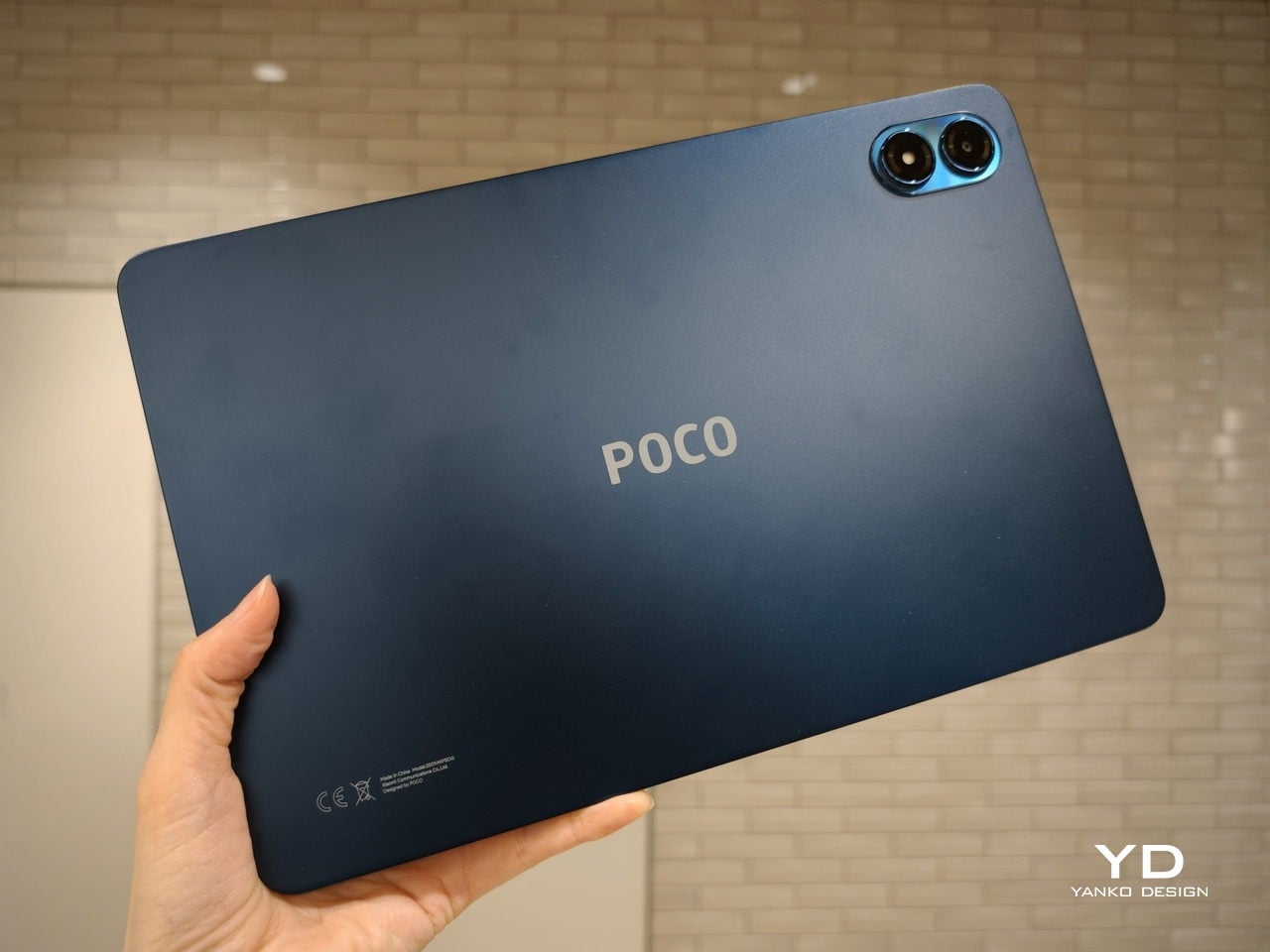
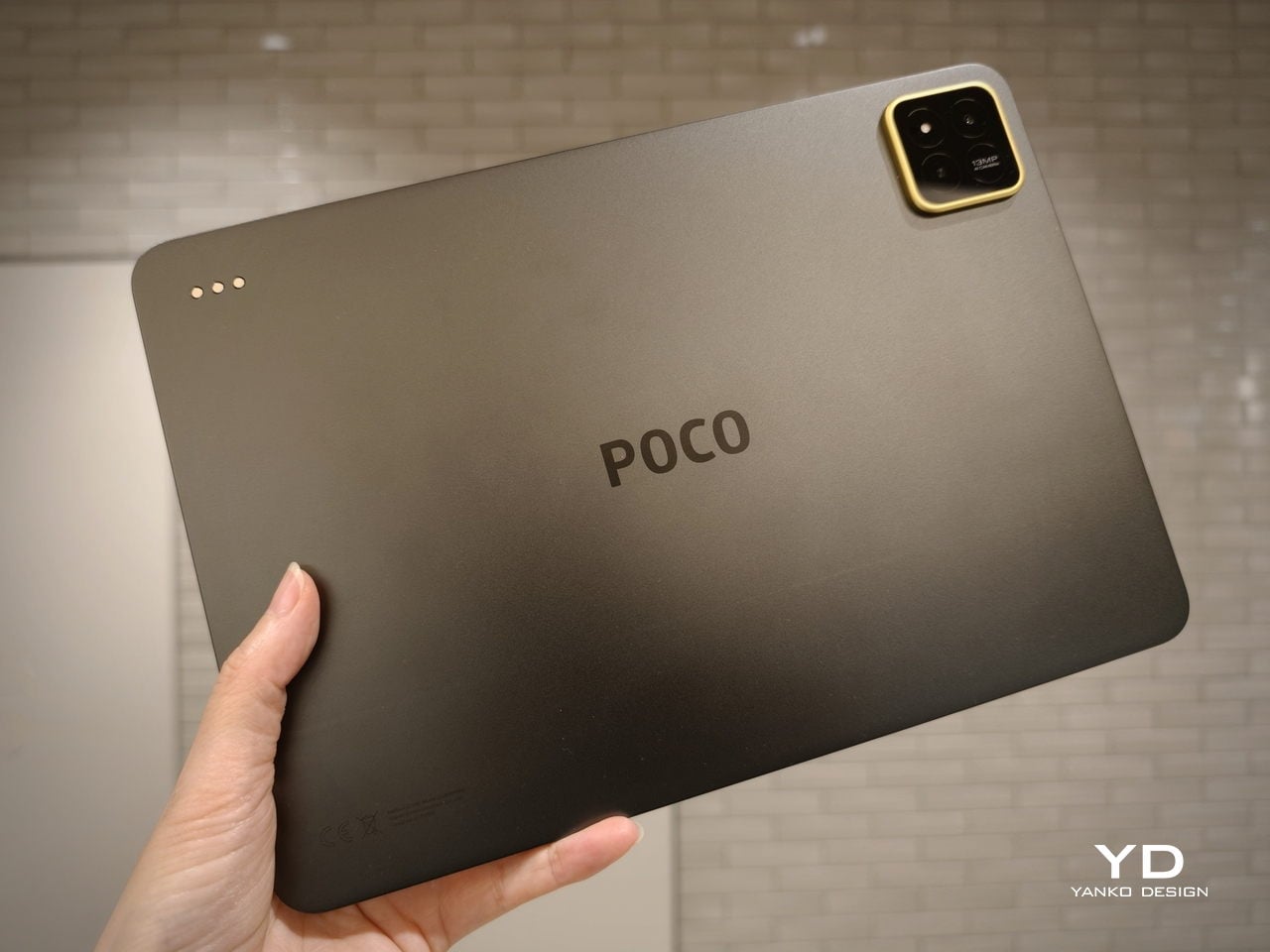
Poco is not trying to reinvent tablet hardware with Poco Pad X1 or Poco Pad M1. Both follow a familiar rectangle with rounded corners, flat sides, and a camera module that sits quietly in one corner. On Poco Pad X1, the focus is clearly on framing its 11.2-inch display as efficiently as possible. Poco Pad M1 takes the same basic formula and scales it up with a 12.1-inch panel.

Color choices on the Pad X1 and the Pad M1 are simple. They both come in Grey and Blue. Grey leans more gunmetal and understated with a contrasting yellow accent around the camera module, while Blue reads a little more casual and friendly, but neither option is loud or experimental. Both tablets use a metal unibody design for the main shell, with separate parts for the camera island and buttons, and a big Poco logo stamped in the center for instant brand recognition. The Poco Pad X1 uses a square camera island, while the Poco Pad M1 switches to a softer oval, which gives each model a slightly different signature when you flip them over.

Poco Pad M1

Taken together, the two tablets look exactly like what they are meant to be. They are straightforward, modern Android slabs that fade into the background and let their screens and specs do the talking. For budget-friendly hardware, that quiet, functional design approach feels like the right call.

Ergonomics

In the hand, the main ergonomic difference between Poco Pad X1 and Poco Pad M1 is simply size and weight, but neither is a true one-handed tablet for long stretches. The Poco Pad X1, with its 11.2-inch footprint and 500 g weight, is the more compact of the two. It is easier to manage on a sofa or in bed than the larger Poco Pad M1, but you will still want a second hand or some support if you are holding it for a long time. Even though the Poco Pad X1 is relatively slim and light for an aluminum unibody tablet with an 8,850 mAh battery, with dimensions of 251.22 x 173.42 x 6.18 mm, it does not quietly disappear in one hand the way a smaller 8 or 9-inch device might.

Poco Pad M1

Poco Pad M1 stretches that template out to a 12.1-inch diagonal with dimensions of 279.8 x 181.65 x 7.5 mm and a weight of about 610 g, which puts it clearly into big tablet territory. It is still slim, but the larger footprint makes it even less suited to long one-handed use, especially if you are moving around. Instead, it feels more like a tablet you rest on a table, prop up with a cover, or pair with its official keyboard, where the extra screen real estate really pays off for split-screen apps, video, and drawing.

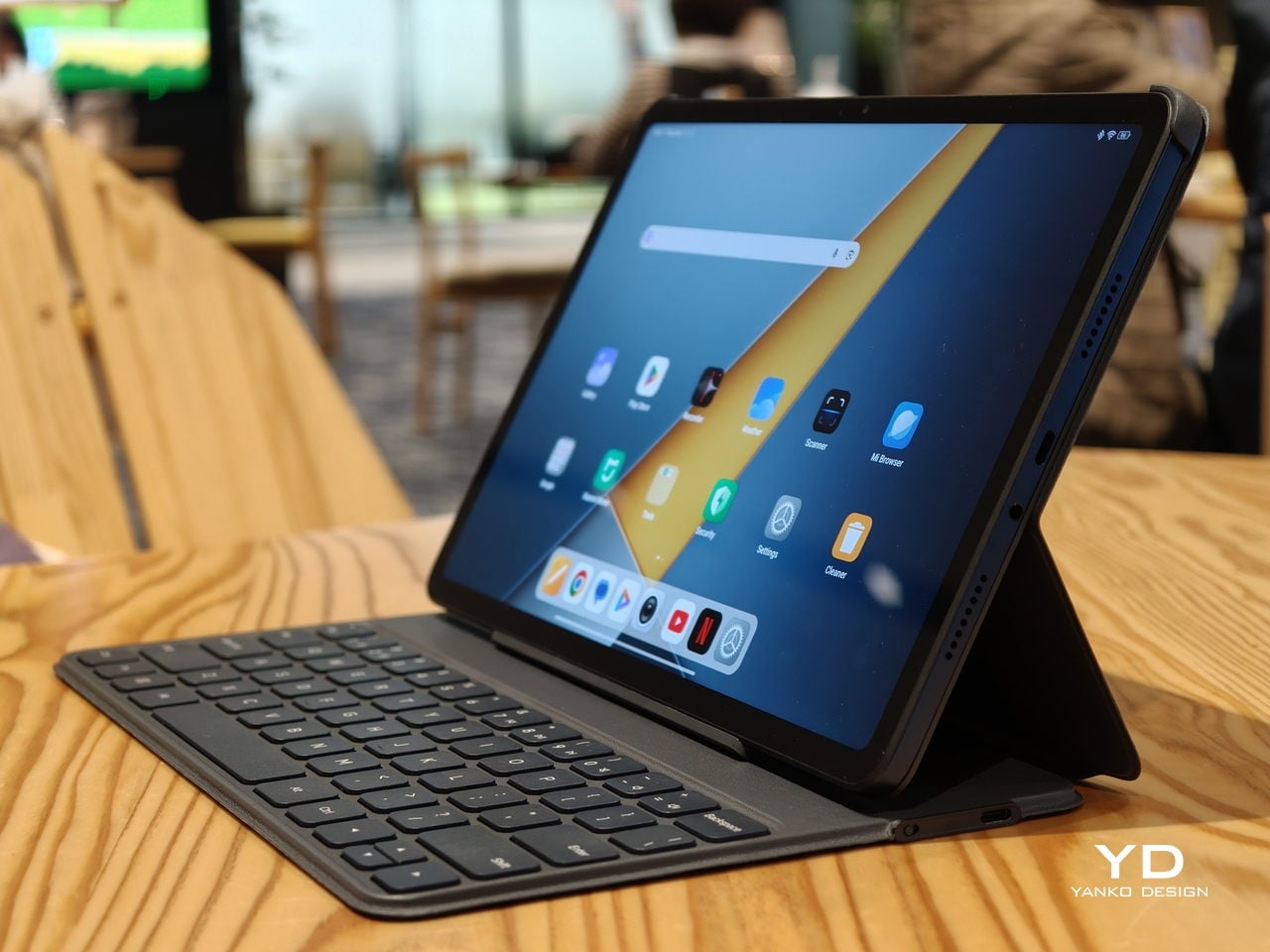
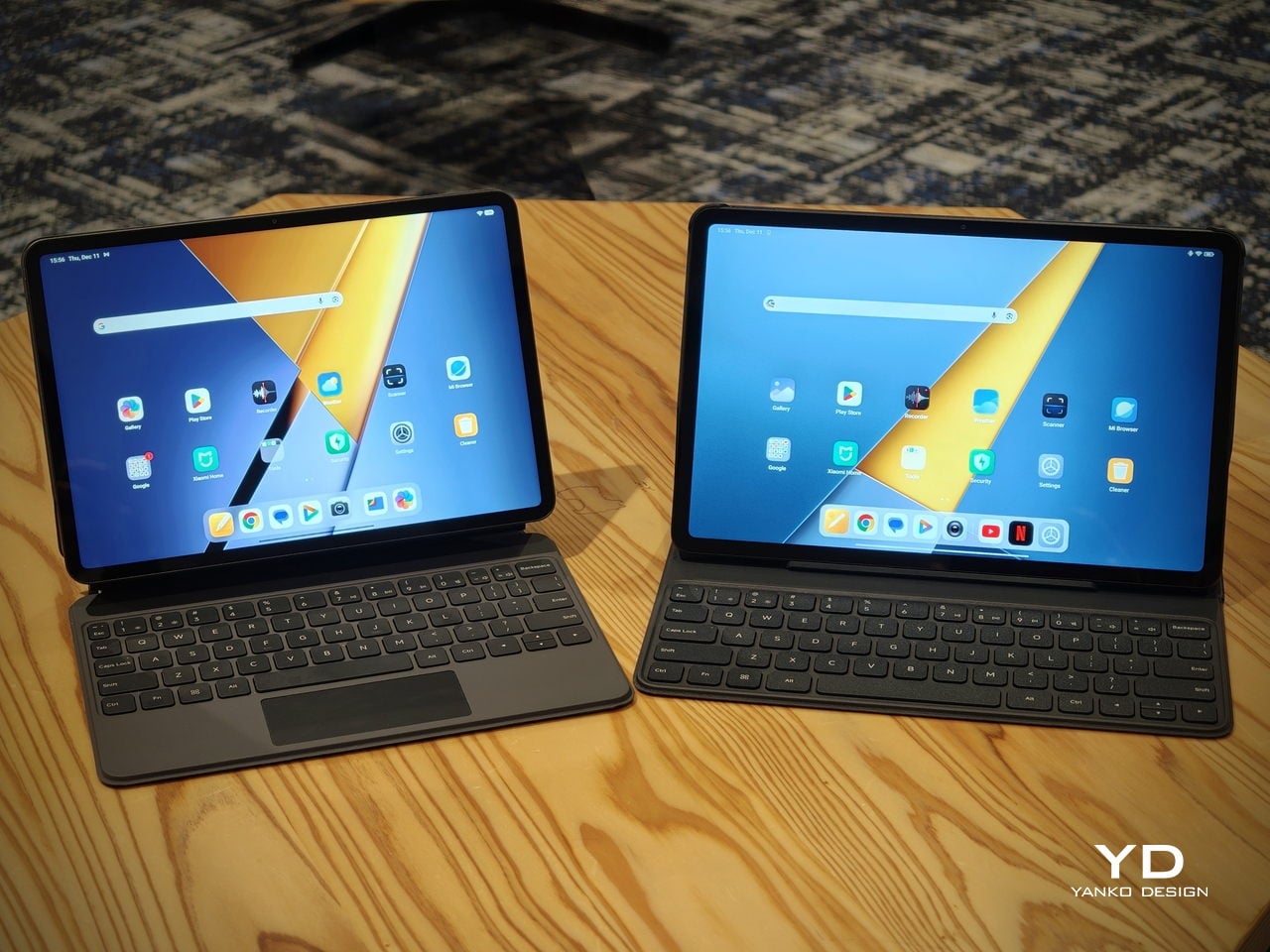
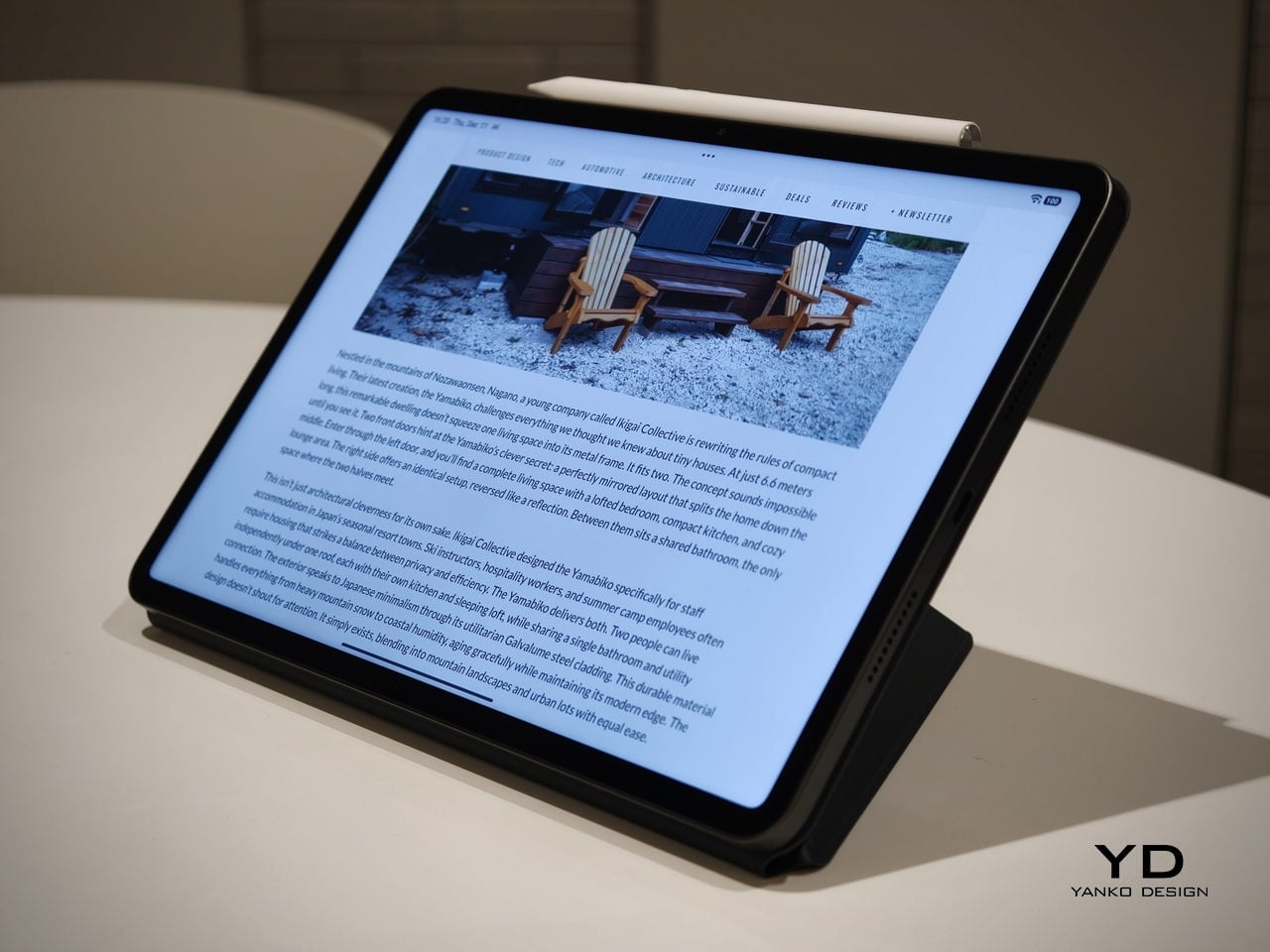
The accessory ecosystem around the Pad X1 and the Pad M1 makes them versatile, but in slightly different ways. Poco Pad M1 is compatible with the optional Poco Pad M1 Keyboard, Poco Smart Pen, and Poco Pad M1 Cover, a trio that turns it into a very capable small-screen workstation. The cover folds into a stand and adds a built-in holder for the pen, which makes it easy to move between bag, desk, and sofa without worrying about where the stylus went. The keyboard is lightweight and easy to carry, but the keys feel a bit plasticky in use, which slightly undercuts the otherwise solid metal body of the tablet.

Poco Pad X1

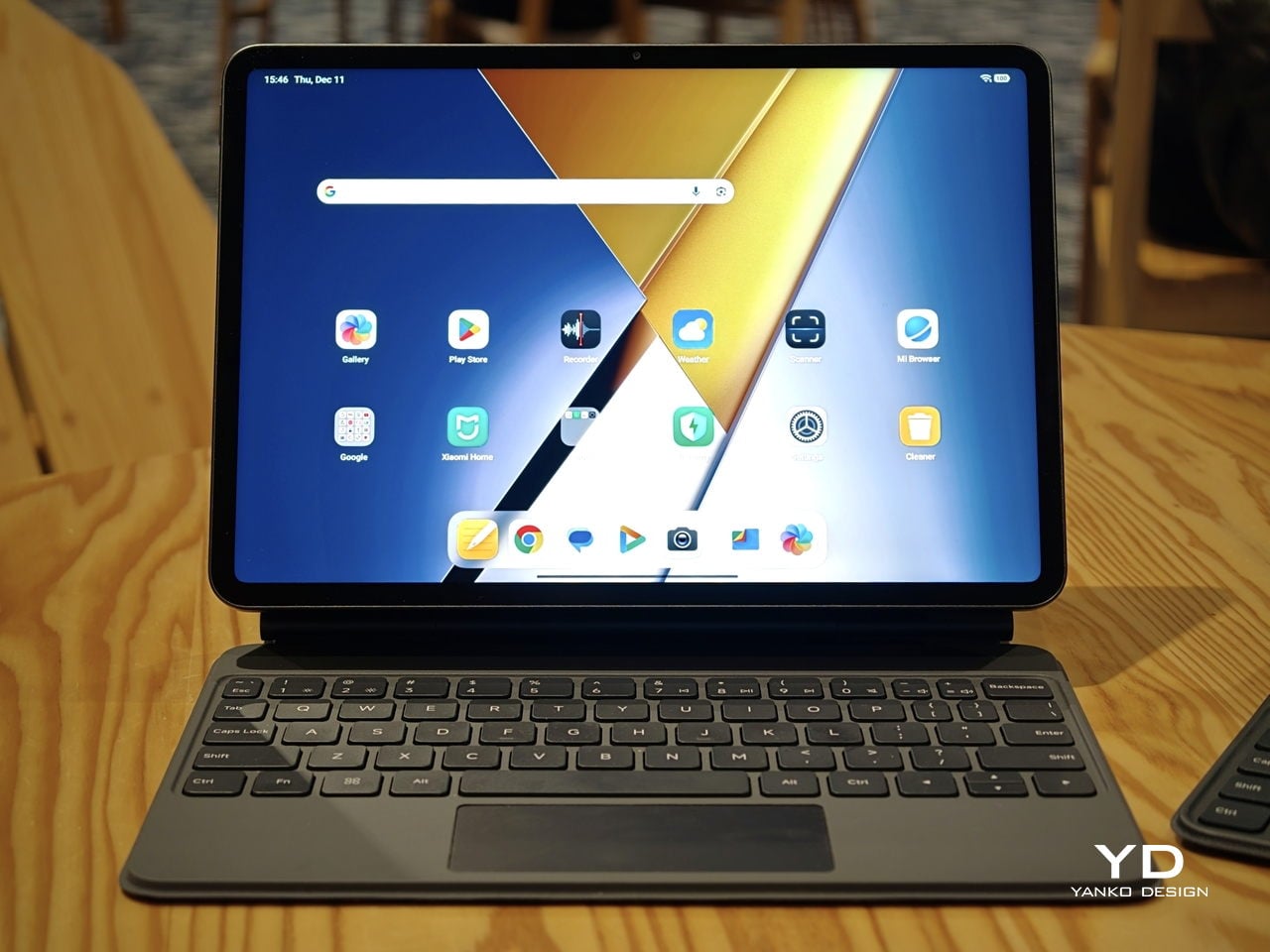
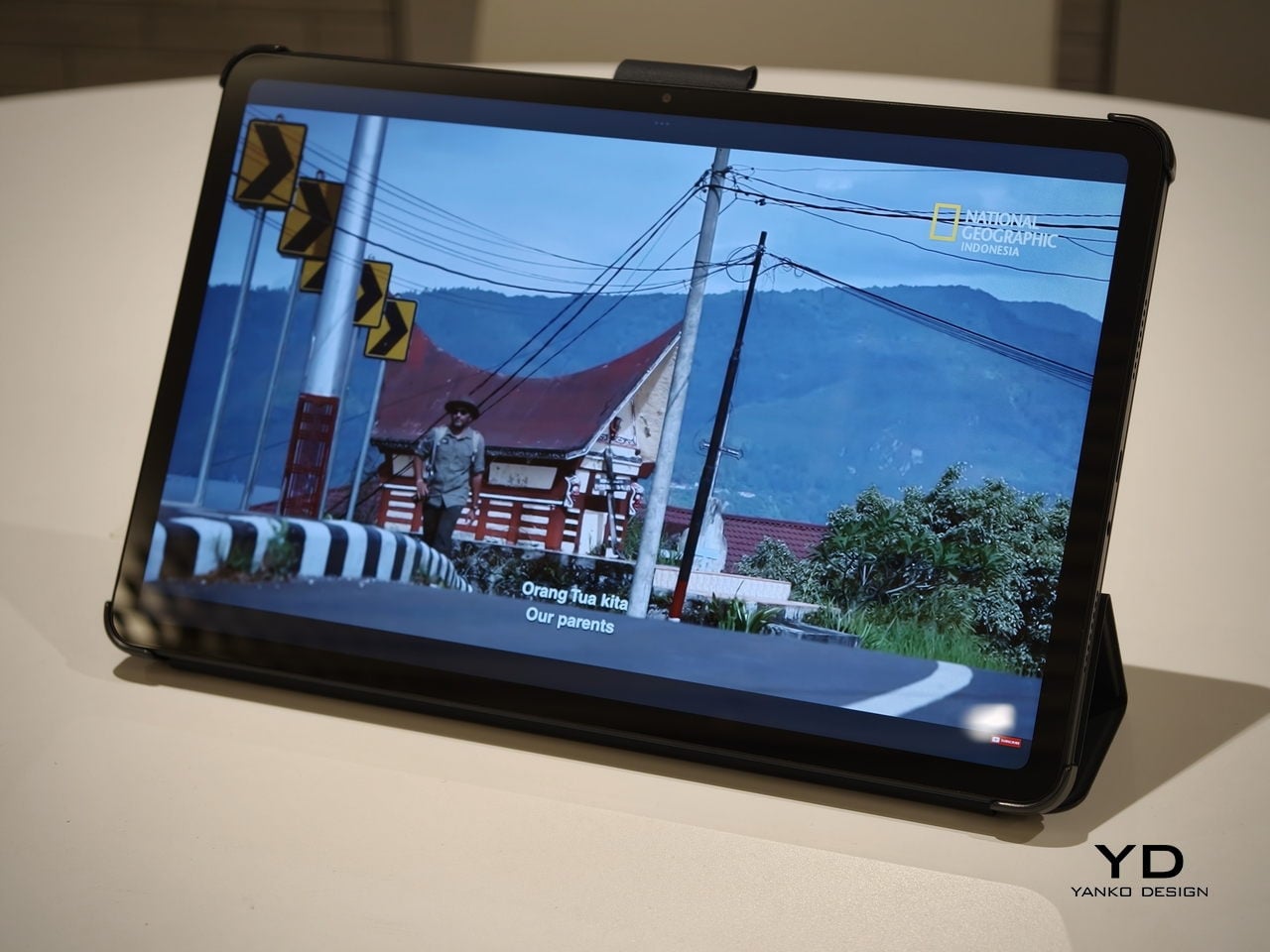
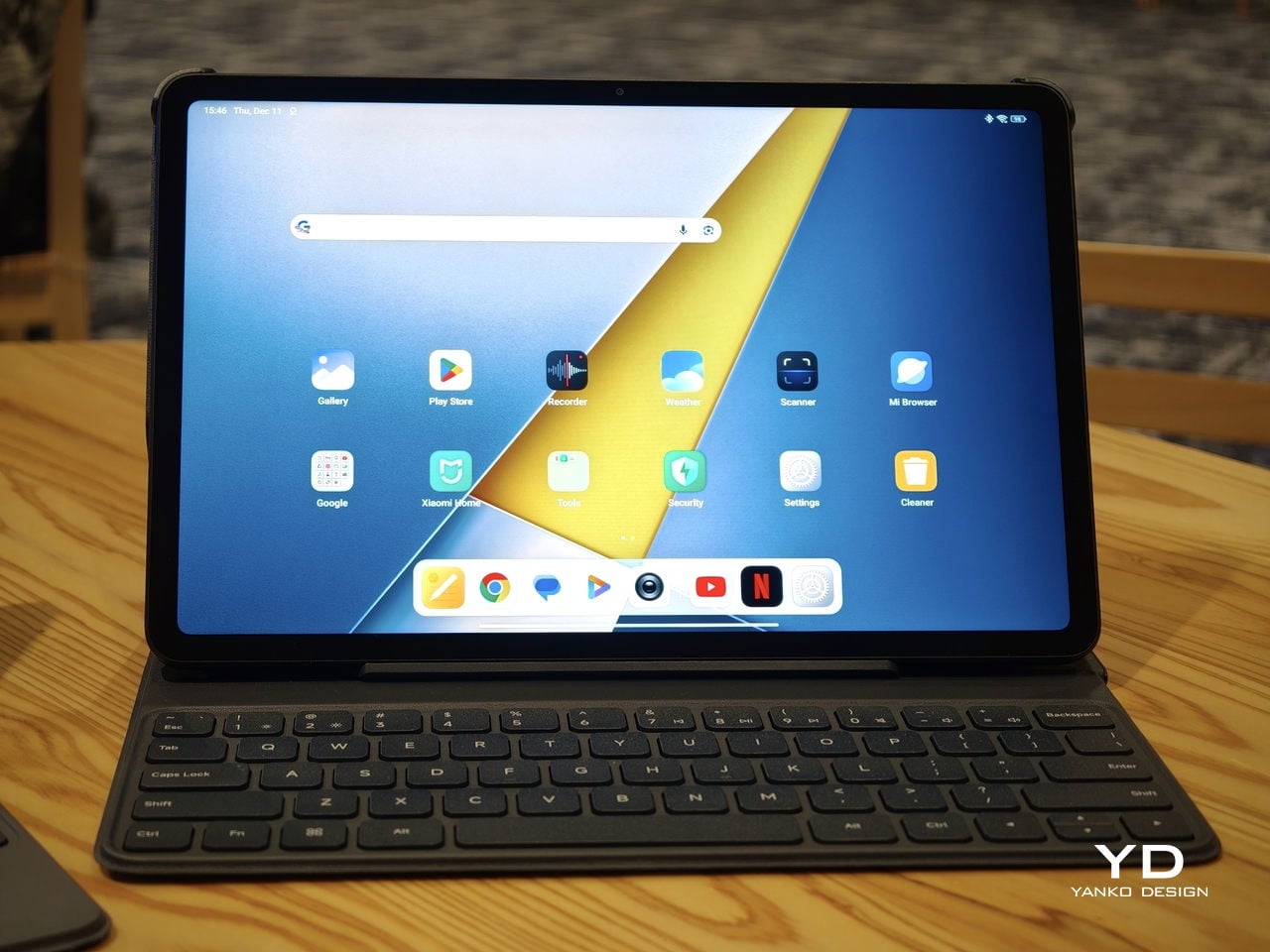
Poco Pad X1 has its own dedicated set of accessories. It supports the Poco Pad X1 Floating Keyboard, the Poco Pad X1 Keyboard, the Poco Focus Pen, and the Poco Pad X1 Cover, which together give it a surprisingly flexible setup for both work and play. The cover folds like origami and doubles as a stand, letting you enjoy the tablet vertically or horizontally, and for horizontal use, you can choose between two different viewing heights.

The Floating Keyboard is the standout here. It adds some weight and only offers a modest tilt range, but the key feel is excellent for this class, and the trackpad is responsive and accurate enough that you quickly forget you are on a tablet accessory. Clipped together, the Poco Pad X1 and the Floating Keyboard behave much more like a compact laptop than a budget slate with an afterthought keyboard, which makes it far easier to treat this smaller tablet as a real writing and work machine when you need it.
 

Performance

Living with Poco Pad X1 and Poco Pad M1 quickly shows how differently they lean, even though they share a lot of DNA. The Poco Pad X1 is the sharper and faster option, with an 11.2-inch 3.2K display at 3,200 x 2,136 px, around 345 ppi, and refresh up to 144 Hz in supported apps. It can hit about 800 nits peak brightness, supports Dolby Vision and HDR10, and uses a 3:2 aspect ratio that feels very natural for reading, web browsing, and document work, helped by TÜV eye care, DC dimming, and adaptive colors to keep things comfortable.

Poco Pad M1

The Poco Pad M1, on the other hand, trades a bit of sharpness and speed for sheer size and flexibility. Its 12.1-inch 2.5K panel runs at 2,560 x 1,600px with around 249 ppi and up to 120 Hz refresh, plus 500 nits typical and 600 nits in high brightness mode. You still get Dolby Vision, DC dimming, and TÜV certifications for low blue light, flicker-free behavior, and circadian friendliness, along with wet touch support that keeps it usable with damp fingers.

Poco Pad X1

Both tablets use quad speakers with Dolby Atmos and Hi-Res support, so you get surprisingly full sound from either. Crucially, the Poco Pad M1 also adds a 3.5 mm headphone jack and a microSD slot for up to 2 TB of expandable storage, which makes it a much easier media hoarder and a better fit for wired headphones and speakers. The X1 relies on its internal storage and wireless audio instead, which suits its more performance-driven, travel-friendly role.

Poco Pad X1

Poco Pad M1

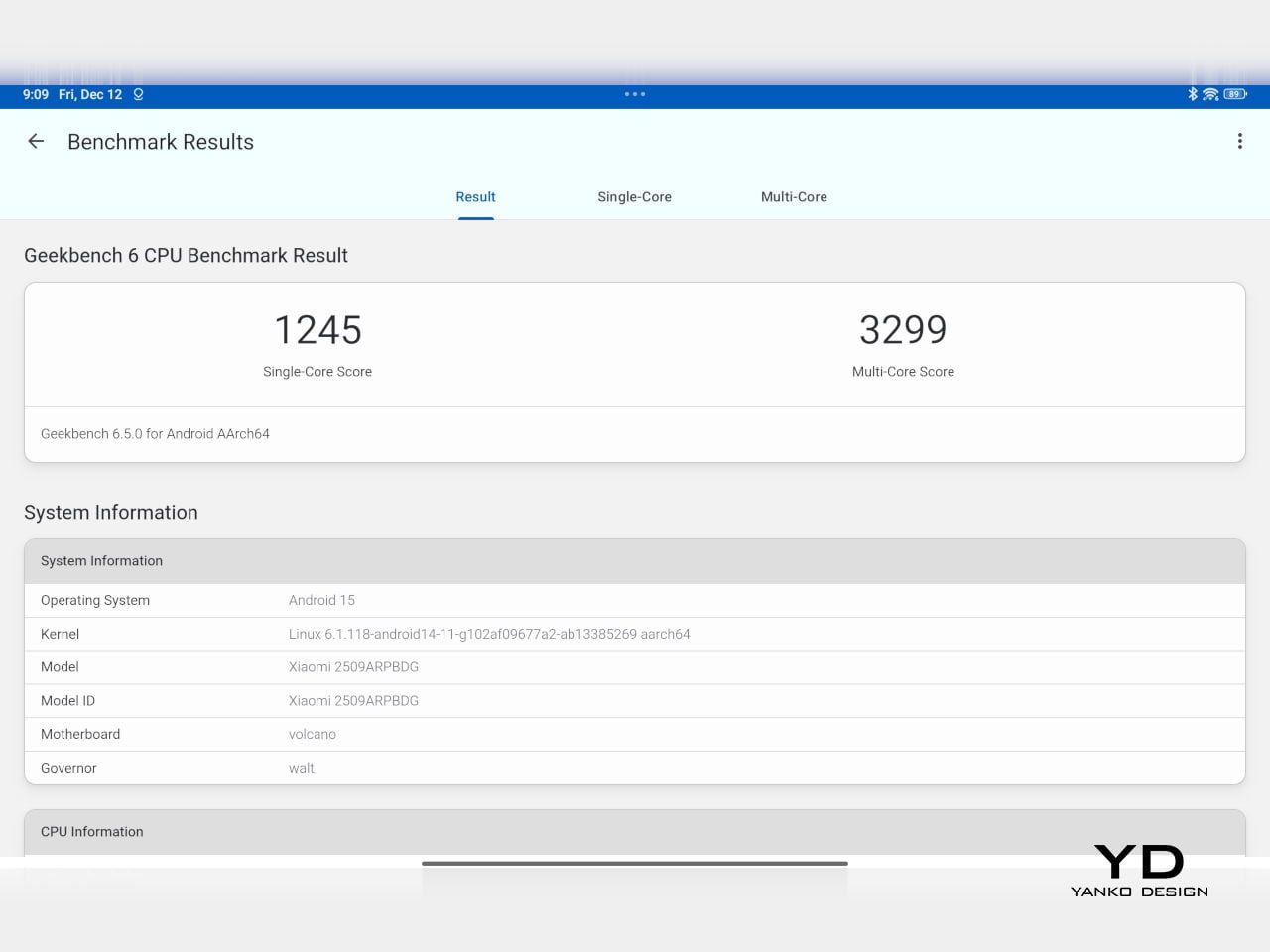
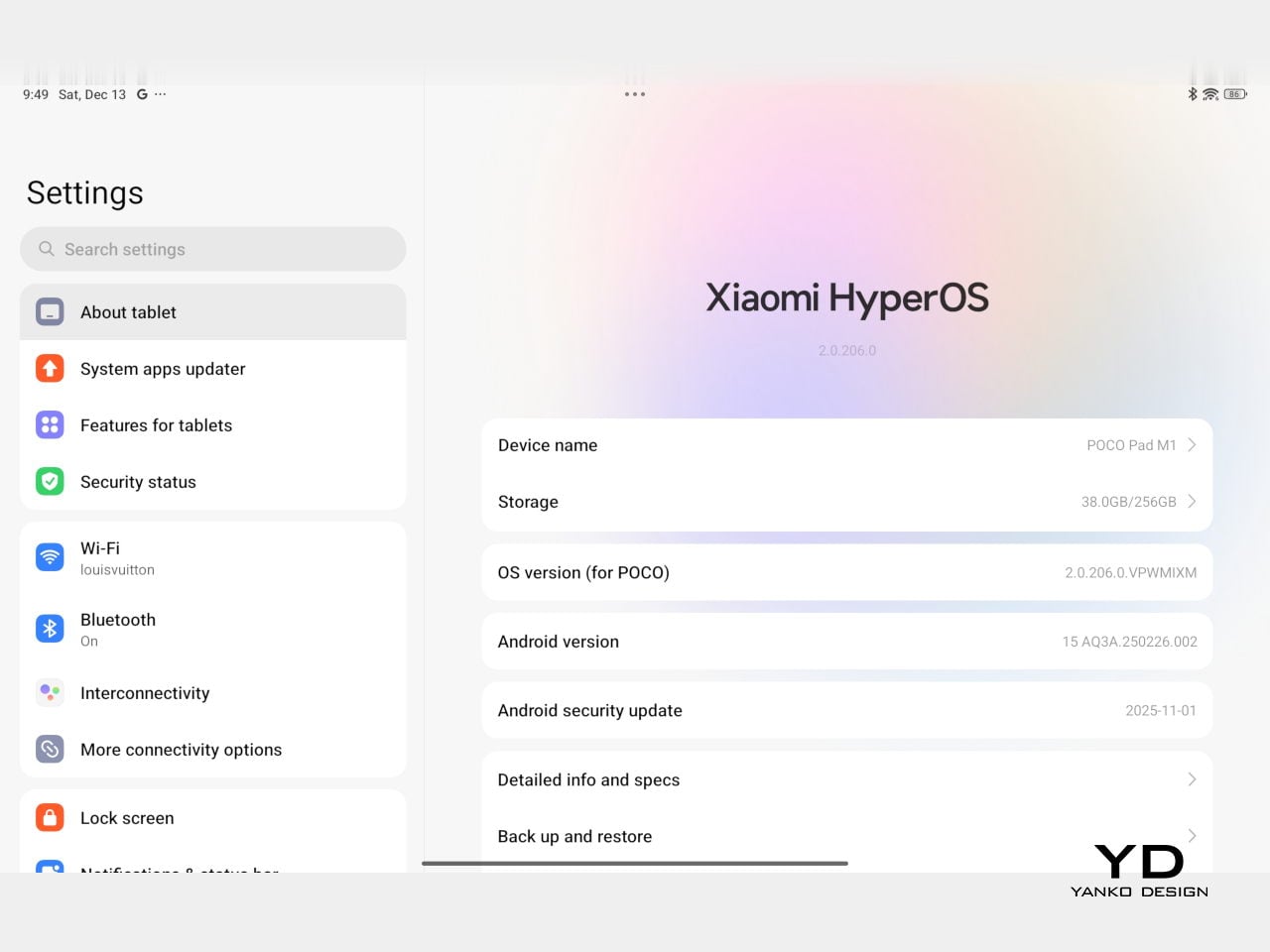
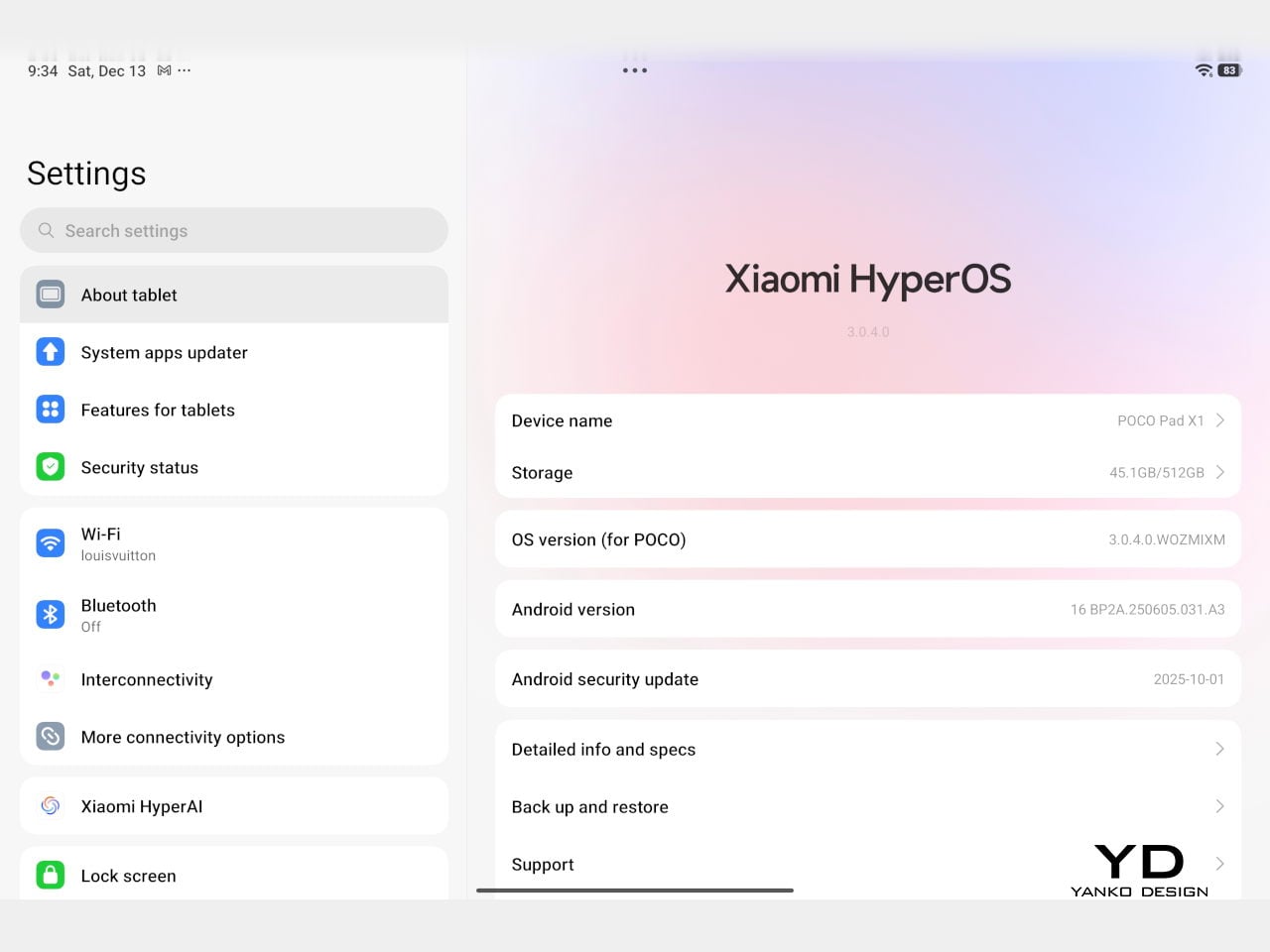
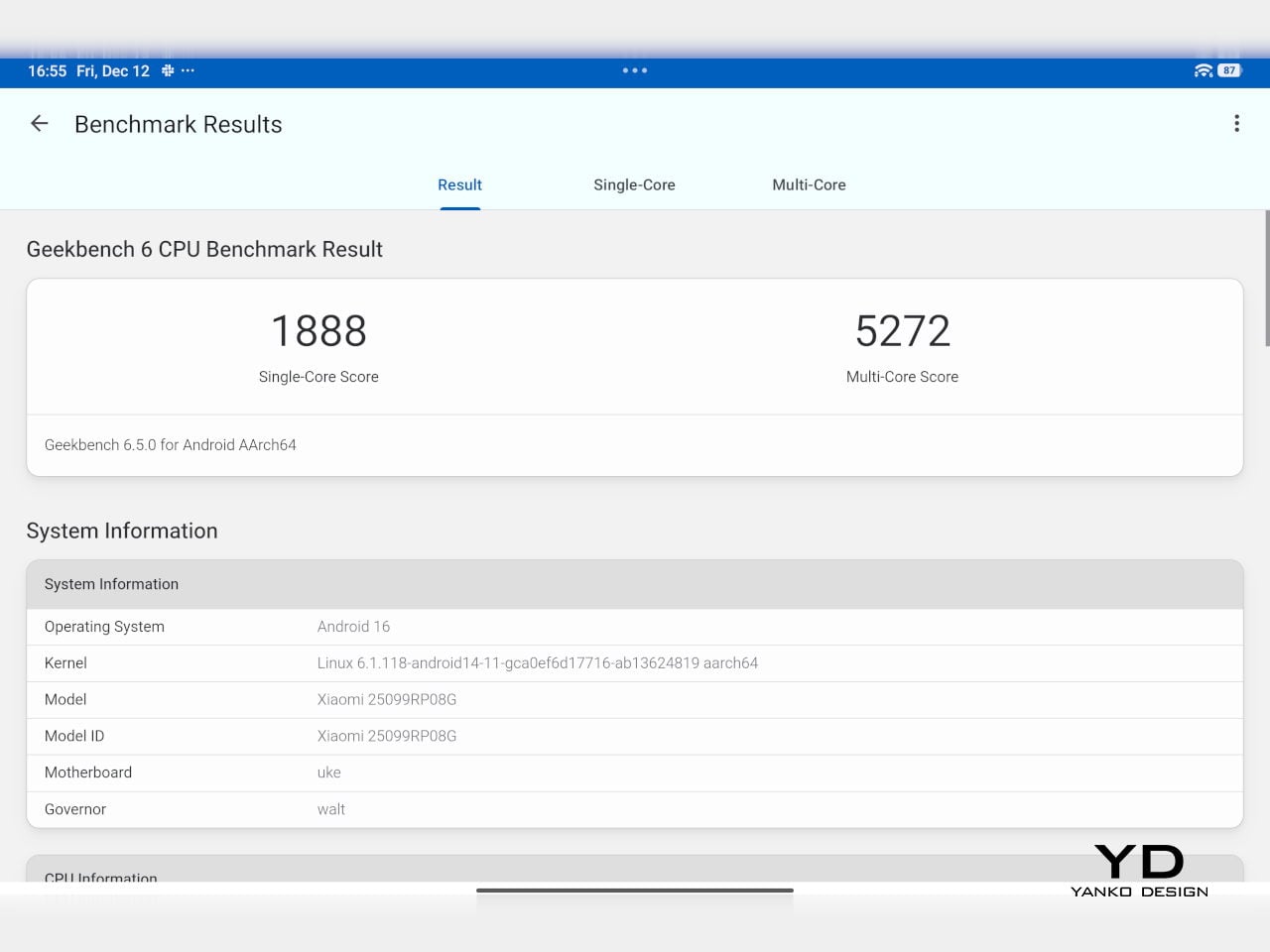
Performance and gaming clearly favor the Poco Pad X1. It uses the Snapdragon 7+ Gen 3 with 8 GB of RAM and up to 512 GB of storage, and combined with the 144 Hz panel, it feels like a handheld console that also happens to be good at multitasking and productivity. The Poco Pad M1 steps down to the Snapdragon 7s Gen 4 with 8 GB of RAM and 256 GB of storage, which is still more than enough for apps and casual gaming, but clearly tuned more for streaming, browsing, and note-taking than for chasing every last frame. In practice, the Poco Pad X1 is the one you reach for when you care about smooth, high refresh gameplay, while the Pad M1 is the one you leave on the coffee table for everyone to use.

Poco Pad M1

Battery life follows the same logic. The Poco Pad X1 pairs its 8,850 mAh battery with 45 W turbo charging, which Poco says can go from zero to full in about 94 minutes, and my experience matches that claim in day-to-day use. The Poco Pad M1 leans into a 12,000 mAh pack, billed as the largest battery in a global Poco device, with up to 105.36 hours of music playback, around 83 days of standby, 33 W charging, and up to 27 W wired reverse charging so it can top up your other devices.

Poco Pad M1

Poco Pad X1

On the software side, both run Xiaomi HyperOS with Xiaomi Interconnectivity and Google’s AI hooks, so you get shared clipboard, call and network sync, Circle to Search, and Gemini support whichever size you choose. As for cameras, Poco Pad X1 pairs a 13 MP rear camera and an 8 MP front camera, while Poco Pad M1 sticks to 8 MP sensors on both sides. The results are perfectly fine for video calls, document scans, and the odd quick snap, but nothing special, which is exactly what you would expect from tablets at this price bracket.

Poco Pad M1

Poco Pad X1

Sustainability

Poco is not making a big environmental branding play with Poco Pad X1 and Poco Pad M1, but there are a few practical touches that matter if you plan to keep a tablet for several years. The most important one is long-term software support. Both Pad X1 and Pad M1 are slated to receive four years of security updates, which gives you a clearer runway for safe everyday use. For budget tablets, that commitment is still not guaranteed across the market, so it is good to see Poco spell it out.

Poco Pad M1


That longer support window pairs well with the hardware choices. The aluminum unibody shells on both models feel sturdy enough to survive several upgrade cycles, and the generous storage options, plus microSD expansion on the Poco Pad M1, reduce the pressure to replace them early just to fit more apps or media. It is not a full sustainability story with recycled materials and carbon tracking, but if your definition of sustainable starts with buying something that will not feel obsolete or unsafe in two years, these tablets are at least pointed in the right direction.

Value

The Poco Pad X1 and Poco Pad M1 both land in the affordable bracket, but they scale very differently once you add accessories. The Poco Pad X1 with 8 GB of RAM and 512 GB of storage is $399 USD, which feels fair for the Snapdragon 7+ Gen 3 and high-end 3.2K 144 hertz display. Its accessories are priced like mini laptop gear, with the Floating Keyboard at $199 USD, the X1 Keyboard at $129 USD, the X1 Cover at $49 USD, and the Poco Focus Pen at $99 USD. A fully loaded X1 setup quickly pushes past $600 USD, but in return, you get a compact tablet that can genuinely stand in for a small laptop and drawing pad.

Poco Pad X1

The Poco Pad M1 starts cheaper at $329 USD for 8 GB and 256 GB, and its add-ons stay firmly in value territory. The M1 Keyboard is $99 USD, the M1 Cover is $29 USD, and the Poco Smart Pen is $69 USD, so even a complete kit undercuts an equivalently kitted X1 by a healthy margin. Factor in the microSD slot and 3.5 millimeter headphone jack, and M1 clearly aims to be the better deal for big screen media, note-taking, and family use, while X1 makes more sense if you are willing to pay extra for performance, storage, and that excellent Floating Keyboard experience.

Verdict

The Poco Pad X1 and Poco Pad M1 end up serving two somewhat different roles. If you prioritize performance, the Poco Pad X1 is the clear choice. The Snapdragon 7+ Gen 3, 3.2K 144 Hz display, 512 GB storage, and excellent Floating Keyboard make it feel like a serious little work and gaming machine, even if the full setup gets expensive and you give up the headphone jack and SD slot. If you care more about big-screen comfort and value, the Poco Pad M1 quietly wins. The 12.1-inch 2.5K screen, quad speakers, 3.5 mm jack, microSD expansion, huge battery, and cheaper accessories make it a better fit for big-screen media and everyday productivity.

Poco Pad X1

Whichever way you lean, you are getting more tablet than the price suggests. For context, Apple’s base iPad costs $449 with only 64 GB of storage and a 60 Hz screen. The iPad still has a faster processor and a tighter app ecosystem, but Poco gives you bigger batteries, sharper displays, and a lot more storage for less money. Pick the Poco Pad X1 if you want compact power and a great keyboard experience. Pick the Poco Pad M1 if you want maximum screen, battery, and flexibility for the money. Either way, you end up with a tablet that feels more considered than most of what you will find at this price.

The post Poco Pad X1 & Poco Pad M1 Review: Budget Tablets That Challenge the iPad first appeared on Yanko Design.
The 2025 Hyundai Elantra N: Korea’s Performance Statement That Actually Delivers


PROS:


  • Exceptional performance-per-dollar: delivers ~Type R pace for ~$11k less.

  • Front-end grip and composure: e‑LSD reins in torque and keeps line mid-corner.

  • Large performance breaks: strong bite, progressive feel, no fade in spirited use.

  • 8‑speed wet DCT: rapid shifts, smart logic, smooth commuting, robust launch control.

  • Adaptive dampers: real spread from Normal comfort to Sport attack.

CONS:


  • Firm ride and road noise can fatigue on rough pavement in Sport modes.

  • Styling is polarizing; aero and accents won’t suit subtle tastes.

RATINGS:

AESTHETICS
ERGONOMICS
PERFORMANCE
SUSTAINABILITY / REPAIRABILITY
VALUE FOR MONEY

EDITOR'S QUOTE:

Track-ready when you want it, daily-friendly when you need it; performance without the premium tax

The 2025 Elantra N arrived at my driveway on a Monday morning, and within the first five minutes behind the wheel, I understood why Hyundai’s N division has earned its reputation. This is not a compromised daily driver with sporty aspirations. This is a legitimate performance machine that happens to be practical enough for grocery runs.

Designer: Hyundai

At around $33,000, the Elantra N undercuts the Honda Civic Type R by roughly $11,000 while delivering 276 horsepower through a chassis that feels purpose-built for enthusiast driving. That price gap matters, especially when you consider what you’re getting for the money.

Design and Ergonomics: Cohesive Performance Inside and Out

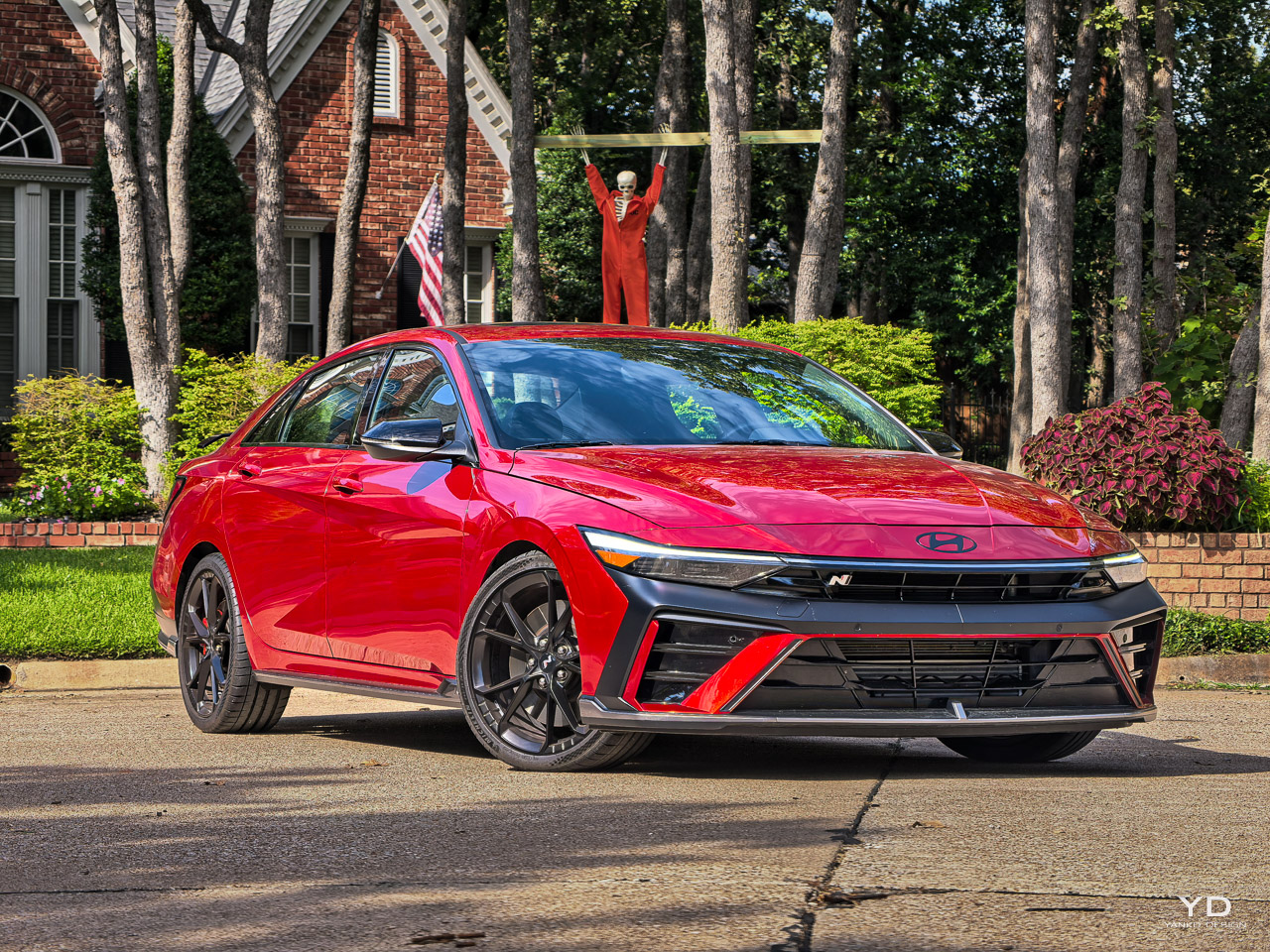
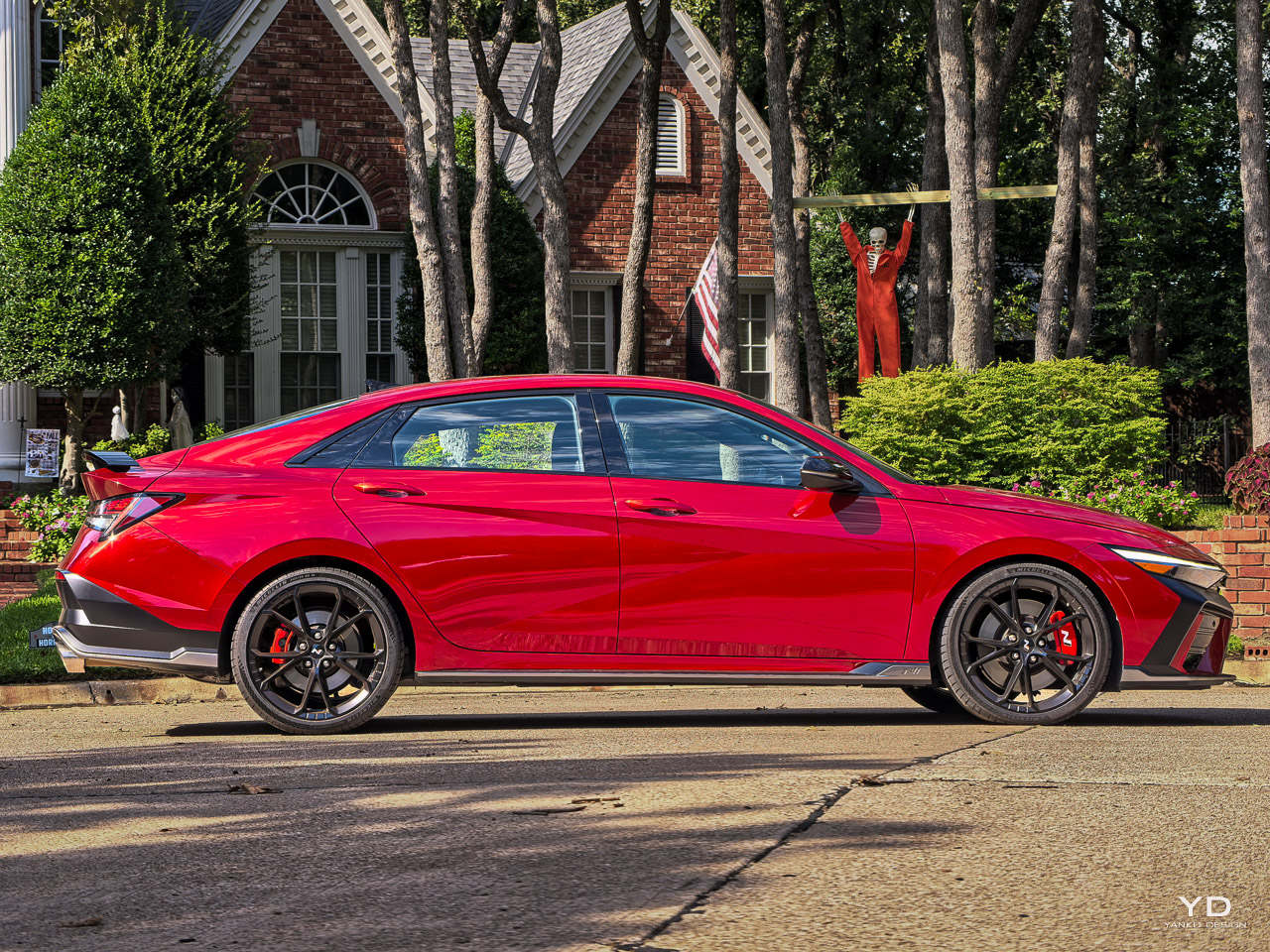
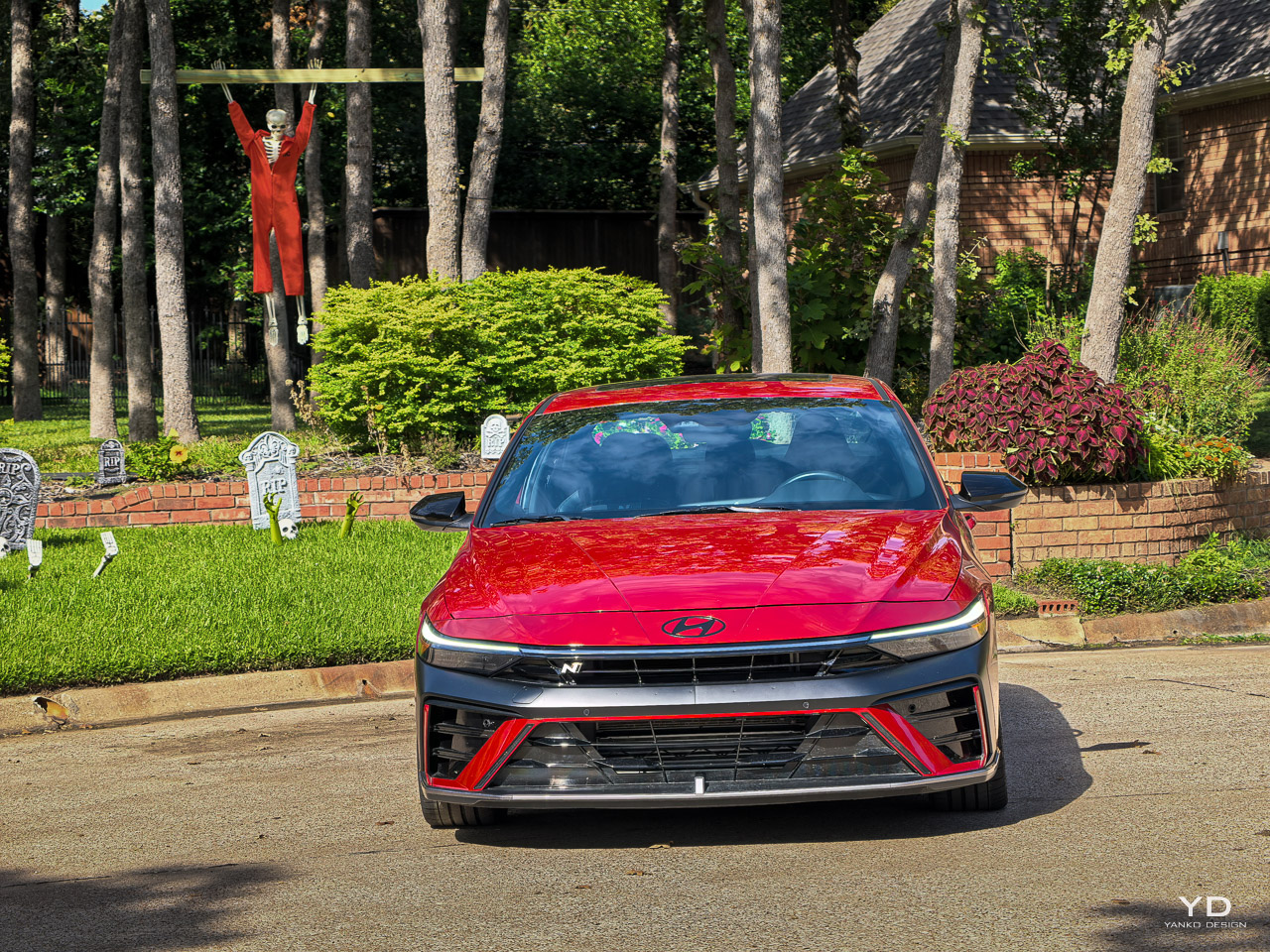
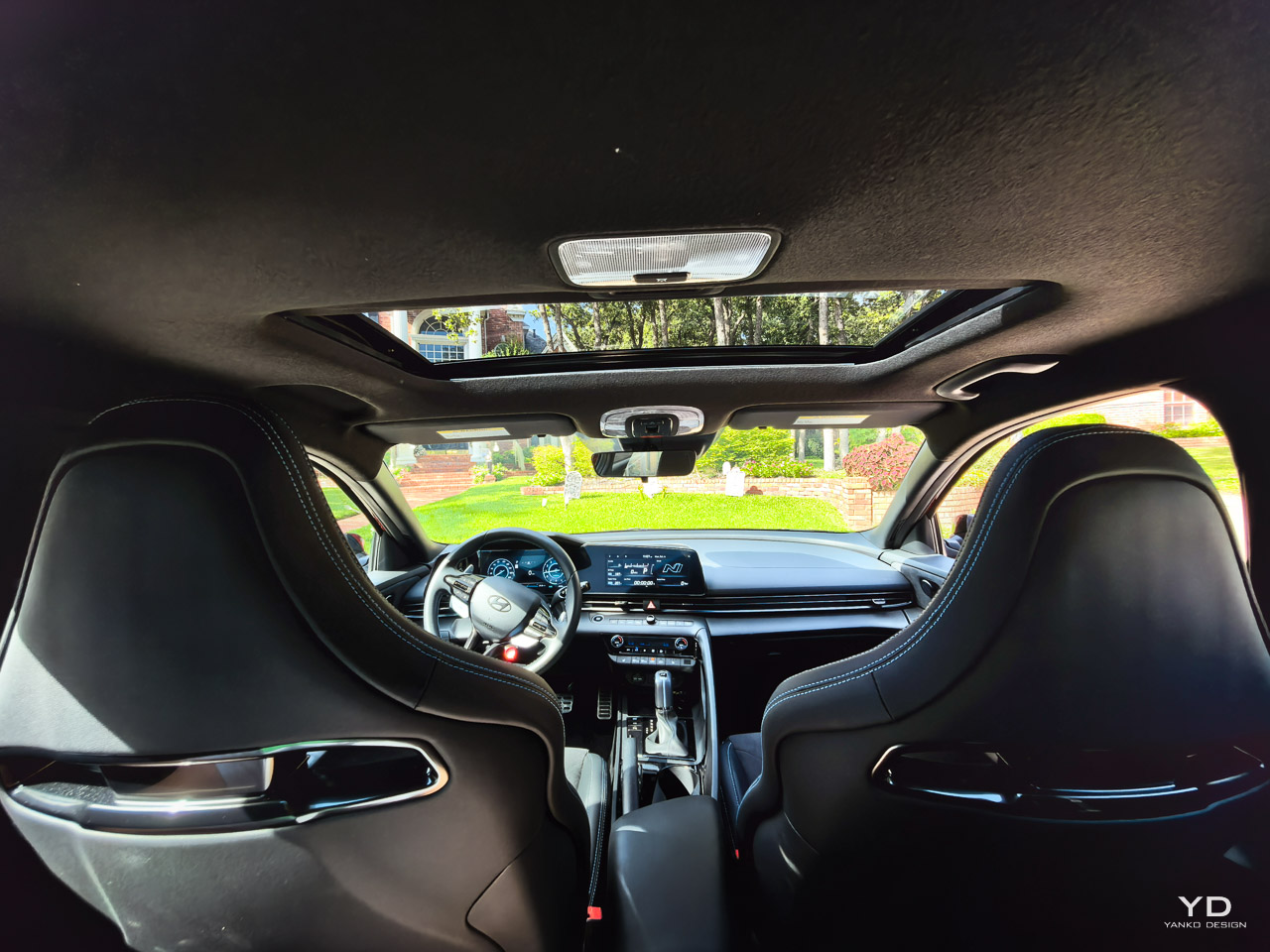
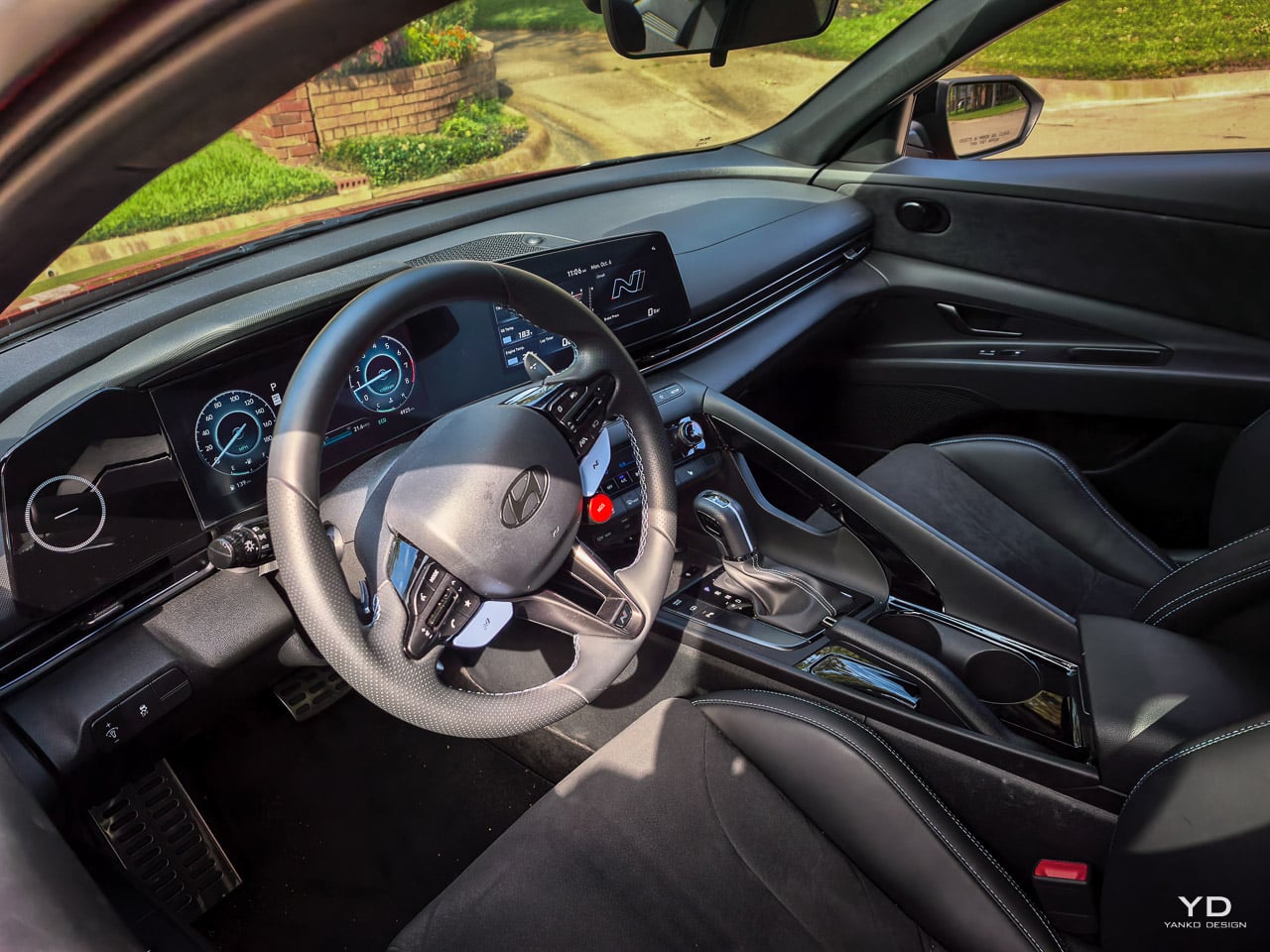
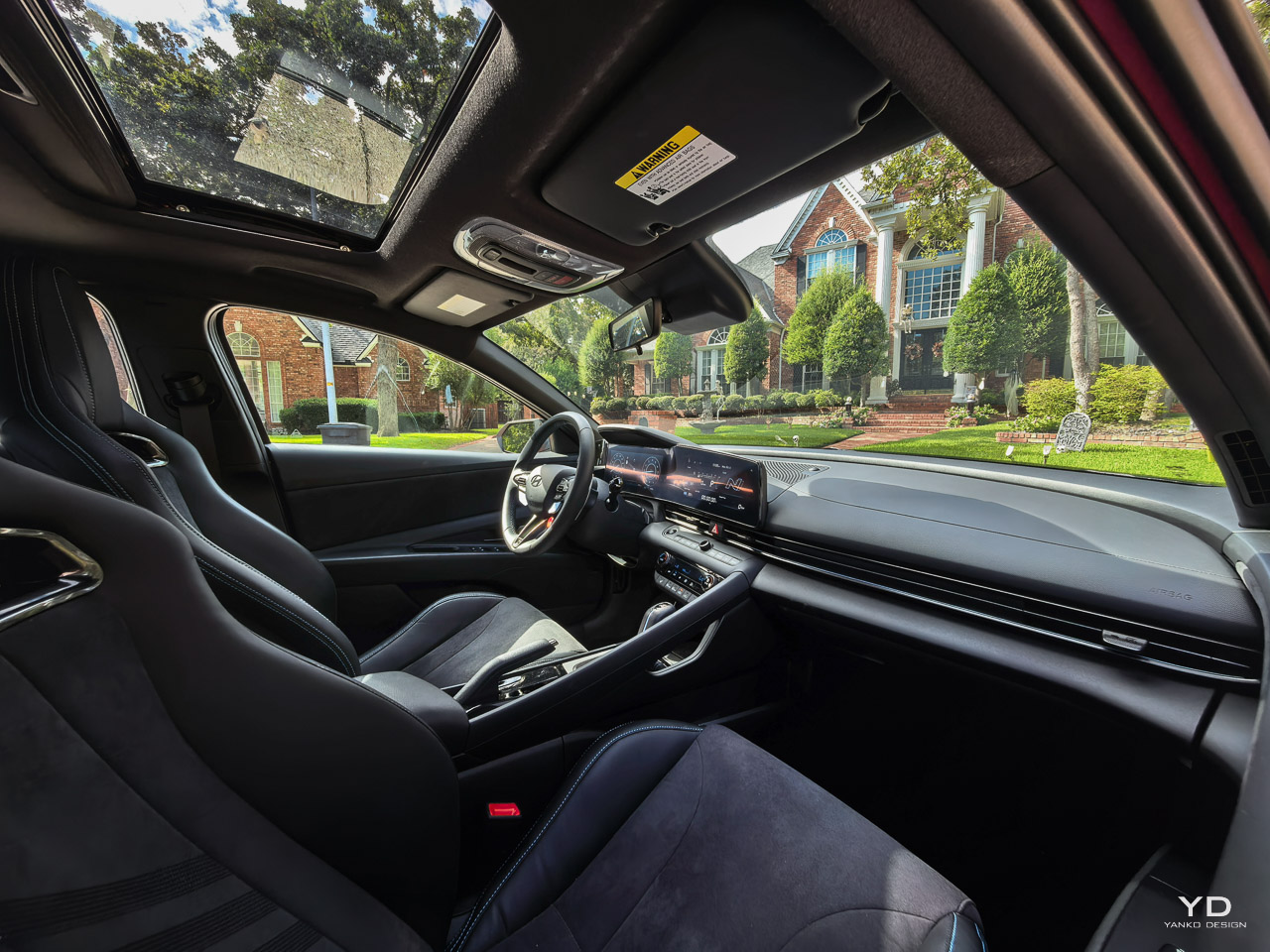
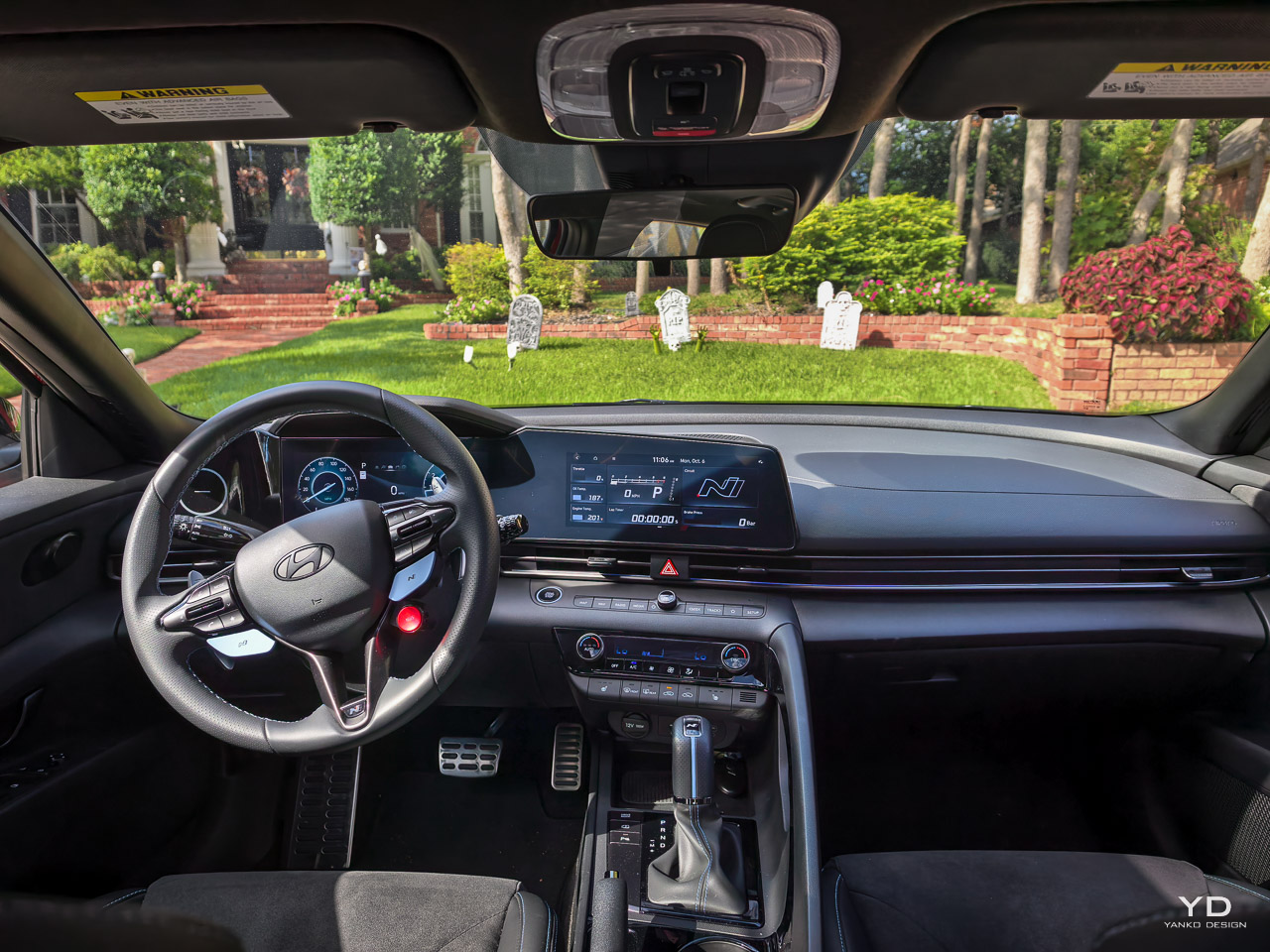
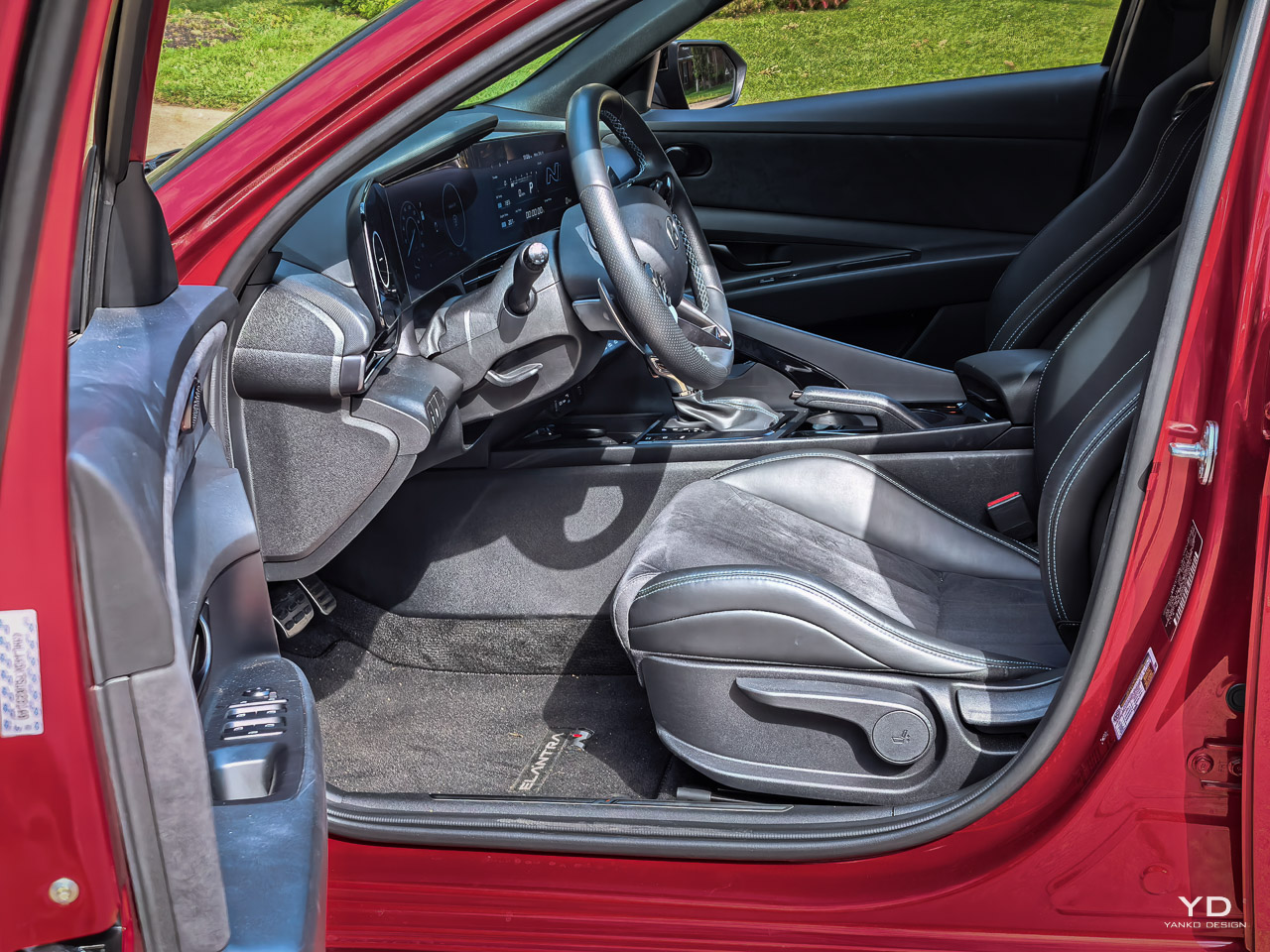
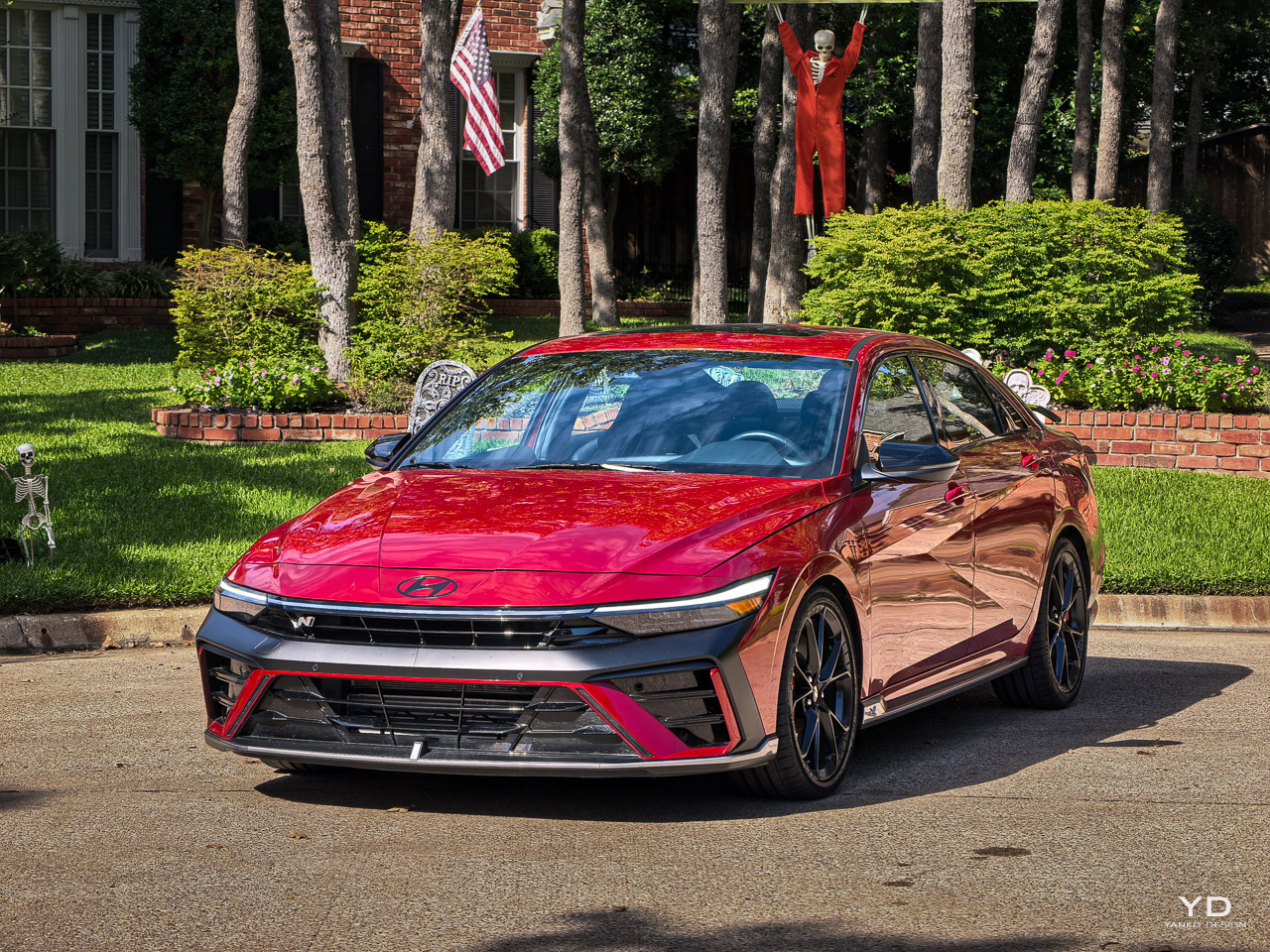
Hyundai’s “circuit sophistication” shows up everywhere: from the functional front intakes and aero management outside to the way your hands, eyes, and torso interface with the car inside. The Elantra N looks planted because it is, and the cockpit is arranged to help you drive it that way.

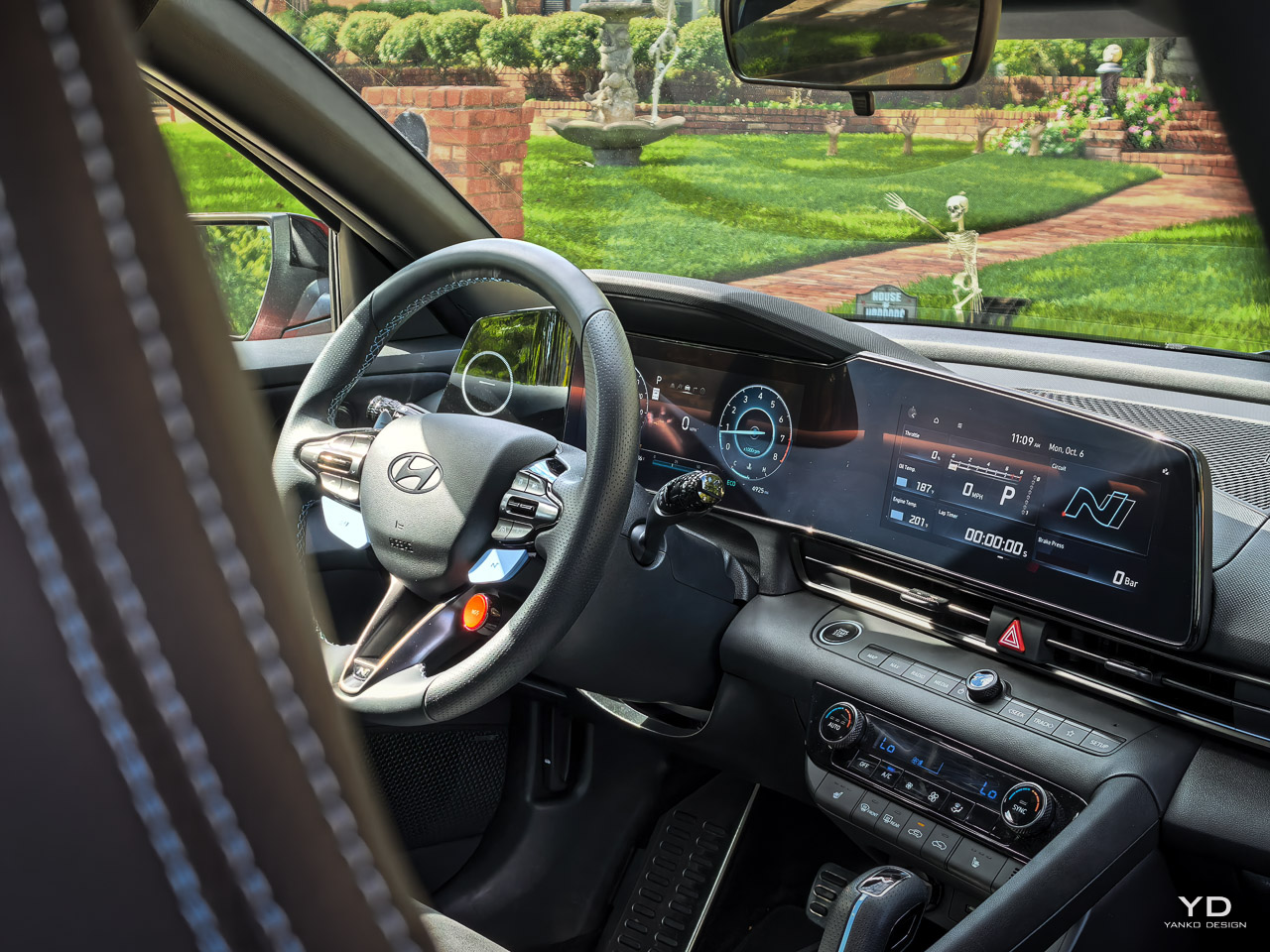
Air is managed with purpose outside; inputs are managed with equal intent inside. The N-mode buttons live exactly where your thumbs fall, the paddles are immediate, and the thick-rim wheel keeps your hands quiet and steady. Grippy suede on key touch zones favors control over flash. The heavily bolstered seats don’t just photograph sporty. They hold you when lateral loads build, without punishing you in the commute. Seat bolstering and hip-point height align with the car’s low roll attitude, so you feel the chassis working rather than bracing against it.

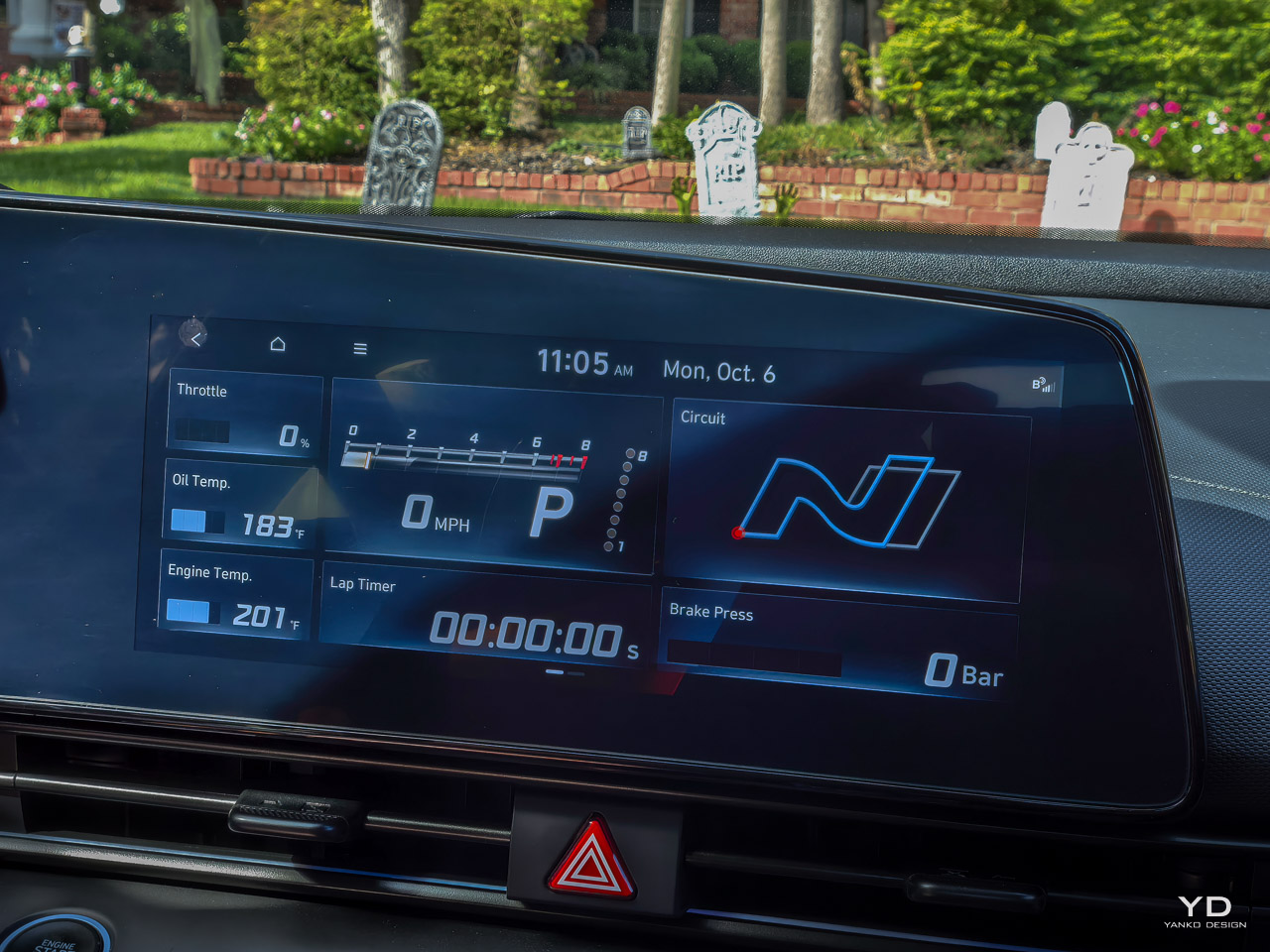
Information carries the same restraint. The N-specific cluster surfaces telemetry you want when you’re pushing, yet it never overwhelms during a coffee run. Compared to the GR Corolla’s rally bravado or the Type R’s anime aggression, Hyundai’s drama feels purposeful rather than performative. The Volkswagen GTI offers restrained elegance, the Golf R delivers understated menace, but Hyundai targets buyers who want their performance intentions visible from three lanes away.

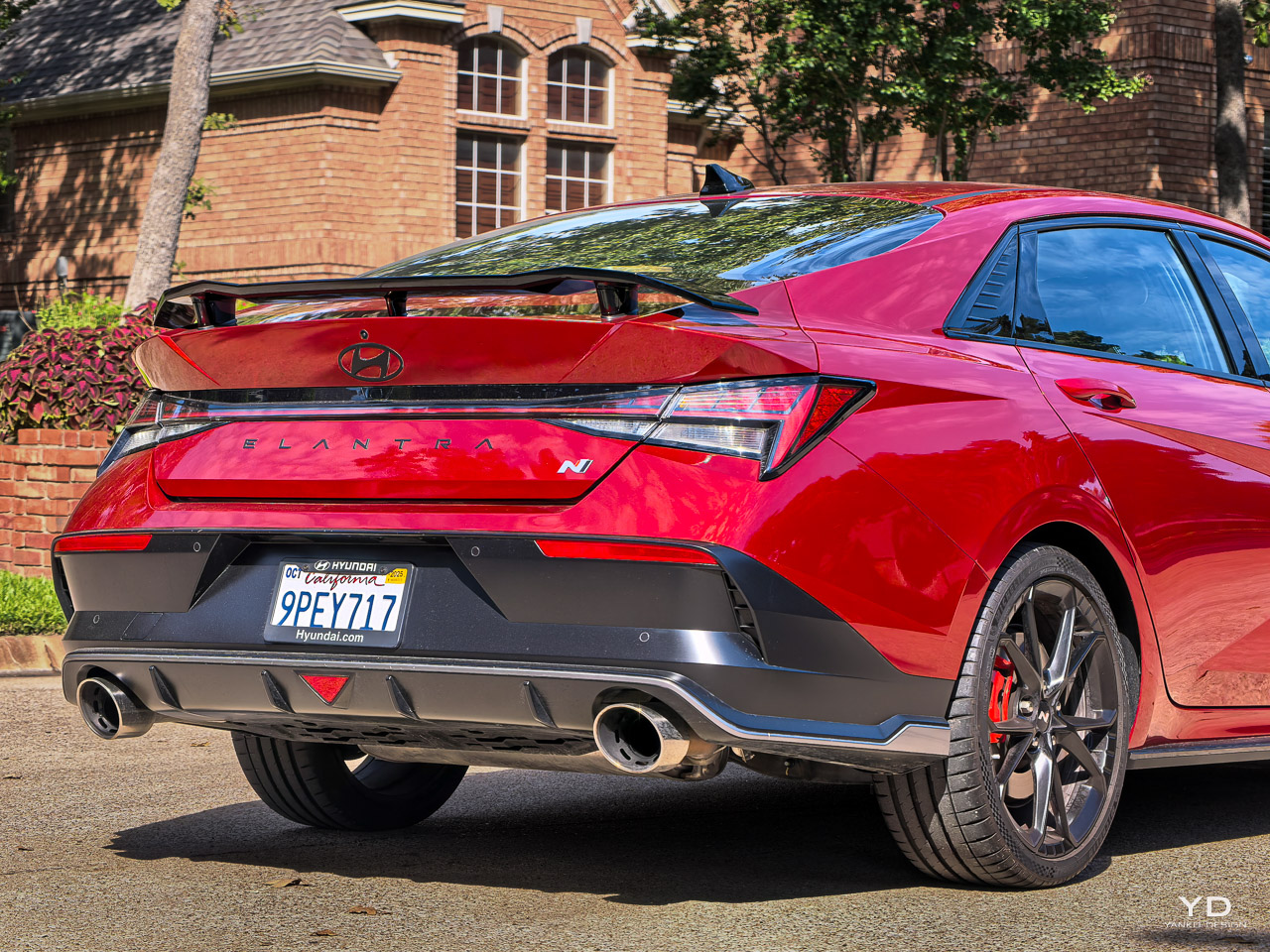
If you want your performance car to advertise its intent from three lanes over, the Elantra N obliges. If you want the cockpit to back that up with clean ergonomics and low noise-to-signal while you’re actually driving, it does that, too. The N-specific blue accents and geometric wheel design create visual cohesion that feels intentional rather than applied by committee.

Technology That Stays Out Of The Way

The 10.25-inch touchscreen runs Hyundai’s latest infotainment system with Apple CarPlay and Android Auto. The interface is responsive and logical. I never fumbled through menus trying to find basic functions. The navigation system worked reliably, though I primarily used CarPlay during my test week.

Hyundai’s SmartSense safety suite is standard, including forward collision warning, blind-spot monitoring, and lane-keeping assist. The systems work unobtrusively in Normal mode. They’re more intrusive in Sport modes, which makes sense because the car is more aggressive in those settings. You can disable most features if they annoy you.

The sound system is good but not exceptional. It’s clear and reasonably powerful, adequate for daily use but not audiophile-grade. The active exhaust provides most of the soundtrack anyway, especially in Sport mode where it pops and crackles on overrun like a proper performance car should.

Daily Driving Reality Check

I drove the Elantra N for seven days as my only vehicle. I ran errands, sat in traffic, made highway trips, and attacked back roads whenever the opportunity presented itself. The car excelled in all those scenarios without demanding unreasonable compromises.

Fuel economy averaged 25 mpg in my mixed driving, which included plenty of enthusiastic acceleration and some sustained highway cruising. The EPA rates it at 22 city and 31 highway. Those numbers are realistic if you can resist the urge to use all that power constantly.

The ride quality is firm but never harsh. The engine note at highway speeds is present but not intrusive. The wind noise is well-controlled. This is a car you can live with every day without feeling like you’re making sacrifices for performance capability.

The Competition Context

The Honda Civic Type R costs around $44,000 and offers 315 horsepower with more aggressive styling. It’s the benchmark for front-wheel-drive performance, and it holds that crown for good reason. But that $11,000 price gap is significant, especially when the Elantra N delivers 90% of the Type R’s capability at 75% of the cost.

The Volkswagen GTI offers hot hatch refinement at a similar price point but with less power and a softer character. It’s the mature choice where the Elantra N is the enthusiast’s choice.

What Works And What Doesn’t

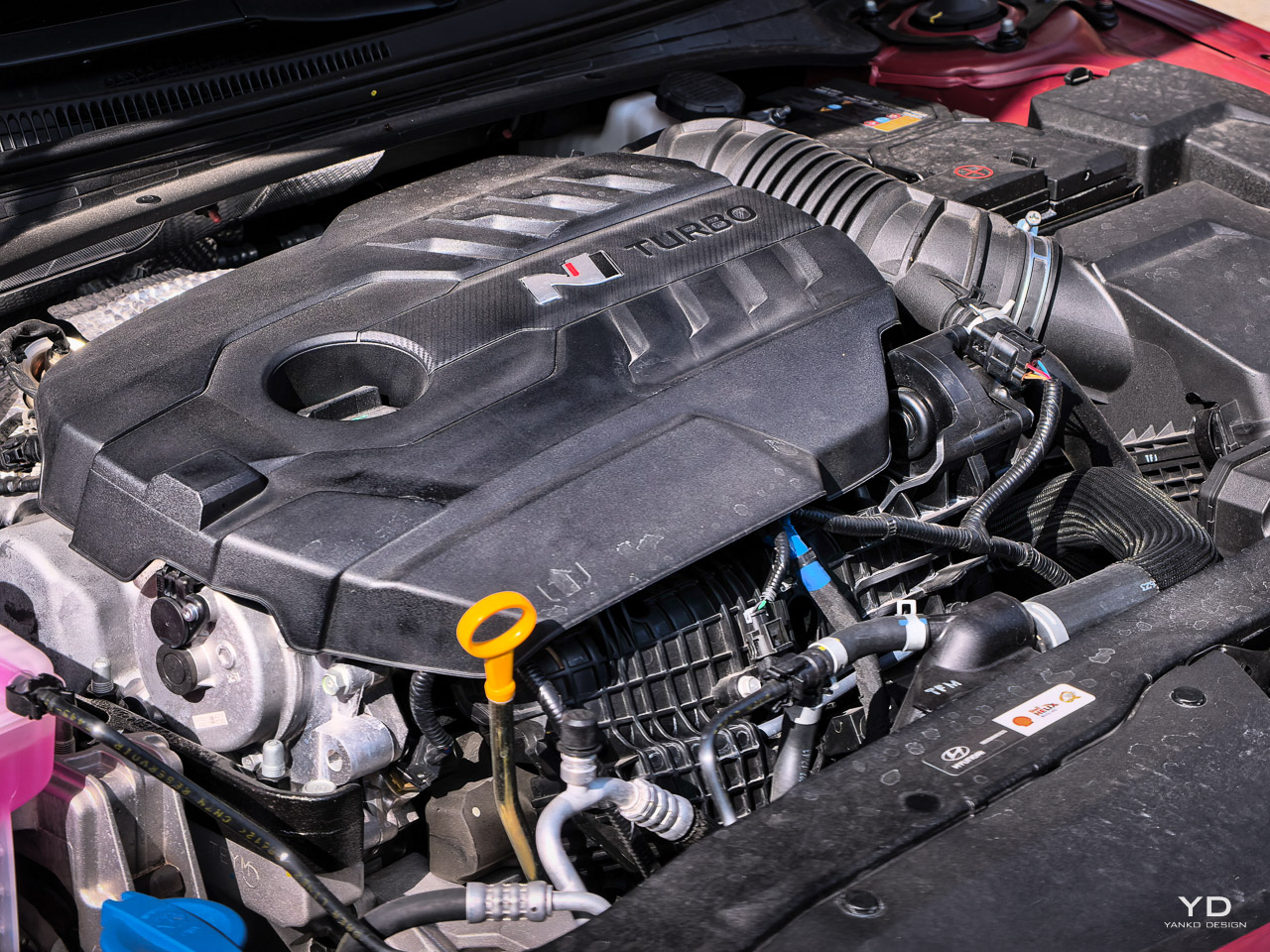
The Elantra N succeeds because Hyundai committed fully to the performance mission without half-measures. The chassis is properly sorted. The engine delivers usable power across the rev range. The DCT transmission offers performance and convenience in equal measure. The brakes inspire confidence. These fundamentals matter more than any individual feature or specification.

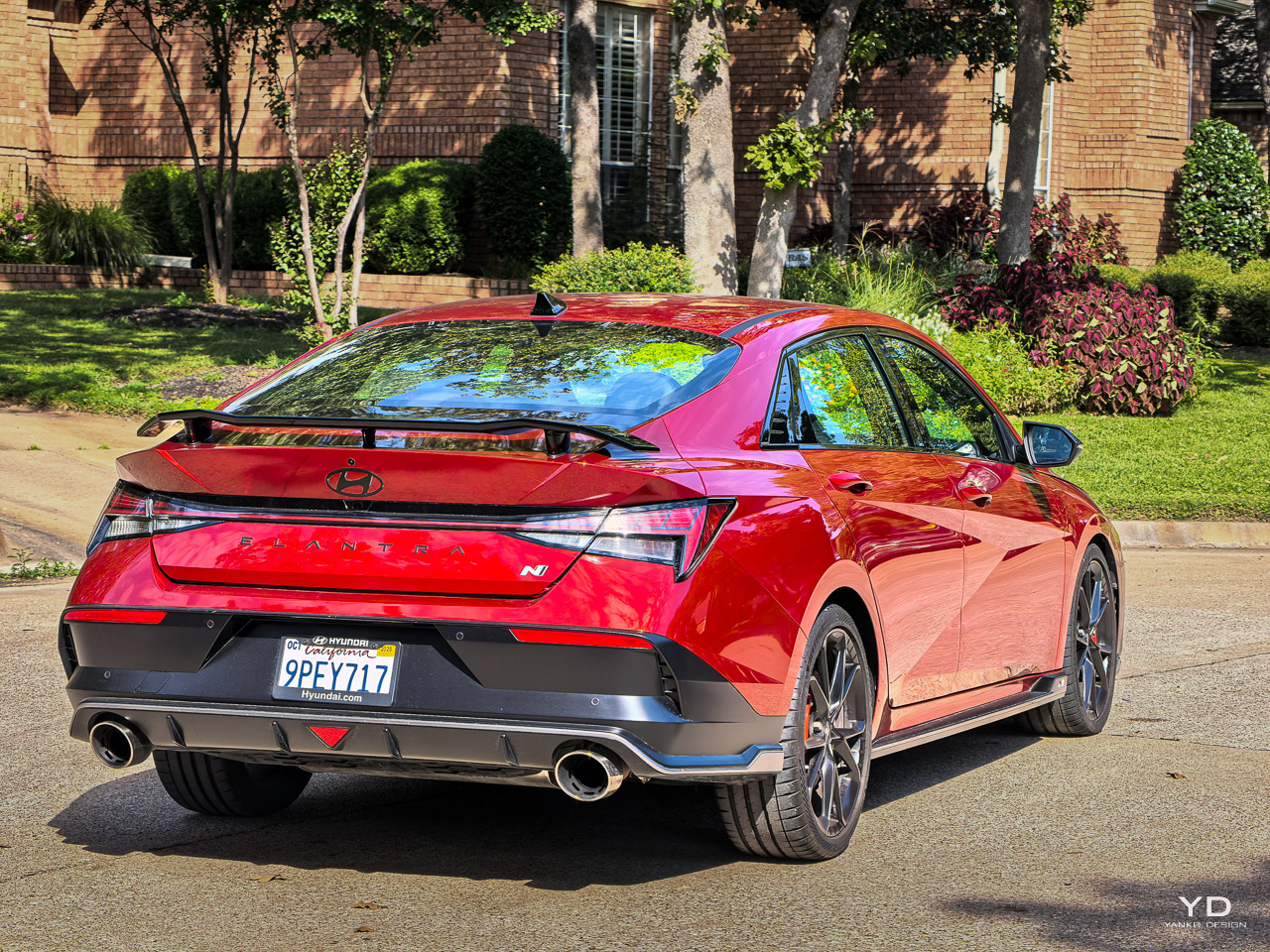
The styling won’t appeal to everyone. It’s aggressive with large intakes, a prominent rear wing, and N-branded blue accents throughout. You’ll either love the look or find it too much. There’s no middle ground, and Hyundai clearly doesn’t care about attracting buyers who want subtle performance.

The ride quality might be too firm for some buyers, particularly in Sport modes. If you prioritize comfort over handling precision, this probably isn’t your car. But if you value dynamic capability and driving engagement, the firm suspension makes sense.

The Bottom Line

The 2025 Hyundai Elantra N with the 8-speed DCT delivers legitimate performance sedan capability at a price that undercuts its primary competition by thousands of dollars. It’s quick, engaging, practical enough for daily use, and genuinely fun to drive hard. Hyundai’s N division has proven it can build cars that satisfy enthusiast drivers without requiring premium pricing.

This is the performance sedan for buyers who want the driving experience without the luxury brand markup. It’s honest, capable, and more enjoyable than its price tag suggests it has any right to be. After a week of driving it in every scenario from rush hour traffic to empty back roads, I came away impressed by how well Hyundai balanced performance and practicality.

The automatic transmission adds a layer of accessibility without compromising the car’s enthusiast credentials. Whether you’re navigating downtown traffic or attacking a favorite back road, the DCT adapts seamlessly to deliver exactly the experience you want.

If you’re shopping for a performance sedan under $35,000, the Elantra N deserves serious consideration. It’s not trying to be everything to everyone. It’s focused on delivering driving enjoyment, and it succeeds without apology.

The Subaru WRX starts around $32,000 with all-wheel drive and 271 horsepower. It’s a different character entirely, built for rally-inspired traction rather than front-wheel-drive dynamics. The WRX feels more utilitarian where the Elantra N feels more refined.

The post The 2025 Hyundai Elantra N: Korea’s Performance Statement That Actually Delivers first appeared on Yanko Design.
❌