By 1996, the arcade was dying. Virtua Fighter and Tekken had the crowds. Sega’s racing cabinets had the spectacle. The conventional wisdom was that 2D games were finished, and anyone still making pixel art sidescrollers was simply behind the curve. Then Nazca Corporation released Metal Slug on SNK’s Neo Geo hardware, and the conventional wisdom had to sit quietly in a corner for a while. The game’s hand-animated sprites moved with a fluidity that polygon games couldn’t touch, and the humor, panicking soldiers, grateful POWs tossing rocket launchers, a tank that waddled like a toy, made the whole thing feel alive in a way that pure technical showmanship never quite manages.
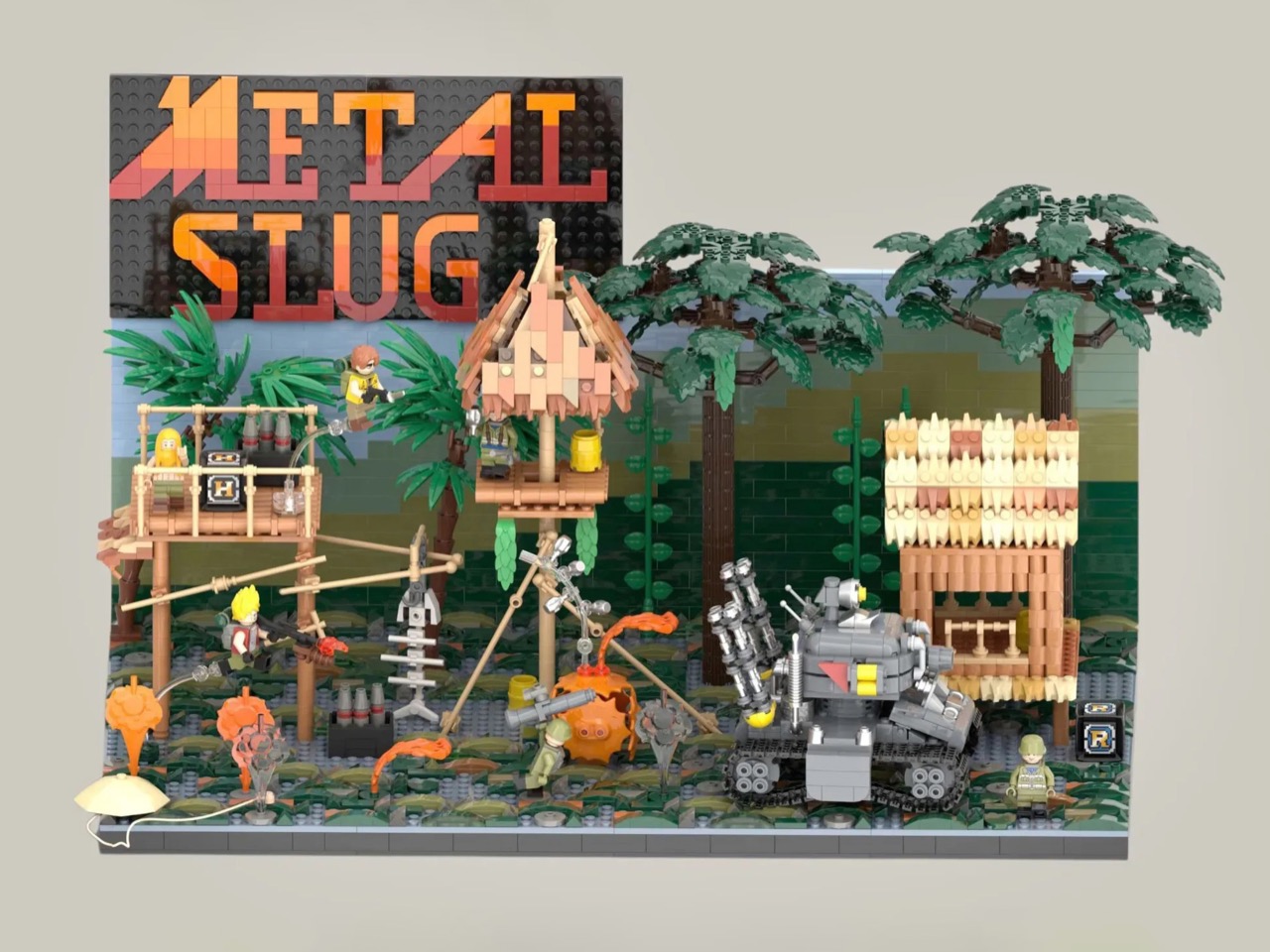
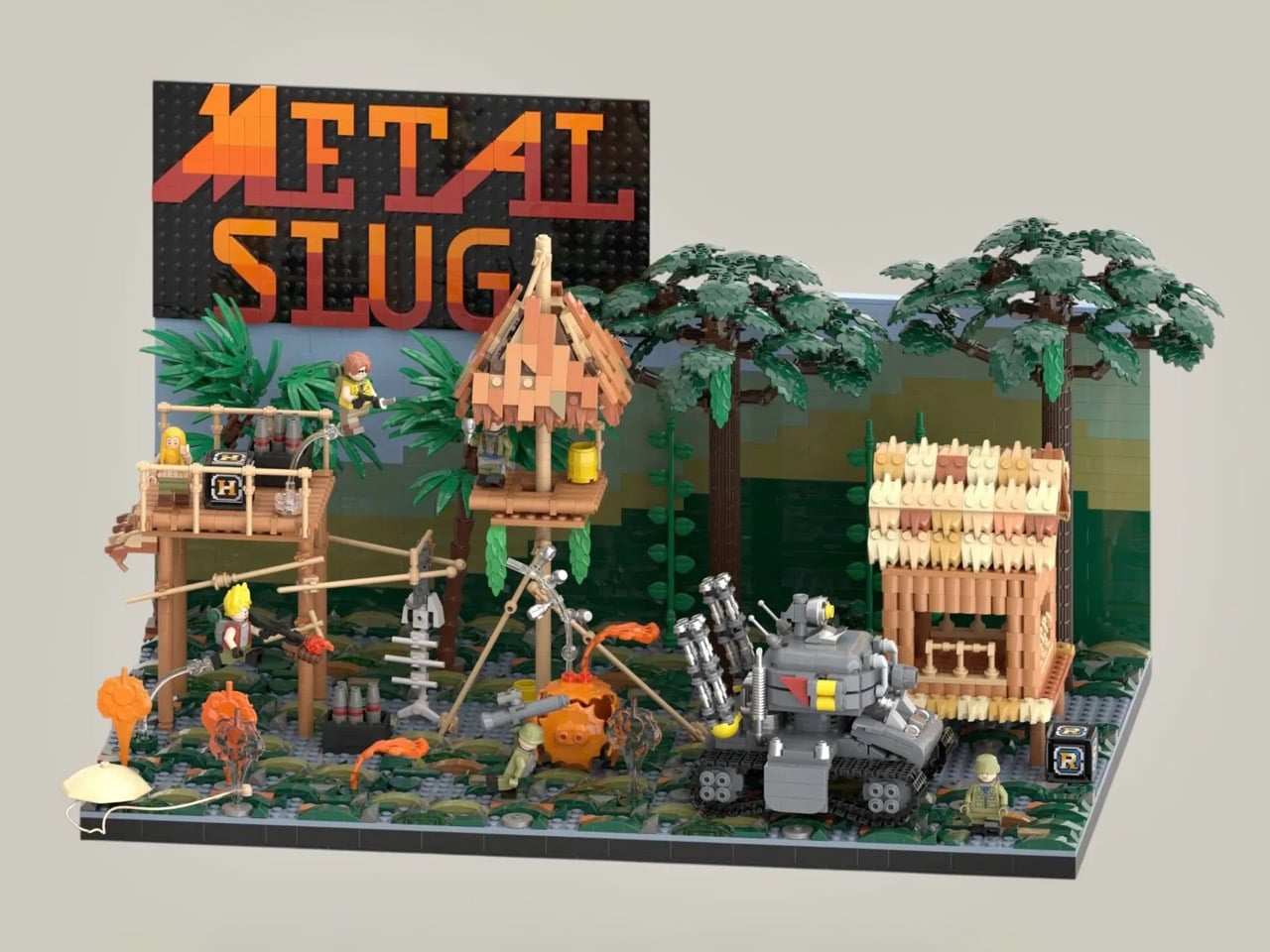
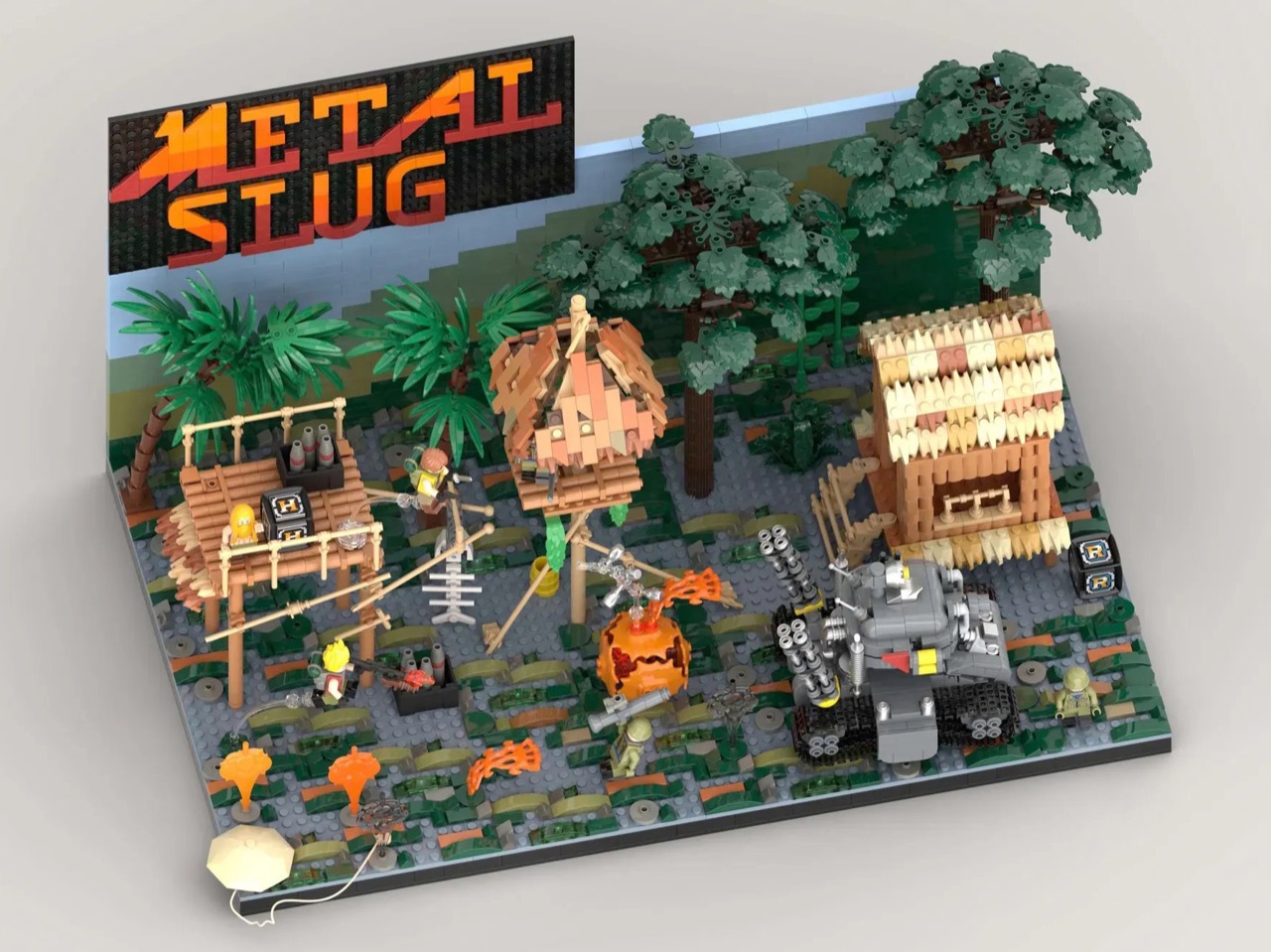
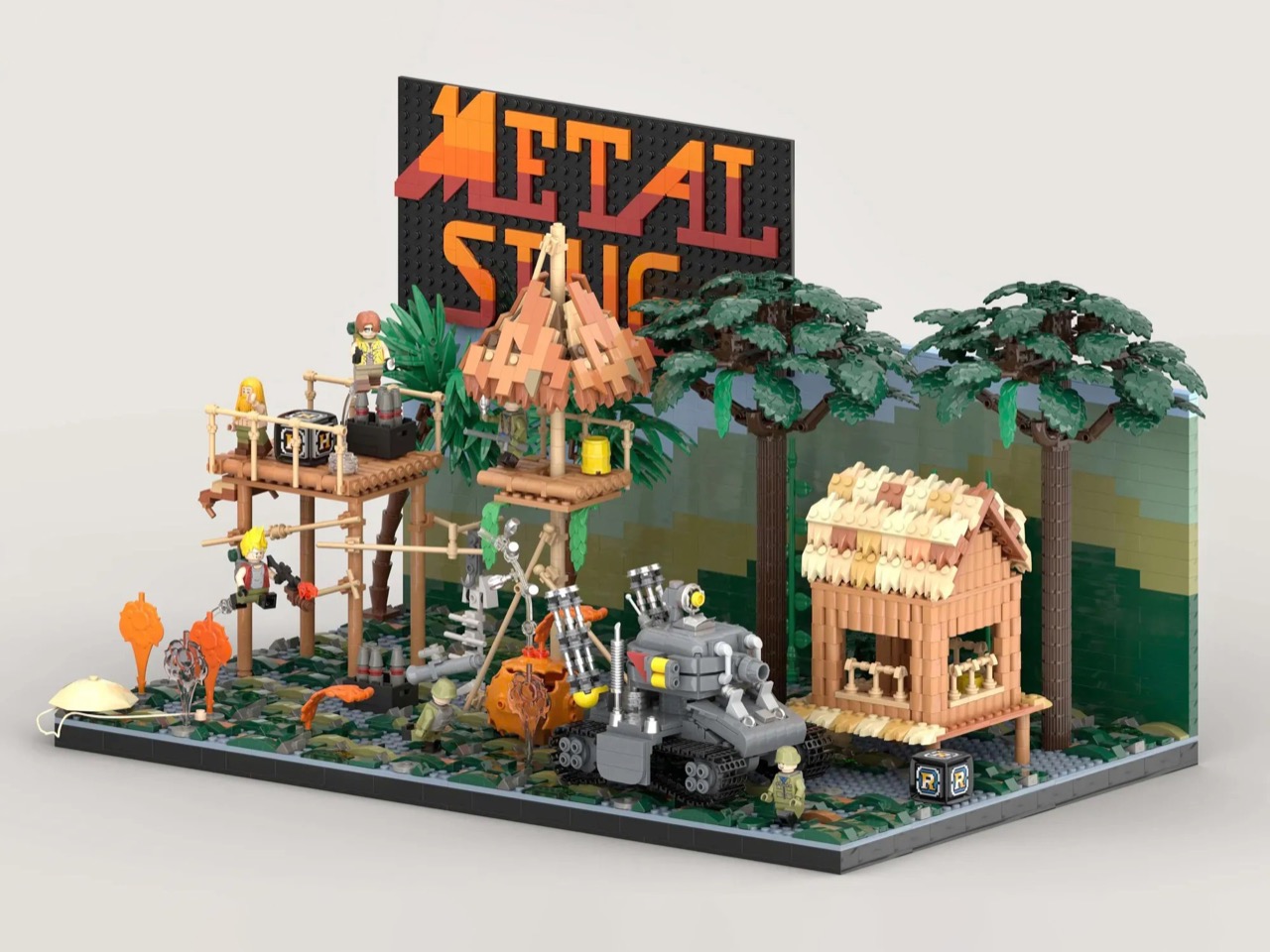
LEGO Ideas builder MagicBrick has captured a freeze-frame of that world in brick form, reconstructing the game’s iconic jungle mission with 2,701 pieces and 6 minifigures locked into a scene of swamp terrain, rebel soldiers, dense jungle vegetation, and the squat, waddling Super Vehicle-001 tank at the center of it all. It’s a dense, affectionate build made by someone who clearly lost many, many credits to this game, and it shows in every deliberately chosen detail, from the mid-jump Marco Rossi clutching a Heavy Machine Gun to the bearded POW standing by with a reward.
Designer: MagicBrick
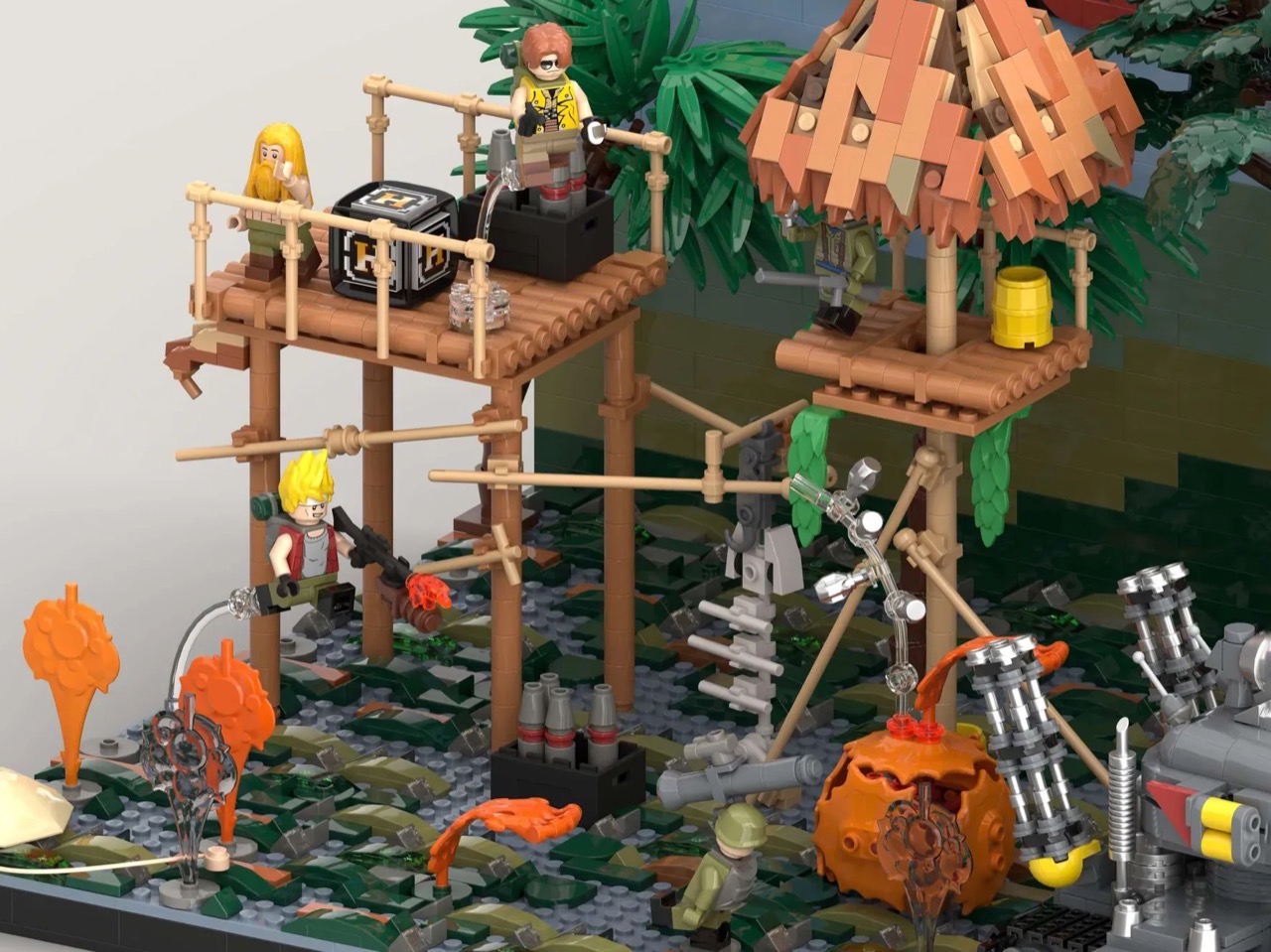
The scene is structured like a freeze-frame from the game itself, which is exactly the right instinct. MagicBrick describes the goal as capturing “a dynamic instant where everything is in motion: jumps, actions, and interactions come together to recreate the fast-paced feeling typical of the game,” and the build delivers on that. Marco Rossi in his red jacket is airborne, Heavy Machine Gun in hand. Tarma Roving, yellow jacket, stands ready with a pistol and knife. Three Rebel Army soldiers in green uniforms and helmets fill out the opposition, armed with bazookas and rifles. The swamp base uses tiles in multiple shades to sell the terrain, jungle trees and palms crowd the background, and the brick-built backdrop reflects the arcade color palette of the original game rather than any attempt at realism. That last decision is a smart one. Metal Slug was never interested in realism, and neither is this.
The Super Vehicle-001 is the centerpiece, and MagicBrick has packed a surprising amount of function into a compact footprint. The rear cannons are adjustable, the tracks are functional, and antennas complete the silhouette. Scattered across the scene are the environmental details that will hit Metal Slug veterans like a reflex: ammo crates, yellow barrels, a hanging fish skeleton, a parachute, and both the Heavy Machine Gun and Rocket Launcher power-up pickups rendered in brick. My favorite touch, though, is the grenade sequence, a classic cartoon-logic arc of thrown grenades ending in a mid-air explosion, frozen in plastic at exactly the right moment of absurdity.
Topping the whole structure is the Metal Slug logo itself, rendered in a red-to-orange gradient that makes the build read as a display piece as much as a playset. It’s that combination of environmental storytelling, playable features, and genuine fan knowledge that separates builds like this from generic video game tributes.
LEGO Ideas is the platform where fan-designed MOCs (My Own Creations) gather community votes, with 10,000 supporters needed to trigger an official LEGO review and potential production as a retail set. MagicBrick’s Metal Slug submission hit 100 supporters almost immediately after going live and has been picking up Reddit traction since. If you grew up feeding tokens into a Neo Geo cabinet, head to the LEGO Ideas page and cast your vote here.
Beethoven composed his Ninth Symphony completely deaf. He never heard a single note of it performed, yet it remains one of the most emotionally overwhelming pieces of music ever written. That particular detail about his life has a way of stopping people cold, the idea that the instrument of his perception was gone, and yet the music kept coming, arguably better than ever. There are very few stories in human history that capture creative resilience quite like his.
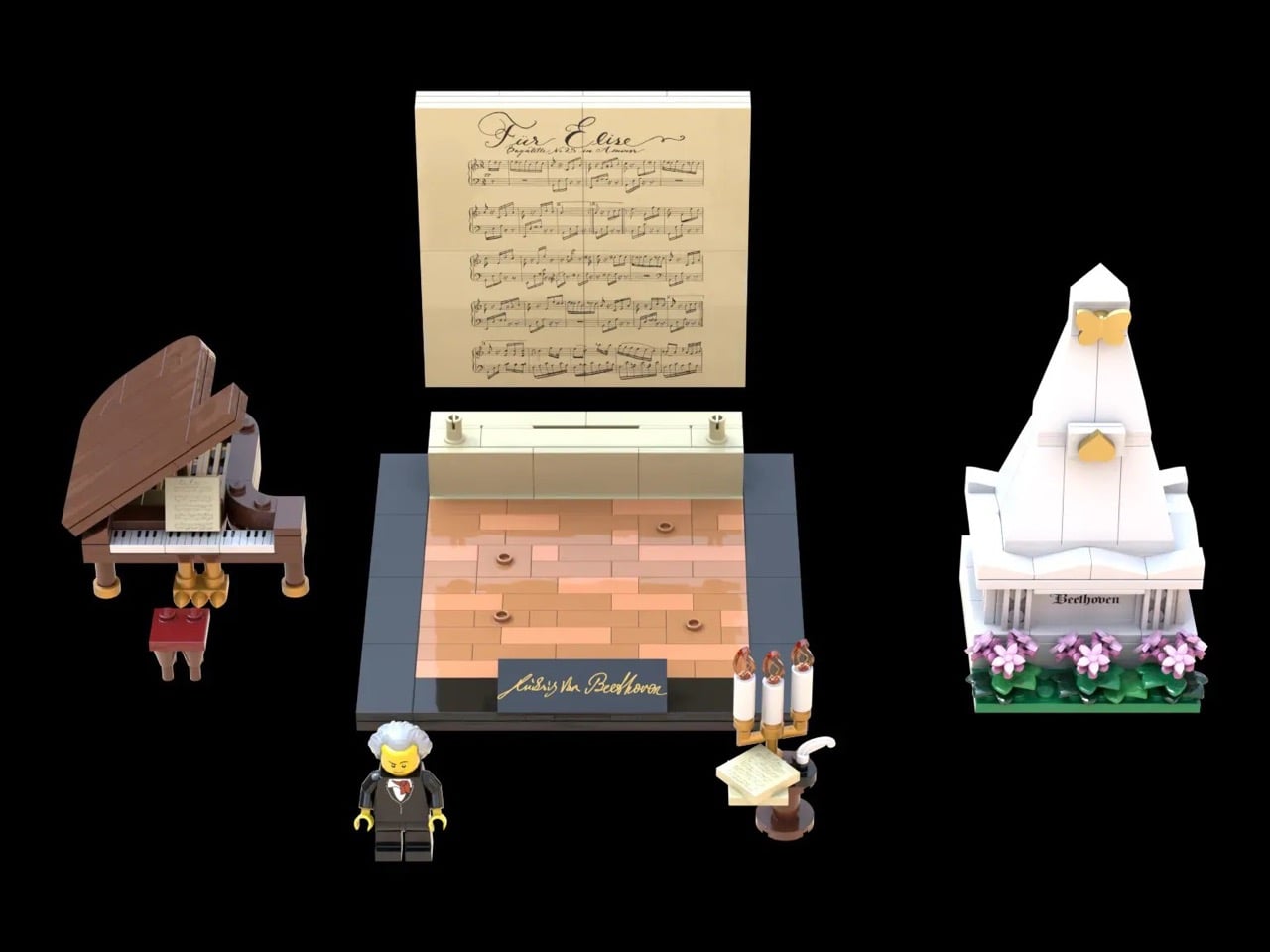
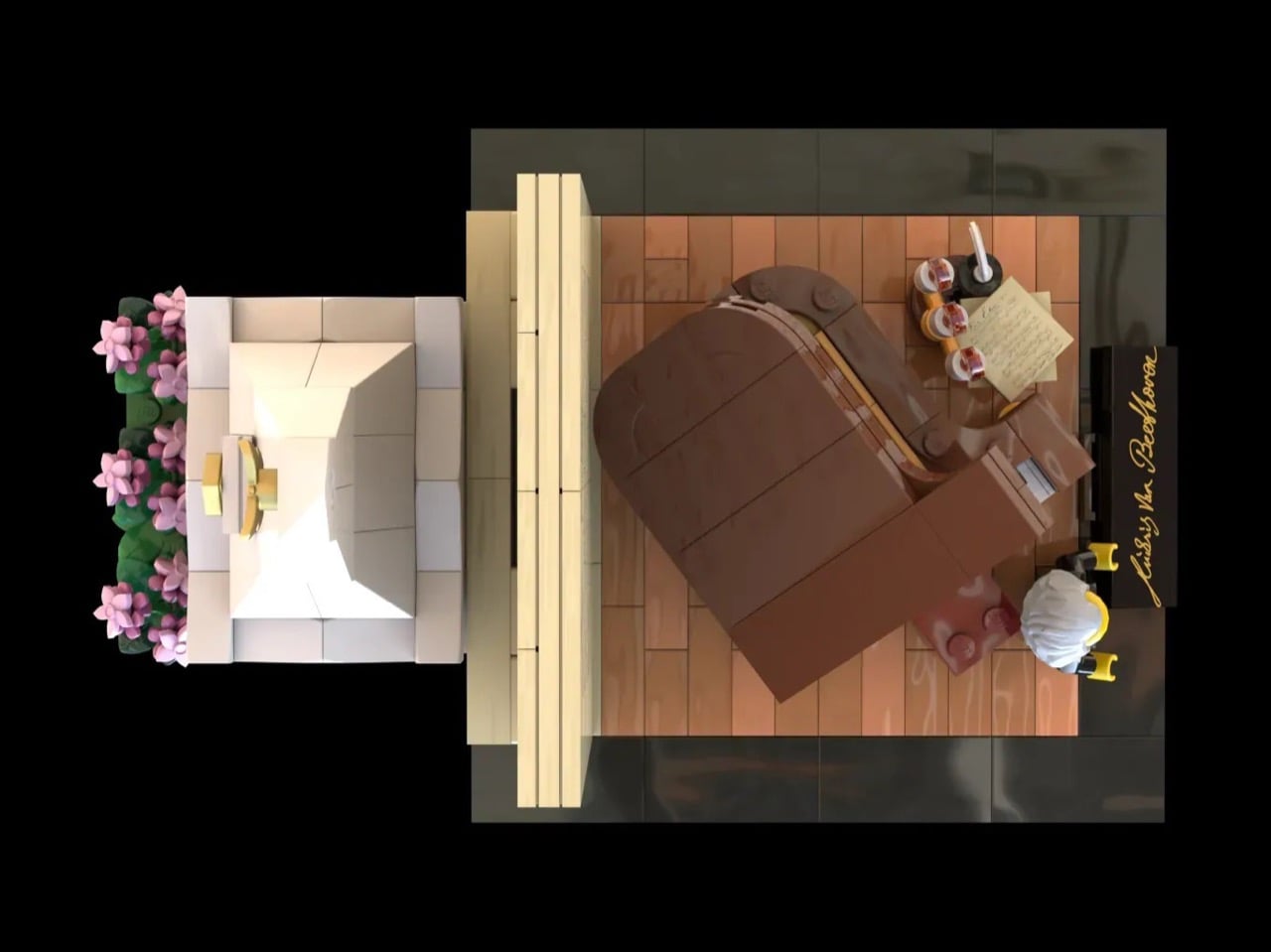
Fan designer CousinExcitedCactus has channeled that legacy into a 358-piece LEGO Ideas set timed to a significant milestone: March 26, 2027 marks the 200th anniversary of Beethoven’s passing. The result is a compact, modular display set with a grand piano, a Beethoven minifigure, a candlelit writing table, and a removable “Für Elise” sheet music backdrop, plus a surprisingly moving recreation of his grave monument in Vienna.
Designer: CousinExcitedCactus
The piano is the heart of this build, and it’s different from your average modern day grand piano. The design draws from two instruments Beethoven actually owned and played: the Érard grand gifted to him in 1803, and the Conrad Graf fortepiano he used in his final years, by which point his hearing was almost entirely gone. Both instruments were period pieces with a lighter, more intimate tone than the thundering concert grands of today, and the LEGO recreation captures that sense of a working composer’s instrument rather than a showpiece. The lid is propped open, strings are visible inside, and a small sheet of music rests on the stand, the kind of atmospheric detail that makes a display scene feel lived-in rather than staged.
The candelabra beside the piano is a three-flame setup rendered with white cylinder candles and transparent flame elements, casting the whole scene in an implied warm glow. The Beethoven minifigure stands on a warm-toned wooden stage floor, white hair, dark formal coat, red cravat, with his signature in gold script on a nameplate tile at the front edge. Behind everything, a large printed tile carries the full opening bars of “Für Elise” in period calligraphy, functioning simultaneously as a backdrop panel and the set’s most immediately recognizable design element. It is a clever piece of dual-purpose design, the kind of thing that looks obvious only after someone else has already thought of it.
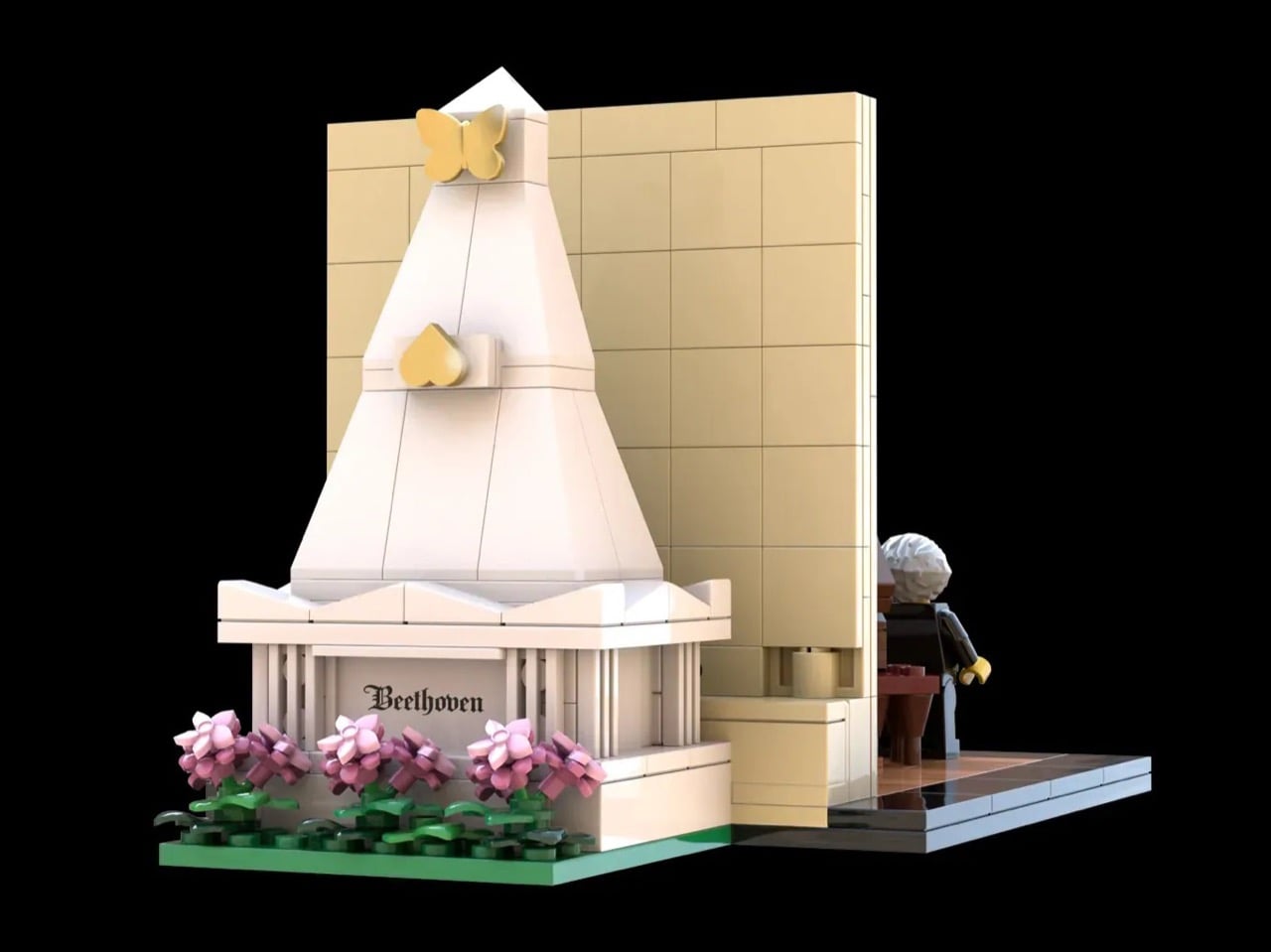
My favorite detail, though, is the grave monument. The builder has included a fully separate modular sub-build recreating Beethoven’s actual resting place at Vienna’s Zentralfriedhof, a white obelisk on a columned base with “Beethoven” lettered across the front, pink flowers at the perimeter, and a golden butterfly at the apex. The reverse side of the “Für Elise” sheet music tile features a printed reproduction of the grave, which means the backdrop itself does double duty depending on which way you face it. That is a genuinely thoughtful design decision.
The set currently sits at 720 supporters on LEGO Ideas, the fan platform where community-made MOCs (My Own Creations) gather votes toward the 10,000-vote threshold required to trigger an official LEGO design review. With 414 days left on the clock, there is plenty of time to get it there. If you want to see this one make it to store shelves in time for the 2027 anniversary, head to the LEGO Ideas page and cast your vote here.
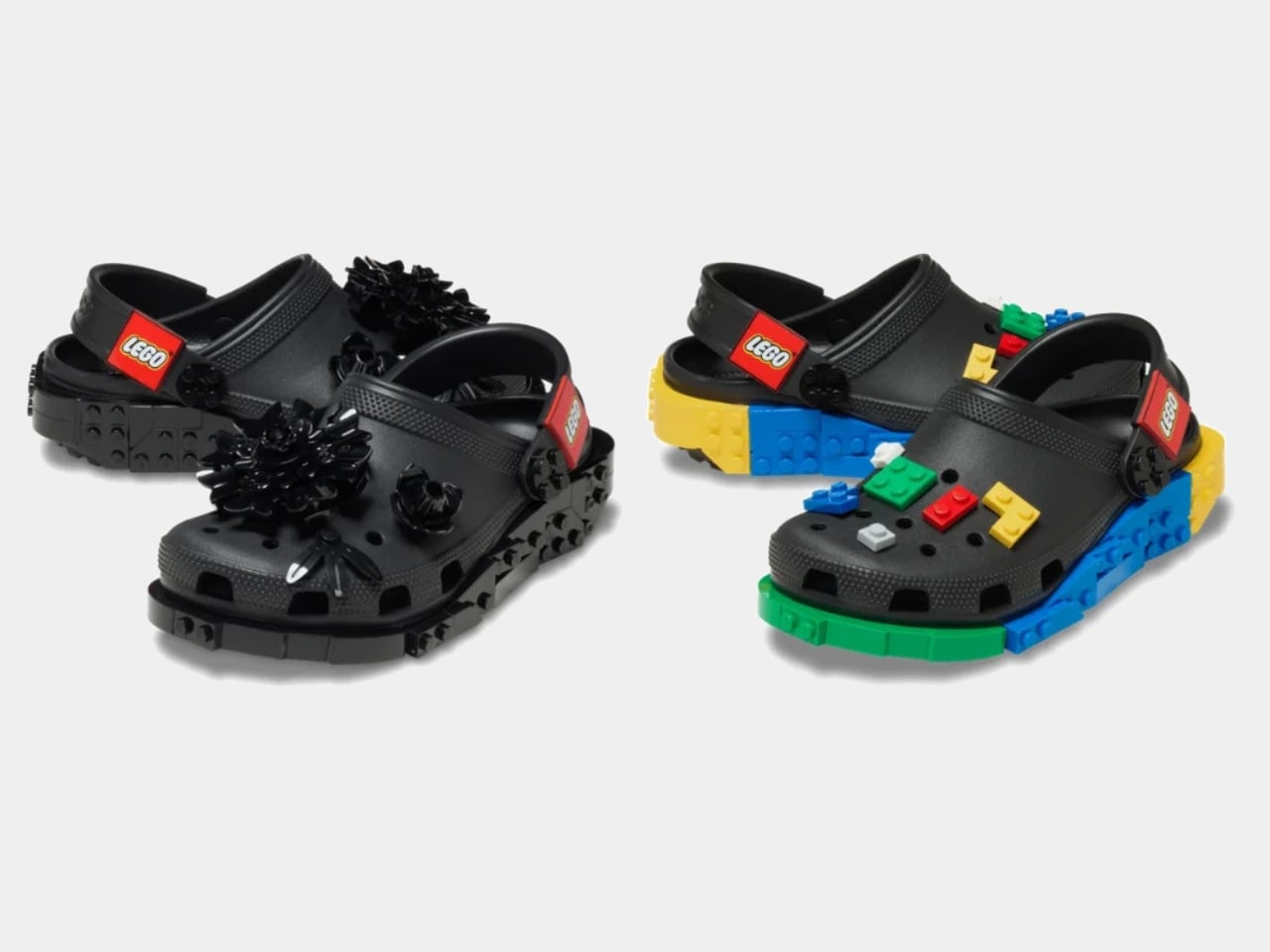
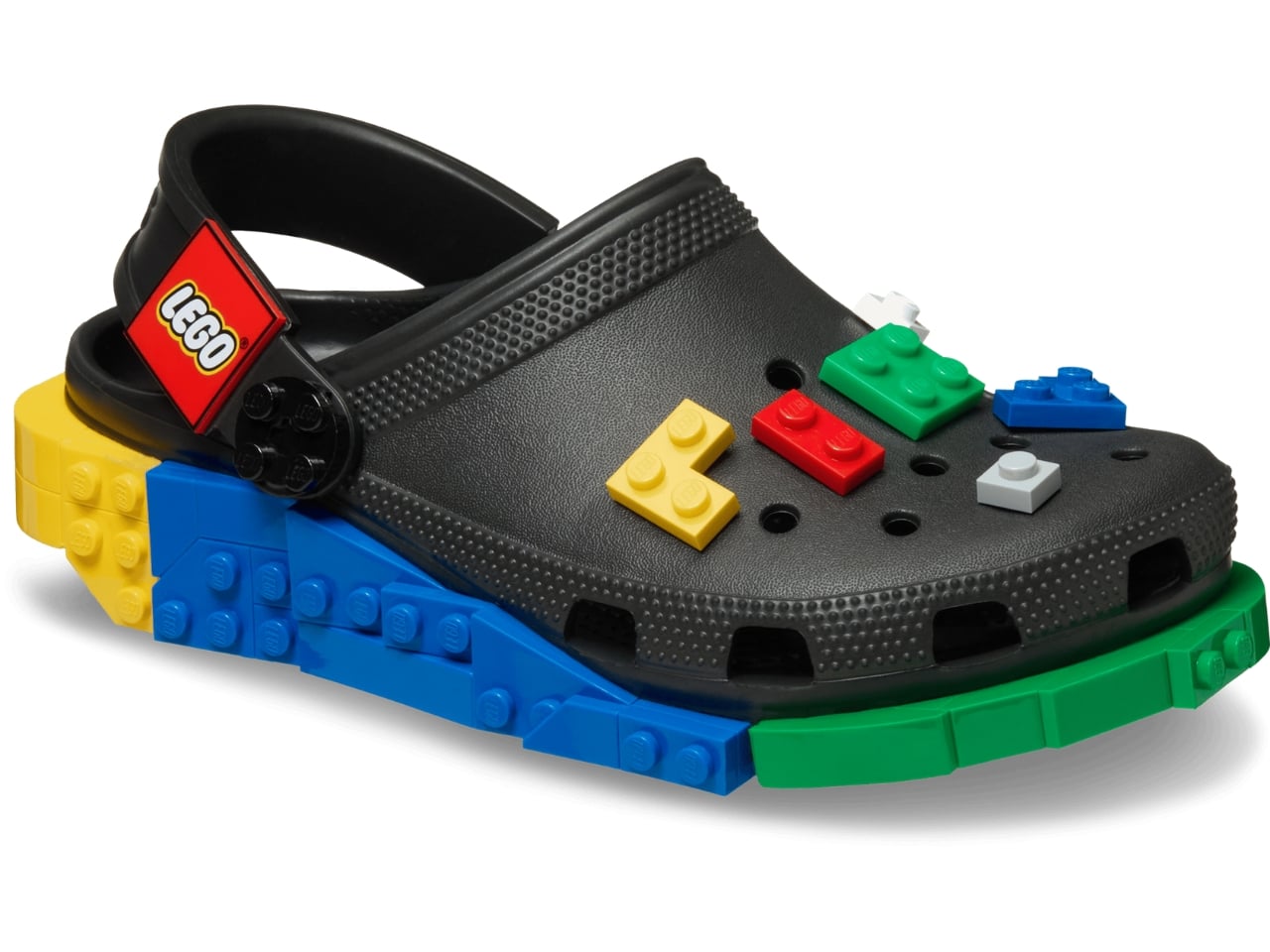
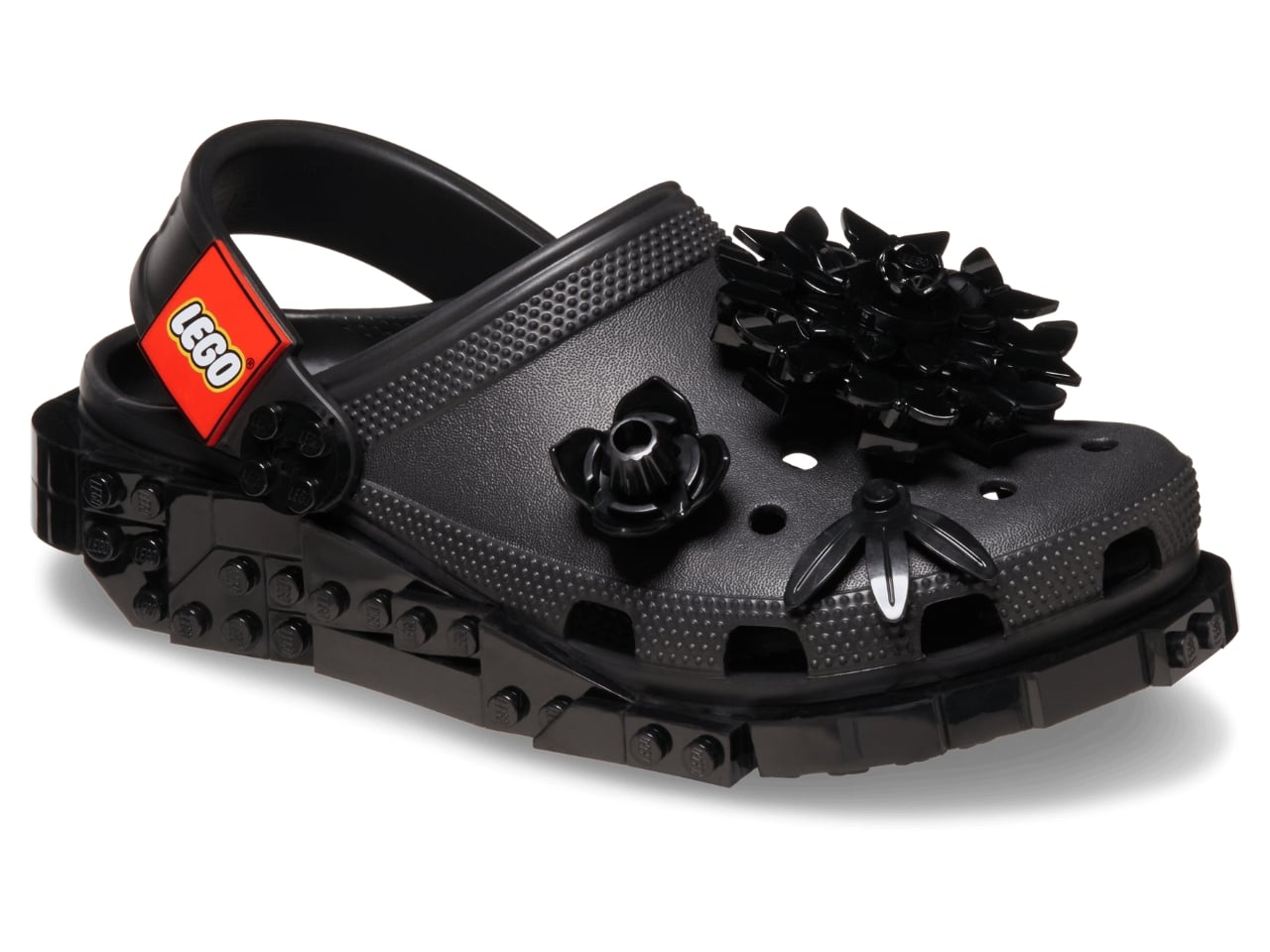
No matter how you feel about Crocs, you cannot deny the brand has a remarkable talent for finding partners that make you stop and say, “wait, actually… that works.” We’ve seen Krispy Kreme clogs dripping in donut-glazed energy, Windows XP nostalgia packed into a wearable throwback, and Ghostbusters uniforms distilled down to clog form. Every time I think Crocs has peaked its collab game, another partnership resets the bar. This time, they’ve linked up with LEGO for the Creativity Clogs collection, and this one lands a little differently.
The appeal is almost embarrassingly obvious in hindsight. Both LEGO and Crocs are built around the same core philosophy: take something simple, make it endlessly customizable, and let people go wild with it. LEGO gave us the stud system; Crocs gave us Jibbitz holes. Jibbitz charms are basically a wearable LEGO build. The two brands have been spiritually aligned for decades without anyone thinking to actually put them together, and the fact that it took this long feels like a design oversight that’s now been corrected.
Designers: LEGO x Crocs
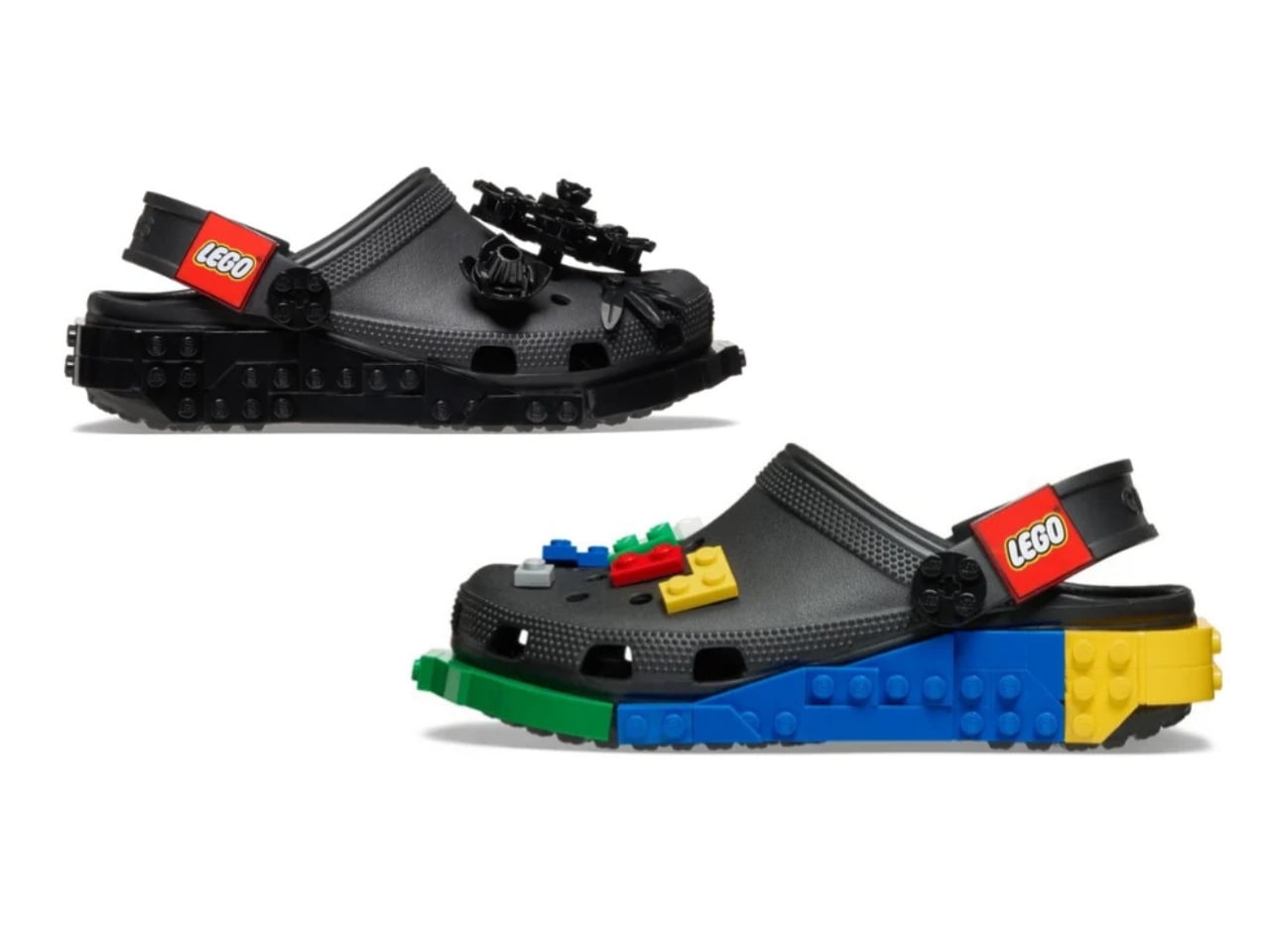
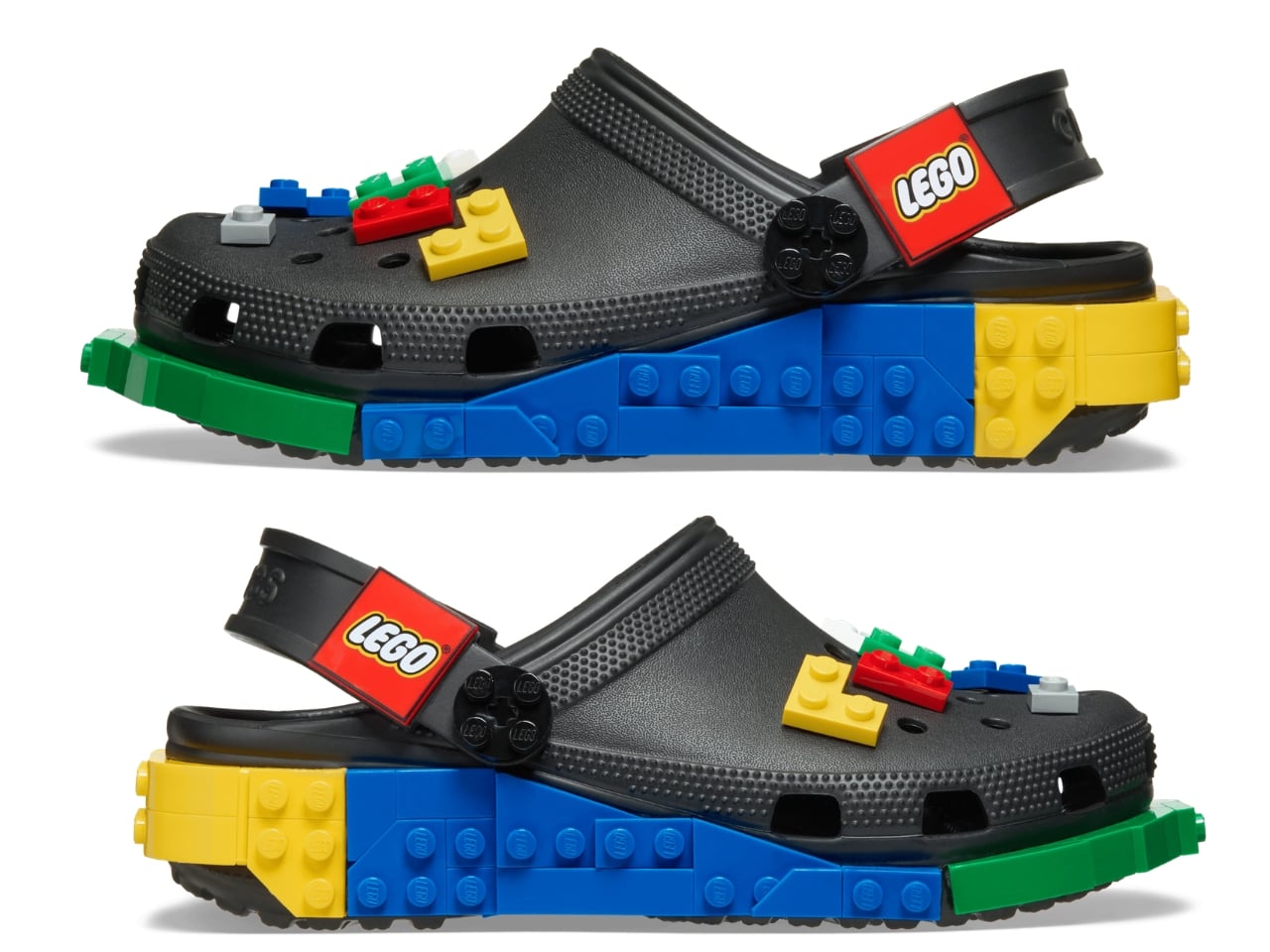
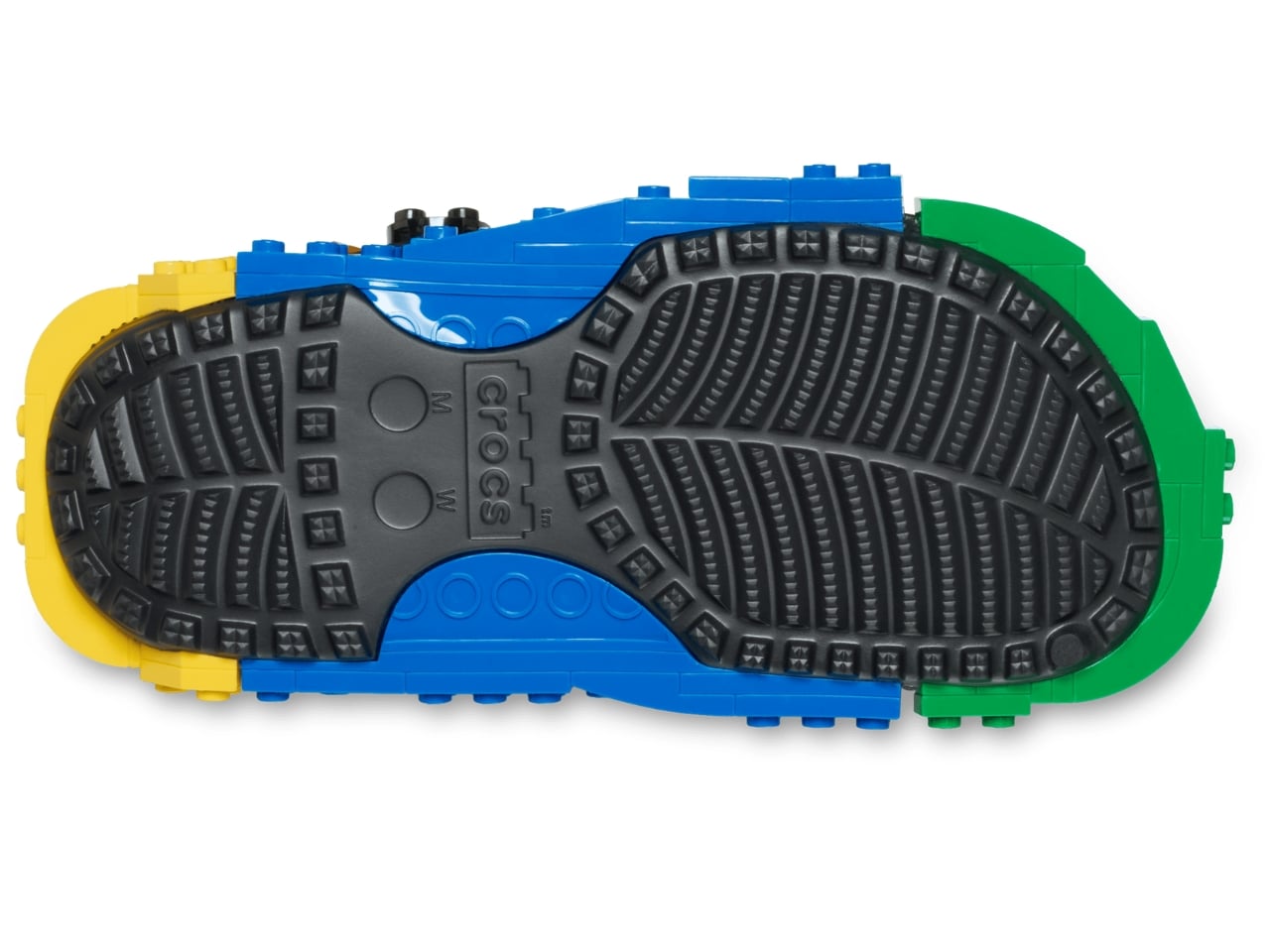
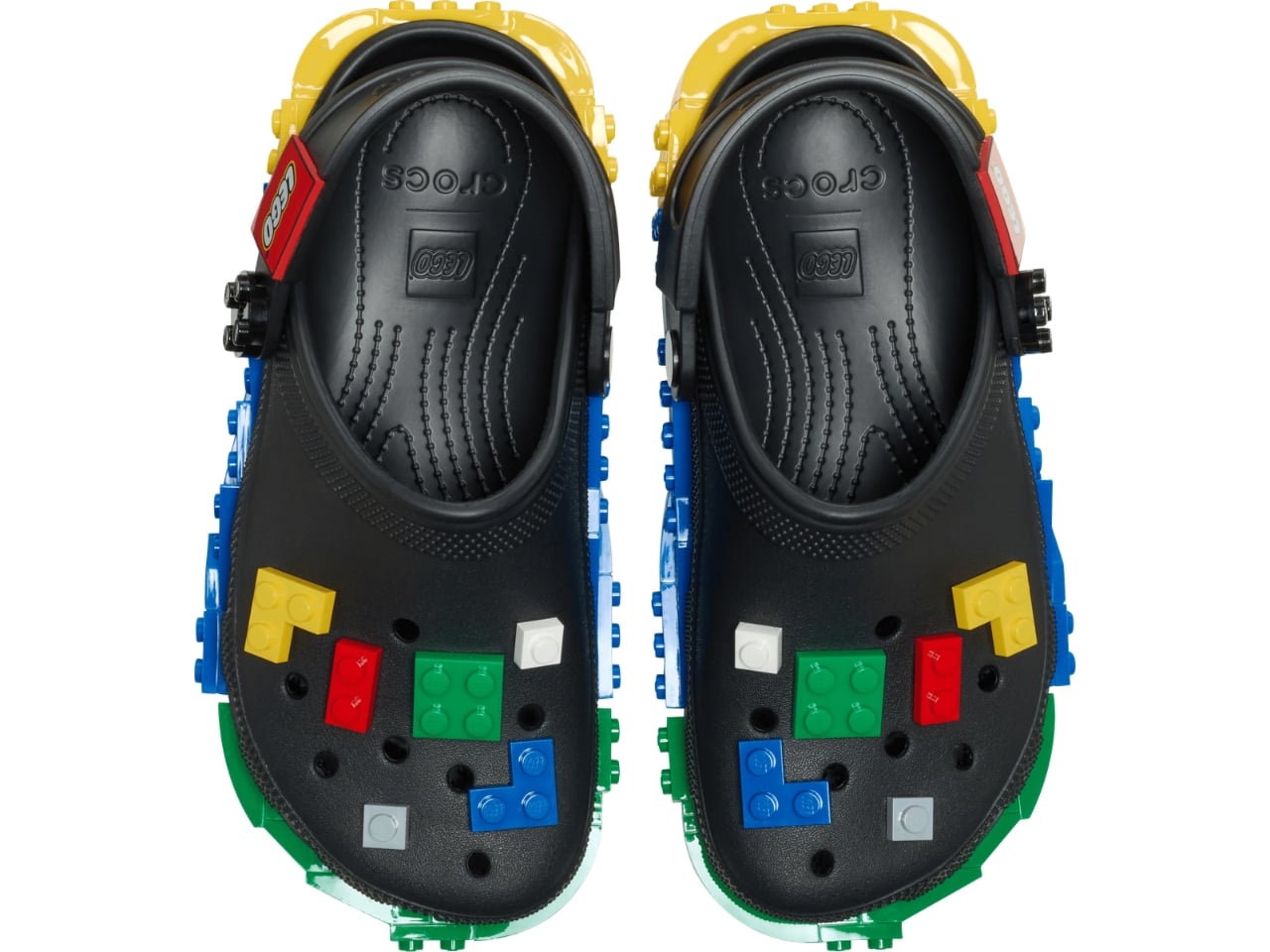
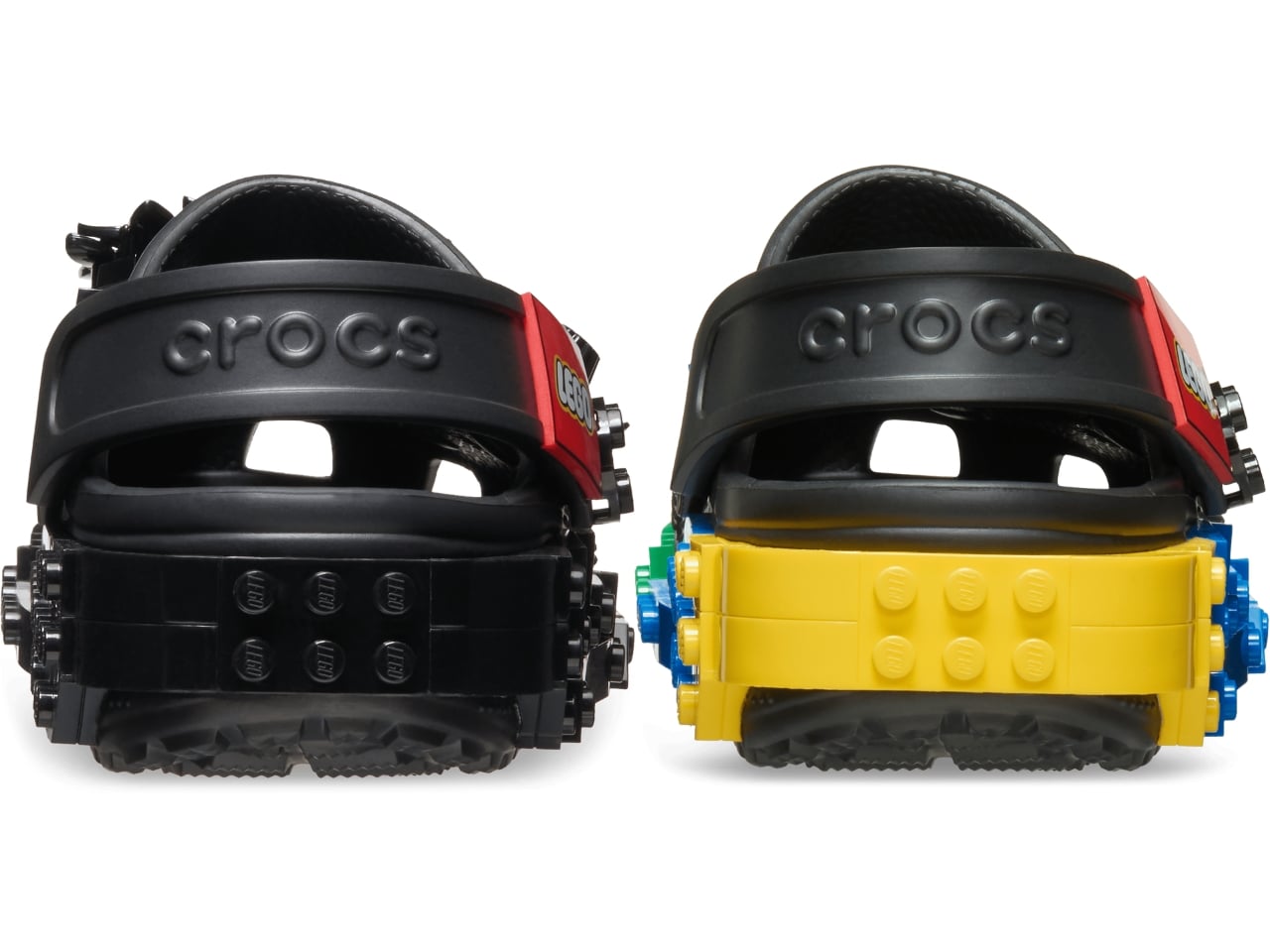
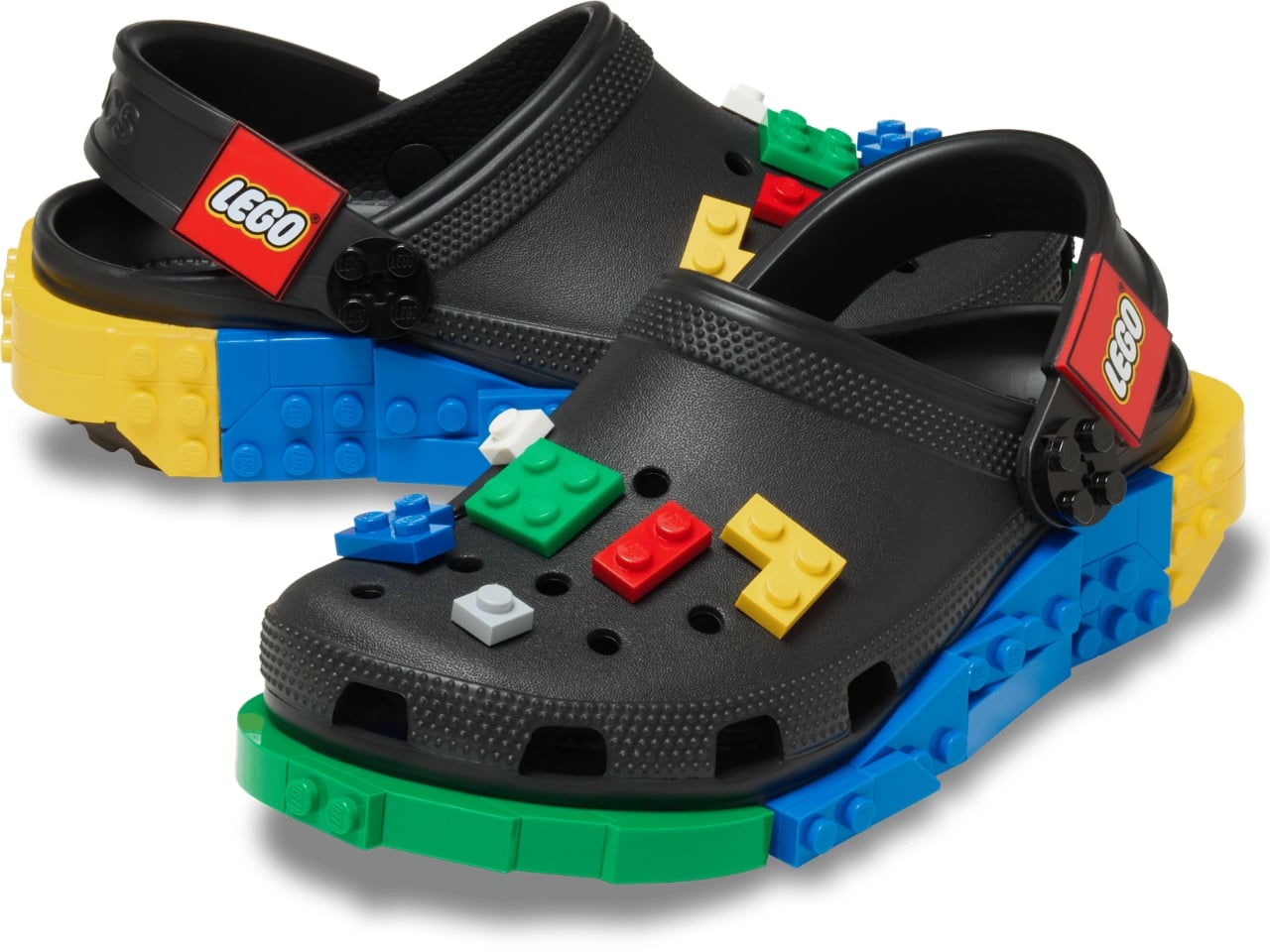
The collection spans several configurations. The base Creativity Clog starts at $79.99, keeping things relatively clean with colorful LEGO bricks along the sole and a Jibbitz-ready upper waiting to be personalized. There is also a Kids’ Creativity Clog at $59.99, because LEGO is a multigenerational brand whether anyone admits it or not.
The Masterbrand Creativity Clog at $89.99 is the one that goes all in. It arrives with 12 LEGO brick Jibbitz charms already loaded onto the upper and around the sole, plus a LEGO Minifigure tucked into the box. That detail genuinely made me smile. It is the kind of considered touch that separates a real collaboration from a brand simply slapping a logo on an existing product.
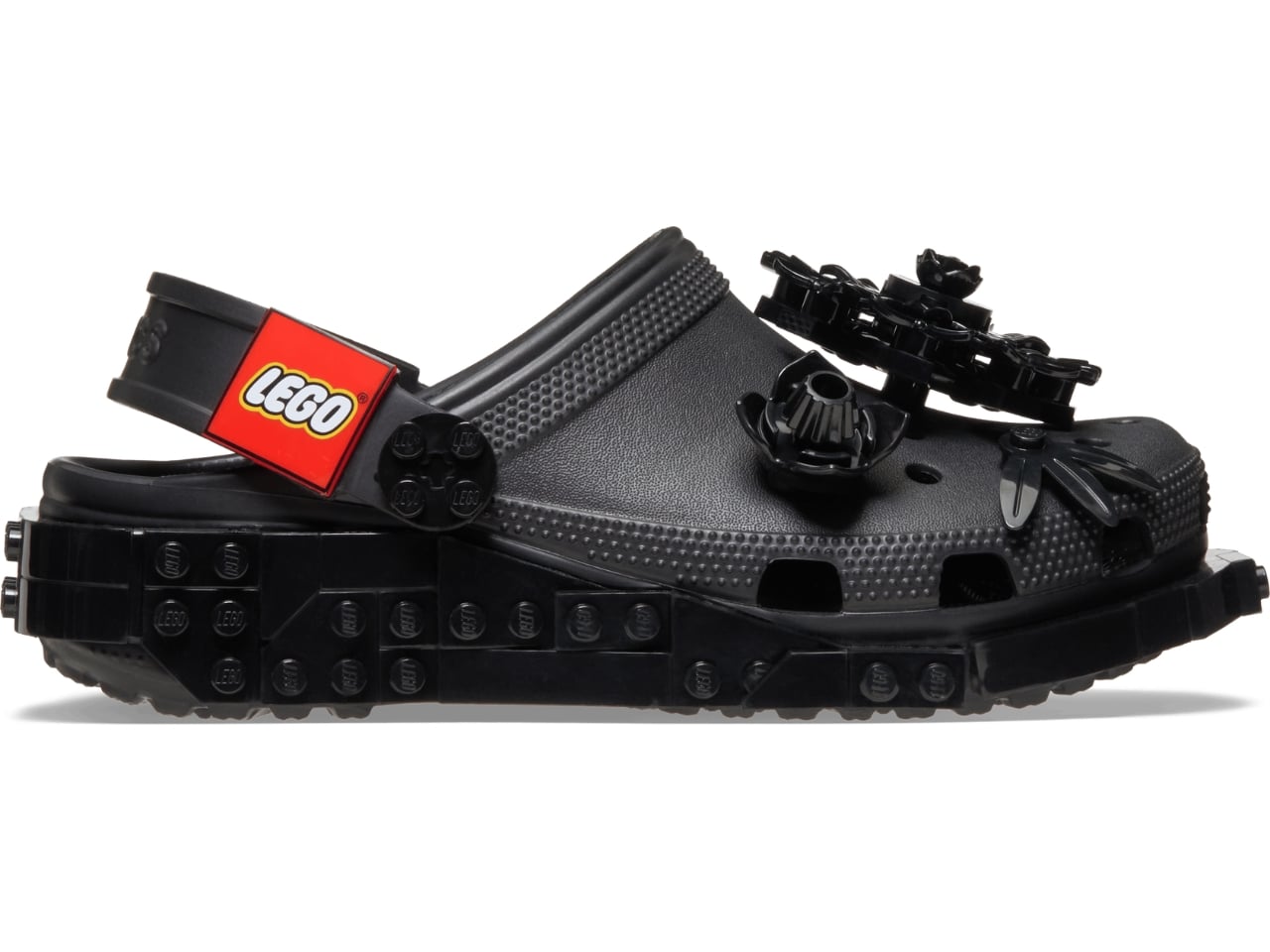
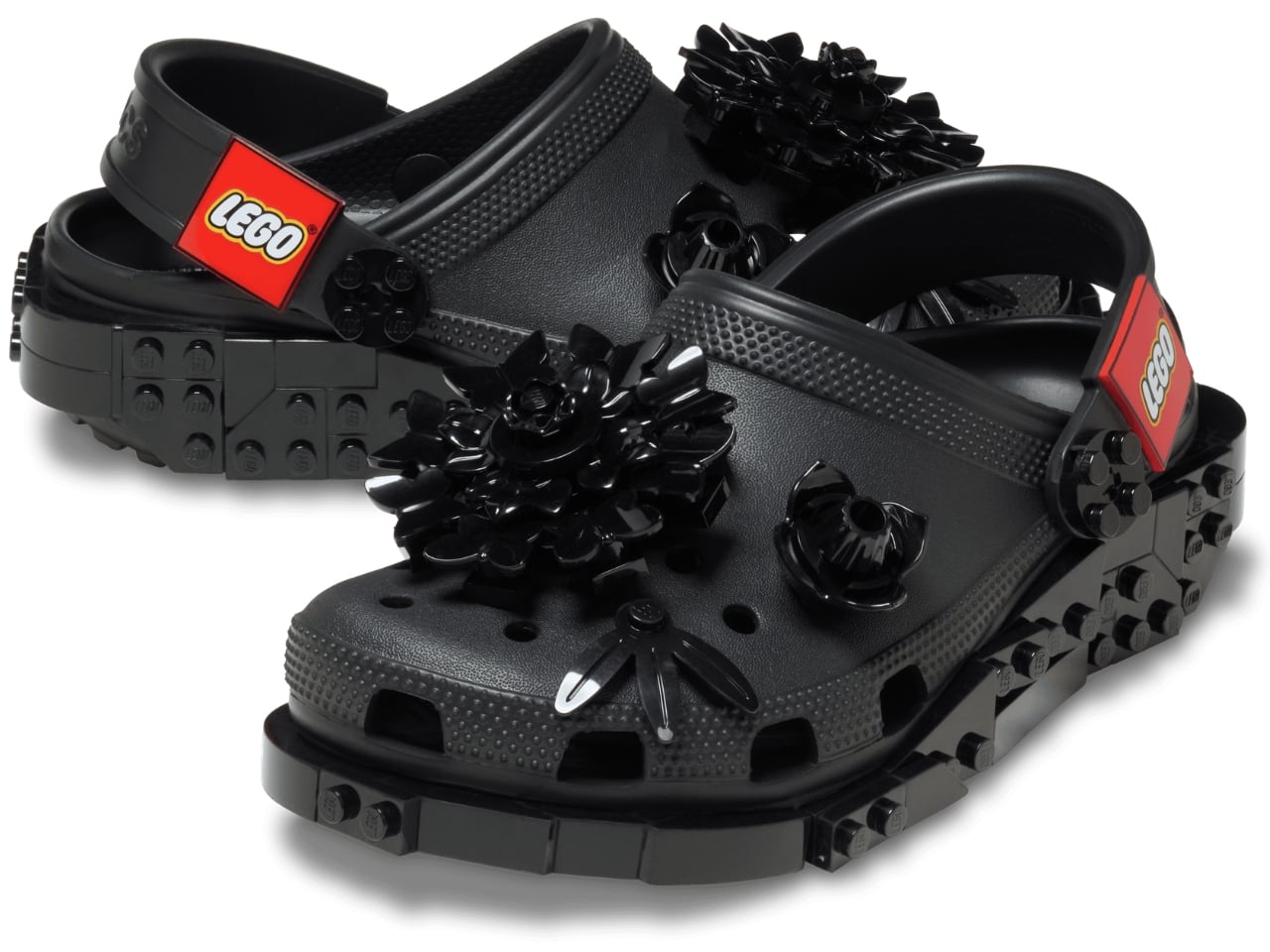
The Midnight Garden Creativity Clog takes the same design language in a different direction. Where the other colorways lean into LEGO’s signature primary palette, this version opts for a darker, more subdued aesthetic that feels almost grown-up by comparison. It is the right pick for someone who wants to quietly signal their appreciation for the collab without committing to the full crayon-box energy of the others.
Visually, these clogs strike a balance I did not expect. The brick texture runs along the sole without overtaking the whole shoe, so you are not walking around in something that looks like a toy store exploded on your feet. It is restrained enough to wear in public while still being obviously, joyfully LEGO. The Jibbitz-ready holes mean you can keep building on top of the base, swapping in dedicated LEGO charm packs depending on your mood. That is exactly the kind of open-ended customization that makes both brands tick.
The LEGO Group and Crocs announced their multi-year global partnership in January 2026, and the Creativity Clogs dropped on March 19, with LEGO Insiders getting a three-day head start. Certain sizes sold out quickly, which tells you all you need to know about the appetite for this one.
My honest read is that this collaboration is smarter than its predecessor. The original LEGO Brick Clogs were built for viral moments and display shelves. Giant foam bricks make a statement, but they do not go anywhere useful. The Creativity Clogs are the real follow-through, translating LEGO as a design language into something you would actually wear to a theme park, a farmers market, or around the house on a slow Tuesday. The playfulness is baked in without demanding you commit to a costume to participate.
That said, $89.99 for a pair of Crocs is a price point worth sitting with, even if the included Minifigure does technically sweeten the deal. Crocs collabs have always commanded a premium over the core classics, and by now the brand’s audience is accustomed to paying for the concept as much as the shoe itself. Whether the LEGO x Crocs Creativity Clog earns its place in your rotation will probably depend on how much real estate your inner kid still occupies. For a lot of people, that answer is quite a bit of space.
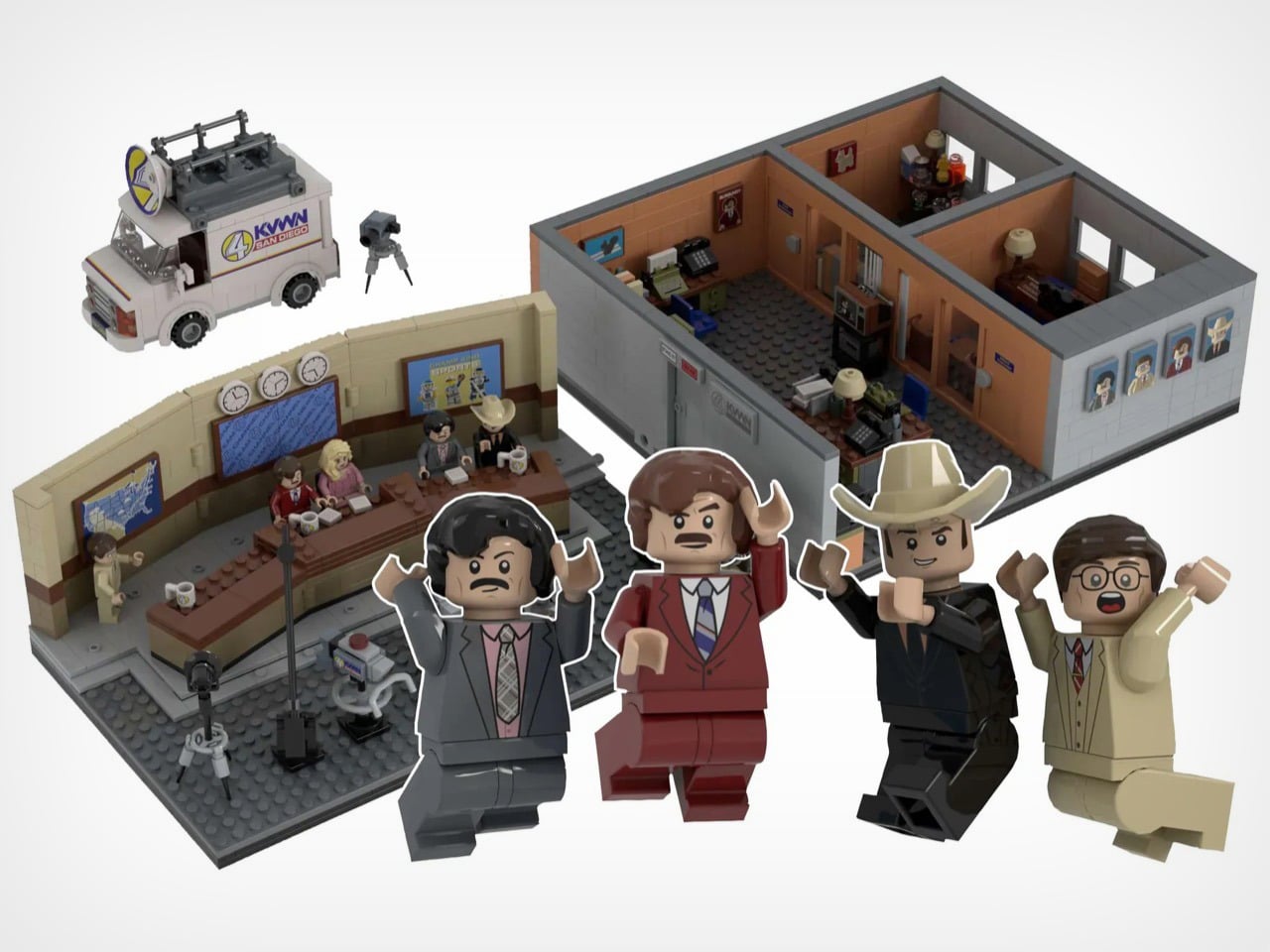
Anchorman: The Legend of Ron Burgundy turned twenty in 2024, and somehow, the film has only gotten funnier with age. What started as a Will Ferrell comedy about a hilariously fragile male ego navigating the very real 1970s newsroom gender wars became one of the most quoted, most meme’d, most endlessly rewatchable comedies in modern American film history. “I’m kind of a big deal,” “I love lamp,” “60% of the time it works every time” – the lines are so deeply embedded in pop culture at this point that people quote them without even knowing where they came from. San Diego’s most legendary fictional anchor deserves better than a passing reference in a listicle, and LEGO Ideas builder footonabrick clearly agrees.
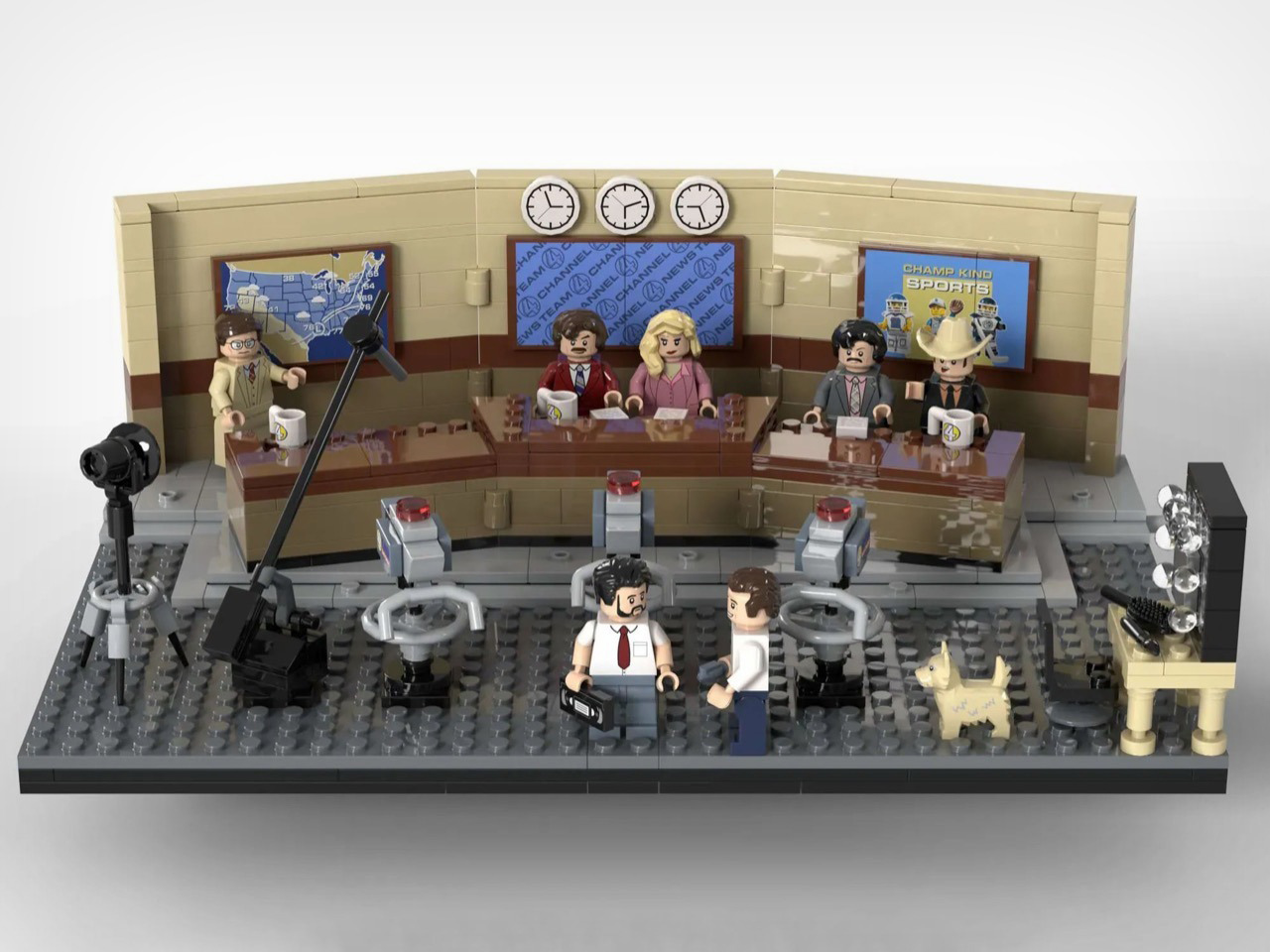
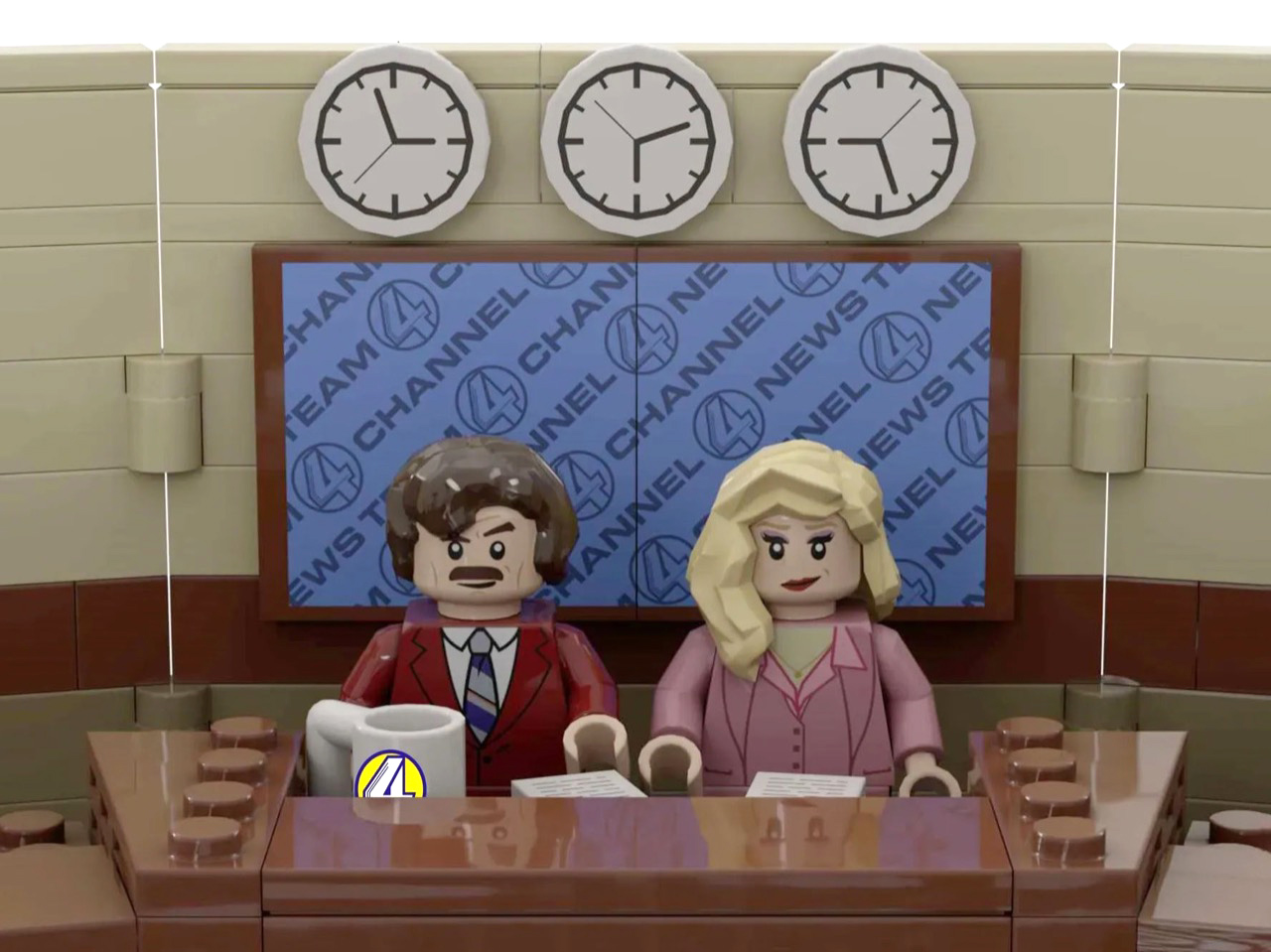
The result is a just-over-1,500-piece MOC (My Own Creation) that reconstructs the Channel 4 News Team’s world with an almost obsessive attention to detail, covering the broadcast studio, the newsroom offices, and even the KVWN news van parked out front. The studio section is immediately recognizable: a curved tan backdrop wall, three wall clocks ticking away above the anchor desk, dual blue Channel 4 News Team screens flanking the set, and the full team seated behind that iconic brown desk with their Channel 4 mugs. It looks like a freeze-frame from the film, and that’s entirely the point.
Designer: footonabrick
The broadcast desk is the centerpiece, and footonabrick nails the warm tan-and-brown palette of that gloriously dated 70s newsroom aesthetic. Ron and Veronica sit front and center behind their Channel 4 mugs, with Brian Fantana, Champ Kind, and Brick Tamland flanking them across the curved desk. The curved wall behind them is one of the trickier builds to pull off cleanly in LEGO, and the segmented panel construction keeps it looking smooth without losing the layered depth of the real set. Camera equipment on the studio floor, a boom-arm mic stand, and a vanity mirror station on the side round out the production floor detail beautifully.
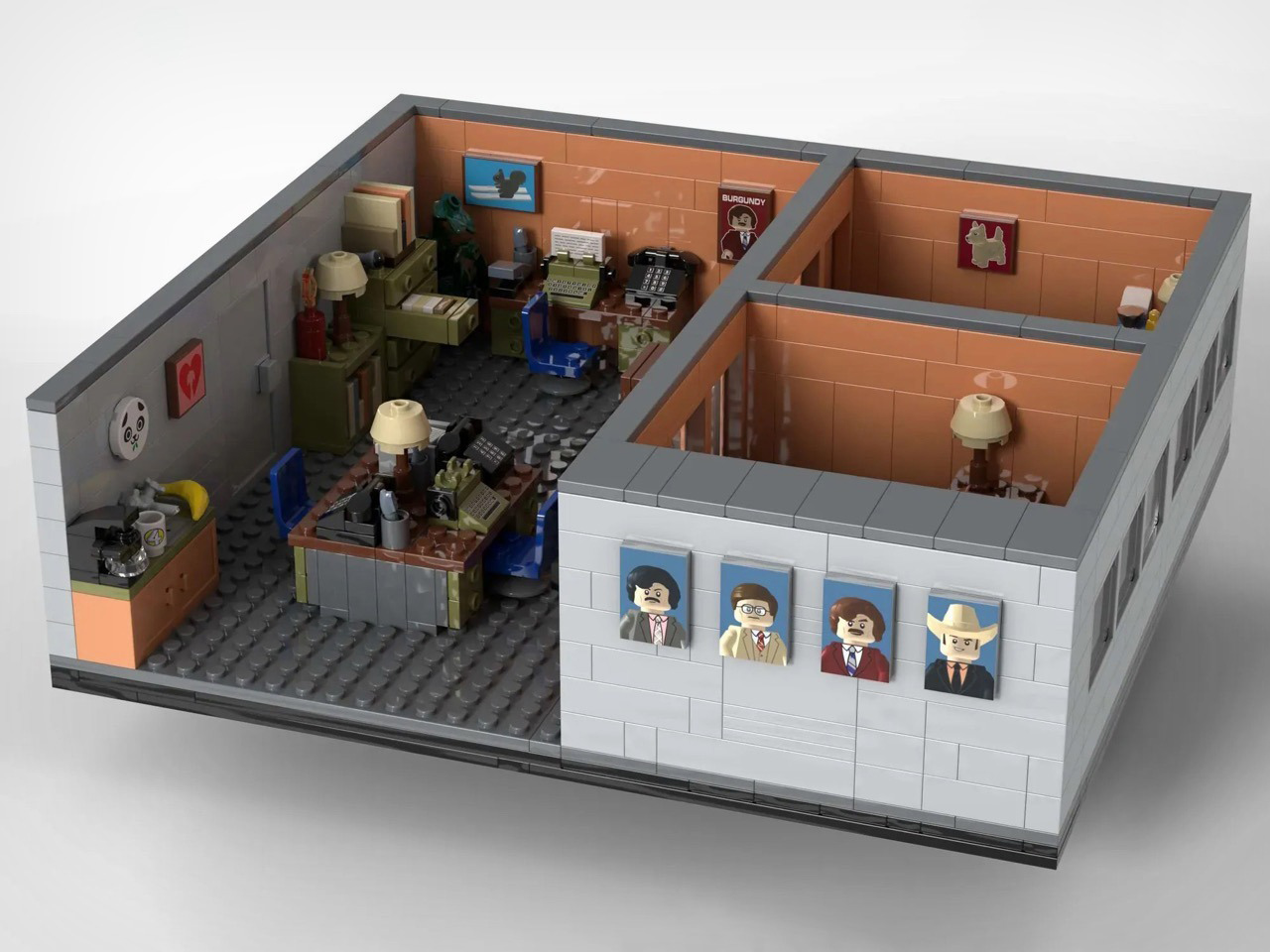
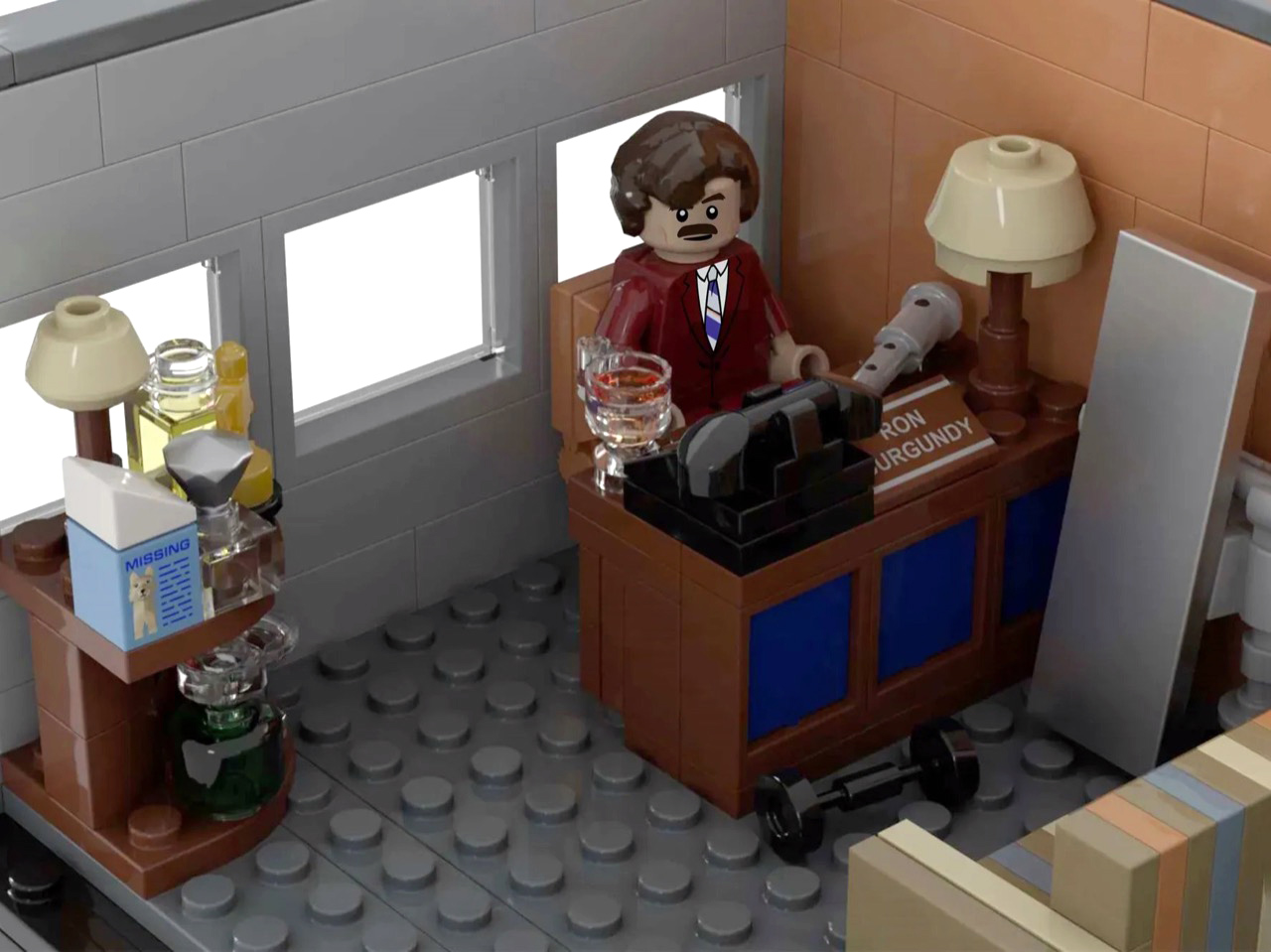
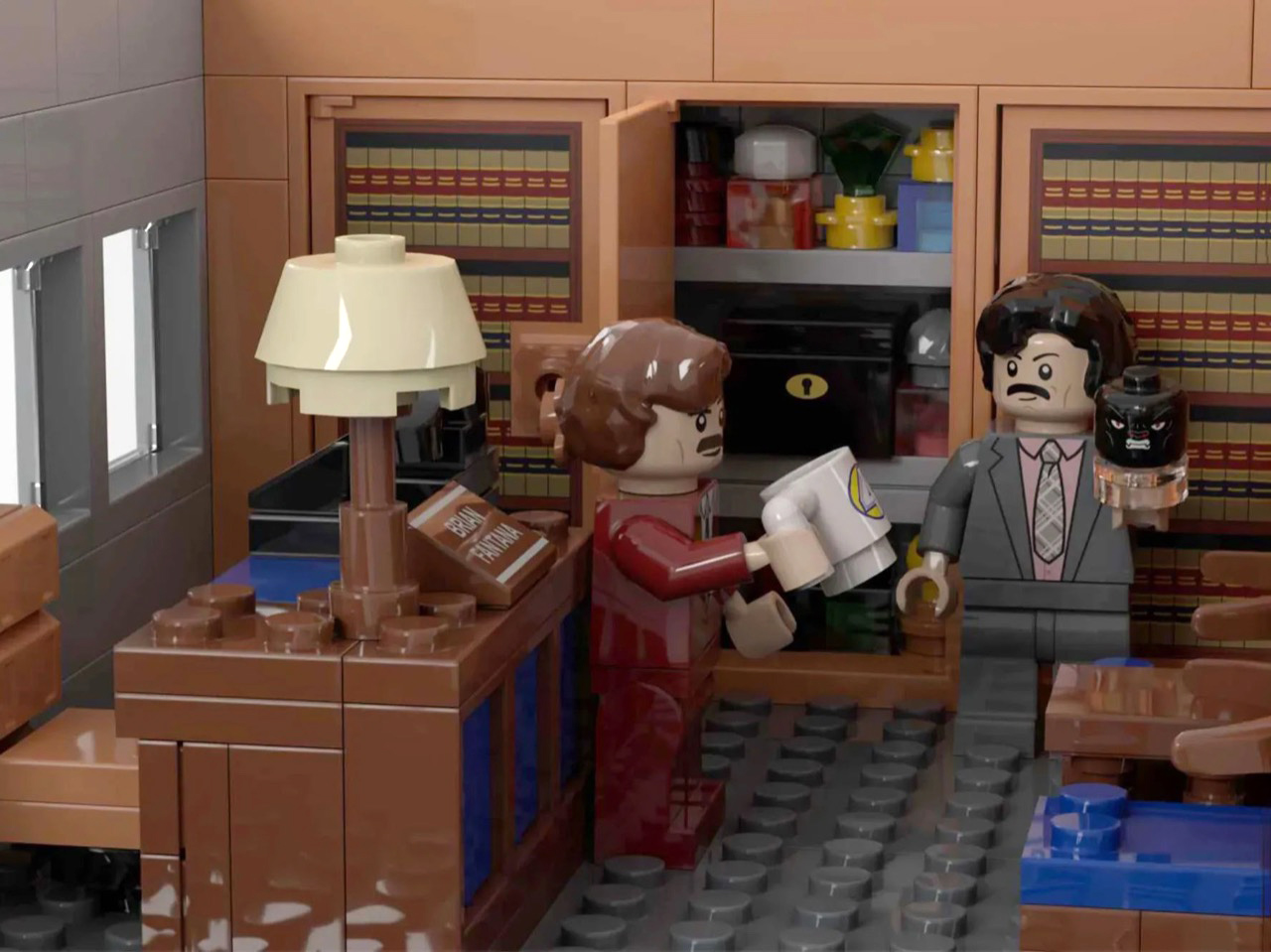
Turn to the office areas and you’ll find a bunch of details and easter eggs. Ron’s private office has his nameplate desk, a glass of scotch rendered in a transparent amber round piece, and a “Missing” poster for Baxter tucked onto a side shelf. Brian Fantana’s cologne closet, one of the film’s most beloved gags, is recreated with an open cabinet stocked with colourful brick-built bottles, with a “Brian Fantana” book sitting on his desk for good measure. The hallway outside features a glass-panel wall looking into Ron’s office, and a Ron Burgundy door nameplate that even Veronica would have to respect. My favorite detail, though, is the row of four team portrait tiles mounted on the exterior office wall, each one a miniature LEGO-art-style illustration of the Channel 4 crew. Tiny, considered, and completely unnecessary in the best way.
The eight minifigures are pitch-perfect. Ron arrives in his burgundy suit with a jazz flute and a scowl that says “I have many leather-bound books.” Brick Tamland, naturally, comes with his trident. Champ has his signature cowboy hat, Fantana carries what appears to be a cologne bottle, and Veronica is rendered in her pink suit with that particular expression of someone perpetually tolerating Ron’s nonsense. Baxter the dog is included as a separate figure, and there’s even a bonus Ron on a tiny red bicycle, which is exactly the kind of specific deep-cut that separates a good MOC from a great one.
footonabrick’s Anchorman set is currently gathering votes on LEGO Ideas, the community platform where fan-created MOCs (My Own Creations) need 10,000 supporters to trigger an official LEGO review and potential retail production. With 344 votes on the board and 421 days left on the clock, there’s plenty of runway. If you want to see this land on store shelves, head to the LEGO Ideas page and cast your vote. You stay classy.
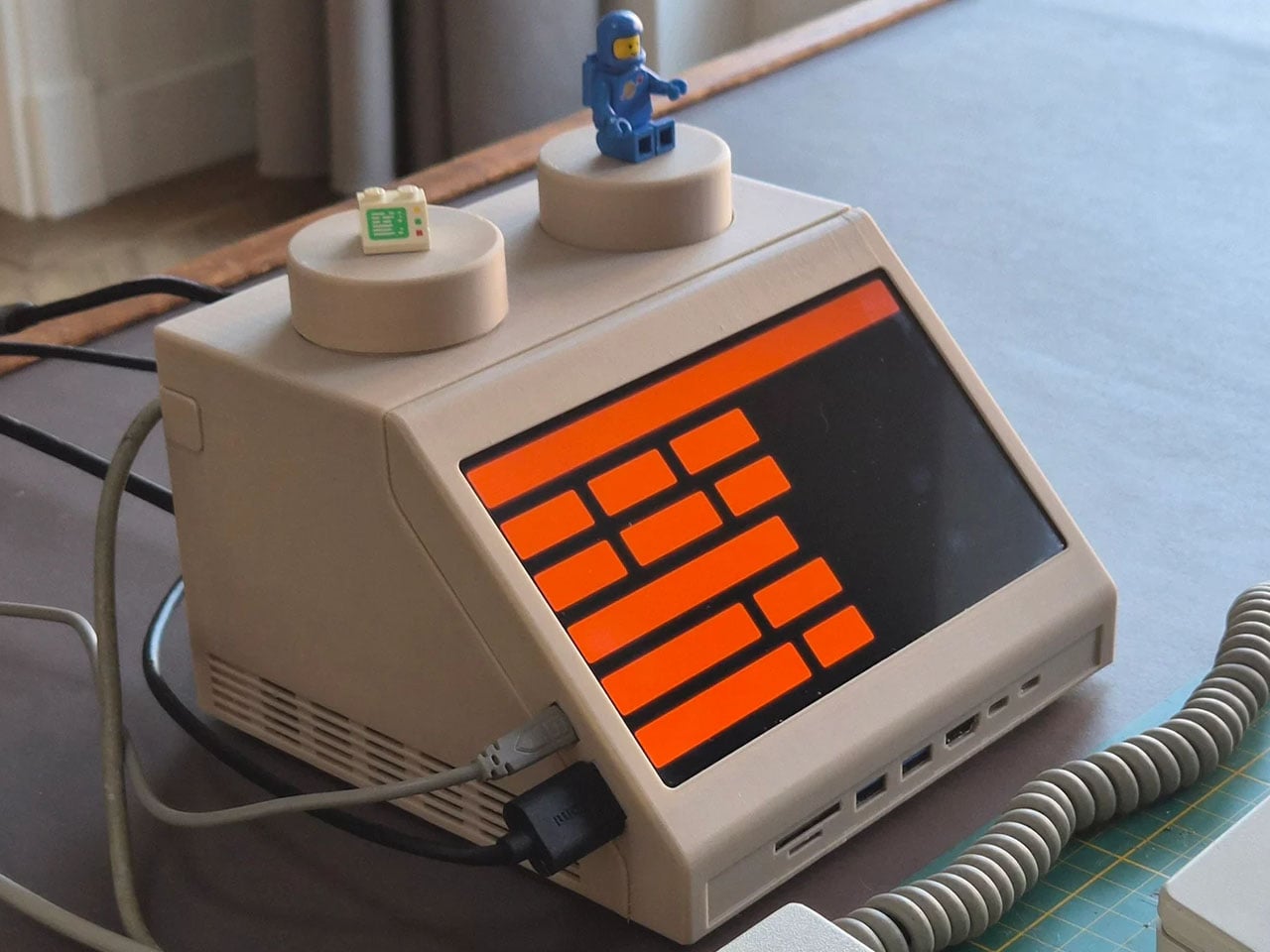
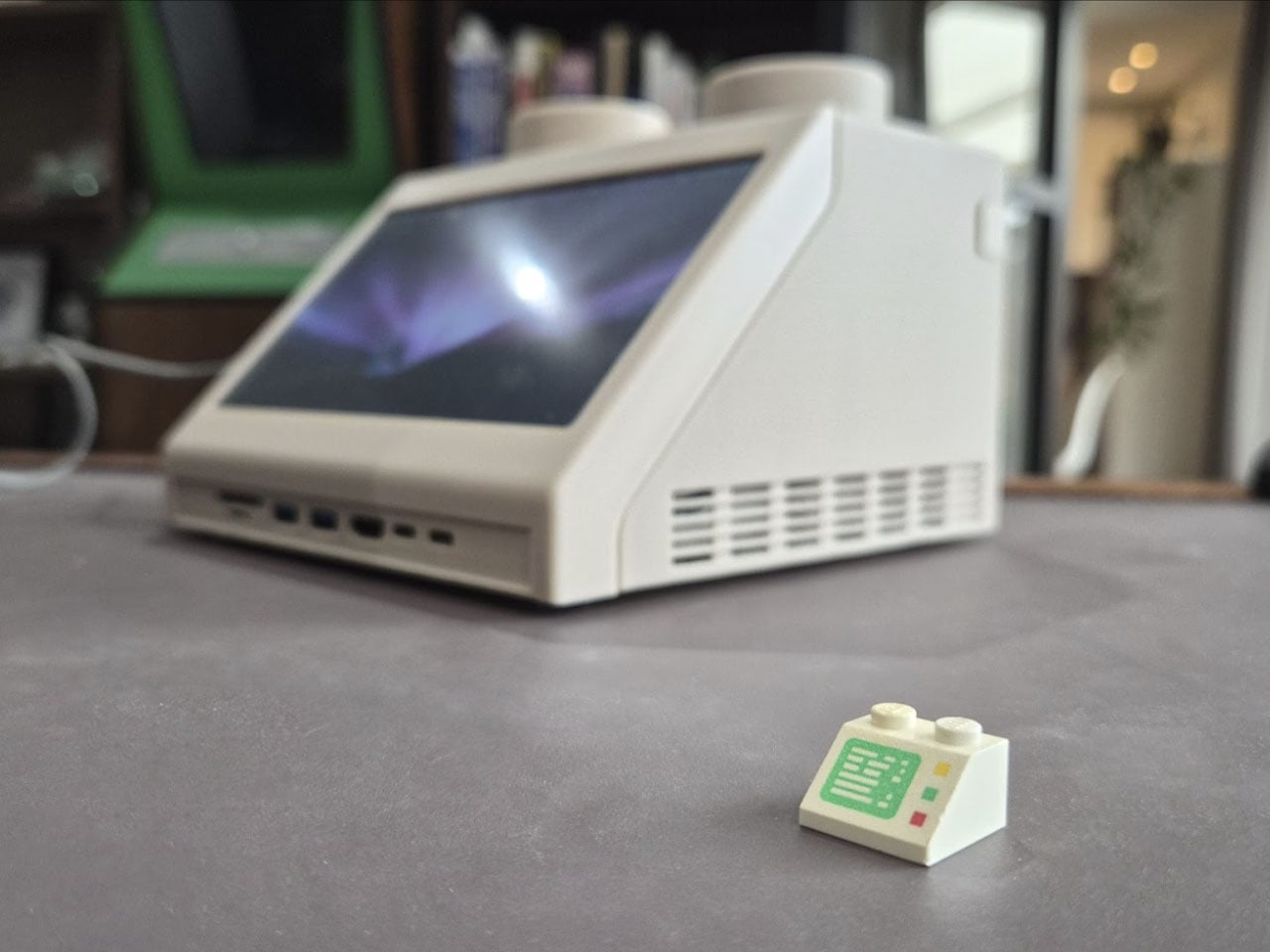
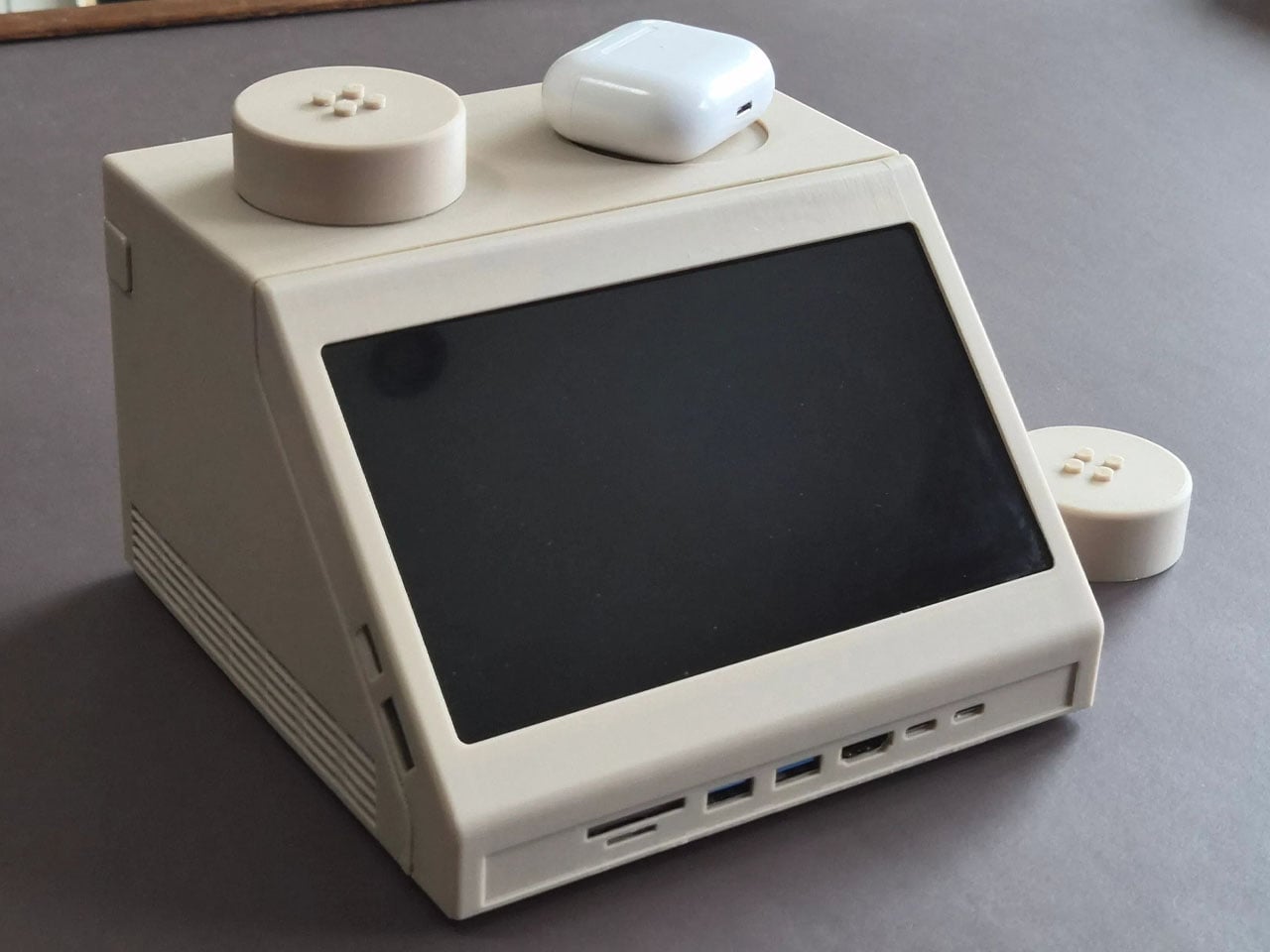
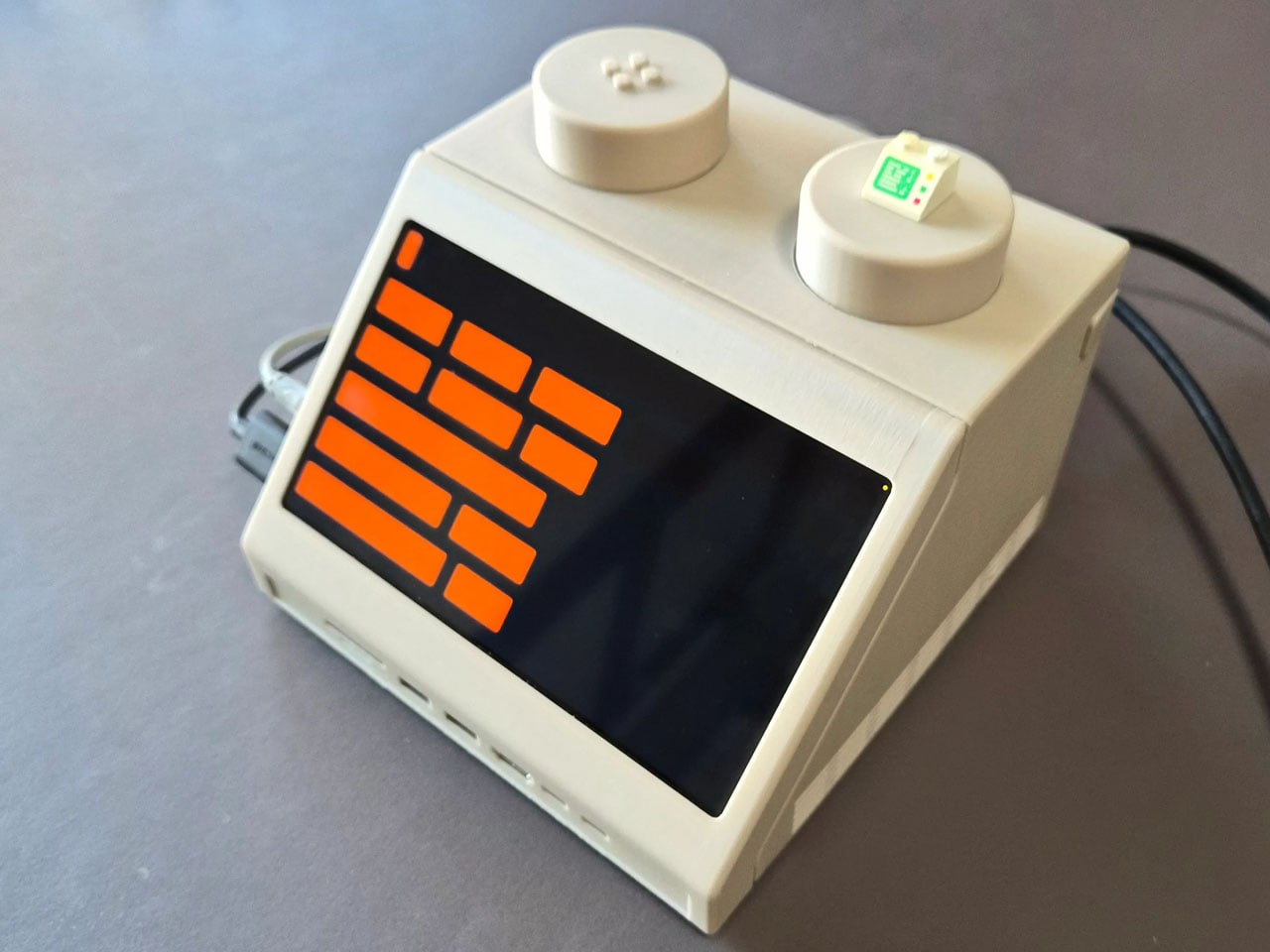
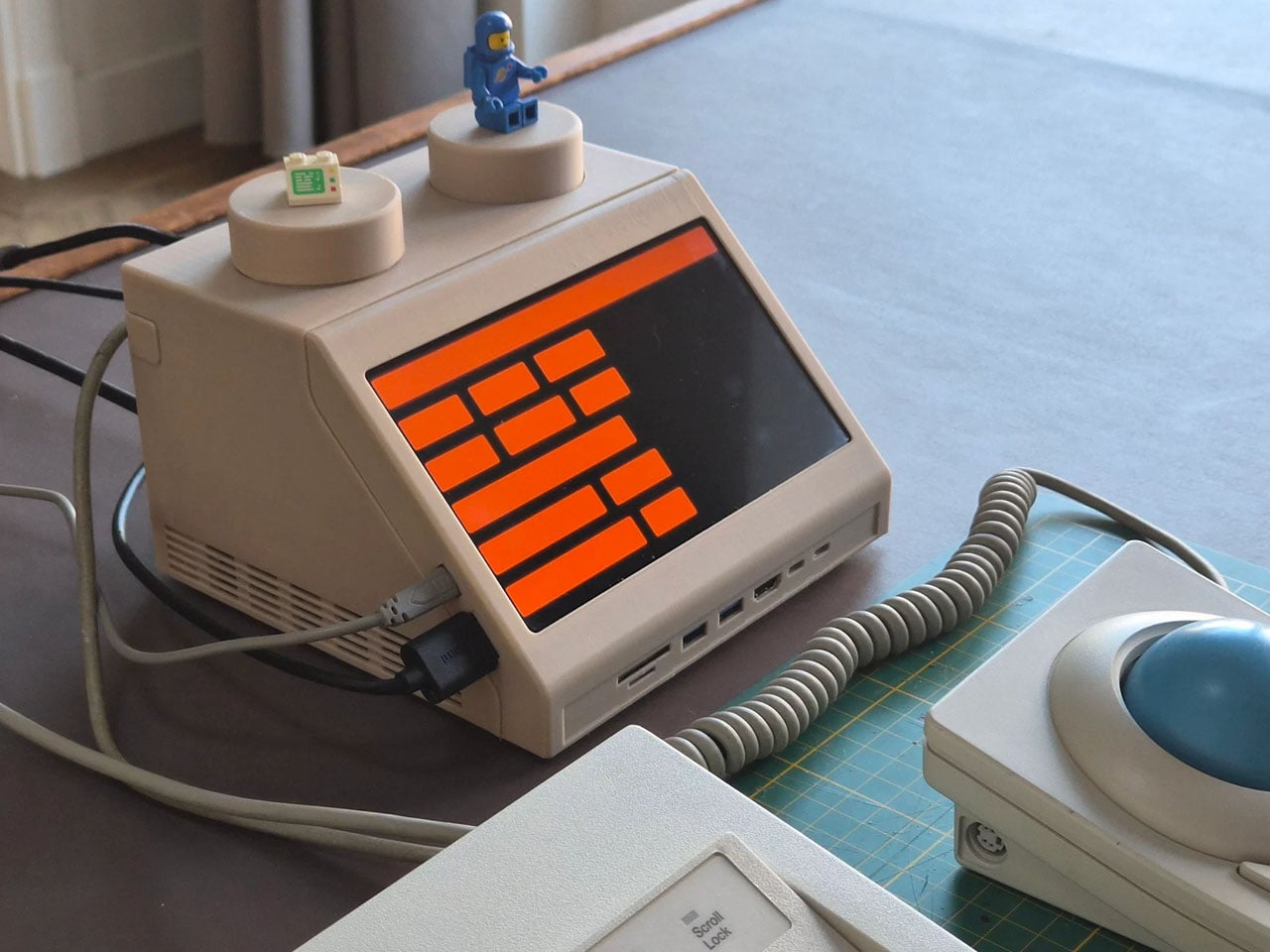
Retro designs often carry a sense of nostalgia, but occasionally they evolve into something more functional and imaginative. The M2x2 workstation by Watt IV is a good example with the inventive reinterpretation of a classic LEGO element transformed into a fully working desktop computer. Created by Dutch designer Paul Staal, the device takes inspiration from the iconic sloped LEGO computer brick introduced in 1979 and scales it up into a practical workstation powered by a modern Mac mini.
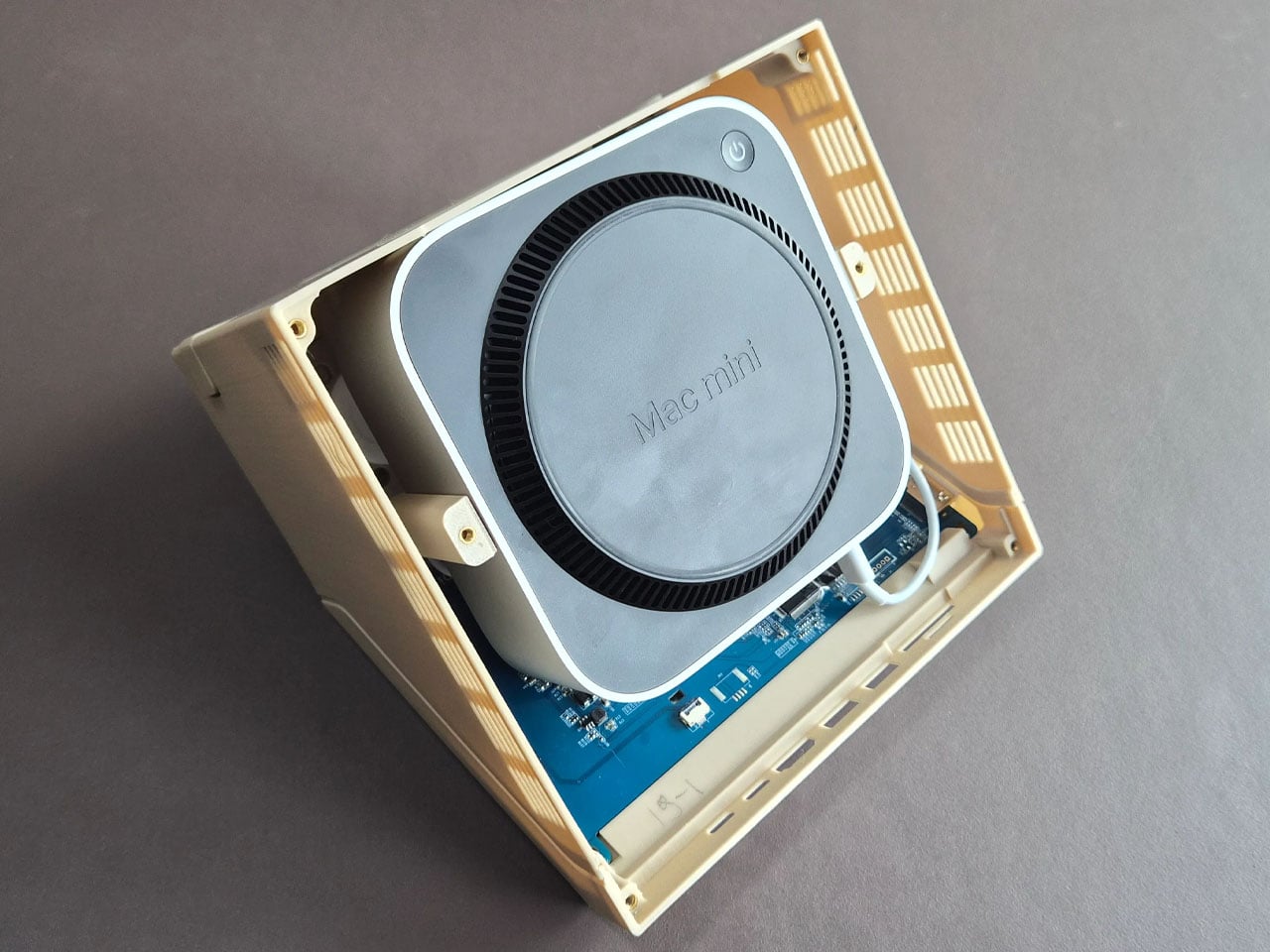
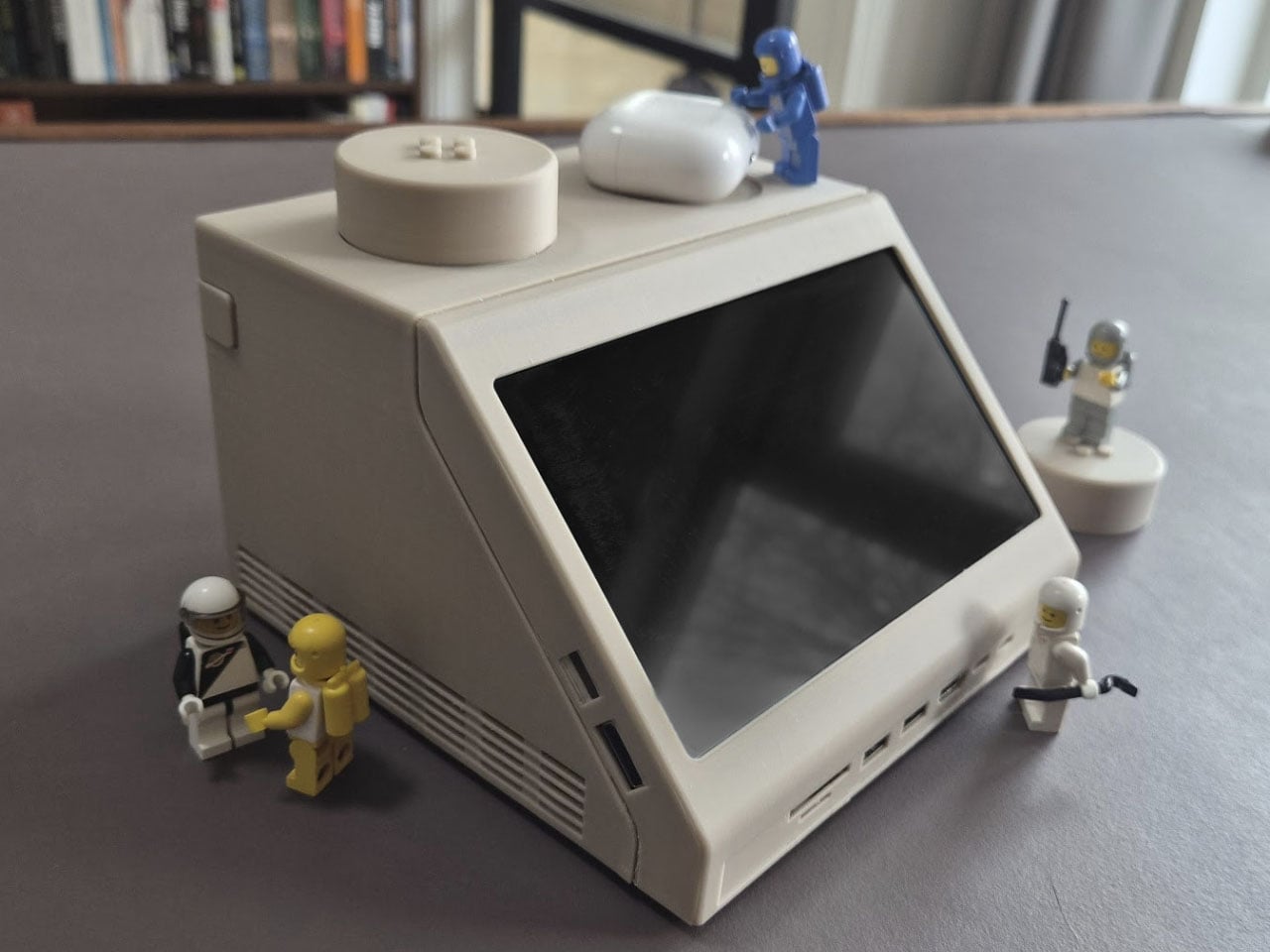
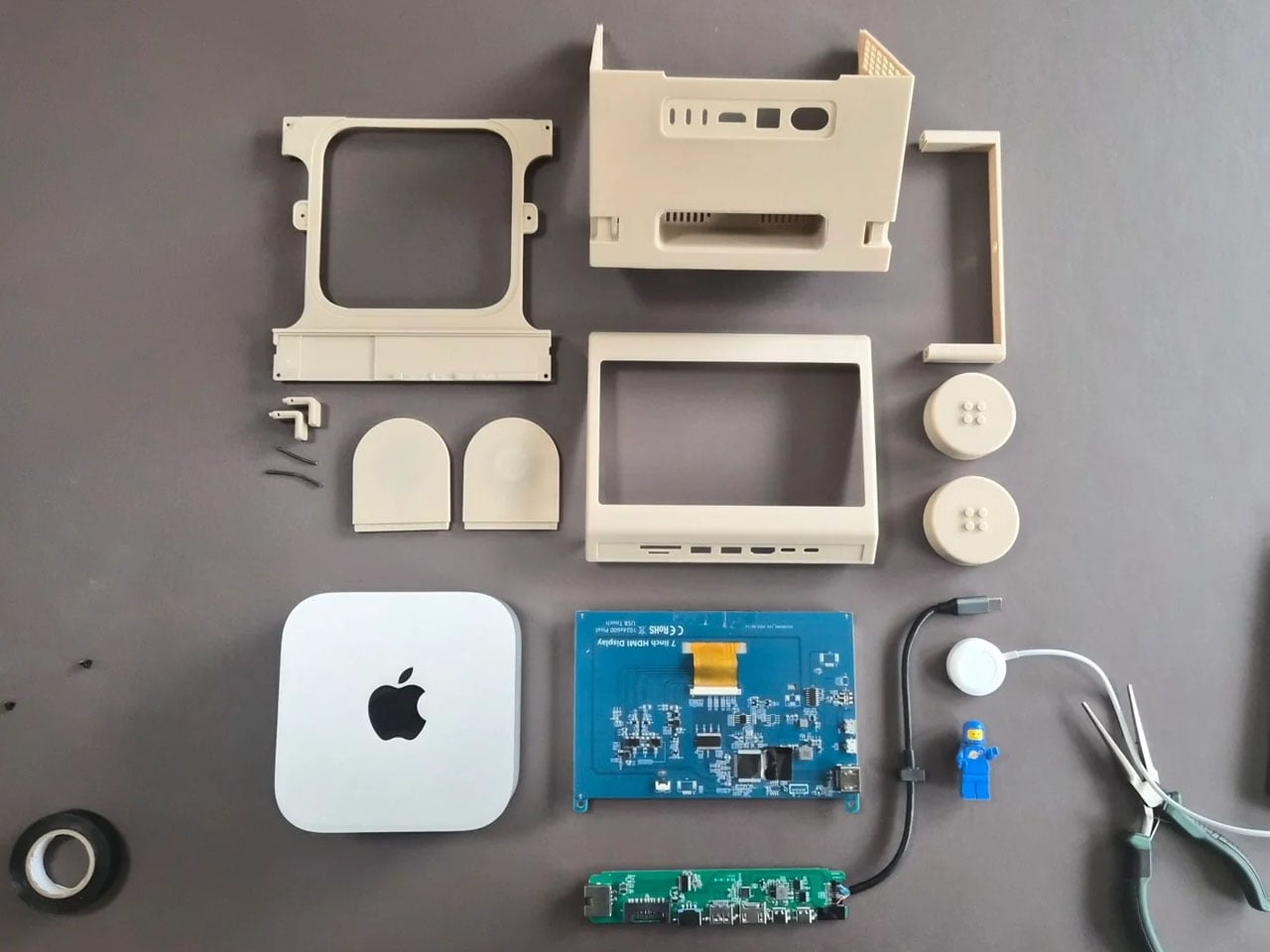
The DIY centers around the familiar wedge-shaped Slope 45 2×2 LEGO piece, a part historically used in LEGO space-themed sets as a representation of computer terminals inside spacecraft cockpits. Staal enlarged this element to roughly ten times its original size, turning it into a functional housing that blends retro toy aesthetics with contemporary computing power. Inside the oversized brick sits an Apple Mac mini equipped with Apple’s M4 chip, transforming the playful concept into a capable desktop system.
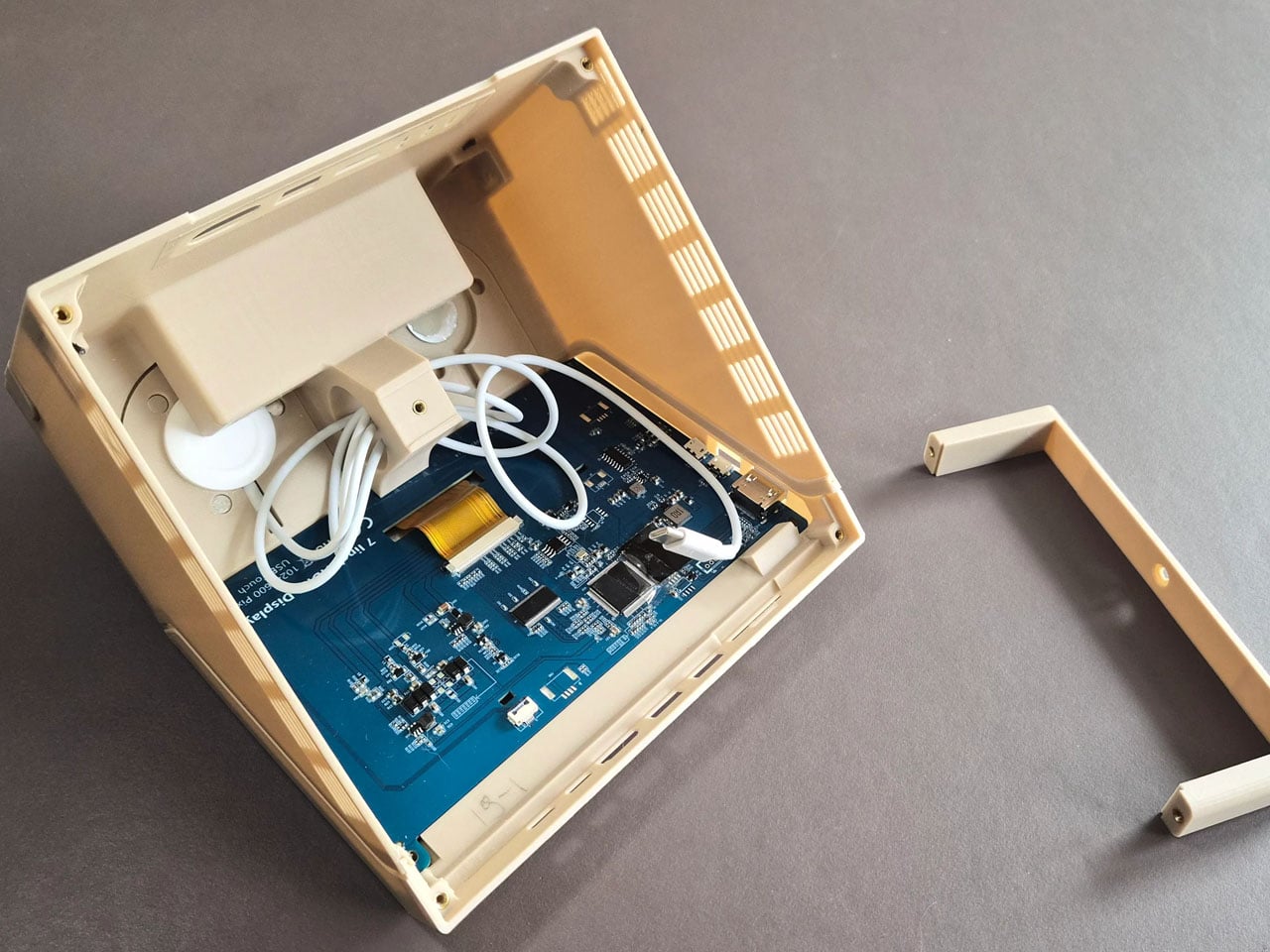
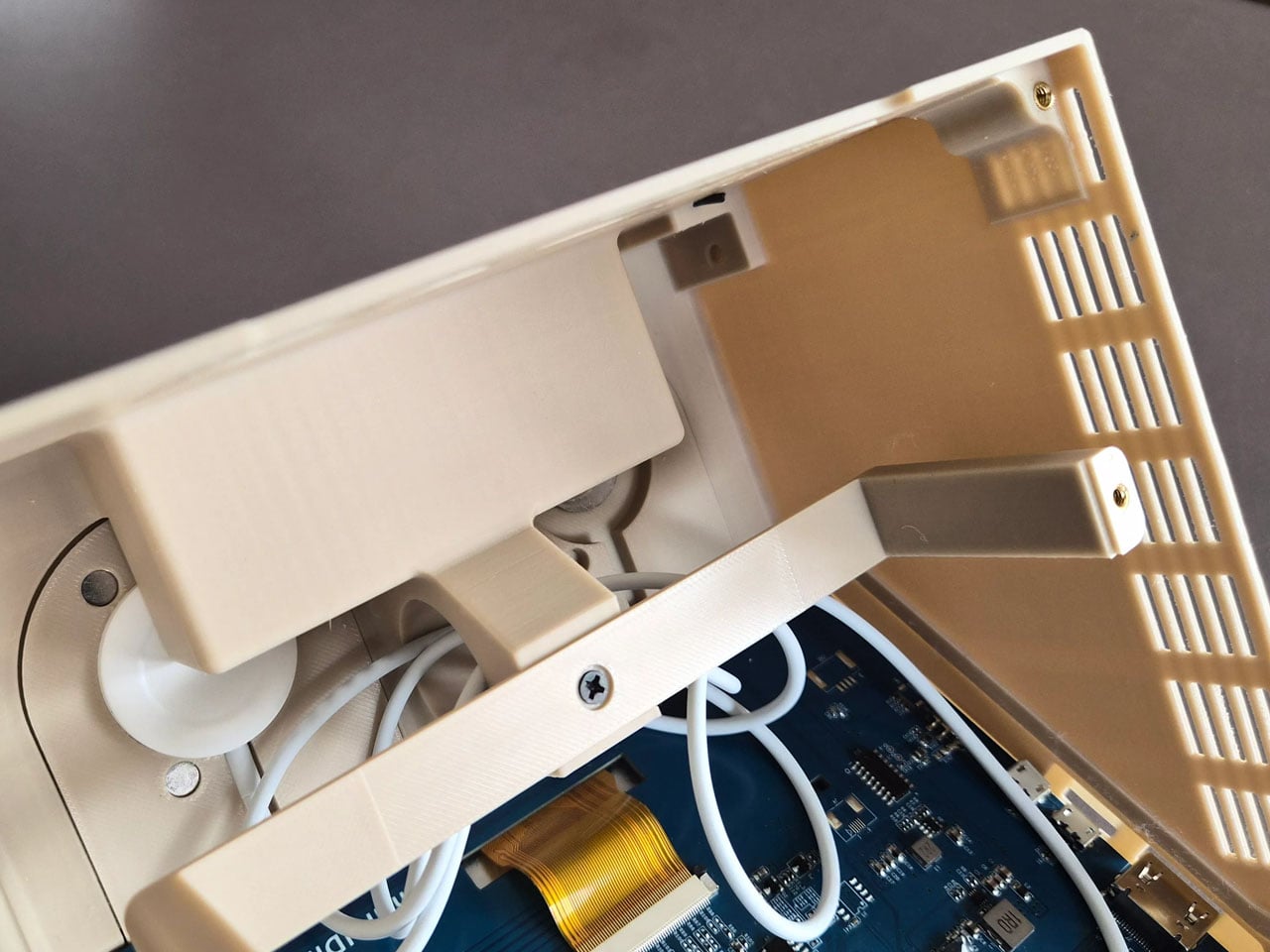
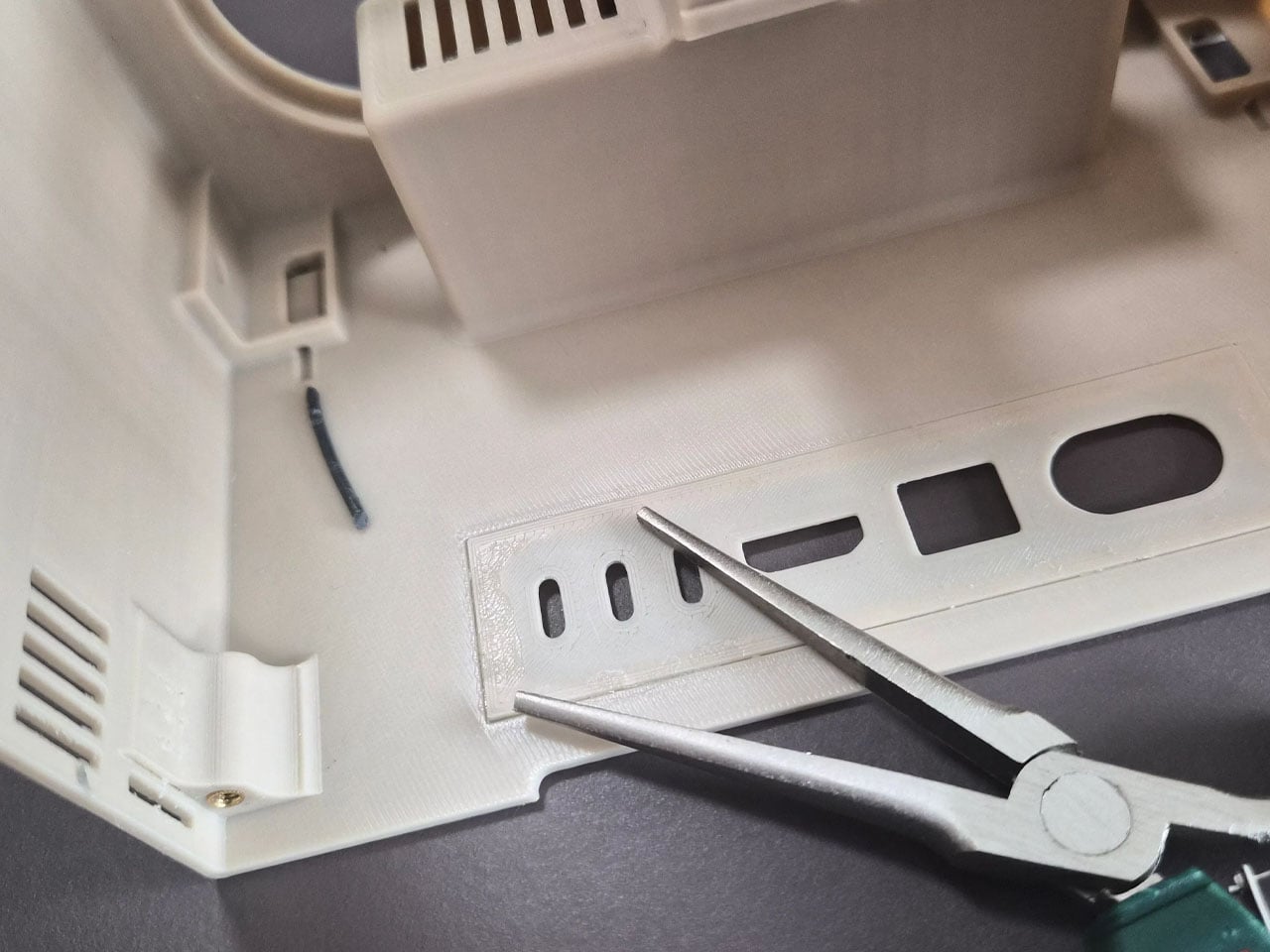
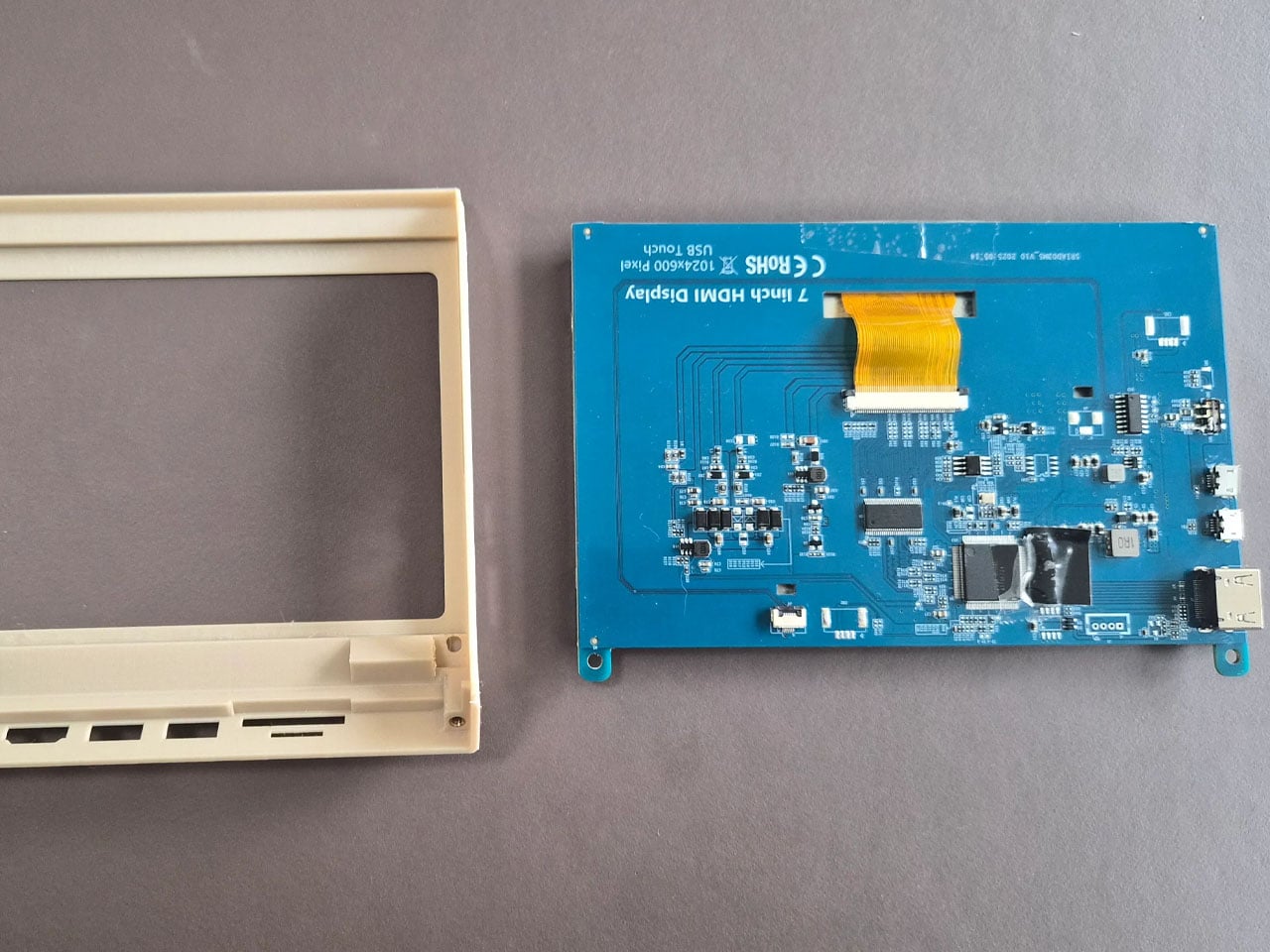
Rather than serving as a simple decorative shell, the M2x2 integrates several practical features that enhance its usability as a workstation. A slanted 7-inch IPS touchscreen is embedded in the front face of the structure, echoing the display graphic printed on the original LEGO piece while providing real functionality. The compact screen acts as a secondary interface, often used for quick system information or dashboards. Staal, for instance, uses it primarily to monitor and control his smart home through a Home Assistant interface while working on a larger external display.
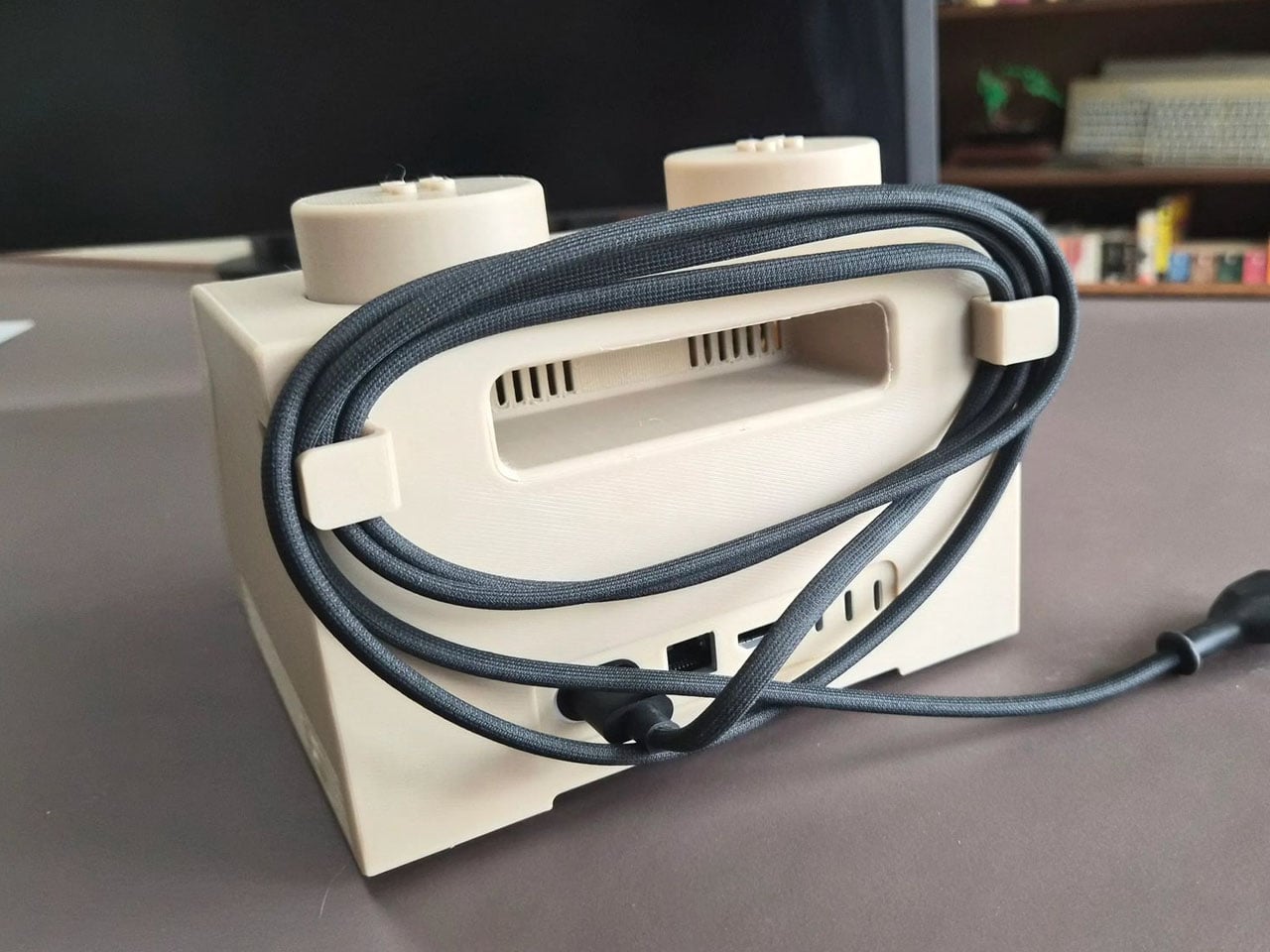
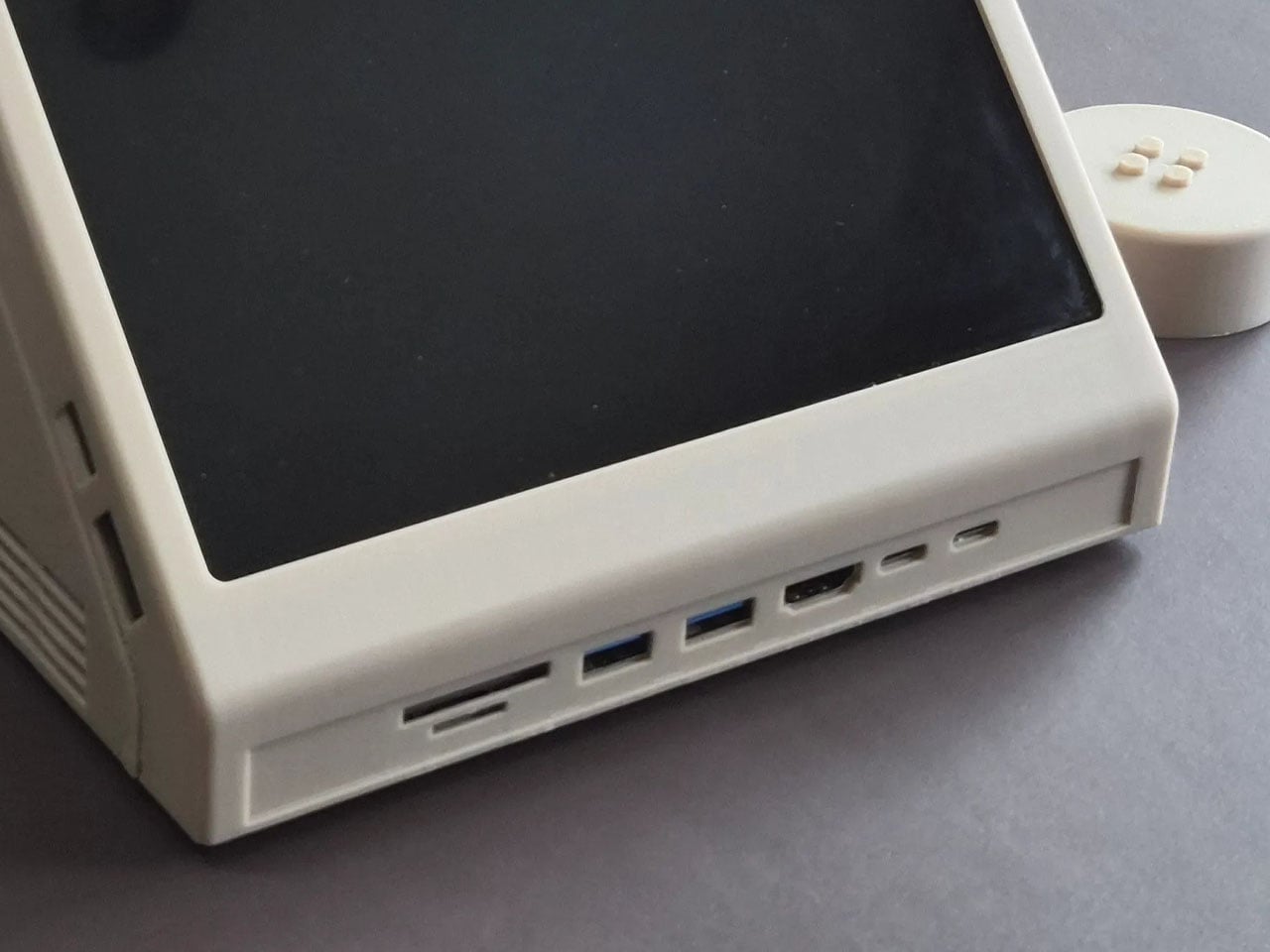
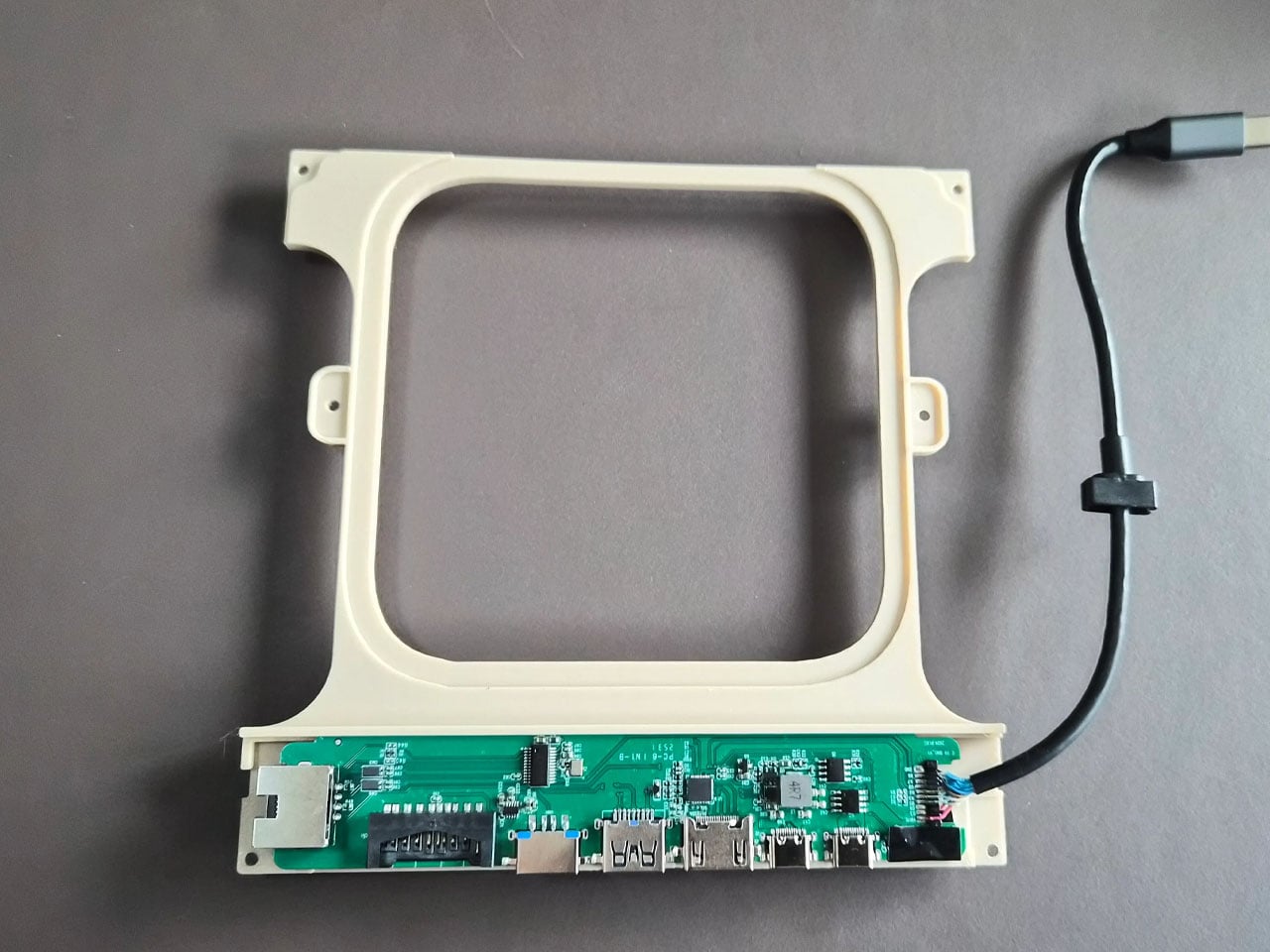
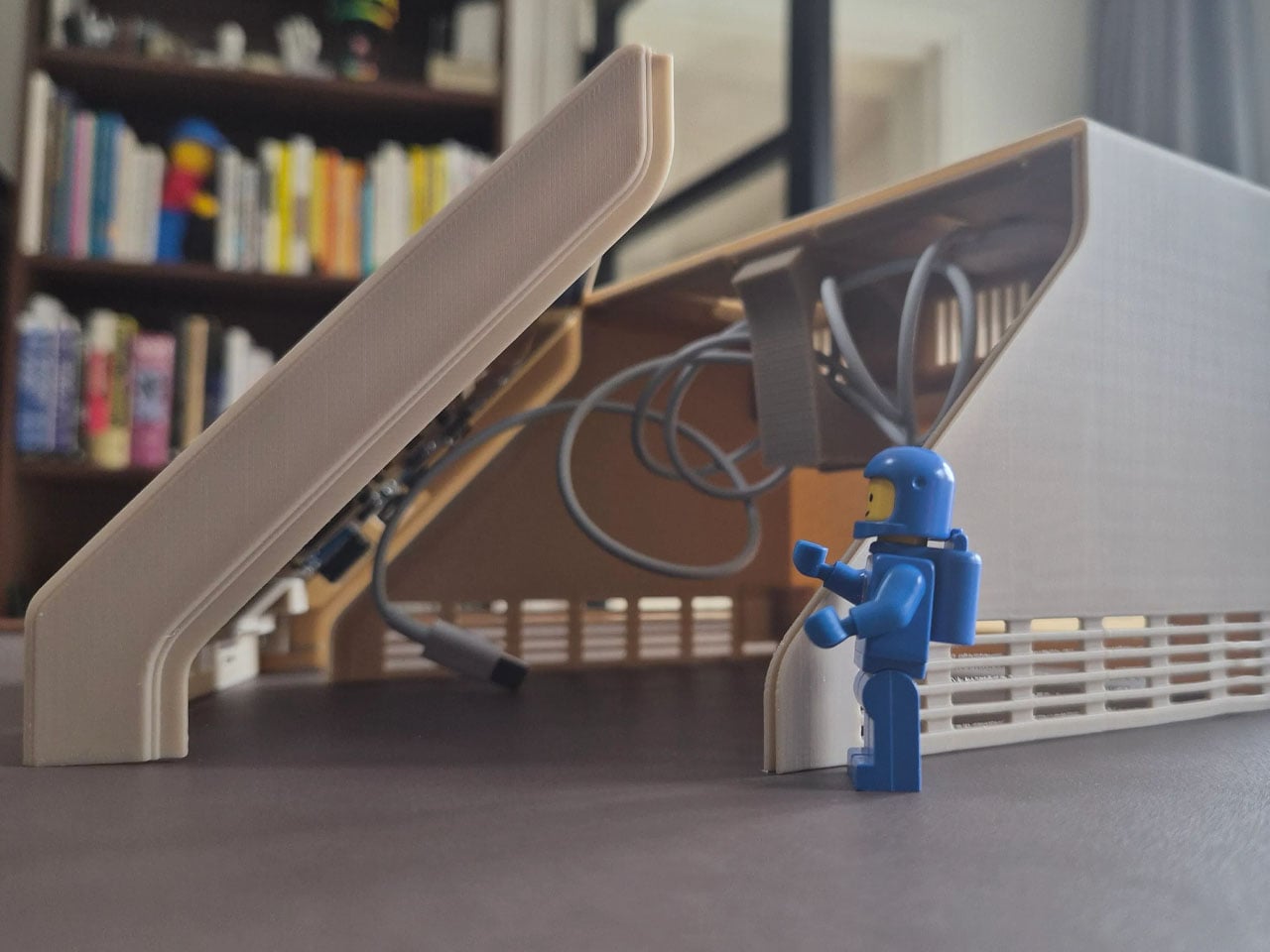
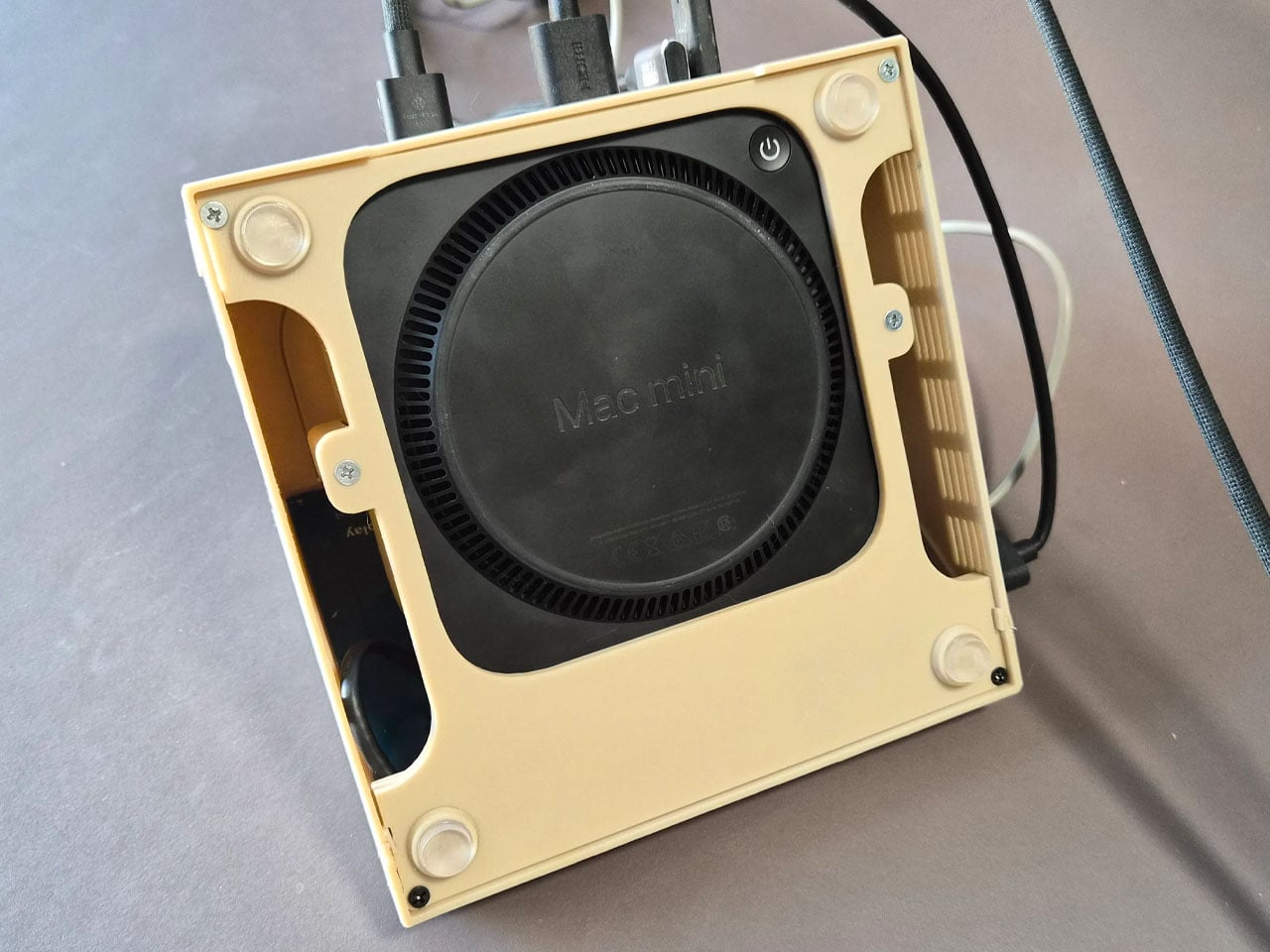
The case includes front-facing ports enabled through a USB-C hub, along with an SD card reader for easy access to external storage and accessories. This arrangement ensures the device remains practical for everyday use despite its playful form factor. The system also retains portability elements inspired by early Apple computers, including a built-in handle at the back that makes the unit easy to move around a desk or workspace. While the M2x2 works as a self-contained computer, it is typically paired with a larger external monitor for full productivity. In everyday use, the Mac mini handles the heavy computing tasks while the built-in display functions as a control panel or status screen.
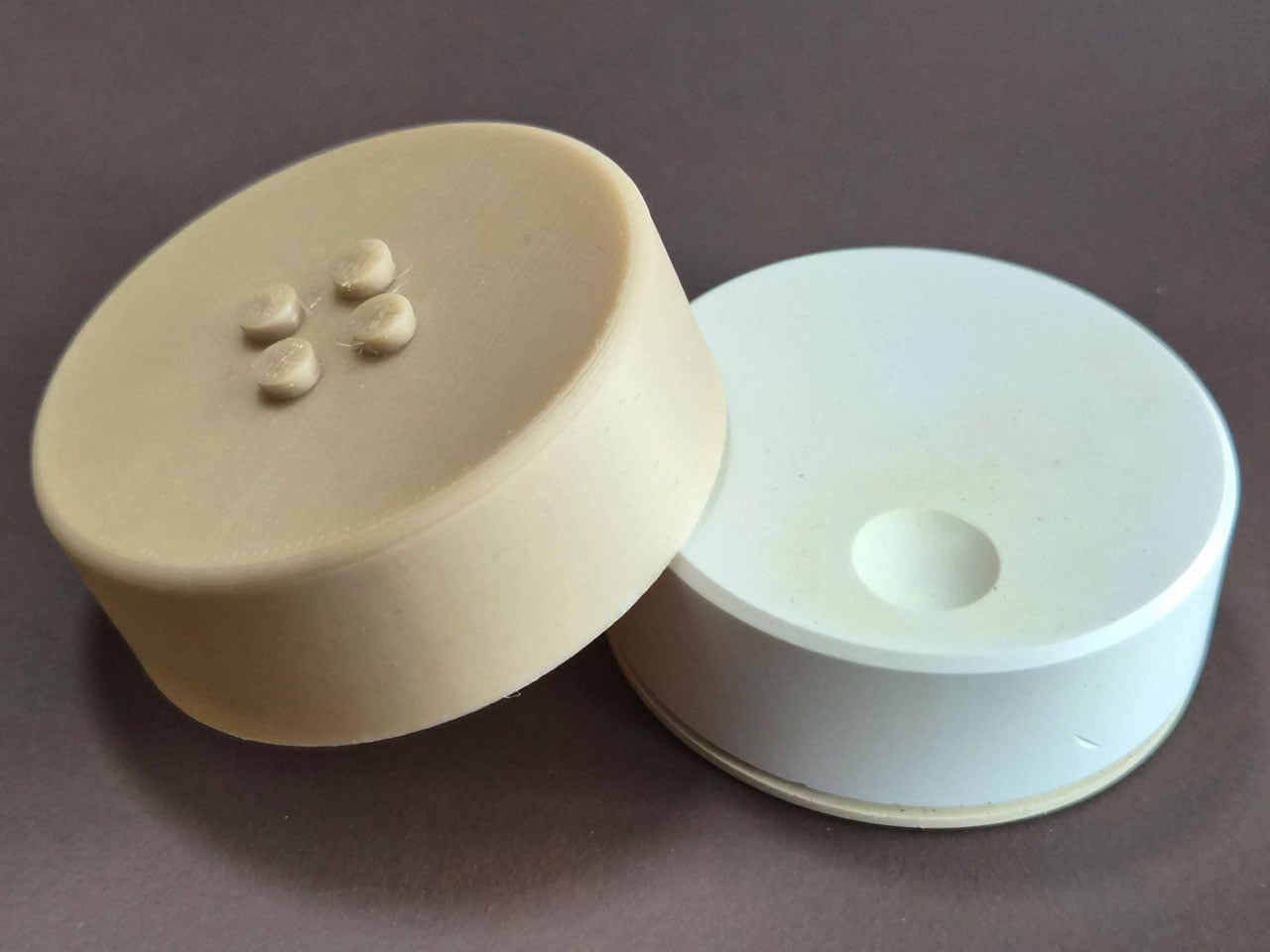
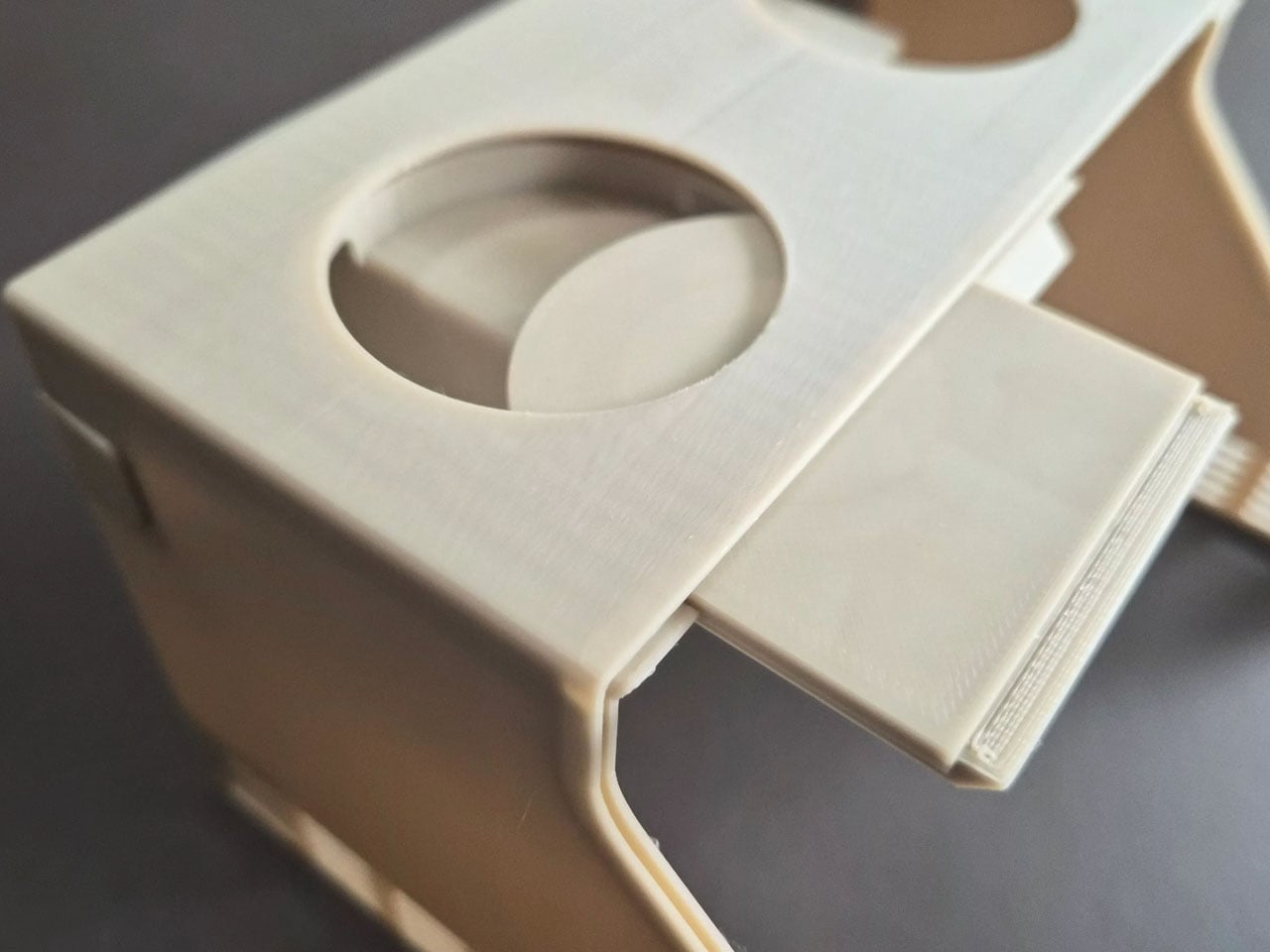
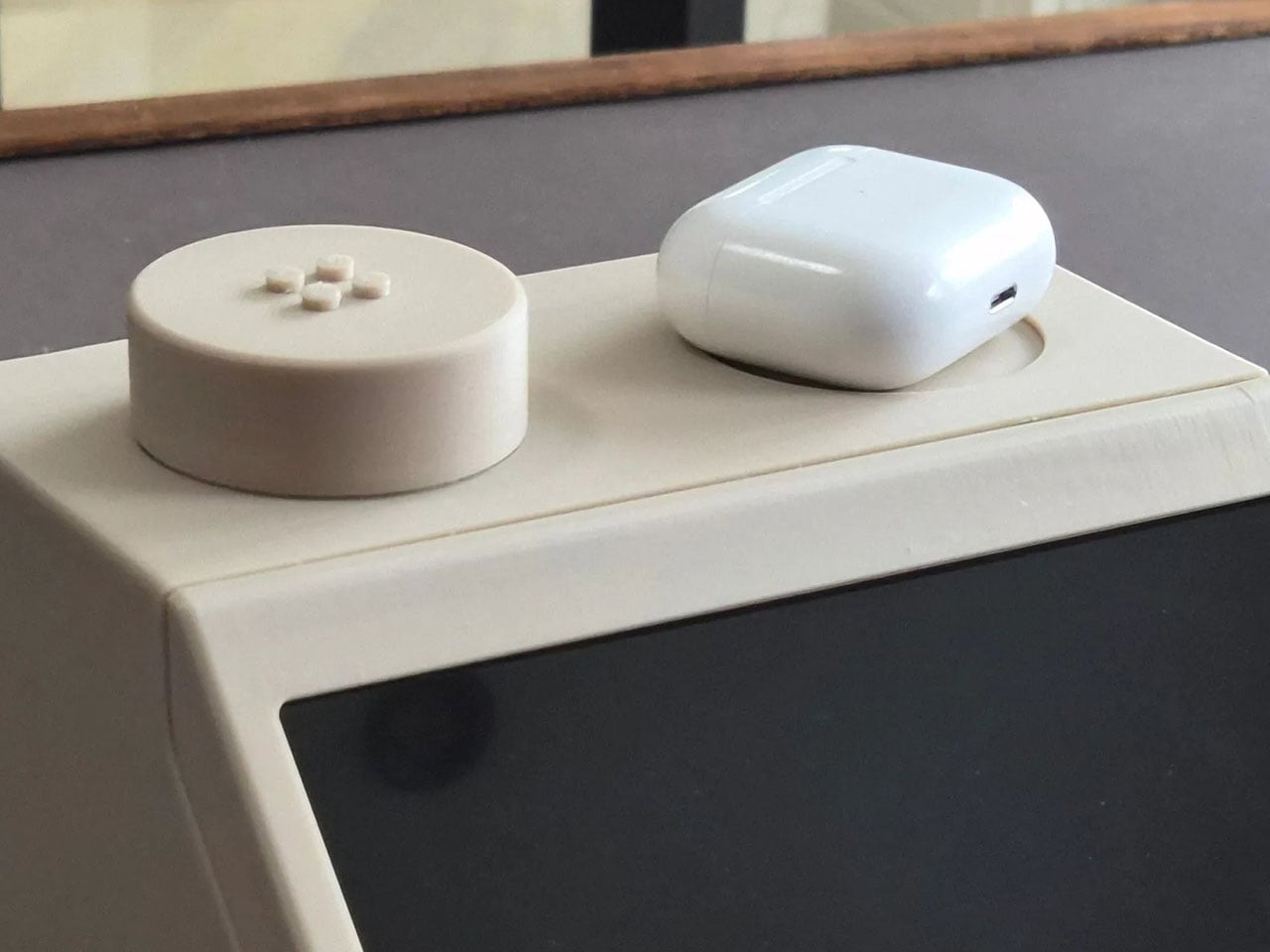
Perhaps the most creative detail lies in the oversized LEGO studs on top of the case. Instead of being purely decorative, these studs are designed to perform useful functions. One of them operates as a rotary control that can adjust volume or media playback, while the other conceals a wireless charging bay capable of powering devices such as AirPods or an Apple Watch. The studs themselves remain compatible with standard LEGO elements, allowing users to attach minifigures or bricks for a playful finishing touch.
The M2x2 is largely built from 3D-printed components, making it accessible to enthusiasts who want to build their own version. Staal modeled the structure in CAD software and designed it as a modular system consisting of multiple printable parts. Aside from the Mac mini itself, the required materials are relatively simple, including PLA filament, a small touchscreen display, screws, and a USB-C hub. Assembly instructions and downloadable files are available, allowing makers to replicate or modify the design to suit their needs.
No matter how old we get, most of us would probably still collect things from our favorite characters when we were kids. Some would call it healing our inner child, while others would simply say we now have the money to buy what we want compared to back then. Either way, there’s something undeniably joyful about it. Snoopy is probably one of the most beloved and enduring characters of all time, and if you’re a LEGO lover as well as a fan of this witty beagle, then you’d want to hold on to your roof.
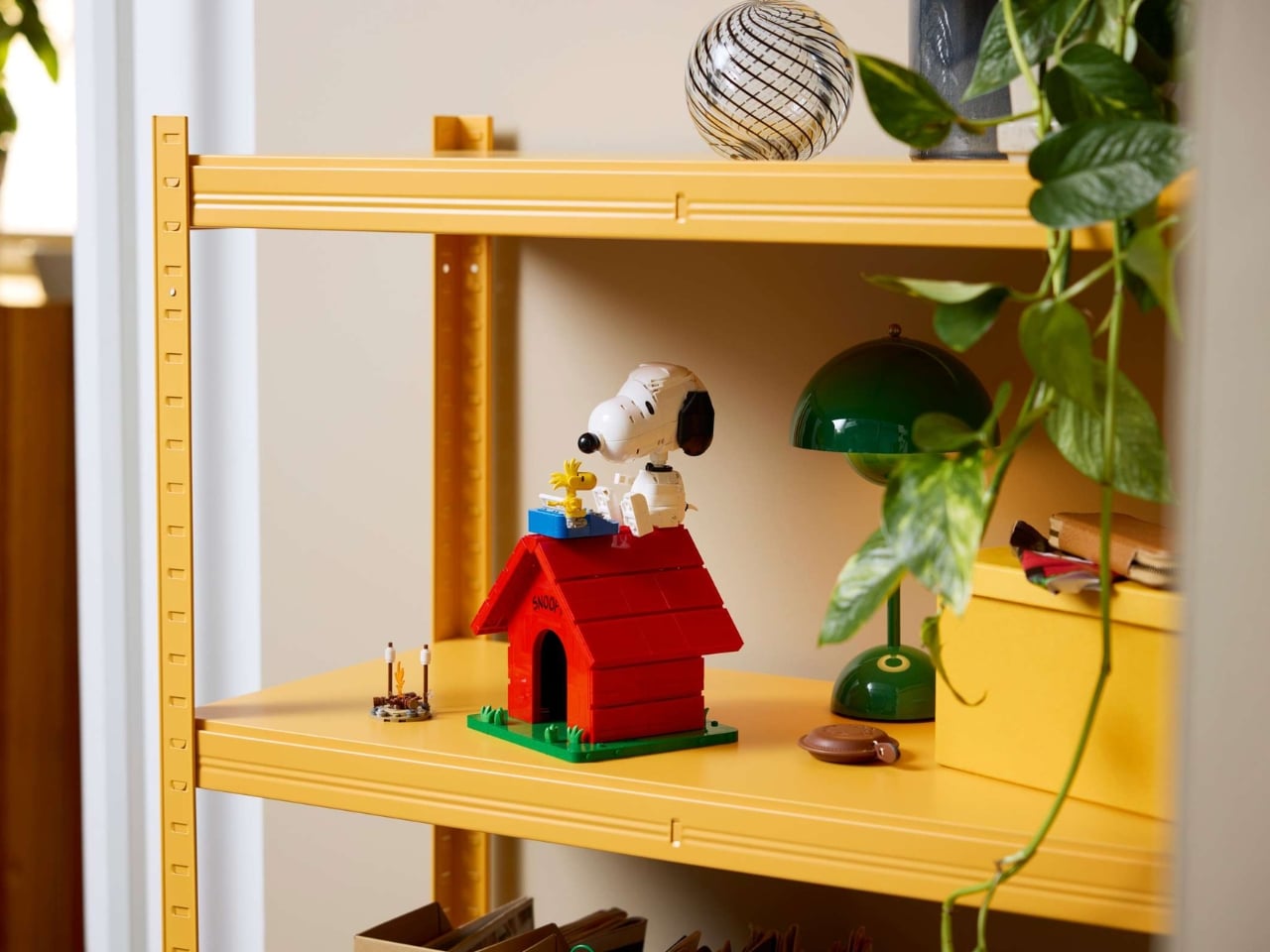
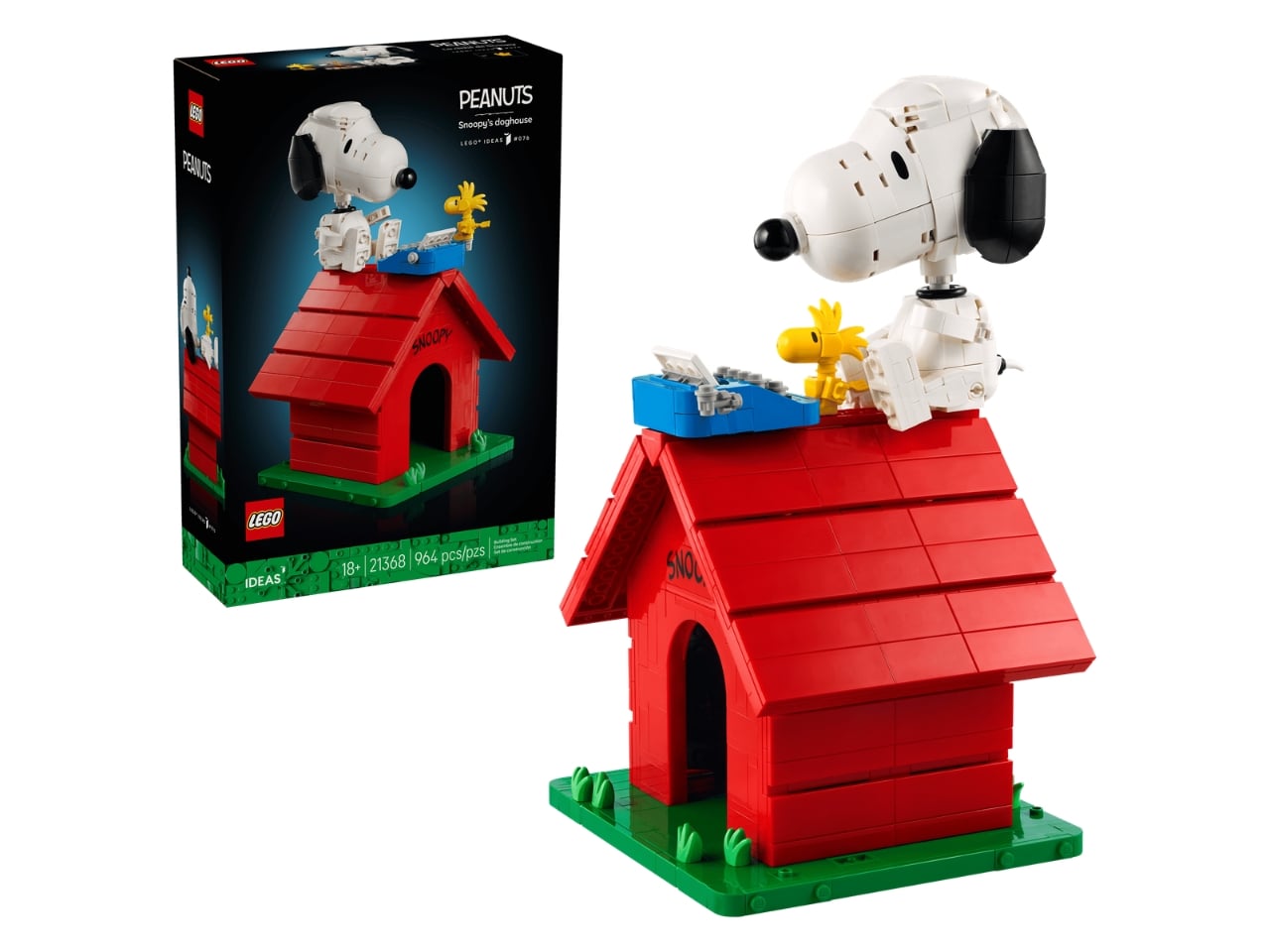
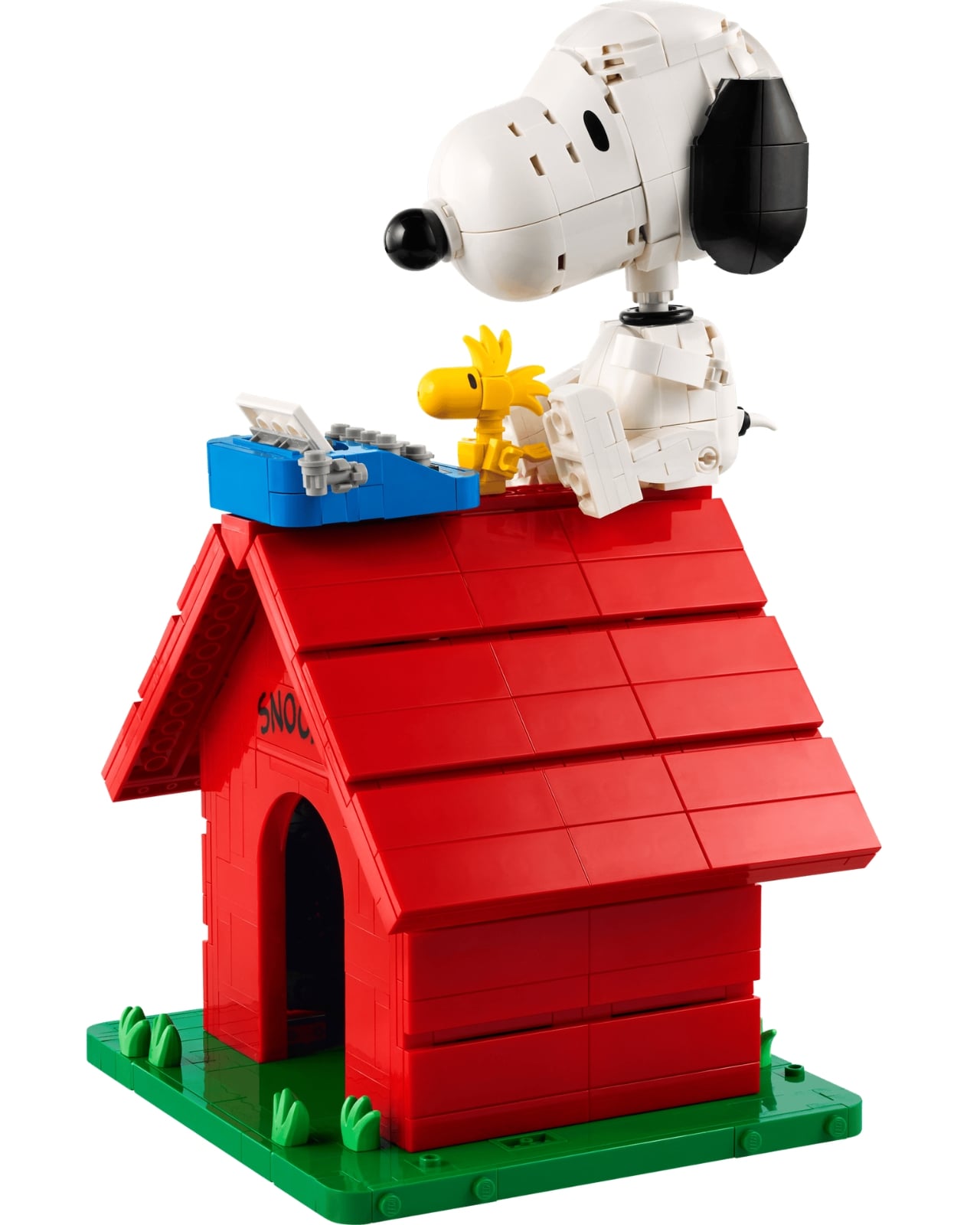
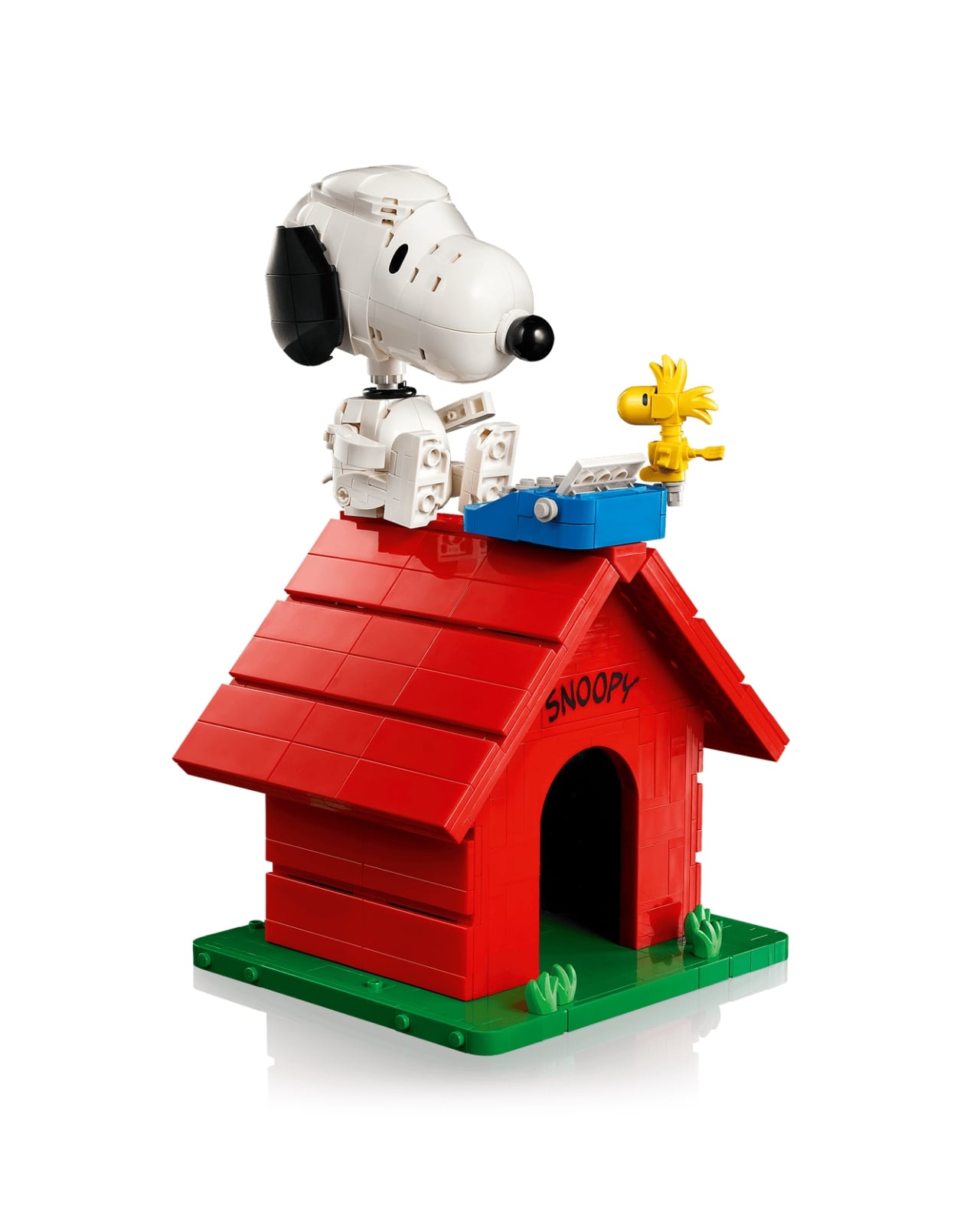
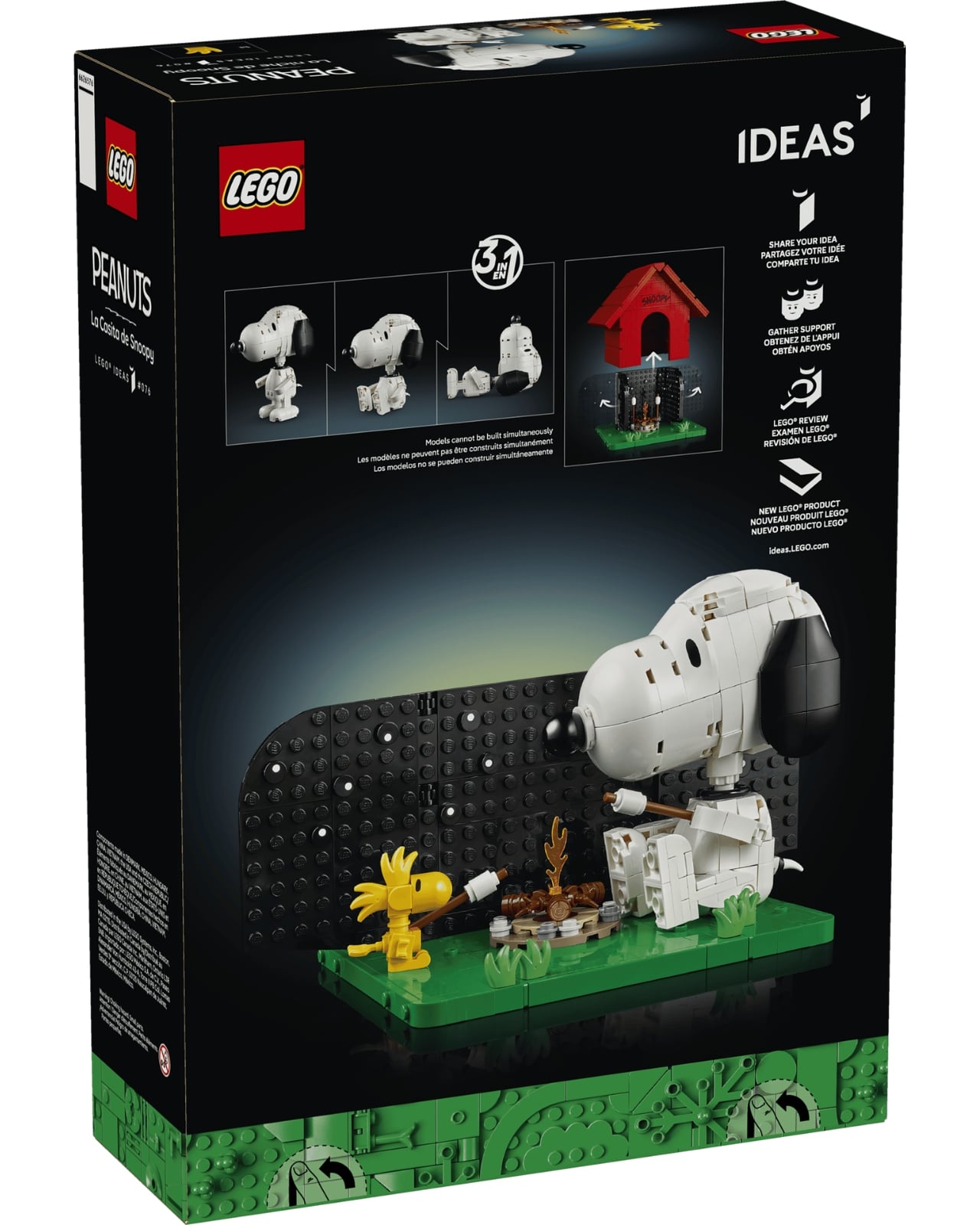
LEGO is releasing a new build for Snoopy fans to celebrate over 75 years of the Peanuts legacy. LEGO Ideas Peanuts: Snoopy’s Doghouse is a 964-piece set that features the iconic dog and his legendary red doghouse. It’s not just a toy, as it’s meant for those who are 18 years old and above. Rather, it’s a display piece that brings together fun, nostalgia, and the unique joy that comes from building something featuring our all-time favorite character.
What makes this set even more special is its origin story. It started as a fan submission on the LEGO Ideas platform, a space where LEGO enthusiasts submit their own brick creations, rally votes from the community, and if they’re lucky, see their dream set come to life. This one was designed by fan creator “bossofdos64,” and after earning enough votes from fellow fans, the LEGO Group worked their magic to make it a reality. So in a way, this set was made by a fan, for fans, and that’s something truly worth celebrating.
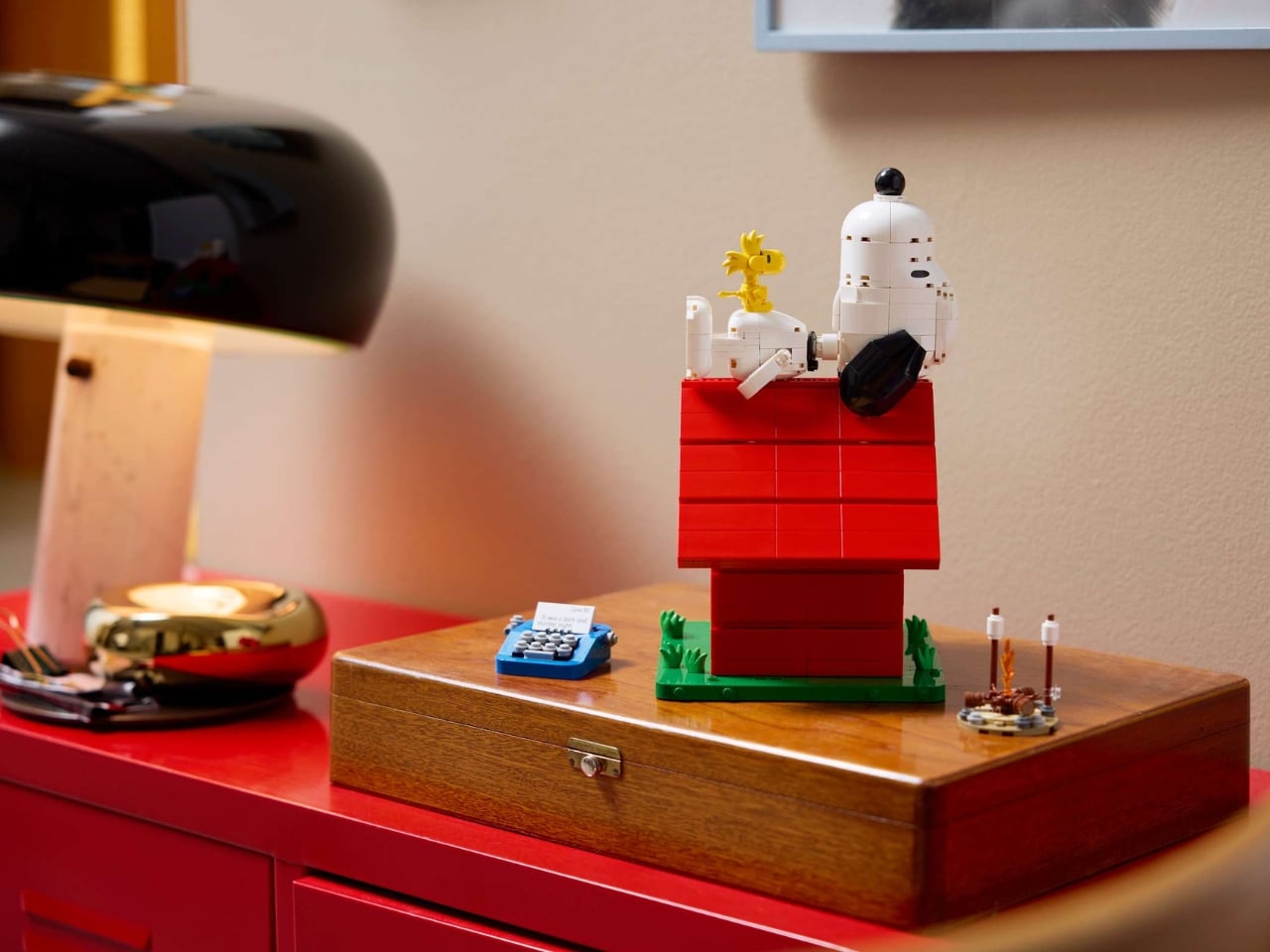
The doghouse itself stands over 10 inches high, 6.5 inches wide, and 5.5 inches deep, making it ideal as a statement piece on your shelf or desk. Aside from the iconic red doghouse that even casual fans would recognize anywhere, the set also comes with a posable Snoopy figure. It has two alternative leg builds so you can pose him sitting or standing, and two neck positions so he can be upright or lying down, fully ready for whatever mood strikes you.
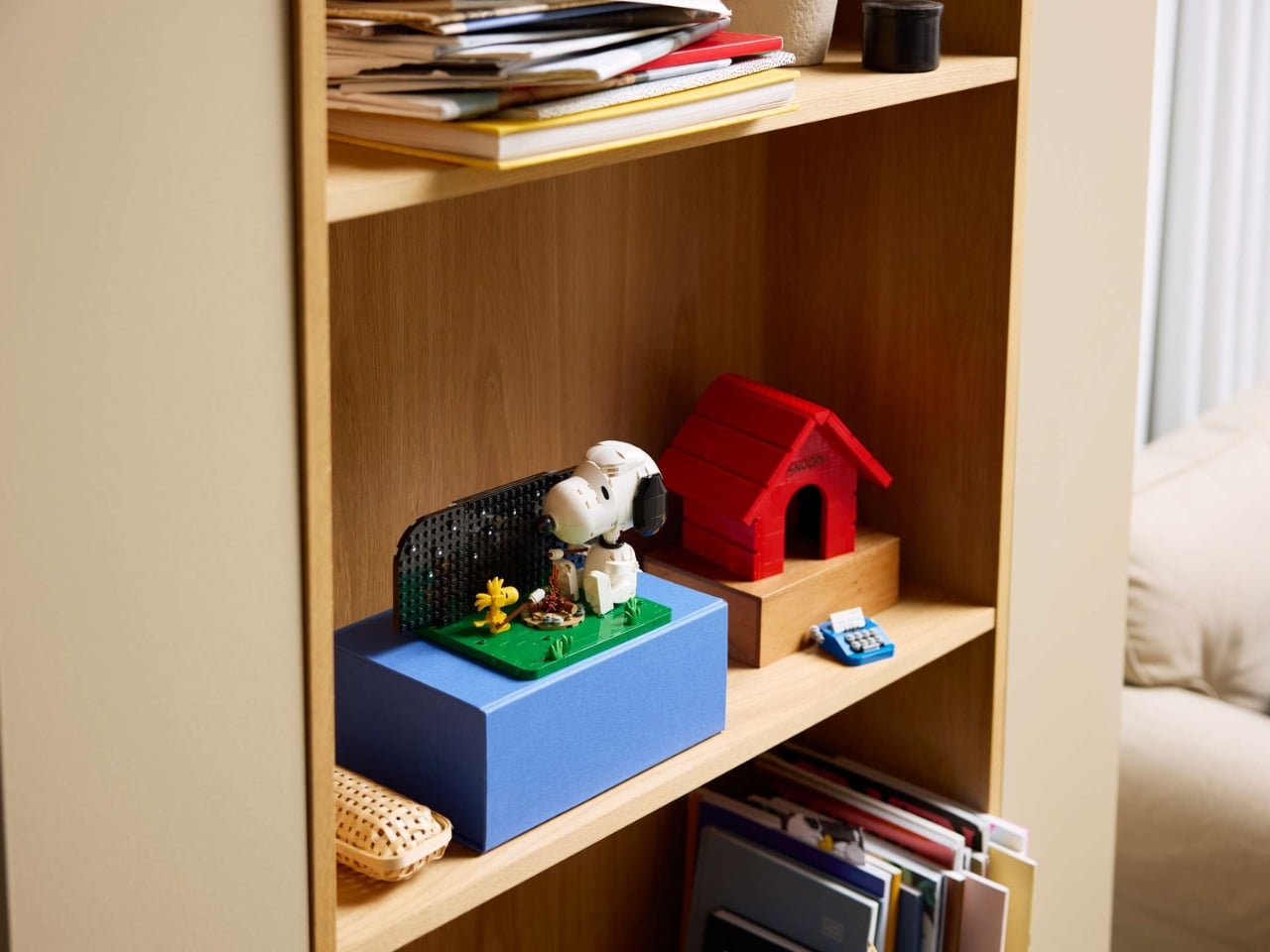
A Snoopy scene wouldn’t be complete without Woodstock, his little yellow bird bestie of officially unknown species. The set also includes accessories like a typewriter to give Snoopy his classic writing moments, a campfire with marshmallows for a cozy toasting scene, and a grassy green base to anchor the whole display together. The interior walls of the doghouse can even be folded out to reveal a gorgeous starry night sky backdrop that really sets the mood.
With all these elements, you’ll be able to recreate some iconic scenes to make your Snoopy heart truly happy. You can display him lounging on top of the doghouse with Woodstock resting on his belly, living his best life and, honestly, inspiring us all. You can also pose Snoopy typing away at his little LEGO typewriter, working on that great novel we’re all still waiting for, or have the two besties toasting marshmallows together under a starry sky. The set offers enough variety that you might find yourself rearranging the display every season just because you can.
The LEGO Builder app gives you access to 3D instructions, whether you’re a first-timer or an experienced builder who wants to zoom in, rotate, and track their progress along the way. The set is priced at $89.99 USD, making it a thoughtful splurge or a perfect gift for any Peanuts lover in your life. You can pre-order the set now, and it will start shipping out this June.
Whether you’re building it for yourself or gifting it to someone whose eyes light up at the mere sight of a little black-and-white beagle, this set is a beautiful reminder that some things never get old. Snoopy has been napping on that rooftop, dreaming big, and making us smile for over 75 years, and clearly, he has absolutely no plans of stopping. Good grief, indeed.
The Furby didn’t just sell 40 million units in its first three years. It created genuine paranoia. Parents whispered about hidden microphones. The NSA had to issue actual statements denying that these fuzzy toys were surveillance devices. Kids would wake up to unprompted Furbish babbling at 3 AM and wonder if their electronic pet had become sentient. Twenty-eight years later, those kids are adults, and one of them just submitted a 1,700-piece LEGO version to Ideas that’s already earned a Staff Pick designation.
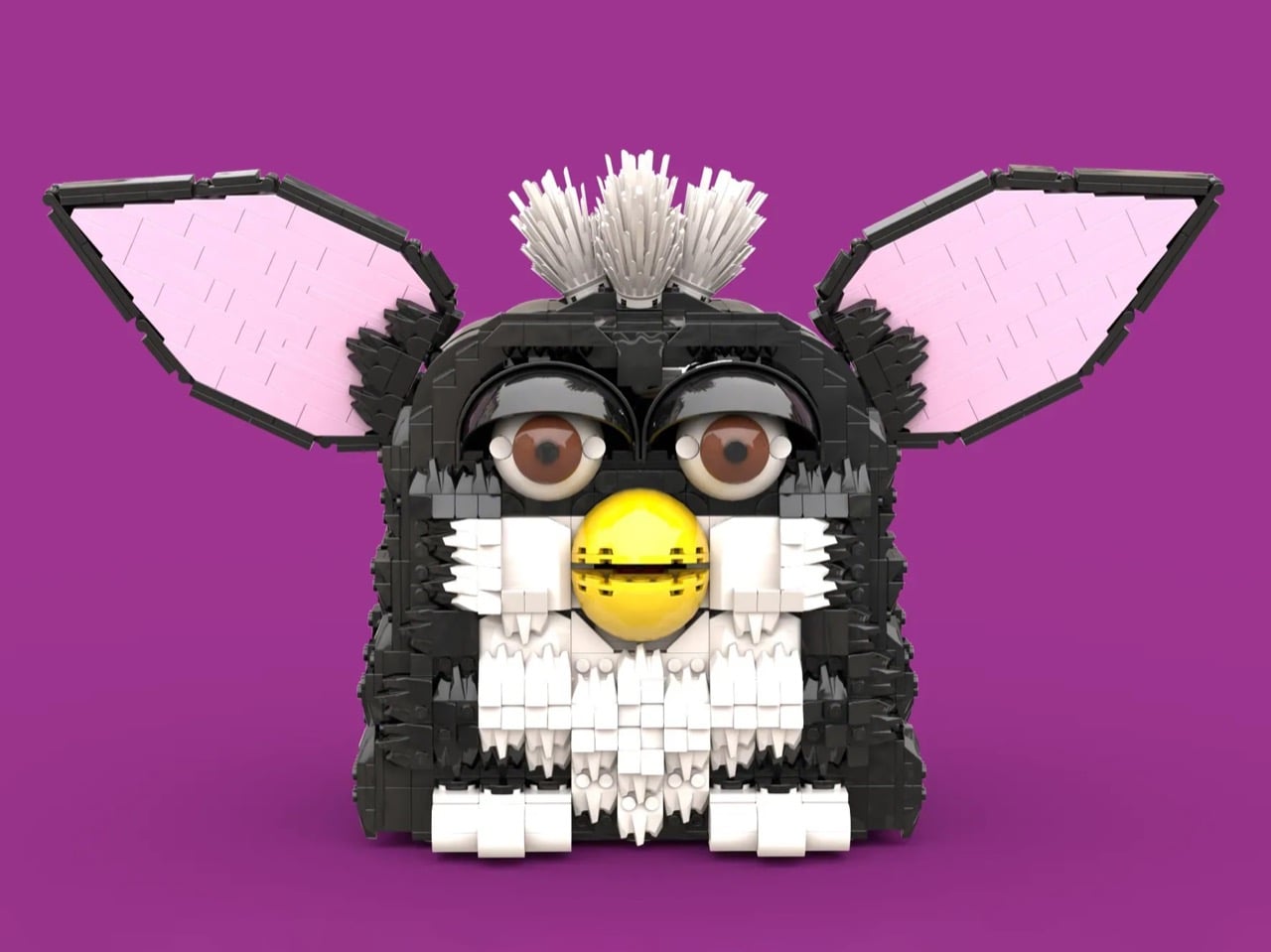
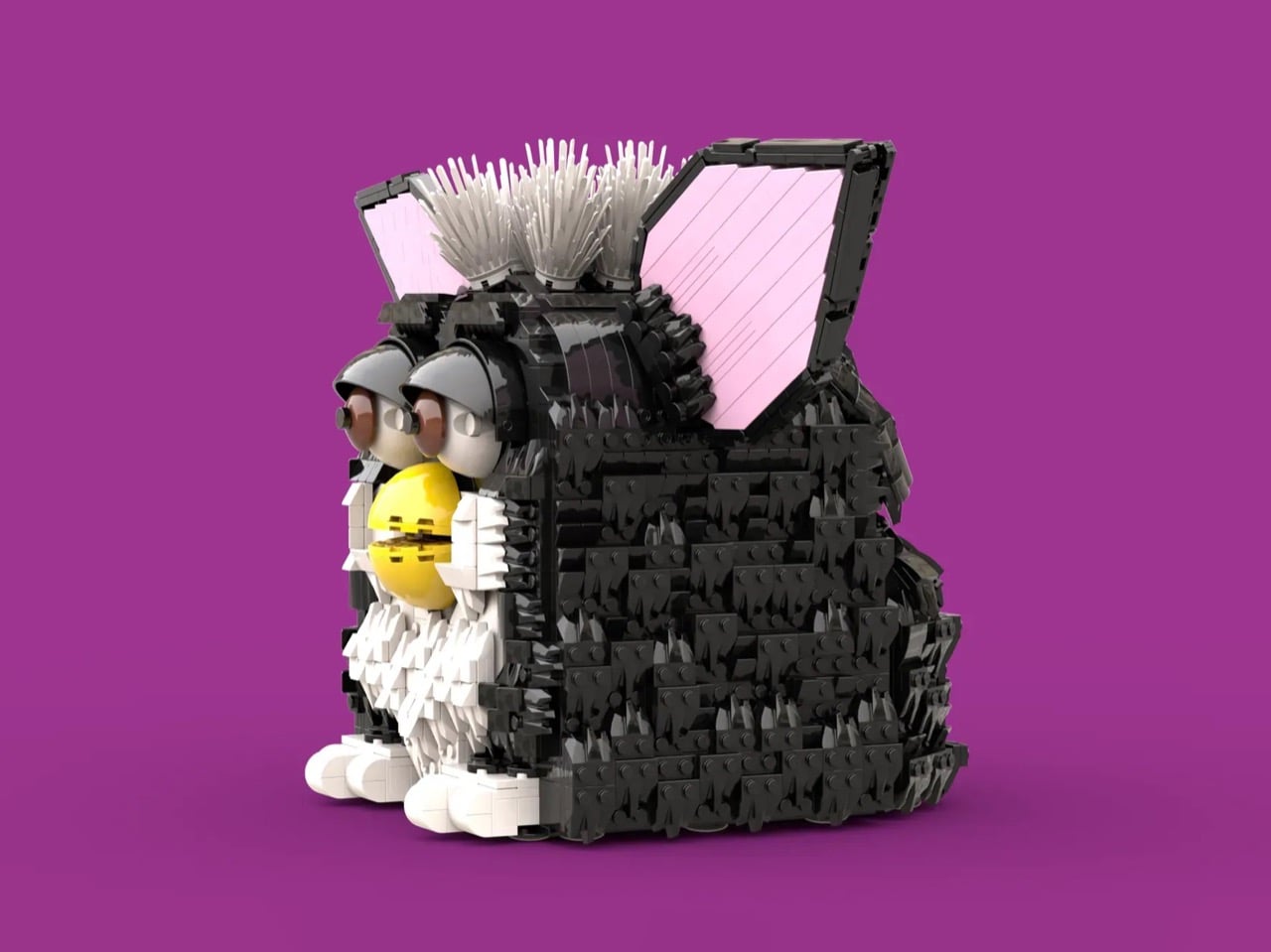
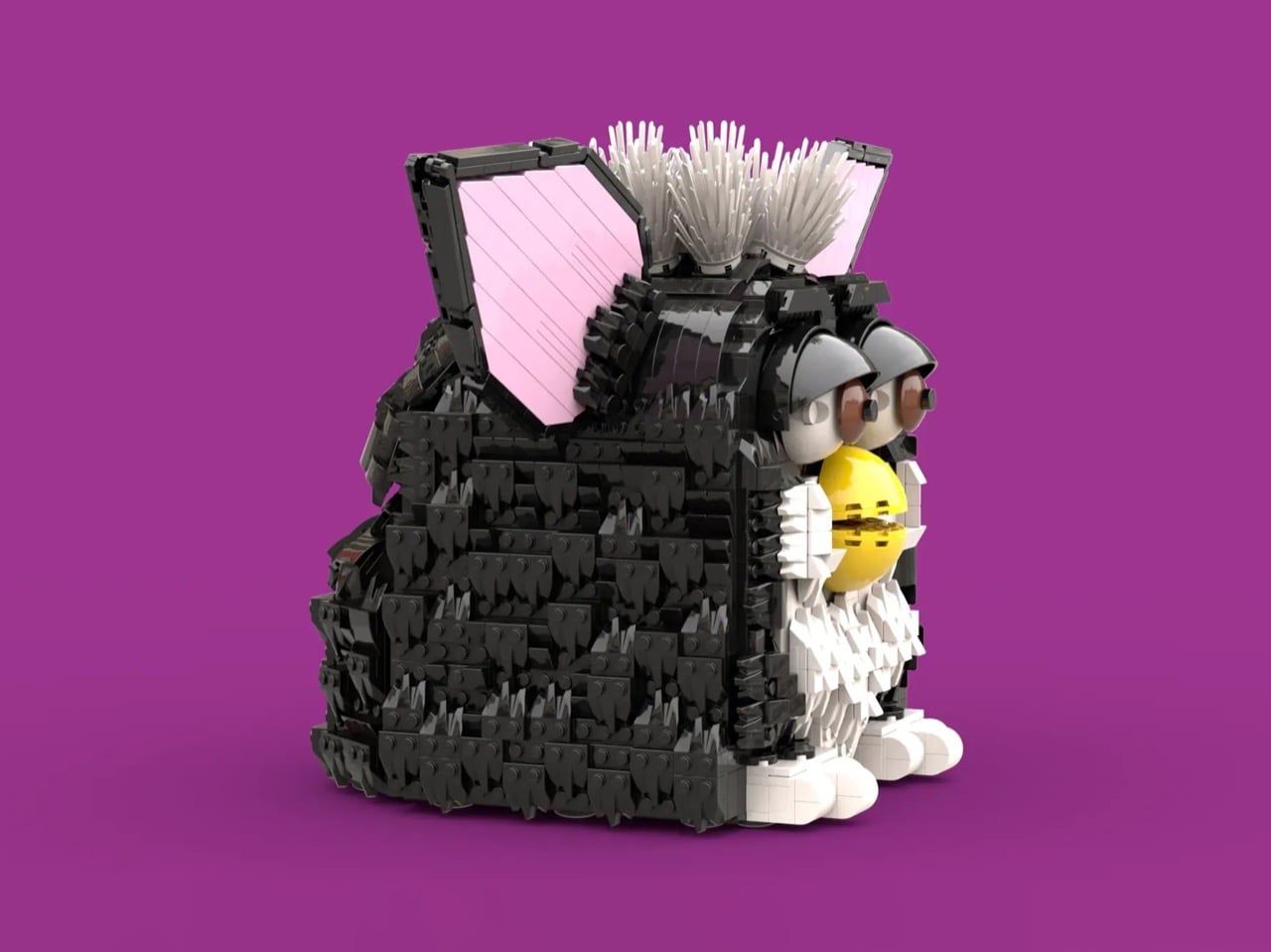
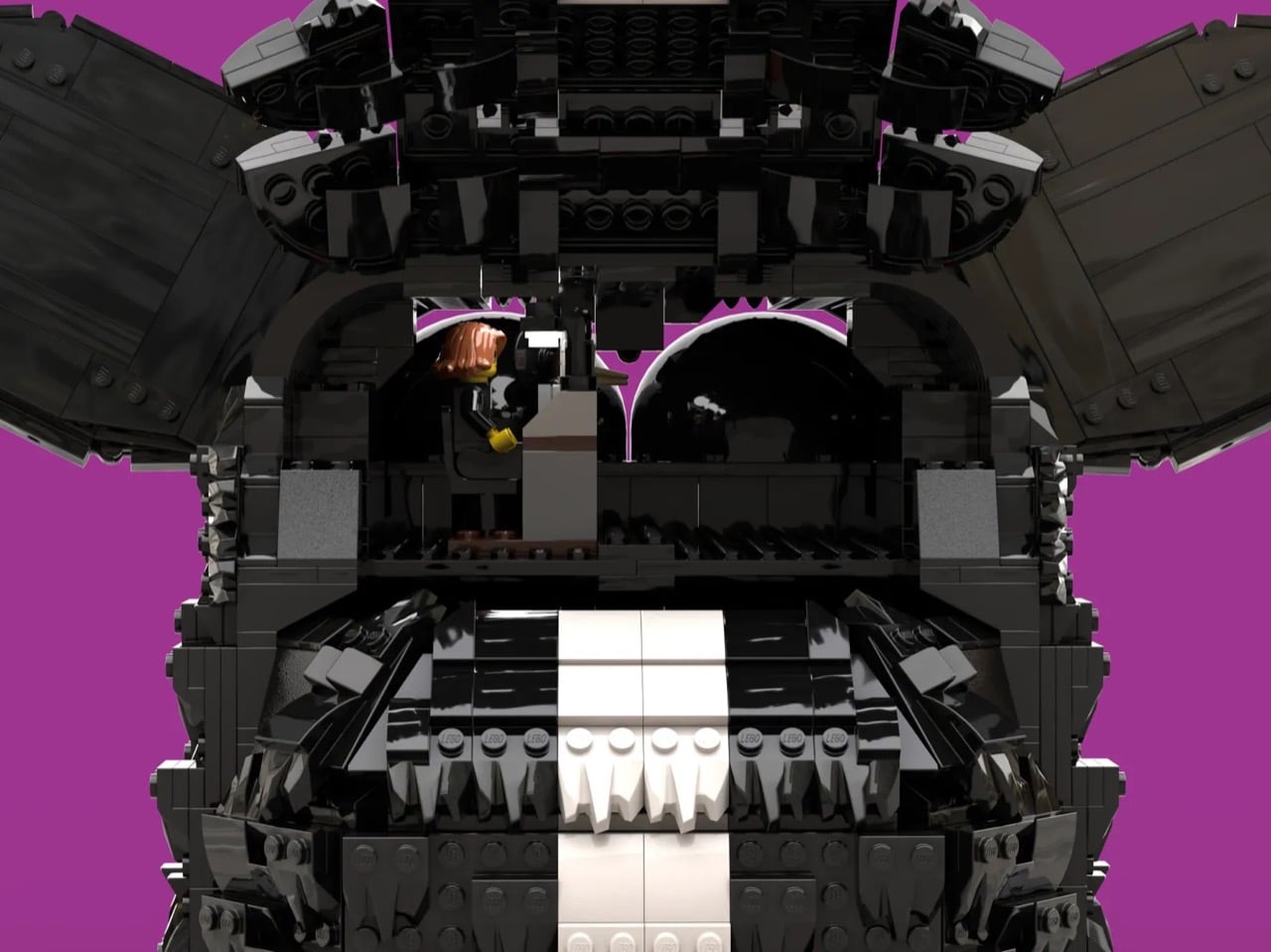
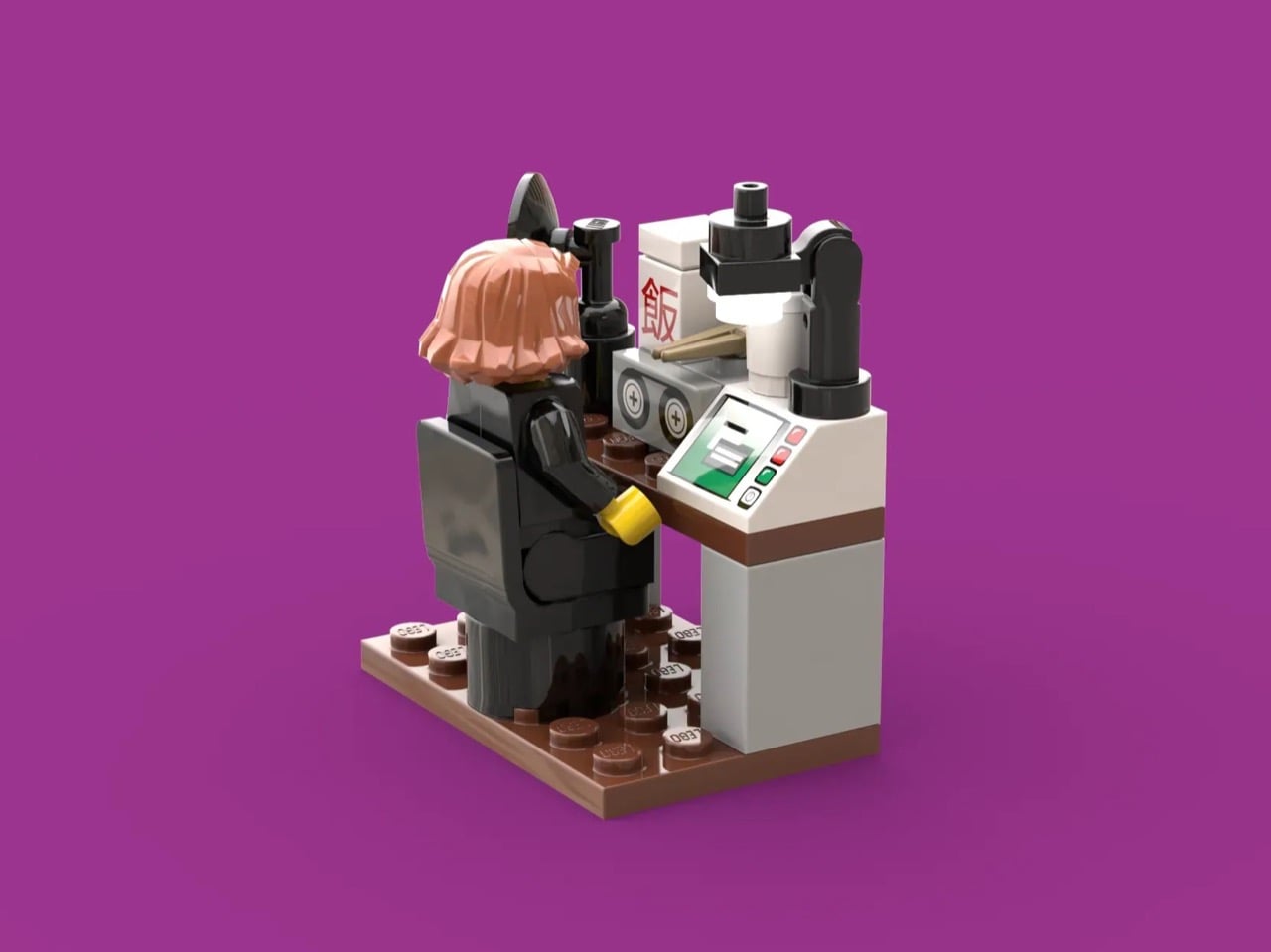
Rancor1138’s Furby 30th Anniversary build stands nearly 19 inches tall in classic black and white, complete with working eyelids, articulated ears, and a movable mouth. The back panel opens to reveal the interior, where two Easter eggs wait. One is a brick-built heart, representing what Furbys were supposed to be. The other is a man in black hiding in the head, recording device in hand, representing what everyone feared they actually were. Both are perfect.
Designer: Rancor1138
The build uses helmet pieces from the buildable Buzz Lightyear sets for those opening eyelids, which captures the curved geometry needed even though they’re not available in black yet. Technic ball joints handle the ear articulation, giving them the full range of motion that made Furbys so expressive. The movable mouth works without gearing or complex mechanisms, keeping the design producible. At 46.6 centimeters tall with ears extended and 22.1 centimeters wide, this thing commands shelf space the way the original commanded attention in toy aisles. The 1,700-piece count puts it in the same territory as LEGO’s typewriter or piano, the kind of weekend project that adult collectors actually want to spend time on rather than snap together in an evening.
Tiger Electronics owns the Furby trademark, but this color scheme reads as “generic Furby” in a way that could survive legal review. You see those colors and ear shapes from across a room and your brain fills in the rest without needing specific commercial variants. The decision to include both the heart and the surveillance agent creates tension that reflects how people actually experienced these toys. They were supposed to be companions. They became sources of low-grade technological anxiety. Both truths exist simultaneously, and hiding them inside the build where you have to open the back panel to see them turns the discovery into a reveal rather than a punchline.
Rancor1138’s child developed an obsession with Y2K electronic toys despite being born decades after they mattered, which prompted the designer to build a LEGO version of the toy as a gift for their kid. The build went through three or four versions before landing to what we see now, and LEGO does have a tendency to tweak MOCs (My Own Creations) further before officially launching them, but this one absolutely needs no changing.
So why make a LEGO Furby in 2026 beyond just the fact that your child loves them? Well, Furby’s 30th anniversary hits in 2028, giving LEGO a marketing angle if this clears the Ideas review process. At 1,700 pieces, the probable price point lands somewhere between $170 and $220 based on how LEGO has priced recent Ideas sets. That positions it as a serious display piece for collectors who remember the original phenomenon and want something substantial to build, not an impulse grab for casual fans.
The man in black sitting inside the Furby’s head with recording equipment directly references conspiracy theories that required actual NSA clarification in 1999. These toys couldn’t record speech despite widespread belief otherwise, which feels simultaneously ridiculous and prescient given the smart speaker landscape two decades later. The heart in the chest cavity provides counterweight, acknowledging that underneath the paranoia these were designed to be loved. Both elements work because they’re physically integrated rather than existing as external commentary. Open the back panel and there they are, permanent features that reward closer inspection.
LEGO Ideas runs on a voting system where submissions need 10,000 supporters to enter review for possible production. This Furby currently sits at 2,622 votes with 563 days left to hit the next 5,000 milestone. The platform has produced genuinely strong sets over the years, proving community-driven design can match LEGO’s internal development when the right projects get traction. Anyone wanting to see this become an actual purchasable set needs to head over to the LEGO Ideas website and vote. The Furby deserves to exist as more than a digital render and some studio photos, if only because that man in black Easter egg is too good to stay conceptual.
On a tous gardé notre âme d'enfant, notamment en ce qui concerne les LEGO. Je connais d'ailleurs pas mal d'adultes qui achètent et montent encore des boites pour le kiff. Et c'est cool parce que ça fait travailler les doigts et l'esprit !
Seulement, si à un moment, il se passe un petit drame et que vous égarez une pièce LEGO, votre vie peut vite être gâchée. Rien que ça oui. Parlez-en à ceux qui font des puzzles par PASSION... Oui y'en a !
Évidemment, il y a plein de sites web où vous pouvez racheter des pièces comme
je vous l'expliquais dans cet article sur la restauration d'anciens sets LEGOs
. Mais si vous avez une imprimante 3D, vous pouvez franchir le pas de la contrefaçon copie privée à but non commercial et produire vous-même la pièce manquante !
Comment ? Et bien grâce à
Printable Bricks
qui vous propose plus de 5000 pièces de LEGO au format STL à imprimer directement et bien sûr compatible avec de vrais LEGO.
Après même si le site a survécu aux menaces DMCA et reste toujours en ligne, prenez quand même le temps de sauvegarder ce dont vous avez besoin, on ne sait jamais ;-)
Et si vous voulez aller plus loin dans la personnalisation, y'a maintenant
MachineBlocks
qui permet de générer des briques sur mesure directement depuis votre navigateur. Vous pouvez ajuster les dimensions, choisir le type de brique, et même utiliser leur outil de calibration pour que ça s'emboîte parfaitement avec vos LEGO originaux. Hop ensuite un export en STL ou 3MF et c'est parti !
Dans le même genre,
le générateur de Lapinoo
vous permet aussi de dessiner la forme de votre brique à la souris sur une grille. Vous voulez une pièce en L bizarre qu'aucun set n'a jamais proposé ? Pas de souci, vous dessinez, vous ajustez les plots et la cavité inférieure, et boum, le fichier STL est prêt.
November 2025 marks a turning point for LEGO. The Danish brick giant has evolved from childhood toy manufacturer into something more nuanced: a creator of kinetic sculptures, display pieces that command adult spaces, and intricate tributes to pop culture that blur the line between building set and collectible art. This month’s releases span from mechanical aquariums to starships, from Hollywood race cars to space exploration milestones, each demonstrating how far brick-based design has traveled.
What unites these seven releases is their refusal to sit still on shelves. They demand interaction, closer inspection, and appreciation for the engineering challenges their designers solved. Whether through cranks that animate underwater scenes, modular sections that separate like the real starship, or intricate layering that creates dimensional depth, these sets prove LEGO understands its adult audience wants more than nostalgia. They want conversation pieces that justify their desk space.
1. LEGO Icons Tropical Aquarium (10366)
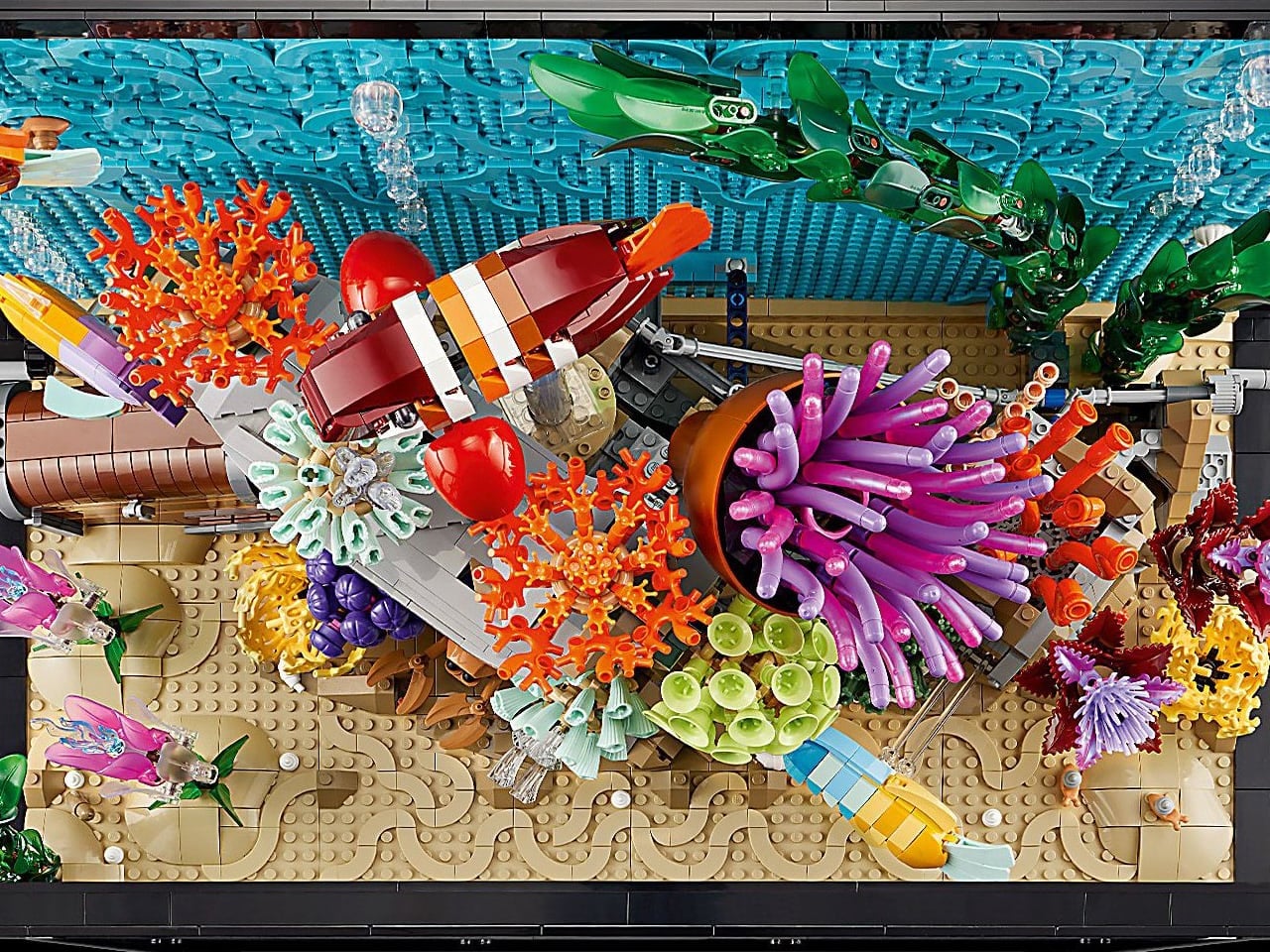
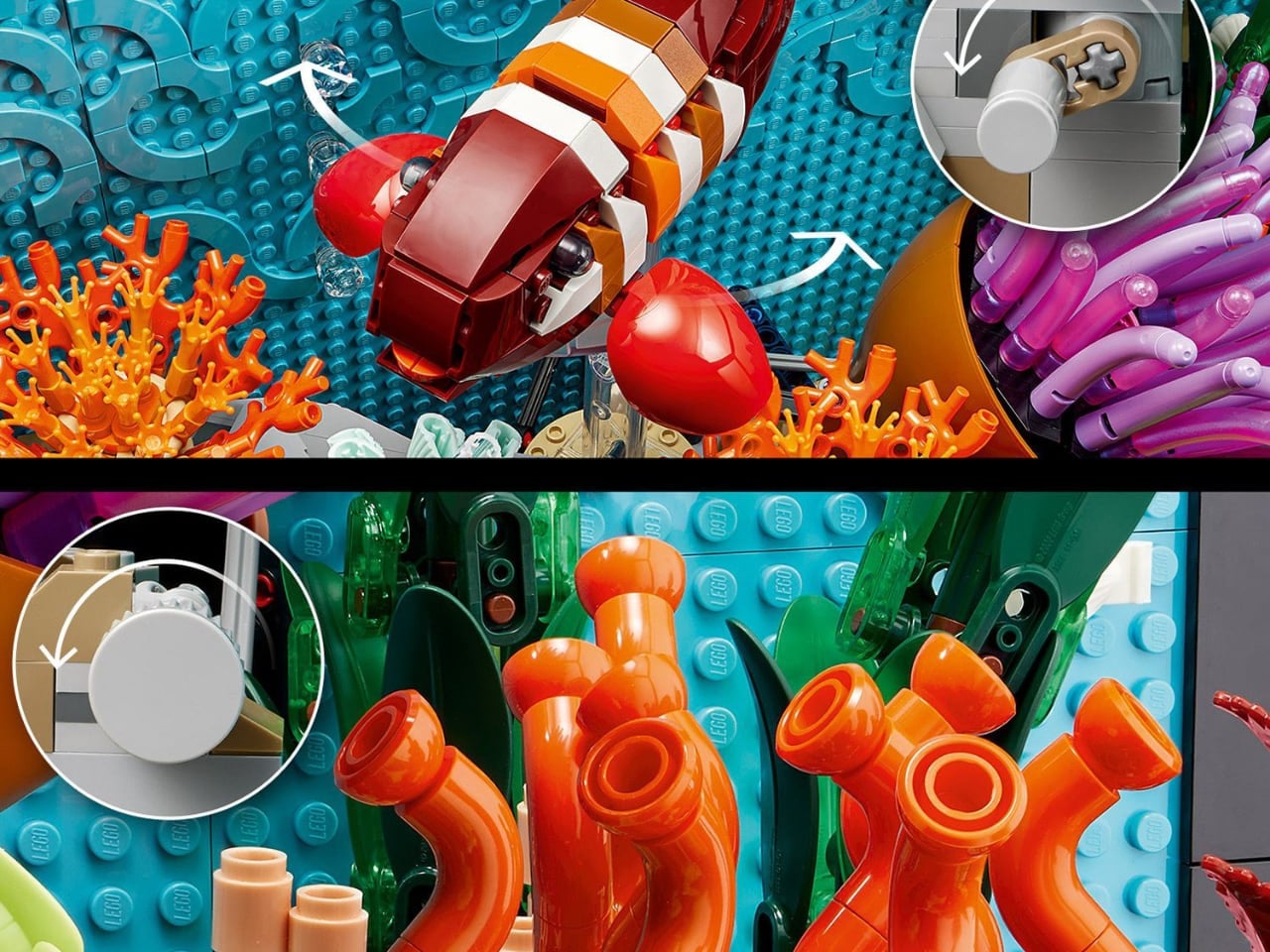
The Tropical Aquarium transforms 4,154 pieces into a living mechanical tableau that launched on November 13 for $479.99. This isn’t decor that fades into the background. Three distinct cranks and dials control independent motion systems, turning the aquarium into a kinetic sculpture where your interaction determines the scene’s energy. Turn one dial and the jellyfish bob through their vertical dance. Another crank sends the sea turtle gliding past coral formations. The third activates smaller fish as they navigate through swaying seaweed and bubble streams that appear frozen mid-rise.
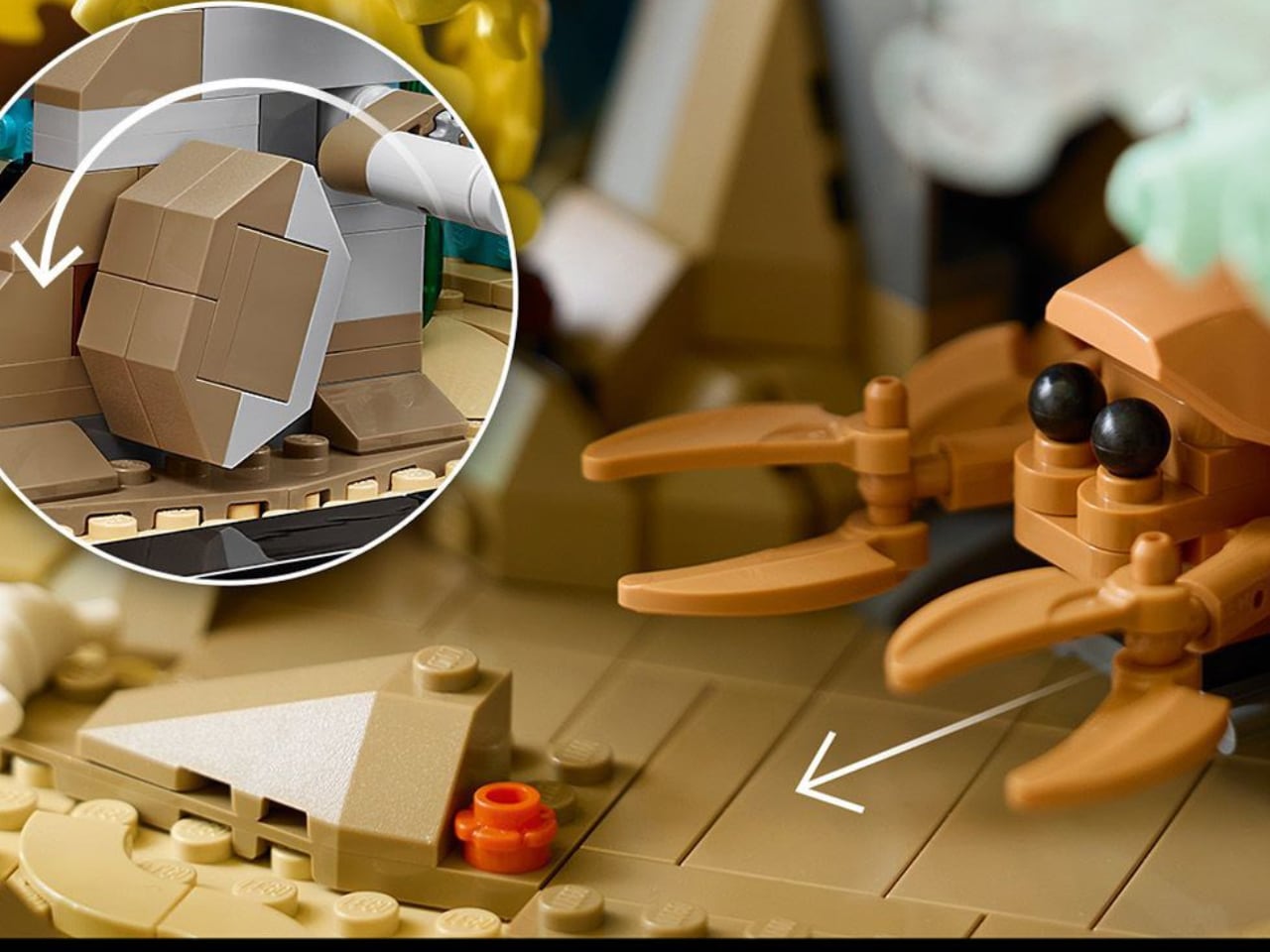
LEGO solved a fundamental design challenge here: creating convincing spatial depth within a fundamentally shallow display case. The build employs layering techniques with translucent elements, representing water, varied-height coral structures, and the strategic placement of marine life to establish foreground, middle ground, and background planes. Four model fish become compositional tools rather than fixed elements. You’re not assembling a predetermined scene. You’re curating an underwater environment where placement decisions affect visual balance. The set includes seaworms, an oyster shell containing a pearl, sea snails, and air bubbles, serving as additional elements for creating your personal ecosystem.
What we like
The kinetic mechanism creates genuine movement that changes depending on your crank speed and direction
Compositional flexibility lets you rearrange elements rather than following rigid instructions
What we dislike
At $479.99, this represents a significant investment for a display piece rather than a traditional play set
The mechanical systems require regular interaction to justify the kinetic elements
2. LEGO Ideas Apollo 8 Earthrise (40837)
William Anders captured humanity’s first color photograph of Earth from space on December 24, 1968, using his Hasselblad 500 EL during the Apollo 8 lunar orbit. That image, titled Earthrise, showed our planet suspended above the moon’s desolate horizon and fundamentally altered how we see ourselves. Now, nearly sixty years later, LEGO Ideas has transformed that pivotal moment into an 859-piece buildable art piece that stands 48 centimeters tall and 32 centimeters wide.
This rendition captures three distinct visual elements that define the photograph: the infinite black void of space, Earth as a cloud-swirled blue marble, and the moon’s cratered, mottled surface in the foreground. LEGO’s designers used the brick medium to convey texture and color gradation across each element. The moon’s surface employs varied grey tones and deliberate gaps between pieces to suggest the shadowed irregularity of impact craters. Earth’s atmospheric layers transition from deep ocean blues to white cloud formations using careful brick selection. The black space background creates negative space that makes both celestial bodies pop forward visually.
What we like
The subject matter elevates this beyond standard space sets into historical tribute territory
At 859 pieces, the build offers enough complexity for an engaging construction experience
What we dislike
The relatively conservative piece count means some details require visual interpretation
Mounting hardware for the wall display isn’t included, requiring a separate purchase
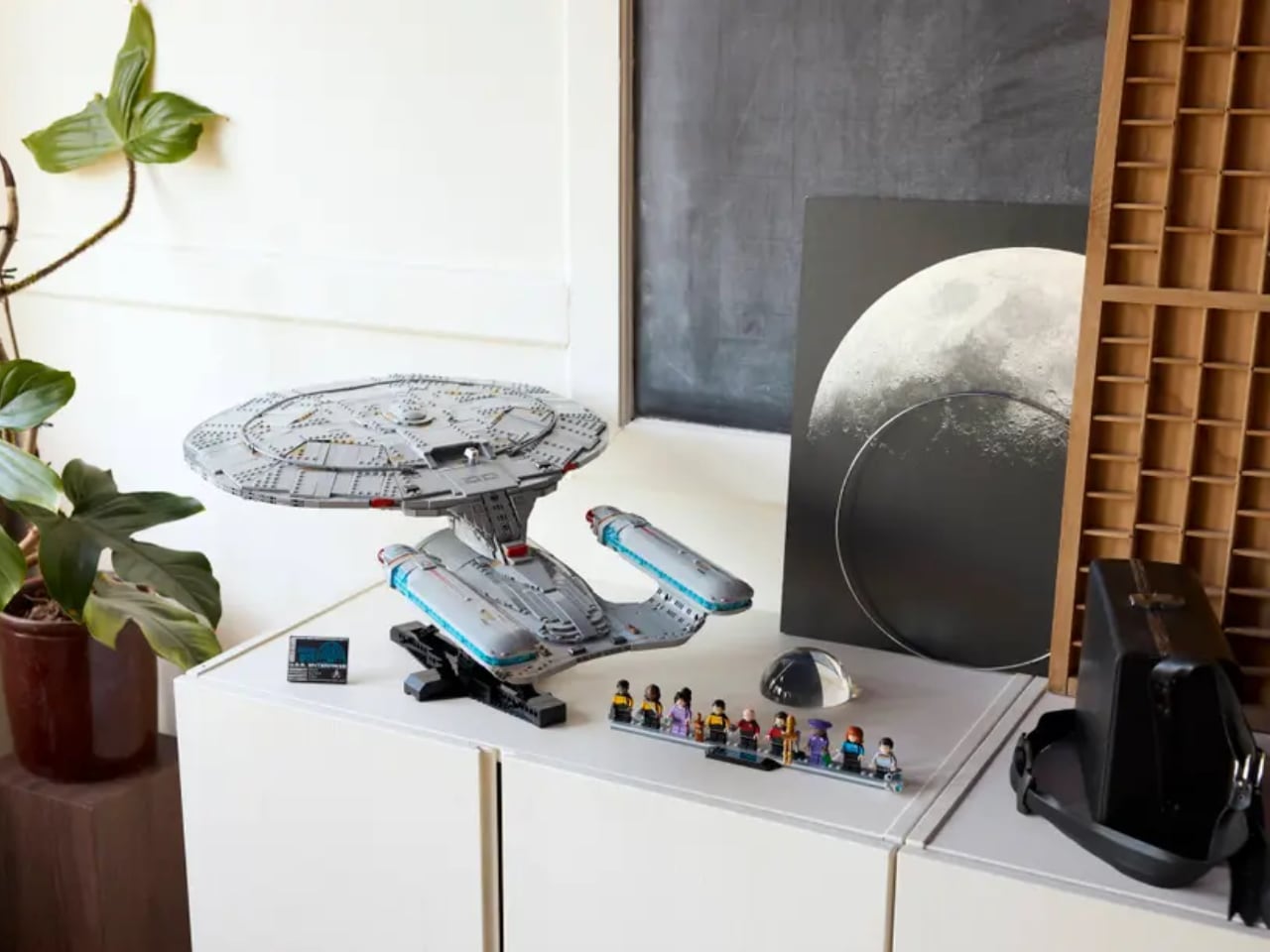
The Galaxy-class flagship from Star Trek: The Next Generation arrives in brick form on November 28 as a 3,600-piece behemoth measuring two feet long. Priced at $399.99, this isn’t LEGO’s first Trek venture, but it represents the most screen-accurate version of arguably the most beloved Enterprise design. The set captures the distinctive saucer-and-engineering-hull silhouette that defined seven television seasons and multiple films, complete with functional saucer separation mechanics that mirror the starship’s emergency protocol capabilities.
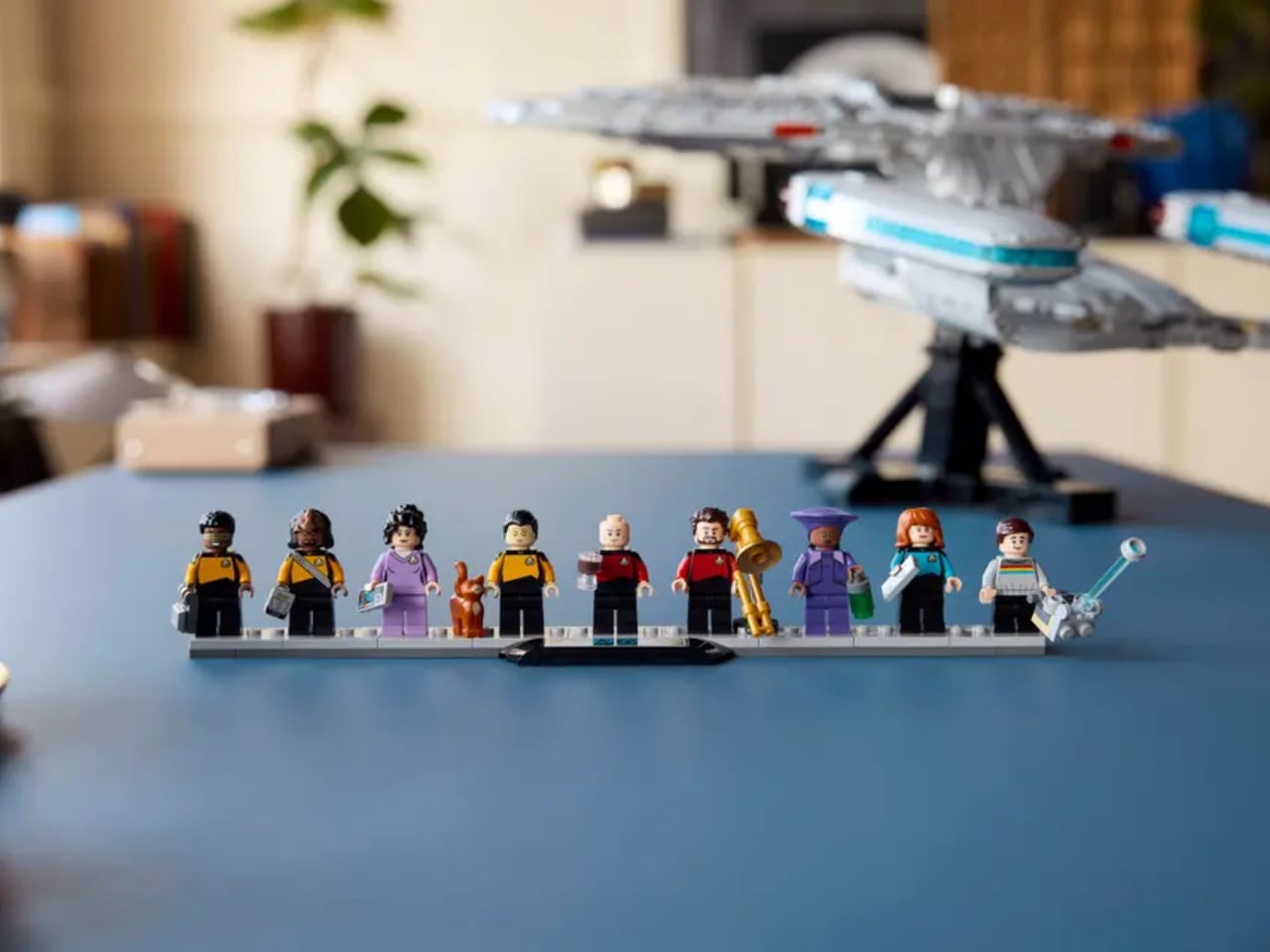
LEGO included enough minifigures to staff the bridge properly: Captain Picard, Commander Riker, Lieutenant Commander Data, Lieutenant Worf, Counselor Troi, Chief Engineer La Forge, and Doctor Crusher. Each figure comes with printed details that capture their Season 1 uniforms and distinctive features. The build itself uses advanced construction techniques to achieve the Enterprise-D’s smooth, curved surfaces while maintaining structural integrity. The warp nacelles attach via articulated pylons. The deflector dish receives intricate detailing. Even the bridge dome atop the saucer section gets architectural attention. This targets adult collectors who want the ship commanding their desk space with the same authority Picard brought to the captain’s chair.
What we like
Functional saucer separation adds interactive play value beyond static display
Screen-accurate proportions and details satisfy longtime Trek fans who know every hull panel
What we dislike
The $399.99 price point places this firmly in premium collector territory
Some builders note that the saucer section’s large, flat surfaces require patience during repetitive sections
4. LEGO Speed Champions APXGP F1 Race Car (77076)
LEGO’s partnership with the upcoming F1 film starring Brad Pitt and directed by Joseph Kosinski produces this sleek recreation of the fictional APXGP team’s race car. The model wears the movie’s distinctive black-and-gold livery, capturing the cinematic energy through carefully applied decals and printed elements. Two minifigures represent drivers Sonny Hayes and Joshua Pearce, complete with race suits, helmets with reflective visors, and printed sponsor logos that tie directly to the film’s aesthetic.
The build distinguishes itself from previous Speed Champions Formula 1 sets through refined proportions and wider Pirelli-style tires that better capture modern F1 car stance. Custom decals add visual depth across the bodywork. The set includes small accessories that reward closer inspection: a wrench and a remote control that nod toward the engineering side of racing. The wrench serves double duty as an actual building tool for applying stickers or separating tight bricks. These thoughtful inclusions demonstrate LEGO understands its audience wants both display accuracy and functional building aids.
What we like
The black-and-gold livery creates a striking visual contrast suitable for display
Film tie-in elements provide cultural relevance beyond generic racing sets
What we dislike
The Speed Champions scale limits interior detail compared to larger Technic F1 sets
Movie-specific branding may not appeal to builders wanting real team liveries
5. LEGO Ideas The Goonies (21350)
This $330 LEGO Ideas release transforms the 1985 adventure classic into a full-blown tribute to one of cinema’s most beloved treasure hunts. The set isn’t just a model you build and stick on a shelf. This captures those iconic moments that blend adventure with just the right amount of creepy: the Fratelli hideout functioning as a haunted house for criminals, the terrifying boulder trap, skeleton-filled caves, and One-Eyed Willy’s legendary pirate ship, the Inferno, complete with sails, treasure, and plenty of bones.
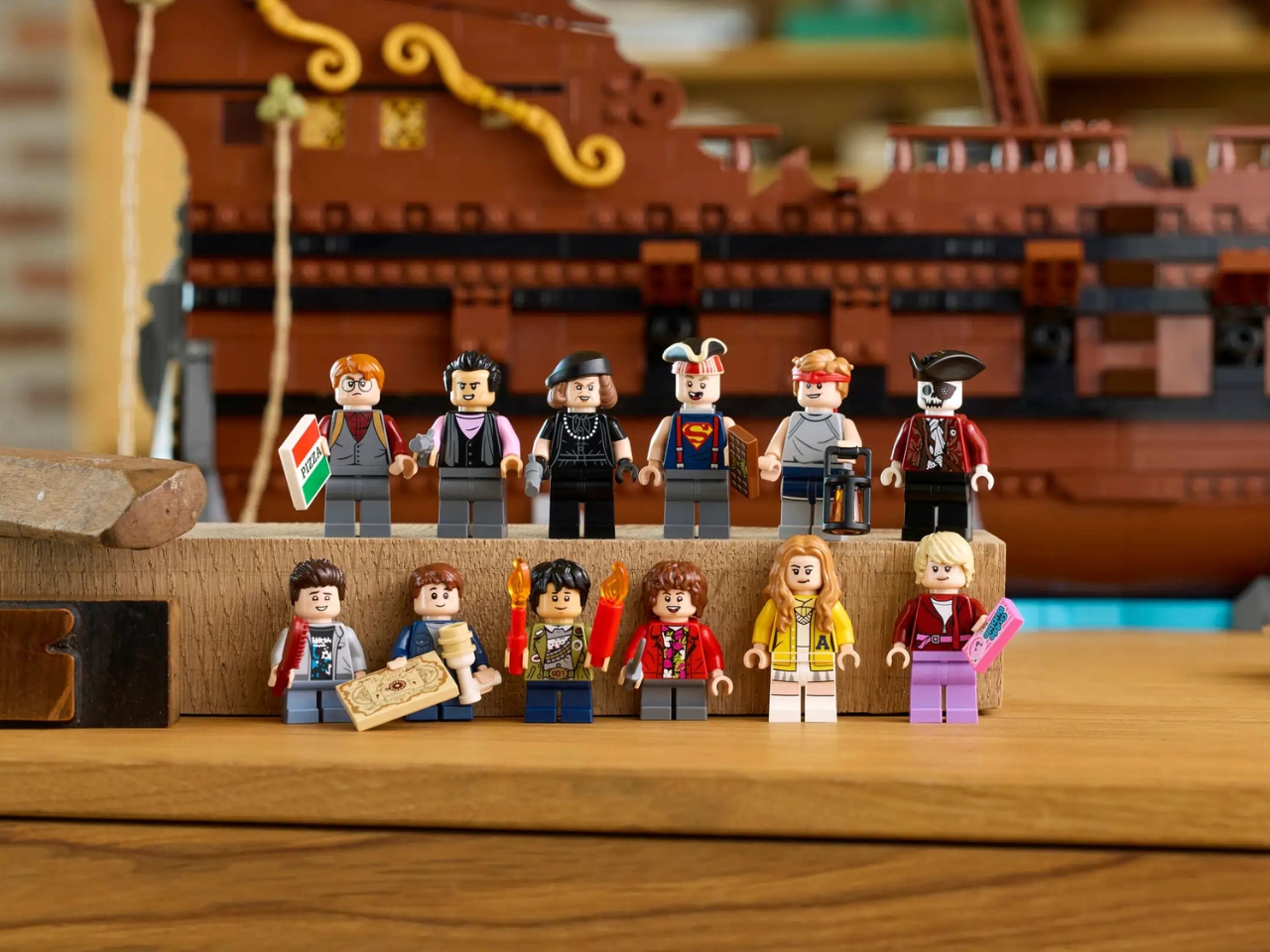
What really makes this set special are the minifigures. All twelve of them. You get the whole gang: Mikey, Mouth, Data, Chunk, Brand, Andy, and Stef, plus Sloth in his Superman shirt, Mama Fratelli, Francis, Jake, and even One-Eyed Willy’s skeleton. LEGO created brand new elements specifically for this set, like Sloth’s pirate hat and Mama Fratelli’s hair and beret combo, showing the level of detail they’re committed to. The skeleton pirate minifigure arrives perfectly timed for Halloween nostalgia, capturing both the film’s adventurous spirit and its spooky underground atmosphere.
What we like
Twelve minifigures provide the complete cast, including villains and One-Eyed Willy’s skeleton
Multiple iconic scenes from the film can be recreated with the Fratelli hideout and pirate ship
What we dislike
The $330 price point may feel steep for fans expecting a lower-tier Ideas set
Balancing multiple scenes in one set means each vignette receives less piece allocation
6. LEGO Ideas Pacific Rim Jaegers
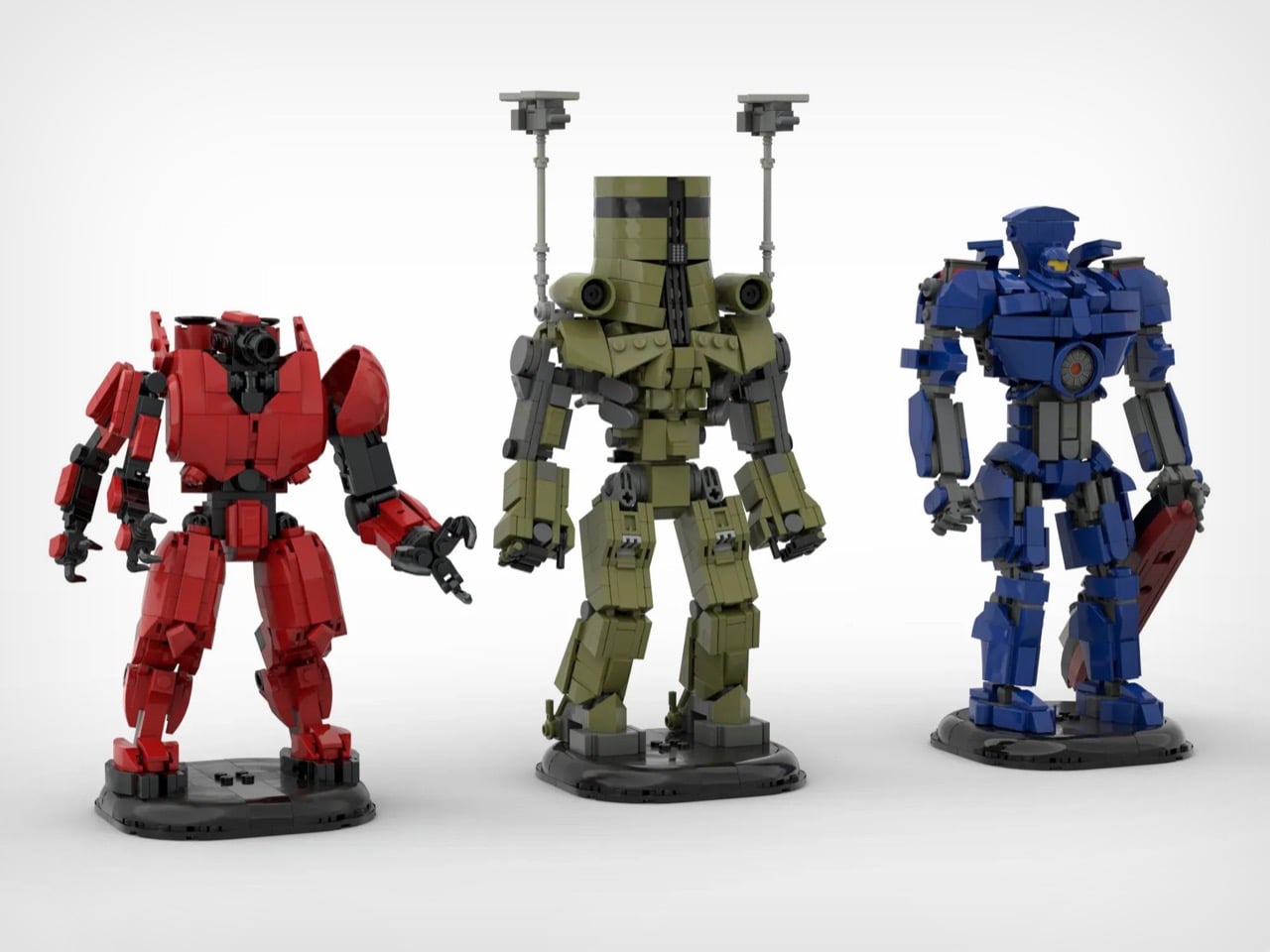
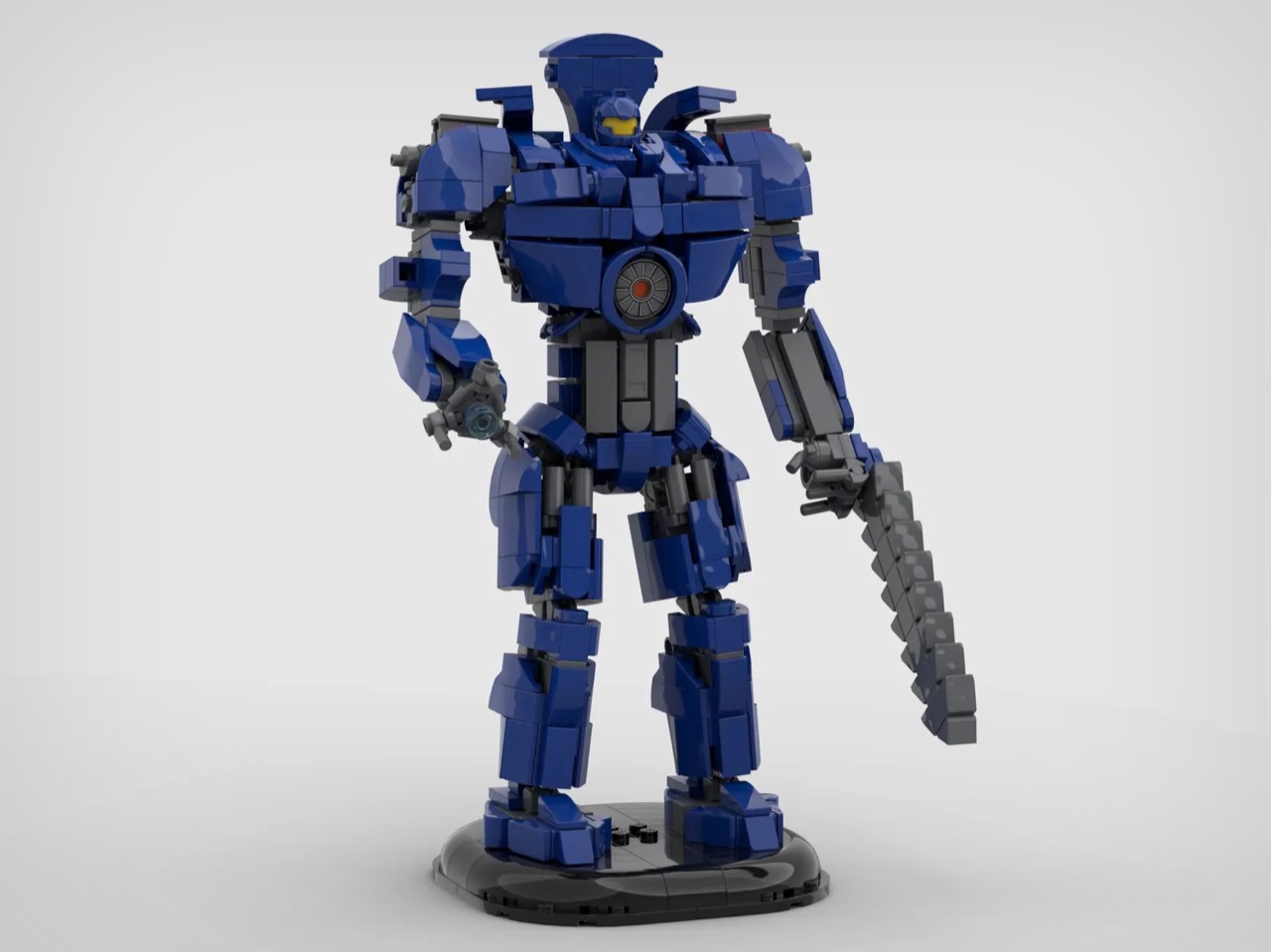
Din0Bricks’ fan-made tribute to Guillermo del Toro’s Pacific Rim has earned LEGO Ideas Staff Pick status and rallied 661 supporters toward the 10,000 needed for official production consideration. The 2,218-piece concept recreates three iconic Jaegers from the 2013 film: Gipsy Danger with a retractable sword, Crimson Typhoon with rotating saw blades, and Cherno Alpha with its brutal industrial aesthetic. Support helicopters accompany each mech, capturing the logistical reality behind deploying humanity’s towering defenders against Kaiju threats.
What makes this concept remarkable is how Din0Bricks solved the challenge of capturing the Jaegers’ massive, imposing presence while maintaining structural stability and playability. Each mech features articulated joints at shoulders, elbows, hips, and knees, allowing authentic combat poses. The retractable sword mechanism on Gipsy Danger uses internal gearing. Crimson Typhoon’s three-armed configuration required custom engineering to balance properly. Cherno Alpha’s distinctive fists and nuclear reactor detailing push LEGO’s aesthetic toward industrial brutalism. This isn’t just a fan project. It’s a masterclass in translating screen designs into buildable, poseable figures that honor the source material’s scale and mechanical complexity.
What we like
Three distinct Jaegers provide variety and display options in a single set
Articulated joints enable dynamic combat poses that capture the film’s action sequences
What we dislike
As a LEGO Ideas concept, this isn’t guaranteed for production without reaching 10,000 supporters
The 2,218-piece count and three large models suggest a premium price point if approved
7. LEGO Ideas NASA James Webb Space Telescope
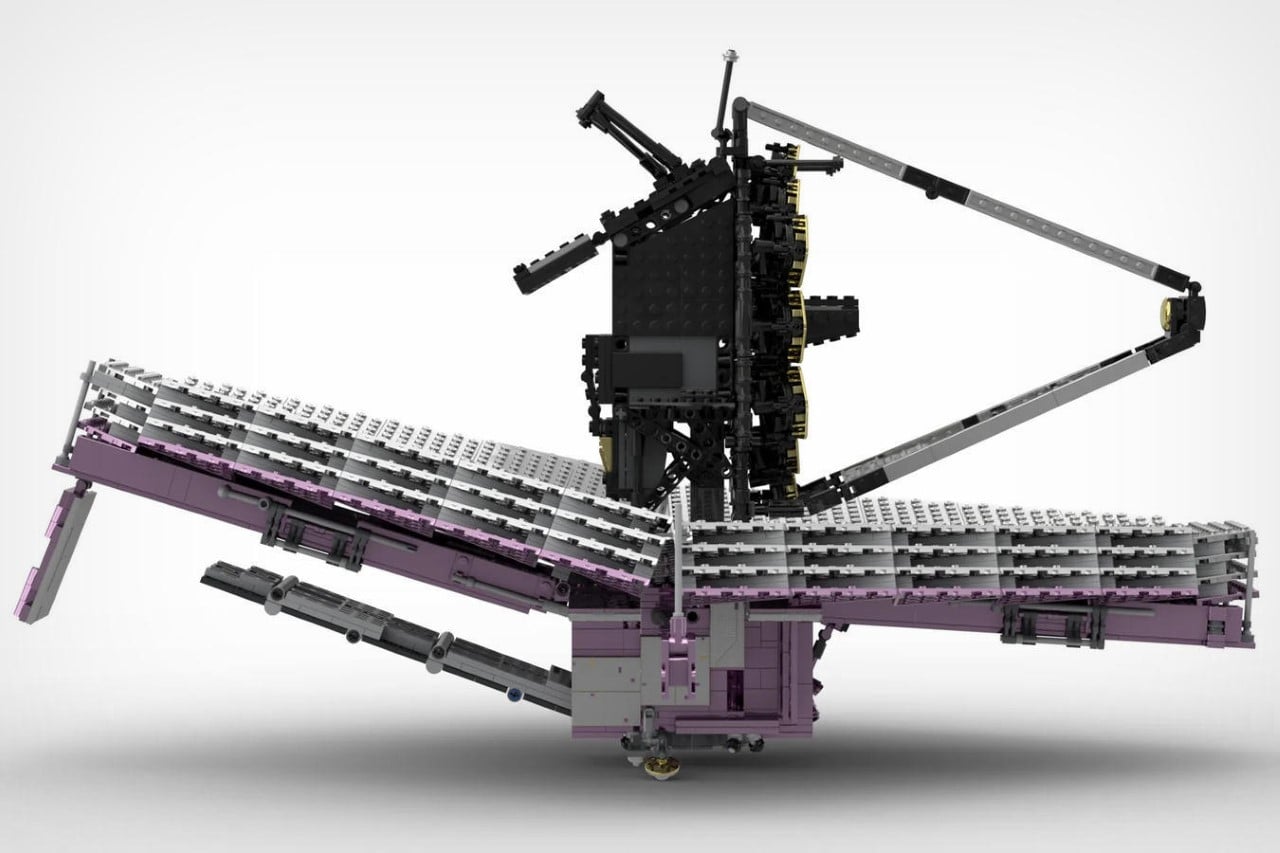
The LEGO James Webb Space Telescope replica tackles one of modern engineering’s most complex achievements through brick-based construction that mirrors the actual satellite’s intricate folding mechanisms. This build captures the telescope’s launch-critical ability to fold into a compact configuration before unfolding in space, requiring builders to understand both structural engineering and the precise mechanical sequences that made the real JWST mission possible. The design transforms complicated aerospace engineering into an accessible building experience that educates while it entertains.
Every major subsystem finds representation in this meticulous replica, from the eighteen iconic hexagonal mirrors that form the light-gathering array to the layered sun shield that protects sensitive instruments. The secondary hinged mirror, science instruments, propulsion systems, and communications arrays all function through LEGO’s mechanical systems, creating an interactive educational experience that illuminates the genuine complexity behind space exploration’s latest triumph. This isn’t a simplified approximation. It’s a functional demonstration of how the telescope actually operates in its orbit at the L2 Lagrange point.
What we like
Functional folding mechanism replicates the actual telescope’s deployment sequence
The complex folding mechanism requires careful handling to avoid stressing connection points
As a concept, availability depends on the LEGO Ideas approval process
Why November 2025 Matters for LEGO Design
These seven releases demonstrate LEGO’s strategic expansion into adult collector territory while maintaining the building experience that defines the brand. The kinetic mechanisms in the Tropical Aquarium, the historical gravitas of Earthrise, the pop culture cachet of the Enterprise and Goonies sets, the cinematic energy of the F1 car, and the community-driven passion behind the Pacific Rim Jaegers and James Webb Telescope all point toward a company that understands its audience has evolved. These aren’t toys. They’re display pieces that arrive in buildable form, offering the satisfaction of construction before claiming their space on shelves, desks, and walls.
What November’s lineup proves is that LEGO has moved beyond simple recreation into thoughtful interpretation. Each set solves specific design challenges: creating depth in shallow spaces, capturing kinetic energy through mechanical systems, translating beloved designs into brick form with screen accuracy, honoring cultural moments that shaped cinema, and making complex aerospace engineering comprehensible. The result is a collection of releases that justify their premium pricing through engineering sophistication, visual impact, and the kind of cultural resonance that makes people stop and ask about the objects commanding your workspace. That’s the difference between a toy and a design statement.
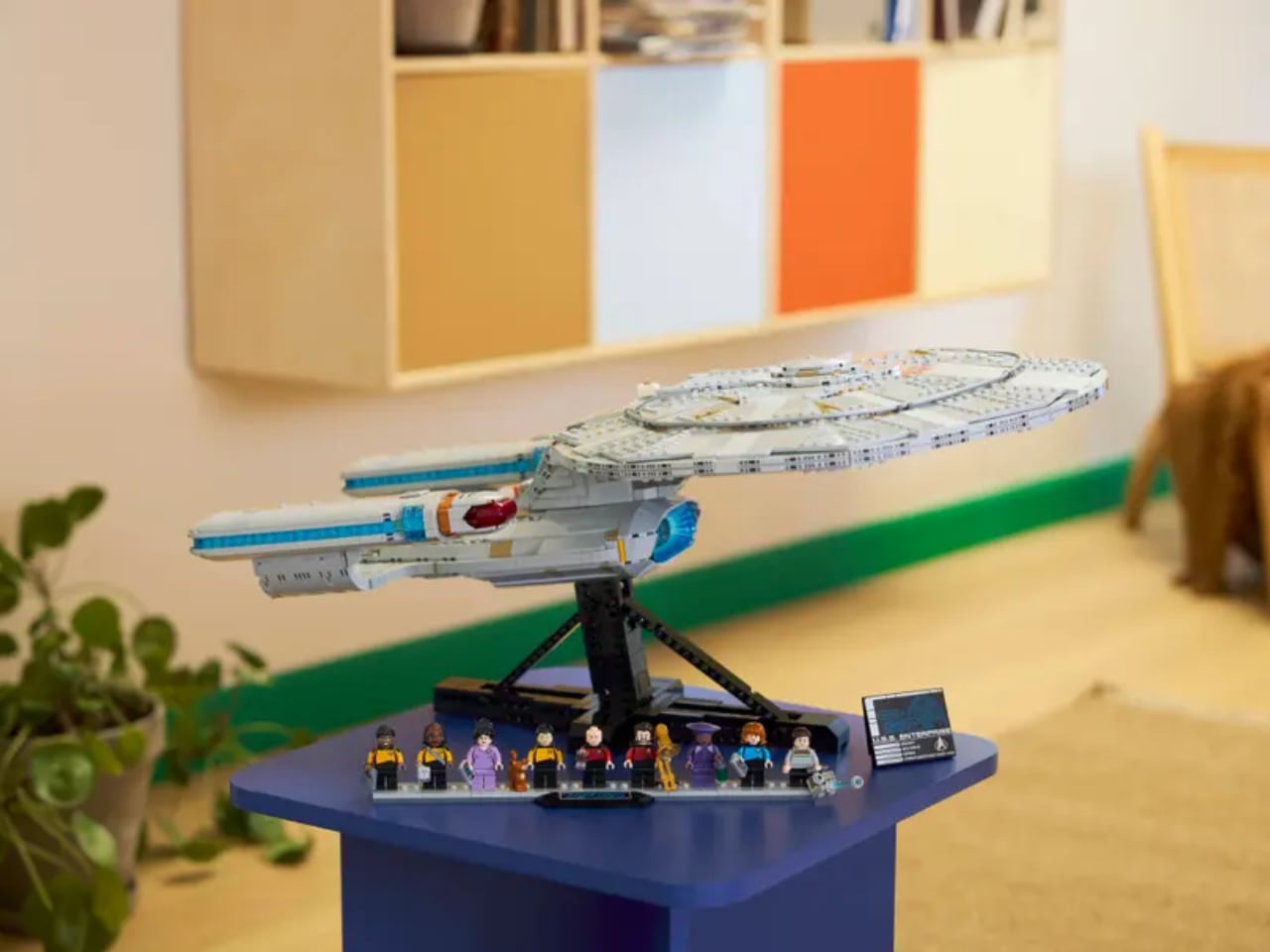
Trekkies, clear your coffee tables. LEGO is launching the U.S.S. Enterprise NCC-1701-D, and this isn’t your childhood spaceship set. At 3,600 pieces and two feet long, this is the Galaxy-class flagship from Star Trek: The Next Generation rendered in meticulous brick form. It’s designed for adults who grew up watching Picard sip Earl Grey and want that same starship commanding their desk space.
Designer: LEGO
The set drops November 28, 2025 for $399.99, and LEGO isn’t holding back on the details. This is the definitive brick-built version of arguably the most beloved Enterprise design, complete with screen-accurate proportions, functional saucer separation, and enough minifigures to staff the bridge. Whether you’re a lifelong Trekkie or a design enthusiast who appreciates iconic sci-fi aesthetics, this set delivers serious display presence.
What makes this release special is how LEGO balanced accuracy with buildability. The Enterprise-D has always been a challenging design to capture because of its smooth, sweeping lines and distinctive saucer-meets-engineering-hull silhouette. LEGO’s designers nailed it, creating a model that reads instantly as Picard’s ship from any angle while maintaining the satisfying tactility that makes LEGO builds so rewarding.
Design Accuracy Meets Functional Features
The centerpiece feature is the detachable command saucer. Just like in the show, the saucer section separates from the secondary hull, letting you recreate one of the Enterprise-D’s most dramatic maneuvers. This isn’t just a cosmetic trick; the engineering required to make a sturdy separation mechanism while maintaining the ship’s graceful lines shows real design sophistication. The connection points are hidden beautifully, so the joined ship looks seamless.
LEGO captured the Enterprise-D’s signature warp nacelles with striking fidelity. The red and blue detailing on these engines is instantly recognizable to any TNG fan, and seeing them rendered in brick form with proper color gradients and proportions is genuinely impressive. The nacelle pylons sweep back at the correct angle, and the overall stance on the included display stand gives the ship that dynamic, forward-leaning energy that made the original VFX model so memorable.
Built for Interaction and Display
This isn’t a static model locked behind glass. The rear shuttlebay opens to reveal two Type-15 Shuttlepods tucked inside, ready for away missions. These tiny craft are surprisingly detailed for their scale, complete with proper hull markings and recognizable silhouettes. Being able to physically open the shuttlebay and extract these little vessels adds a layer of interaction that transforms the model from sculpture to storytelling tool.
The angled display stand deserves special mention. Rather than a boring flat base, LEGO designed a stand that tilts the Enterprise at a dramatic angle, as if banking into warp speed or executing a tactical maneuver. A schematic plaque with ship statistics sits at the base, adding that museum-quality presentation polish. This stand transforms the model into a legitimate piece of desk art rather than just a toy on a shelf.
For builders who want every construction detail at their fingertips, the LEGO Builder app provides 3D digital instructions alongside the printed manual. You can rotate, zoom, and view assembly steps from any angle on your phone or tablet, which is genuinely helpful for a build this complex and detailed.
The Crew You Need
Nine minifigures ship with the set, representing the iconic TNG bridge crew plus a few beloved supporting characters. You get Picard (with teacup, naturally), Riker (complete with trombone and stand for jazz night), Worf, Data (with his cat Spot), Dr. Crusher, Geordi, Troi, Guinan, and Wesley Crusher. Each figure comes with custom accessories that reference their character perfectly. Data gets Spot, the cat he famously cared for while learning about emotions. Picard gets his Earl Grey tea. Riker gets his trombone because of course he does.
The accessory selection goes deep: phasers, tricorders, PADDs, engineering cases, even a portable tractor beam generator. LEGO clearly consulted with people who know this show inside and out, choosing items that feel authentic to the TNG universe rather than generic sci-fi props. These aren’t just decorative additions; they’re storytelling tools that let you recreate specific episodes or imagine new adventures.
Collectability and Display Presence
At 24 inches long, 19 inches wide, and 11 inches tall (including stand), this Enterprise commands serious real estate. That scale is intentional. This is designed to be a showpiece, the kind of build that anchors a room and starts conversations. The detailing holds up to close inspection, which is exactly what a centerpiece model needs to do. From across the room it reads as a sleek, powerful starship. Up close, you appreciate the clever techniques LEGO’s designers used to achieve those curves and gradients within the constraints of rectangular bricks.
For serious collectors, LEGO is offering a bonus Type-15 Shuttlepod as a gift with purchase during the launch window, plus other limited-time bonuses like Classic Animation Scenes. The set also earns 2,600 LEGO Insiders Points, which is a nice bonus for people already invested in LEGO’s ecosystem. With only 10,000 sets produced initially (per LEGO’s typical Icons limited run strategy), this will likely appreciate in value for those who keep it sealed.
The U.S.S. Enterprise NCC-1701-D represents everything LEGO’s Icons line does best: taking beloved cultural touchstones and translating them into buildable, displayable art. This isn’t a toy, though it has playful elements. It’s not quite a model kit, though it requires serious building skill. It exists in that sweet spot where nostalgia, design appreciation, and hands-on creativity converge. For $399.99, you’re getting 3,600 pieces of carefully engineered brick design that lets you spend hours building, then years displaying. That’s a fair trade for the flagship of the Federation.
The only thing worse than ‘Floor is Lava’ is probably ‘Floor is LEGO Brick’. LEGO bricks are famously torturous to step on. The studs, the sharp corners, the unforgiving plastic, all of these combine into creating something that feels like modern day torture. Step on a lego brick with enough body-weight and that thing practically digs into your tissue, causing probably one of the most painful experiences according to the internet. However, what if there was a ‘right’ way of stepping on LEGO bricks?
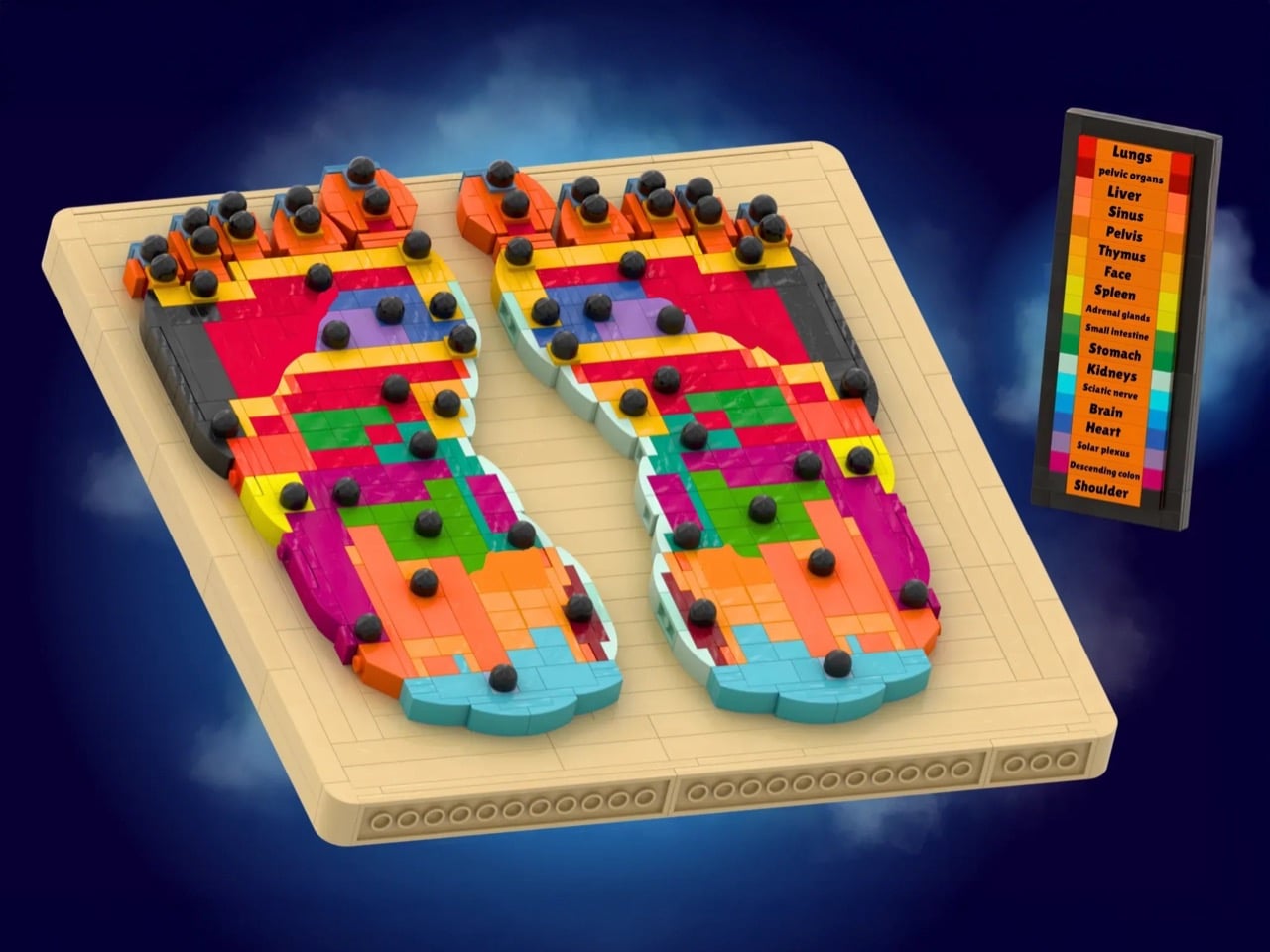
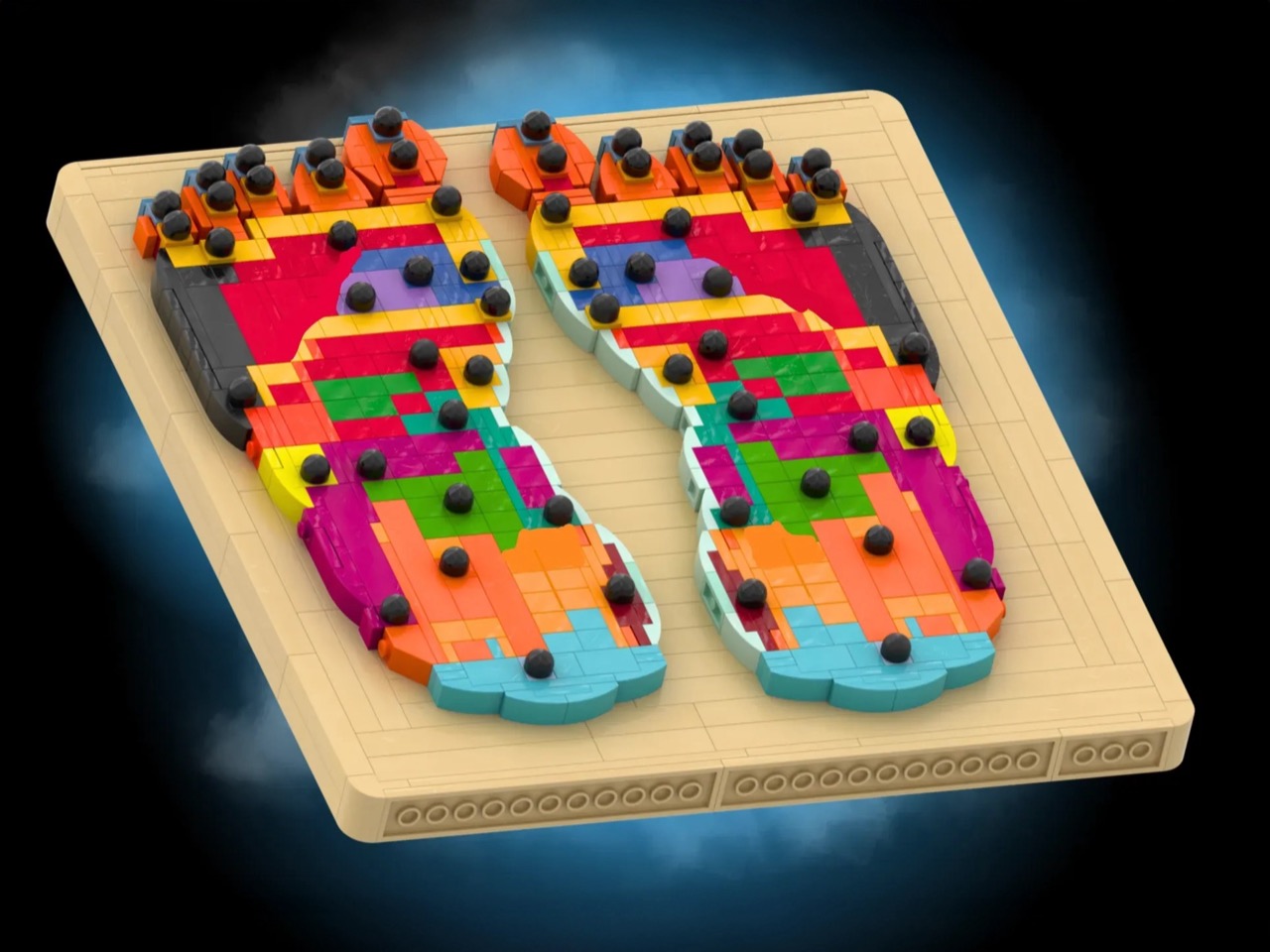
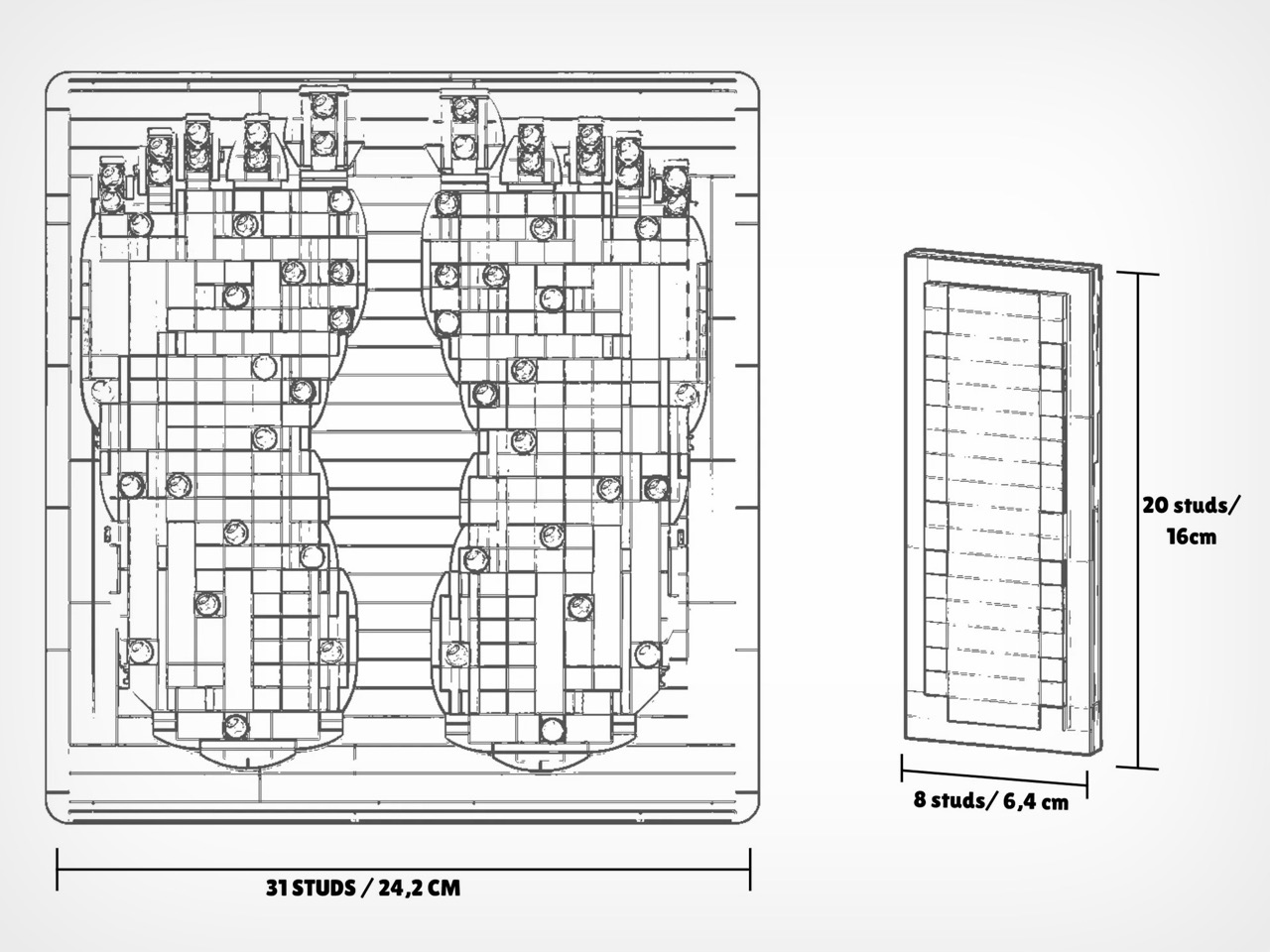
No, I’m not talking about some mind-over-body nonsense where you overcome your ability to feel pain. LEGO builder eat.sleep.build.repeat. designed a foot reflexology mat using just LEGO bricks, tapping into ancient eastern healing techniques to create a stimulating mat that helps you boost blood flow to your legs and to even other parts of the body. Made from just 820 bricks, this piece, titled ‘How to Step on a LEGO Brick?’ is a rather fun and informative hat-tip to old culture, using modern-day plastic bricks. One might say it puts the LEG in LEGO!
Designer: eat.sleep.build.repeat.
“Foot reflexology is an ancient practice, extremely common in China, where people step on mats with pressure nodes that practitioners believe produce beneficial effects elsewhere in the body,” says eat.sleep.build.repeat. “Decades later, their popularity remains strong as people continue to embrace simple, natural methods for daily wellness.”
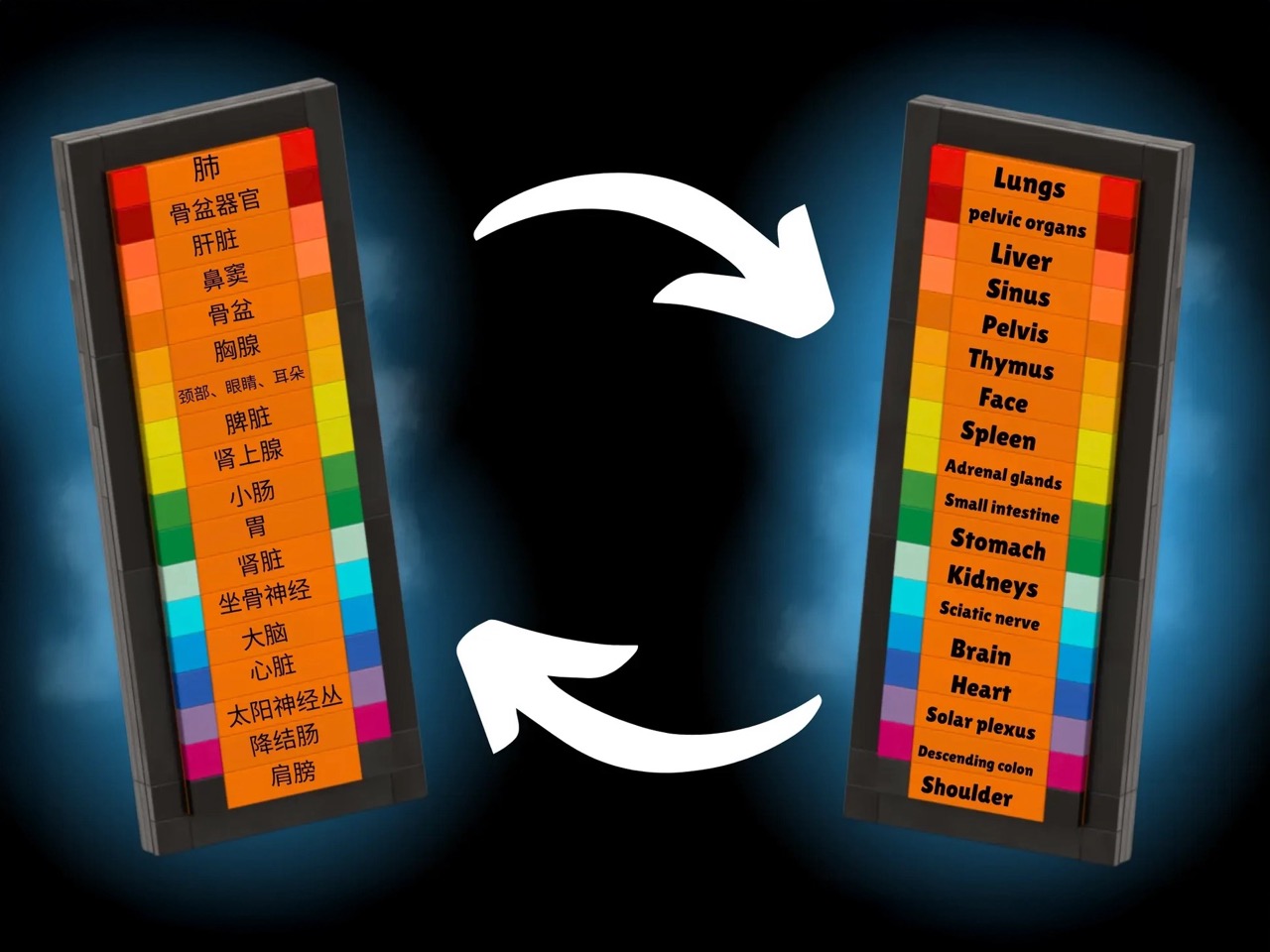
The 820-brick MOC comes with the foot mat itself, color coded to perfection with different zones that supposedly stimulate different parts of the body. Each kit also comes with a coded legend that lets you see which color is assigned to which body part. Not that we’re medical professionals (please don’t take this as medical advice), but standing on the mat while having pressure applied (thanks to the LEGO studs) on different parts of the foot is known to be able to cure diseases and boost recovery. Who knew standing on LEGO bricks could be this therapeutic?!
The MOC (My Own Creation) is currently gathering steam on the LEGO Ideas website, an online forum dedicated to enthusiasts who build and vote for their favorite LEGO creations. If this particular build sounds enticing to you (apart from the prospect of stepping on LEGO bricks of course), head down to the LEGO Ideas website and cast your vote for this build!
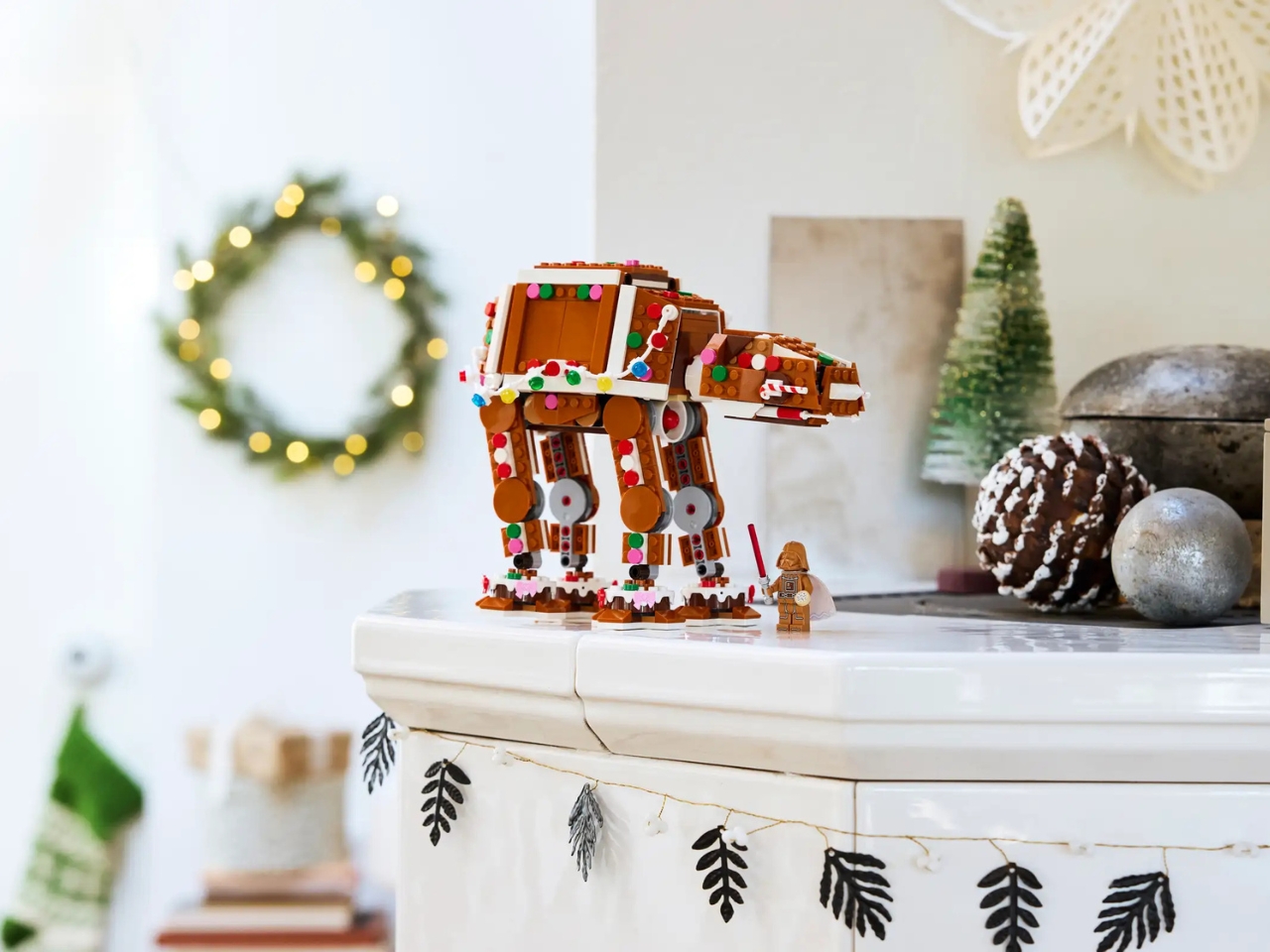
Star Wars and Christmas just seem to go together well. Maybe it’s because of the famous (or infamous) Star Wars Holiday special or because it’s gift-giving season, but we always look forward to what holiday-themed things they bring out every year. The combination of these two beloved pop culture behemoths has become a cherished tradition for fans of all ages, creating that perfect blend of nostalgia and festive cheer that makes the holidays even more special. And while it’s most likely the adults that they cater to with their builds and sets, sometimes we do get reminders that Star Wars is for kids too (at least originally). Their newest festive build is out and it’s the perfect companion as you sip and eat your gingerbread-themed desserts.
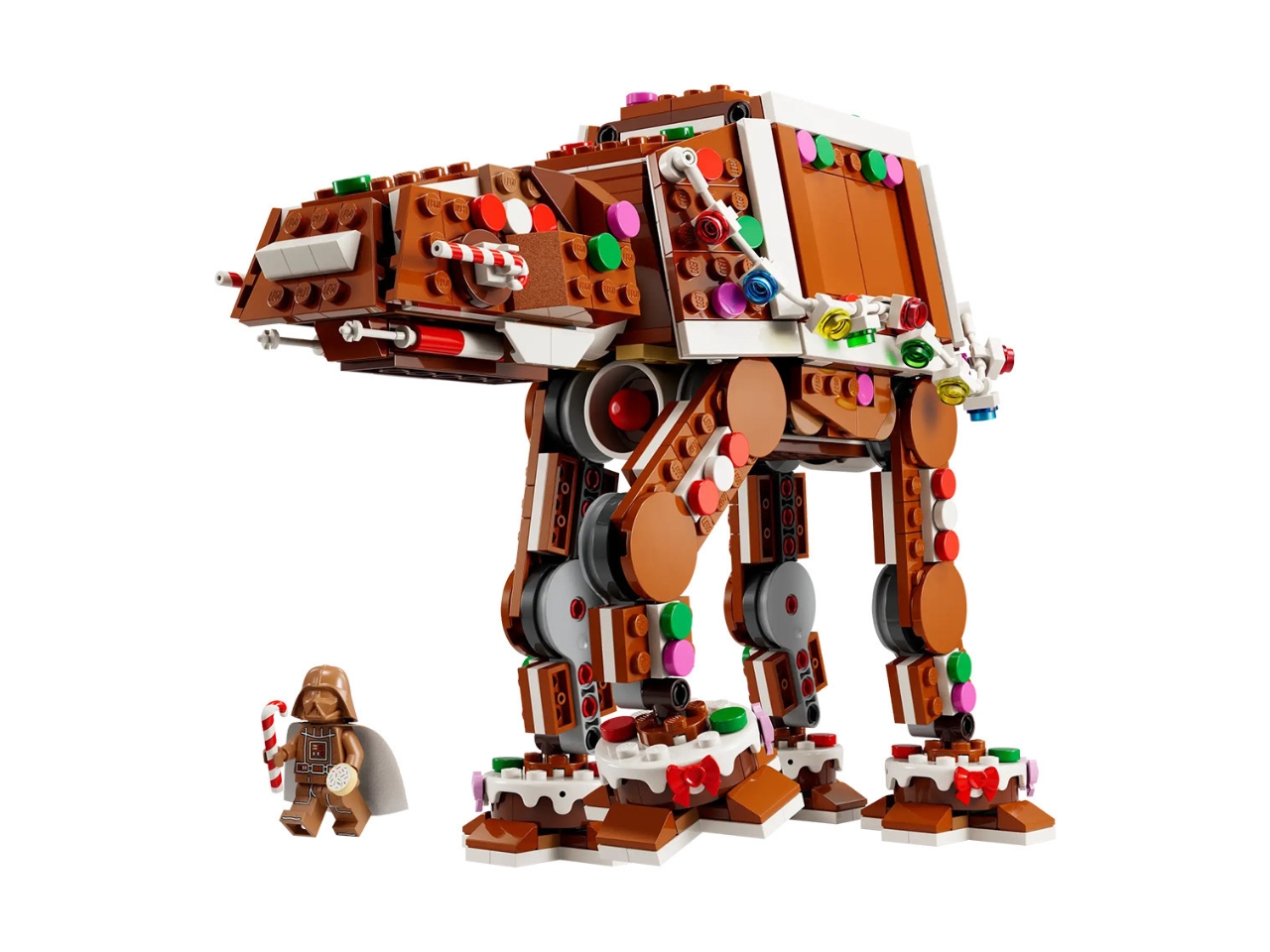
The LEGO® Star Wars Gingerbread AT-AT Walker is a great gift idea for the kids and the kid in you who love creating these famed transport and combat vehicles from the Star Wars universe. Whether you’re shopping for a young builder just discovering the galaxy far, far away or treating yourself to a delightful addition to your collection, this set checks all the boxes. The Christmas craft building set may not be as complicated or grand as the usual Star Wars sets that we get, but it’s a fun activity that young Star Wars fans who want to create their own All Terrain Armored Transport will absolutely adore (in case you didn’t know, that’s what AT-AT means).
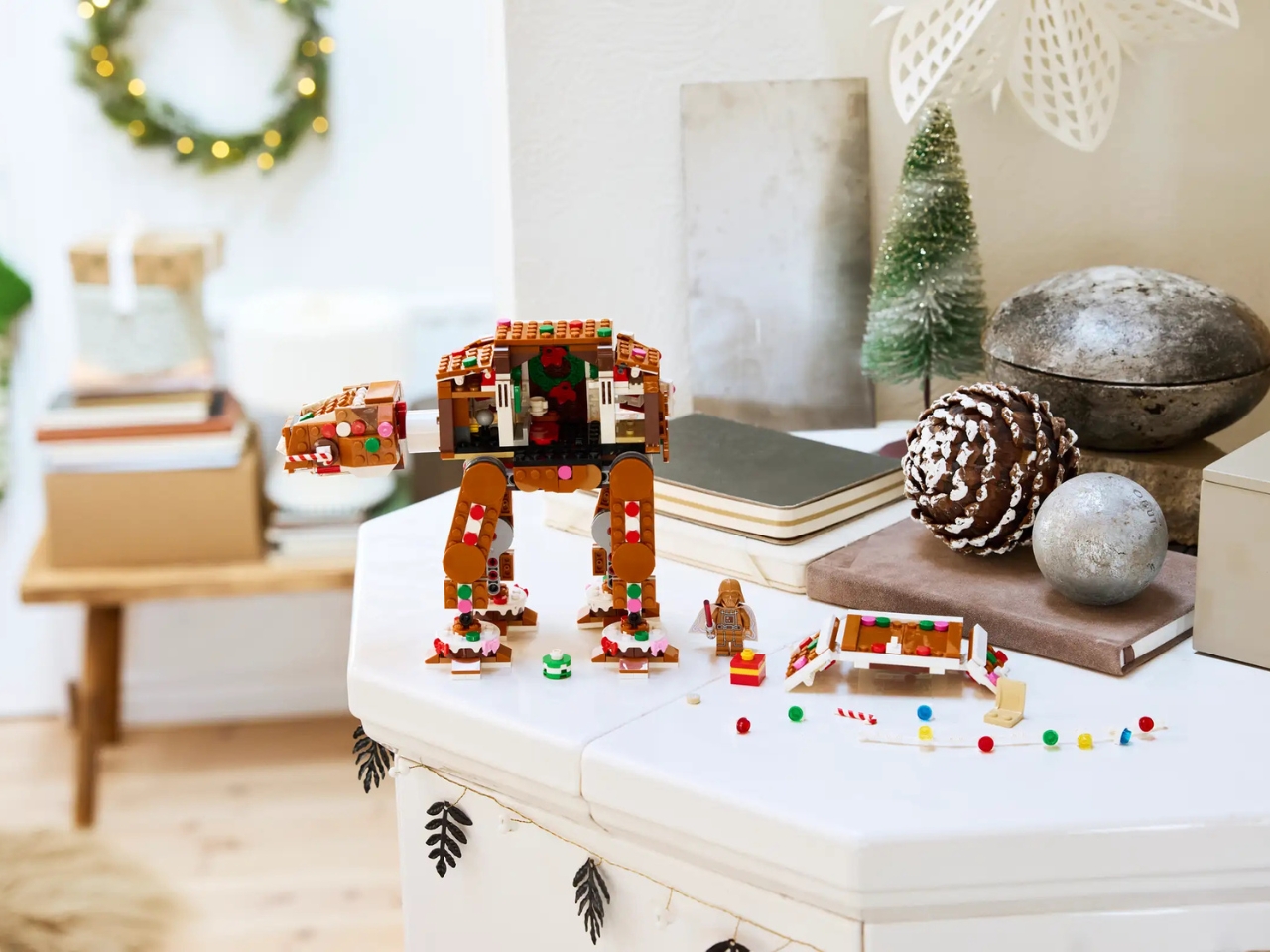
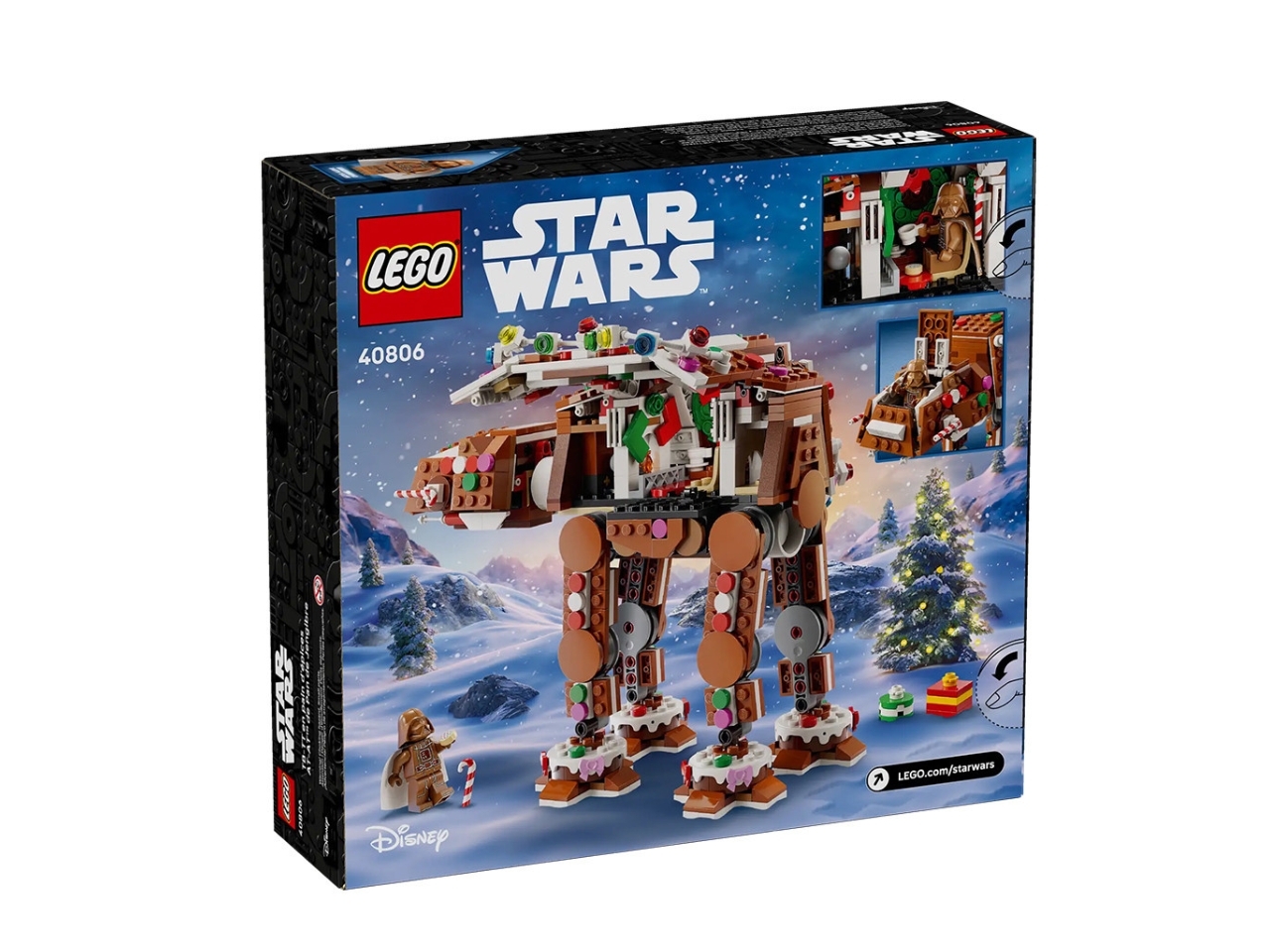
The AT-AT Walker in this set has all the regular features of the ones that we see in movies and TV shows, but with a holiday flair that makes it uniquely charming. It is designed with gingerbread-house-style decoration through the colorful round pieces that are included in the set, giving it that whimsical, festive feel that’s perfect for the season. You can do things like pose its legs in different walking positions, open the cockpit to reveal the pilot area, and even see what’s inside by flipping up the sides of the main compartment. The attention to detail here really shines through, making it both a display piece and an interactive toy.
The interior may not be what you expect a combat vehicle to look like as it’s pretty cozy and warm—more gingerbread cottage than Imperial war machine. There’s a fireplace complete with flickering flames, a table set for a holiday feast, a drinking cup, cookie and candy cane elements that look good enough to eat, stockings on the wall waiting for tiny gifts, and a pile of beautifully wrapped presents on the side. In other words, this is a Christmas getaway for your favorite Star Wars villain. Oh and did we mention that the set comes with a Gingerbread Darth Vader LEGO minifigure? It’s absolutely adorable with its brown gingerbread coloring and festive details. Just resist the urge to eat it as it’s not edible, even though it certainly looks sweet enough to try!
This 697-piece building kit measures around 7.5 inches high, 9 inches long, and 4 inches wide, making it a substantial but not overwhelming display piece. Once the kid (or you) finishes building the AT-AT Walker, it’s perfect to be placed on your own fireplace mantel, bookshelf, or even as a centerpiece on your holiday table as part of your upcoming holiday decorations. The warm gingerbread tones and festive details make it blend beautifully with traditional Christmas decor while still celebrating your Star Wars fandom.
If they (or you) need help in building this, the LEGO® Builder app is always there to guide them through each step and even view a 3D digital version of the Gingerbread walker. This digital companion makes the building experience even more enjoyable, especially for younger builders who might be tackling a LEGO set of this size for the first time. The app allows you to zoom in, rotate, and view the model from every angle, ensuring that every piece goes exactly where it should.
This delightful set makes for wonderful quality time during the holidays, whether you’re building it solo with a cup of hot cocoa or making it a family activity. It’s these kinds of seasonal releases that remind us why we fell in love with LEGO and Star Wars in the first place as they bring joy, creativity, and a touch of magic to the season.
J’espère que votre semaine se passe bien. Moi c’est la course comme d’hab… Mais je viens de tomber sur un truc que j’ai trouvé super cool et je ne résiste pas à l’envie de partager ça avec vous. Vous avez vu le nouveau set
LEGO Game Boy officiel
(lien affilié) qui vient de sortir ? 421 pièces, une soixantaines d’euros, une réplique à l’échelle 1:1 avec des cartouches Link’s Awakening et Super Mario Land faits de briques… C’est joli, c’est nostalgique, mais ça ne fait strictement rien. C’est juste décoratif.
Et bien
selon The Verge
, une moddeuse australienne du nom de
Natalie the Nerd
a trouvé ça carrément abusé, alors elle a fait ce que ferait n’importe quel geek qui se respecte : elle l’a transformé en vraie console Game Boy fonctionnelle. Et attention, je ne vous parle pas d’un vulgaire Raspberry Pi Zero planqué dedans avec un émulateur. Non, non, non, elle y a mis des vrais morceaux de Game Boy, avec de VRAIES cartouches qui tournent, ainsi qu’un circuit imprimé qu’elle a conçu elle-même.
Bah oui, pourquoi faire simple quand on peut faire compliqué ?
Pour arriver à ses fins, elle a dû miniaturiser toute la logique d’une Game Boy sur un PCB de la taille d’un timbre-poste. Elle a installé l’écran le plus petit du marché (ce qui l’a obligée à retirer quelques briques LEGO au passage), passé un port USB-C pour l’alimentation, et même prévu des boutons totalement fonctionnels.
D’ailleurs, en août dernier, Natalie avait fait aussi le buzz avec
une Game Boy Color entièrement transparente
, circuit imprimé inclus. Elle a conçu un PCB en matériau acrylique transparent où on voit tous les fils de cuivre flotter dans le vide. Super beau, super technique, mais elle-même disait que c’était juste un projet artistique pour montrer son travail, et pas quelque chose de très pratique.
Elle a même fondé le
Modded Gameboy Club
, une communauté avec un Discord et un Wiki où les gens partagent leurs tutos pour réparer, modifier, upgrader leurs vieilles consoles Nintendo. Elle vend aussi des composants de seconde main pour les modders et partage ses designs de circuits en open source.
Et bonne nouvelle pour ceux qui voudraient reproduire sa version fonctionnelle de la LEGO Game Boy puisqu’elle a annoncé qu’elle publierait les schémas et les plans une fois qu’elle serait satisfaite du résultat final. Donc si vous avez des compétences en soudure et que l’idée de fabriquer un PCB custom ne vous fait pas peur, vous pourrez bientôt tenter l’aventure.
En tout cas, moi je trouve ça trop super méga génial !
Attention les nostalgiques ! Si vous avez grandi dans les années 90 avec un PC sous Windows 95 et que vous étiez fan de LEGO, y’a de fortes chances que vous ayez passé des heures sur LEGO Island. Ce jeu culte de 1997 où on incarnait Pepper Roni, le livreur de pizzas le plus cool de l’île, vient de recevoir une seconde jeunesse grâce au projet isle-portable.
Pour ceux qui ne connaissent pas, LEGO Island c’était LE jeu en monde ouvert avant l’heure. On pouvait se balader librement sur une île peuplée de personnages loufoques qui se démontaient dans tous les sens pour nous faire marrer. Entre les courses de jet-ski, les missions de dépannage et la fameuse poursuite en hélicoptère où on balançait des pizzas sur le méchant Brickster (oui, des pizzas, le truc qui l’avait aidé à s’échapper), c’était du grand n’importe quoi mais qu’est-ce qu’on adorait ça !
Vous pensiez que votre imprimante 3D était le summum de la technologie ? Et bien Dr. Engine vient de vous prouver le contraire avec sa factory LEGO qui transforme de la pâte à modeler en produits manufacturés. Et franchement, c’est pas mal foutu du tout !
Cette machine automatisée combine laminoir motorisé, convoyeur à bande et guillotine de précision pour traiter de la modeling clay (comprenez de la pâte à modeler style Play-Doh) avec un sérieux qui ferait pâlir d’envie certaines chaînes de production industrielles.

 Connexion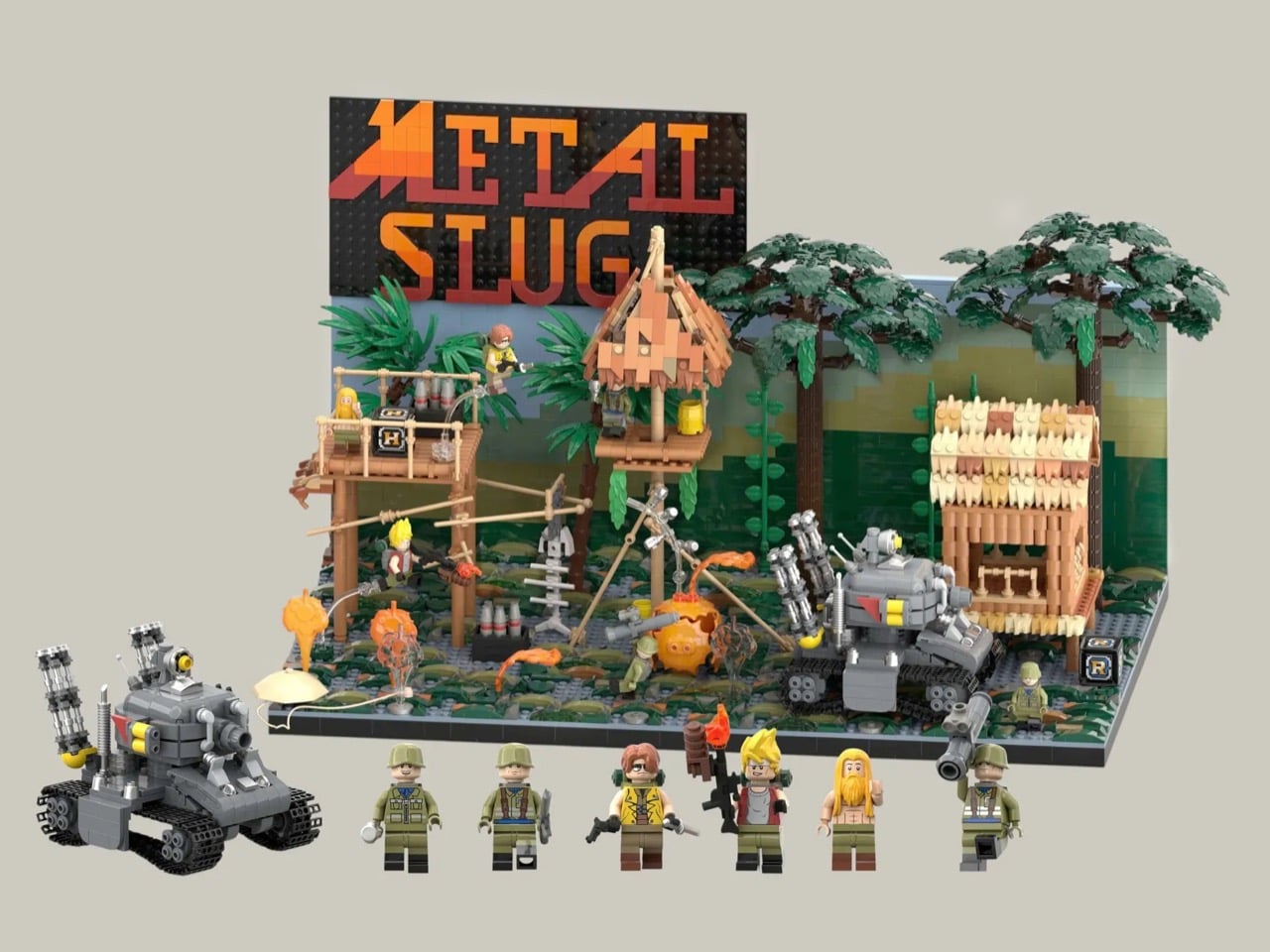






























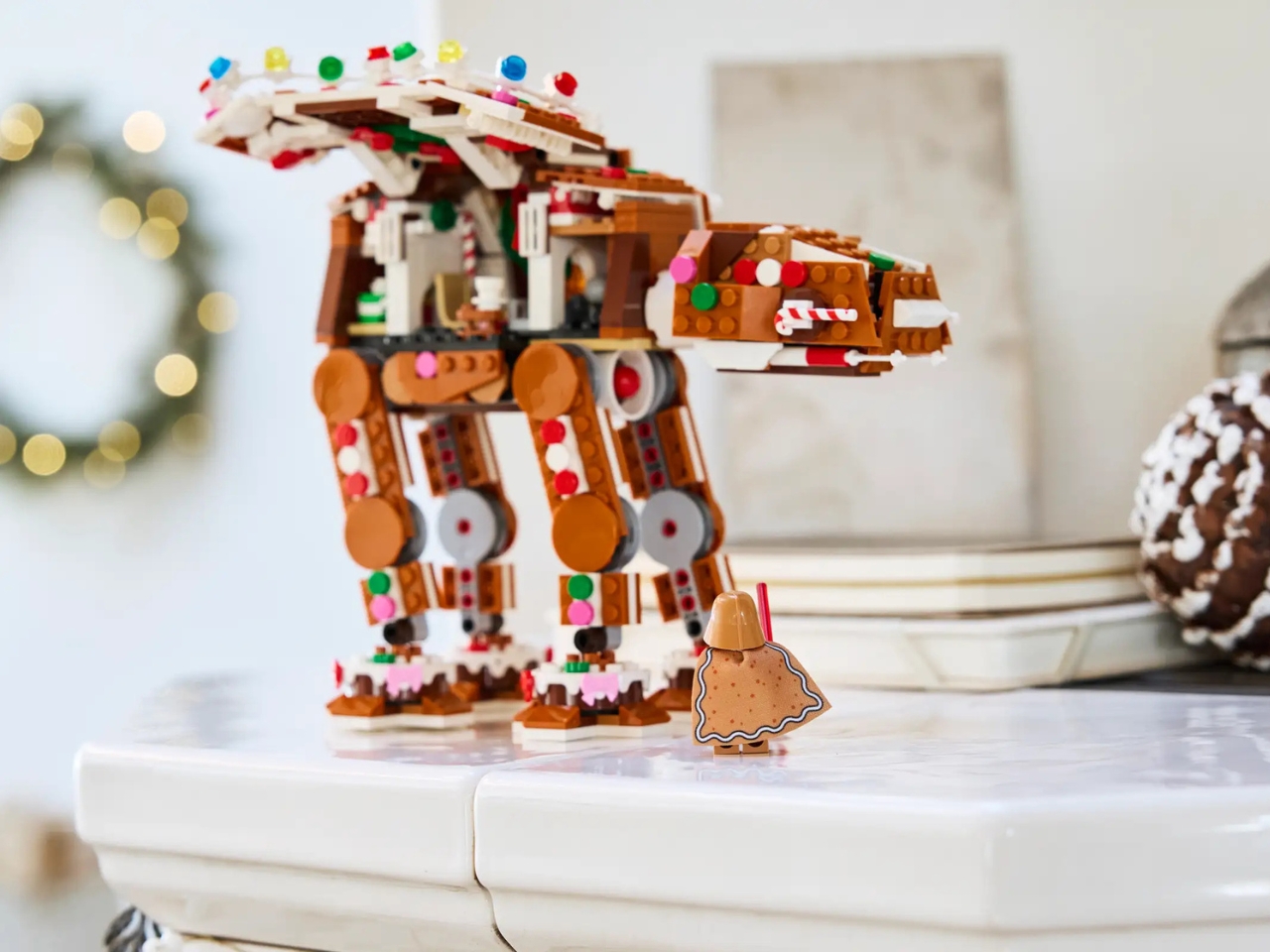
 Gingerbread AT-AT Walker is a great gift idea for the kids and the kid in you who love creating these famed transport and combat vehicles from the Star Wars universe. Whether you’re shopping for a young builder just discovering the galaxy far, far away or treating yourself to a delightful addition to your collection, this set checks all the boxes. The Christmas craft building set may not be as complicated or grand as the usual Star Wars sets that we get, but it’s a fun activity that young Star Wars fans who want to create their own All Terrain Armored Transport will absolutely adore (in case you didn’t know, that’s what AT-AT means).