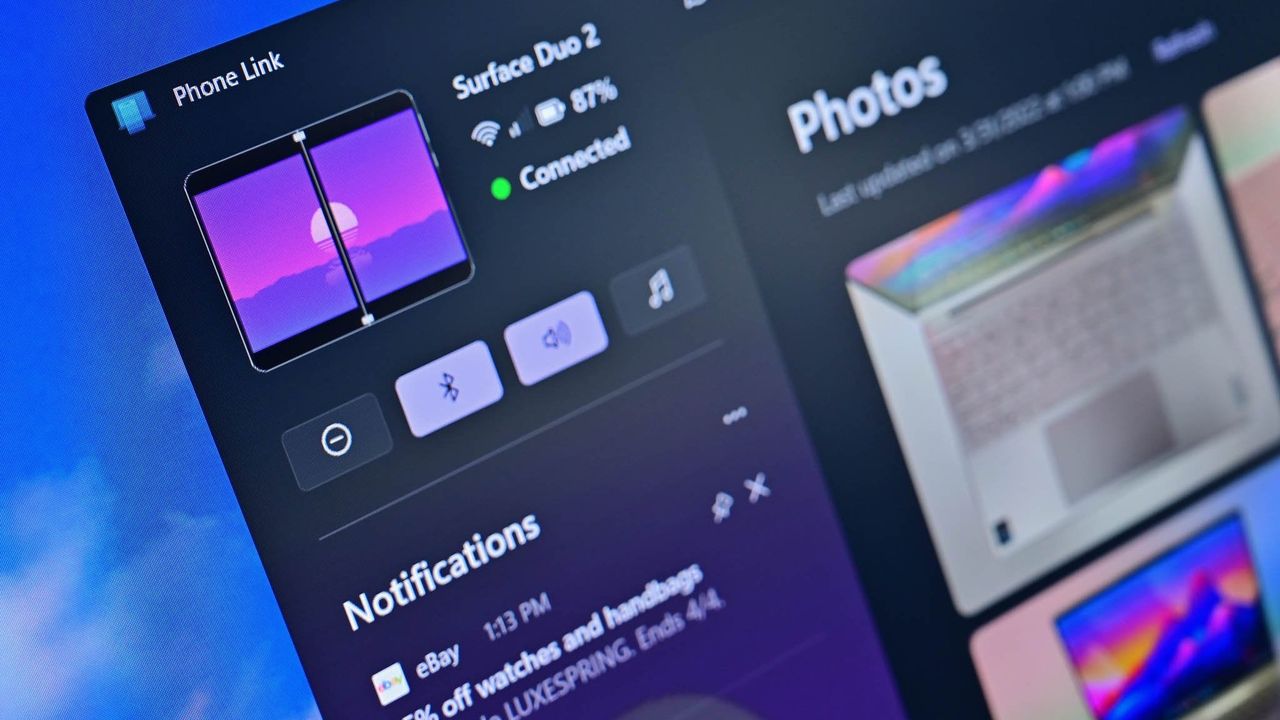
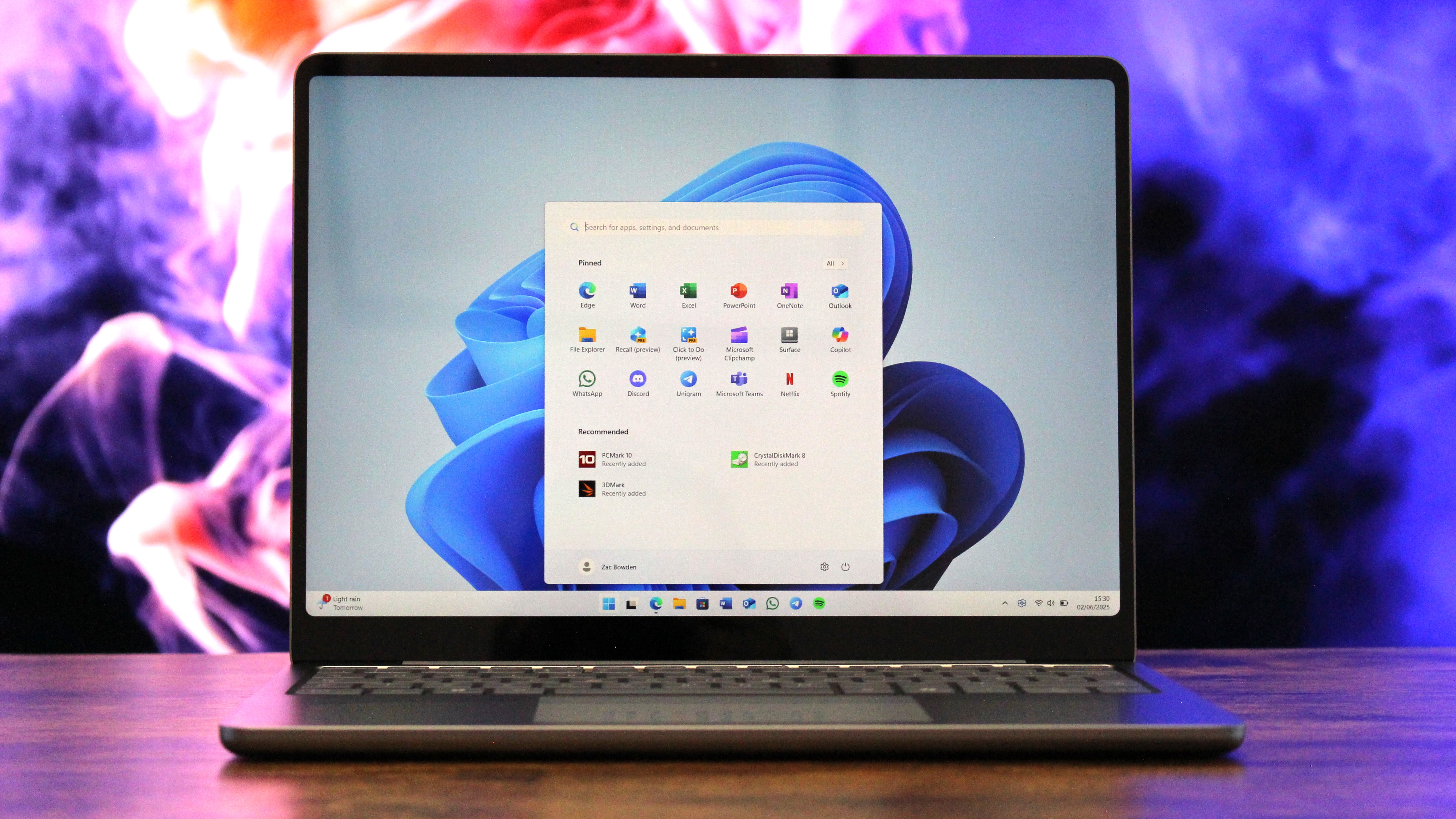
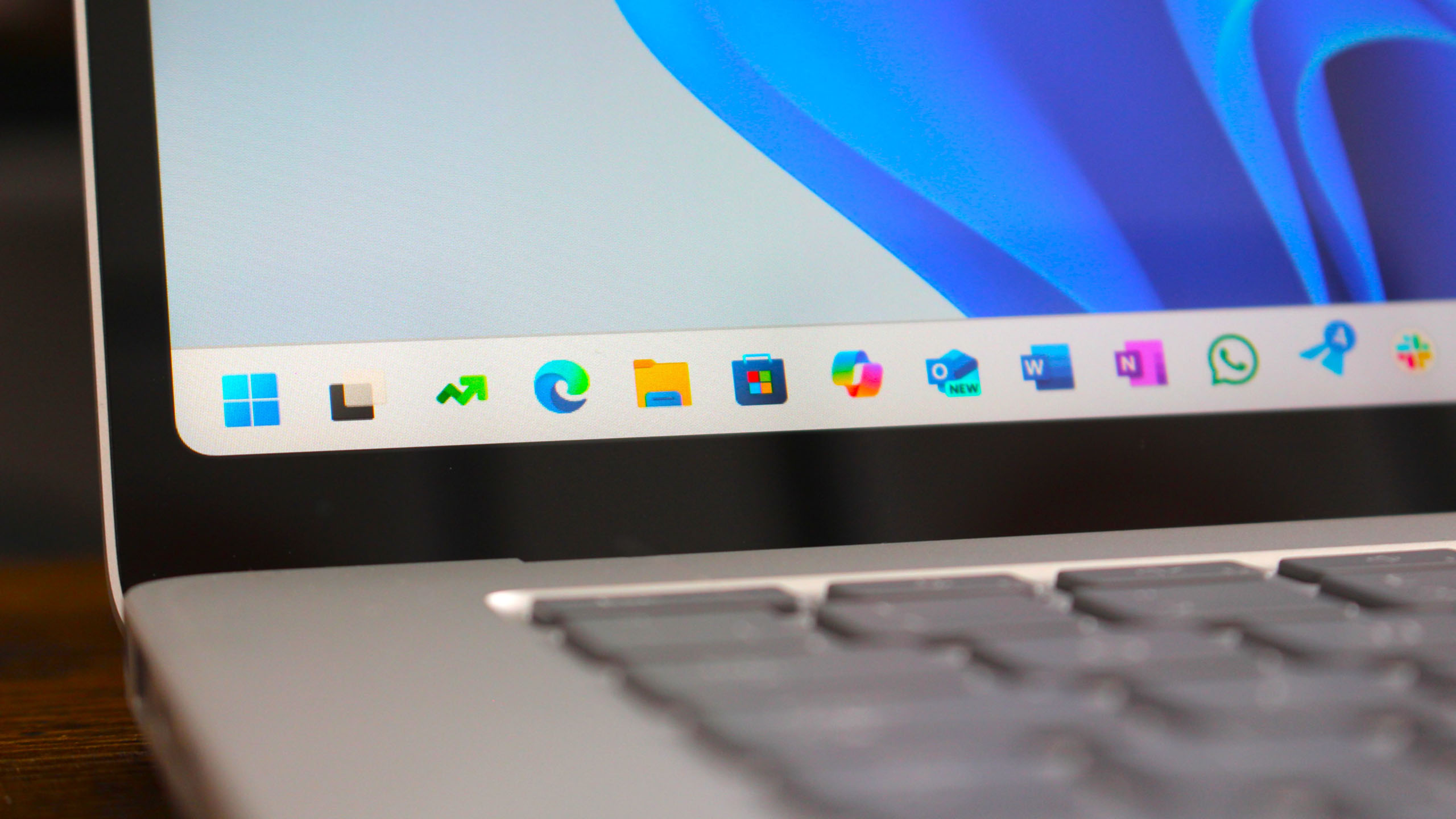
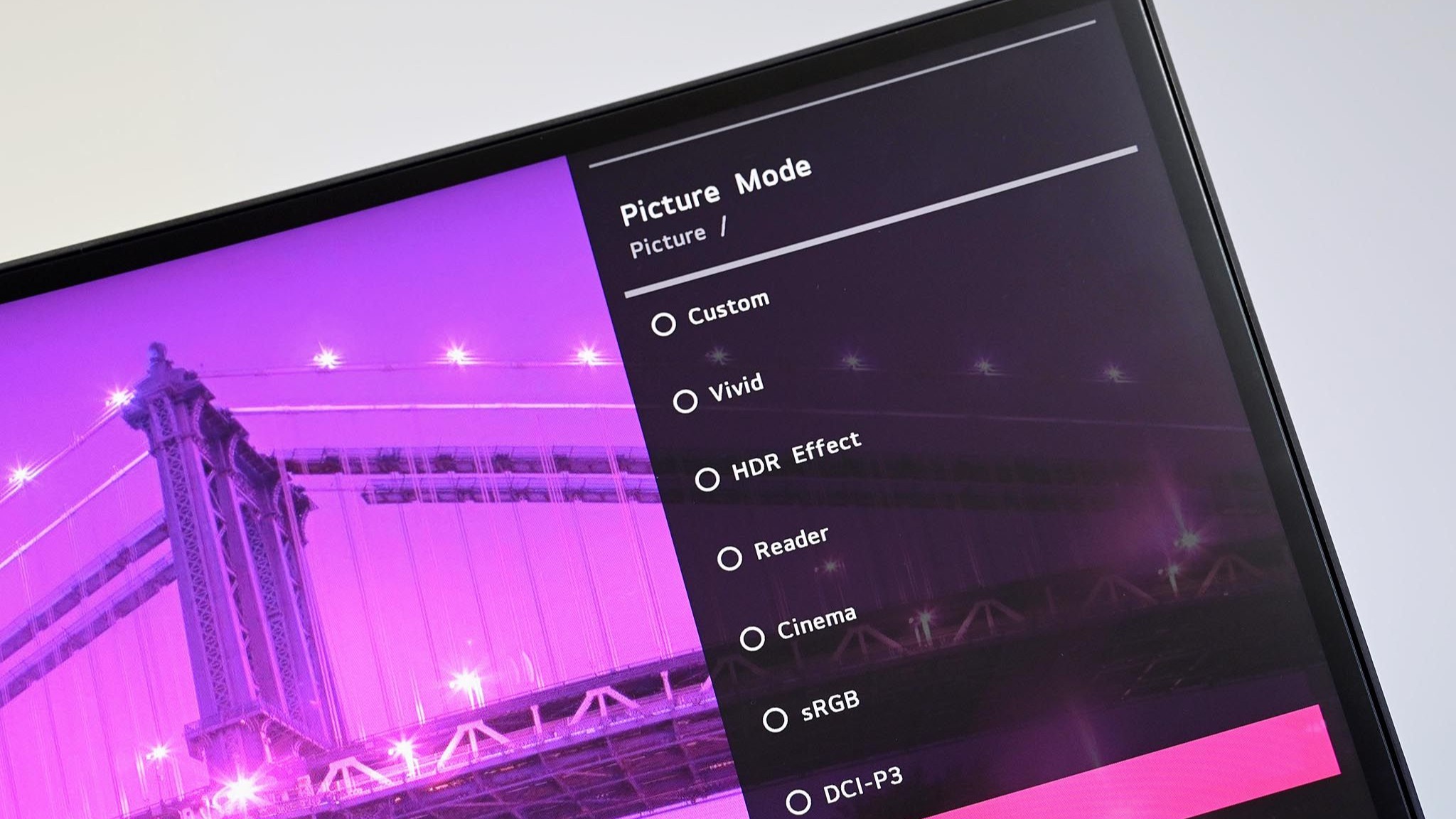
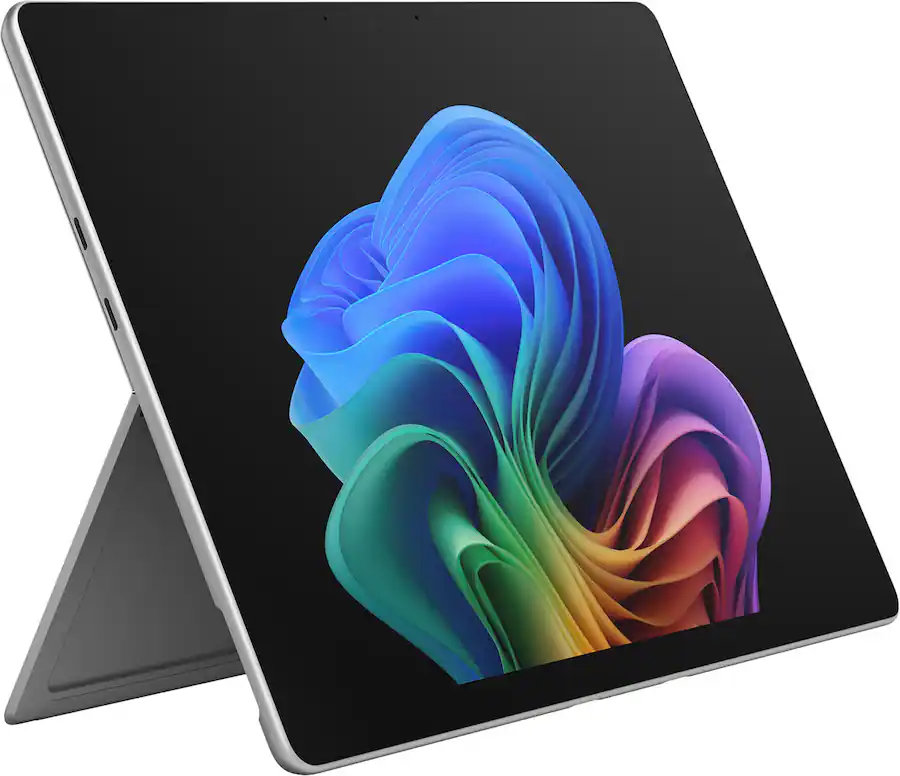
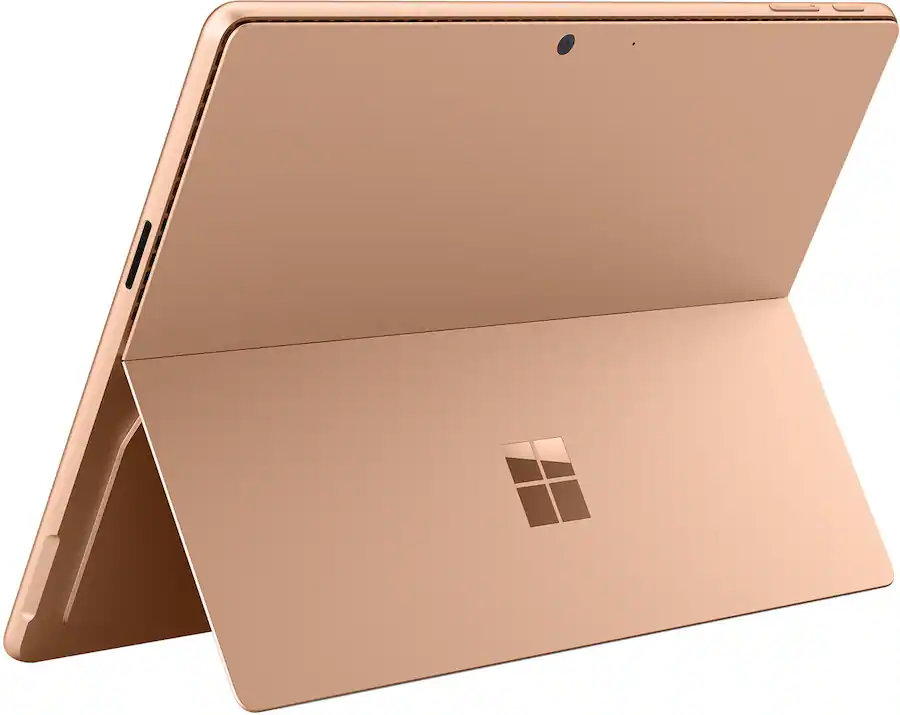
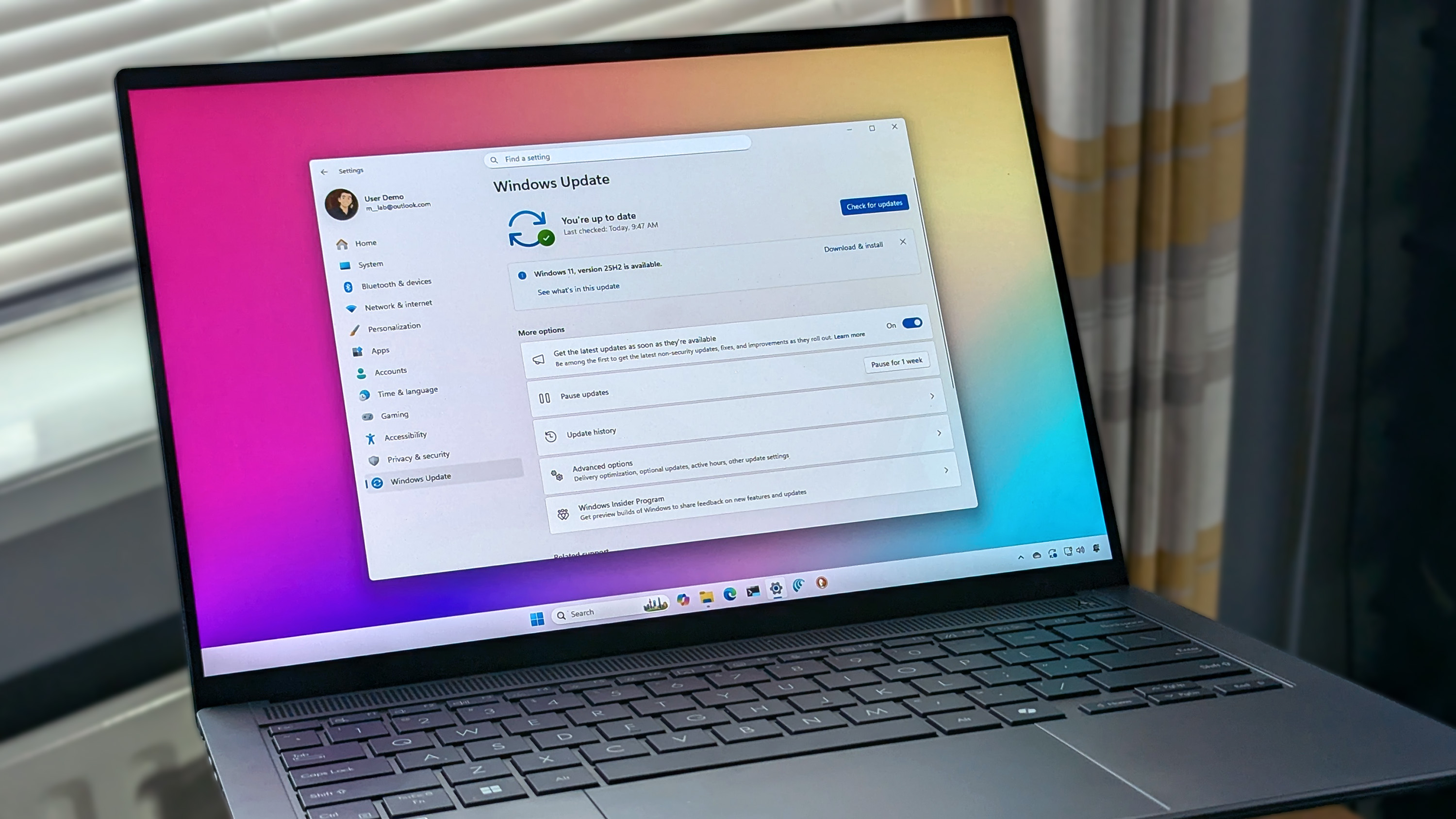
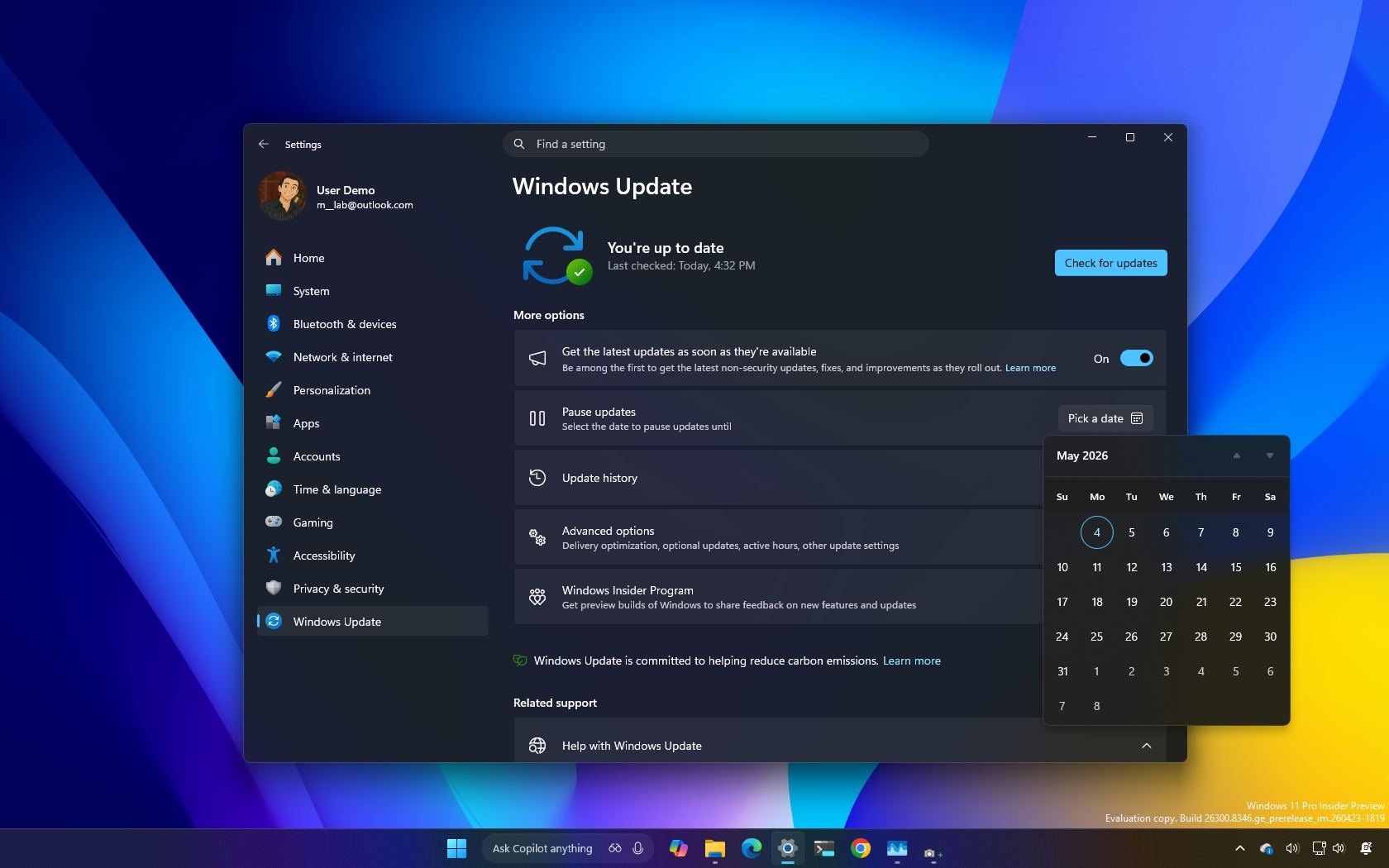
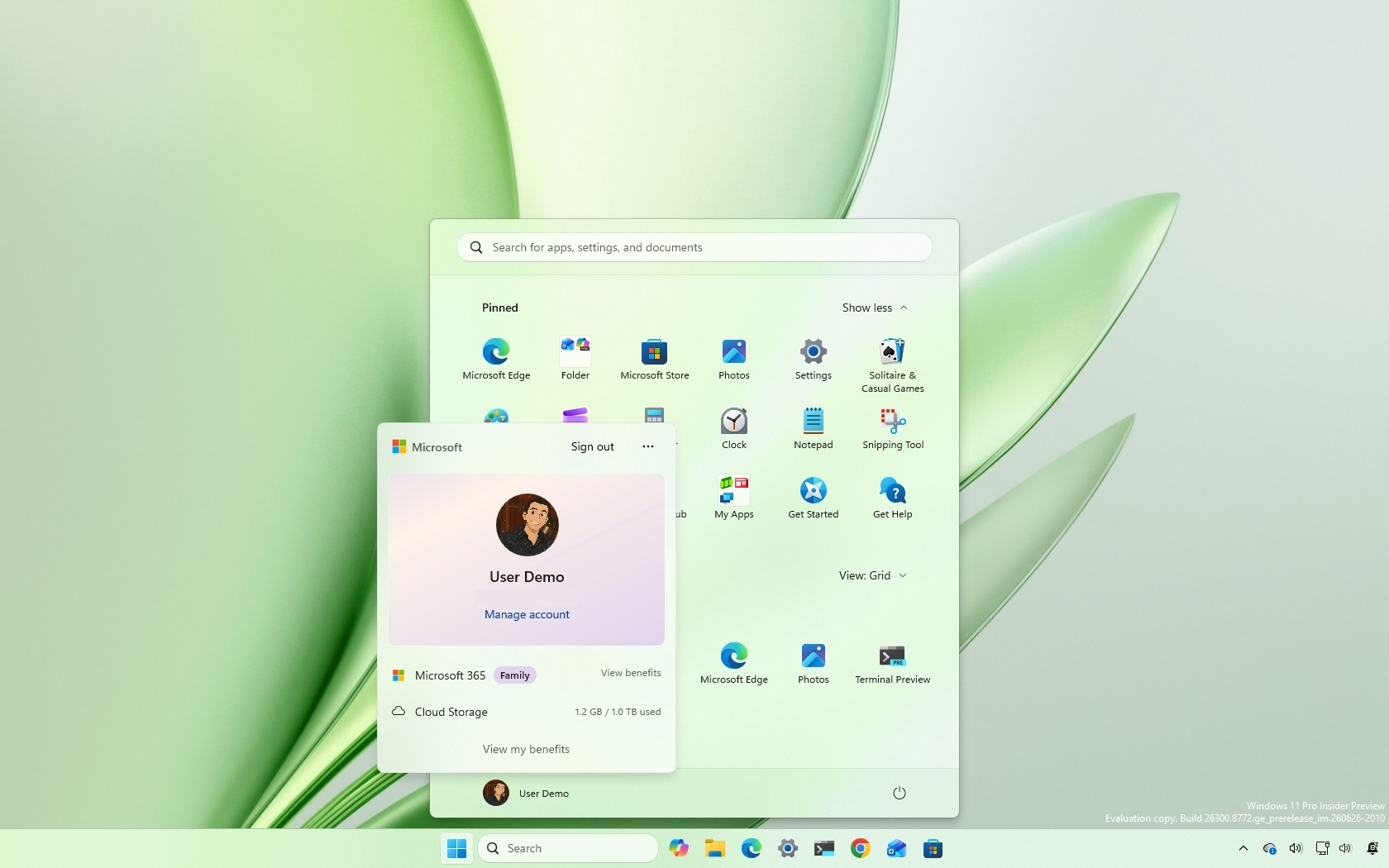
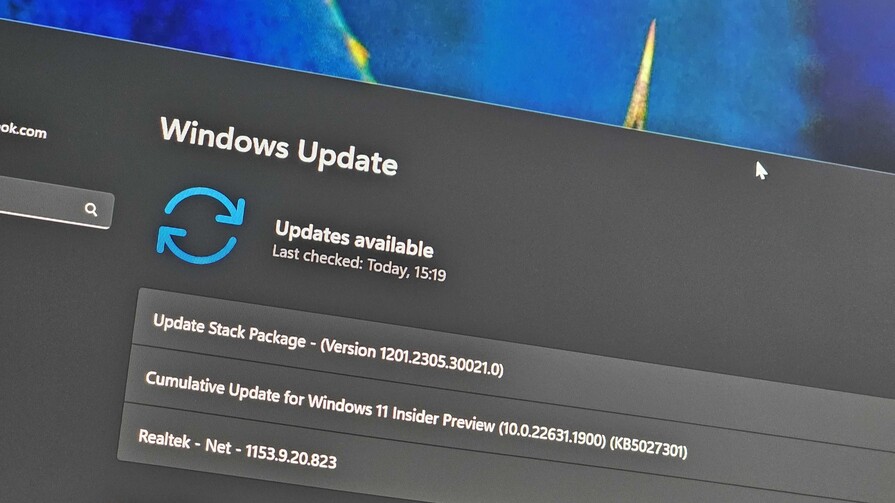
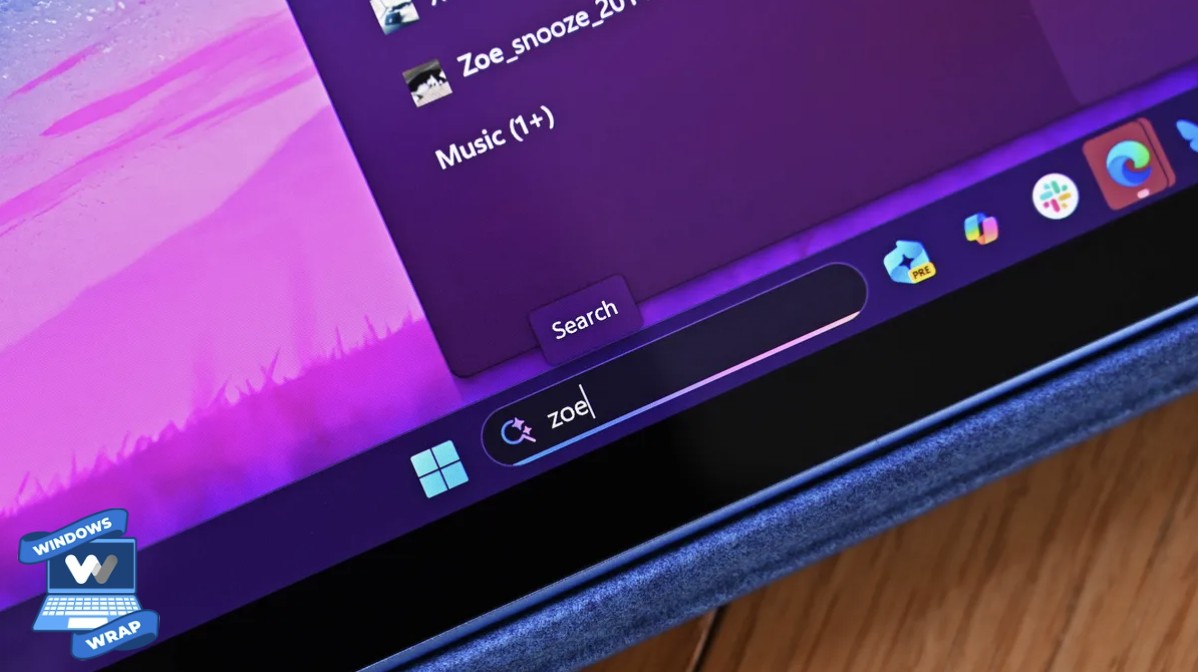
Windows Insiders have new features to try out, including improved Windows Search and an upgraded Phone Link. The changes come with Windows 11 Insider Build 26300.9032, which is now available through the Experimental Preview Channel.
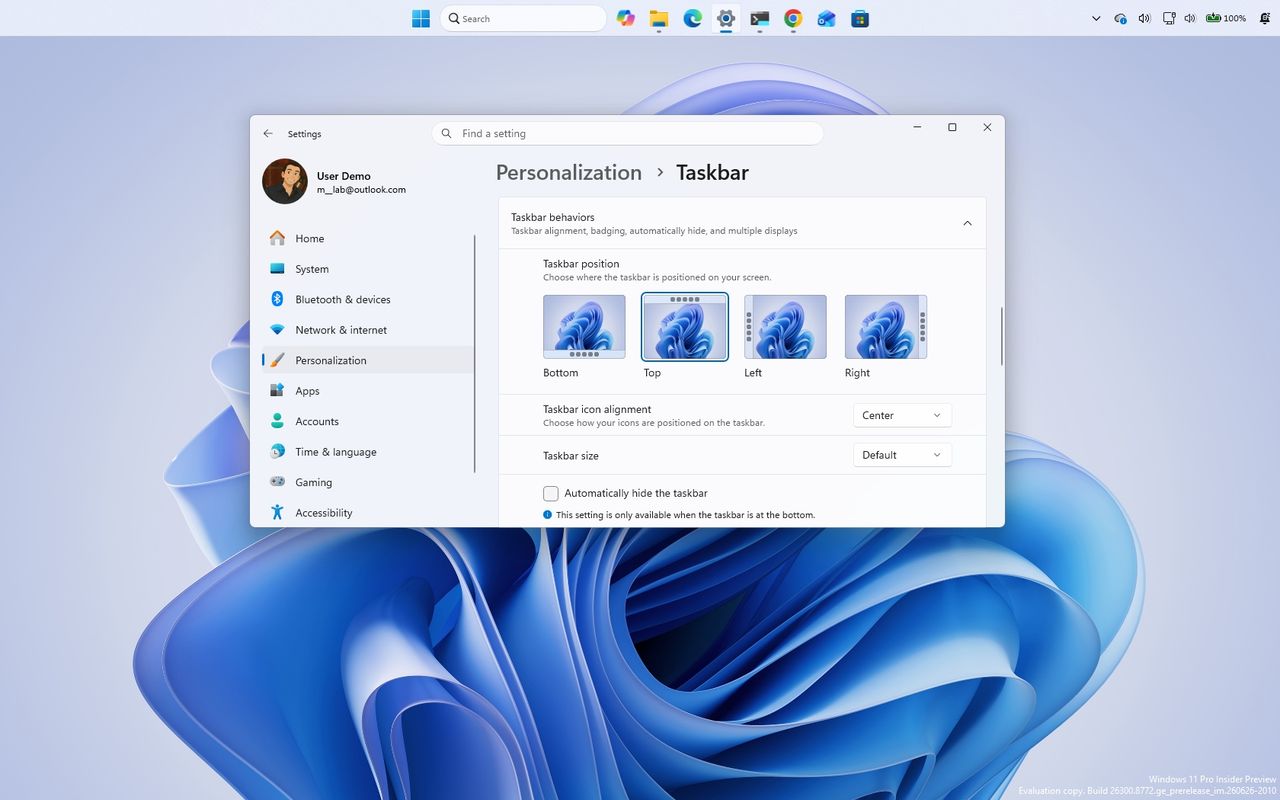
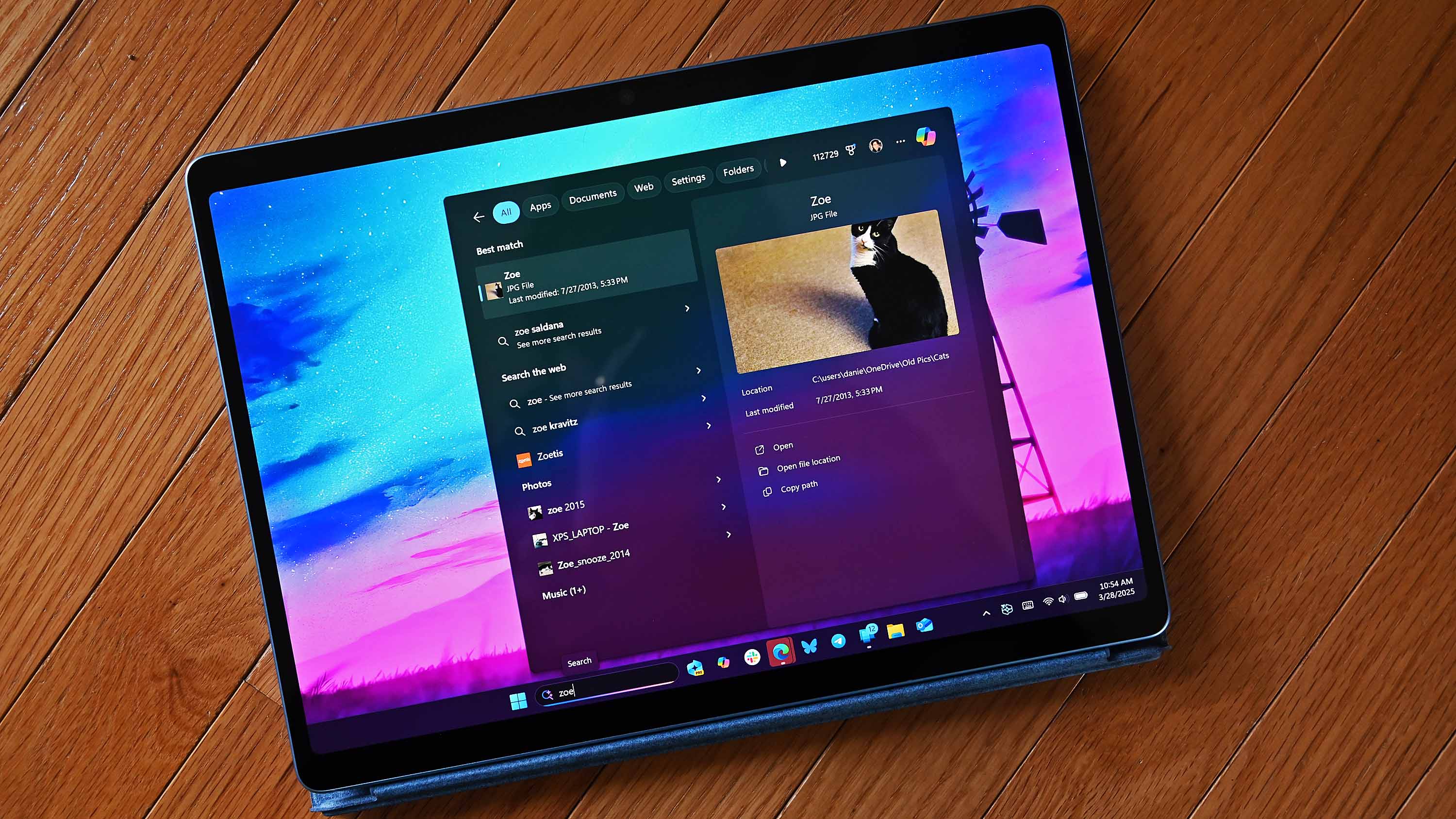
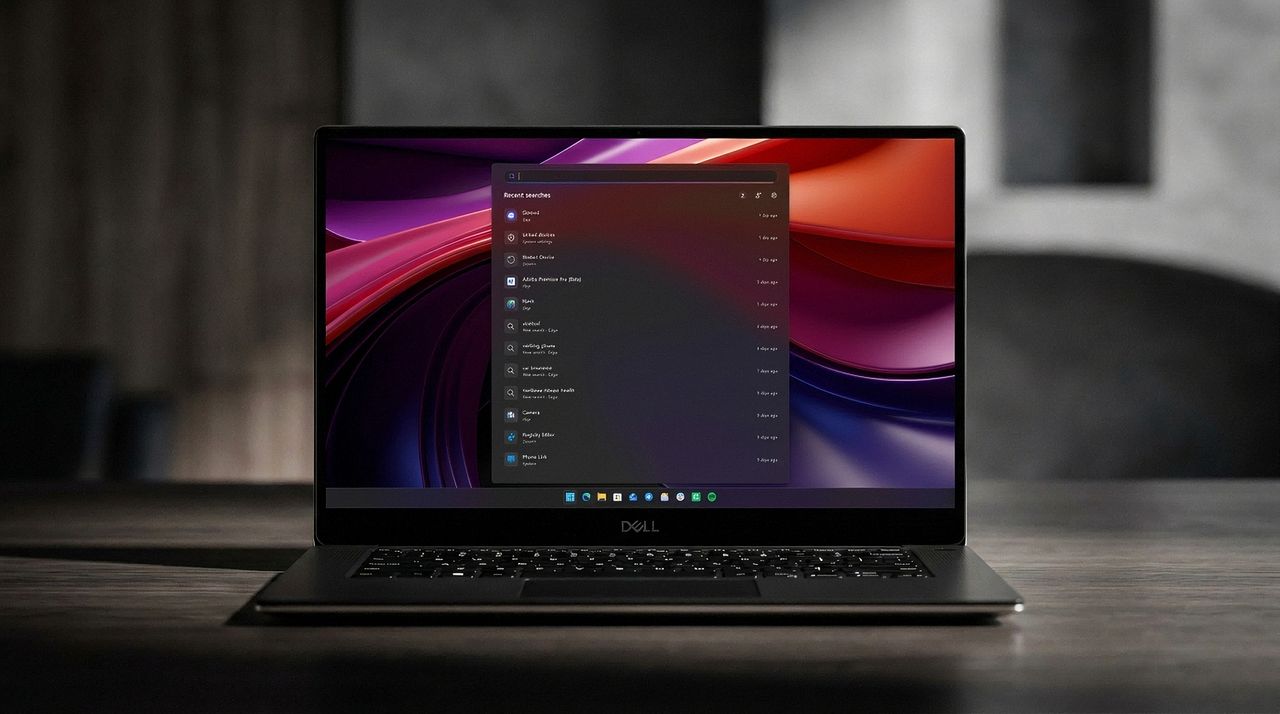
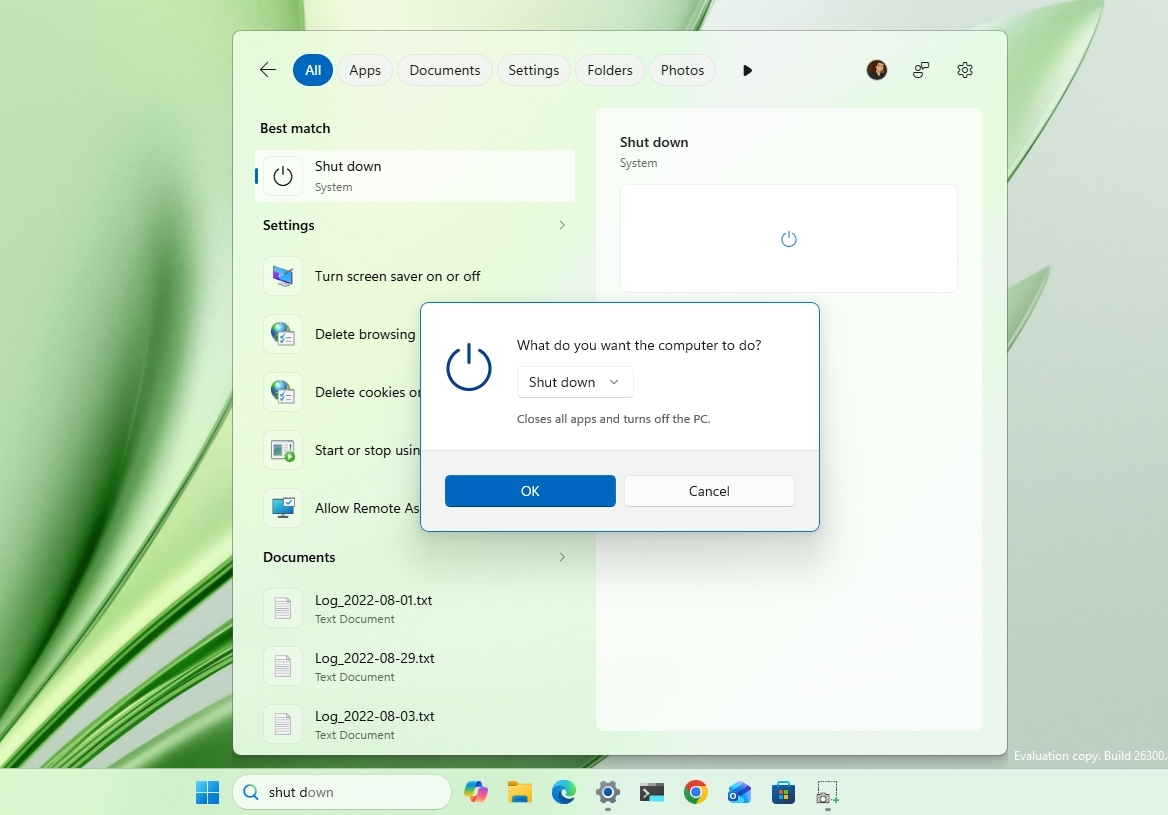
The improved Windows Search is customizable, including some options that were already available. You can enable or disable integration with your personal Microsoft account or work or school account. You can also set Search to look through your OneDrive or not search your cloud storage.
The most recent addition of automatically expanding indexing in Windows Search based on your activity can also be enabled or disabled with a toggle.
Phone Link keeps getting better
The changes to Phone Link are more significant, but I wonder how many people they will affect. Based on comments here and on social media, it feels like Phone Link is a good idea that few people actually use daily. But Microsoft continues to improve it, so there must be a healthy user base.
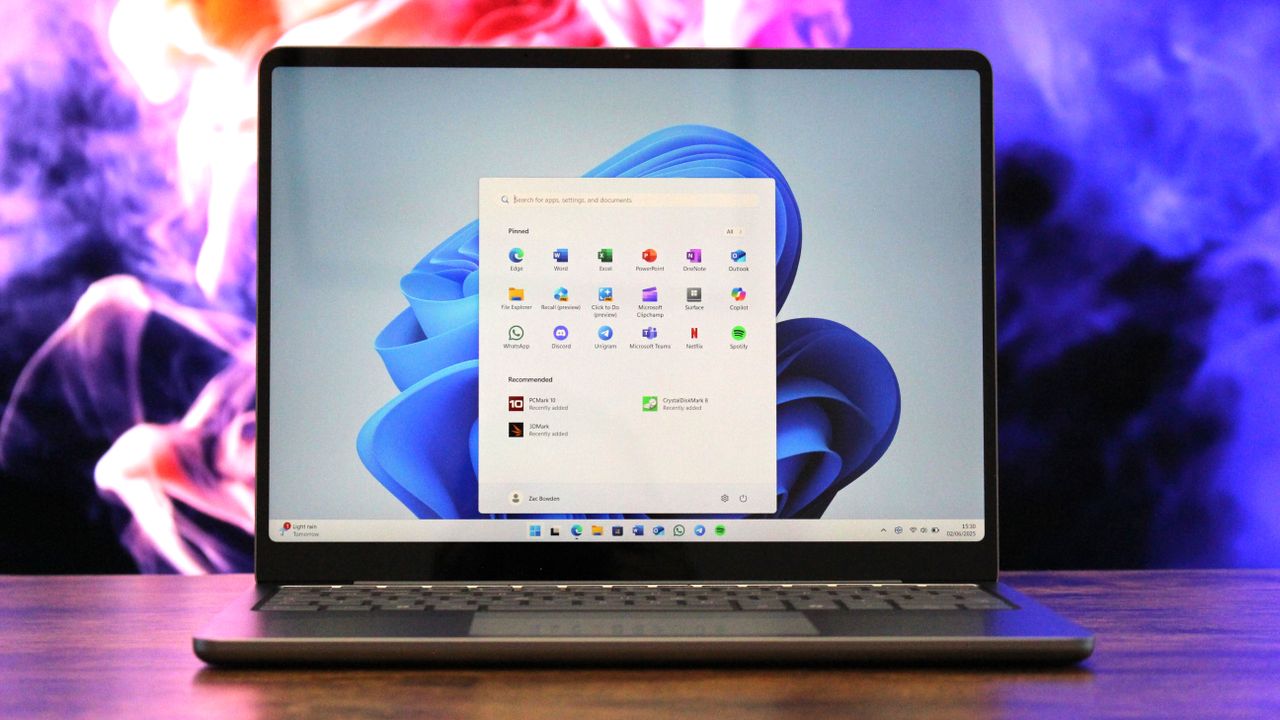
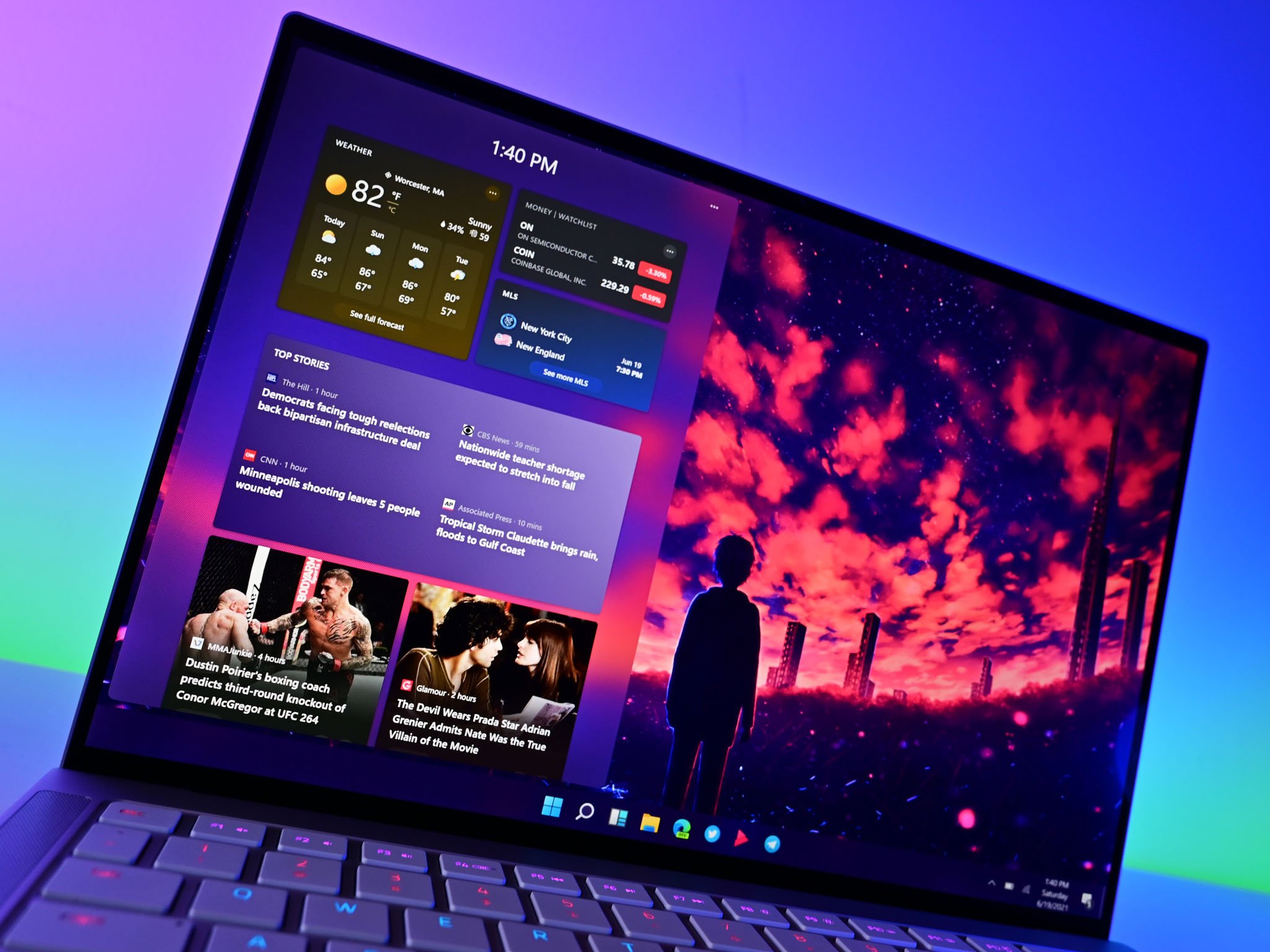
In the most recent Windows Insider build, Phone Link can show more activity at a glance. Hovering over a recent message or notification in the recent section of the Start menu will show a preview of content. That experience is rolling out gradually, though, so you may not see it even if you're on the latest build.
Microsoft has big plans for Phone Link and even has a dedicated Messages app in the works that will support SMS conversations. Our Senior Editor Zac Bowden reported that the new features "are being explored and prototyped internally," but that they might change or not ship.
Eventually, Phone Link may integrate with the Windows shell rather than existing as a standalone app on top of Windows 11.
Microsoft has also played around with integrating Windows 11 and smartphones directly rather than through Phone Link. There's probably a place for both, but I'm curious if you have a preference regarding how to connect a smartphone and a PC.
Windows 11 Insider Preview Build 26300.9032
Search
Windows Search can now automatically expand its indexing scope based on your activity, using signals like recent files and frequently accessed locations. This helps ensure that relevant files across your device are discoverable without requiring manual indexing configuration.
To manage this feature, go to Settings > Privacy & security > Search.
Phone Link
The phone companion experience in Start already helps you keep up with activity from your mobile device. With today's update, you can see even more at a glance.
Get more from your latest activities: Hover over a recent message or notification in the Recent section to preview its content directly in Start. There's no need to pick up your phone or open the item to see what's new.
Whether you're checking a message or deciding if a notification needs attention, these updates make it easier to stay informed and keep your focus.
This experience is gradually rolling out to Insiders on the Experimental channel with a minimum Phone Link build of 1.26021.3.0. Go to Phone Link > Settings > Start menu personalization.
Settings
We've improved search in the Settings app to help you discover and navigate to settings more quickly. Search now surfaces results from more areas within Settings, with improved ranking to help relevant settings appear higher in results.
Adaptive hibernate policy
Updates to the adaptive hibernate policy increase instances of instant-on resumes from Modern Standby and increase battery preservation at the low end of the battery. Noticeable changes include less hibernation while the battery is above 80% and hibernating sooner when the battery is below 10%.
Start menu
Fixed an issue causing the Start menu to crash for some Insiders recently when dragging apps.
Taskbar
Fixed a recent issue where, when the taskbar was in an overflow state, hovering over the preview thumbnail for an app window in the overflow area would immediately dismiss it.
File Explorer
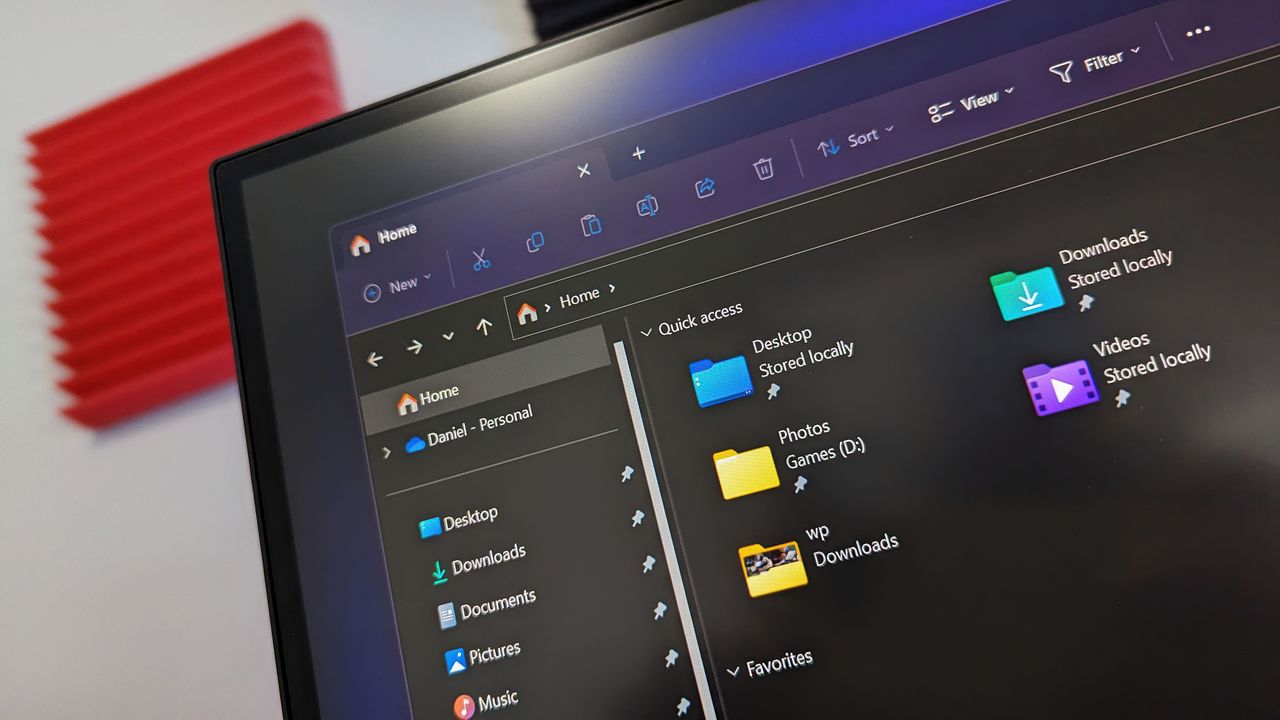
File Explorer Home now preserves the state of sections (expanded or collapsed), so you can pick up where you left off.
We've addressed an issue that caused the address bar contents to be cleared when entering edit mode by clicking near the right end of the bar.
We've improved the reliability of File Explorer when dragging files to a disconnected network drive.
This update addresses an issue where files stored on a DFS mapped drive could be incorrectly treated as originating from the internet after the device started while disconnected from the network and later reconnected. This could cause File Explorer's Preview pane to display the message, "The file you are attempting to preview could harm your computer," or cause files copied from the DFS drive to receive an unexpected Mark of the Web.
Windows Spotlight
Made some underlying changes to help improve reliability for Windows Spotlight on the lock screen.
Storage
This update fixes an issue that affects File History automatic backups to network shares using Server Message Block (SMB). Backups didn't work because Windows showed a false "invalid credentials" error when connecting to SMB shares.
Join us on Reddit at r/WindowsCentral to share your insights and discuss our latest news, reviews, and more.
Windows 11 is being fixed, and that’s not just lip service. Microsoft is making meaningful changes to its operating system. Menus are being decluttered, legacy components are being revamped, and features like Xbox Mode are reshaping Windows 11.
Just this week, we saw that Microsoft has plans to fix context menus on Windows 11 and get rid of the page-tall menus that plague PCs. Microsoft also committed to making Windows 11 perform better on systems with only 8GB of RAM.
I’ve talked about Windows 11's improvements several times this year in the Windows Wrap. Generally speaking, I’m happy that they’re happening but confused about Microsoft's timing. On top of questions like "Why did it take several years to make Windows 11 look nice?" There are also usability questions like "Why did Microsoft start selling a Surface with only 8GB of RAM before optimizing Windows 11 to work on that machine?"
Now, don’t get me wrong, Windows 11 can run on a system with only 8GB of RAM. I think many tests performed online are done in bad faith. Some people have dozens of Chrome browser tabs open and a bunch of apps running at once and then complain about performance.
But by Microsoft’s own admission, Windows 11 needs to be better on low-memory systems. With the cost of RAM skyrocketing and not looking like it will go down at any point in the near future, it’s more important than ever for Microsoft to optimize Windows 11.
Biggest News of the Week
Earlier this year, Microsoft started selling Surface PCs with only 8GB of RAM, specifically the Surface Pro 12-inch and Surface Laptop 13-inch. I appreciate the gesture. In today’s economy, getting a PC with too much RAM or too much storage for your everyday needs can cost hundreds of dollars extra.
I covered several Surface deals this week, including some options that are up to $450 off. While that is a significant savings, those deals are all on models of the Surface Pro (13-inch) with 16GB of RAM. It’s still difficult to find that type of Surface Pro under $1,200.
Many people just want a PC that’s reliable and that can handle their everyday tasks. Even those shopping in more premium categories, such as Surface, often prioritize design and form factor over getting the highest specs. For those types of customers, an 8GB RAM Surface makes sense, but not if Windows 11 is still a problem.
Microsoft put the cart before the horse with the 8GB Surface PCs. The tech giant responded to the RAM crisis with more affordable PCs, but Microsoft failed to optimize Windows 11 for lower memory first.
To me, that shows a disconnect between the Windows and Surface teams at Microsoft.
Shopping with Sean
Until Microsoft fully optimizes Windows 11 for PCs with only 8GB of RAM, you might feel a bit of a pinch in performance with that amount of memory. The current discounts on Surface Pro get you more memory without having to pay as much of a premium.
The best Surface Pro deals are spread across Amazon and Best Buy this week.
This Surface Pro is both the best deal of the day and the highest spec'd configuration you can get through Amazon. It pairs the new Snapdragon X2 Elite with 16GB of RAM and 1TB of SSD storage. Plus, it has a lovely OLED screen for deep blacks and high contrast.
This is the Goldilocks model of the Surface Pro, balancing high-end specs like an OLED screen with value for money. At $300 off, it has the highest discount available through Best Buy. Its Dune color is stunning as well and a personal favorite.
If you love the form factor of the Surface Pro but don't need the Snapdragon X2 Elite, this model is a great bargain that still features plenty of storage and RAM.
This is the most affordable Surface Pro you can grab. Its Snapdragon X2 Plus delivers snappy performance for everyday computing and you still get 16GB of RAM. Just be aware that it has only 256GB of storage.
The biggest perk here is wireless functionality. You can detach the keyboard and type comfortably while keeping the tablet propped up at eye level, which is a lifesaver on cramped desks or airplane trays.
I'm a big fan of Windows apps that launch quickly and get straight to the point without draining too much of my PC's memory. It might seem like a redundant preference, but when some of Microsoft's most basic software becomes oversaturated with unusual features, like AI writing tools in Notepad (which were later scaled back), performance can feel like an afterthought.
Plus, Windows 11 is regularly under fire for its more unpopular changes and additions, while some genuinely useful inclusions are often overlooked. Even so, it's not like Microsoft To Do is the best in its class, because it really isn't. Plenty of enthusiasts would likely point me towards something like Todoist rather than Microsoft's restructured version of what was Wunderlist.
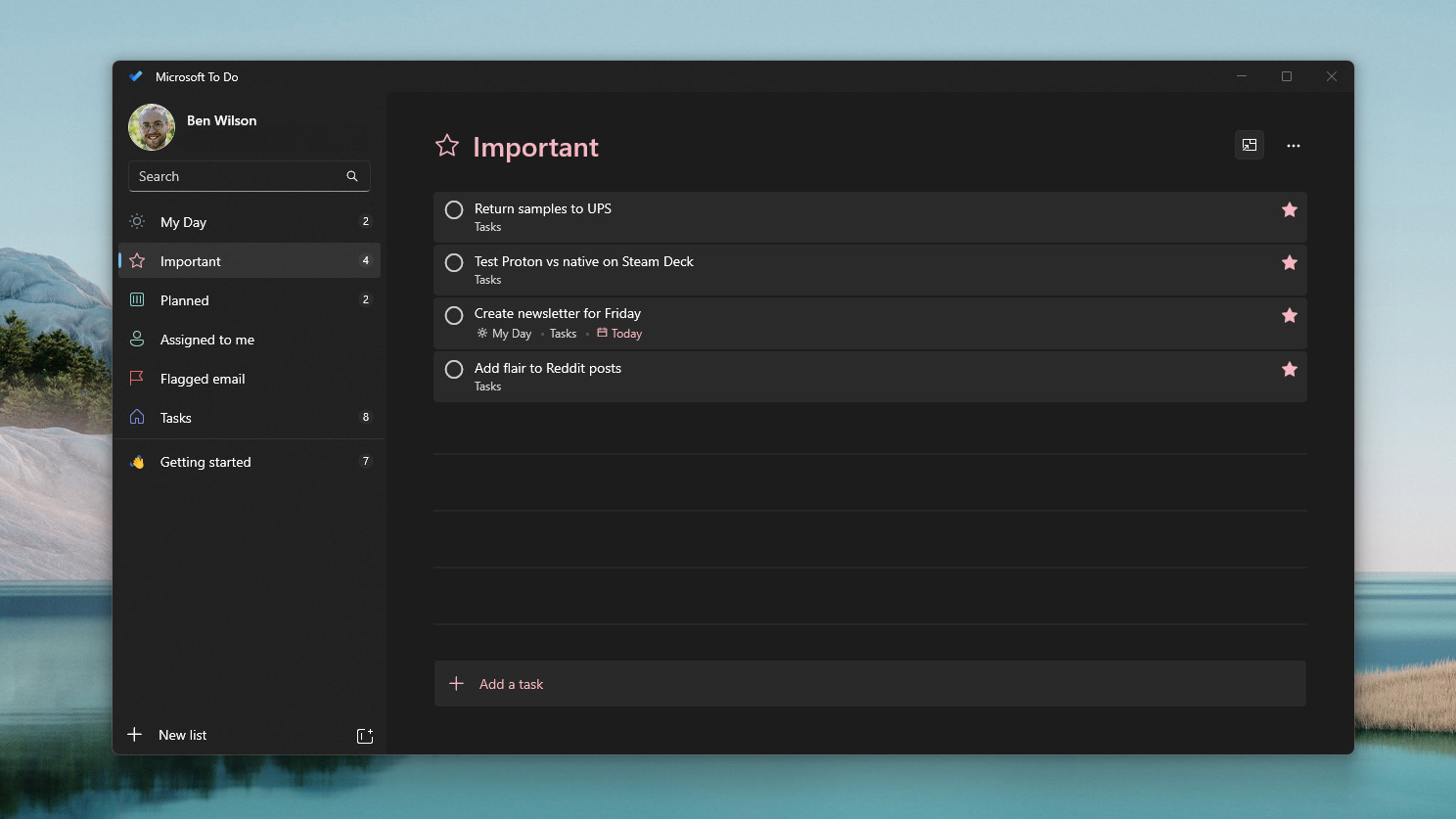
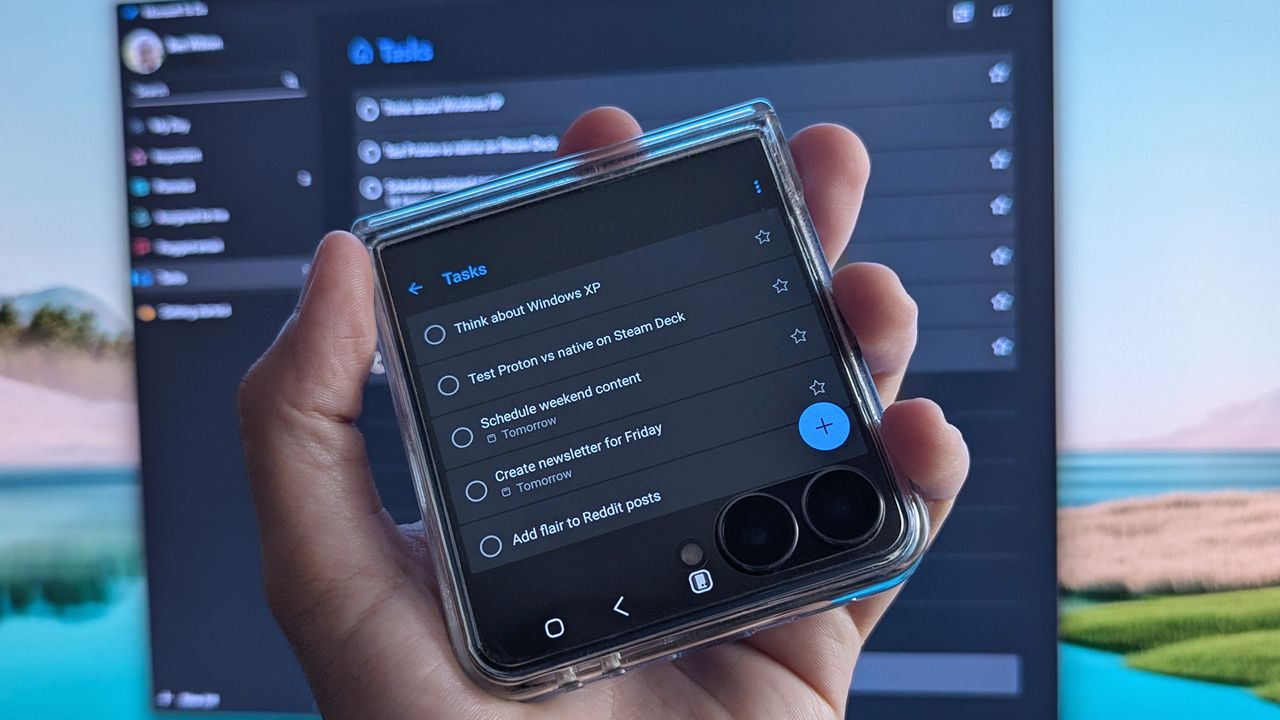
However, there's nothing inherently wrong with To Do, either. It's lightweight and runs on all my PCs — even my Android phone — with a functional widget I can add to the cover screen of my Samsung Galaxy Z Flip 7 for glanceable reminders. It pulls hints from natural language to set due dates and, more importantly, helps me remember everything in my daily workflow.
I make Microsoft's to-do list work for me
I could opt for deeper synchronization with my Outlook account, but To Do offers enough to me with just a simple list. (Image credit: Ben Wilson | Windows Central)
I find that a to-do list can either make my day much more manageable by breaking it into chunks, or it can freeze up my brain when I look at a daunting list of deadlines. It all depends on how you use it, but I've certainly found it helps me keep track of recurring tasks that pop up every day. Plus, the little 'ping' sound that plays when I mark a task as complete delivers a nice hit of serotonin.
However, part of the reason I keep Microsoft's own offering around is that it syncs so naturally across my devices. Again, there are probably third-party apps that deliver the same experience — perhaps something even better — but I'm not trying to overcomplicate a list of daily tasks. That, and my brain thinks differently as soon as I walk away from the computer, so reminders really work.
The future of Microsoft To Do seems to have two potential outcomes, though one of them is far more likely than the other. First, it could eventually be abandoned. Microsoft still has the Windows 10 icon on the app's download page, so it's hardly treated as cutting-edge among its portfolio, and its plot in the Microsoft Graveyard might already be reserved.
I just want a chance to be heard by the right person at Microsoft and let them know that their in-house apps are still appreciated.
Second, it goes the way of Microsoft Whiteboard and is absorbed into Microsoft 365, potentially renamed or adapted entirely as a feature in another app. This one feels less likely because it doesn't offer much collaborative substance to lock behind a paywall, but stranger things have happened. I'm trying to remain optimistic, but there's a small chance To Do transforms into something else.
Ultimately, this feels like the same trend as when I recently praised accessible gaming efforts with the XBOX Adaptive Joystick; I just want a chance to be heard by the right person at Microsoft and let them know that their in-house apps are still appreciated — at least when they're done right — and I'll happily use them despite there being alternatives out there.
Join us on Reddit at r/WindowsCentral to share your insights and discuss our latest news, reviews, and more.
Samsung Galaxy Z Flip 7 smartphone cover screen showing Microsoft To Do app with listed tasks and the Windows equivalent in the background displayed on a PC monitor
Walking away from my PC can be like emptying my brain's Recycle Bin, but keeping Microsoft To Do on my phone helps me stay on track.
Microsoft is expanding one of the least understood security features in Windows 11. Beginning with the August 2026 update, Enhanced Sign-in Security (ESS) now supports compatible external fingerprint readers, extending the company's most secure Windows Hello experience to devices without built-in biometric hardware.
The timing couldn't be better because Enhanced Sign-in Security has confused users ever since Microsoft introduced it. Some users assume it's simply a newer version of Windows Hello, while others think it's reserved for businesses or Copilot+ PCs.
The reality is that Windows Hello and Windows Hello Enhanced Sign-in Security use the same sign-in experience, but they protect your biometric data in different ways.
After spending time digging through Microsoft's support page, I think that's the distinction most explanations miss. Enhanced Sign-in Security isn't about making facial recognition more accurate or fingerprint sign-in faster. It's about making the entire authentication process harder to attack.
Standard Windows Hello is already one of the best security features
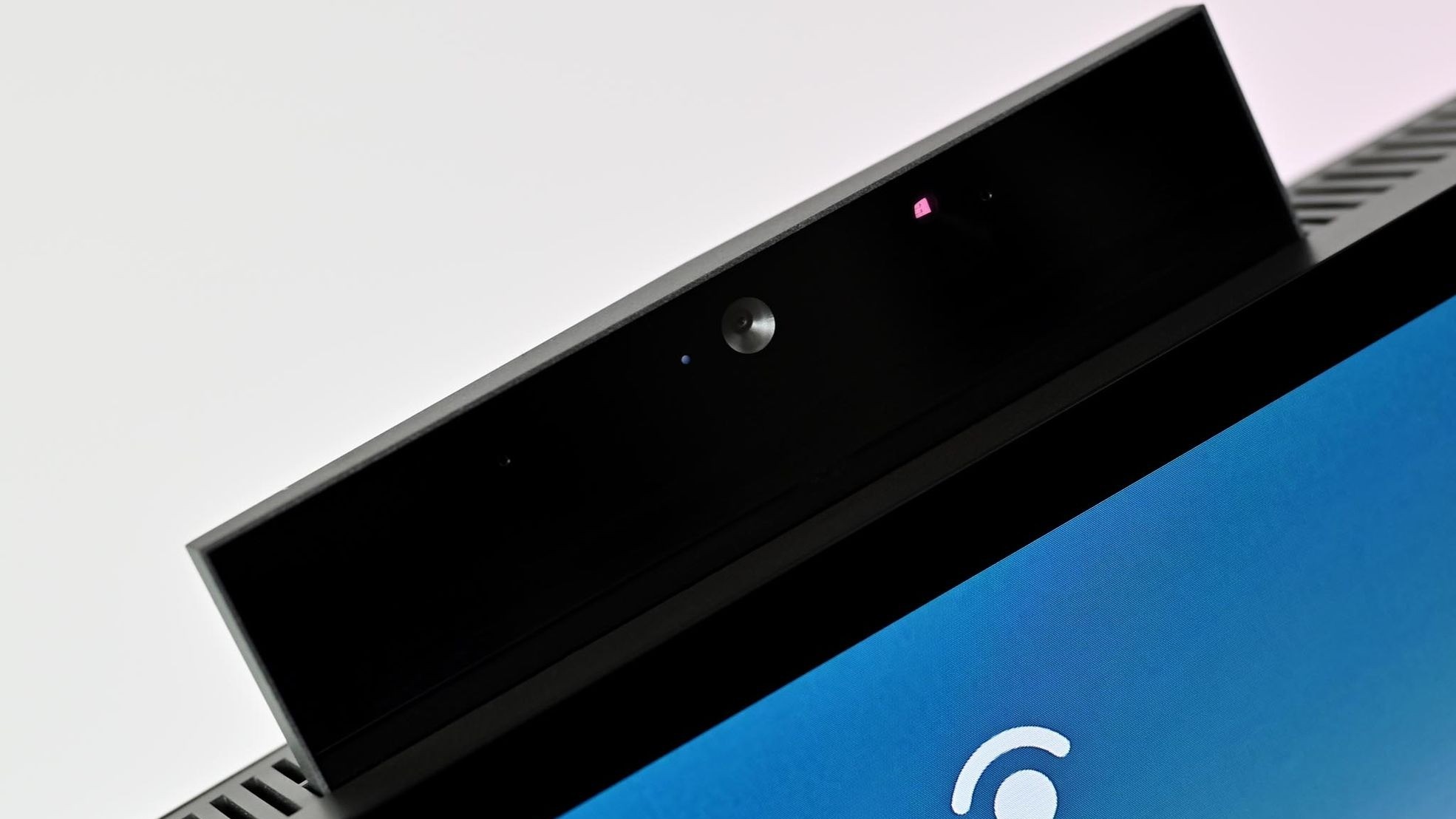
A pop-up webcam in a Windows all-in-one PC that also supports Windows Hello facial recognition. (Image credit: Future)
Before the Enhanced Sign-in Security feature was introduced, Windows Hello had already replaced passwords with a much stronger authentication model.
Instead of storing passwords that can be stolen or reused, Windows Hello creates cryptographic credentials that are attached to the Trusted Platform Module (TPM) available on your computer. Facial recognition and fingerprints are used only to unlock those credentials, and your biometric templates remain on the device rather than being uploaded to Microsoft's servers.
For the average home user, that already provides excellent protection against phishing, password reuse, and stolen credentials.
The Enhanced Sign-in Security feature doesn't replace the architecture already in place. Instead, it builds another layer on top of it.
The real difference is where the trust is placed
This is where the comparison becomes interesting. Using the standard Windows Hello, the operating system relies on the system to process biometric authentication after receiving data from the trusted sensor. Enhanced Sign-in Security moves much of that work into isolated, hardware-protected environments.
When using the Enhanced Sign-in Security feature, Microsoft improves that trust. Instead of allowing sensitive biometric operations to occur in the normal Windows environment, the feature isolates them using Virtualization-Based Security (VBS) and Trusted Platform Module (TPM) 2.0 technology.
The algorithms for facial recognition run in a protected memory region, secure fingerprint readers perform matching within the hardware itself, and communication between the biometric sensor and the operating system is encrypted and isolated.
In other words, Windows Hello protects your credentials, and Windows Hello Enhanced Sign-in Security protects both your credentials and the path your biometric data takes before Windows 11 authenticates you.
Fingerprints show the biggest difference
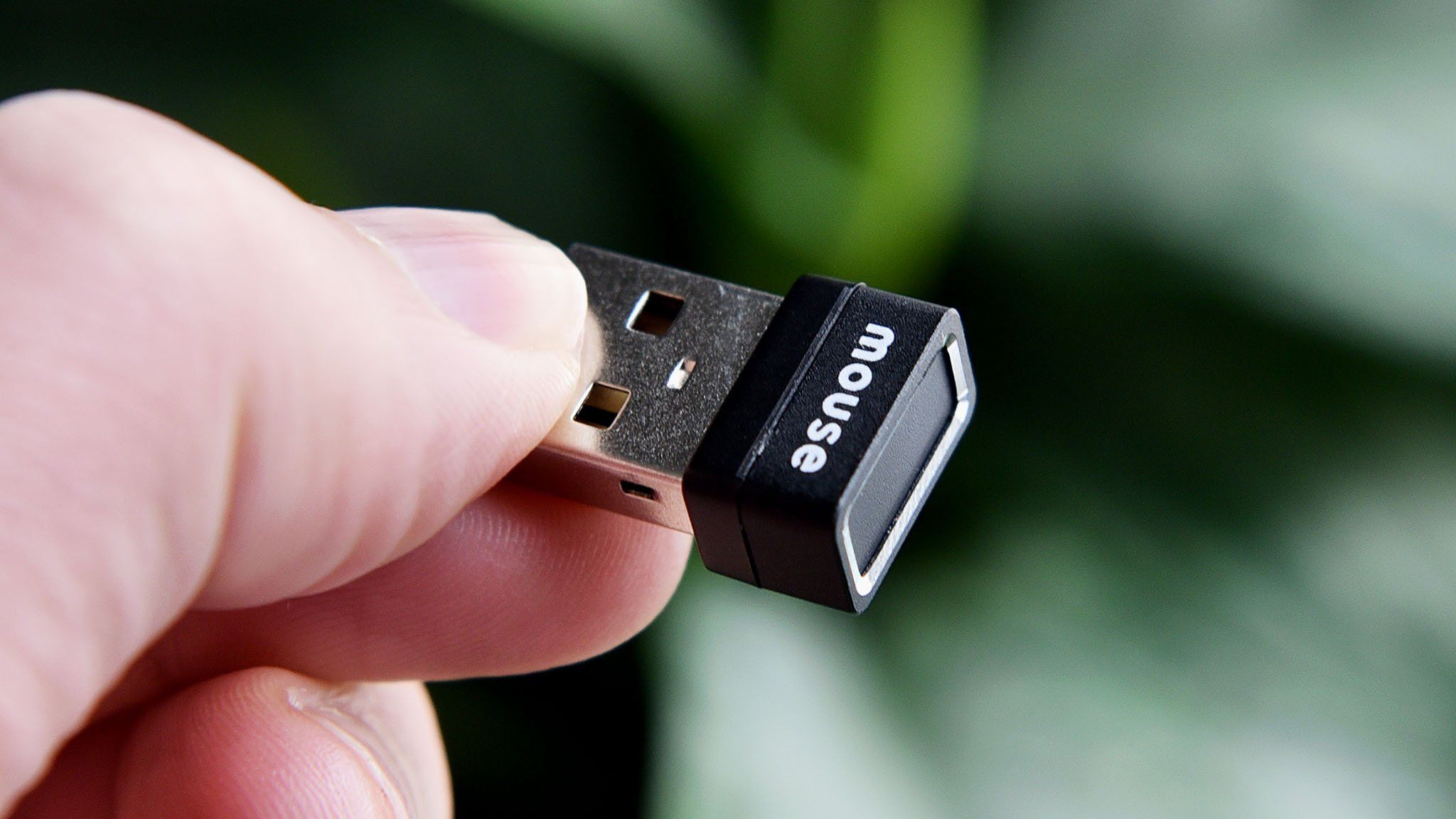
An example of an external fingerprint reader for Windows Hello and Windows PCs.
The August 2026 Security Update highlights the biggest architectural difference between standard Windows Hello and Enhanced Sign-in Security.
Using a standard Windows Hello fingerprint reader, the sensor captures your fingerprint, and Windows 11 verifies it securely using the operating system and TPM-backed credentials.
An ESS-compatible fingerprint reader moves more of that process into the hardware itself. These readers include a dedicated secure processor,store fingerprint templates inside the device, contain a Microsoft-issued certificate that proves they're trusted hardware, and establish an encrypted communication channel with the operating system. Instead of receiving raw biometric data, Windows 11 receives only the authentication result.
Microsoft hasn't explained why ESS still doesn't support external Windows Hello cameras (likely because USB can be a vector for attack). However, its support page shows that enhanced security for facial recognition relies on specific camera hardware, firmware, and protected memory through Virtualization-Based Security (VBS), whereas ESS fingerprint readers can perform biometric matching inside certified hardware. That architectural difference may explain why Microsoft expanded support for external fingerprint readers first.
The practical benefit is a smaller attack surface. In simple terms, even if malware gains elevated privileges, it has fewer ways to interfere with the biometric authentication process.
Should you enable Enhanced Sign-in Security?
If your computer doesn't support Enhanced Sign-in Security, there's no reason to worry. The standard security of Windows Hello remains one of the strongest consumer authentication systems available, and it's already a significant upgrade over passwords.
However, if your device includes Enhanced Sign-in Security-compatible hardware, or you're planning to buy a new external fingerprint reader that supports the feature, I'd recommend enabling it and leaving it on.
Not because Windows Hello suddenly became insecure, but because the enhanced option can add an extra layer of security. If your hardware supports it, there's little downside to leaving it enabled.
How to enable the enhanced security feature
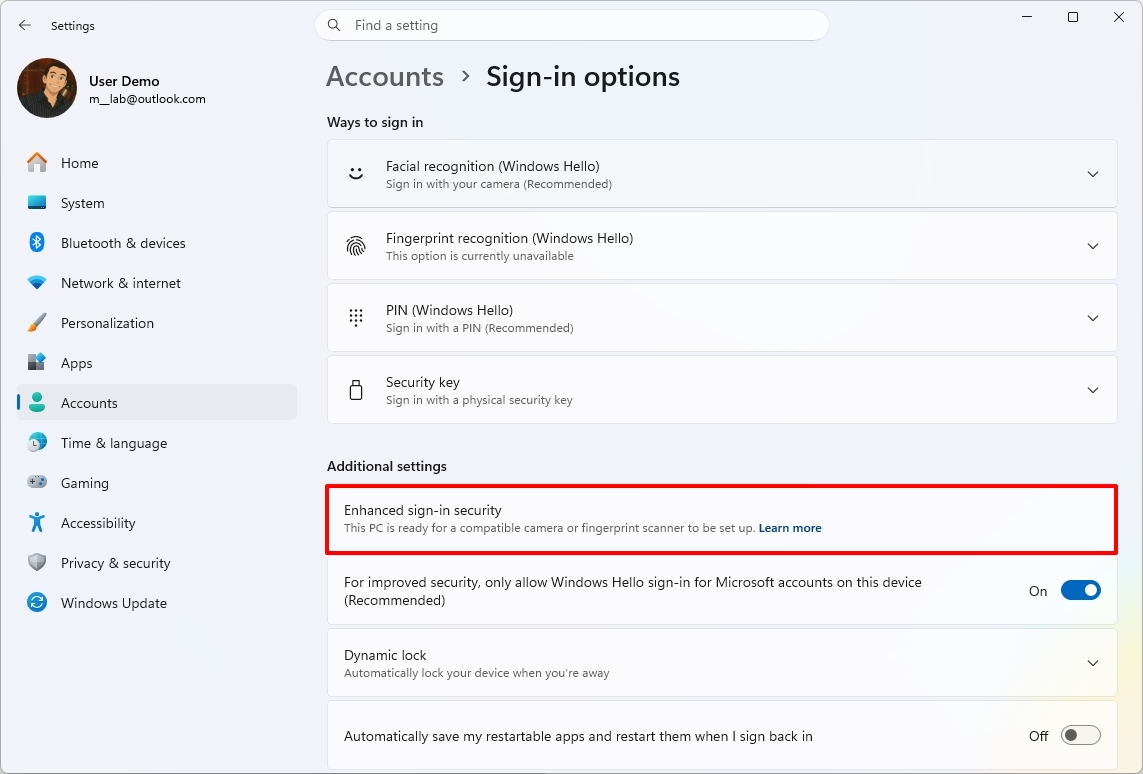
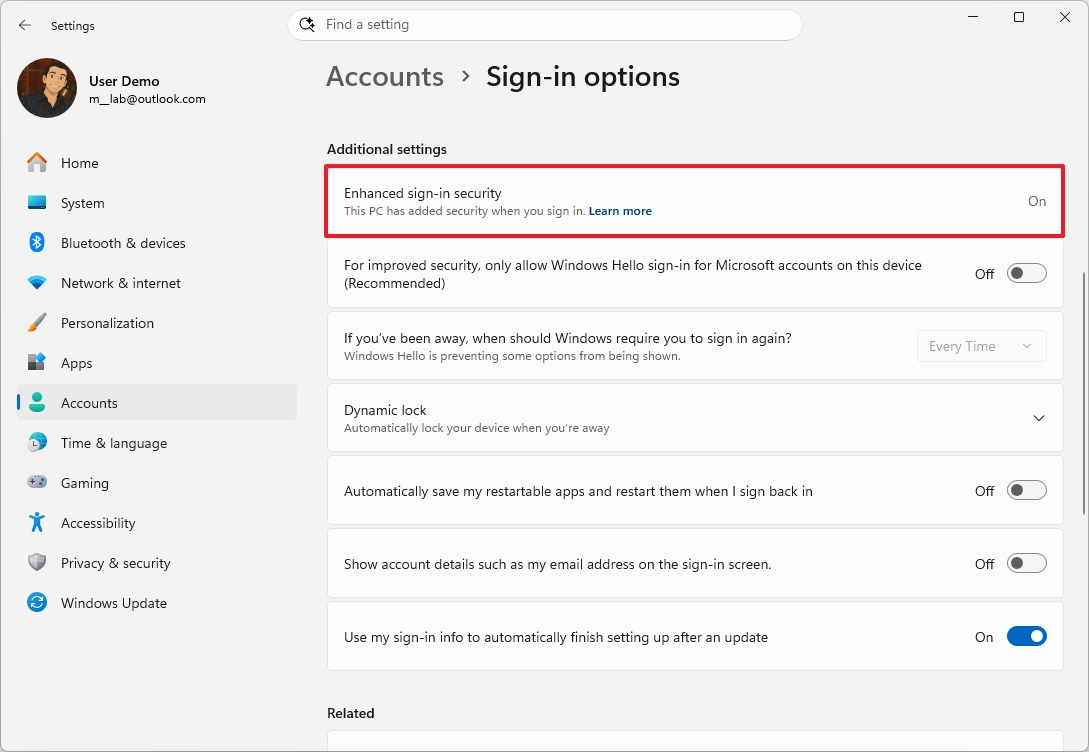
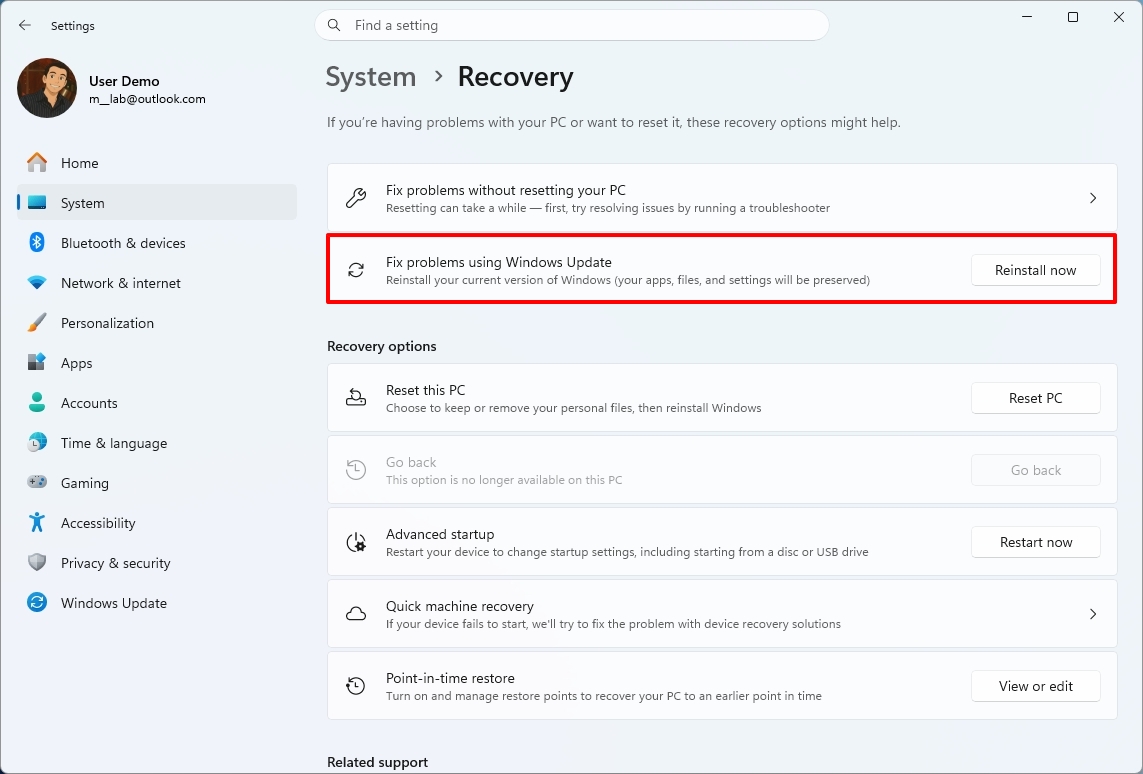
If the feature is available for your Windows Hello-compatible authentication device, you can enable it by going to Settings > Accounts > Sign-in options.
Once the USB fingerprint reader is connected and recognized by the operating system, on this page, under the "Additional settings" section, check the state of the "Enhanced sign-in security" setting.
If your system wasn't previously running ESS, you may see a prompt showing "Pending set up" or "Update PIN."
(Image credit: Mauro Huculak)
If the "Update PIN" option shows up, use it to complete the setup. On the other hand, if you see the "Pending set up" option, then configure the "Fingerprint recognition" feature under the "Ways to sign in" section.
One important note. When upgrading your system to Enhanced Sign-in Security, Windows 11 will remove any existing non-ESS biometric enrollments and associated credentials to ensure a clean, secure environment. You will need to refresh your PIN and register your fingerprints again using the new sensor. Once complete, the ESS toggle will show as enabled.
Also, while the feature is turned on, you won't be able to use peripherals that do not support the security feature.
Windows Central's Take
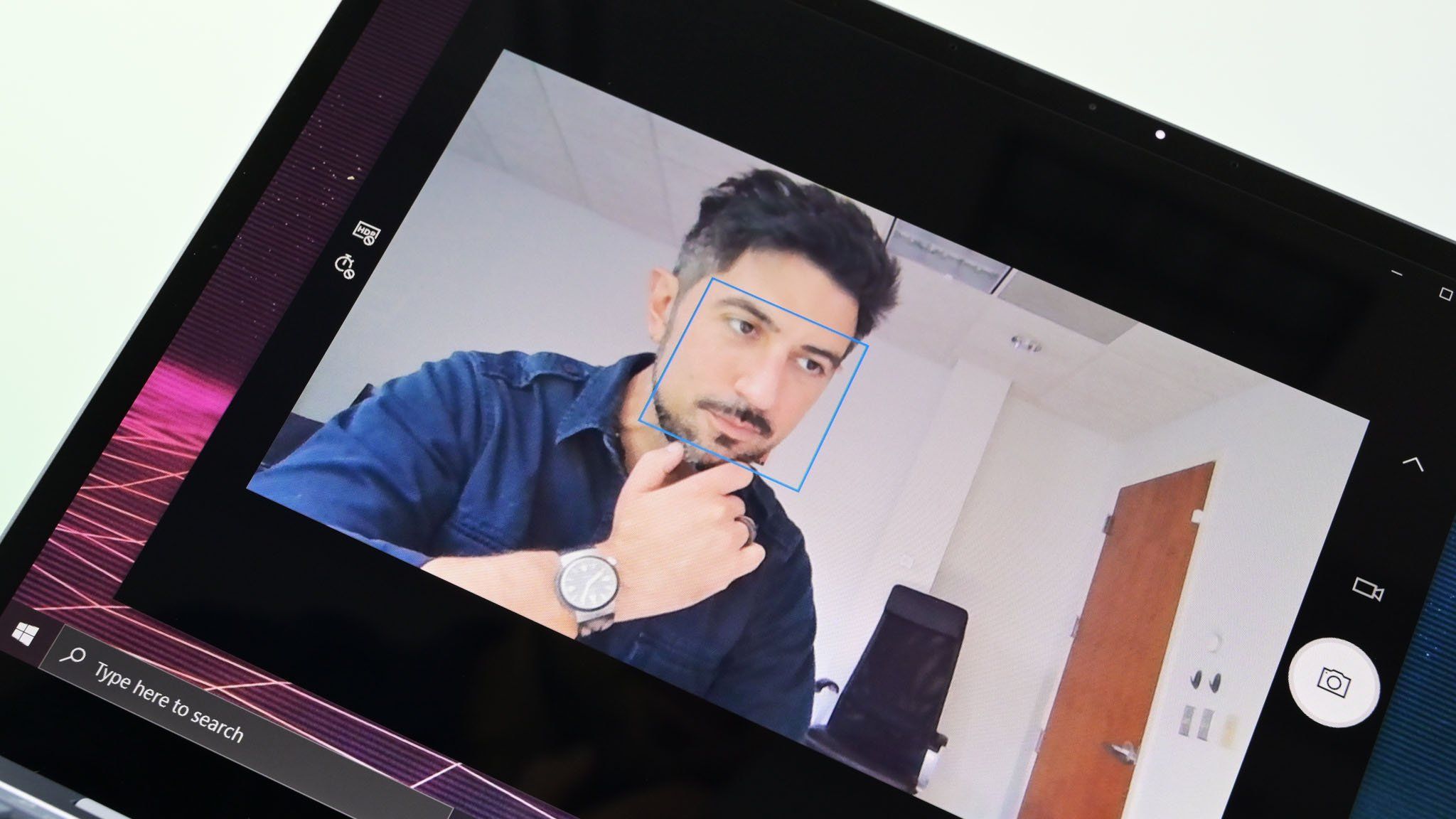
Windows Hello, web cam, and the Surface Pro PC. (Image credit: Daniel Rubino / Windows Central)
Microsoft hasn't done itself any favors with the name "Enhanced Sign-in Security." It sounds like an entirely new authentication system, when in reality it's an evolution of Windows Hello that strengthens how biometric authentication is processed behind the scenes. A lot of users will never notice the difference because the sign-in experience is exactly the same.
What makes the August 2026 Security Update important isn't that Windows Hello suddenly became more secure, as the standard Windows Hello has long been one of the strongest authentication systems available on consumer devices. The real significance is that the company is lifting the limitations by adding support for compatible external fingerprint readers.
If your computer already supports Enhanced Sign-in Security, I'd leave it enabled. If it doesn't, I wouldn't replace perfectly good hardware to get the feature because standard Windows Hello is already an excellent authentication system. However, if you're buying a new fingerprint reader for your computer, choosing an Enhanced Sign-in Security-compatible model is the better long-term investment since Microsoft is clearly expanding support for that ecosystem.
Do you think Enhanced Sign-in Security is worth using, or is standard Windows Hello already enough for your needs? Let me know in the comments.
More resources
Explore more in-depth how-to guides, troubleshooting advice, and essential tips to get the most out of Windows 11 and 10. Start browsing here:
My mom hated Windows 8. That's an understatement; she despised it. Like so many others who had grown used to the Start menu and general interface of previous versions, Windows 8 came as a jarring change to my mom.
But a funny thing happened when Windows 10 came out; my mom was reluctant to upgrade. Despite hating Windows 8 and Windows 8.1, she had grown used to them and made them fit her workflow. Having to relearn yet another interface was extra work that my mom was slow to sign up for.
She eventually upgraded to Windows 10 and later Windows 11, but her experience and her frustrations were not unique. Sometimes the enemy you know is better than the one you don't, even if you got to know that enemy begrudingly.
So, what does this have to do with Windows 11? Windows 11's upcoming Patch Tuesday update has a feature that I believe will elicit a similar reaction to my mom being presented with Windows 10.
Starting next month, Windows 11's File Explorer will show file sizes using the appropriate units (KB, MB, and GB). That means you'll no longer see a file that's 1,500,000 KB. Instead, you'll see that file listed as 1.5GB.
I believe many will see this change as an improvement. Dealing with millions of KB can be awkward, especially when other parts of Windows use different units. But part of me would love the option to keep everything in KB.
Because File Explorer has stuck with KB for so long, I've gotten used to scanning file sizes based on how many digits they are. After next month's update, I could have a file that's 400KB right between files that are 400MB. While the larger files would be clearly labeled, I've learned to expect files listed in KB after years of use, so there will be a learning curve.
I'm curious how people feel about these types of changes. Do you embrace what Microsoft deems an improvement to Windows 11, or are you frustrated with a feature or layout you're familiar with being changed?
Microsoft could always keep options for legacy features and new options, but if that happens for decades, you end up with a bloated OS. Take a look at the soon-to-be revamped context menus of Windows 11 if you want to see what years of tacking things on does to an operating system.
Join us on Reddit at r/WindowsCentral to share your insights and discuss our latest news, reviews, and more.
Windows chief Pavan Davuluri has posted an article on X today that outlines the journey Microsoft has taken so far to fix and improve Windows 11. Since March, the company has been laser focused on addressing Windows 11's biggest issues, delivering many new features and changes that are designed to improve the reputation and experiences around Windows.
While that work is still ongoing, Davuluri has now outlined four new areas of focus that Microsoft will be working on for Windows 11 between now and the end of the year:
Onboarding and setup. Delivering a faster and more efficient out-of-box experience.
Memory optimization for 8GB and above. Reducing Windows memory footprint to deliver a fast and responsive Windows experience across the PCs customers use every day.
Family. Providing a faster set up and making it easier for families to access useful parental controls.
Voice. Making voice more natural and fluid to interact across the apps you use every day.
Microsoft has confirmed that it's planning to improve Windows 11 so that it runs better on PCs with just 8GB of RAM. MacBook Neo took the world by storm earlier this year, and while Windows OEMs have since stepped up to offer better value for money, Windows itself is still quite heavy on these limited memory devices.
The company is now working to reduce Windows 11's memory footprint, ensuring that the OS feels fast and responsive even on 8GB RAM. It's yet to dive into how it's planning to make these changes, but it's likely related to how the company is moving more areas of the Windows UI to WinUI, which is lighter than WebView.
"We're going to take everything we've learned since March and keep listening and closing the loop on your feedback. The signal from you is clear: keep going. We intend to," says Davuluri.
Additionally, Microsoft has confirmed that it's rethinking the Windows out of box experience, with a new faster and more efficient set up experience in the works that will make booting up a new PC for the first time seamless and straight forward.
The other two areas of focus are Family and Voice. The company says it's working to deliver new Family Safety features across the OS, including enhanced parental control setup and more.
Voice is the final area of focus. Microsoft is on record as stating the future of computing will be one that is multi-modal, with voice acting as a primary input method alongside the keyboard and mouse. The company intends to make voice input more natural and fluid across the OS and apps you use.
Microsoft is clearly very proud of the work it has done so far this year to fix Windows 11. Compared to late last year, Windows 11 is in a very different spot. The company has delivered genuinely meaningful improvements and changes that are already impacting the OS for the better, and it sounds like there's more to come soon.
Join us on Reddit at r/WindowsCentral to share your insights and discuss our latest news, reviews, and more.
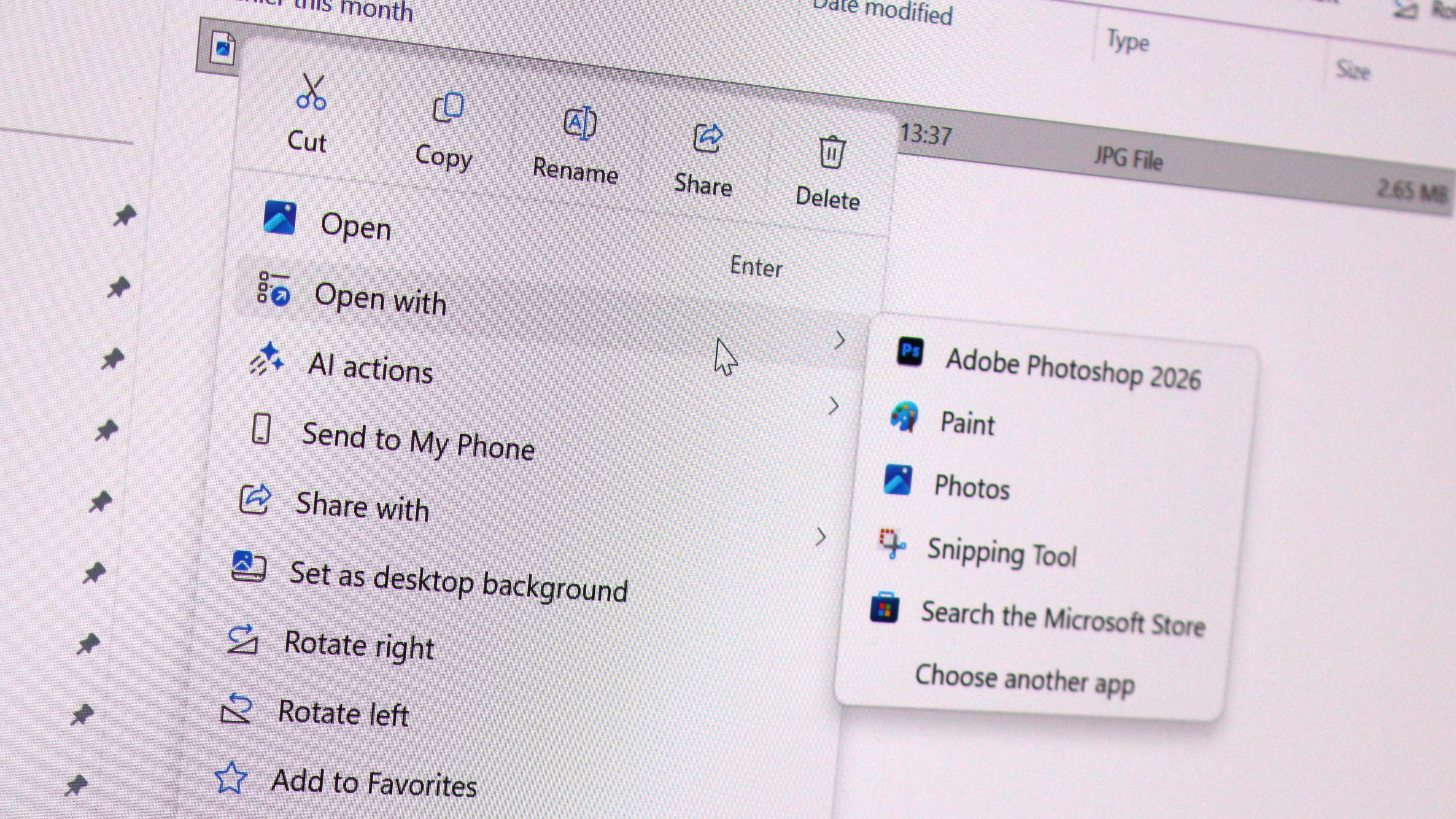
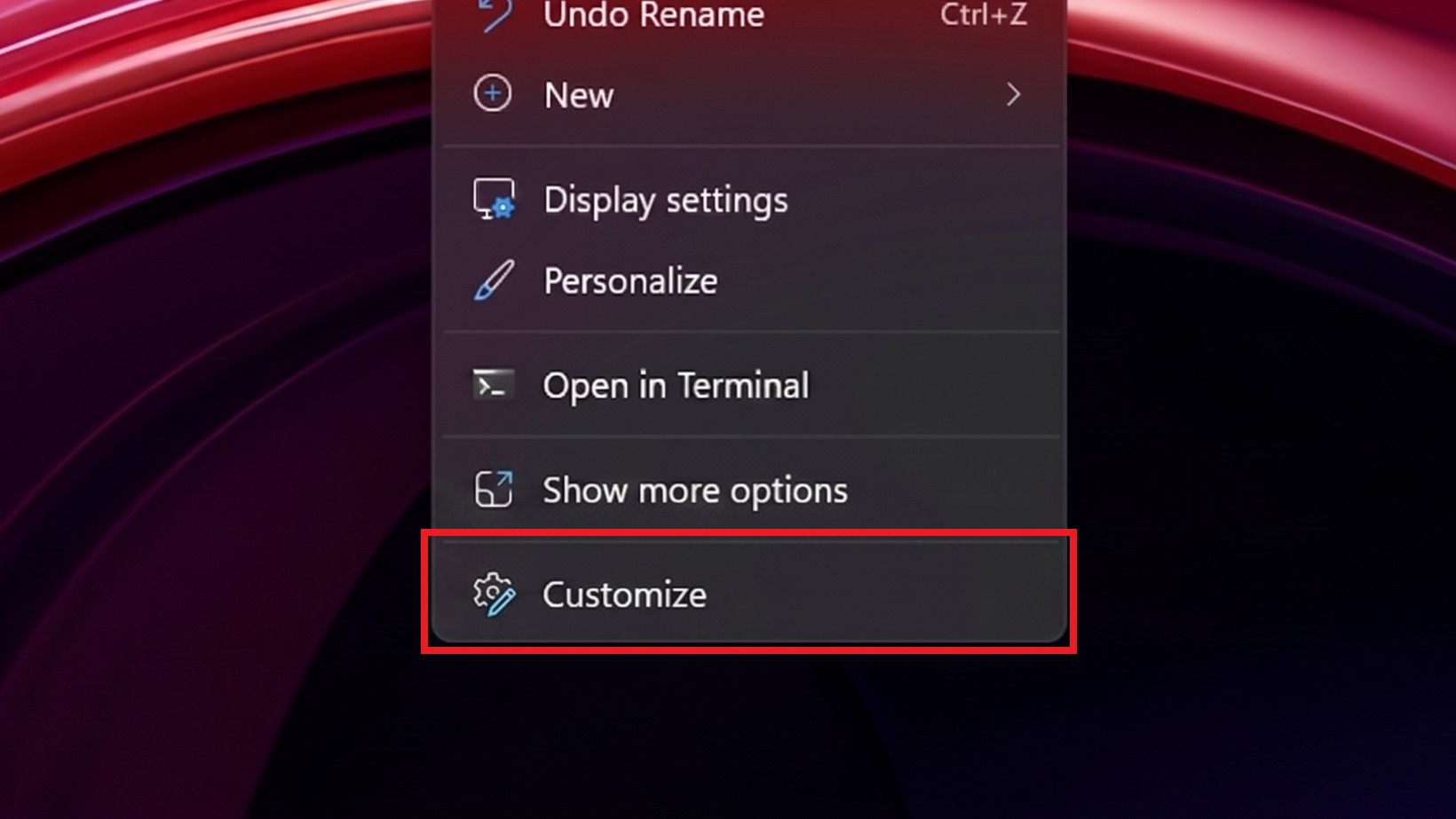
Microsoft is working on a major overhaul to the context menu system on Windows 11 that is designed to fix performance and reliability issues by allowing users to customize what appears within the right-click menu across the system. The company is also working on a new compact menu design that will be faster to open and interact with.
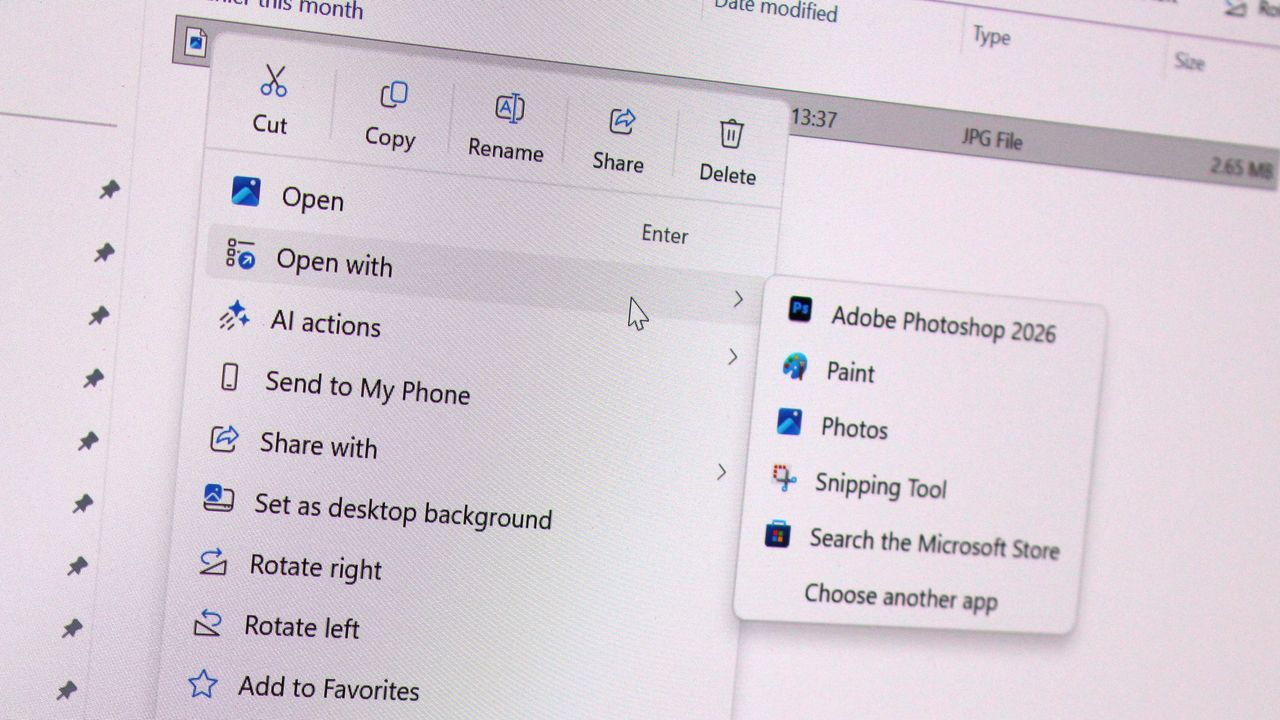
One of Windows 11's more frustrating problems currently is how cluttered the modern context menus have become. Since Windows 11's debut, context menus have become bloated and overburdened by apps and actions from both Microsoft and third-party developers, which can add themselves into the context menu without user input.
This has resulted in the context menu being very slow to initiate, often taking a second or two to appear when the user right-clicks in File Explorer on a system with many apps installed and actions available. According to sources familiar with Microsoft's plans, the company is working on a new compact context menu design to fix this, that prioritizes the most common actions above everything else.
This new compact menu will be much faster and more reliable, as it foregoes needing to load in all the third-party actions that slow it down currently. Additionally, at the Windows Insider Meetup in London, Microsoft showed me a new context menu customization feature coming soon that will let users configure what apps and actions appear in the right-click menu.
The option to customize the context menu will be added. (mockup) (Image credit: Windows Central)
Users will be able to show and hide actions and apps, as well as change the order in which these actions and apps show within the right-click menu. The menu will include a new "customize" option at the very bottom which can be accessed at any point to begin changing the menu options.
These changes are part of Microsoft's larger effort to fix Windows 11's biggest problems and issues under the Windows K2 initiative, which has been ongoing since last year. The company has confirmed plans to move more areas of the Windows system over to WinUI for consistency and performance reasons, with areas like File Explorer file properties and the Start menu getting the WinUI treatment soon.
Context menus are already powered by WinUI, and these new improvements that are currently in the works are designed to speed up the menus so that they are instantly responsive whenever you right-click within File Explorer, the desktop, or other native Windows UI interfaces.
It's unclear when these context menu updates are set to be announced, but the demo I saw a few weeks back was real working code and relatively polished, so I suspect we'll see an official announcement about these changes in the near future. I expect Microsoft is hoping to get these improvements out the door before the end of the year.
Join us on Reddit at r/WindowsCentral to share your insights and discuss our latest news, reviews, and more.
Windows 11 context menu
Cluttered context menus will soon be a thing of the past.
The Windows vs. Linux debate usually starts with the same arguments. Linux users point to freedom, customization, and control. Windows users point to compatibility, software support, and the fact that things generally work without much effort.
However, a recent discussion on Reddit about Windows 11 caught my attention because it challenged one of the biggest assumptions in that debate, which is that anyone with deep Linux experience would automatically reject Windows.
The original poster was not someone casually experimenting with another operating system. He grew up using Linux, started with a Raspberry Pi, spent years using Linux as his primary desktop platform, and understood the Unix ecosystem well. After switching his main device to Windows 11, however, his conclusion was far more balanced than the usual online arguments.
He found that Windows 11 wasn't perfect, but it worked better for his needs. That's probably the biggest takeaway from the discussion. People often choose an operating system based less on personal preference and more on whether it helps them get things done.
A Linux user switched to Windows 11 for practical reasons
(Image credit: Daniel Rubino / Windows Central)
On Reddit, the user explained that compatibility with apps like Microsoft Office and Autodesk software played a major role in the switch. While Linux has excellent alternatives and compatibility layers, native support remains one of the biggest advantages.
The user also explained that tools like MSYS2 helped bridge the gap by bringing a more familiar Unix-like environment to Windows 11.
"I like to consider myself a practical person - I'm making this decision based on the os which works for my workflow and the tools I need to use, not based on idealism / dislike for Microsoft's practices," said @Puzzleheaded-Sky2284.
The comment highlights something that often gets lost in operating system debates. A lot of people aren't choosing an operating system to defend a company or community. They choose the platform that best supports their work, and for developers, creators, gamers, and professionals, compatibility often matters more than personal preference.
Windows 11 has improved, but Microsoft remains the controversial part
One of the interesting themes in the discussion was that many users separated Windows 11 itself from Microsoft's decisions around the operating system.
One commenter with professional experience managing Windows environments argued that Microsoft has solved many long-standing problems around fragmentation, updates, and compatibility.
"On good hardware - Windows simply works," @ChampionshipComplex noted.
Unlike operating systems designed for a limited range of hardware, Windows has to support thousands of hardware configurations, countless drivers, and decades of applications. That complexity is messy, but it's also one of the biggest strengths.
Another commenter (@TheTerraKotKun) shared a similar view: "Windows 11 is good OS but Microsoft as a company... I don't think that it's really good."
This may actually represent where many experienced users are today. The complaint is often not that Windows 11 cannot do the job. The complaint is about Microsoft's direction, including advertisements, online account requirements, and increased integration of cloud services and AI.
Critics still have valid complaints about Windows 11
(Image credit: Future | Edited with Gemini)
The discussion wasn't entirely positive. Some users argued that Windows 11 still has problems, particularly around resource usage, user control, and Microsoft's approach to the desktop experience.
A common criticism is that Windows has become more focused on promoting Microsoft services instead of remaining a neutral operating system.
One commenter (@Pale-Muscle-7118) explained: "My main problem is not really with the software or OS itself but with Microsoft behind it."
That's an important distinction because Windows 11 can be a capable operating system while Microsoft continues making decisions that many users dislike.
It's also worth noting that Microsoft has acknowledged many of these pain points. Through its Windows K2 initiative, the company has been focusing on improving performance, reliability, and the overall user experience while scaling back some of the interface decisions that have drawn criticism.
Linux still offers something Windows cannot replace
CLI: for people who hate clicking things. (Image credit: Windows Central)
The discussion also highlighted why many people continue using Linux, which is because it provides a level of control that Windows simply does not.
Users can choose different distributions, desktop environments, window managers, package systems, and customization options. For people who enjoy controlling every part of their computing environment, Linux remains extremely attractive.
However, that flexibility can also create challenges. The original poster pointed out that fragmentation can make Linux harder for some users: "Linux is great (as is Windows), but many members of the community are... not so great."
He wasn't criticizing Linux itself. Instead, he argued that the Linux desktop ecosystem often requires more research, troubleshooting, and decision-making than, in this case, Windows 11. For some users, that's part of the appeal. For others, it's a barrier.
The real debate is not about winners and losers
The biggest takeaway from this Reddit discussion is that the Windows vs. Linux argument is often framed incorrectly, because there is no universal winner.
The discussion shows why the Windows versus Linux debate rarely has a clear winner. Every operating system involves tradeoffs. Linux gives users more control and flexibility, while Windows prioritizes compatibility and broad software support. The right choice depends less on which platform is objectively better and more on which one fits the way you work.
Even users who criticize Microsoft often continue using Windows because it solves practical problems.
As one commenter (@animalcrossing4_4) summarized: "The OS is a means to an end so stop shoving the holiness of some OS on me."
That may be the most accurate description of the entire debate.
An operating system is a tool. The best one is not necessarily the one with the most features, the most customization, or the strongest community.
It's the one that lets people spend less time fighting their computer and more time using it.
Windows Central's Take
The 2026 ASUS Zenbook A16 laptop featuring the new Qualcomm Snapdragon X2 Elite Extreme processor. It can't run Linux. (Image credit: Daniel Rubino | Windows Central)
This particular Reddit discussion isn't about Windows 11 suddenly winning over Linux users. However, it does reinforce something I've believed for a long time, which is that most people eventually end up with the operating system that helps them get their work done with the fewest compromises. That's why Windows continues to dominate the desktop despite Microsoft's occasional missteps.
Over the years, Microsoft has improved Windows where it matters most, including stability, hardware compatibility, and the developer experience with WSL and Winget. At the same time, the company has also made decisions that frustrate users, such as adding promotional content and pushing more Microsoft services (and AI) throughout the operating system.
Those criticisms are fair, but they don't necessarily outweigh the biggest advantage of an operating system that runs virtually on any modest hardware.
I always think it's interesting to find someone who sees Windows without treating the Windows versus Linux debate like a competition. Every operating system has strengths and weaknesses, and the right choice depends on your workflow, not on loyalty to a particular platform.
If Windows 11 helps you spend less time troubleshooting and more time being productive, then it's doing exactly what an operating system is supposed to do.
What do you think? Have you switched between Windows and Linux, or are you sticking with Windows 11? Let me know in the comments.
More resources
Explore more in-depth how-to guides, troubleshooting advice, and essential tips to get the most out of Windows 11 and 10. Start browsing here:
I've installed various versions of Windows more times than is probably necessary, across hundreds of laptops and desktop PCs that I've built, tested, and reviewed. Even if I narrow it down to Windows 11 alone, I reset devices back to a clean install practically every week, so I've built up a collection of useful commands and shortcuts.
For the most part, they aren't particularly innovative, and some won't even be surprising to enthusiasts, but they're definitely useful in my day-to-day experiences with Microsoft's operating system. Whether you consider yourself anything from a casual PC user to a service-hardened admin, you'll find at least some of these as useful as I do.
And, as with absolutely anything regarding commands copied and pasted into Command Prompt, PowerShell, or any other kind of terminal, you should always practice sensible backups and data protection habits. Keep your most important files in multiple places where possible, and only run high-level commands if you're a confident PC user — though I promise to explain what they all do.
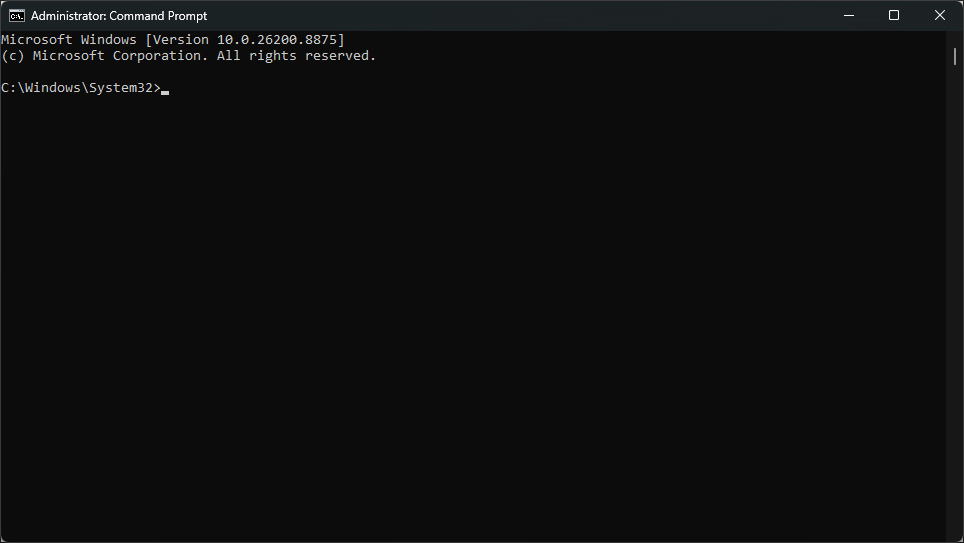
Press Shift + F10 during Setup to open Command Prompt
There is a little quirk to this one, though. When the Command Prompt window first opens, you'll probably see a flashing caret that suggests you can type, but you'll often (if not always) find that your keyboard inputs are ignored. By default, the Command Prompt window isn't focused, so you'll need to either use a connected mouse to click it or press Alt + Tab if you only have a keyboard.
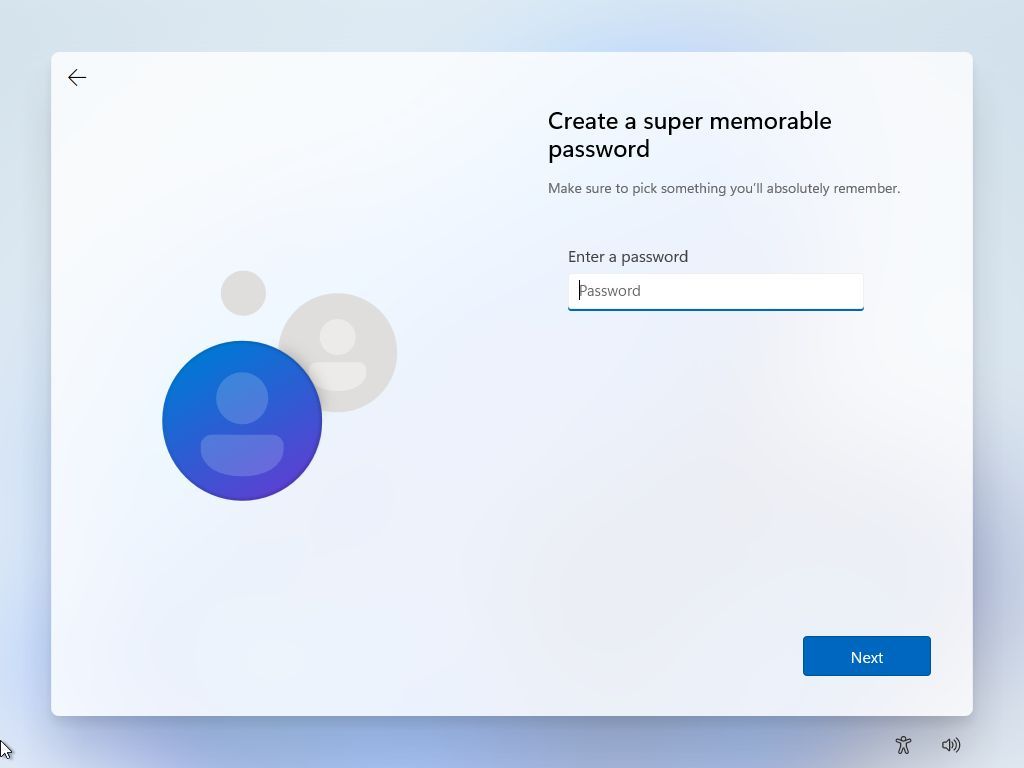
Create a local account
(Image credit: Mauro Huculak)
Because I test so many PCs, I certainly don't want to sign into absolutely all of them with my personal Microsoft account. Unfortunately, the options to use a local account are becoming more limited as workarounds are removed, but my preferred Windows 11 ISO (disc image) still works with this method.
Shift + F10 opens Command Prompt
Enter this command: start ms-cxh:localonly
Create a user (passwords are optional)
Bingo. Some apps will still ask you to sign in, and when they do, you'll need to make sure Windows doesn't try to "automatically sign in to all desktop apps." If you're ever prompted with that request, respond with the closest equivalent of "no, sign in to this app only".
Checking battery health
(Image credit: Ben Wilson | Windows Central)
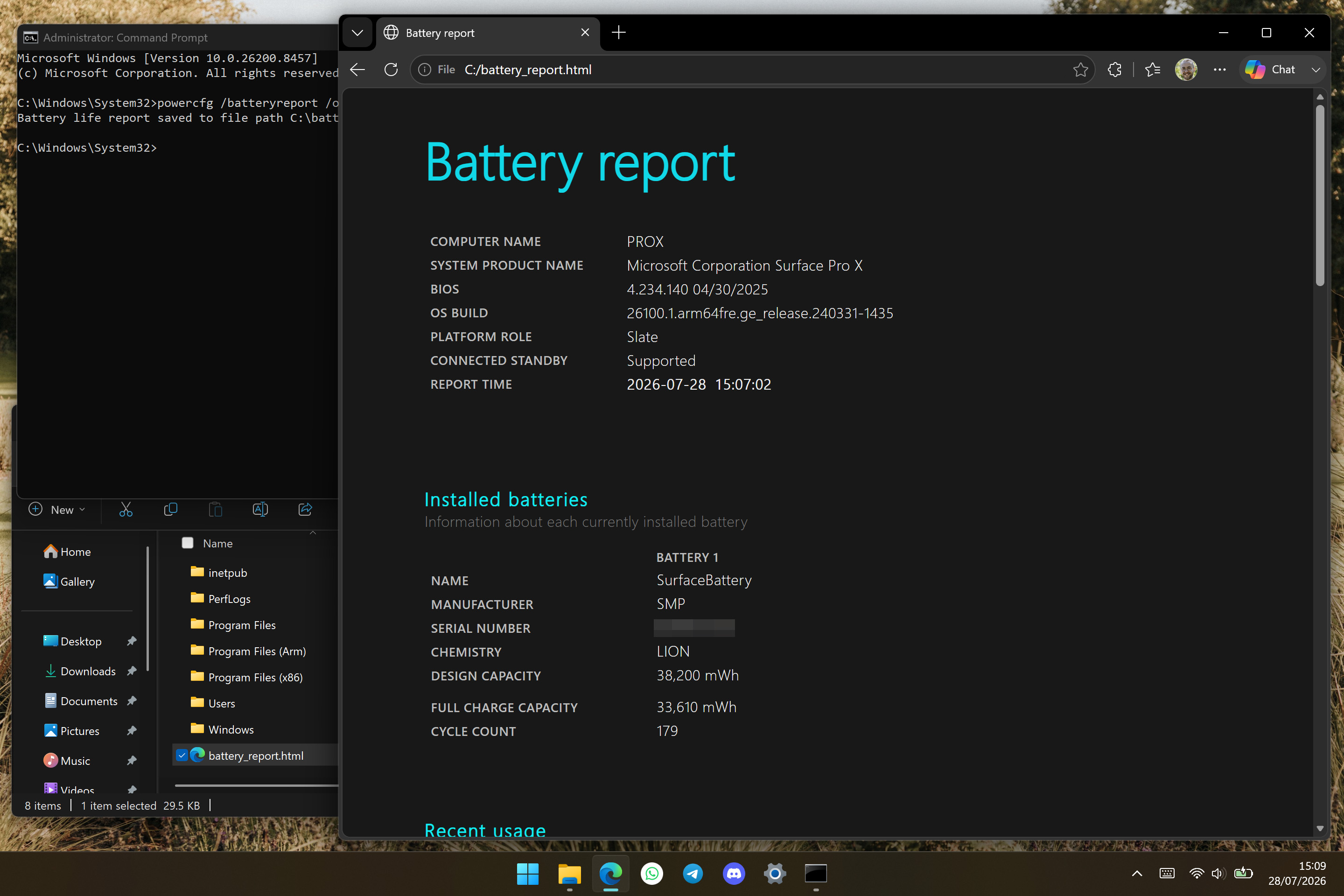
This one is slightly more niche because it's primarily about how I test battery life on sample laptops. Still, checking your battery health also has a convenient crossover for anyone who might pick up a refurbished or pre-owned model, and seeing your battery cycle count alongside its design capacity is just plain useful.
Open the Start menu
Find CMD (Command Prompt) and Run as administrator
Enter this command: powercfg /batteryreport /output "C:\battery_report.html"
Find the generated file on your C: drive to see helpful details, such as battery life estimates near the bottom of the page, all based on how long your laptop lasted on each charge. I always like to generate one of these reports when I'm using a brand new laptop over a full week during a review. It's good stuff.
Faster Task Manager
(Image credit: Ben Wilson | Windows Central)
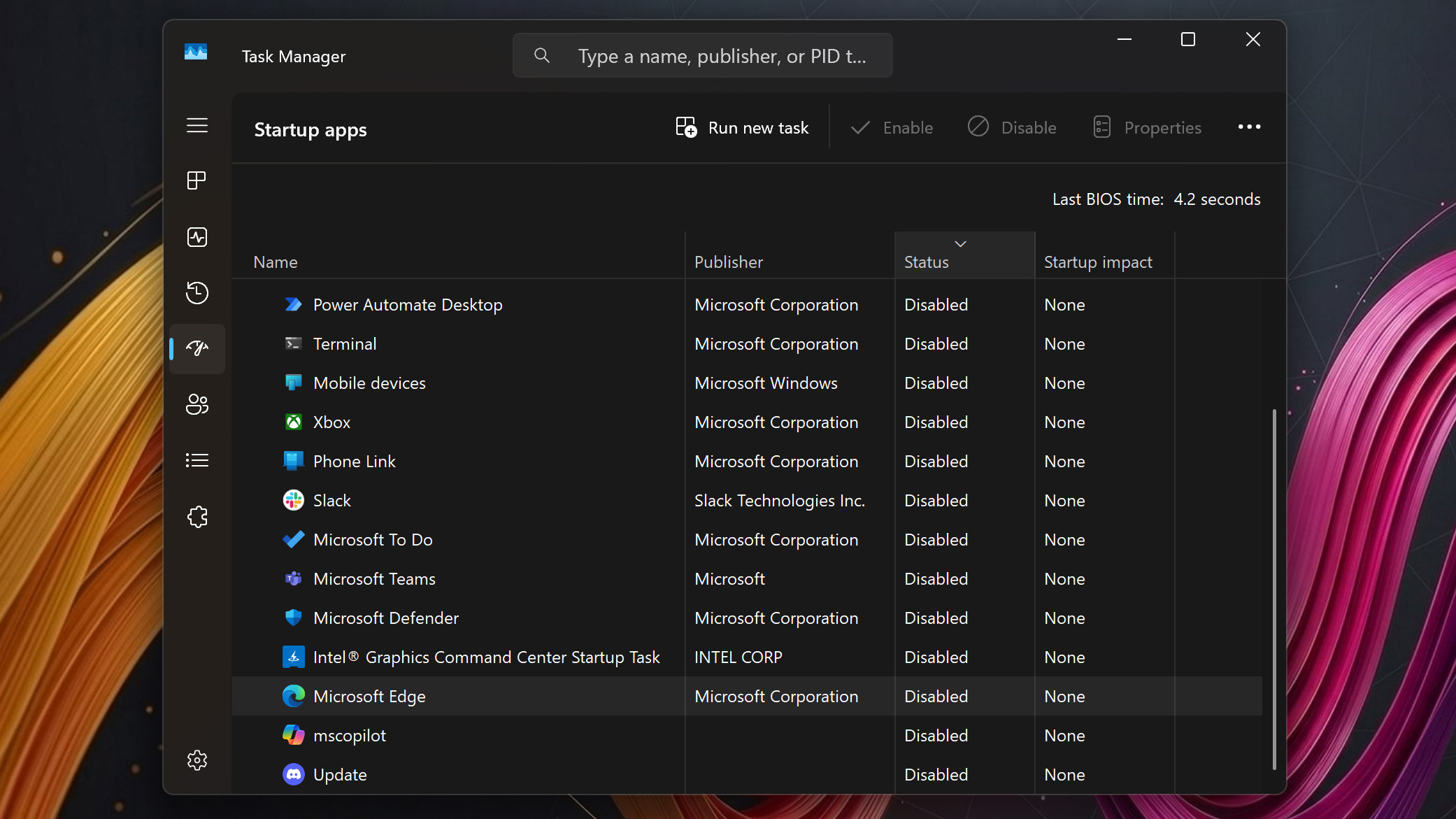
Now, if anything on this list is liable to pull ire in the comments, it'll be this one. Yes, I know that Task Manager is probably the most widely known feature of Windows, but plenty of people still think you need to press Ctrl + Alt + Delete to access it. However, there are two faster methods that I always use, depending on whether I'm using a keyboard or a mouse at the time.
Right-click the Taskbar and click Task Manager
(or) Press Ctrl + Shift + Esc to open Task Manager
The more interesting part of accessing the Task Manager is the reason for opening it on a brand new PC: disabling startup apps. On the left side, you'll find the dedicated category, which exposes any unwanted 'bloatware' that might have come pre-installed on your machine. If not, I usually disable msedge.exe (Microsoft Edge) anyway, because it doesn't seem to be necessary.
Clipboard history
(Image credit: Ben Wilson | Windows Central)
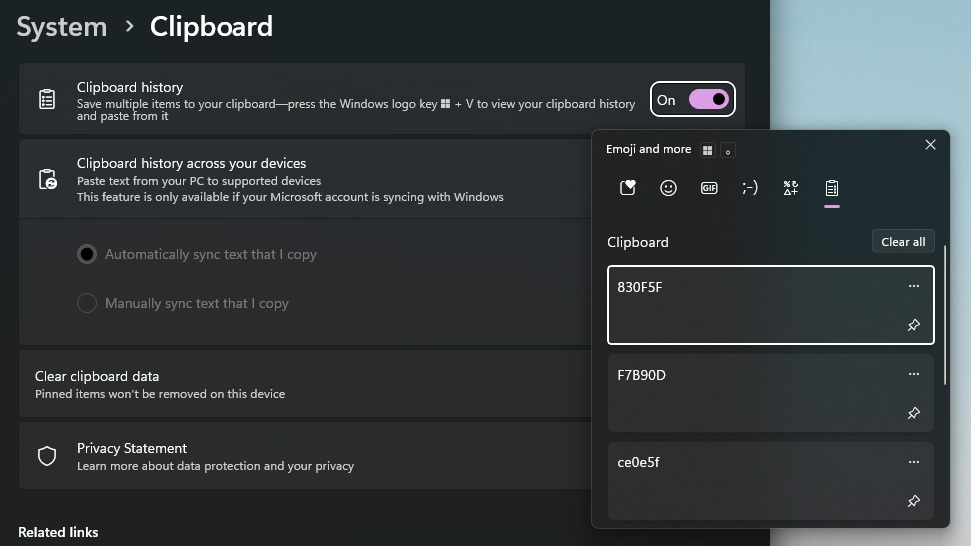
If you head to the Settings app and find System > Clipboard, you'll see the Clipboard history toggle, and I strongly recommend keeping it on. I'm constantly copying and pasting serial keys for licensed software, hex codes for colors, and all kinds of other jargon that happily sits in this pop-up list.
Press Windows + V to open Clipboard history
Alternatively, pressing Windows + . (the period key) takes you straight to the emoji picker, which is part of the same floating window as Clipboard history. You can start typing keywords and descriptors as soon as it appears, so finding a tiny laptop for your social posts (or anything else) is easy. 💻
Access your Desktop
(Image credit: Ben Wilson | Windows Central)
This is a surprising entry, as I assume everyone knows about both methods. Getting back to your desktop feels like an obvious one to learn, as minimizing individual apps is painfully inefficient. However, even my PC-building colleague Cale Hunt wasn't aware of the second one, and frankly, I don't remember when or how I figured it out.
Press Windows + D to access your Desktop
(or) Click the blank Taskbar space to the right of the clock
A third, lesser-known shortcut of Windows + , (the comma key) will briefly show your Desktop, but it disappears when you let go of the Windows key. I can't say I ever use that one, but I've been habitually clicking the blank space to the right of the "system tray" (now the clock and notifications area) for years. If I don't have a mouse, the first one works, and pressing it again restores my windows.
Moving off-screen apps on multiple monitors
(Image credit: Future)
Finally, I don't need this one as often as the others, but it's still a critical one to remember when I do. Sometimes, when I connect a second (or third) monitor to a desktop or laptop setup, the app I'm using will disappear from view. It's still technically active, but I just can't see it anymore. Thankfully, it's quite an easy fix if you remember this shortcut.
Press Windows + an arrow key to move the active app
The arrow key you press depends on how you've organized your screens, both physically and in alignment with what Windows 11 expects. For example, if you want an app to move to a display on your right side, press the right arrow key. If nothing moves around, try pressing Alt + Tab first to ensure your target app is in focus!
There's no doubt that each enthusiast will have their own favorites and likely views these entry-level commands as basic knowledge, but we all start somewhere. Sometimes it feels like muscle memory, but with Windows 11, there's so much going on that it's easy to forget some of the most useful shortcuts aren't as obvious to everyone!
Join us on Reddit at r/WindowsCentral to share your insights and discuss our latest news, reviews, and more.
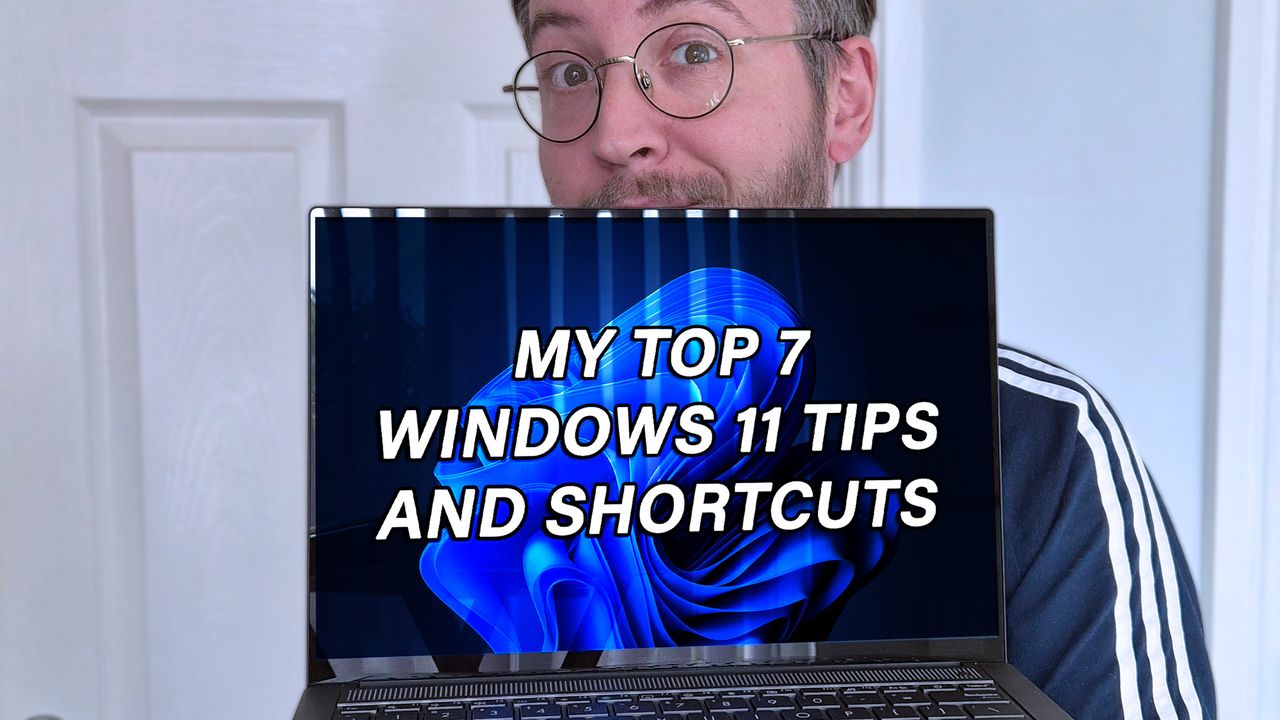
Ben Wilson of Windows Central holding a laptop with "MY TOP 7 WINDOWS 11 TIPS AND SHORTCUTS" displayed on the screen
Until they change, these are my current favorite tips for Windows 11 newcomers (and enthusiasts).
Windows Insiders have a new build of Windows 11 to install, and it comes with some exciting improvements for accessibility. The biggest change is to Voice Access, which can now isolate your voice to better control your PC while in a crowded room.
Voice Access allows you to control your PC with only your voice. Once you launch the feature, a dock appears and stays along the top of your screen. That bar shows commands as you enter them, which helps confirm what you've said to your computer.
At the moment, using Voice Access in a room with background noise can be tricky. But that will change with the update to Windows 11 that's now in testing. That upgrade is just the latest in a long string of accessibility improvements from Microsoft.
Microsoft and accessibility
Windows 10 added eye tracking in 2017. The feature lets you type with your eyes.
Microsoft has prioritized accessibility for a long time. It's genuinely one of the most endearing aspects of the company. Here are just a few of the Windows features and pieces of hardware we've covered over the past few years that are part of Microsoft's push to make technology more accessible.
Accessibility is about everyone. When Microsoft develops a feature or accessory with one type of user in mind, there's often a knock-on effect. For example, Read Aloud in Microsoft Edge makes PDFs more accessible, but it also improves reading comprehension and lets you multitask while hearing what's on your screen.
I use Read Aloud every day to proof read my articles. I find that listening as I read improves comprehension and helps me spot typos or other mistakes.
New and improved accessibility in Windows 11
The latest Windows Insider build includes several improvements to accessibility features. Voice Access now supports Voice Isolation, which filters out other speakers and background noise.
It's a small change that makes it possible to use Voice Access in a broader range of work environments. If you rely on Voice Access, a shared office can cause frustration.
Hybrid and in-office work often places colleagues too close to each other to use Voice Access. Voice Isolation allows someone who needs the feature to control a PC to work in the same space as their coworkers.
The same Insider build brings support for displays that use the HID (Human Interface Device) standard to Narrator. That standard enabled plug and play support for braille displays and is backed by Microsoft, Apple, and other tech giants.
Here's the change log for Windows 11 Insider Preview Build 29634.1000 that relates to accessibility.
Windows 11 Insider Preview Build 29634.1000
Voice Isolation in Voice Access
We’re introducing Voice Isolation, a new option in Voice Access that helps it focus on your voice, even when others are speaking nearby. Whether you’re in a shared office, an open floor plan, or at home with family around, Voice Isolation filters out other voices and background noise so Voice Access can better understand you. All processing happens privately on your device.
Getting started Voice Access now offers three speech recognition modes under Voice Access settings > Improve speech recognition:
Voice Isolation — Filters out other speakers and background noise (one-time voice setup required).
Remove background noise only — Filters out non-speech sounds like typing or door slams. No additional setup needed.
No filtering — Default microphone input with no additional processing.
To set up Voice Isolation, select it from the menu and follow the short, guided setup where you’ll read a brief paragraph aloud so Voice Access can learn your voice. It only takes a minute, and your voice data never leaves your device
Narrator
Braille displays now connect instantly with Narrator
We’re making refreshable braille displays easier to use in Windows. Narrator now supports displays that use the HID standard — an open industry standard for braille displays. If your display supports HID, simply connect it via USB and start reading — true plug-and-play with no additional setup required. For Bluetooth, pair your HID braille display in Settings > Bluetooth & devices just like any other accessory, and you can work wirelessly without being tethered to your PC.
Compatible HID displays include models like the Orbit Reader 20, Orbit Slate 340, Freedom Scientific Focus 40, and APH Mantis Q40.
HID braille displays now work during the initial Windows setup experience (OOBE) over USB — meaning users who are deaf-blind can set up their PC independently, right from the first screen. You can customize braille input and output options anytime in Settings > Accessibility > Narrator > Braille.
Join us on Reddit at r/WindowsCentral to share your insights and discuss our latest news, reviews, and more.
Microsoft is expected to release the Windows 11 August 2026 Security Update on Tuesday, August 11, 2026. In this eighth month of the year, the software giant is rolling out several new features, improvements for existing features, and fixes.
In this quality update, Microsoft will introduce new features, including Windows Hello Enhanced Sign-in Security (ESS) support, the ability to uninstall AI models from Copilot+ PCs, touchpad gestures, voice isolation for Voice Access, Fluid Dictation for Voice Typing, and more.
There are also improvements to File Explorer, Windows Search, Widgets, Windows Update, power and battery, sounds, and more.
Furthermore, Microsoft is updating the interface for the Account Control flyout in the Start menu, the Windows Setup experience now includes a parental controls notice, and the list continues.
In this guide, I'll highlight the most significant changes in the August 2026 Security Update for Windows 11 versions 25H2 and 24H2, since both are identical.
Windows 11's new features arriving in August
As usual, the company uses Controlled Feature Rollout (CFR) to roll out new improvements gradually, so it may take some time before you see them.
File Explorer changes
Although the updated version of File Explorer doesn't introduce flashy features, the development team is making some worthy improvements.
First, when using the "Details" view, the file sizes now show appropriate units (such as KB, MB, and GB), instead of displaying every value in kilobytes.
(Image credit: Mauro Huculak)
It's now possible to use the middle-click to open a folder in a new tab from the address bar and Home page.
Other improvements on the Home page include a gray flash bug on loading and scrolling, and thumbnails in the Recommended section now appear with better quality.
Windows Search tweaks
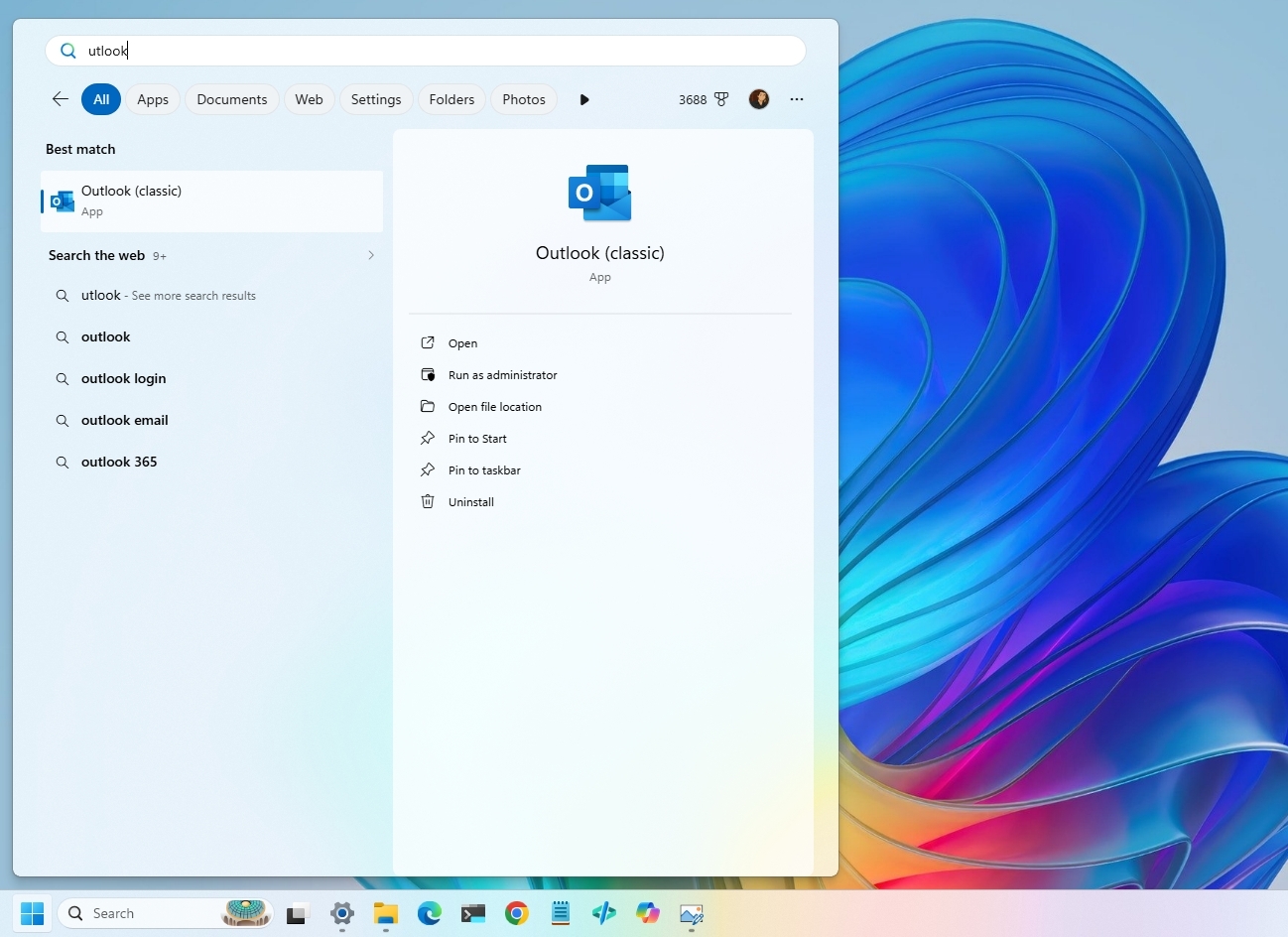
Starting with the August update, Windows Search now includes improvements to better handle typos, and you can start searches with two-character queries.
(Image credit: Mauro Huculak)
When searching for apps, Windows Search improves recognition of partial names and typos. Also, in the Settings app, the search rank has been updated to show more relevant options higher.
Windows Hello support
In this update, Microsoft is bringing Windows Hello Enhanced Sign-in Security (ESS) support for external fingerprint sensors.
In short, standard Windows Hello encrypts the sign-in data. However, enhanced security support takes it a step further by isolating the biometric process into a secure memory space, away from the operating system.
The option is available through Settings > Accounts > Sign in options.
(Image credit: Mauro Huculak)
In the past, this feature was only available for devices with built-in sensors, such as Copilot+ PCs, but now, it'll be available for external peripherals.
AI model uninstall option
Although adding the ability to uninstall something from the operating system doesn't scream new feature, Microsoft is now allowing users to uninstall the Image Generation AI model from Settings > System > AI Components.
And this is a big deal, because one of the biggest complaints about Windows 11 has been the integration of AI features. While supported devices still don't have a master switch to completely disable AI on Windows 11, this is a small step in the right direction.
Widgets improvements
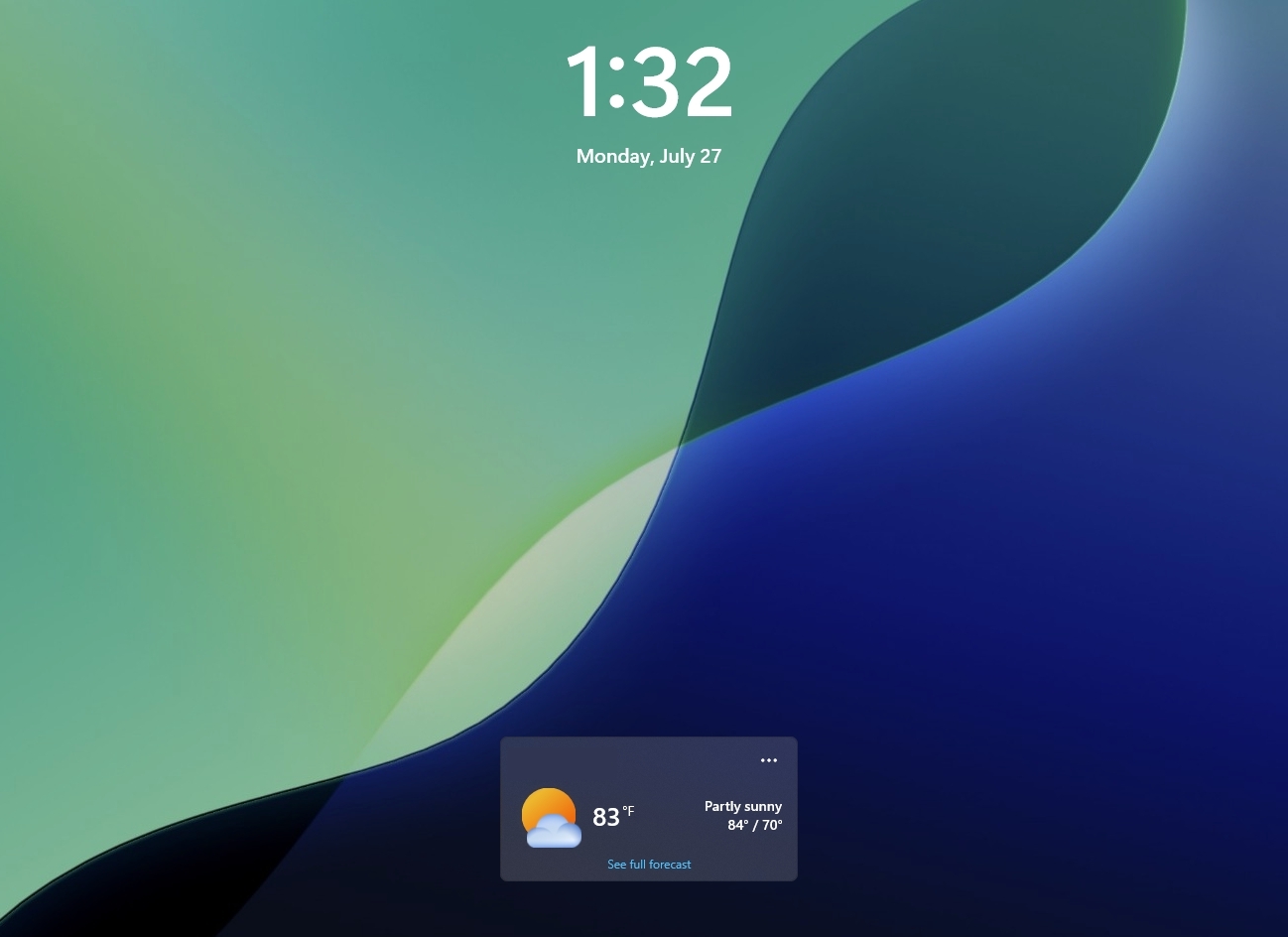
In the Lock screen, the experience should now be less distracting, as now, by default, users will only see the Weather widget.
(Image credit: Mauro Huculak)
Also, notification badges in the Taskbar will now take the current accent color instead of the previous red indicator.
Touchpad new gestures
After installing the August update, on Settings > Bluetooth & devices > Touchpad, users will be able to customize the speed for scroll and zoom gestures.
In addition, there's a new option to enable accelerated scrolling, which is a feature that increases the scrolling speed as gestures are repeated.
Voice Typing and Access
In Voice Typing, Microsoft is now deactivating Fluid Dictation by default and integrating tooltips to help users understand how the feature works.
Voice Access now comes with Voice Isolation that improves speech recognition by filtering out background noise and other speakers.
In addition, the company is making available three speech recognition settings from Settings > Voice Access > Improve speech recognition.
The "Voice Isolation" option requires a one-time voice setup and filters both background noise and nearby conversations.
Users will also find the "Remove background noise only" mode suppresses sounds such as typing or doors closing without additional setup.
Finally, the "No filtering" mode uses the microphone input without any processing.
Account Control redesign
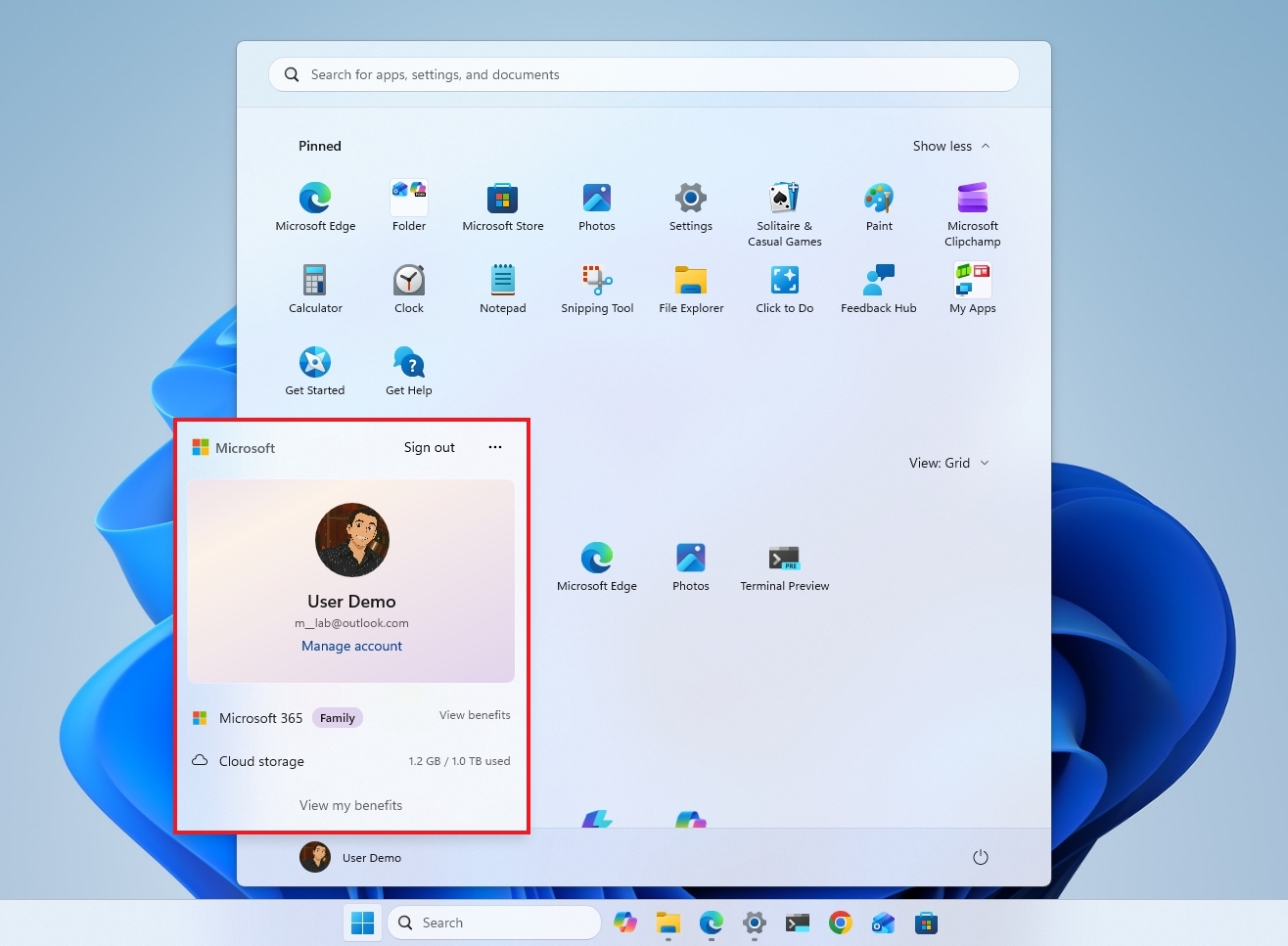
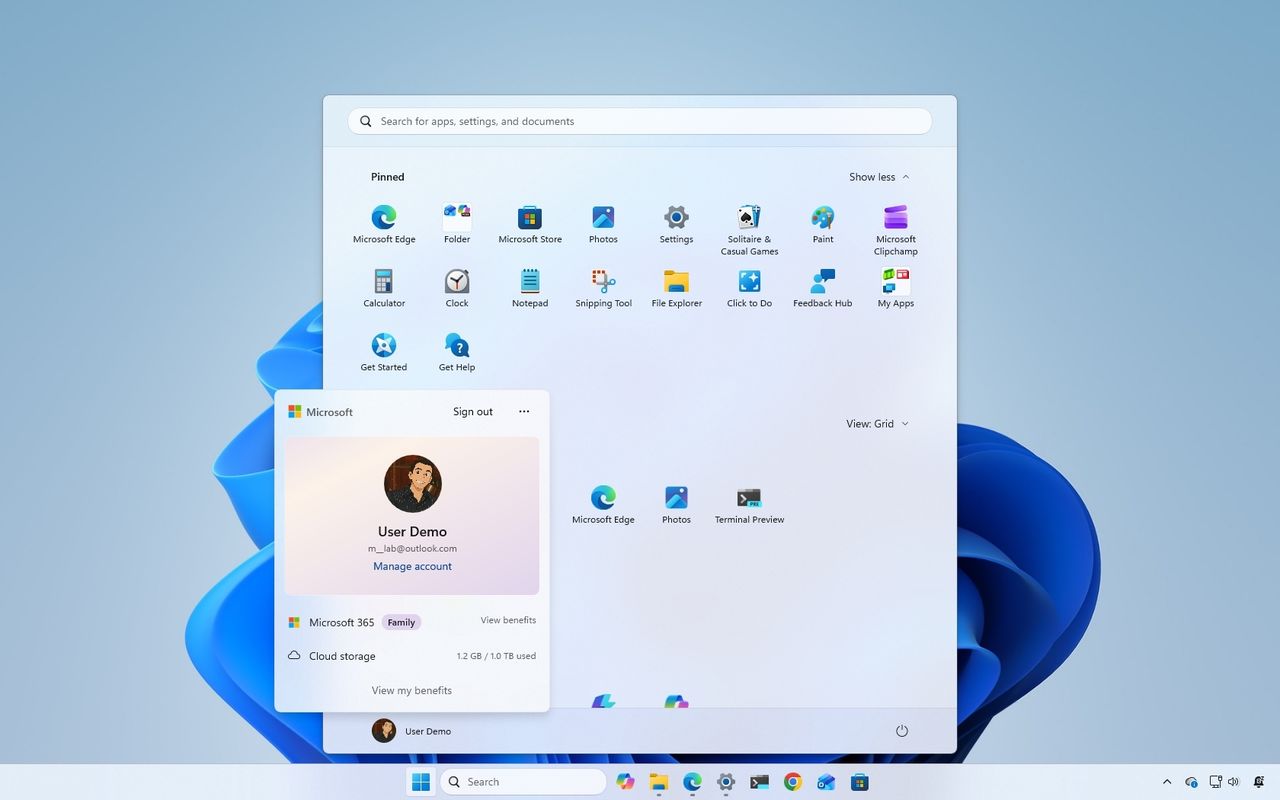
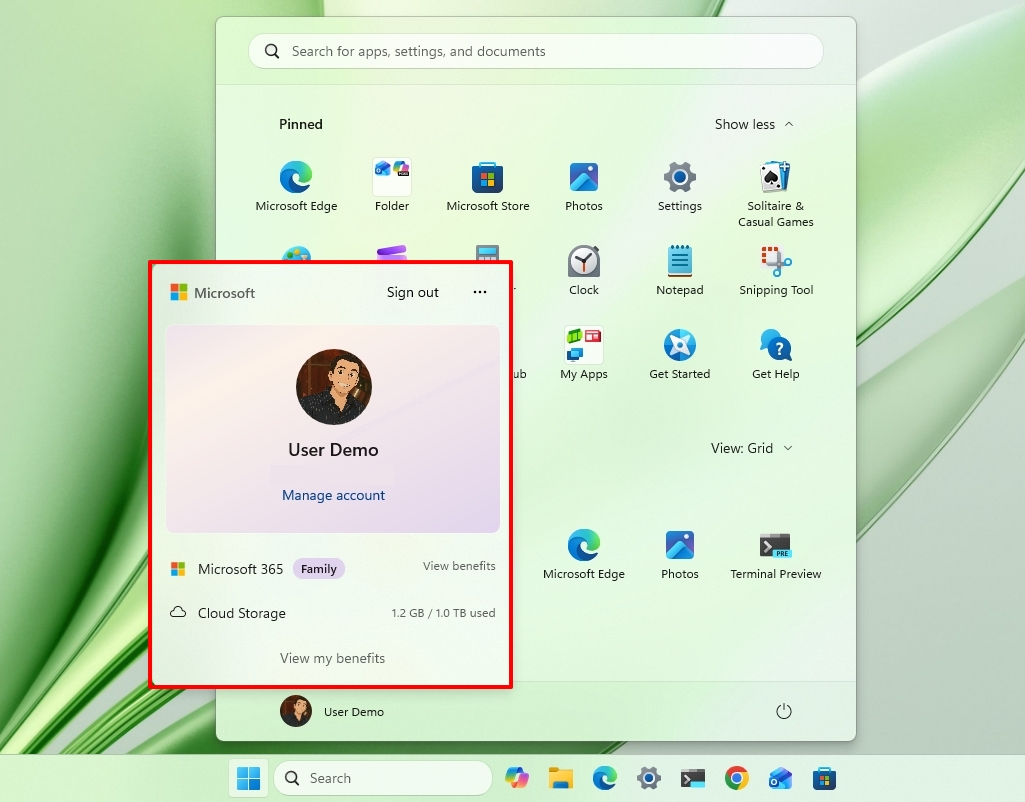
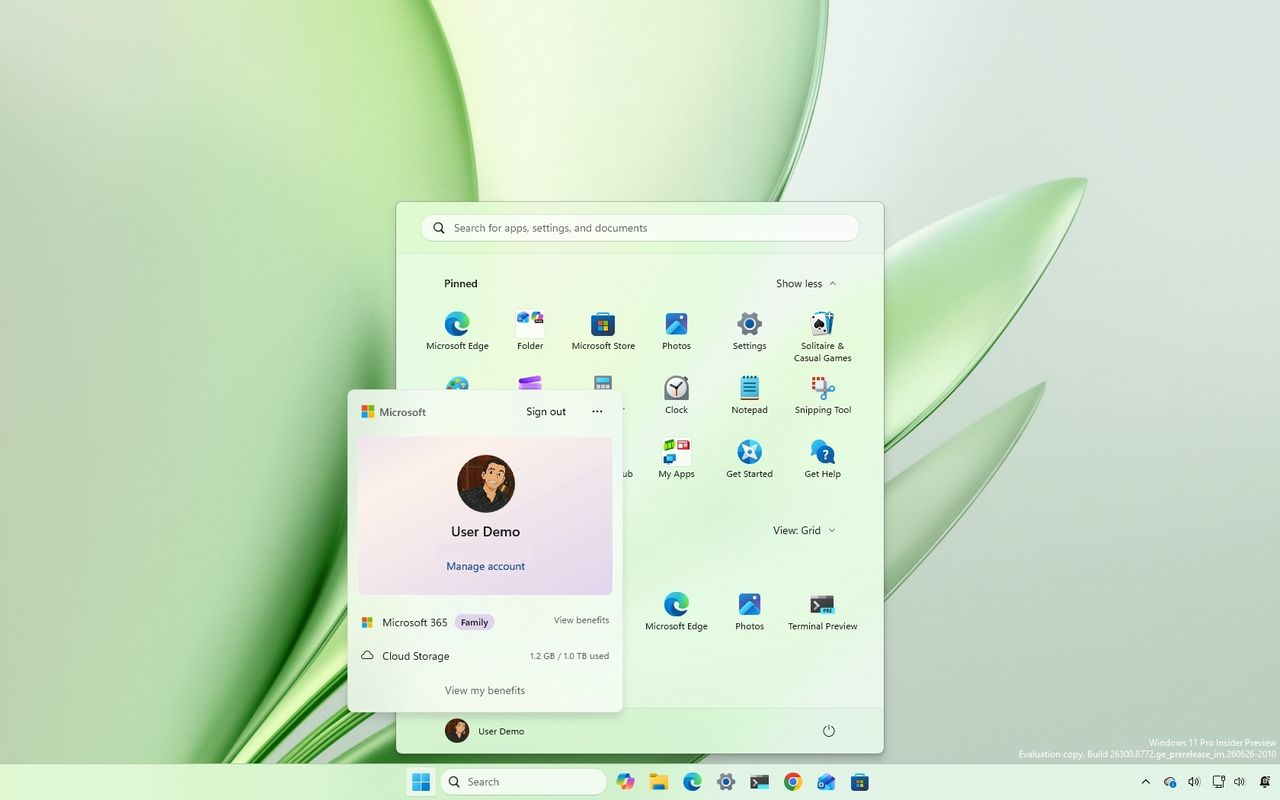
The flyout that appears when clicking the profile button in the Start menu is known as the Account Control interface, and in this release, Microsoft is adding some design changes.
(Image credit: Mauro Huculak)
The changes aim to make it more modern and clearer. For instance, the new design adds a new badge to quickly understand the current plan and state. In addition, it gives users access to their plan benefits as well as other information, such as storage usage from OneDrive.
Power and battery
In this release, the company is making changes to how power settings are applied in the system.
(Image credit: Mauro Huculak)
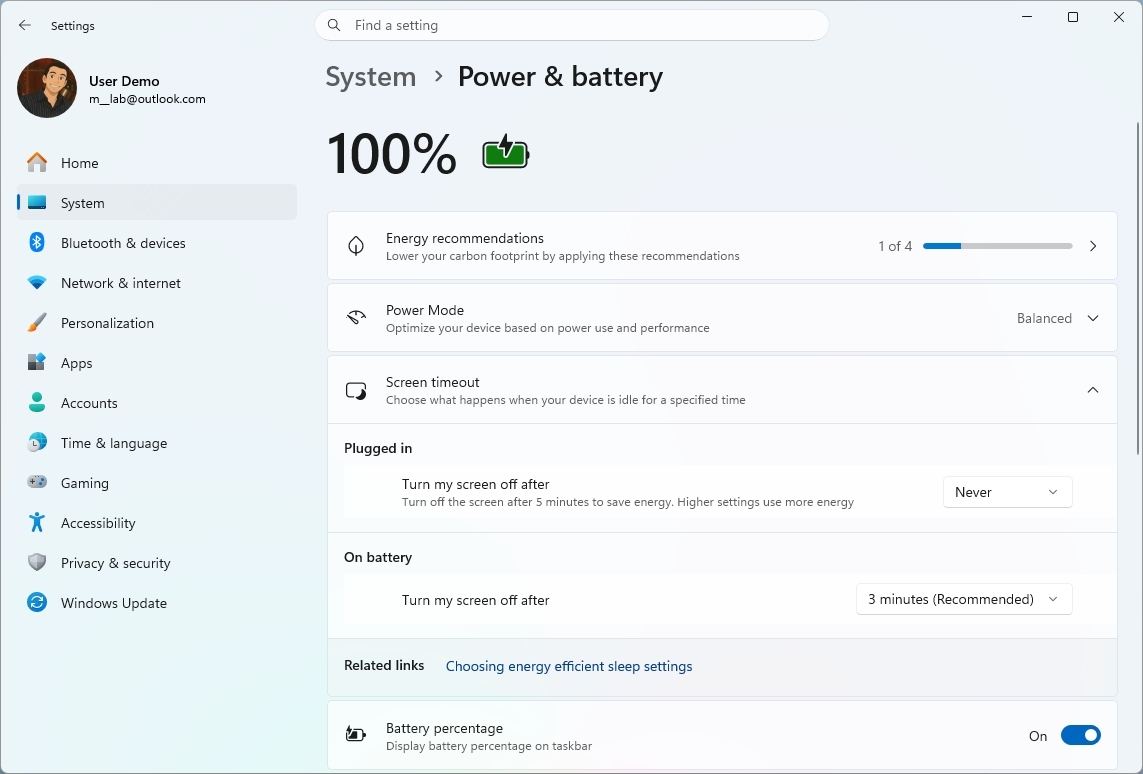
According to Microsoft, customizations made to the display timeouts, sleep and hibernate timers, and laptop lid actions are now automatically applied to every power plan instead of only the active one.
Finally, the ability to configure the battery percentage for "Energy Saver" is coming back to the "Power & battery" settings.
Windows Update improvements
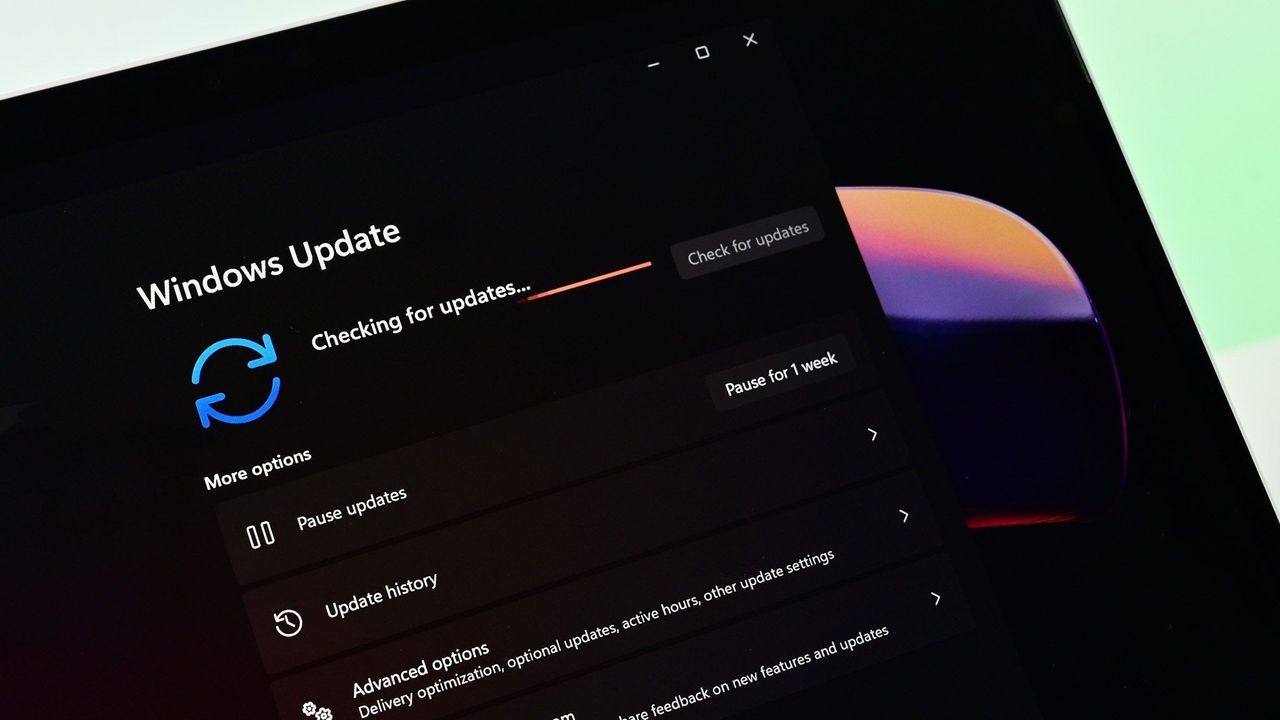
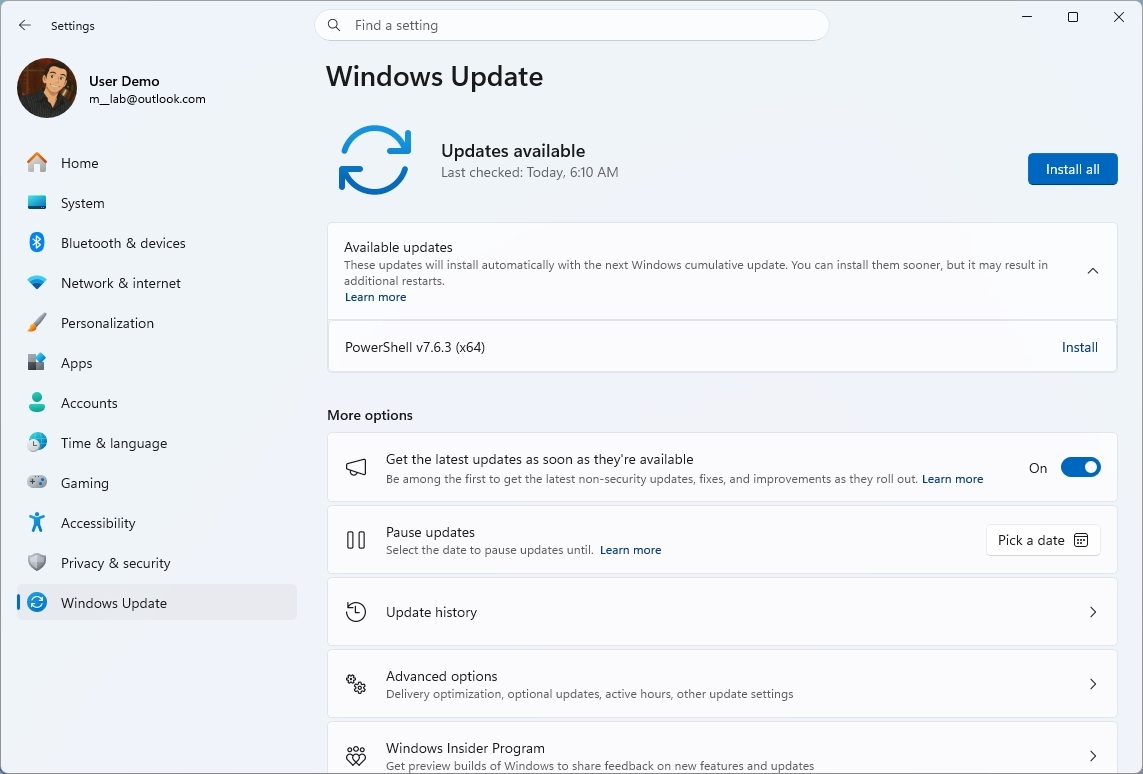
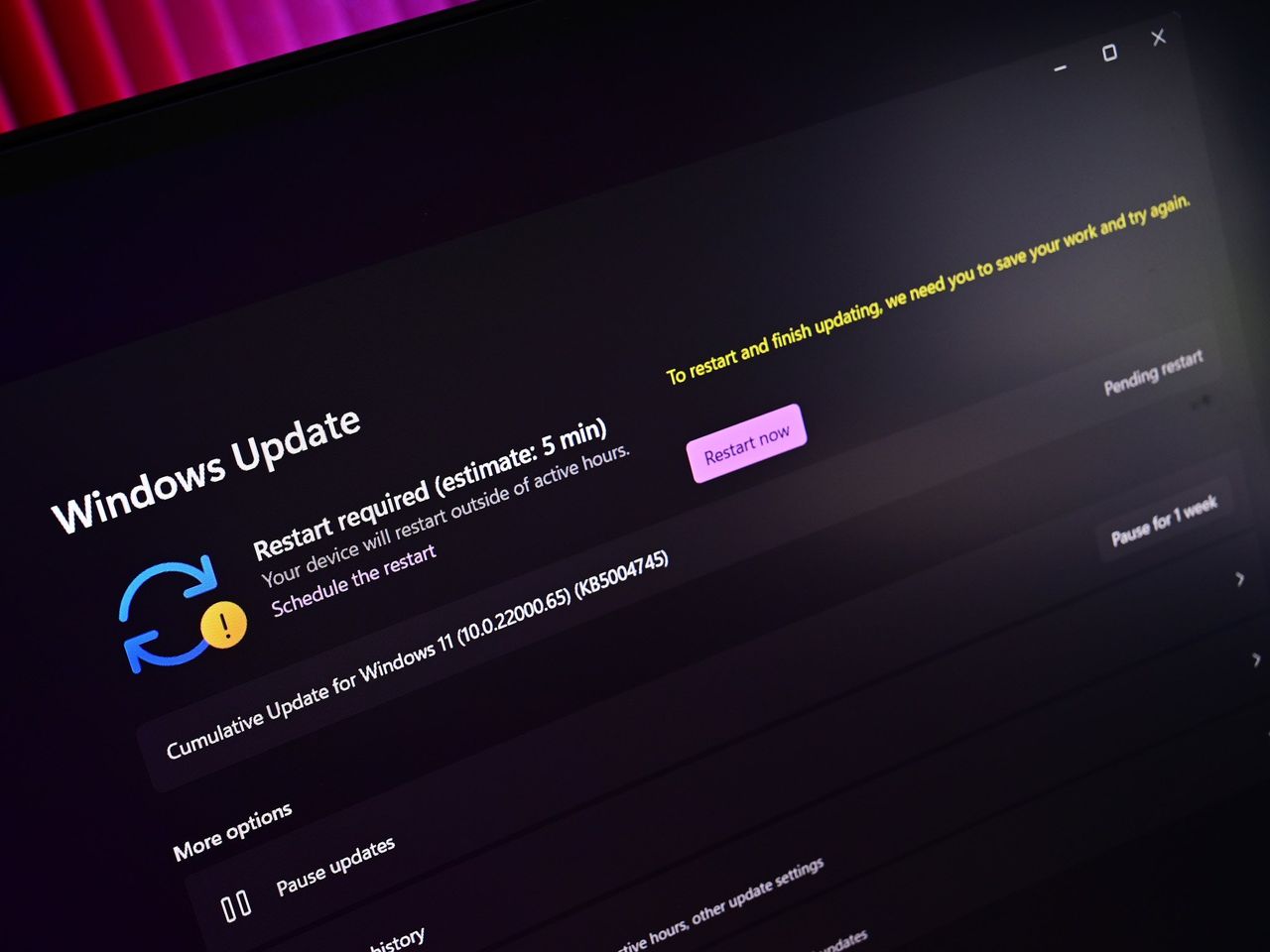
Microsoft continues improving the update system, and this time around, Windows Update will provide more accurate progress estimates during updates.
(Image credit: Mauro Huculak)
Furthermore, the company is updating the cleanup process after installing updates to improve system performance.
System sound in dark mode
After installing this Patch Tuesday update, users should also notice improvements to system sounds in dark mode.
Windows Central's Take
From my perspective, this is the kind of Windows 11 update I like to see. It's not built around a flashy headline feature, but instead focuses on polishing the experience in dozens of small ways. Improvements to File Explorer, Windows Search, Windows Update, touchpad gestures, and power management won't generate a lot of excitement, but they're the kinds of changes that make the operating system feel more refined day after day.
I also think Microsoft's decision to let users uninstall the Image Generation AI model is an important step, even if it's a modest one. People have been asking for more control over AI features, and while this isn't a universal switch to remove AI, it shows Microsoft is at least acknowledging those concerns. I'd like to see the company continue in that direction by giving users even more choice over what AI components are installed.
As with every Patch Tuesday release, I'd still recommend waiting a few days before installing the update on your primary computer unless you need the latest security fixes immediately. Monthly updates occasionally introduce unexpected issues, and giving Microsoft a little time to address early reports has rarely been a bad strategy.
What are your thoughts about the Windows 11 August 2026 update? Which new feature or improvement are you looking forward to the most? Let me know in the comments.
More resources
Explore more in-depth how-to guides, troubleshooting advice, and essential tips to get the most out of Windows 11 and 10. Start browsing here:
Cursor has patched a high-severity Windows vulnerability that allowed malicious Git repositories to execute code, highlighting security risks in AI coding environments.
Microsoft is expected to roll out the 2026 Update for Windows 11 (version 26H2) later this year, marking the fifth feature update for the desktop version of the operating system. However, this release isn't a full operating system swap, but it's still important not to skip it.
In this guide, I'll walk you through 10 interesting facts about Windows 11 version 26H2 to know before upgrading once it becomes available.
Facts to know about Windows 11 version 26H2
These are some facts about the new version for Windows 11.
1. Same operating system platform
Although the company will market Windows 11 version 26H2 as a new release, it shares the same platform as version 25H2, meaning both operating systems are identical under the hood. This is exactly the same case as versions 24H2 and 25H2.
2. Same set of features and improvements
Windows 11 version 26H2 includes the same features and improvements already available in version 25H2. Microsoft isn't introducing a separate feature set for this release because both versions share the same platform.
Perhaps the most noticeable differences between Windows 11 versions 26H2 and 25H2 are their version and build numbers, along with their support lifecycle.
For example, version 26H2 uses build numbers in the 26300 series, while version 25H2 uses the 26200 series. Now, despite the different build numbers, updates for both versions typically share the same cumulative update (KB) number because they are based on the same code and include the same features and improvements.
Microsoft is expected to continue servicing both versions with the same features and improvements for the foreseeable future. As a result, version 26H2 is not expected to introduce major new capabilities at launch. Instead, it serves as another enablement package release that activates a new version number while preserving the same experience users already have on version 25H2.
3. Enablement Package-based installation
Similar to Windows 11 version 25H2, version 26H2 is expected to be rolled out as an Enablement Package (eKB). This means that if you're already running version 25H2, upgrading to 26H2 will be similar to installing a regular monthly cumulative update, without requiring a complete reinstallation of the operating system.
An Enablement Package is a small update that acts as a switch to activate features already included in the operating system but kept dormant. Once installed, it simply changes the version number from 25H2 to 26H2 while enabling the new release (if applicable).
Because version 26H2 shares the same platform and feature set as version 25H2, the installation process is expected to be quick and require only a single restart. As with previous enablement package releases, Microsoft will likely offer the update as an optional installation at first before making it available automatically to eligible devices as version 25H2 approaches the end of its support lifecycle.
4. Full reinstallation upgrade
Although Windows 11 version 26H2 is virtually identical to version 25H2, the upgrade path depends on the version currently installed on your computer.
If you're already running Windows 11 version 25H2 (or 24H2), you can upgrade through the Enablement Package without reinstalling the operating system. However, devices running an older release (such as version 23H2) will need to perform a full feature update to move to version 26H2.
5. Upgrade from Windows 10
If your computer is still running Windows 10, upgrading to Windows 11 version 26H2 requires a full feature update. Compatible devices will receive the latest supported version of Windows 11 directly through Windows Update, so you won't have to install 24H2 or 25H2 first.
If your computer doesn't receive the upgrade through Windows Update, you can also perform an in-place upgrade using Microsoft's installation media.
6. Direct upgrade from older versions
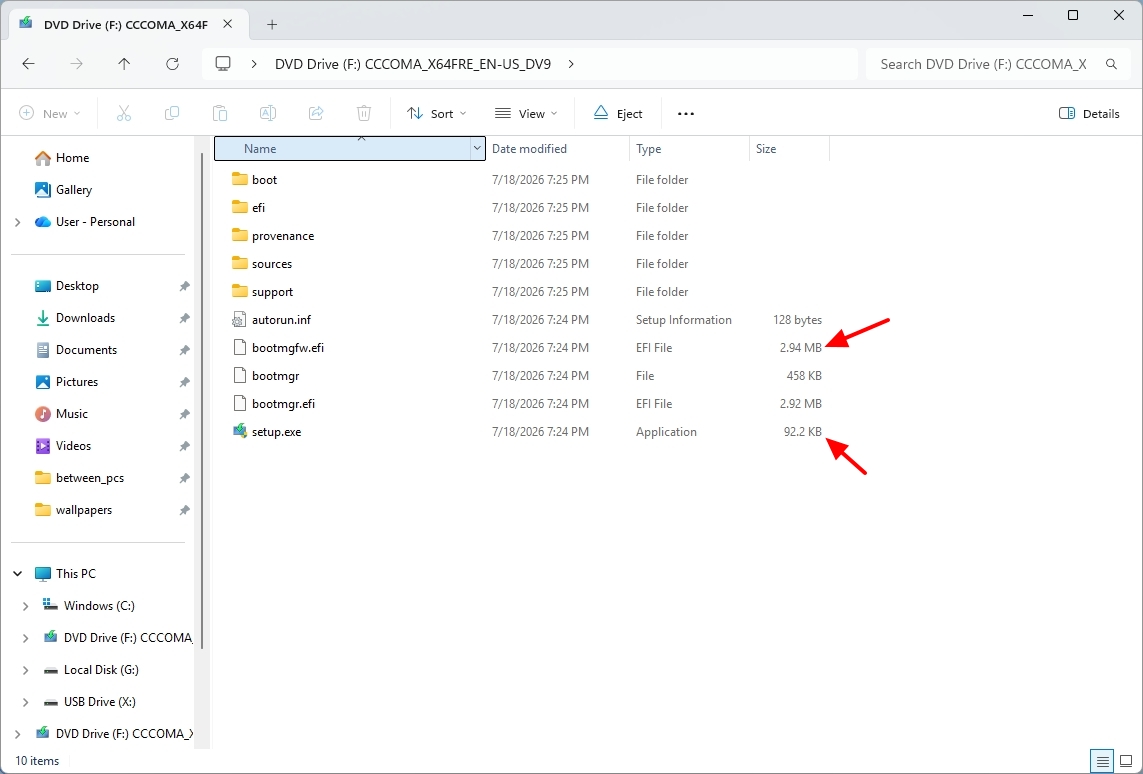
(Image credit: Mauro Huculak)
You can upgrade directly to Windows 11 version 26H2 from version 23H2, 22H2, or an earlier release, as well as from Windows 10, using the ISO file or other Microsoft installation media.
These methods perform a standard in-place feature update, allowing you to keep your files, apps, and settings while installing the latest version of the operating system.
7. Upgrade tools trigger a full feature update
Although upgrading from Windows 11 versions 24H2 or 25H2 to version 26H2 through Windows Update only requires installing a small Enablement Package, using the official ISO file or other installation media will perform a full in-place upgrade instead.
The installation still preserves your files, apps, and settings, but it reinstalls the operating system rather than simply activating the new version with the Enablement Package. This results in an unnecessarily longer installation process compared to upgrading through Windows Update.
8. Reasons to upgrade to version 26H2
Since the last three releases of the operating system are virtually identical, the primary reason to upgrade is to extend your device's support lifecycle rather than gain access to new features.
Windows 11 version 25H2 remains supported through October 2027, but upgrading to version 26H2 extends support for another year. As with previous releases, Microsoft is expected to provide 24 months of support for the Home and Pro editions and 36 months for Enterprise and Education editions.
This also means there won't be any urgency to upgrade as soon as version 26H2 becomes available. Because these releases offer the same features and improvements, you can continue using version 25H2 until you're ready to switch. However, you should plan to install version 26H2 before version 25H2 reaches the end of its support lifecycle to continue receiving security updates and bug fixes.
It's worth pointing out that version 24H2 is set to retire on October 13, 2026, and it's recommended to upgrade as soon as possible to the next supported version.
9. Same hardware requirements
(Image credit: Future)
Windows 11 version 26H2 does not introduce new hardware requirements compared to version 25H2. The same requirements for supported processors, TPM 2.0, and other system components remain in place.
These are the minimum requirements to install or upgrade to Windows 11:
CPU: 1GHz or faster processor, or System on a Chip (SoC) with at least two cores.
RAM: 4GB or more.
Storage: 64GB or larger storage device.
Firmware: UEFI firmware with Secure Boot capability.
TPM: Trusted Platform Module (TPM) version 2.0.
Graphics: Compatible with DirectX 12 or later with a WDDM 2.0 driver.
Display: High-definition (720p) display larger than 9 inches diagonally, with 8 bits per color channel.
This means that if your device can already run Windows 11 version 25H2, it will also be compatible with version 26H2 without requiring any hardware changes.
10. Rollout strategy will be gradual
Although the Enablement Package that upgrades Windows 11 from version 25H2 to 26H2 is a small update, Microsoft will likely follow the same gradual rollout strategy used in previous releases.
The company typically uses the Controlled Feature Rollout (CFR) system to monitor the update experience, check for potential compatibility issues, and expand availability over time. As a result, not every device will receive the Windows 11 2026 Update immediately through the Windows Update settings page.
Availability will gradually expand over several weeks or months as the company confirms that the update is ready for a wider range of hardware configurations. If your device doesn't see the update right away, it doesn't necessarily mean there's a problem. It simply means the rollout has not reached your hardware configuration yet.
Windows Central's Take
(Image credit: Future)
I think the Windows 11 2026 Update is a good example of how the software giant is changing how it delivers upgrades. A new version number no longer automatically means a major redesign or a long installation process. Instead, the company is leaning more toward smaller transitions that keep computers current with less disruption.
From my experience covering the operating system, I think this approach makes a lot of sense. Full feature updates have historically been among the most complicated parts of maintaining the operating system, often leading to compatibility issues, driver problems, and upgrade failures. By using an Enablement Package model, Microsoft can accelerate the transition, reduce the risk of errors, and make it easier for more users to move to the latest supported version.
This strategy also benefits the company because a simpler upgrade experience could encourage more people to stay on newer versions instead of delaying updates for months or years. When an upgrade takes only a few minutes instead of requiring a complete operating system installation, users are more likely to accept it.
That said, I don't see 26H2 as an update users need to install immediately. If you're already running 25H2, the main reason to move will be support rather than new features. However, I think this is a better direction for the operating system. Making upgrades faster and more reliable could help reduce the problems that have caused many users to delay installing new versions.
What are your thoughts about Windows 11 version 26H2 following the same path as 25H2? Do you prefer smaller, smoother updates, or do you want major new features with every release? Let me know in the comments.
More resources
Explore more in-depth how-to guides, troubleshooting advice, and essential tips to get the most out of Windows 11 and 10. Start browsing here:
Can you hear that? It's the sound of capitalism crumbling. After years of pushback against ads, Microsoft has finally given in and decided to make a cleaner Search experience in Windows 11.
Sarcastic quips aside, Search is genuinely going to improve. Microsoft unveiled a massive upgrade to Search this week that will improve the accuracy of results, shift away from relying on the web, and yes, remove ads and promotional material.
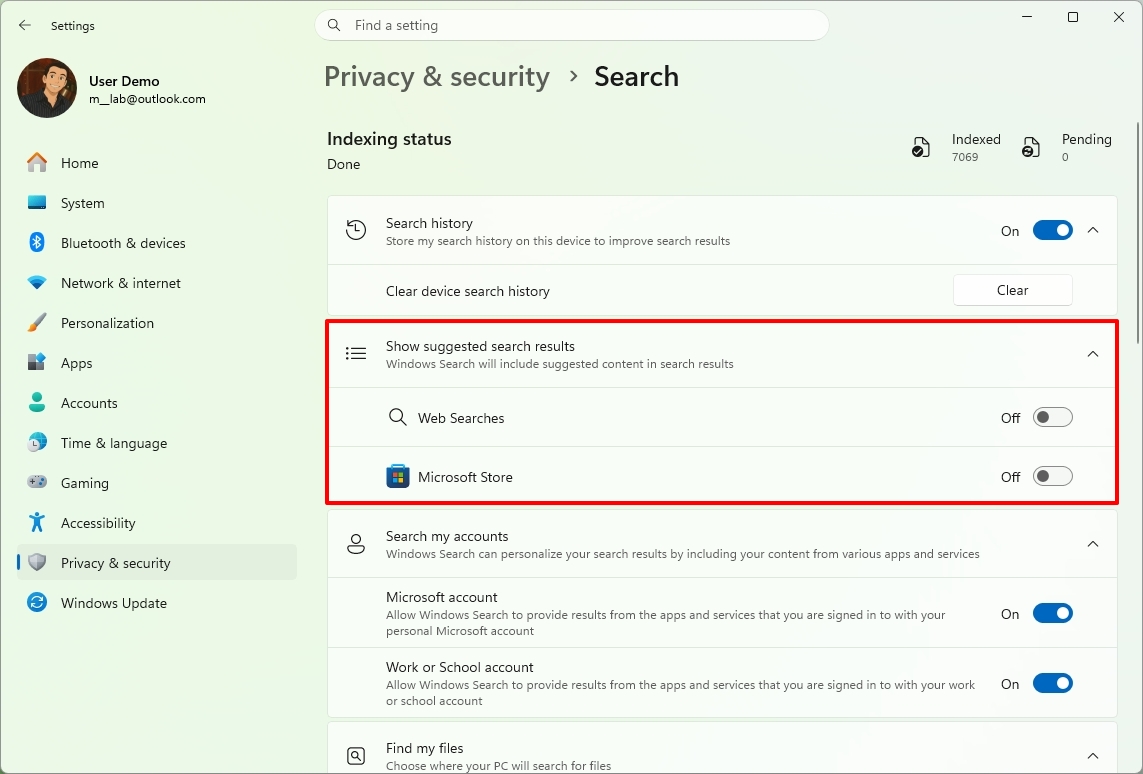
The improved search will prioritize local results over grabbing information from the web. You'll even be able to customize whether web and Microsoft Store suggestions appear alongside local results at all. Search should also be more forgiving of typos, which should reduce frustration.
The upcoming improvements to Search were the biggest Windows 11 story of the week, but several other topics trended as well.
Biggest News of the Week
I'd argue that Windows 11 never should have placed ads within Search in the first place. Certainly, Windows 11 Pro should have been ad-free. I'm glad to see Microsoft listen to feedback and get rid of some ads. I just think it's wild that the tech giant needs to be pushed in that direction.
I'm happy to see Microsoft did more than remove ads and call it a day. The new Search experience is better across the board. Our Zac Bowden was impressed after going hands-on with the feature.
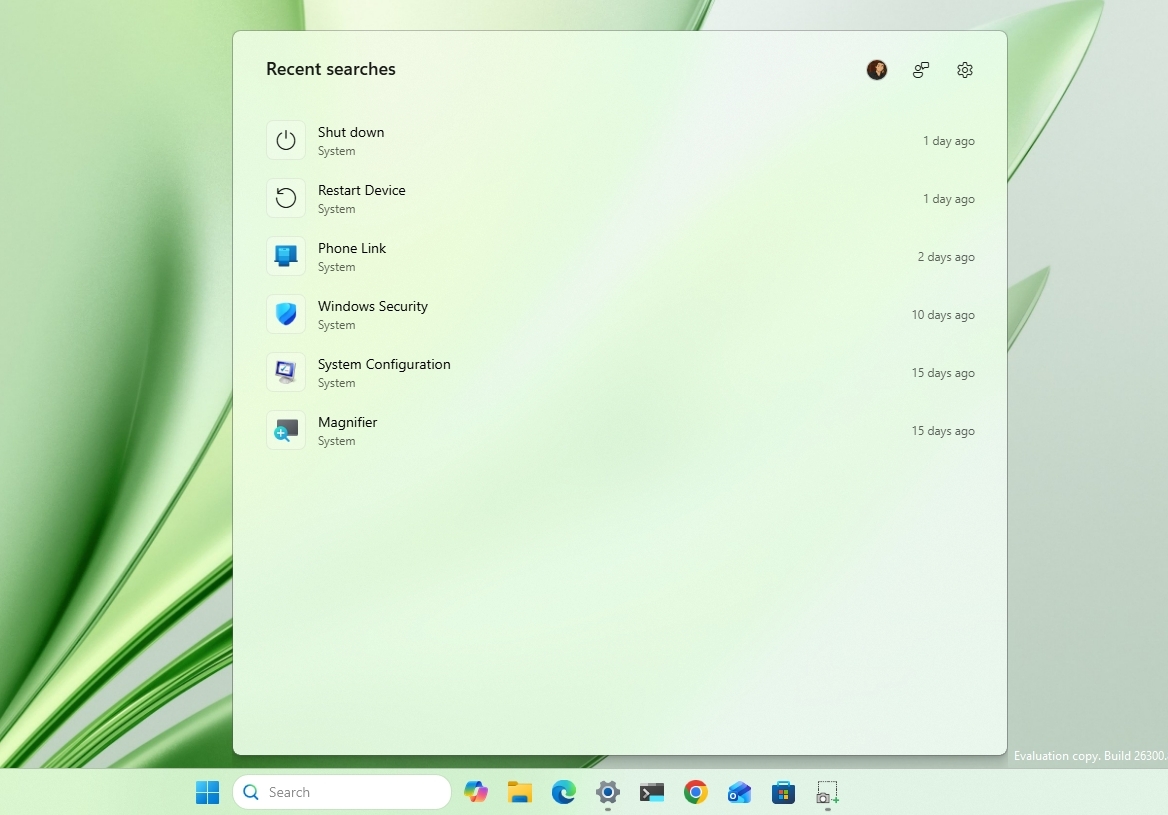
I'm very impressed with the new experience. Right off the bat, the search pane is no longer a noisy mess of Bing ads and sponsored content. It's a clean list of recent searches, exactly what you'd expect from a search pane.
Zac Bowden, Senior Editor, Windows Central
As always with updates like this, you can focus on the fact that Microsoft should have launched Windows 11 in this state rather than be strong-armed into making search usable. Alternatively, you can choose to be happy that Windows 11 is finally getting fixed. I choose the latter.
Shopping with Sean
Laptop deals have cooled off a bit, but you can still save hundreds of dollars on the Samsung Galaxy Book6 or the HP OmniBook Ultra 14. Both are excellent laptops with gorgeous displays and snappy performance.
If you're a gamer, make sure to check out the Xbox Ultimate Game Sale that's now live. Hundreds of games are discounted in what might be one of Microsoft's best-ever sale events.
"I’ve been using the Samsung Book 6 for a while now and honestly it’s been solid. It’s lightweight, looks premium, and the battery easily gets me through most of the day. Performance is smooth for studying, browsing, videos, and everyday work." ~ VALENTIN, customer review
4.8 out of 5 Stars (based on 40 Best Buy customer reviews)View Deal
HP's new OmniBook Ultra is the best Snapdragon X2 laptop we've tested yet, complete with a gorgeous design, incredible keyboard and trackpad, best-in-class touchscreen OLED display, and incredible battery life and performance.
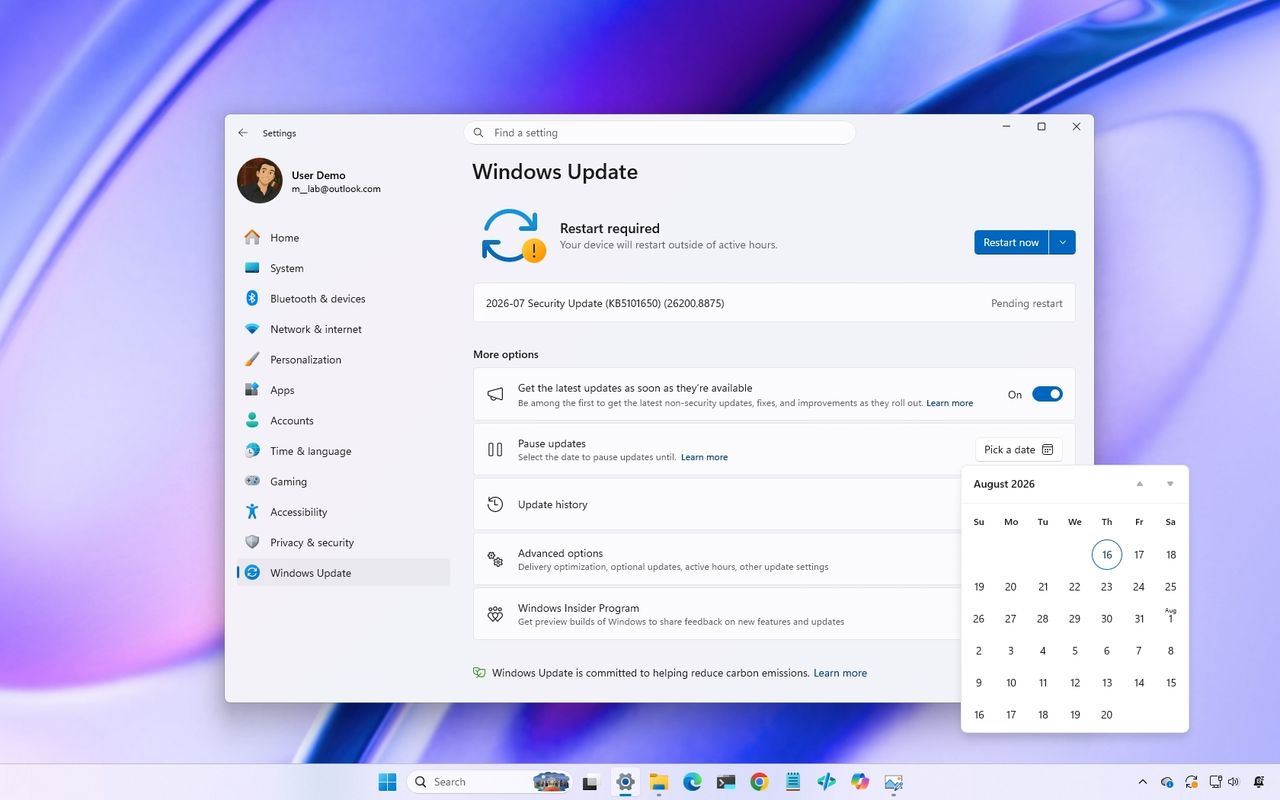
For users, the update arrives as KB5101650, bringing version 25H2 to build 26200.8875 and version 24H2 to build 26100.8875.
The number is certainly eye-catching. Microsoft fixed more than four times the number of security issues compared with July 2025, when the company addressed 137 vulnerabilities.
However, the bigger story is not simply that the company patched hundreds of security flaws. The July 2026 security update is an early example of a major shift Microsoft has already warned about. AI is changing vulnerability discovery, and Windows 11 updates are expected to become larger as a result.
The software giant says that as AI helps security researchers find more issues across more code, customers will see a higher volume of security fixes included in future security releases.
In other words, larger Patch Tuesday updates are not necessarily a sign that Windows is becoming less secure. They are also a sign that Microsoft is finding and addressing more problems before attackers can use them.
Why Windows 11's July 2026 update is so large
The July 2026 update addresses vulnerabilities across many core areas of Windows, including the Windows Kernel, Win32k, NTFS, Remote Desktop, Secure Boot, BitLocker, File Explorer, and more.
Several of these fixes address vulnerabilities that could allow remote code execution, where an attacker could potentially run malicious code on a system remotely.
The scale of the release follows a sharp increase in security fixes throughout 2026.
Here's a comparison based on vulnerability counts reported by Windows Latest and security-tracking data, showing how the number of fixes has increased since 2025.
Month
Vulnerabilities fixed in 2025
Vulnerabilities fixed in 2026
January
159
114
February
55
58
March
57
79
April
134
167
May
72
120
June
66
200
July
137
570
January–July total
680
1,308
However, Microsoft says the growing number of fixes should not be interpreted as the operating system becoming less secure. Instead, the company says AI is helping identify vulnerabilities earlier and at a larger scale.
Microsoft is using AI to find Windows vulnerabilities faster
(Image credit: Screenshot: Windows Central / Laptop: Edited with Gemini)
The company has been investing in AI-powered security tools to reduce the time between discovering a vulnerability and protecting customers.
One of those tools is MDASH, Microsoft's multi-model agentic security scanning harness.
MDASH uses multiple AI models and more than 100 specialized AI agents to analyze code, identify potential vulnerabilities, debate findings, and validate whether issues are real.
Unlike a traditional scanner that simply reports possible problems, Microsoft's system is designed to reduce false positives by using multiple stages of analysis and validation.
The company notes that MDASH helped security researchers discover 16 vulnerabilities in networking and authentication components, including critical remote code execution flaws affecting areas such as the TCP/IP stack and IKEv2 service on Windows 11.
Those findings demonstrate how AI can help uncover complex security issues that may be difficult to identify through traditional approaches.
Microsoft has not said that MDASH discovered all 570 vulnerabilities included in the July 2026 update. Instead, the technology represents part of a larger effort to expand the company's vulnerability research capabilities.
Microsoft expects Windows 11 security updates to get bigger
The biggest takeaway from the new approach is that larger security updates are becoming expected. In a recent explanation of its vulnerability management strategy, Microsoft said: "As AI helps defenders discover more issues, customers will see a higher volume of security updates included in each security release."
The company says AI is being integrated into the entire security process, from finding vulnerabilities to helping engineers understand issues, develop fixes, and identify possible regressions.
Microsoft is also using additional validation systems to make sure faster security fixes do not come at the cost of update quality.
The goal is to shorten the time between vulnerability discovery and customer protection while maintaining reliability.
Why users should install updates faster on PCs
(Image credit: Future)
As security updates grow larger, Microsoft is also pushing users and organizations to reduce delays before installing them, because attackers are also benefiting from AI.
Microsoft says attackers can now exploit newly discovered vulnerabilities much faster than before, leaving users and organizations with less time to install security updates.
For users, that means monthly updates are becoming more important. While temporarily pausing updates can still make sense if a release causes compatibility problems, leaving security fixes uninstalled for long periods creates unnecessary risk.
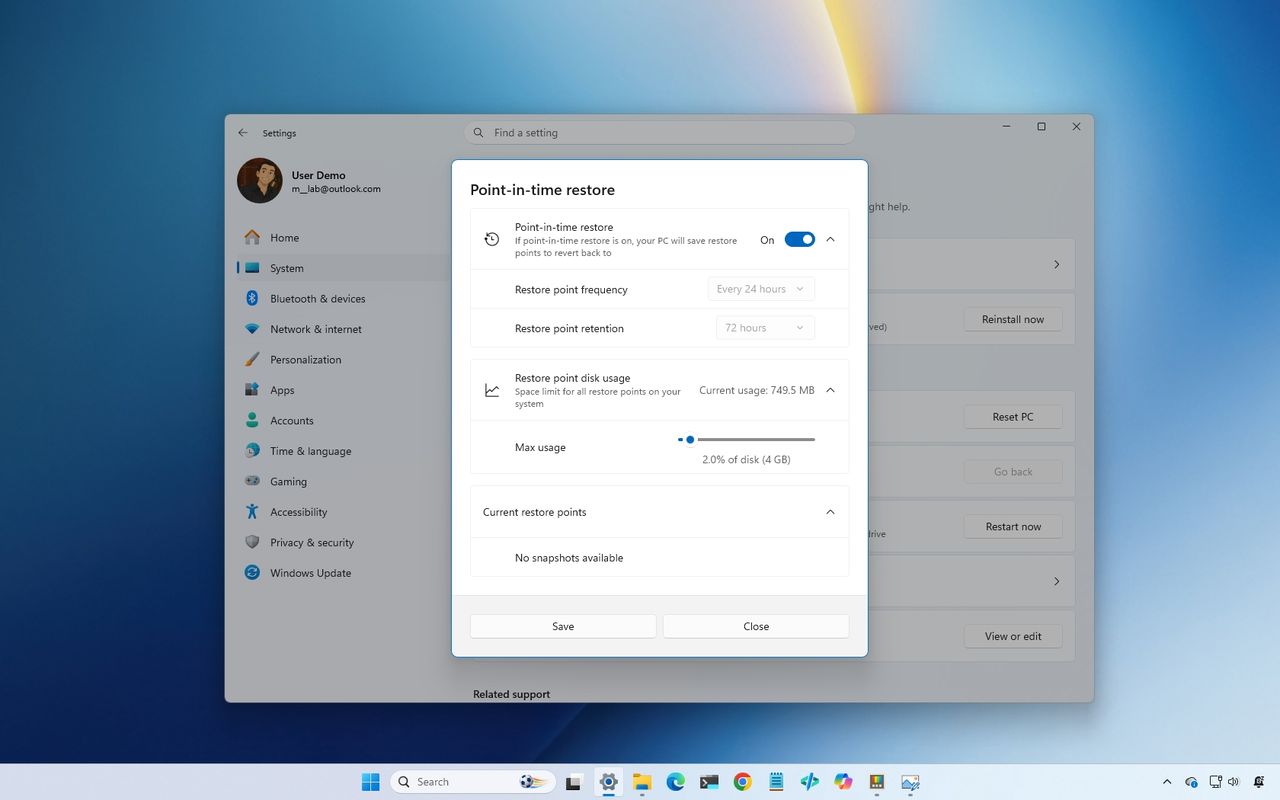
The July 2026 update also includes non-security improvements, including Point-in-time restore, Screen Tint, improved Bluetooth reliability, File Explorer improvements, and much more. However, the security changes are the main reason users should prioritize installing it.
Windows Central's Take
When I first saw that Microsoft had patched 570 vulnerabilities in a single Patch Tuesday release, I didn't immediately think Windows 11 had become less secure. Instead, my first thought was that this was exactly the kind of update the company had been preparing users for when it said AI would dramatically increase the number of vulnerabilities it could discover.
I actually think this changes how we should judge Patch Tuesday updates. For years, I've looked at the size of a security release as a rough indication of how much could potentially go wrong after installing it. In the future, that assumption may no longer hold true. A bigger update could only mean that the software giant is finding and fixing more issues before attackers have the chance to exploit them.
That said, Microsoft still has something to prove. Discovering more vulnerabilities is only half the equation. Users will judge this new approach by whether these larger updates remain reliable and don't introduce new issues of their own. If the company can consistently deliver both better security and stable updates, I think that's a tradeoff most users will gladly accept.
Do you think larger Patch Tuesday updates are a good sign for Windows 11 security, or do they make you more cautious about installing updates? Let me know in the comments.
More resources
Explore more in-depth how-to guides, troubleshooting advice, and essential tips to get the most out of Windows 11 and 10. Start browsing here:
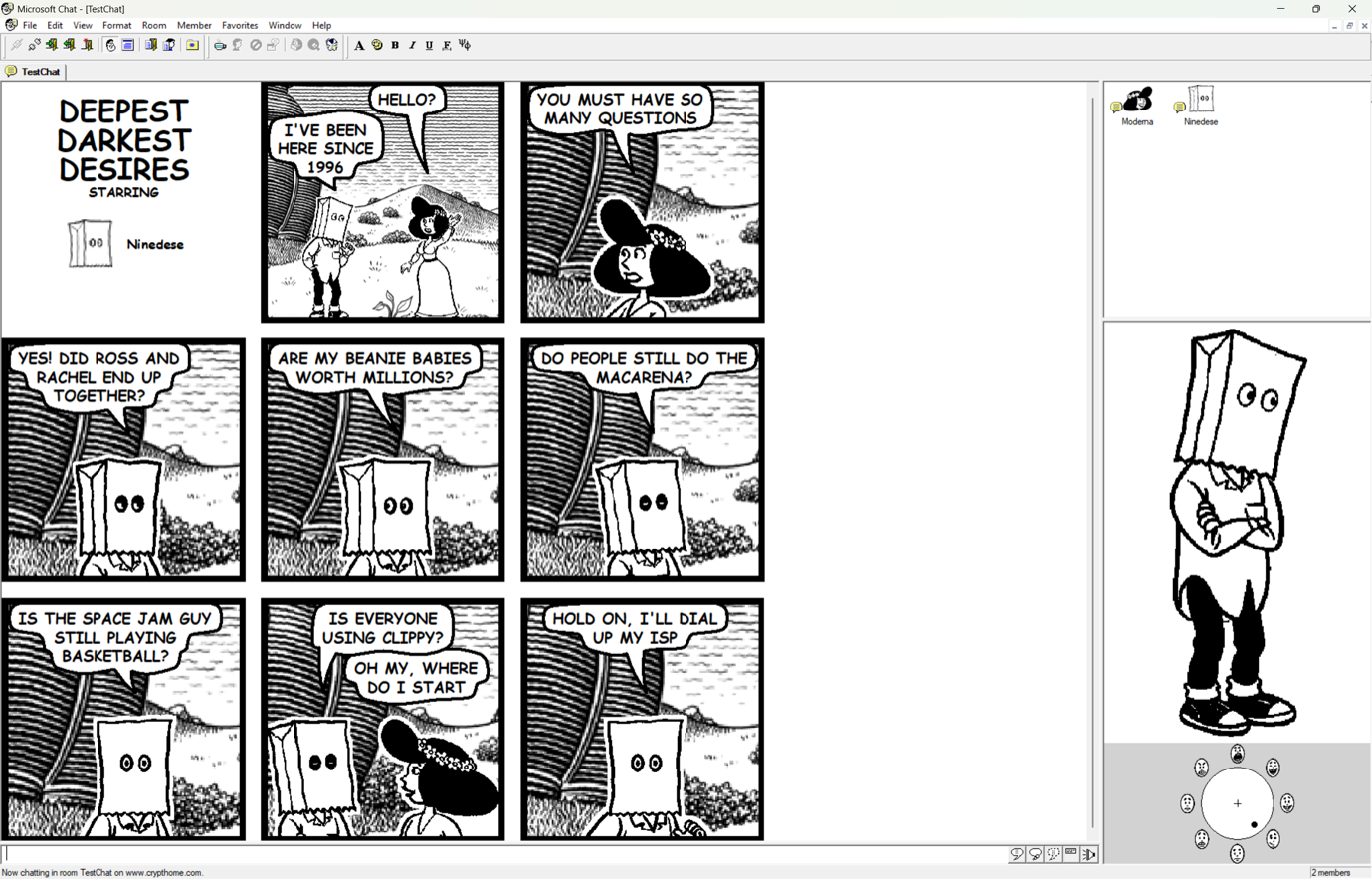
Microsoft's once popular IRC client "Comic Chat" is being open sourced to celebrate its 30th anniversary. Those who frequented the world wide web in the 90's will likely remember Comic Chat for being a unique experiment into how IRC chatting could be, featuring graphical avatars that presented chats and chatrooms in comic strip form.
Originally developed by Microsoft Researcher David Kurlander and released on August 13, 1996, Comic Chat began life as a research project before morphing into Microsoft Chat and becoming the default chat client for MSN.
"Today, we’re excited to announce the open-source release of Microsoft Comic Chat, the chat client that automatically turned conversations within Internet Relay Chat (IRC) into comic panels featuring illustrated characters, speech bubbles, and expressions, and helped introduce the world to a little font called Comic Sans," Microsoft's Scott Hanselman announced in a blog post today.
Comic Chat running on Windows 11. (Image credit: Microsoft)
"For many people, Comic Chat is a nostalgic artifact from the early days of the internet as we transitioned from technologies like telnet, Usenet, and IRC to the largely visual web that we enjoy today. For others, it’s a legendary piece of Microsoft history they have only heard about in stories, screenshots, and debates about typography. Now, developers, historians, retro computing enthusiasts, and anyone who appreciates a wonderfully unconventional idea can explore the source code for themselves."
Although from the 90s, Comic Chat is still functional as an IRC client today, though most people likely don't use it anymore. Still, with the app now being open source, perhaps developers and tinkerers will be more open to breathing life back into the 30 year old app.
The Comic Chat source code is now public on GitHub for anyone who wants to take a look and compile their own version.
Join us on Reddit at r/WindowsCentral to share your insights and discuss our latest news, reviews, and more.
As part of the Windows Insider Program, Microsoft released several preview builds of Windows 11 in early July 2026, some of which introduced new features and others only improvements for existing experiences.
In the first two weeks of July, the company began the public test of the Cloud rebuild recovery feature, revealed a new design update for the account manager available through the Start menu, and made other improvements for version 26H2
In addition, Microsoft is continuing to expand previously announced features to more Insider channels, including the ability to upgrade from Windows 11 Home to Pro Education for K-12 environments. The company is also rolling out Taskbar position and size options, along with Windows Update improvements designed to reduce the number of required restarts each month.
In the Experimental track, we've seen builds 26300.8772 and 28120.2387, and builds 28020.2380 and 26220.8764 have been released in the Beta channel.
In this recap, I'll highlight the latest and most noteworthy changes available through the Windows Insider Program.
Biggest improvements from the Windows Insider Program in July 2026
In this recap, I'll highlight the latest and most noteworthy changes available through the Windows Insider Program since my last roundup.
Cloud rebuild new feature
Starting with build 26300.8772, Windows 11 introduces a new recovery feature known as "Cloud rebuild," which has been designed to make it easier to reinstall the operating system when the computer is unable to start, or you're looking for a fresh install.
(Image credit: Mauro Huculak)
If this feature sounds familiar, it's because it's similar to the Cloud download option in Reset this PC. However, Cloud rebuild introduces a new workflow that downloads the Windows 11 installation files and drivers and performs a clean installation without requiring a bootable USB drive, a custom recovery image, or access to the desktop environment.
Cloud rebuild can be accessed from the Windows Recovery Environment (WinRE) by going to the "Troubleshoot" page and using the "Cloud rebuild" option.
Before you can use the feature, the computer must be running Windows 11 on compatible hardware, and the device must be connected to the internet using a wireless or wired connection.
Once you confirm the Windows 11 version, edition, and language, click "Install," and the system will erase the hard drive and reinstall the operating system and drivers.
Account Control flyout redesign
In the Start menu, Microsoft is also updating the Account Control flyout with build 26300.8772. The new design offers a more modern style that highlights your account information and picture.
(Image credit: Mauro Huculak)
It also highlights your Microsoft 365 subscription, cloud storage, and access to your benefits.
Backup and restore default settings
In commercial computers, starting with the preview build 26300.8772, Windows 11 is enabling the backup and restore feature policy by default for devices enrolled in a Microsoft Entra ID or Entra hybrid-joined environment.
The idea is to start the device with backup protection to make recovery smoother. For example, when a device is reset or replaced, users can quickly return to their personalized desktop without extra steps.
Of course, network administrators can always control this experience, and Microsoft notes that existing policies will remain in effect, and manually configured settings always take priority over the default behavior.
Taskbar position settings
The company is also bringing back the ability to change the Taskbar location with the release of build 28120.2387 in the Experimental channel.
This change allows users to place the Taskbar at the top of the screen, as well as at the left or right edges, rather than being limited to the bottom.
The setting appears on Settings > Personalization > Taskbar, under the "Taskbar behaviors" section. The setting is called "Taskbar position."
(Image credit: Mauro Huculak)
The company notes that flyouts, tooltips, and animations will follow the Taskbar orientation regardless of the position.
Also, most existing features will continue to work, including the option to ungroup and show labels for apps.
Furthermore, the company is updating the "Show smaller taskbar button" option to make the Taskbar smaller instead of just the buttons. (As we have already seen in other tracks, the company is expected to create a separate option to make the Taskbar smaller.)
Windows Update with fewer reboots
As part of Windows 11 build 26220.8764, the company is introducing a new unified Windows Update experience that coordinates monthly quality updates with driver, .NET, and firmware updates.
By bundling these updates into a single installation cycle whenever possible, Microsoft aims to reduce the number of restarts users experience each month, with the long-term goal of requiring just one monthly reboot.
Windows 11 Pro Education for K-12 free upgrade
Microsoft is changing the installation requirements to allow devices running Windows 11 Home to upgrade to Windows 11 Pro Education at no additional cost for K-12 education.
This change aims to give schools more flexibility when acquiring new devices. However, the company says that this is one-way only. After the upgrade, the only way to roll back to the Home edition is by performing a clean installation of the operating system.
Windows Search upgrades
Outside its regular download schedule, Microsoft recently began rolling out a slew of improvements to the Windows Search experience on devices enrolled in the Experimental channel.
First, the company is decluttering the home screen and focusing on the search experience. As part of this rollout, the Windows Search home screen only includes your recent searches, ditching the visual clutter, including those annoying advertisements.
(Image credit: Mauro Huculak)
In addition, when performing a search and a web result is more relevant, the experience will now prioritize the answer rather than products and promotions.
Microsoft is also introducing design tweaks to better indicate where each result comes from. For example, you'll find better spacing between items and interface changes when selecting a result, including thumbnail previews.
Second, you'll now have more control over search results with the options to disable web searches and Microsoft Store apps from appearing in the Windows Search experience.
However, by default, search will work as always. It's up to you to customize your search experience from Settings > Privacy & Security > Search.
(Image credit: Mauro Huculak)
Third, the search experience now improves local content and rankings, meaning local results are given higher priority in apps, settings, and files, instead of web and Microsoft Store results showing up first when there are better results.
(Image credit: Mauro Huculak)
As part of the ranking tweaks, you'll notice that searches for settings now appear higher in the results.
Fourth, Microsoft is also focusing on improving search accuracy through two specific changes. For instance, Windows Search has been updated to better handle typos, missing or extra letters, and partial words.
In addition, the feature will now show results for local files using two-character file search, and more accurately surface cloud and connected files when they're the best match.
Windows Central's Take
I think these Insider builds show Microsoft focusing on what Windows 11 has needed for a while, improving the experience instead of simply adding more features. Cloud rebuild could make recovery much less stressful, while the Windows Search changes address one of the operating system's biggest frustrations by prioritizing useful local results over web content.
The reappearance of Taskbar positioning is also a welcome change. It shows Microsoft is still paying attention to feedback and bringing back flexibility that many users have missed since Windows 11 launched.
What are your thoughts on these latest Windows 11 Insider changes? Let me know in the comments.
More resources
Explore more in-depth how-to guides, troubleshooting advice, and essential tips to get the most out of Windows 11 and 10. Start browsing here:
Microsoft has confirmed that it has blocked the availability of the recent Windows 11 July Patch Tuesday update (KB5101650) on Dell PCs, after Dell reported a number of issues including unexpected shutdowns, overheating, poor performance, and more caused by the preview update that released before it.
The KB5101650 began rolling out on July 14, and includes a number of quality of life improvements and fixes. For most users, this update is issue free, but Dell PCs will find that the update is not available for them currently.
"A limited number of Dell devices might display a yellow exclamation point in Device Manager next to the Intel Innovation Platform Framework Processor Participant driver. These devices can potentially experience unexpected shutdowns, poor performance, increased heat, and battery drain."
This issue applies to both the KB5101650 update that rolled out on July 14, and the optional preview update KB5095093 that rolled out on June 23, on either Windows 11 version 24H2 or 25H2. Dell PCs running either of these updates and experiencing issues should roll back.
The bug in question appears to be caused by the new Windows USB-C Connection Manager interface, with the Intel Innovation Platform Framework Processor Participant driver no longer functioning as intended. "This issue was reported by Dell during testing and identified as an incompatibility between the Intel driver and the new Windows USB-C Connection Manager interface."
Microsoft says that it's working on a fix, and will release a resolution for the PCs that are impacted by this issue soon. The good news is that it appears Microsoft was aware of the problem right away, as the July 14 update was blocked on Dell PCs right out of the gate.
Unfortunately, there was no immediate block on the optional update that released on June 23, meaning some devices may have installed the update that is causing problems. The best course of action in that situation is to simply roll-back to the previous update.
If you've been using Windows as long as I have, you probably remember when a serious problem often meant backing up your files and reinstalling the operating system from scratch. Whether it was a bad driver, a failed update, or corrupted system files, a clean install was frequently the fastest way to rescue your computer.
I don't think that's the case anymore. Over the past several years, Microsoft has quietly transformed Windows 11 into a much more resilient operating system. Instead of relying on a single recovery option, the operating system now bundles a collection of tools designed to solve different types of problems. Some can repair Windows 11 while minimizing changes to your data. Others can roll back a problematic update, recover a computer that won't boot, or completely rebuild the system from the cloud.
The downside is that all these options can be confusing. Microsoft doesn't always make it clear which recovery feature you should use first, and many of them sound similar even though they solve different problems.
A lot of the recovery features discussed in this guide are available through the Windows Recovery Environment (WinRE). This separate recovery workspace runs outside the normal installation and provides access to tools that can repair, reset, or troubleshoot the operating system when the computer cannot start normally.
In this guide, I'll outline the recovery features available on Windows 11 and when I would actually use them.
Important: The right recovery option depends mostly on what went wrong. A broken update, a damaged driver, and a corrupted installation all require different approaches.
Fix problems using Windows Update
If the computer still starts normally but something doesn't feel right, I'd try the "Fix problems using Windows Update" recovery option first.
(Image credit: Mauro Huculak)
This feature repairs the operating system by downloading the same version of Windows 11 installed on your computer through Windows Update and reinstalling it over your existing installation. Unlike resetting your computer, it preserves your personal files, installed apps, user accounts, and settings.
If system files have become corrupted, built-in features have stopped working, or you're seeing unusual behavior after an update, this repair process can often restore the operating system without forcing you to reinstall your apps afterward.
I like this approach because it's the least disruptive recovery option Microsoft offers. If it solves the problem, you save yourself the time of reinstalling software and reconfiguring the system.
Best for:
Corrupted system files.
Missing or broken features.
General system instability.
Repairing Windows 11 while keeping apps, files, and settings.
Reset This PC
When repairing Windows 11 isn't enough,"Reset This PC" is usually the next step.
This feature reinstalls the operating system and lets you choose between two options.
(Image credit: Mauro Huculak)
Keep my files reinstalls Windows 11 while preserving your personal files, pictures, and videos, but it removes installed applications and resets system settings.
Remove everything wipes the computer completely before installing a fresh copy of Windows 11, making it a good choice if you're selling the device or want to start over.
You'll also choose between "Local reinstall," which uses recovery files already stored on the computer, or "Cloud download," which downloads a fresh copy of Windows directly from Microsoft's servers.
Personally, I almost always recommend Cloud Download. It takes longer because it downloads several gigabytes of data, but it also avoids problems caused by damaged local recovery files.
Best for:
Severe software problems.
Persistent performance issues.
Malware cleanup after backing up your data.
Preparing to sell or give away the computer.
Cloud rebuild
Cloud rebuild is one of Microsoft's newest recovery tools, and I think it fills an important gap in Windows recovery.
(Image credit: Mauro Huculak)
Available through the Windows Recovery Environment (WinRE), Cloud rebuild reformats the operating system partition, downloads a fresh Windows 11 image and compatible drivers from Windows Update, and restores the computer to the out-of-box setup experience.
Unlike Reset This PC, it doesn't depend on the recovery image already stored on your computer, and more importantly, it also includes the device drivers.
To me, this feature sits somewhere between Reset This PC and creating a bootable USB installer. It gives you a completely fresh installation without requiring installation media or another computer to download the setup files.
Best for:
Severely corrupted installations.
Failed Reset This PC attempts.
Damaged recovery files.
Rebuilding Windows 11 from scratch.
Go Back (rollback)
The upgrade process to a new version doesn't always go smoothly, and that's exactly why "Go Back" exists.
(Image credit: Mauro Huculak)
After upgrading to a new version of the operating system on top of an existing setup, Windows 11 temporarily stores your previous installation in the "Windows.old" folder. If the new version introduces compatibility problems, driver issues, or poor performance, you can roll back to the earlier version with just a few clicks.
The only catch is that this option is temporary. The system typically removes the previous installation files after about 10 days to free up storage.
If you notice problems immediately after installing a feature update, don't wait too long before deciding whether to roll back.
Best for:
Performance problems after upgrading.
Driver incompatibilities.
Software compatibility issues.
Bugs introduced by a feature update.
Uninstall Updates
Not every system update improves the experience. Sometimes a cumulative update can introduce startup problems, driver conflicts, or unexpected bugs.
When that happens, Windows 11 includes an option in the Windows Recovery Environment that lets you remove the latest update without resetting the entire computer.
The first option is usually the one you'll use after Patch Tuesday problems.
Best for:
Device problems after installing an update.
Boot issues caused by a recent update.
Update-related stability problems.
System Restore
Some people think System Restore is outdated, but I still think it's one of the most underrated recovery features in the operating system.
(Image credit: Mauro Huculak)
System Restore creates restore points that save system files, drivers, registry settings, and installed applications. If something goes wrong after installing a driver or application, you can return Windows to an earlier working state without affecting your personal files.
It's often much faster than resetting the computer and can solve problems in just a few minutes.
Best for:
Bad driver installations.
Faulty software.
Registry changes.
Recent system configuration problems.
Startup Repair
If Windows 11 won't boot, Startup Repair remains one of the built-in recovery tools designed to fix common startup problems.
(Image credit: Mauro Huculak)
Available through the Windows Recovery Environment (WinRE), the tool scans the system for damaged startup files, corrupted Boot Configuration Data (BCD), missing system files, and other issues preventing the operating system from loading correctly. If it finds a problem it knows how to fix, it attempts the repair automatically.
Depending on your recovery configuration, Windows 11 may first attempt newer recovery mechanisms, such as Quick Machine Recovery, before Startup Repair becomes available.
It won't solve every startup issue, but when it works, it can save you from more drastic recovery options like resetting or reinstalling the operating system.
Best for:
Windows 11 stuck during boot.
Endless restart loops.
Missing or damaged boot files.
Startup-related errors.
Safe Mode
Sometimes Windows 11 itself isn't the problem. Safe Mode starts the system with only the essential drivers and services needed for the operating system to run. That makes it much easier to remove a problematic graphics driver, uninstall recently installed apps, or troubleshoot malware that's preventing Windows 11 from working normally.
(Image credit: Mauro Huculak)
If Windows 11 works as expected in Safe Mode but crashes at startup, it's usually a sign that a third-party app or driver is causing conflicts.
Best for:
Troubleshooting driver problems.
Removing incompatible software.
Malware cleanup.
Diagnosing startup crashes.
Quick Machine Recovery
Quick Machine Recovery is one of the newest additions to Windows 11, and I think it's a direct response to lessons Microsoft learned from major outages like the CrowdStrike incident.
(Image credit: Mauro Huculak)
If a bad update or driver prevents Windows 11 from starting, the feature can automatically enter the Windows Recovery Environment, connect to Microsoft's recovery service, download a remediation package, and attempt to repair the problem before you ever reach the desktop.
Ideally, you'll never have to think about this feature because it works automatically behind the scenes. If the automated recovery isn't successful, you can continue troubleshooting using the other recovery options available through the Windows Recovery Environment.
Best for:
Startup failures caused by updates.
Driver-related boot issues.
Automatic recovery without user intervention.
Point-in-time Restore
Point-in-time Restore is another piece of Microsoft's evolving recovery strategy.
Rather than asking users to troubleshoot a failed Windows Update manually, Point-in-time Restore is part of Microsoft's effort to make Windows Update failures easier to recover from automatically.
A lot of people may never notice it working, but that's exactly the goal. The more the system can recover automatically, the less often users need to search for recovery guides or perform clean installations.
Best for:
Failed system updates.
Rolling back to a previous working update state.
Automatic update recovery.
Other details
This guide focuses on Windows 11 features that can restore the operating system to a known working state or help troubleshoot problems preventing the system from working correctly. However, the operating system also includes other recovery-related tools that serve a different purpose.
The Windows Recovery Environment (WinRE) is the workspace where many of these options are available, including Startup Repair, Reset This PC, System Restore, Cloud rebuild, and other troubleshooting tools. It does not repair Windows 11 by itself. Instead, it provides access to the features that can recover the operating system.
The Recovery Drive works in a similar way. It does not fix the setup directly. Instead, it creates a bootable USB drive that lets you access WinRE if the built-in recovery options are unavailable.
Other tools, such as Command Prompt, Startup Settings, and UEFI settings, are designed for advanced troubleshooting. They can help diagnose and manually repair problems, but they do not automatically restore the operating system.
Also, the Windows Backup app is part of the recovery experience, but it serves a different purpose. Instead of repairing a broken installation, it helps restore settings, credentials, Microsoft Store apps, and files stored in OneDrive after reinstalling Windows 11 or moving to a new computer.
The legacy Backup and Restore (Windows 7) tool is still available on Windows 11 and can create file backups and full system images. Unlike newer recovery features such as Reset This PC or Cloud rebuild, it relies on a backup created ahead of time. If you have a system image available, you can use it to restore the computer to a previous state, including the operating system, apps, settings, and drivers.
However, Microsoft has shifted toward newer recovery experiences that rely more on Windows Update, cloud services, and automatic repairs.
Windows Central's Take
After covering the operating system for more than two decades, I think Microsoft has finally addressed one of the biggest weaknesses: recovery.
The company has built a much more complete safety net into Windows 11. However, these tools only matter if they work when users need them most. A failed update, broken driver, or corrupted system file can still leave people searching for answers because the recovery experience isn't always predictable.
What I find interesting is that Microsoft didn't replace older tools like System Restore or Safe Mode. Instead, it kept building on top of them with newer experiences such as Cloud rebuild and automatic recovery features. The result is a layered recovery system that makes Windows 11 far more resilient than previous versions.
The next challenge isn't creating another recovery feature. It's making the existing ones easier to understand. If the operating system can better recognize what's wrong and automatically recommend the right recovery path, most people may never have to wonder whether to use System Restore, Reset This PC, or Cloud rebuild.
That's the direction recovery should continue moving toward, with less troubleshooting, fewer reinstalls, and more automatic repairs that keep people productive.
Have you ever had to use one of these Windows recovery features? Which one helped you get your device back up and running? Let me know in the comments.
More resources
Explore more in-depth how-to guides, troubleshooting advice, and essential tips to get the most out of Windows 11 and 10. Start browsing here:

 Connexion