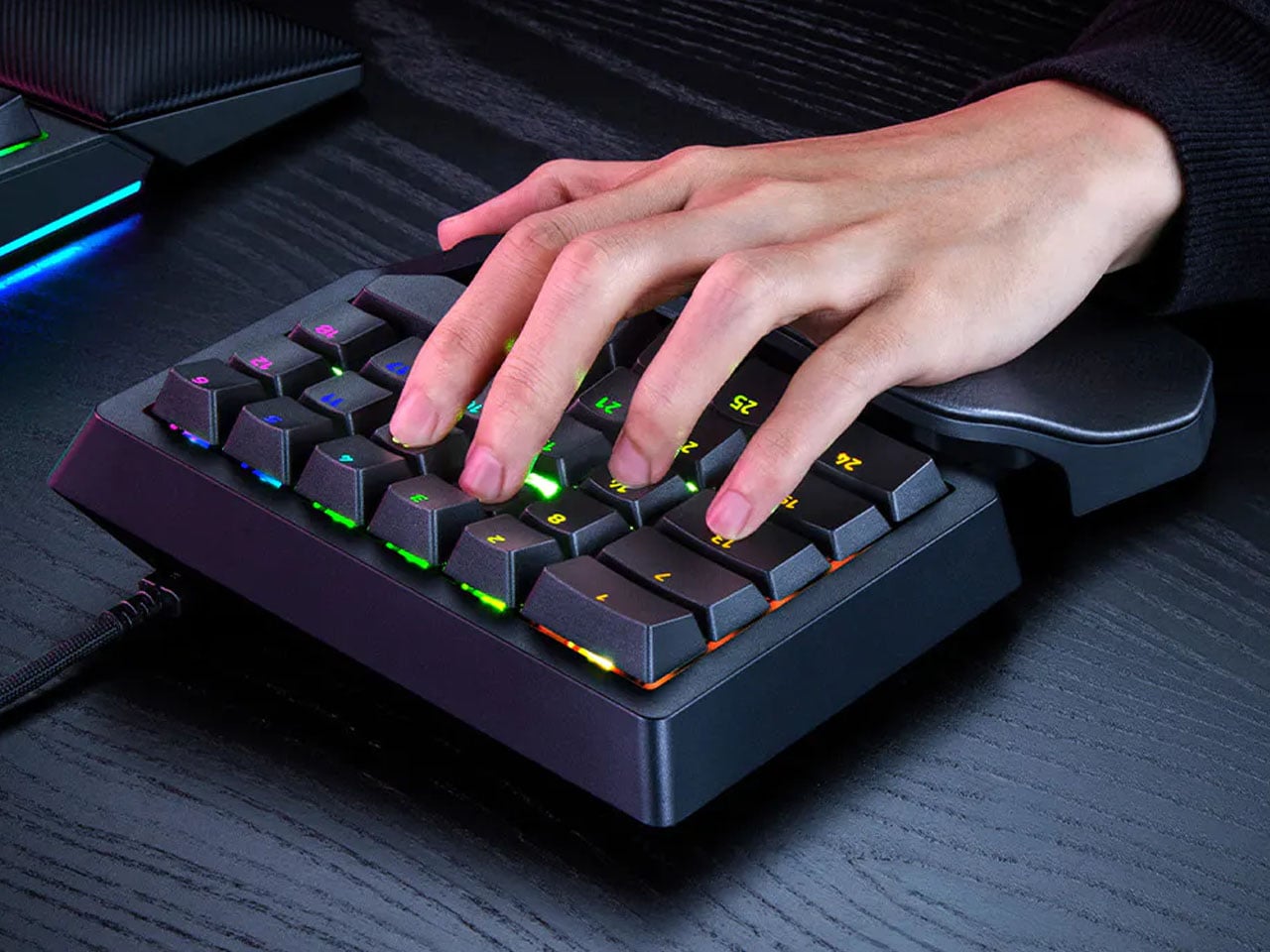
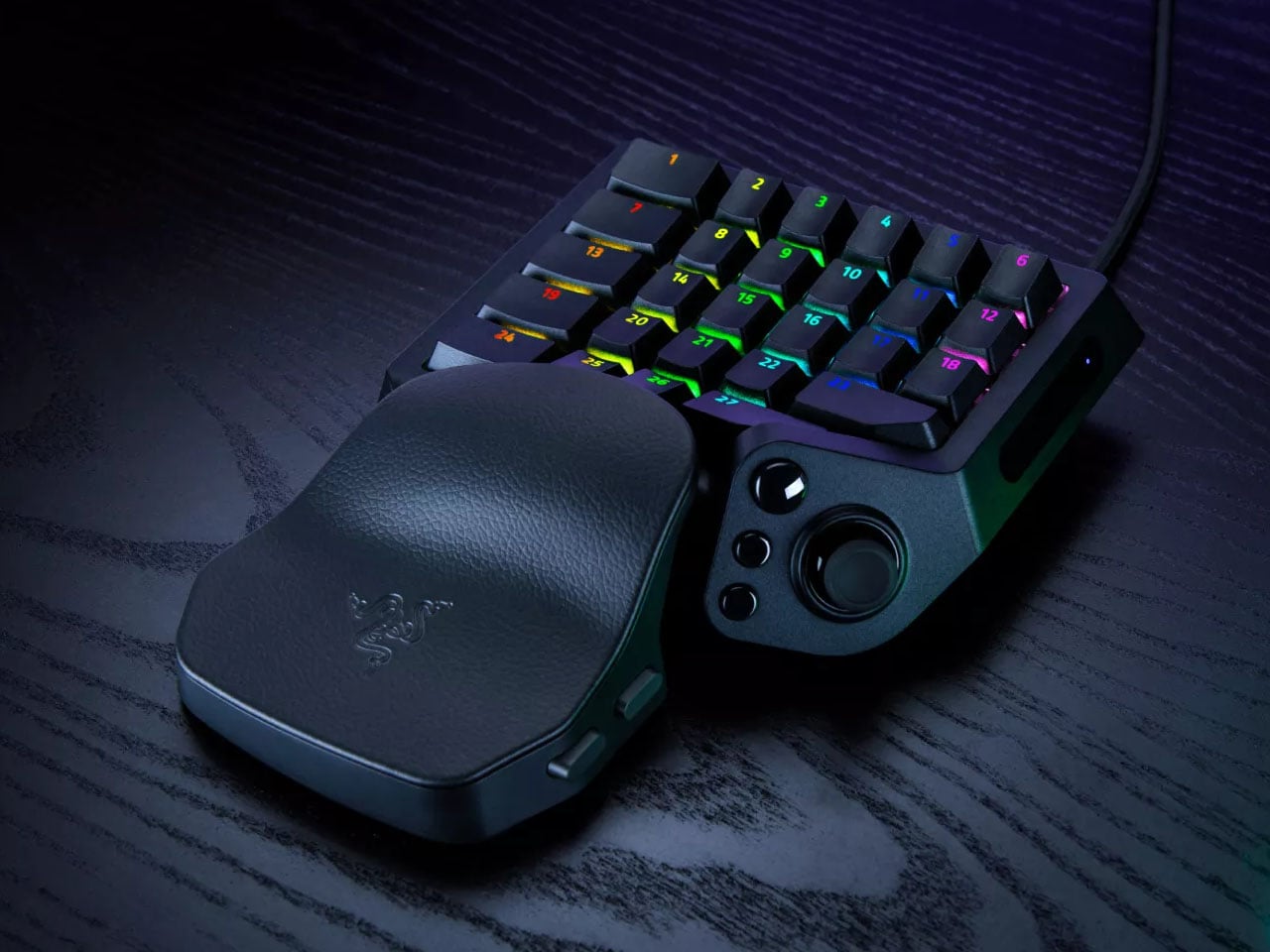
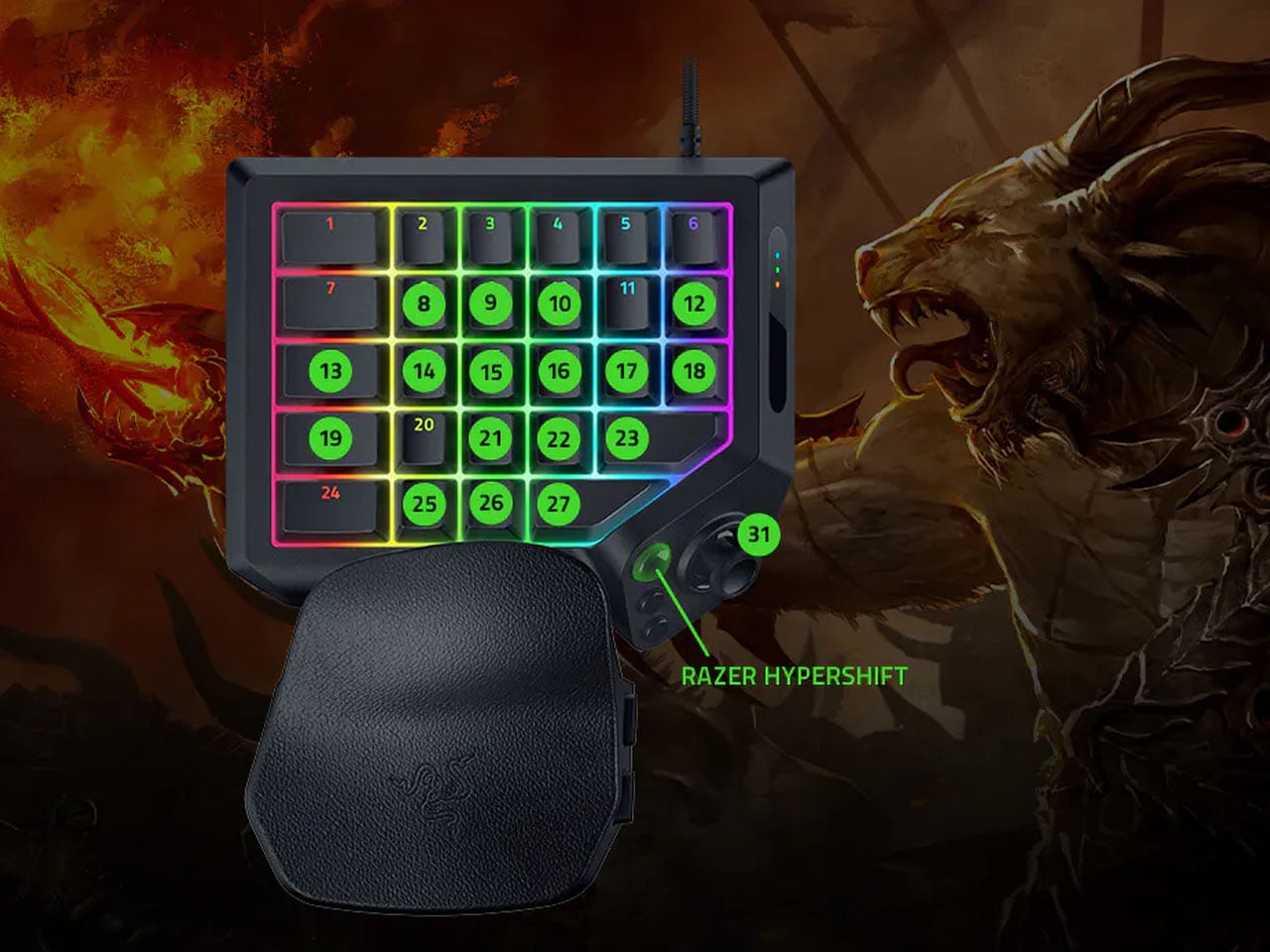
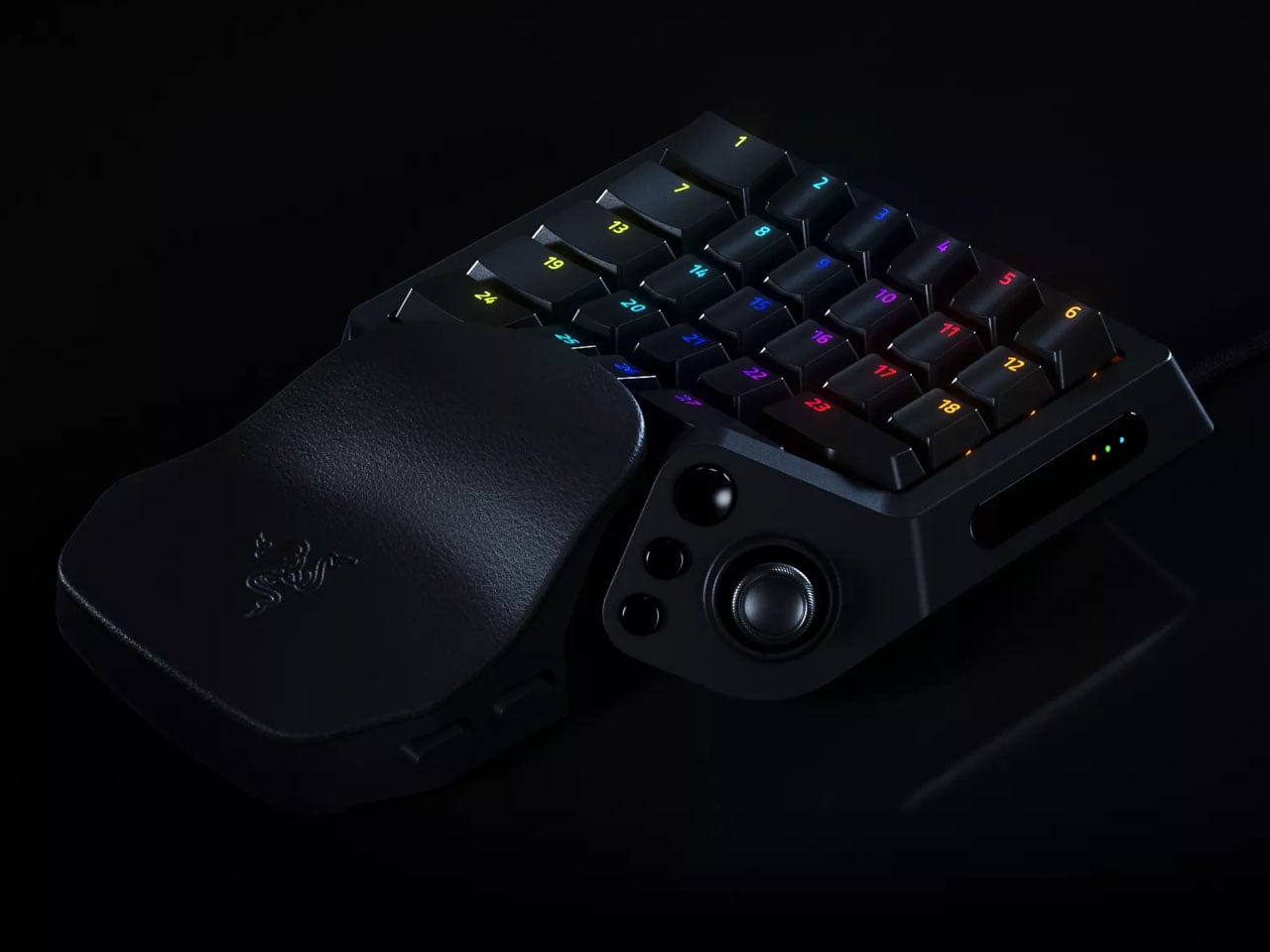
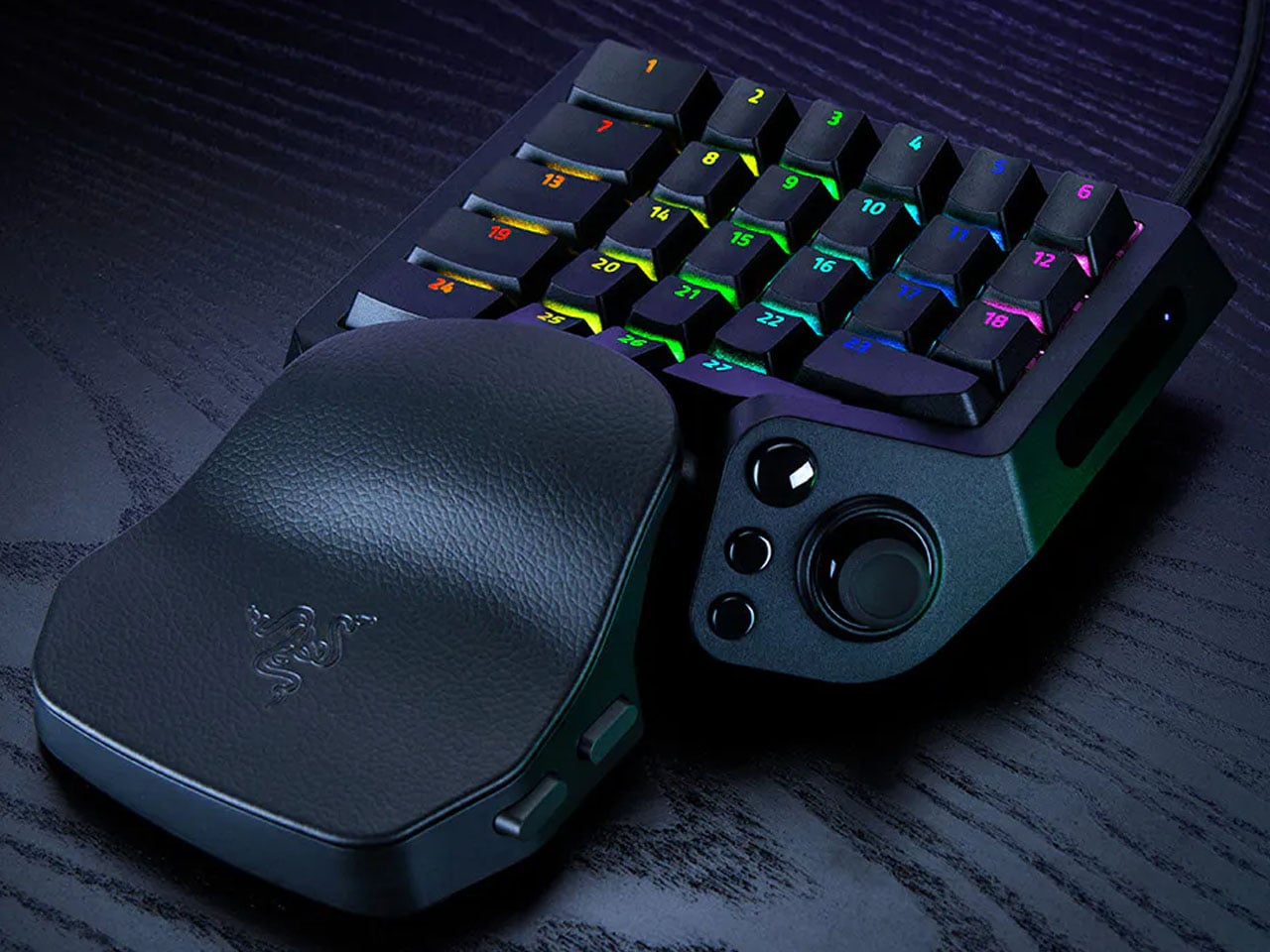
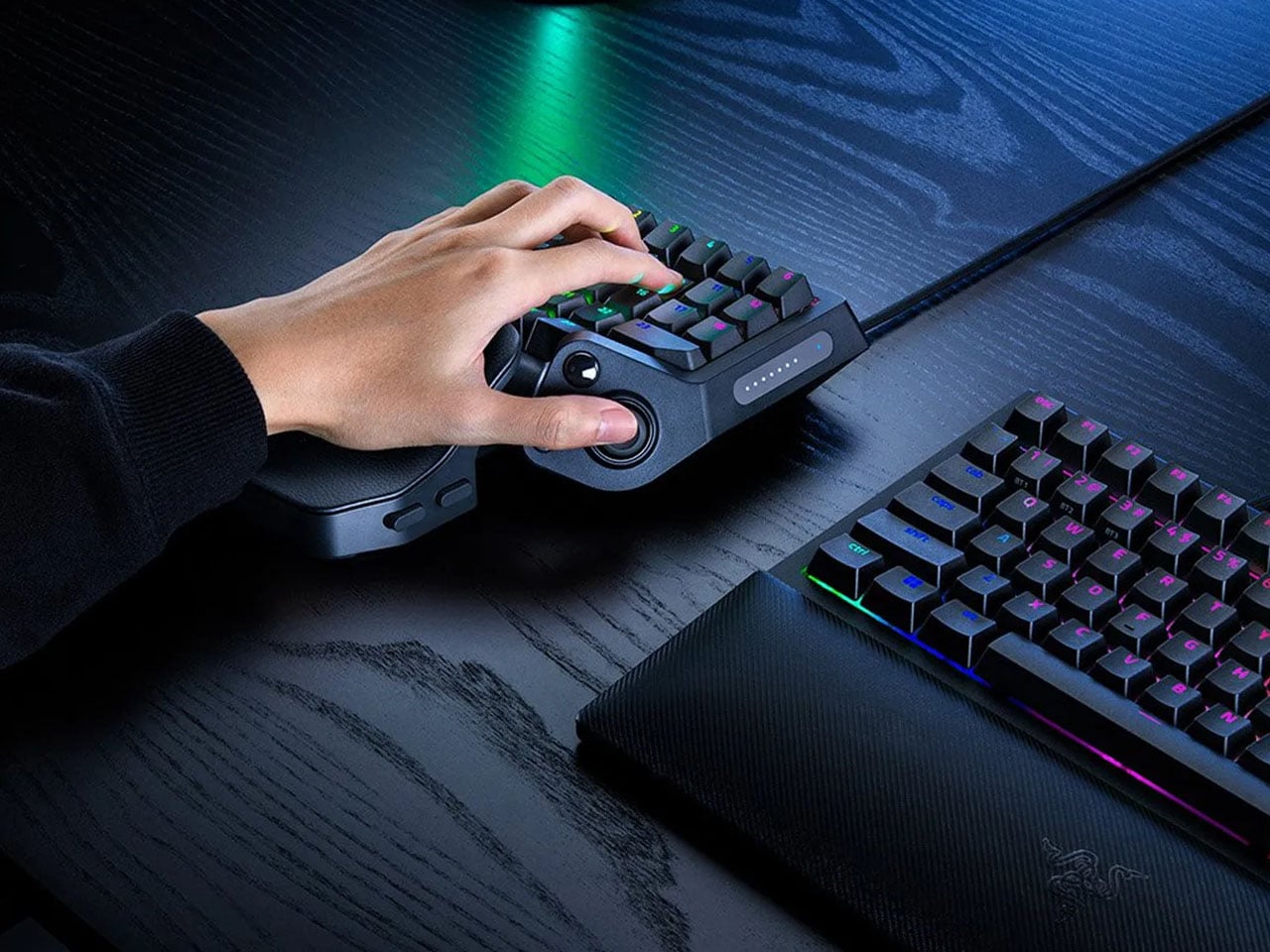
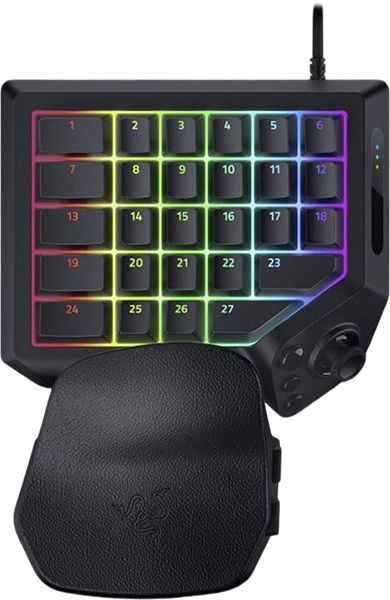
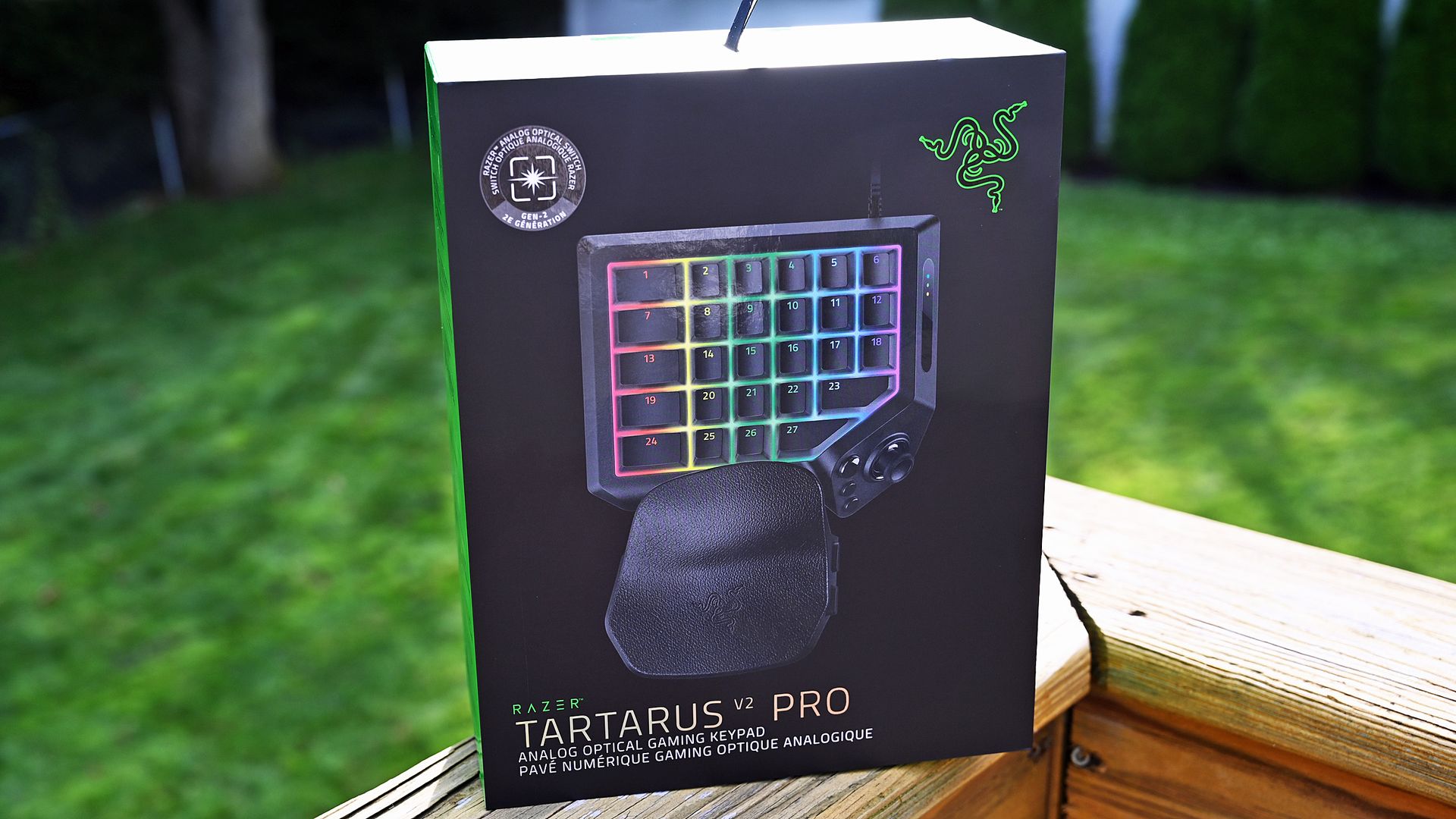
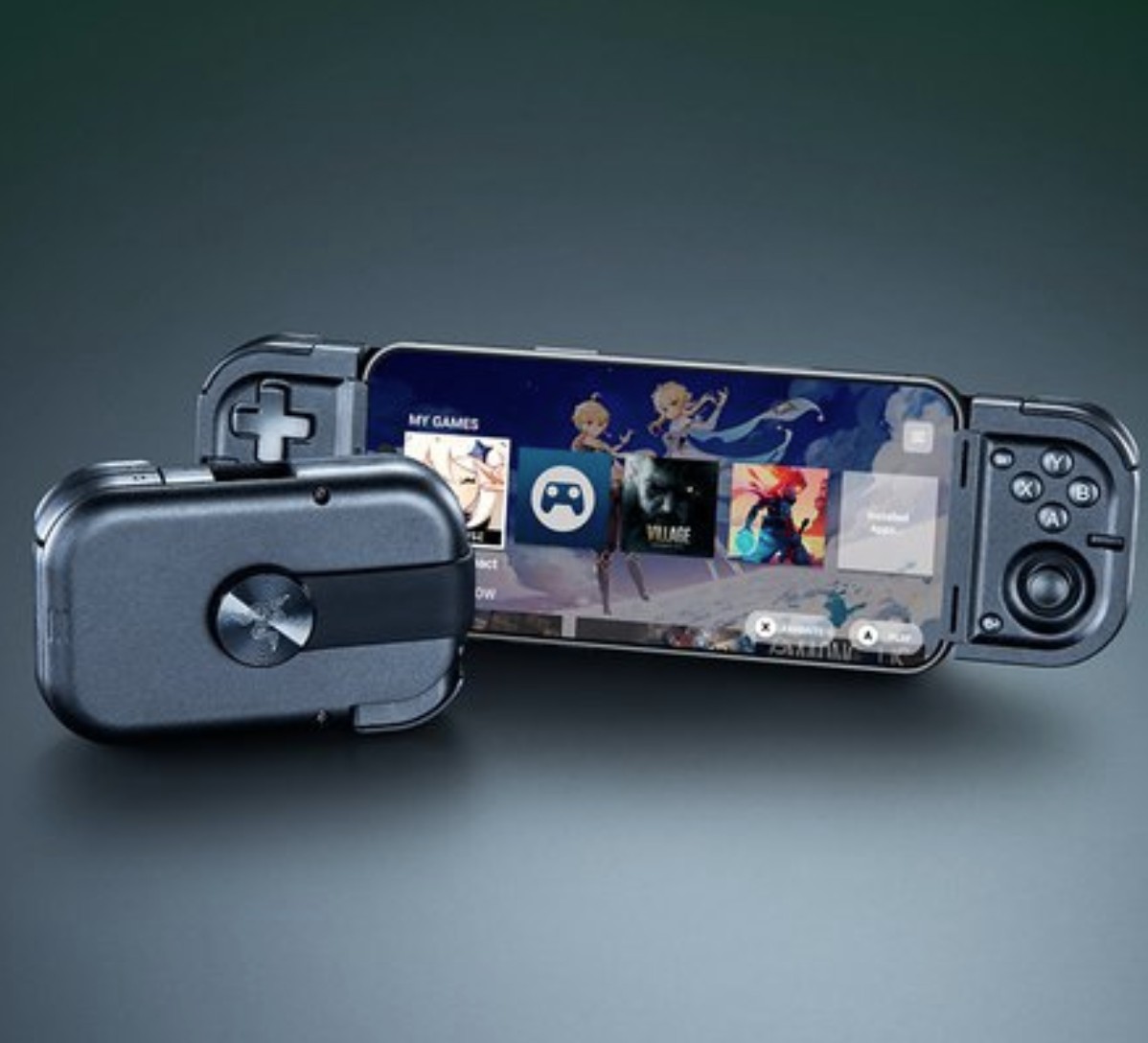
A keyboard can give you plenty of keys, but when you’re gaming, you rarely use all of them. What matters is having the right controls exactly where your hand needs them. That is the idea behind Razer’s new Tartarus V2 Pro, a one-handed gaming keypad that packs 31 programmable controls into a much smaller footprint while adding a proper analog thumbstick, something most keypads don’t have.
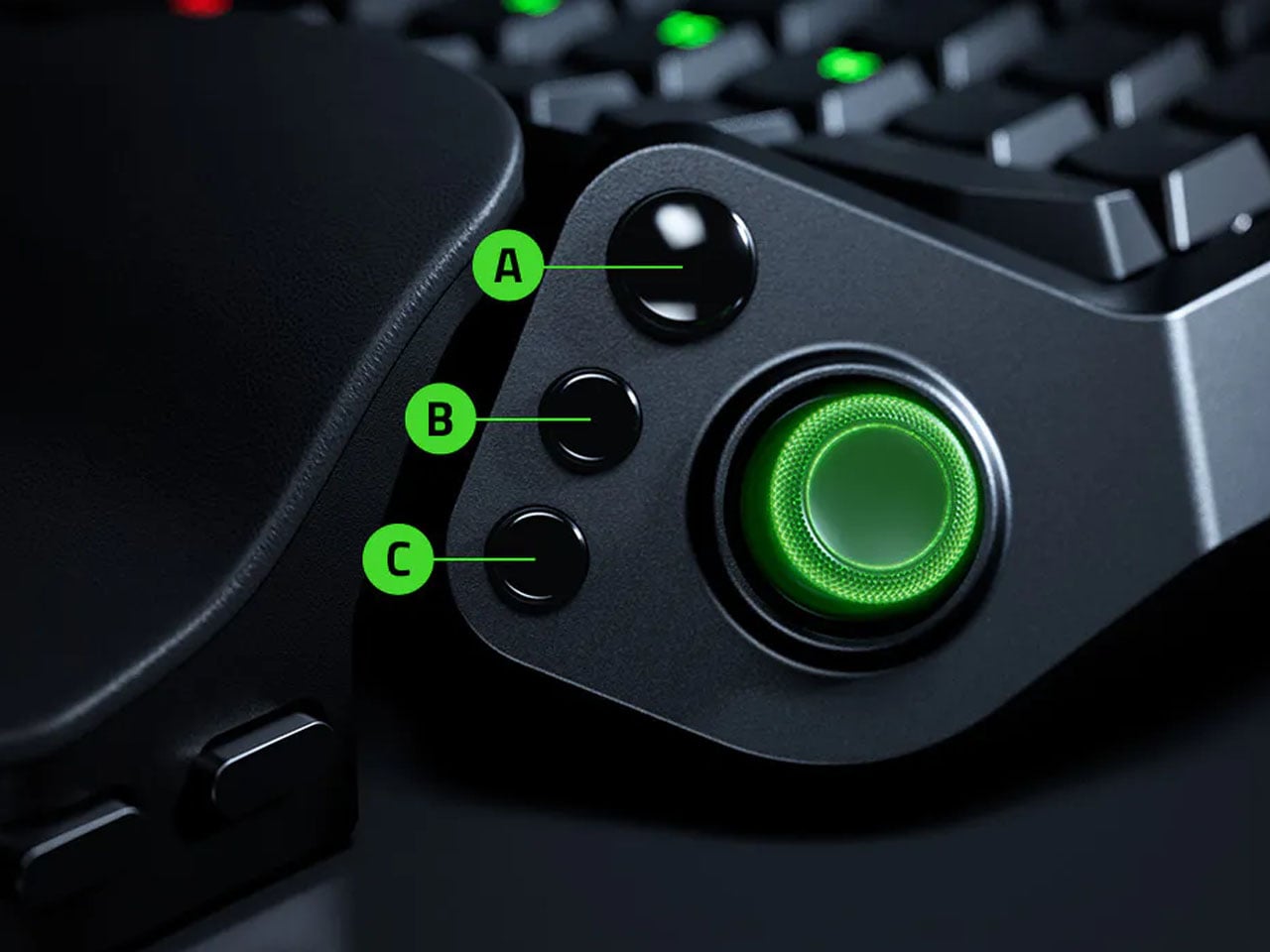
The thumbstick is one of the more interesting bits of the accessory. It uses TMR technology with anti-drift positioning and sits alongside three dedicated thumb buttons, giving the left hand a combination of keyboard and controller-style controls. The stick can handle movement, but it can also be assigned to other commands, making it useful for games that rely heavily on shortcuts, radial menus, or multiple simultaneous inputs.
Razer has also moved beyond the usual mechanical-switch approach, as Tartarus V2 Pro uses second-generation Analog Optical Switches that can recognize how far a key is pressed. Their actuation point can be adjusted anywhere between 0.1 and 4.0 mm, allowing the keys to be tuned for either quick, light presses or a more deliberate response. Rapid Trigger goes further by detecting upward movement as small as 0.1 mm, which can make repeated inputs feel considerably more immediate. Razer rates the switches for up to 100 million keystrokes.
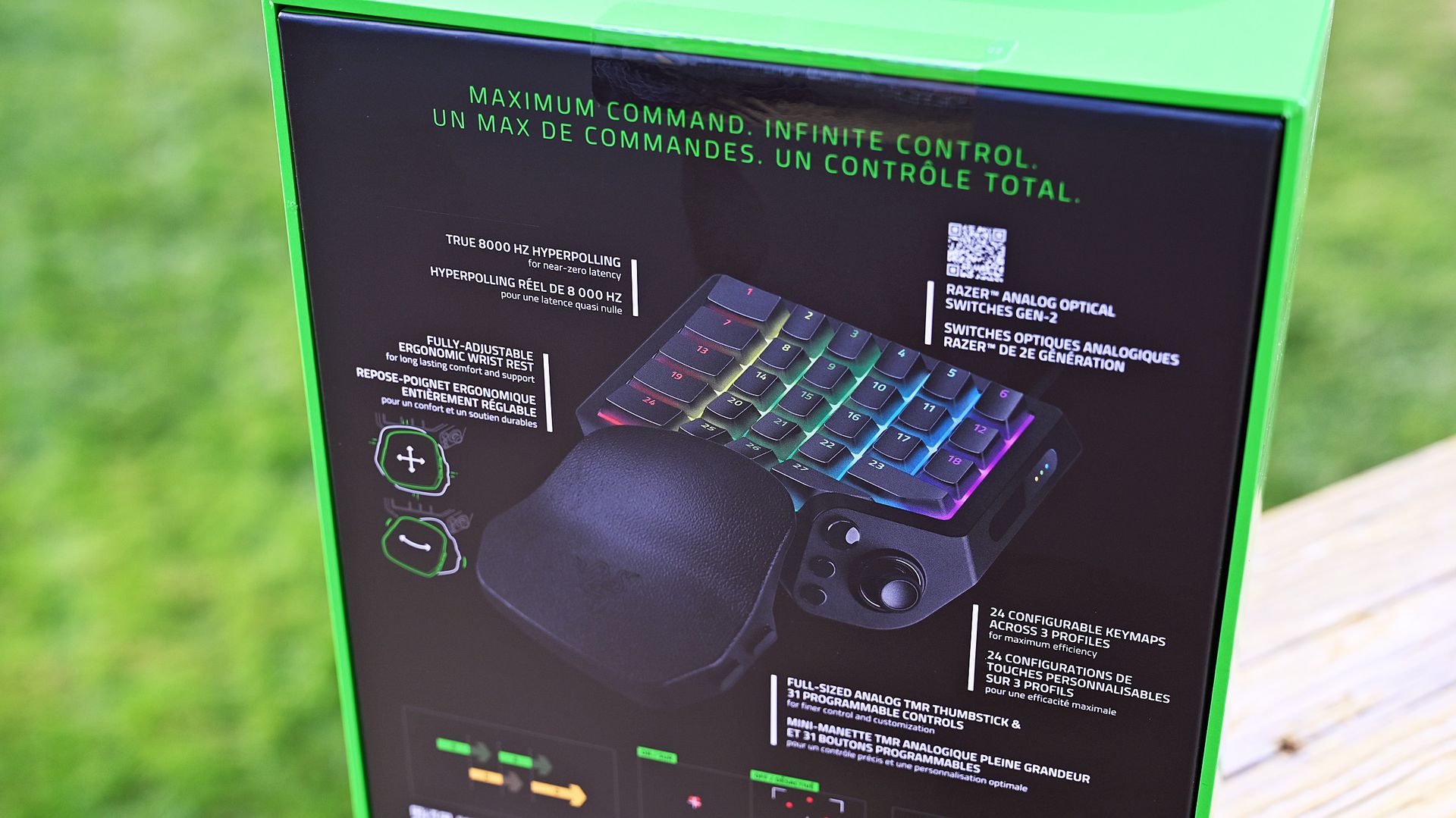
There is plenty of control over how those inputs behave as well. Razer’s Advanced Input Control features include Snap Tap, Snap Flex, Dual-Keypress Priority, and Dynamic Keystroke. These allow players to change the way directional inputs work, prioritize simultaneous key presses, or assign different actions depending on how far a key is pressed. The wrist rest can slide outward and rotate from side to side, so the position of the hand can be adjusted instead of forcing it into one fixed angle. The keypad uses textured doubleshot PBT keycaps and a 5052 aluminum alloy top plate, with Chroma RGB lighting adding the familiar Razer touch.
True 8000 Hz HyperPolling is built in, while Razer Synapse handles deeper customization. Players can create up to 24 keymaps across three onboard profiles, with actuation and Rapid Trigger settings adjustable to suit different games. An onboard LED array also provides visual feedback without needing the software open.
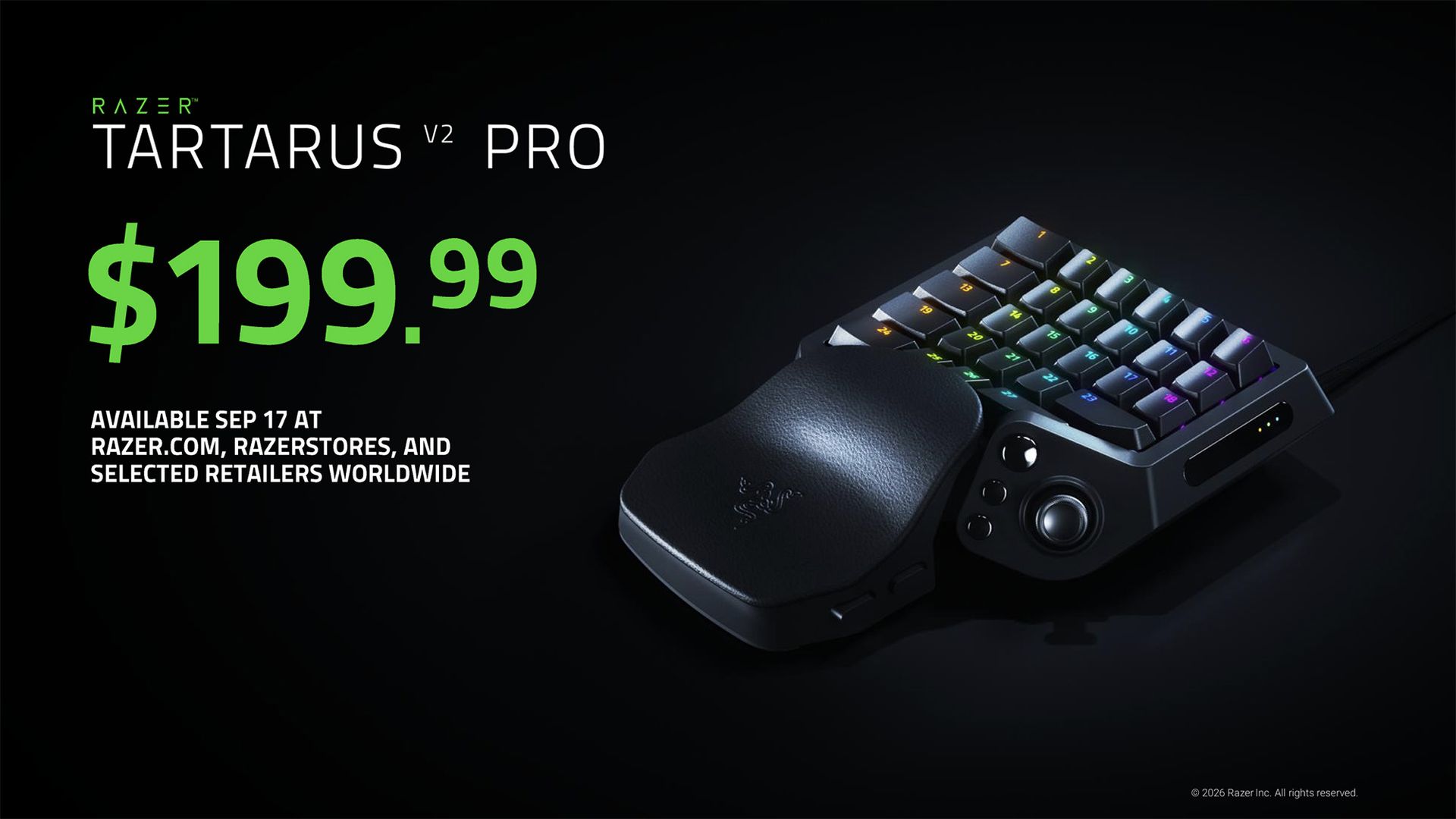
At 211 × 159 × 49 mm and 486 grams, Tartarus V2 Pro takes up far less desk space than a conventional keyboard. Priced at $199.99, the gaming accessory changes how the player’s hand interacts with a game. Instead of reaching across a keyboard for commands, movement, and shortcuts, the controls are gathered into one compact surface designed specifically around that hand.
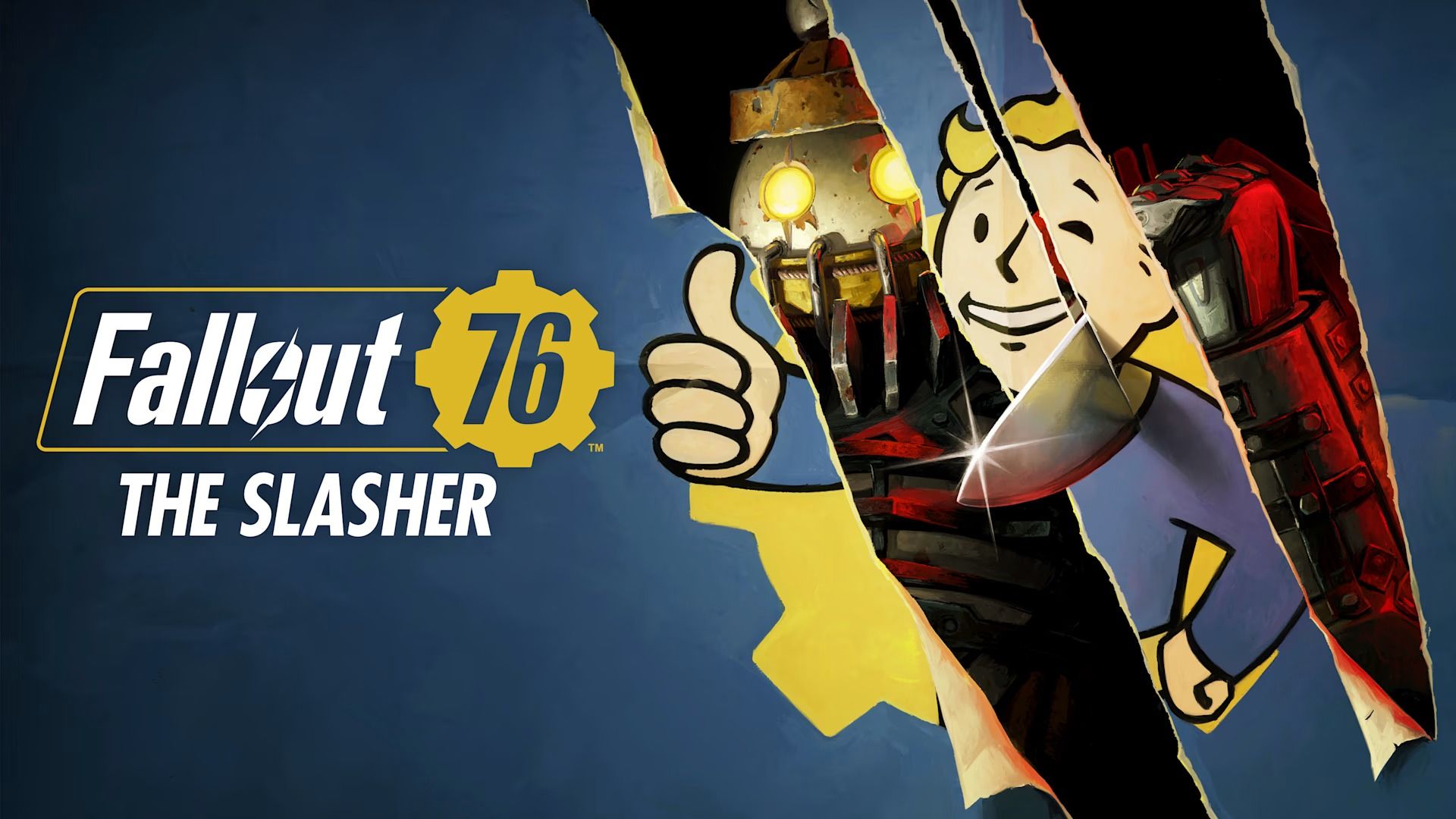
During the Xbox Tokyo Game Show 2026 showcase, Fallout 76 appeared with a trailer for a content update called 'The Slasher' where players are tasked with hunting down the titular serial killer in a new questline.
However, this newly implemented update has a massive, Fatman Nuke-sized bombshell feature that Fallout fans have been waiting for for years: native Xbox Series X|S support.
That's right, you can run Fallout 76 on modern Xbox consoles (and PlayStation 5) and take full advantage of their hardware to play the game at 60fps and 4K resolution on compatible TVs.
Slasher villains and next-gen support aren't the only new pieces of content in this update. The Fallout 76 'The Slasher' update also includes:
Improved weapon crafting so that Unique weapons and armor can have their Legendary Mods changed and have a 4th Legendary Mod added to them.
Legacy Seasons, which will bring back one past season to run alongside a current one for players who missed out on it. The first Legacy Season will be 'Armor Ace and the Power Patrol in Cold Steel' and will last for the entirety of Season 26.
Season 26: Beware the Blood Moon, which will reward Halloween-themed items.
New Seasonal fish will appear on September 22, 2026 (visit Captain Raymond for clues on where to find them).
On top of that, the update has a ton of bug fixes and balance change patch notes which you can read in their entirety on the Fallout 76 website.
Windows Central's take
I don't play Fallout 76, but I do remember my friends playing it when it first came out in 2018 and bemoaning that it didn't receive Xbox Series X|S support as the consoles were released shortly after Fallout 76 did in 2020.
So I'm betting they're pretty stoked to see this game finally get smooth 60fps with 4K resolution on Xbox Series X|S so they don't have to dodge Super Mutants and Deathclaws with sub-30fps anymore.
What do you readers think? Are you happy Fallout 76 can finally be played at a smooth 60fps with 4K resolution? Are you still playing Fallout 76 after all these years?
If you have any thoughts on the matter, please let us know in the comments section, poll, or through our Reddit page linked below.
Join us on Reddit at r/WindowsCentral to share your insights and discuss our latest news, reviews, and more.
I’ve never really gravitated towards the MOBA genre. The borderline toxic finger-pointing from teammates, and the steep learning curve hasn’t made them very approachable at least for me.
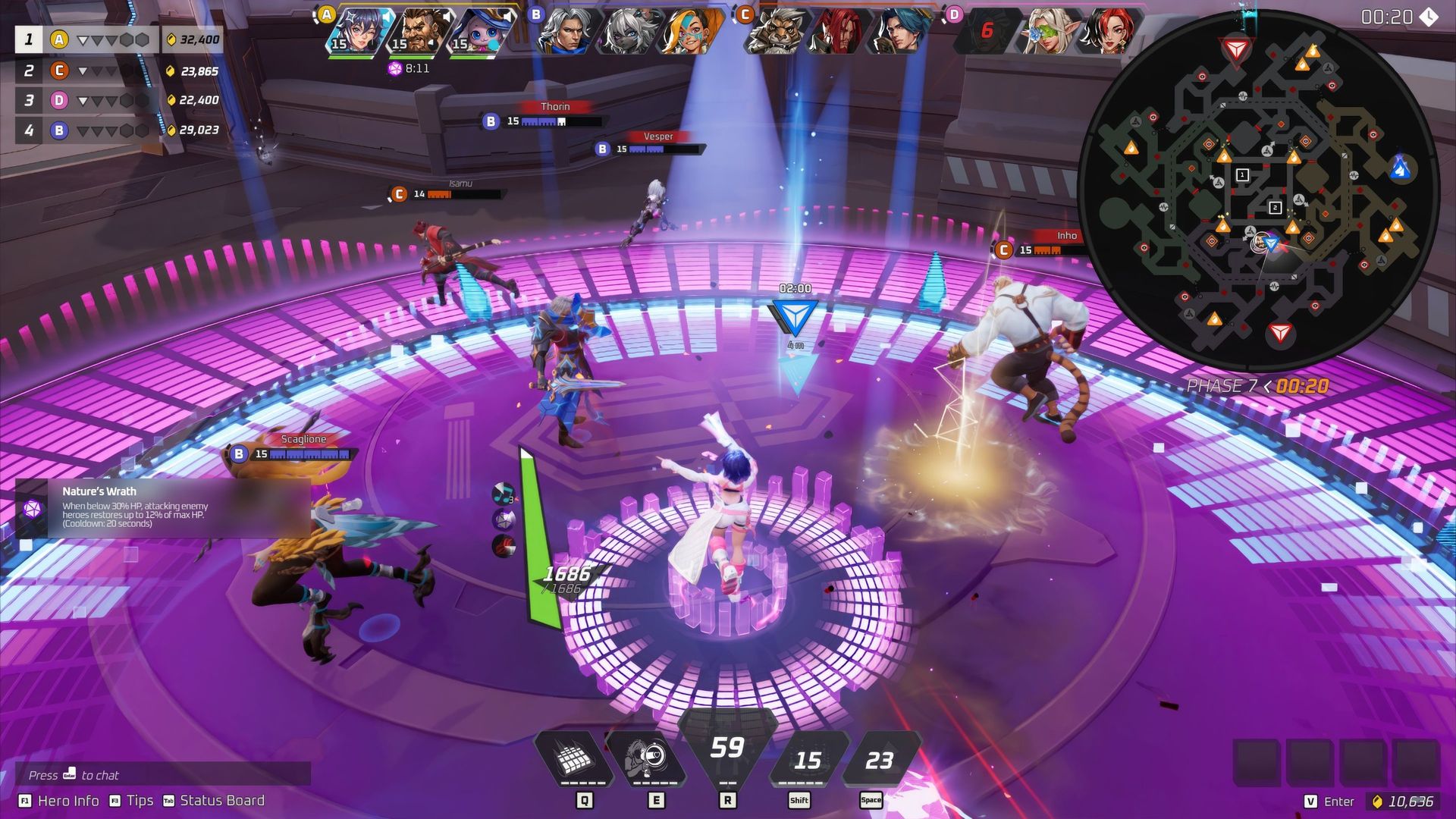
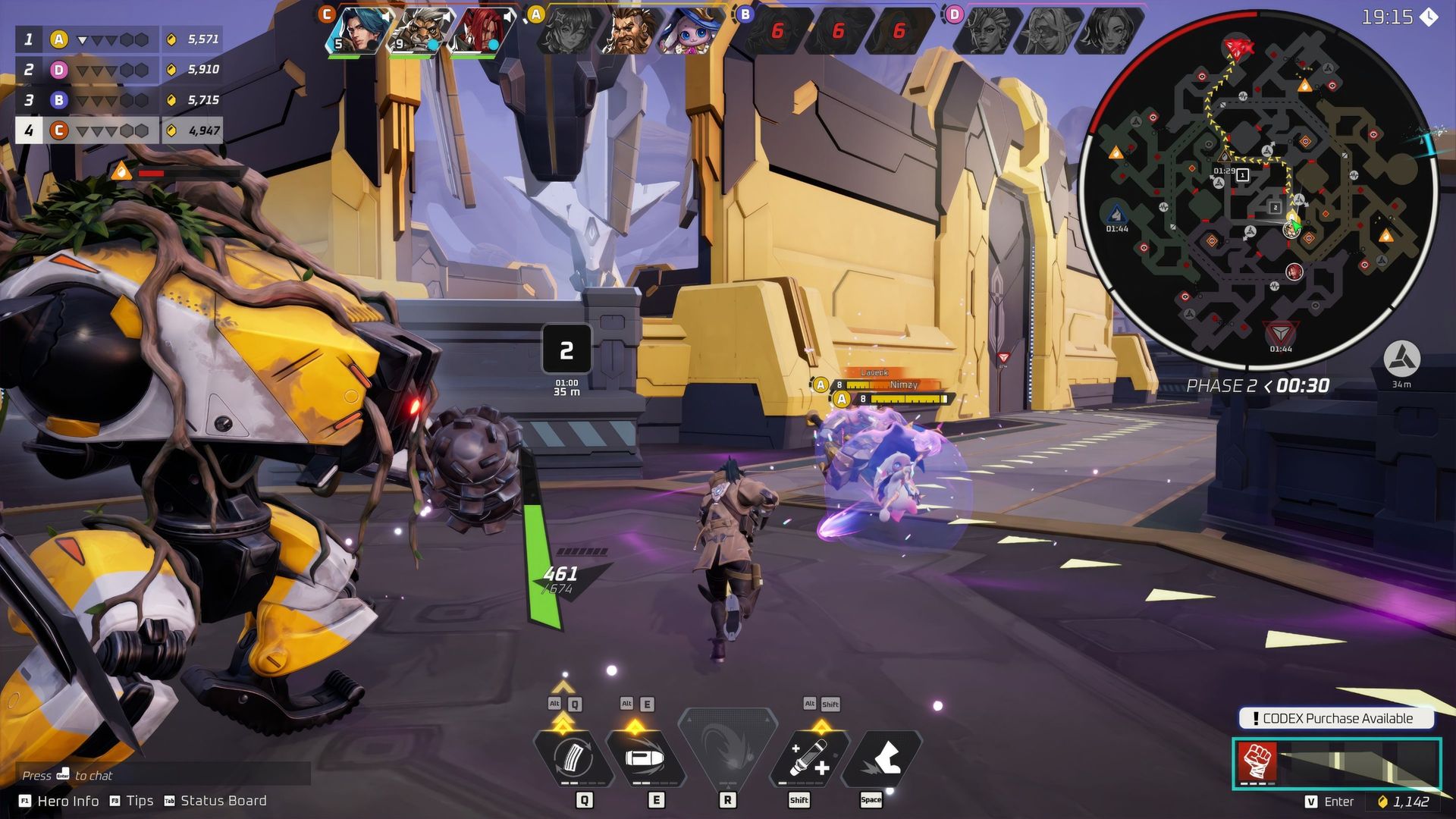
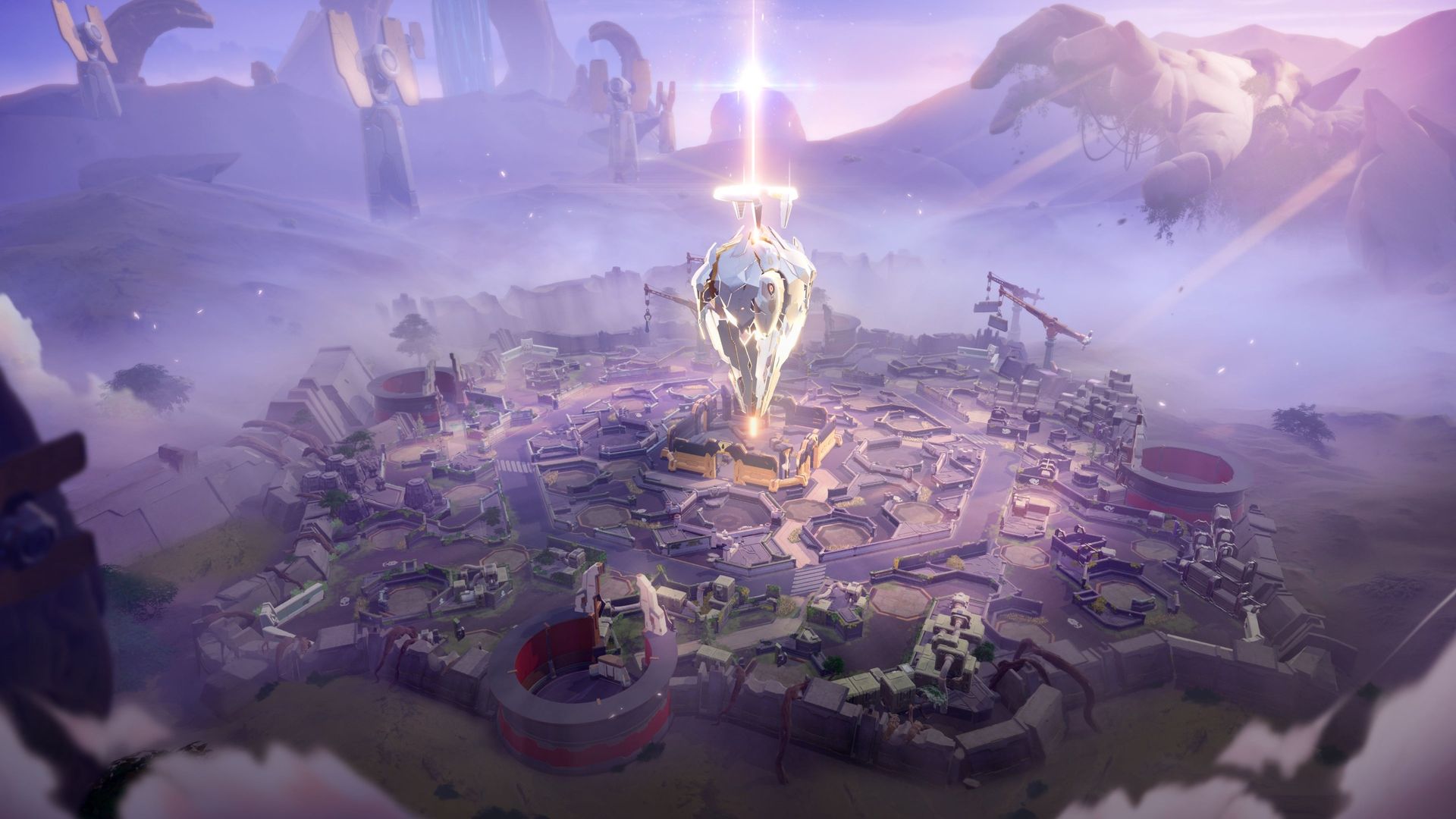
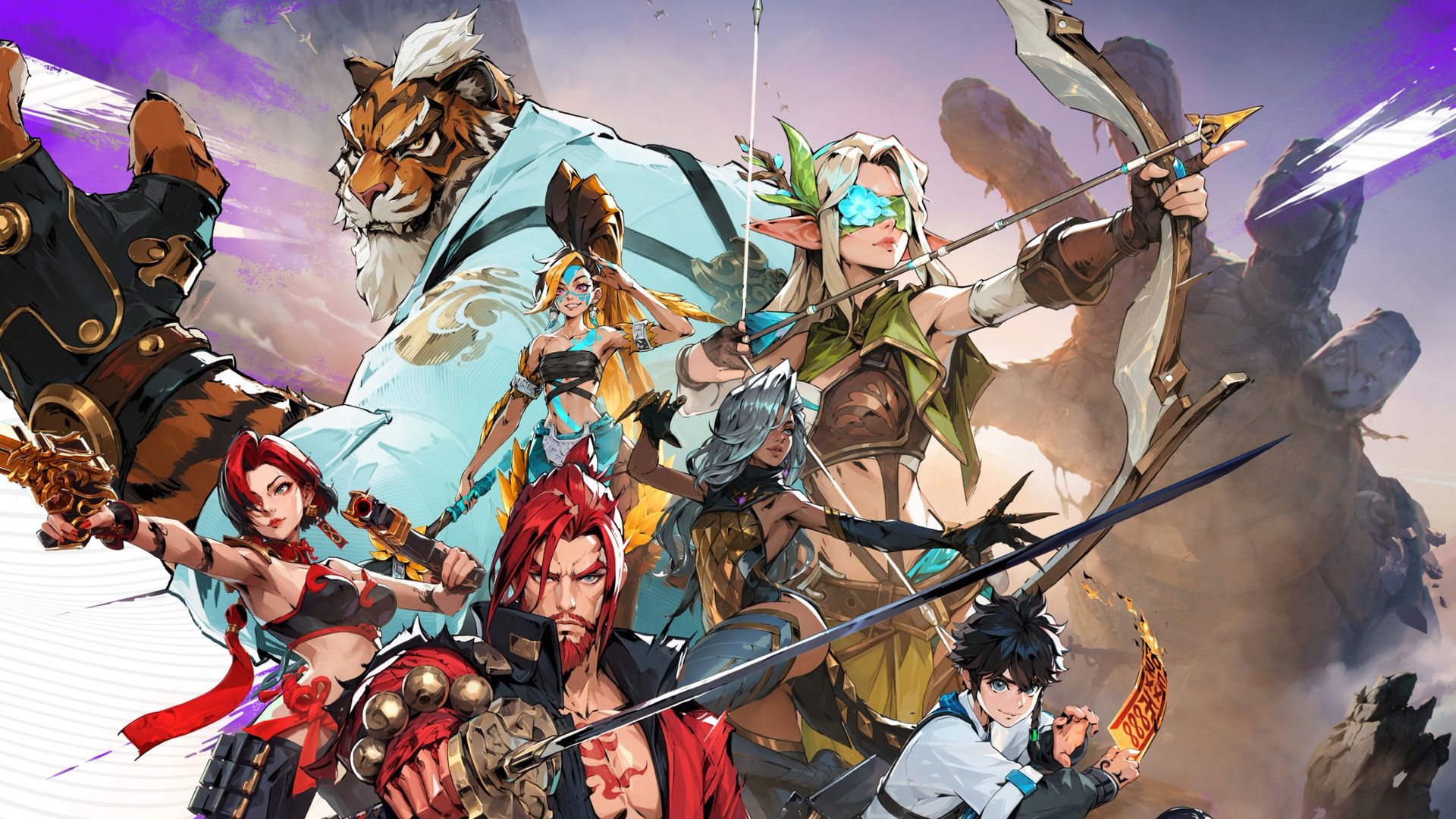
While at Gamescom 2026 though, I got to check out Project Zeta, published by Krafton and developed by a group of industry veterans at NIRVANANA. Project Zeta sounds a bit like one of those insane CES Razer concepts, but it's a game that pledges to shake up the MOBA genre completely and throw out the rulebook.
Four teams and zero laning
While I didn't get to go hands-on with the game myself, I sat down with the developers to pick apart what makes this upcoming multi-team tactical arena different to the MOBAs that have come before it.
The developers opened with an interesting elevator pitch. “Imagine dropping MOBA heroes straight into a Formula One race.”
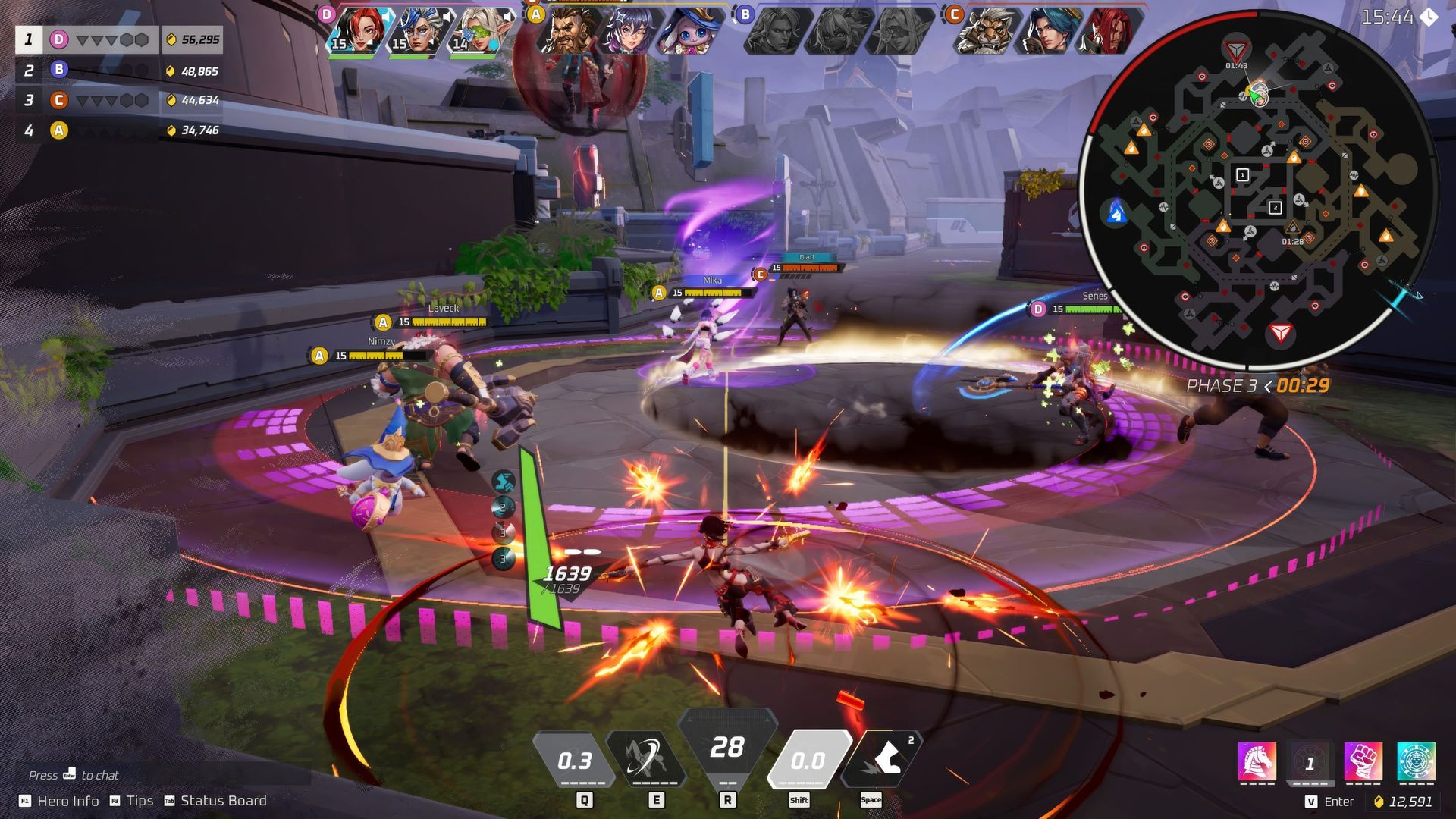
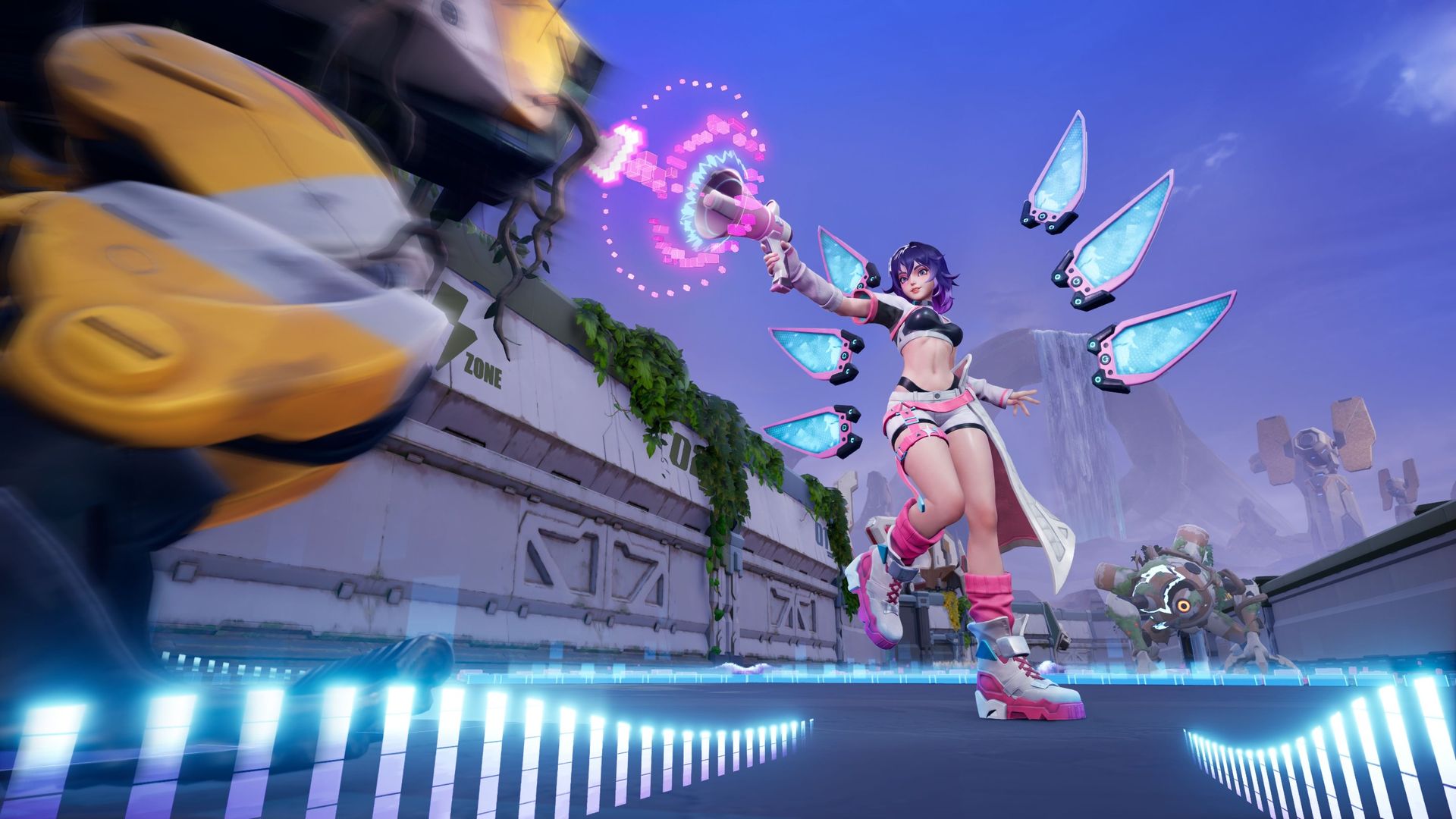
Coming to PC and PlayStation 5, Project ZETA drops four teams of three players onto the Aran Plateau for breathless, roughly 20-minute matches. Unlike traditional MOBAs that lock you into rigid lanes and slow early-game farming, ZETA features no laning phase whatsoever., you’re straight into the action.
KraftonKraftonKrafton
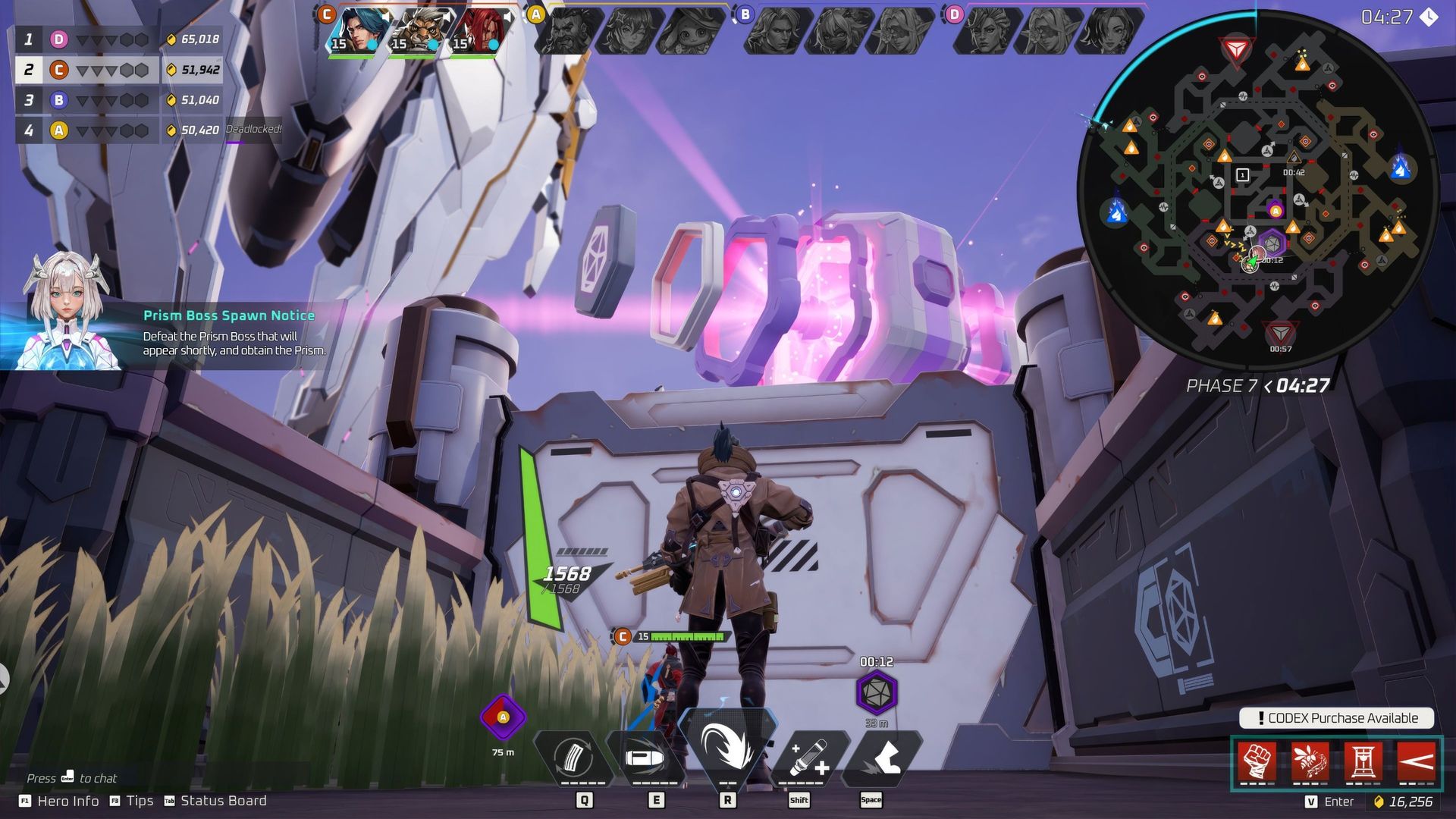
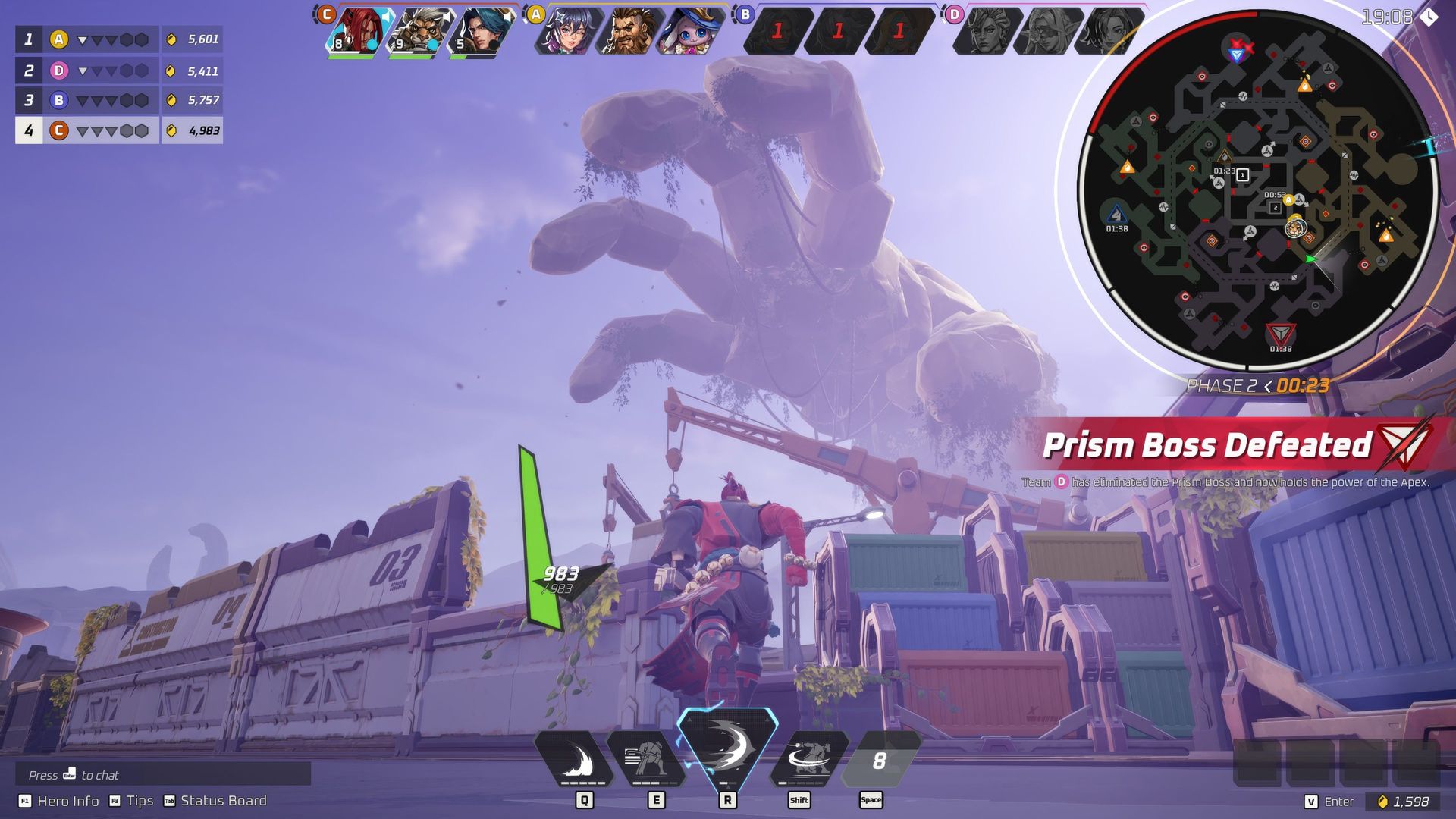
The map is immediately open and alive from the jump. Matches are broken down into active phases where players scrap for ordinary monsters and shards to level up. The primary objective is to hunt down Prism bosses spawning on the map, grab the dropped Prisms, and haul them to the central ballast to score. The first team to lock in five Prisms wins the match.
Having four squads on the map instead of the usual two completely shifts how a match plays out. The developers pointed out a neat psychological trick they are using here: Spreading the competition across multiple teams means your frustration naturally targets the rival squads out to get you, rather than bleeding out into arguments with your own teammates.
Fighting spirit and the Art of the Deca-kill
KraftonKraftonKrafton
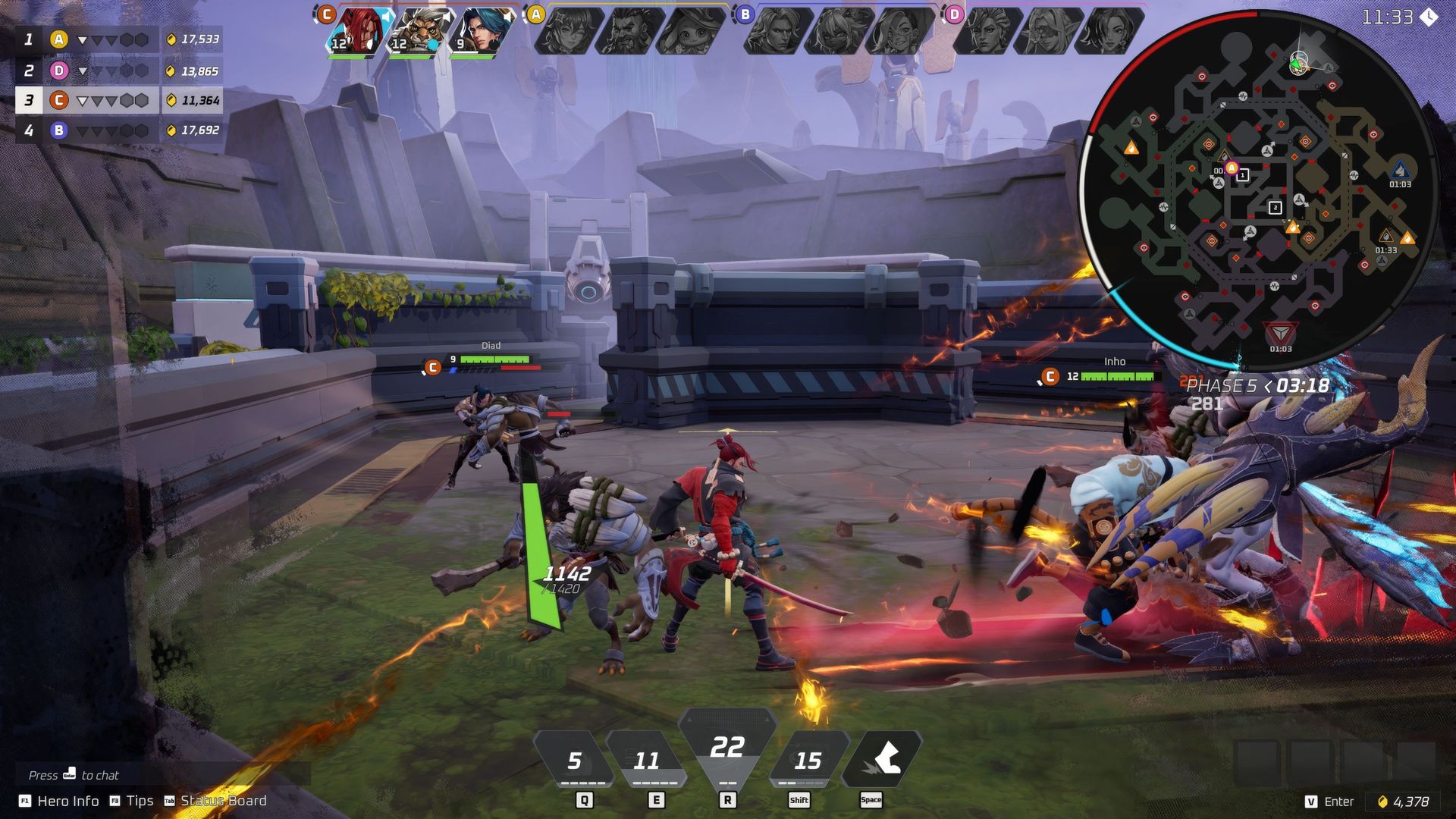
The pacing feels entirely different too, mostly because of how death is handled. Traditional tactical games usually force people into ultra-passive habits where a single misstep gets you sent back to the lobby. ZETA avoids that entirely with unlimited respawns and manual teammate revivals.
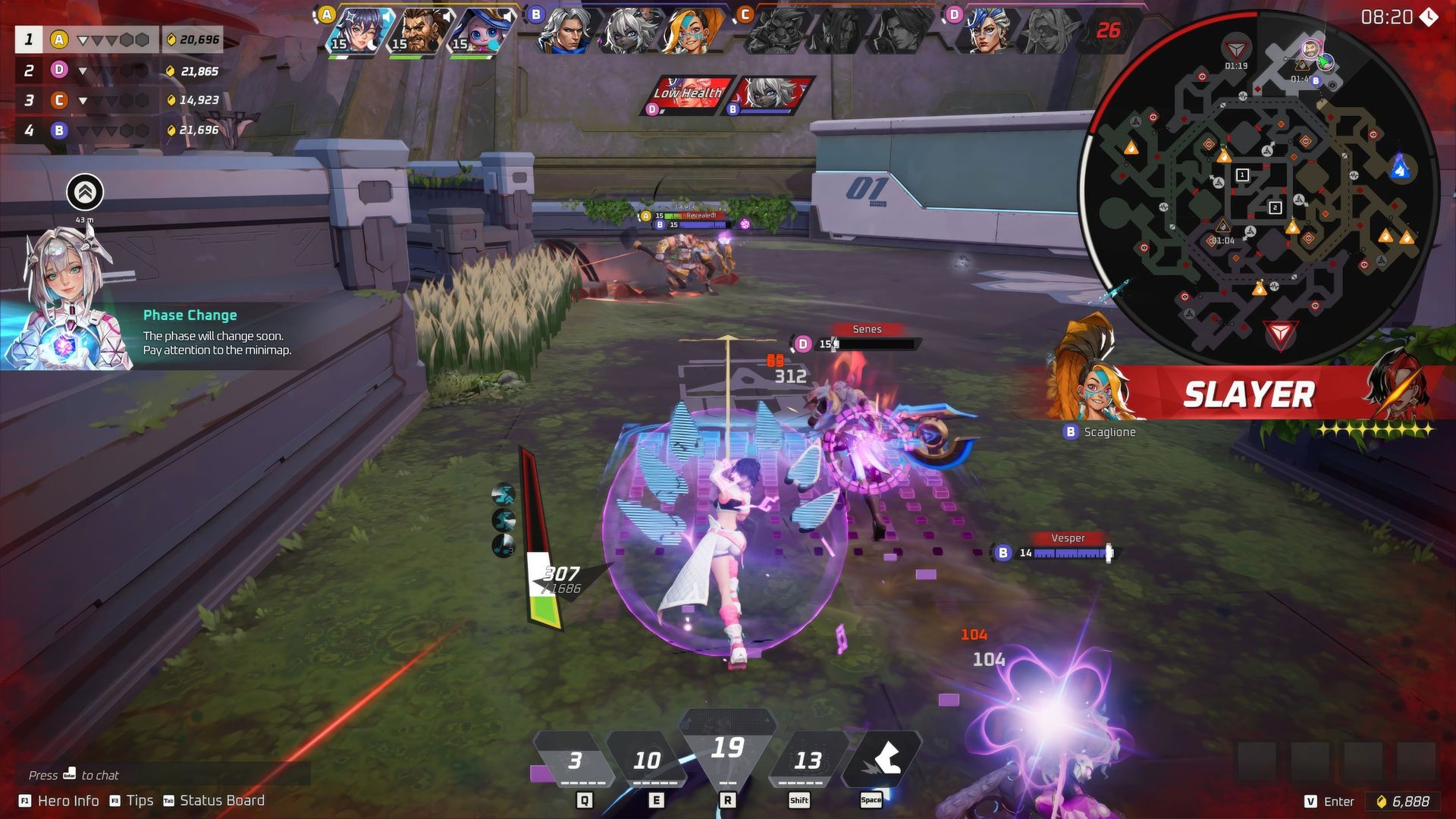
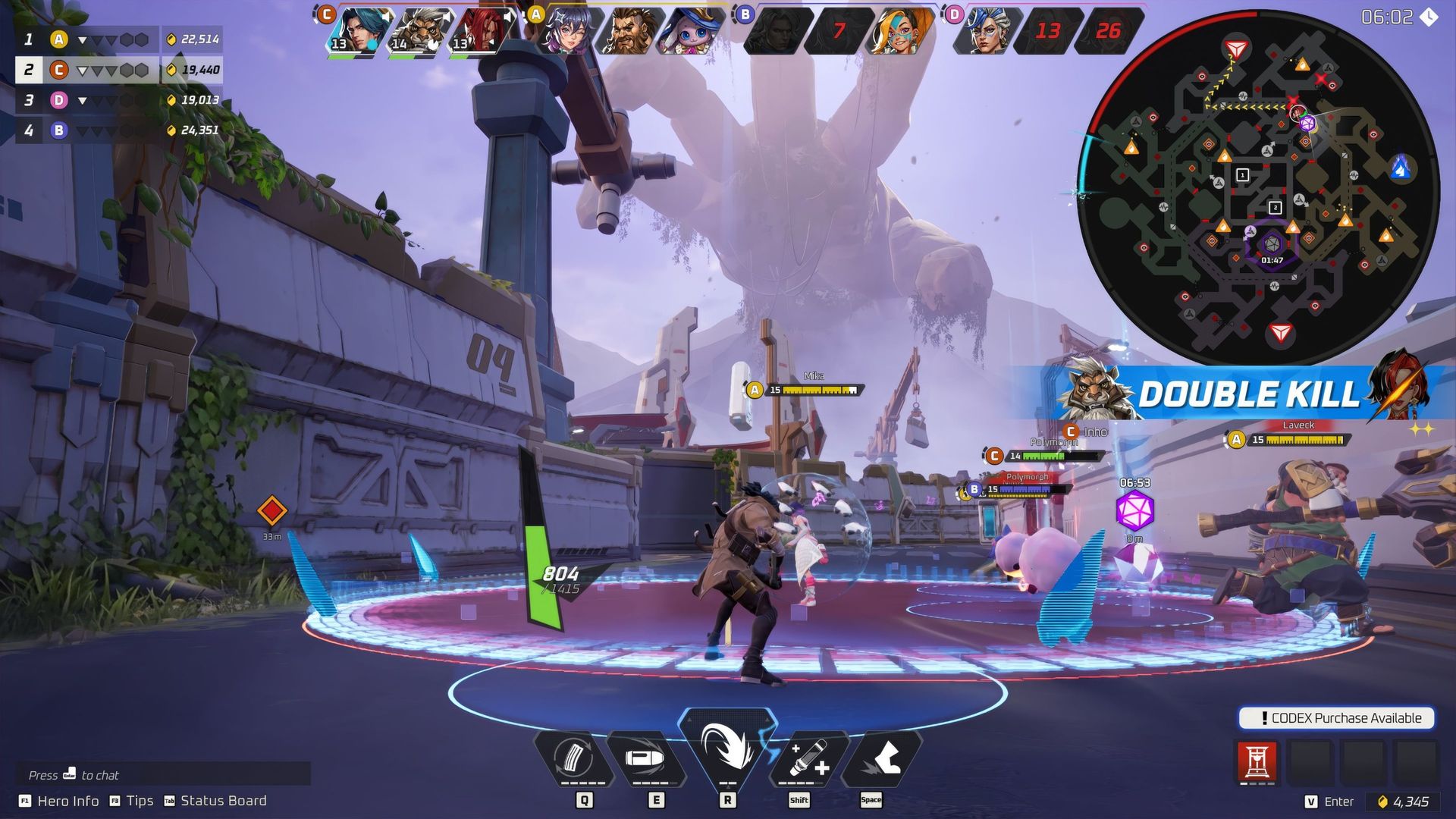
Even cooler is the Fighting Spirit mechanic. When a team manages to completely wipe out an enemy squad, they are instantly rewarded with fully restored health, refreshed cooldowns, and revived teammates. This keeps the momentum driving forward and opens the door for rare big highlight plays like Deca-kills, where you rack up ten rapid kills in a single window. Reviewers testing the game have aptly nicknamed it the "espresso MOBA" compared to the slower, more traditional "Americano" style of its predecessors.
Shrinking maps and tweaking the scale
KraftonKraftonKrafton
Making a brand new competitive game is never a straight line, and Project ZETA has changed a ton over its four years in development. After early playtest feedback, the team made major adjustments.
Most notably, they shrunk the map down to a third of its original size and cut the team count from five to four. Those were aggressive cuts, but they did it on purpose to eliminate dead space and force nonstop, high-intensity scraps.
Built for accessibility
(Image credit: Krafton)
Unlike traditional PC MOBAs that need a keyboard and a mouse packed with macros, ZETA was built from day one to feel smooth on a controller, complete with cross-play between PC and PlayStation. (So you won't need this bonkers Razer Tartarus V2 Pro to play it.)
Looking ahead, NIRVANANA wants to keep the meta alive by regularly dropping new heroes (like Nova Crush and the assassin Azrakall) alongside terrain changes and shifting boss patterns that mix up which characters have the upper hand from season to season.
Whether it turns into a massive esports staple or just the go-to fast arena fix for streamers, Project ZETA definitely isn't playing it safe. The developers are targeting an early access launch for late 2026, and you can wishlist the game on Steam.
Join us on Reddit at r/WindowsCentral to share your insights and discuss our latest news, reviews, and more.
Alongside the new, and honestly quite epic-looking, campaign trailer for Call of Duty: Modern Warfare 4 that was released during the Xbox Tokyo Game Show presentation, we have some comments on the future of one of Microsoft's crown jewels.
Underneath the X post publishing the trailer on the official Call of Duty account, Modern Warfare 4 players are invited to "witness the epic conclusion".
The latest game does indeed follow Modern Warfare 3 and the storyline first introduced when the franchise was rebooted back in 2019, and all signs point to this being the final entry in a now quadrilogy.
You could read into this however you wish. It's obviously bringing the current series to a close, but does Modern Warfare still have a future as a franchise?
What we do at least know is that Call of Duty 2027 is being made by Sledgehammer Games, and we're anticipating a new sub-series, the first in six years by that point from Sledgehammer last introducing the newness that was Vanguard.
Will Modern Warfare 4 be the last we see of the franchise, or will it just get rebooted again? (Image credit: Windows Central)
I think now is the time to draw the curtain on both Modern Warfare and Black Ops, in all honesty. Since 2019 we've had four Modern Warfare games, three Black Ops games, and Vanguard.
The complaints will never go away, though, whatever Call of Duty does. But I genuinely think that Modern Warfare and Black Ops fatigue, even if subconscious, is partly at fault. By October 23, these two series will have resulted in 14 of the 23 total Call of Duty games we've had.
Business-wise, it's easy to see why. The likes of Ghosts, Advanced Warfare, and Infinite Warfare weren't as well received, nor were WW2 or Vanguard. But I'm convinced now that we've played more than enough Modern Warfare and Black Ops for a while. Unless the original Black Ops games are to get remakes, I don't think we need to see it again for some time after back-to-back years.
And that's the other thing. The last five years have seen back-to-back Modern Warfare titles, then back-to-back Black Ops titles, before going back to Modern Warfare again. They're clearly the most successful by a number of metrics, but it isn't going to last forever.
Campaign aside, Black Ops 7 hasn't been a bad game at all. (Image credit: Xbox Game Studios)
I do think there's an element of rose-tinted glasses, too. Modern Warfare (2019) is looked upon very highly, but we also need to remember that it, and Warzone that came in the same year, was around at a time we were all locked indoors with nothing to do. Personally, I didn't take to the all-new Modern Warfare coming after Black Ops 4 and ended up having some time away from playing Call of Duty entirely.
Treyarch has already teased that the studio is ready to make "something new and something that nobody's ever experienced before" when it comes back around to its turn for Call of Duty in a couple of years.
I will close, though, by saying that I have (mostly) enjoyed Black Ops 6 and Black Ops 7, and the latter I don't think is deserving of a lot of the negativity thrown its way. But it is time for something new, something that isn't Black Ops or Modern Warfare, and frankly, something that doesn't feel like it's built entirely to provide a platform for Warzone.
What that looks like only time will tell, but if Microsoft wants to keep its golden goose going strong, it needs to take some risks. I'm already of the mind that not putting Modern Warfare 4 on Game Pass is going to affect its player count, especially given GTA 6 launches less than a month later. I guess we'll see what happens.
Join us on Reddit at r/WindowsCentral to share your insights and discuss our latest news, reviews, and more.
The future ironically lies in the past, as WoW players finally get their wish: a version of the game inspired by the Classic era, albeit with new dungeons and raids, refreshed visuals, new storylines, and new class balancing.
World of Warcraft: Forever launches in November, but I got an opportunity to speak with World of Warcraft Game Director Ion Hazzikostas to learn all about what the future holds for the franchise in general, and answer some burning philosophical questions about the game's direction.
On the popularity of WoW "Classic+", and its future
I remarked to Ion Hazzikostas that I was a tad surprised Blizzard ended on World of Warcraft: Forever rather than StarCraft, which I would've expected to have broader appeal. Hazzikostas remarked upon Blizzard's commitment to the BlizzCon audience and the company's core, who have been very patiently waiting for their answer to "Classic+."
"It's going to be a huge part of the future, and will shape World of Warcraft going forward," Hazzikostas told me, "A big part of it is, that this isn't 'Classic,' right? Classic remains, with Vanilla, Burning Crusade ... that ecosystem will continue. Forever is designed to be a third pillar alongside Retail and Classic."
He explained that WoW: Forever will maintain roots in Classic, drawing on philosophical design ideas pioneered by the old-school version of the game. That means a more grounded storyline, more "crunchy" systems, and a bigger emphasis on community building over auto-matchmaking systems. Although he did acknowledge that WoW Forever will streamline many things beyond Classic. Talent trees and specs will be rebalanced, trying to make every class viable (which was not the case in Vanilla), and things like tedious World Buff farming for raiding will also be removed from WoW Forever.
"There's a large pre-existing audience that has been asking for something like this, who are closely connected to Classic. We are trying to position this as a truly new experience, right? This is a new game. There are new adventures here. Everyone can start at the beginning, and will be updated for years to come. That's not something that comes along very often in World of Warcraft. We've got expansions people have come to expect and re-releases of prior expansions ... but this is something truly new and open-ended. That's quite exciting."
Talking WoW Forever vs. WoW Retail, and community fragmentation
On the topic of something new, as a World of Warcraft retail enjoyer, I couldn't help but wonder if Blizzard is going to end up stretching themselves too thin here. There are already things in WoW Forever that retail players are hoping to see emerge in the modern era of the game.
I asked Ion Hazzikostas pretty broadly, will WoW Forever lead to further degradation of WoW Retail's "social" fabric as players seeking social experiences drain out even more from Retail? I made the point that chat channels on my server on WoW Retail are already dead, and WoW Forever will likely make it even worse.
"Anytime we think about any new WoW experience, even if it's something simple or as like a Plunderstorm or a Remix, we think about fragmentation, the risk of splintering communities — because of how important that is to World of Warcraft. So we do it very carefully."
"In no way, shape, or form, do we see any perceived withdrawal from social systems in WoW retail as desirable, or as a good thing. I think there's a lot more we can and should do there. There are still strong communities in retail, but a lot of that organization now happens outside of the game in Discord. It's inevitable that when you offer more solo convenience and reduce friction, many take the path of least resistance, and you end up with a more solitary experience.
"The presence of friction, the lack of automatic matchmaking ... that lends itself to establishing social connections. It's part of the thing that makes Classic inherently more social. On the other hand, it can be alienating for a number of players. It's inconvenient. It means if you log in and want to run a dungeon on your lunch break, you likely can't. There are inherent trade offs here. There remains very large differences between Classic and Modern, in terms of pace, difficulty, right? People who enjoy gameplay at a cutting edge level, Heroic or Mythic raiding, pushing keys ... that is not what Forever is going to be about."
A world where the outer world is devoid of threats or excitement is missing something. We would never say 'Go play Classic if you want that.' All versions of WoW should have that.
Ion Hazzikostas
Hazzikostas emphasized that Blizzard wants to make WoW Retail a place where you can make new friends too, even in an era where it's designed for maximum convenience. I really wanted to drill down into this point of divergence, though, as the Classic and Modern games develop away from each other.
Does this mean that we should no longer expect the Modern WoW games to get things that are objectively more interesting in Classic, like a more consistent world for leveling alts? A more polished and immersive new-player experience? A more engaging open world?
"No," says Ion Hazzikostas. "We do not think along those lines. Those are problems that I acknowledge are real problems in Modern, and things we want to fix. We've done experiments like the Heroic World Tier in Remix ... I think they're promising. I think we would like to offer something like that in The Last Titan, for people who want a more challenging, rewarding outdoor experience ... as well as more friction, and more purpose. A world where the outer world is devoid of threats or excitement is missing something. We would never say 'Go play Classic if you want that.' All versions of WoW should have that."
Hazzikostas also commented on the difficulty of performing another "revamp" on WoW's modern leveling system for new players, Cataclysm style, noting that it's a "challenging pitch" to ask players to stick through dozens of hours of leveling to catch up to friends. However, he emphasized that Blizzard knows it has "a lot more" work to do to make the new player experience up to par in WoW's modern version, to help players get immersed in their class fantasy, and learn the story.
On the Horde vs. Alliance, and the future of faction identity
Blizzard has worked to de-emphasize faction conflict in recent WoW expansions, to mixed reviews. (Image credit: Blizzard Entertainment)
On the topic of class fantasy, I wanted to ask how Ion and the WoW team are thinking about reactions to World of Warcraft's modern story direction, with Horde and Alliance de-emphasized in favor of a single neutral storyline every player experiences. I asked if the choices therein represent budget constraints ... or something more philosophical.
"It's a bit of both, right? Resources are finite, and while the WoW dev team is bigger than ever, we still have to choose where we place our time and efforts. Building two versions of the levelling storyline inherently means giving players half as much of an experience, times two. But it's also a function of the story, and feedback we do get from our players. If a majority of players were saying they wanted faction conflict, then we'd lean into faction conflict. That isn't what we're hearing ... they want more cross-faction gameplay ... it's also story credibility to some extent. The Horde and Alliance being at each other's throats in the face of world-ending threats ..."
I noted here that I wasn't necessarily talking about Horde vs. Alliance conflict open war, but more about faction identity and world-building consistency.
"Horde and Alliance identity is something we definitely want to preserve," says Hazzikostas. "We want to make it clear that there's a deep history of enmity and conflict here that shouldn't be forgotten or brushed over ... but there is a need to co-operate in the face of ... just as was the case back in Warcraft 3 at Mount Hyjal. Nothing else mattered except saving Azeroth. Given the current storyline, faction enmity gets pushed aside a bit, but they're still there. I think it's something we intend to return to in a more central way further down the line ..."
I'm still not getting my playable ogres ... though ...
Not more elves?!!? (Image credit: Blizzard Entertainment)
World of Warcraft remains near and dear to my heart despite having played it for decades. I'm not always a fan of the game's direction (where are my playable ogres, Blizzard?!), but it remains a valuable source of rest and relaxation for me. I have an awesome guild, made lifelong friends therein, and still find myself as intrigued by its potential today as I was over 20 years ago, which is not something you can say about most games.
BlizzCon offered a glimpse at World of Warcraft's near future, and the franchise's potential more broadly. We're still left wondering what's on the horizon for World of Warcraft: The Last Titan, and what might lie beyond the Worldsoul saga in general.
I'm concerned that Blizzard might split itself too thinly attempting to develop three separate pillars of the game in tandem ... I'm also concerned that community fragmentation may become an issue as players drain out of regular Classic and Retail looking for the "newness" of Forever. But it's also exciting too. I've always hoped Blizzard would look to Classic for inspiration when shaping Retail, because I do think Retail could use a little more danger and immersion. Whether or not we ever get it remains to be seen.
Join us on Reddit at r/WindowsCentral to share your insights and discuss our latest news, reviews, and more.
Today, Razer announced the Tartarus V2 Pro, an ergonomic gaming "keypad" with 31 total programmable inputs, priced at $199.99 (and £199.99 in the United Kingdom) at its online store, physical stores, and partner retailers. It follows the first Tartarus Pro, itself a successor to the original — and its own V2 variant — all built for personalization with a particular audience in mind.
To provide a more personalized fit, the Tartarus V2 Pro features an adjustable wrist rest that can be tailored to different hand sizes and desk setups.
Razer
Fans of MMORPGs such as World of Warcraft (and its many variants, like the anticipated WoW Forever) may recognize the Tartarus and possibly its origins in the Nostromo and Orbweaver. Now, the Tartarus V2 Pro features Razer's analog optical key switches with support for accurate, rapid input and adjustable actuation (multiple inputs on a single key), plus a drift-proof TMR thumbstick.
Offering the same Snap Tap and Rapid Trigger tech we saw in its excellent Huntsman V3 Pro keyboard, the Tartarus V2 Pro also appeals as an ergonomic option for competitive FPS players with its 8,000Hz 'HyperPolling' rate and adjustable wrist rest. Either way, gamers can store up to 24 configurable keymaps in the Razer Synapse companion app to match most genres.
"Grasp the true meaning of command with the Razer Tartarus V2 Pro — our most advanced analog optical gaming keypad."View Deal
Bizarre, niche, and totally fascinating
(Image credit: Razer)
I've glanced at the Tartarus a few times over the years, intrigued by its weirdness. Then again, most ergonomic hardware looks a little strange at first, but you'll probably only understand what it's trying to do once you use it. Sure enough, Razer offered a sample, and I couldn't resist, so keep your eyes peeled for my Tartarus V2 Pro review coming soon.
Frankly, I also have an ulterior motive for wanting to go hands-on with this unusual keypad. My wife is an avid World of Warcraft enjoyer, but she also suffers from chronic joint pain that led her to use the Xbox Adaptive Joystick for over a year. It certainly impressed, and I share the same praise for that joystick today as I did in my initial Adaptive Joystick review.
(Image credit: Daniel Rubino)
However, you'll notice the glaring difference between Microsoft's and Razer's offerings in button count alone. The Tartarus V2 Pro is borderline hilarious in that regard, wrapping 27 keys around your fingertips in a comfortable fashion, with a TMR joystick to boot. In theory, this could be the next step in accessible gaming for her, since she'll barely need to move her hand.
I want it for Counter-Strike 2, but she wants it for WoW. No prizes for guessing which one of us will get more use out of it. Ultimately, I'm craving something more gaming-centric after switching to a low-profile office keyboard and realizing how much that nerfed my experience. The Tartarus V2 Pro might be overkill, or it might be absolutely perfect. I'm excited to find out which.
Join us on Reddit at r/WindowsCentral to share your insights and discuss our latest news, reviews, and more.
Après quatre ans de travail, le bidouilleur canadien DiscoStarslayer
a annoncé
que son firmware du MechaCon était enfin sorti ! Si vous ne connaissez pas le MechaCon, c'est la puce de sécurité que Sony avait posée en 1999 dans les premières PlayStation 2, et c'était encore jusqu'à aujourd'hui, l'un des derniers composants de la console dont personne n'avait pu obtenir le code...
Ce MechaCon tire son nom de la mécanique qu'il surveille, à savoir le lecteur optique et la mémoire flash, sauf que ces petits malins de Sony lui ont confié bien plus que ça... En effet, cette bestiole sais déchiffrer les cartes mémoire MagicGate, et surtout c'est elle qui décide si le disque que vous venez d'insérer est authentique ou pas. Donc une PS2 dont le MechaCon est raide mort, ça devient une jolie brique
La puce, soudée sur une carte mère Sony de 1999 (
Source
)
Pour aller lire dedans, il a fallu y aller à la manière forte... La puce a donc été ouverte chimiquement pour mettre le silicium à nu, puis lue au microscope. C'est une opération délicate qui consiste à recopier optiquement le contenu de la ROM directement depuis le circuit. C'est lent, et c'est source d'erreur, mais ces dumps crasseux n'étaient pas le but, mais plutôt le moyen... En effet, Libby, un autre hacker qui a collaboré au projet, y a trouvé une faille exploitable, et c'est cette faille qui a ensuite permis de sortir le contenu de la puce via logiciel.
Comme ça, plus besoin de sacrifier une console pour en lire une.
Le firmware extrait, ouvert dans un éditeur hexadécimal : les chaînes laissées par le développeur Sony sont encore dedans (
Source
)
Après attention, il s'agit pour le moment uniquement du premier MechaCon, c'est à dire de celui des PS2 d'avant les SCPH-500xx. Celui des modèles suivants, un ARM que Sony avait baptisé Dragon, était déjà tombé au combat, et c'est de ce dump-là qu'était sorti par la suite
l'exploit MechaPwn
. Donc ni les Slim ni les dernières Fat ne sont concernées ici par ce nouvel exploit.
Alors qu'est-ce que ça débloque ?
TechPowerUp
écrit qu'il y a de bonnes chances que ça finisse par permettre un vrai émulateur de lecteur optique, un de ces boîtiers qui remplacent le bloc optique par une carte SD, ce que les fans réclament depuis des années. Sauf qu'un des développeurs qui ont participé au reverse
est allé démentir ça sur Hacker News
: les dumps seuls ne donnent pas assez d'informations pour fabriquer un tel boîtier. En effet, il manque de quoi rejouer le dialogue côté lecteur, et c'était justement ça la partie difficile.
Après pour lancer des copies de jeux non plus, il n'y a rien de neuf là-dedans puisqu'on les lance déjà depuis une carte mémoire, un disque dur ou l'exploit du lecteur DVD. Ce qui devient envisageable par contre, c'est une puce qui prendrait la place du MechaCon en laissant le processeur de signal de la console continuer à lire les disques. Autrement dit, une console que son MechaCon a brické pourrait être réparée au lieu de finir à la poubelle.
Et ça, je trouve que c'est plutôt une bonne nouvelle même si la méthode d'extraction écrit énormément dans la NVRAM de la console, et ça use le matériel.
Ahet il n'y a pas que des consoles de salon dans l'affaire puisqu'on retrouve également le MechaCon dans des cartes d'arcade à base de PS2, dont les Namco System 246 et System 256.
Quoiqu'il en soit, ces dumps serviront aussi à l'émulation, parce que toute la sécurité des cartes mémoire et des exécutables signés passe par cette puce. Ça devrait être bien utile !
I am chuckling a little at this, because among all the discourse around physical media of late, I feel like Rockstar Games just threw out an almighty troll.
GTA 6 will, of course, only be available digitally. Even if you buy it from a third-party retailer, you're only getting a download code inside the case. You can put it in your collection with your other physical games, but there's nothing inside.
Today, though, Rockstar has announced there is some physical media coming for fans and collectors. Except, no, it hasn't done a massive U-turn. But you can buy a copy of the GTA 6 soundtrack to listen to and keep forever.
I'm not belittling the fact that the GTA 6 soundtrack is getting a physical release. I love that it is. GTA games usually have outstanding soundtracks thanks to the variety of radio stations you can listen to. And my love of physical media doesn't just cover games.
Better still, you'll be able to get it on both CD and vinyl, with two versions of the latter including a significantly more expensive limited edition release. This one seems to have some exclusive artwork, as well as "transparent magenta discs filled with blue liquid."
That should look pretty trippy as it goes around on your turntable.
It's hard not to see a troll in this, though, too. GTA 6 is going to be one of the biggest game launches in the history of game launches, and merchandise of all kinds will be part of that.
But given the stance regarding digital vs physical for the game, the irony isn't lost that the same doesn't apply to the soundtrack. Even if it existing is a good thing.
Some of the artists and tracks teased so far include:
Yung Lean - That's It (feat. Future & Metro Boomin)
Travis Scott - RHYNO (prod. by Guy-Manuel de Homem-Christo)
CA7RIEL & Paco Amoroso, PinkPantheress, Fred again.., & Etienne de Crécy - Sexy Magic
Morgan Wallen - Last Thing You Need
Rauw Alejandro - Macacoa 2000
Keith Richards - Bright Lights, Big City
If you want a copy of your own, you can pre-order it now on Rockstar's new dedicated store, with shipping expected on November 20. Will you be picking one up?
Join us on Reddit at r/WindowsCentral to share your insights and discuss our latest news, reviews, and more.
The Xbox Tokyo Game Show 2026 showcase has just wrapped up, and it showed off a mountain's worth of trailers for some highly anticipated Xbox games like Call of Duty: Modern Warfare 4 and Persona 4 Revival.
It also debuted some original and artistically creative Xbox titles coming soon with Xbox Play Anywhere support.
Here are all the announcements made during the show.
The first new game revealed is Gachiakuta: Breakout, an action-RPG with survival elements set in the world of the popular anime series Gachiakuta.
This game will be released in 2027 for Xbox Series X|S, PlayStation 5, and PC.
Crazy Taxi: World Tour
Next up, we have a new gameplay trailer for Crazy Taxi: World Tour, which showcases a level set in Japan.
This upcoming revival of SEGA's classic Crazy Taxi series is set to release in 2027 for Xbox Series X|S, PlayStation 5, Nintendo Switch 2, and PC.
Call of Duty: Modern Warfare 4
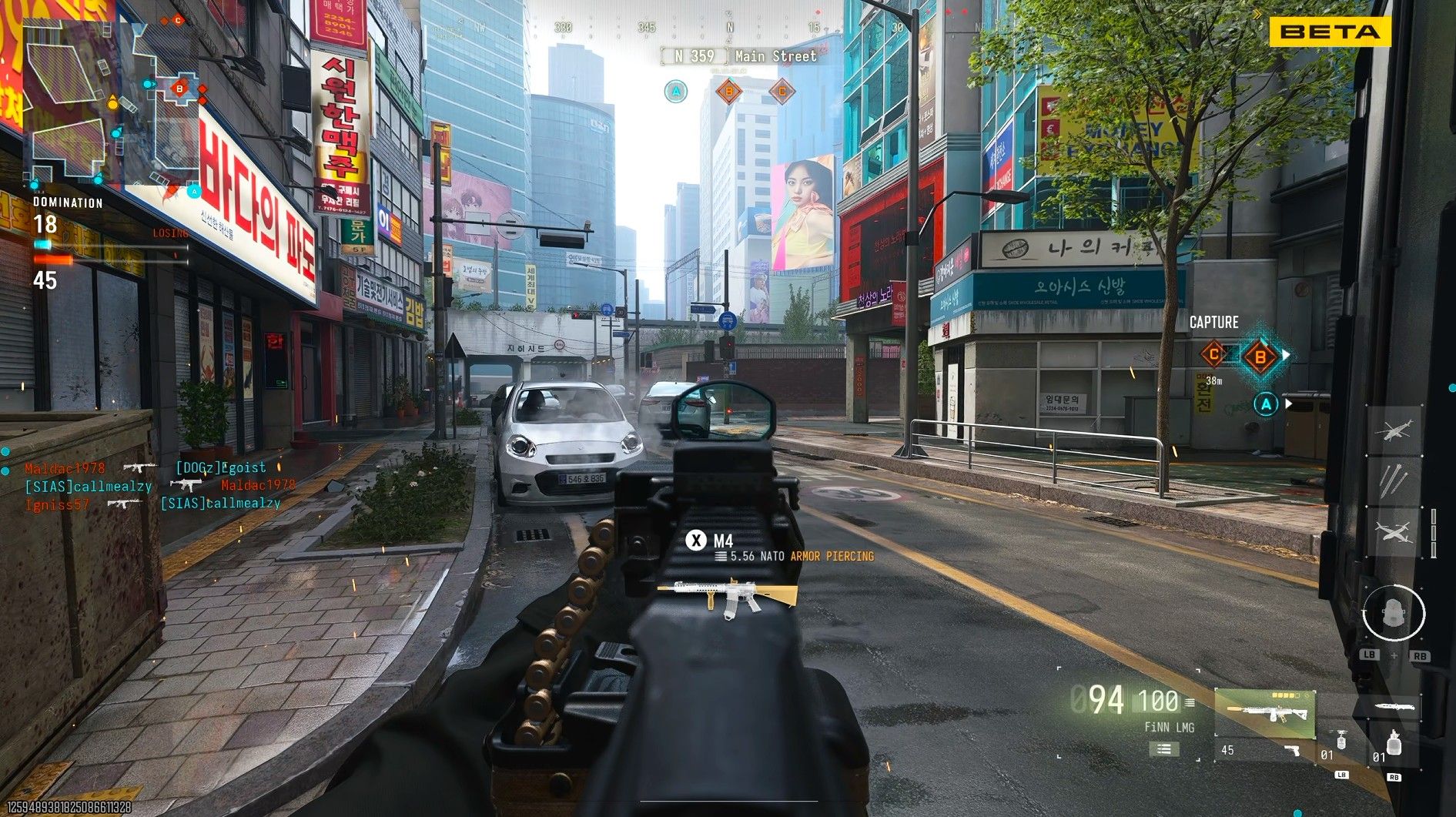
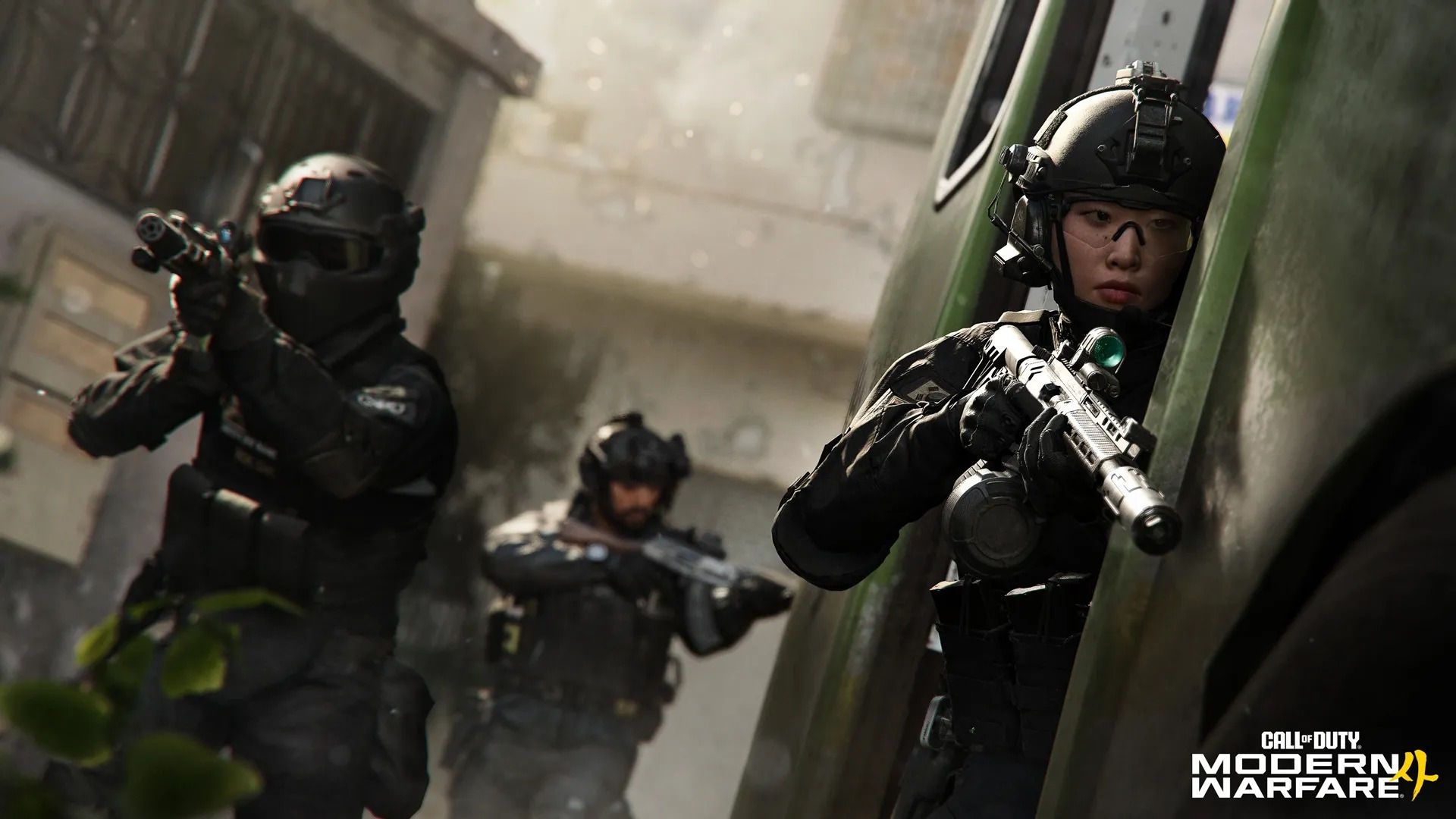
Call of Duty: Modern Warfare 4 showed up with a new cinematic trailer for its single-player campaign mode, which will involve a brutal war on the Korean Peninsula.
Call of Duty: Modern Warfare 4 is set to release on October 23, 2026, for Xbox Series X|S, Xbox Cloud Gaming, PlayStation 5, Nintendo Switch 2, and PC.
Persona 4 Revival
Persona 4 Revival gives players a glimpse of Naoto, one of the most popular characters from the original Persona 4. She is a private detective seeking to uncover the murder mysteries of Inaba, and eventually gains the power of Persona to aid the player in battle.
Persona 4 Revival is set to launch on February 18, 2027, for Xbox Series X|S (with Xbox Play Anywhere), Xbox Cloud Gaming, Xbox Game Pass, PlayStation 5, and PC.
It will also release for Nintendo Switch 2 on May 20, 2027.
Shape of Dreams
Shape of Dreams was an action-roguelike released in 2025 on PC, but it's available right now on Xbox Series X|S (with Xbox Play Anywhere), Xbox Cloud Gaming, and Xbox Game Pass.
Play as one of eight travelers and fight your way through a nightmare world filled with never-ending monsters, each wave more deadly than the last. You can take on these foes alone or with friends in 4-player co-op.
Wo Long 2: Wings of Ember
Behold the Zuochi, one of the earliest bosses you'll face in Wo Long 2: Wings of Ember. (Image credit: Koei Tecmo)
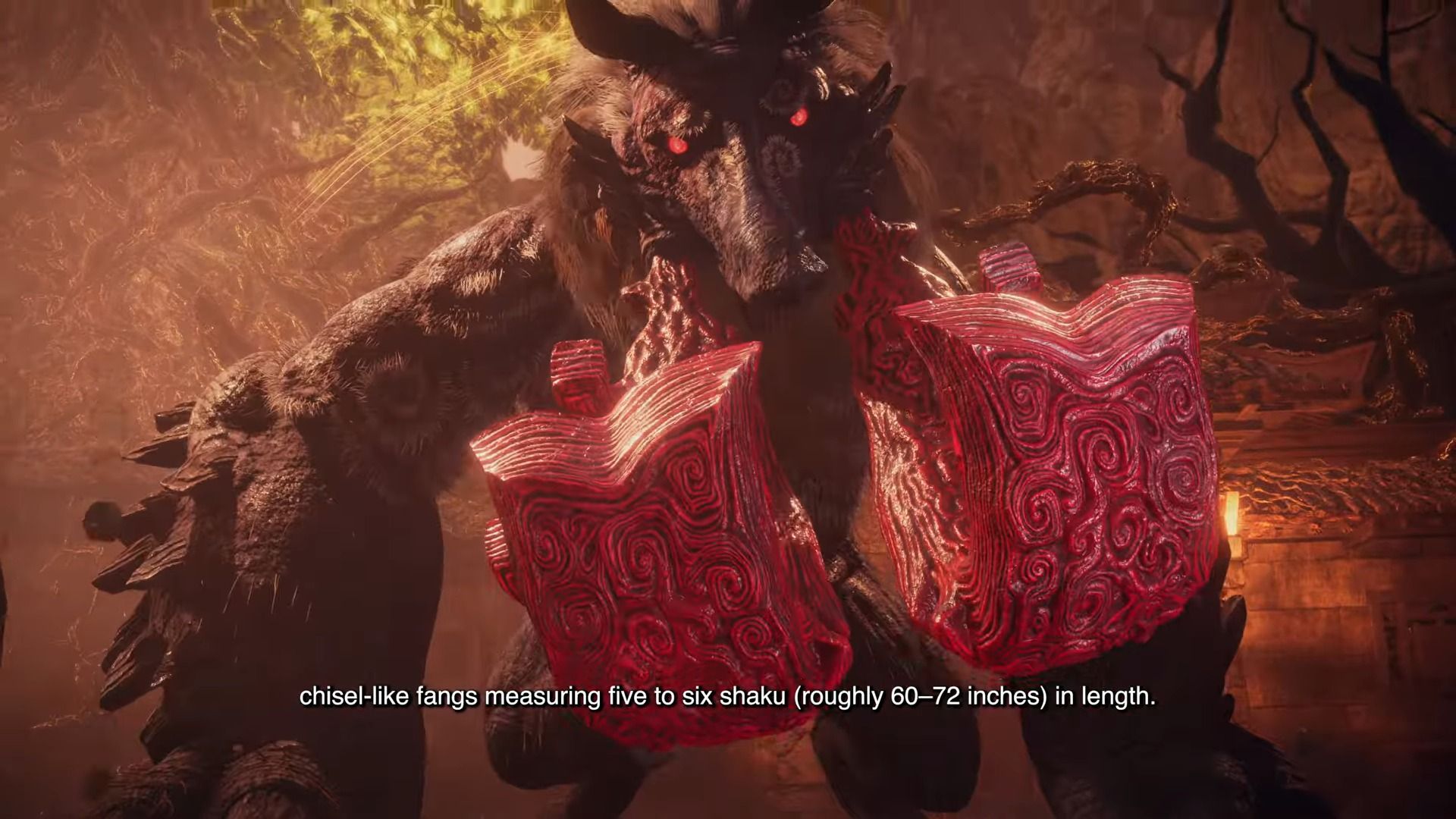
Koei Tecmo and Team Ninja revealed a short gameplay deep dive into the upcoming action-Soulslike, Wo Long 2: Wings of Ember. It featured a look at a massive, humanoid boar/monkey boss named Zuochi and a brief description of the new Insight Skills mechanic.
Insight Skills enhance the player's actions if they perfectly parry or dodge an enemy's attack at the last second. For example, using Insight Skills to deflect an enemy's attack will knock them back into the environment for extra damage while briefly stunning them.
Hope in the City is a new narrative-adventure game where you play as a young teenager looking for her missing parents after their apartment was ransacked.
Hope in the City is set to release on November 10, 2026, for Xbox Series X|S, PC, and Xbox Game Pass with Xbox Play Anywhere.
Bloomwalker
Bloomwalker is an upcoming crafting adventure game where you play as the titular Bloomwalker on a journey to bring nature back to life in a world ravaged by pollution.
Bloomwalker is coming soon to Xbox Series X|S, Xbox Cloud Gaming, Xbox Game Pass, PlayStation 5, Nintendo Switch 2, and PC.
Faraday Blues
Faraday Blues is a visual novel/strategy card game where you determine people's fates through the cards you play, with 64 endings to unlock across three dramatic storylines.
Faraday Blues is set to release in 2027 for Xbox Series X|S, Xbox Cloud Gaming, Xbox Game Pass, PlayStation 5, and PC.
Atelier Karia: The Night Kingdom & the Guide of Memories
Atelier Karia showed off a new trailer showcasing the personalities and abilities of Rutger & Lenja, two playable party members originally from Atelier Yumia.
Atelier Karia: The Night Kingdom & the Guide of Memories is set to release on February 25, 2027, for Xbox Series X|S, PlayStation 5, Nintendo Switch 2, and PC.
Raji: Kaliyuga
Next, we have a developer commentary trailer for Raji: Kaliyuga. This is an action-adventure title where two sibling warriors, Raji and Darsh, are on a quest to stop the evil warlord Mahabalasura from unsealing the heavens and waging war throughout the cosmos.
Raji: Kaliyuga is set to release sometime in the future for Xbox Series X|S, Xbox Cloud Gaming, Xbox Game Pass, PlayStation 5, and PC.
Once Human: Isles of Abyss
The free-to-play survival game, Once Human, has announced a new expansion called "Isles of Abyss," which will let players explore the seas to uncover the riddles of a mysterious journal. But beware, foul sea monsters will be lurking around every corner of the sea, waiting to sink your ship.
The Once Human: Isles of Abyss expansion will launch on October 22, 2026, for Xbox Series X|S, Xbox Game Pass, PlayStation 5, and PC.
Edge of Memories
Edge of Memories has at last revealed its release date with a new gameplay and cinematic montage trailer.
This upcoming action-RPG, where you fight to save the world from corruption while risking turning into a monster, will be released on November 5, 2026, for Xbox Series X|S, PlayStation 5, and PC.
Genigods Nezha
Next, we have a developer behind-the-scenes look at an upcoming action-RPG called Genigods Nezha. This game has you play as a powerful demigod known as the Spirit Pearl and embark on a journey to save the world from reality-warping spacetime rifts while battling colossal beasts and gods inspired by Chinese mythology.
Genigods Nezha is set to be released sometime in the future for Xbox Series X|S, Xbox Cloud Gaming, Xbox Game Pass, PlayStation 5, and PC.
Fallout 76
Fallout 76, the open-world, MMO-like spin-off of Fallout, has just received a Halloween-themed update called "The Slasher". It will have players explore a crooked home and struggle to survive while fighting the update's titular serial killer.
Bloodstained: The Scarlet Engagement
From the creators of Castlevania: Symphony of the Night comes a new trailer for Bloodstained: The Scarlet Engagement, the long-awaited sequel to the beloved 2019 indie Metroidvania game, Bloodstained: Ritual of the Night.
This game tasks you with tearing through armies of demons, vampires, and more to free 16th-century England from the tyrannical reign of the Demon Lord, Elias.
Bloodstained: The Scarlet Engagement is set to be released in 2027 for Xbox Series X|S, Xbox Cloud Gaming, PlayStation 5, and PC.
OD and Physint
The Xbox Tokyo Game Show 2026 showcase closes with a video of Hideo Kojima announcing that development for his upcoming horror game, OD, is progressing smoothly.
Plus, Hideo Kojima has revealed that Swedish actor Bill Skarsgård will be voicing the main character in his upcoming stealth-action game, Physint.
Both OD and Physint will be released on Xbox and PC at a later date.
Join us on Reddit at r/WindowsCentral to share your insights and discuss our latest news, reviews, and more.
It's that time of year again where a new Call of Duty is on the horizon and the existing game has been played so much that older titles in the franchise get wheeled out for a dose of nostalgia and a change of pace.
With an Xbox Game Pass subscription, that's even easier. In my case, I've been checking out a couple of previous Call of Duty games I originally skipped for various reasons. The first being Black Ops Cold War, the latest to join Game Pass, and now, Modern Warfare 3.
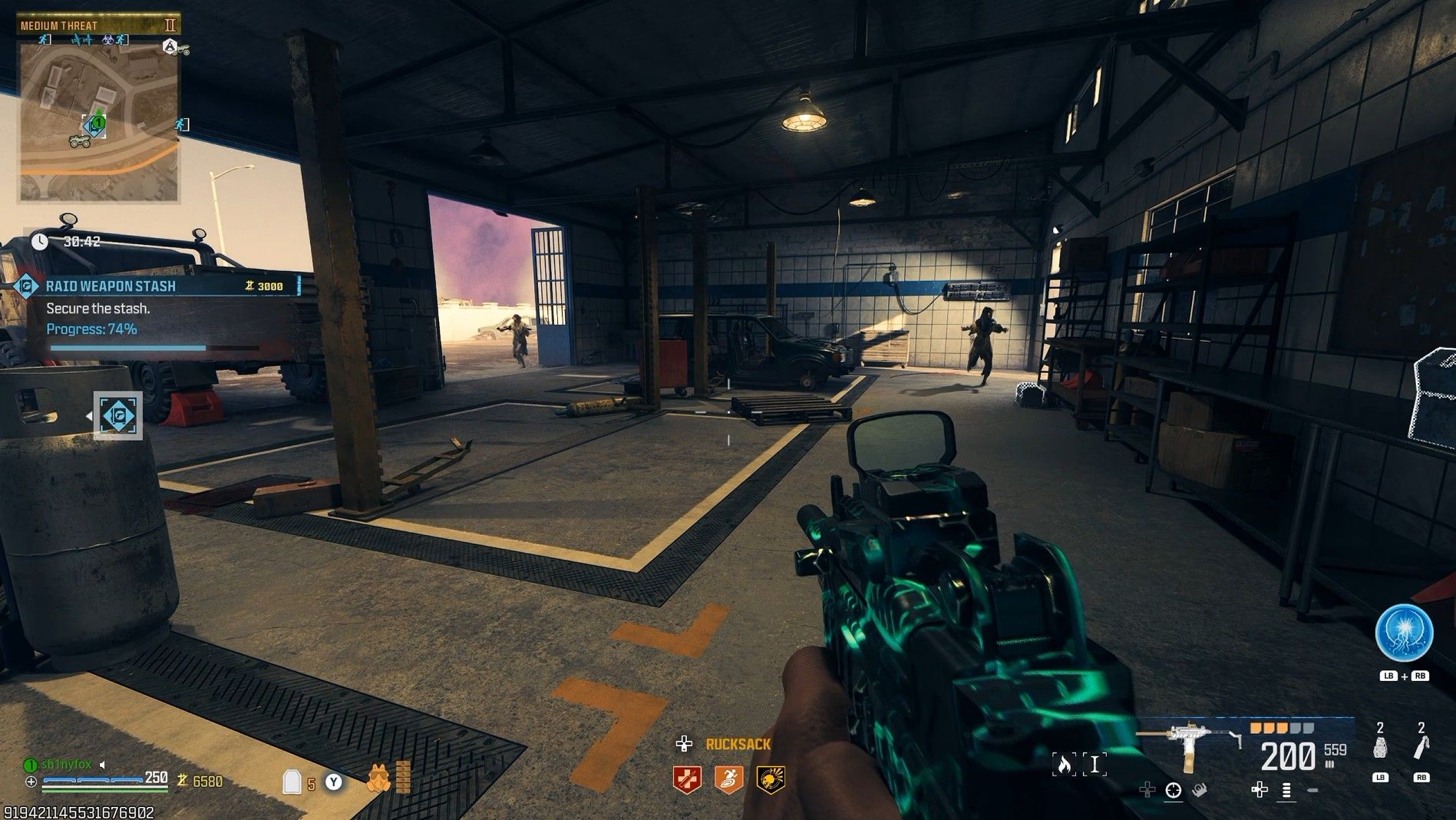
Except, in a change of pace, I haven't touched multiplayer, nor the campaign, not yet, anyway. My YouTube feed was filling up with folks playing Modern Warfare 3 Zombies (also referred to as MWZ), and it looked very much like my jam. So I installed it and jumped right in.
How have I not played this before? Zombies purists may look upon this take on the franchise very differently, but I'm the furthest thing from that. Traditionally I love open-world games, looter shooters, and experiences with a big sandbox to explore and find things to do with rewards to chase. It's why I love The Division 2 so much.
I'm hooked. Instantly hooked. A good chunk of my time in Black Ops 7 has been spent in the Endgame mode, with its lighter take on an extraction shooter proving to be a lot of fun. MWZ is also a PvE-exclusive extraction shooter; it came a couple of years before Black Ops 7, and I think it's actually better.
MWZ feels less daunting as a newcomer over more classic Call of Duty Zombies experiences
Some of the content is harder solo, but much of it, especially early on, isn't too daunting. (Image credit: Windows Central)
Don't get me wrong, I totally get why people love Zombies. All told, I should be one of them. PvE gameplay is always my preference, and the whole idea of the easter egg quests, the continued storyline that's crossed multiple games, and the replay value ticks the right kind of boxes.
But I've never really played the mode for whatever reason, and the round-based gameplay does feel a little daunting to me. The way the difficulty keeps ramping up is a good challenge to have, but I can also see how it could be off-putting to newcomers and more casual players.
Like Black Ops 7 Endgame, MWZ lets you play entirely at your own pace. Eventually you'll need to go into the higher-tier threat level zones, but you decide when. While you're getting to grips with the mode, as I have been doing, you can just run around in tier 1.
Getting used to the map, the gameplay, doing the Act 1 missions, and raising your Containment Level to make life simpler when you do decide to take on the more difficult parts.
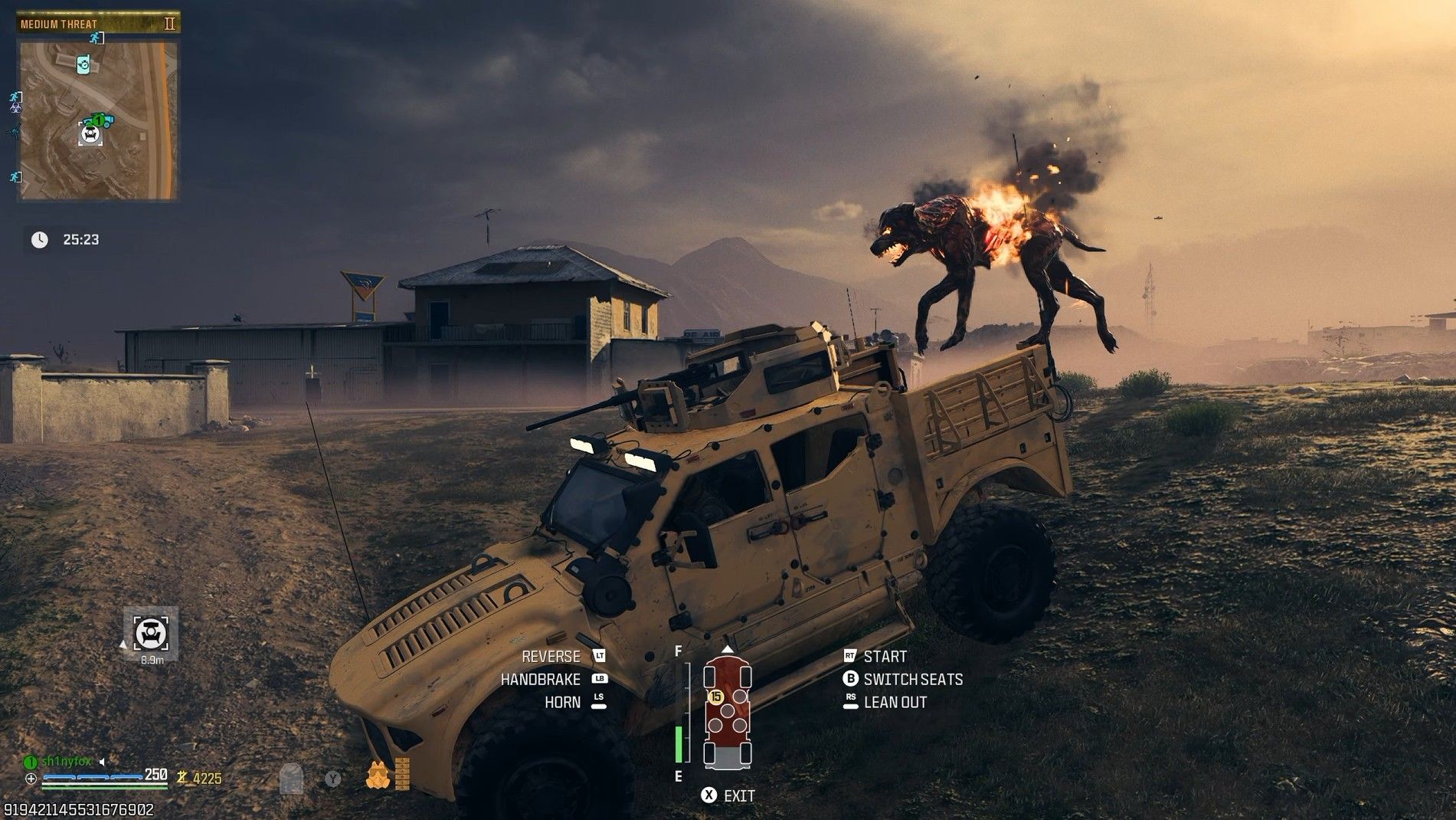
You don't want to pet this dog. (Image credit: Windows Central)
What I also really like as a new player is that thanks to the scale of the Urzikstan map over a more traditional round-based Zombies map, it's easier to get out of trouble. The trap I always fall into any time I try Zombies is getting boxed in, and it's game over. MWZ has the added bonus that even without a Self Revive equipped, other players in your match can pick you back up, even if they're not in your squad.
It's not easy, but it does feel more approachable. And if you ever played Warzone on Urzikstan, you'll already feel at home on the map.
MWZ also has a series of story missions to progress through that you don't have to figure out for yourself like a traditional easter egg. There still are easter eggs to complete if you wish, but there's a more linear story you can also follow in the different Acts, with smaller side missions to progress through before hitting the final story mission.
I don't think it's "hand-holding," but I do appreciate being pointed in the right direction without needing to follow a YouTube video.
I love the loot system in Modern Warfare 3 Zombies
Being able to start a new run with sweet loot extracted from previous ones is real handy! (Image credit: Windows Central)
As a looter-shooter kind of guy at heart, I really like the way that your gear is handled in MWZ. In traditional round-based Zombies, you can build a loadout, but you're starting from scratch every game.
In MWZ, if you've managed to extract with the right gear, you can use it right away to juice yourself up for more difficult content right out of the chopper.
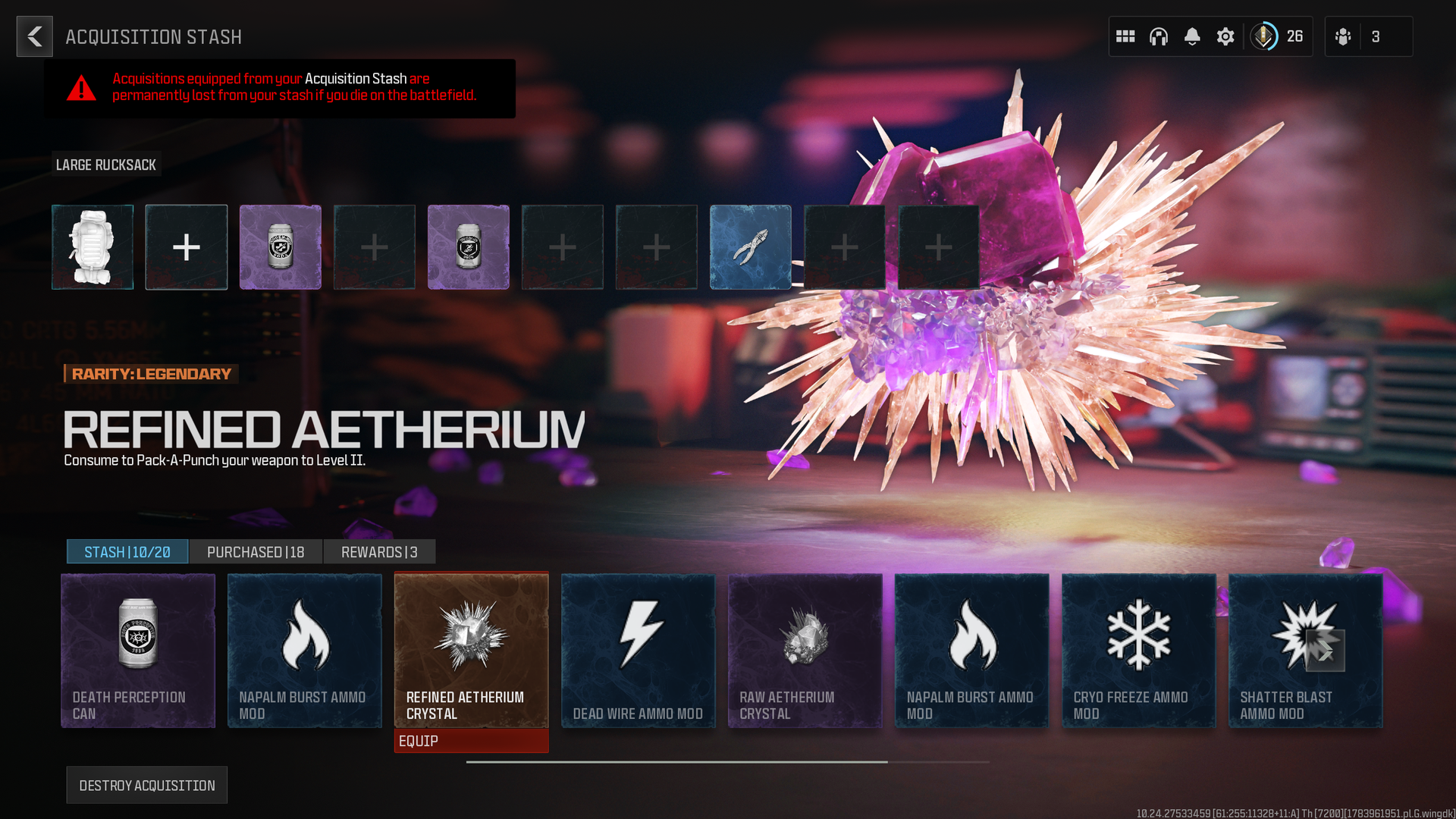
I've barely scratched the surface so far, but already I've built up a stash of Aetherium Crystals to avoid needing to use the Pack-a-Punch machine (and save my points for something else) as well as getting my hands on the schematics for some of the perks.
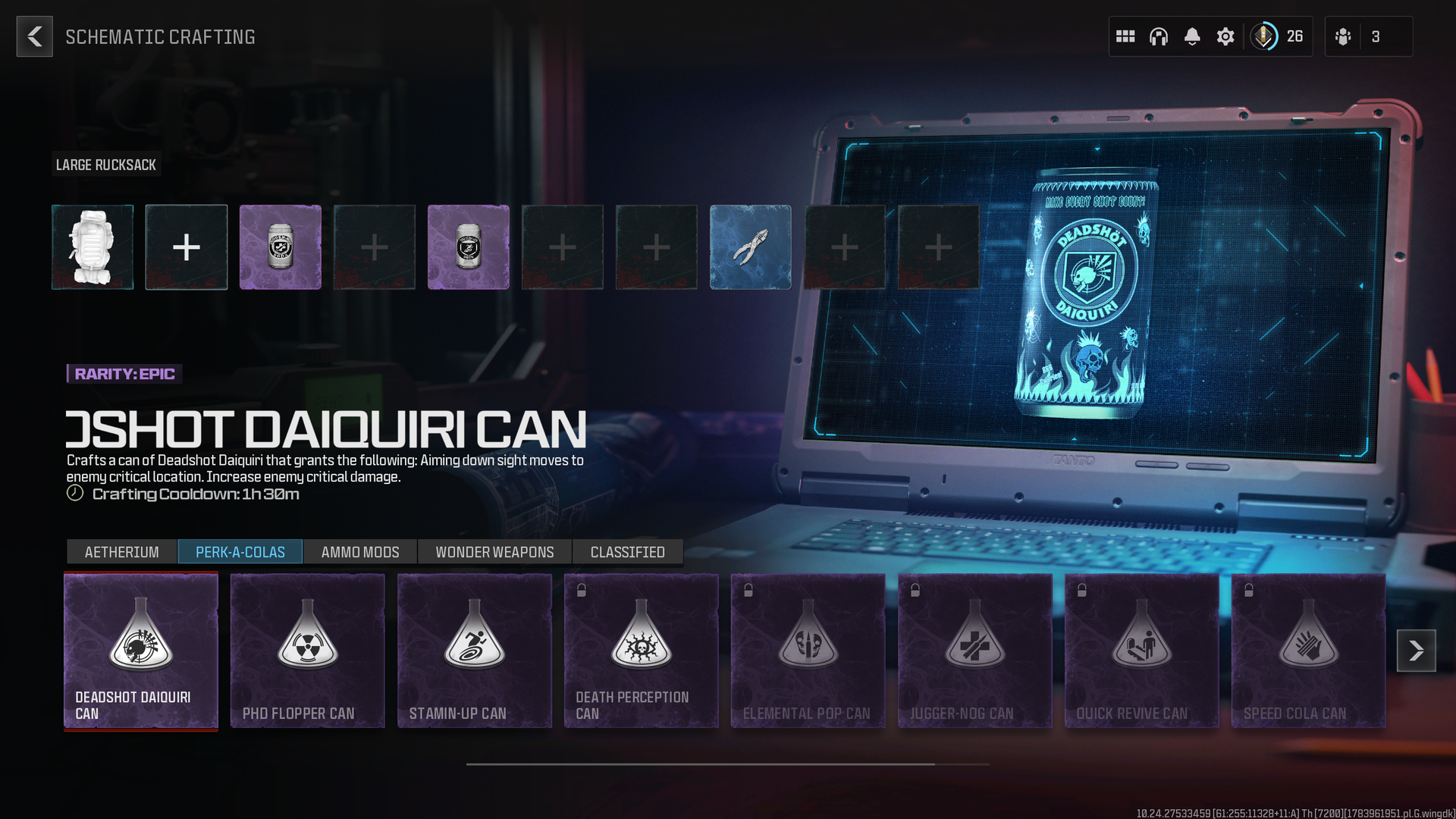
Acquiring Schematics to craft items before a run is a fantastic addition. (Image credit: Windows Central)
The cooldown on using the Schematics adds an element of planning to the equation, but already as a total noob I can drop in with a couple of useful perks, as well as any I managed to extract from a previous run.
As a not-very-good Zombies player, one of the things I always seem to struggle with the most is managing my points with how many different things you have to use them for. MWZ doesn't rely as heavily on them when you get rolling and build up a good stash.
But also as a looter-shooter fan, I love that in MWZ you actually have a loot chase. There's a ton of stuff to acquire, and thanks to RNG, plenty of reasons to keep replaying, chasing the items. It's a different experience from the traditional Call of Duty grind, where the focus is on Camos and Calling Card challenges.
It's also pretty fantastic that you can literally start at level 1 and get your hands on weapons that, in multiplayer, you wouldn't get access to until you unlock them at their relevant levels. I'm running around with a WSP Swarm right now (and have already done some of its Camo challenges) that I still haven't reached the right level for.
Living proof PvE content in Call of Duty is worth having
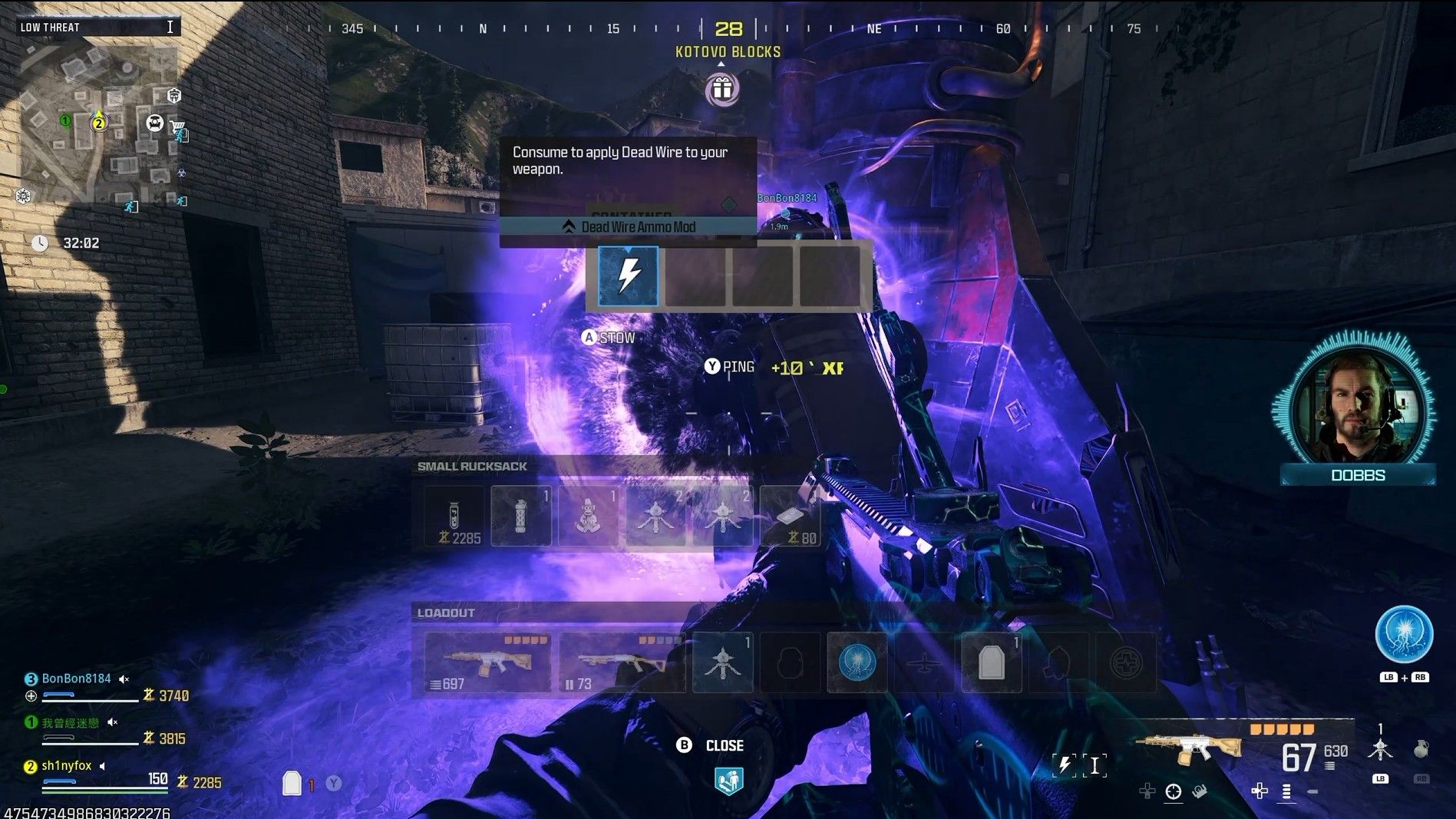
Would you look at that, a Dead Wire ammo mod from the easiest zone that I can come back into a different run with! (Image credit: Windows Central)
While I have enjoyed Black Ops 7 in Endgame, dipping into MWZ immediately made me think of the upcoming DMZ mode in Modern Warfare 4.
There is no Zombies this year, be it round-based or an MWZ-type experience. There's nothing. The continual focus of Call of Duty is on its bread and butter: multiplayer and Warzone.
Zombies has always proved that PvE has a place in Call of Duty, and Endgame was a decent experiment with Black Ops 7, too. But DMZ in Modern Warfare 4 is planned as a PvPvE experience, always throwing in the chance that other real-world players will spoil your fun.
And let's face it, this is Call of Duty; it will absolutely fill up with sweats that have no mission beyond wiping out as many players as possible.
I'm all for as much PvE content in Call of Duty as we can get. (Image credit: Windows Central)
We're seeing the thirst for purely PvE play elsewhere, too. Bungie is adding a PvE-only mode to its own extraction shooter, Marathon. There's plenty of us out there that want to enjoy these types of experiences without wanting to be on edge constantly waiting for a PvP demon who exists just to ruin your day.
It's why in my 1,000 or so hours in The Division 2, probably 6 of those have been spent in the Dark Zone. If I want PvP, I play multiplayer.
So I hope that it's at least a consideration down the line to add a PvE mode to DMZ in Modern Warfare 4. It's the mode I'm pinning most of my hopes on, but if it ends up turning into Warzone lite, it'll get dropped.
It's a typically 'me' thing to do discovering games years later that I actually really enjoy, and that's the same here. I haven't touched Modern Warfare 3's campaign or multiplayer modes at all. Only Zombies.
Being on Xbox Game Pass makes it easy enough to try. Even if you're not into Zombies, it's worth giving a go if you skipped it in the past and you like open-world looter-type games.
Join us on Reddit at r/WindowsCentral to share your insights and discuss our latest news, reviews, and more.
Microsoft has been on the defensive somewhat with the service, removing Call of Duty earlier this year on rumors that it's simply "too generous" and potentially unsustainable.
Furthermore, even more rumors have been circulating online that Xbox Game Pass may be undergoing a massive restructuring in 2027, with changes that purportedly include:
The inclusion of "ads" in Xbox Game Pass with different versions. One version of Xbox Game Pass with ads will cost $12.99 per month, and one without ads will cost $19.99 per month or $239.99 annually.
New Xbox games will no longer release day one" for Xbox Game Pass "starting somewhere between February and April 2027," in exchange for reducing the cost of Xbox Game Pass by $3.
The claim "cloud streaming will no longer be a part of Xbox Game Pass."
Cloud Streaming will be "an add-on bundle" that costs $5.99 for 25 hours.
Here's one I would actually like: "Xbox Game Pass' Family plan will be included, as a $5.99 addon."
"We regularly test different Game Pass offerings and look at what works best for players in different markets. We don’t have any changes to announce today or plans that have been finalized. There are no changes to previously announced games coming to Game Pass Ultimate on day one.”
Statement I got from an Xbox spokesperson about this:"We regularly test different Game Pass offerings and look at what works best for players in different markets. We don’t have any changes to announce today or plans that have been finalized. There are no changes to previously… https://t.co/CLLSEppdBPSeptember 15, 2026
Additionally, we've been doing some digging of our own and can confirm that the list of "changes" outlined by the above forum aren't based on any current plans within Microsoft and amount to "speculation or guesswork," trusted sources suggest.
However, it's no secret that Microsoft is actively exploring "changes" to Xbox Game Pass, which could include some of the guessed ideas outlined in the forum post.
Our sources say that there's no current plan to remove "day one" games as a feature of Xbox Game Pass Ultimate in totality, but like the statement to Paul Tassi says, changes are coming. But, 100% speculatively and analytically: I think it's probably worth expecting that more franchises like Call of Duty may be pulled from day one access even on Xbox Game Pass Ultimate.
Perhaps bigger franchises might be moved onto an even more expensive tier, or come with some kind of "addon" bundle like a cable TV package.
In short, Xbox is effectively denying these specific rumors, while acknowledging that changes are coming. Like Paul Tassi spotted, the mention of "previously announced games" in Xbox's quote is interesting, as the wording increases the likelihood that future Xbox Game Pass game additions could be altered or paired back.
Anonymous forum rumors should be always be taken with a huge grain of salt. However, with the recent changes to Xbox Cloud Gaming getting monthly restrictions, I have a feeling some of the suggestions in the thread could materialize in a worst case scenario.
Xbox Game Pass is a huge revenue stream for Microsoft today, but balancing that against retail sales and cash flow back to studios (particularly first-party studios) has been a subject of debate for some time.
However, we will have to wait until 2027 to find out if these rumors of Xbox Game Pass changing are true or false.
Join us on Reddit at r/WindowsCentral to share your insights and discuss our latest news, reviews, and more.
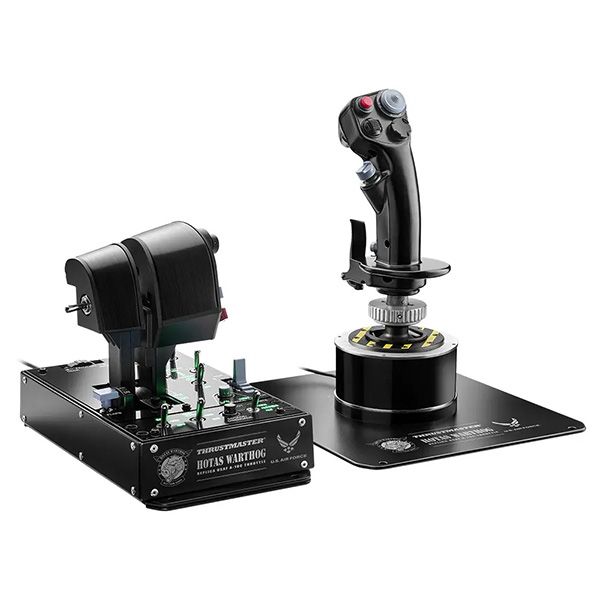
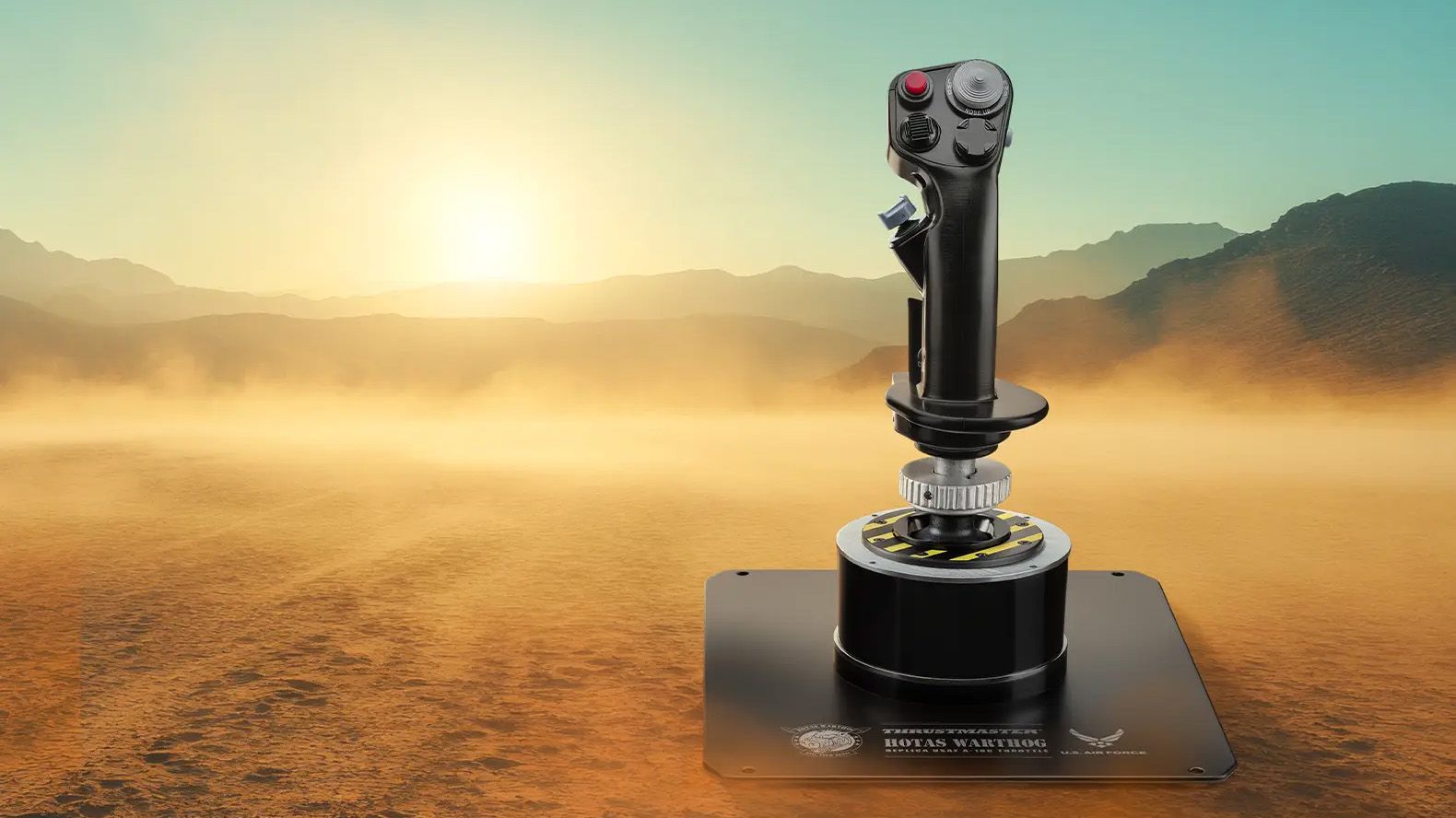
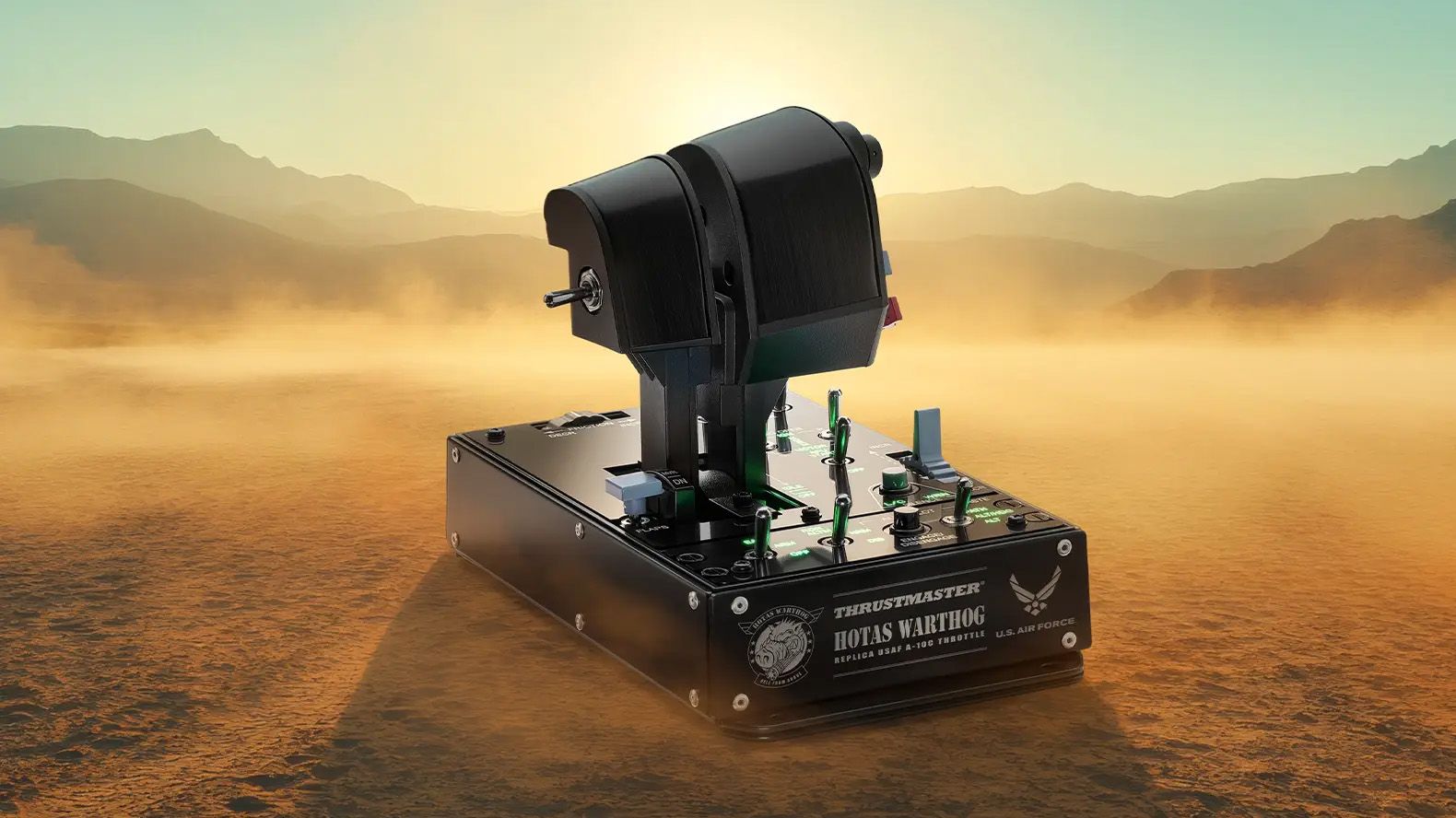
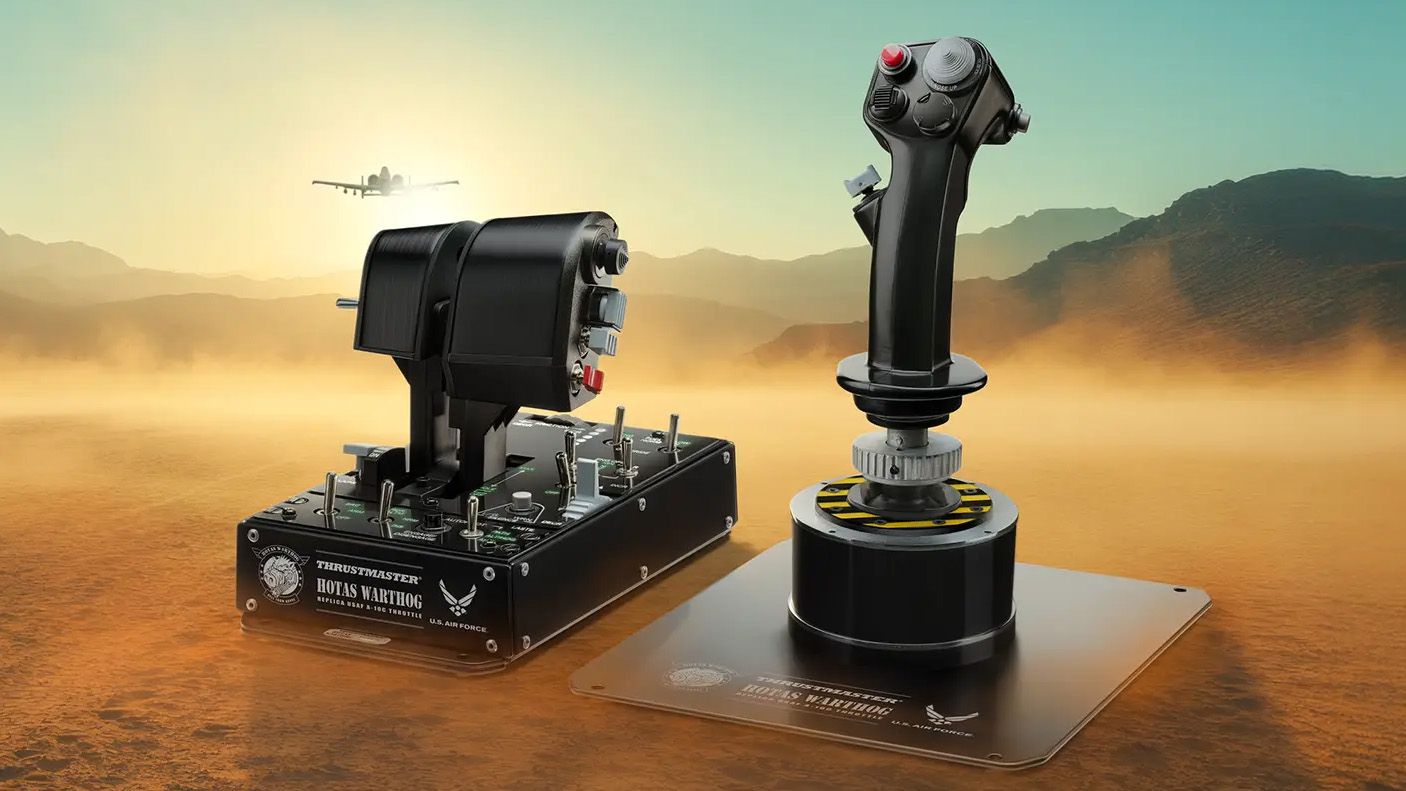
Already synonymous with flight simulation hardware, Thrustmaster is expanding its sim gaming range again with the HOTAS Warthog Mk. II, an "enhanced" variant of its popular, military-themed stick and throttle bundle for PC. Previously announced at Flight Sim Expo, it's releasing today, September 16, 2026, at an MSRP of $599.99, it's available from the official eStore and Amazon.
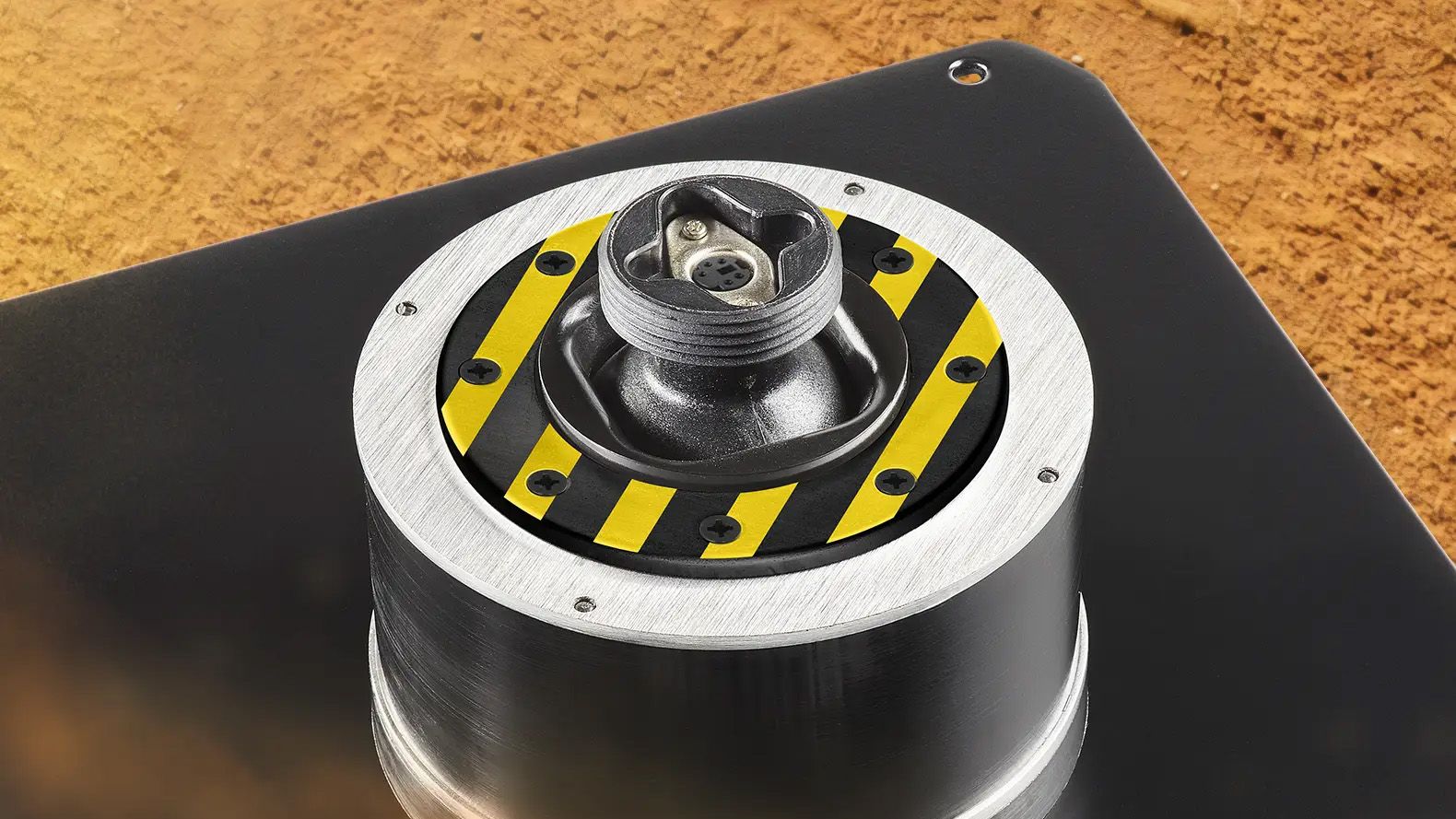
Indeed, the Warthog Mk. II features the same official U.S. Air Force licensing as its predecessor, with a design that seems almost indistinguishable from the Mk. I at a glance. In reality, Thrustmaster has focused mostly on the internals, redesigning its "H.E.A.R.T." Hall-Effect sensor mechanism "to offer enhanced smoothness and durability".
On the outside, it's still a 1:1-scale recreation of a Viper stick grip and the Warthog A-10C throttle with separate controls for both simulated engines (plus a locking system). Despite a few visual tweaks, the Mk. II supports full compatibility "with all Thrustmaster grips", which is great news for any sim enthusiasts who already adopted the brand's ecosystem on Windows PCs.
Thrustmaster's VIPER flight stick.ThrustmasterAnd its companion, the WARTHOG throttle unit.ThrustmasterThe refined MK II flight stick base.ThrustmasterAnd Thrustmaster's Hall-Effect sensors visualized.Thrustmaster
I've tested a huge number of flight sticks for games like Microsoft Flight Simulator, but I haven't strayed too far into military sims, or even further out to space-faring dogfights in titles like Elite Dangerous. However, I've always seen the Thrustmaster Warthog Mk. I appearing among some of the top-rated HOTAS sets in my adventures, so I definitely knew about it.
This release came with a chance to test the Warthog Mk. II for myself, so of course I said yes to a sample. Imagine my surprise when Thrustmaster's shipping confirmation included the 6.56 kg heft of this dense, 100% metal monster listed in its specs, with some extra weight on top for packaging. My word, what am I getting myself into?
The Viper flight stick grip provides a flight experience that's as close as possible to a real fighter pilot's.
Thrustmaster
Don't get me wrong, it's not like I've never, ever tried a flight stick in a combat game, but a HOTAS set of this intensity needs to be paired with something that fits better than a Cessna in Microsoft Flight Simulator. I'm looking forward to seeing how the first Warthog version built such a reputation, and whether its accolades carry over to the "sturdier" Mk. II.
That, and I need to figure out bindings for the stick's 19 buttons and the 8-way hat switch, even if the latter is usually quite obvious, before moving on to the Warthog control panel and its wealth of chunky levers, switches, and dials. That's up to 128 total buttons — should be fun! Stay tuned for my HOTAS Warthog Mk. II review going live before the end of the month.
Join us on Reddit at r/WindowsCentral to share your insights and discuss our latest news, reviews, and more.
Additionally, Koei Tecmo has released a free playable Alpha demo available to download on all the aforementioned platforms (except Nintendo Switch 2) and has opened pre-orders for the game.
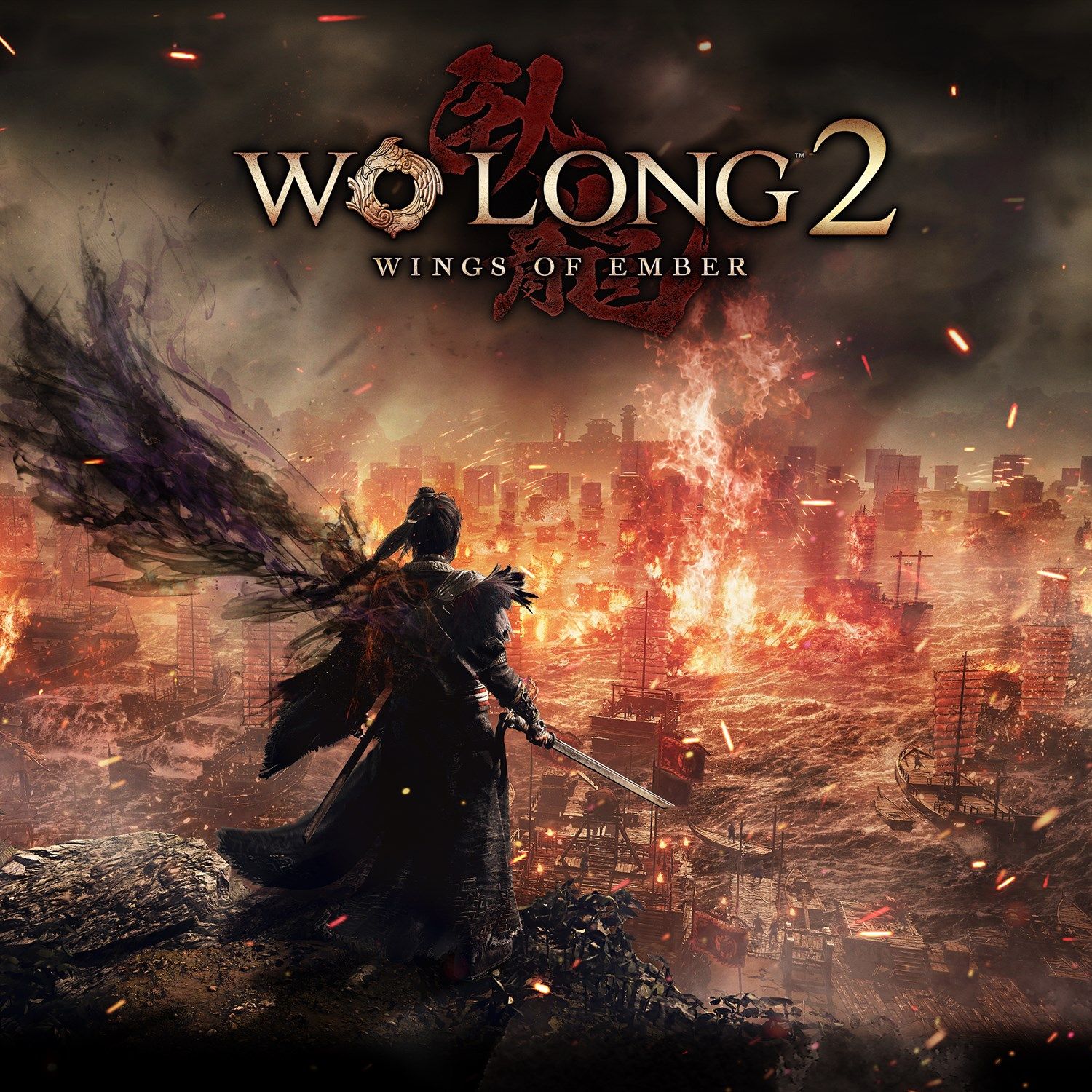
Wo Long 2: Wings of Ember is a sequel to Wo Long: Fallen Dynasty. It will take the player on a bloody and brutal journey across a dark fantasy version of China's Three Kingdoms period and battle many challenging foes, including iconic warriors from that era along with towering demons.
The game aims to top its predecessor with new weapons, magic, and techniques to master, more epic combat scenarios to survive in, and more challenging bosses to overcome.
You can get a taste of the early portions of Wo Long 2: Wings of Ember through its public Alpha Demo. It's free to download and play until September 30, 2026, and if you complete it, you will unlock a special Fledging Phoenix Helmet that can be used in the full game.
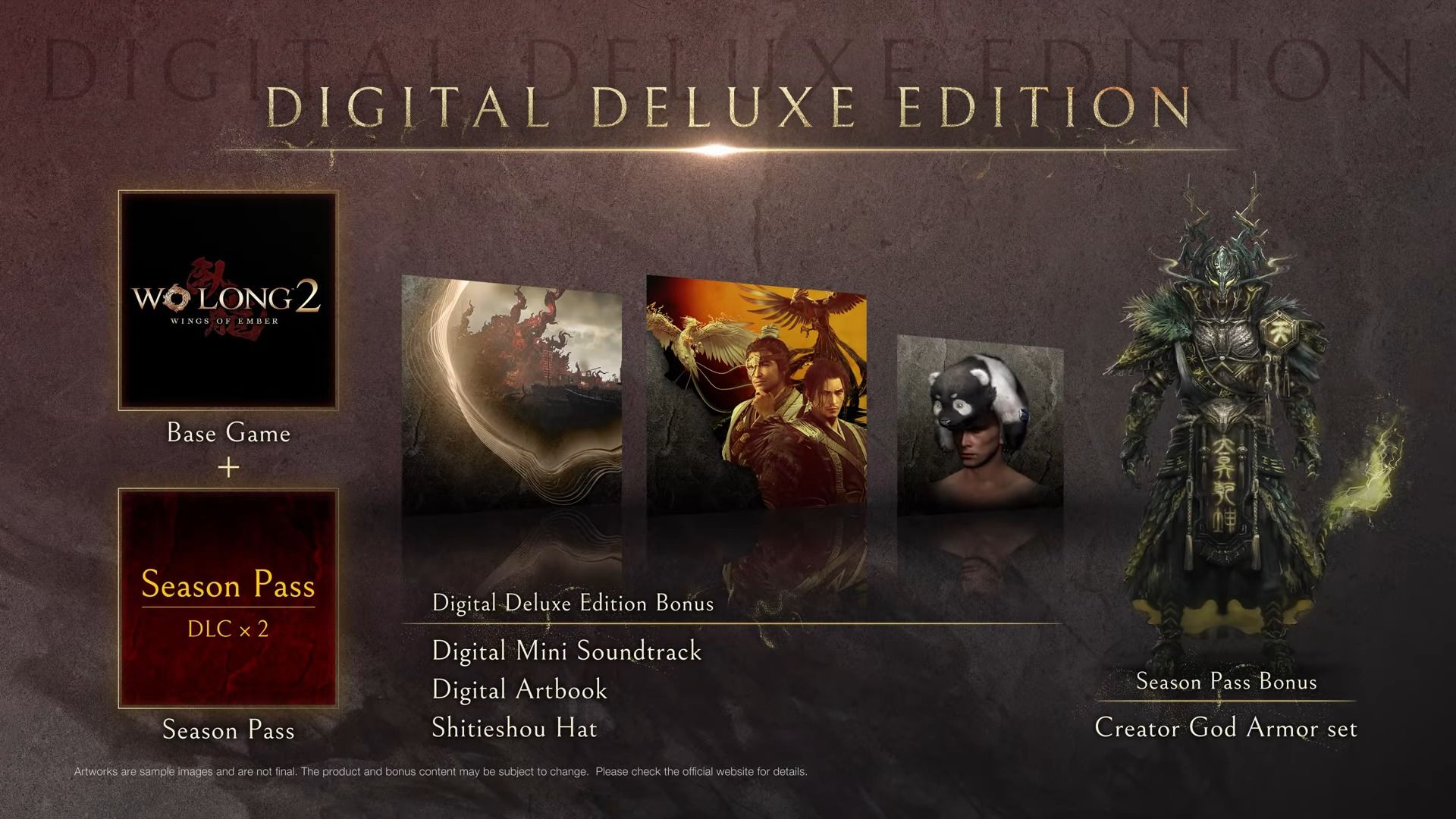
Wo Long 2: Wings of Ember Digital Deluxe Edition. (Image credit: Koei Tecmo)
If you pre-order Wo Long 2: Wings of Ruin, you can get exclusive access to the Creator Goddess Garb armor set and early purchase access to the Harvest God Armor set.
The game will come in a standard edition (which only contains the base game) or a Digital Deluxe Edition, the latter of which features:
Season pass that grants access to two future DLC expansions (the first will release on August 31, 2027, and the second on October 31, 2027), plus the Creator God Armor set as a Season Pass Bonus.
Digital Mini Soundtrack
Digital Artbook
Shietieshou Hat.
Can't wait to dive back into this grim dark Soulslike take on the Three Kingdoms era
The original Wo Long: Fallen Dynasty was an immensely fun, underrated Soulslike that we gave a 4.5/5 star review for its in-depth combat system and nail-bitingly tough bosses that were so satisfying to beat.
So I can't wait to see if its sequel has what it takes to top the first game when Wo Long 2: Wings of Ember launches next year on March 4, 2027.
In the meantime, I'll be playing the Alpha demo, as it's been a long while since I played a Soulslike, so I'll need to shake off the rust before the full game arrives.
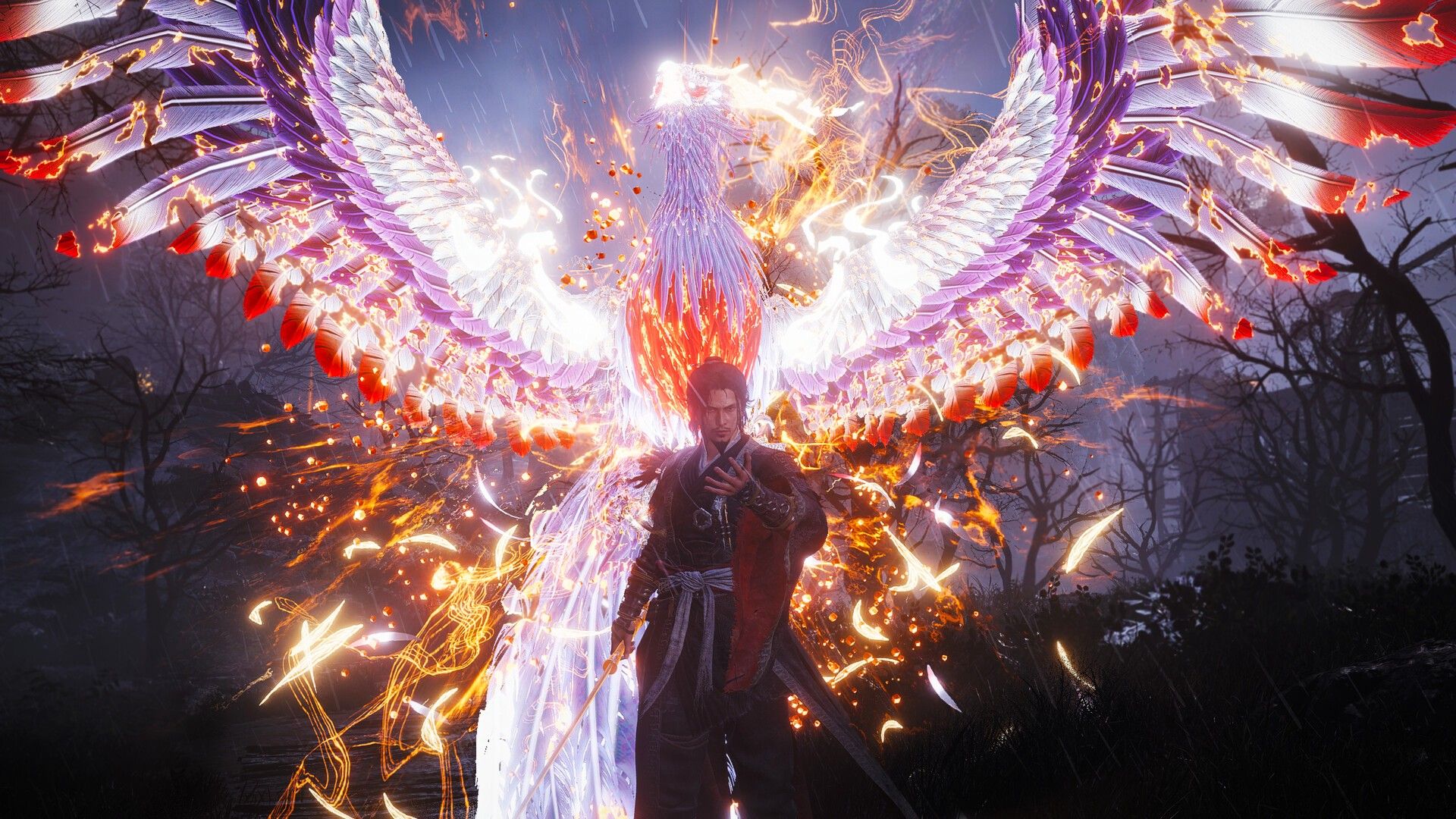
Embody the power of a fiery Phoenix and descend upon the battlefield to purge horrifying demons and duel legendary heroes of the Three Kingdoms in Wo Long 2: Wings of Ember.
Mobile gaming controllers have come a long way over the last few years, but they all suffer from one common flaw: they're rarely as portable as the phones they're designed to enhance.
That's always seemed ironic to me. Smartphones fit in our pockets, but many mobile controllers require a dedicated carrying case or space in a backpack. At that point, I often find myself wondering why I didn't just bring a handheld gaming PC instead.
That's exactly the problem the new $99Razer Prio aims to solve.
Rather than chasing the biggest grips or most console-like ergonomics, Razer built something fundamentally different. The Prio folds into a compact package measuring just 107mm by 67mm when closed, making it roughly credit card-sized in length and width, while weighing only 101 grams.
It's the first mobile controller I've used that genuinely disappears into a pocket.
And that's what makes it special.
Razerhad no input, nor did it see the contents of this review, prior to publication.
A clever design that solves a real problem
The Razer Prio mobile controller (folded) next to the Xiaomi 17T Pro with a rather large 6.83 inches display. (Image credit: Daniel Rubino)
The Prio's standout feature is its unique folding mechanism.
Using an interlocking design, each half rotates and folds inward, transforming from a compact rectangle into a full mobile controller. Razer's engineers deserve credit here because this doesn't feel like a gimmick. It's solving a legitimate problem that nearly every competing product ignores.
The trade-off, however, is that setup isn't immediately intuitive.
The first few times I unfolded the Prio, I found myself fumbling with the locking mechanism and trying to remember exactly which piece rotated where. Razer could absolutely improve the onboarding experience with clearer instructions.
Fortunately, the learning curve doesn't last long. After a handful of uses, unfolding the controller becomes second nature, and you begin to appreciate just how clever the entire design is.
More importantly, because it's so small, I actually carried it around.
That's a bigger compliment than it may sound. Many mobile controllers are technically portable but not especially convenient. The Prio is different because you can toss it in a pocket and completely forget it's there until you need it.
Small controls, surprisingly good results
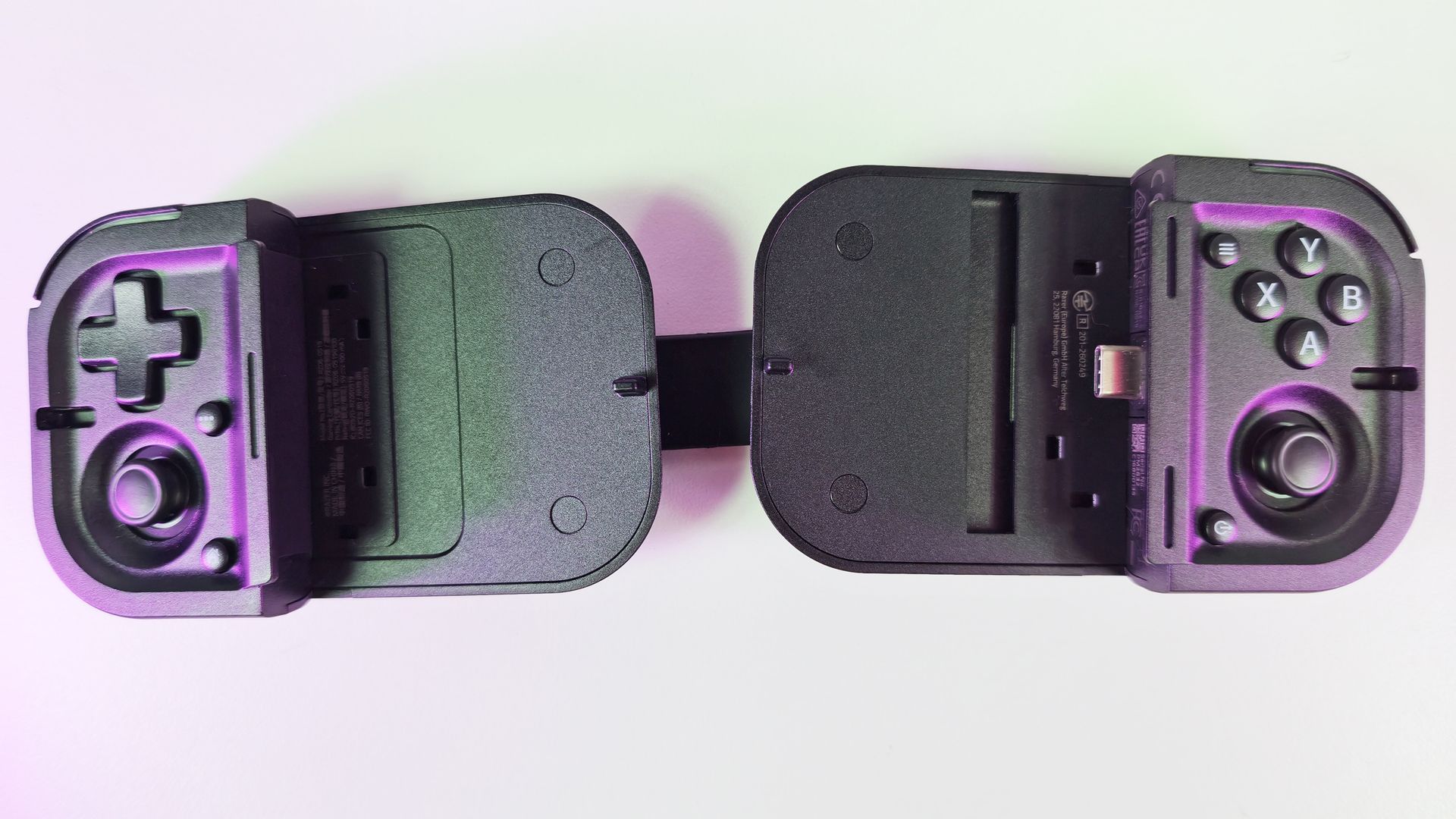
Top-down view of the unfolded Razer Prio controller without a phone, showing its central bridge, USB-C plug, D-pad, face buttons, and dual analog sticks. (Image credit: Daniel Rubino)
Once unfolded, the Prio reveals a complete controller layout that includes dual thumbsticks, a D-pad, bumpers, triggers, face buttons, and dedicated function buttons.
Naturally, any controller this compact requires compromises.
The thumbsticks are noticeably smaller than what you'd find on a traditional controller, and the face buttons reflect the Prio's portable-first design philosophy. If you're expecting Xbox controller levels of comfort, you'll need to temper expectations.
That said, I liked using them more than I expected.
The D-pad feels tactile and responsive, the face buttons provide good feedback, and the thumbsticks are particularly interesting. Razer uses capacitive thumbsticks with contactless sensors that can detect movement without relying on traditional mechanical contacts. In theory, that means improved durability and resistance to stick drift compared with conventional designs.
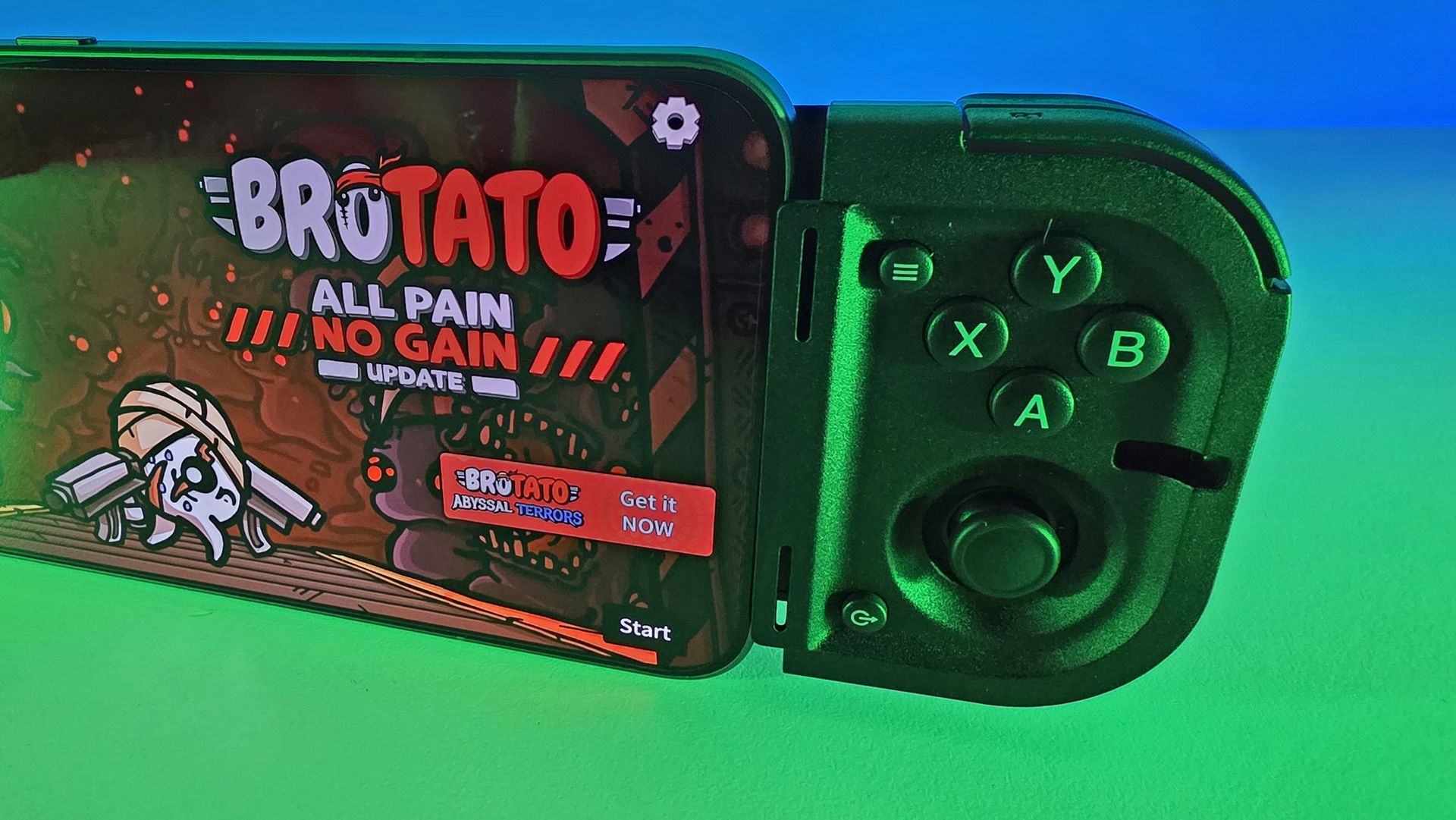
The thumbsticks are tiny, but it sure beats onscreen controls any day. (Image credit: Daniel Rubino)
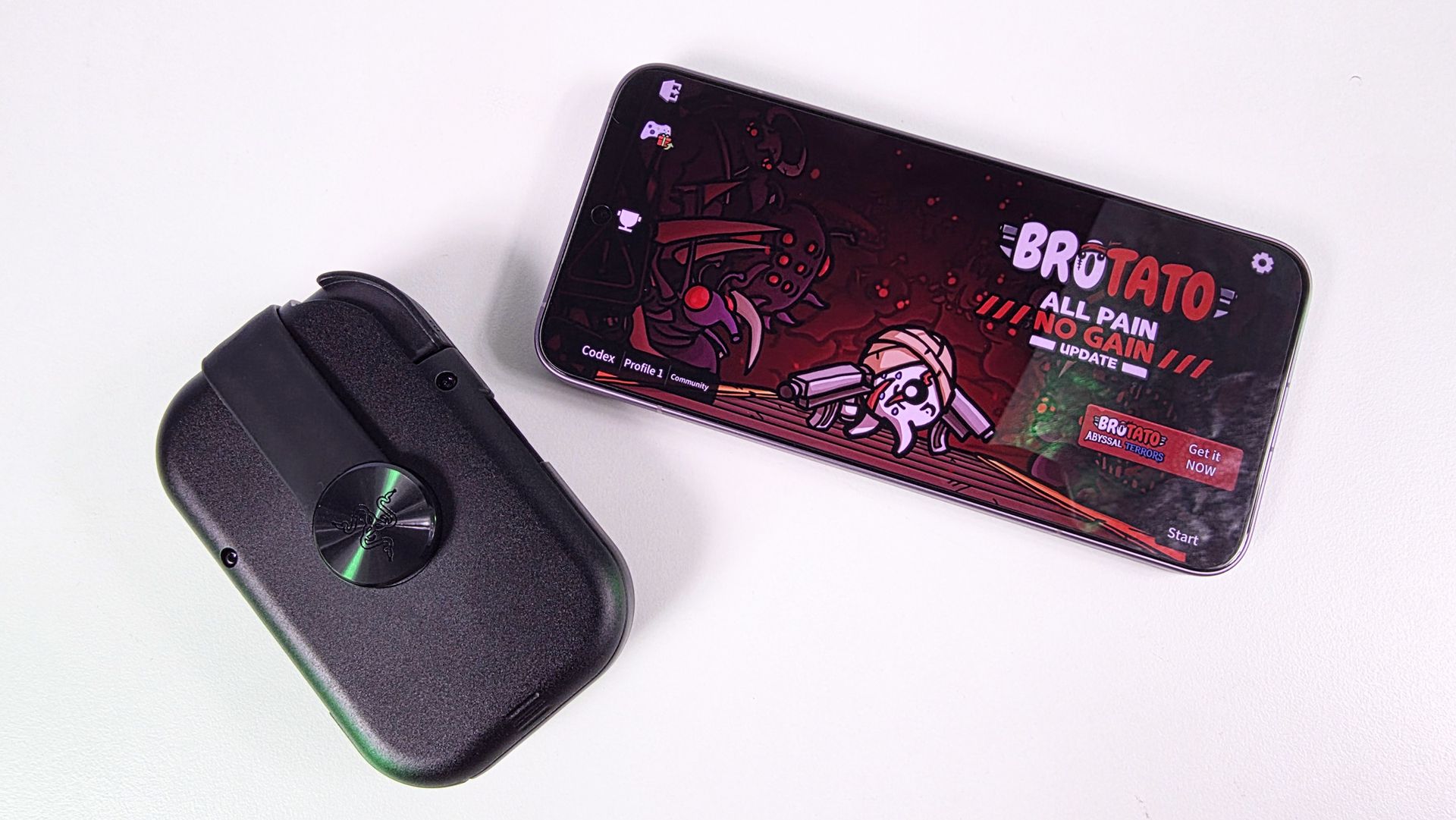
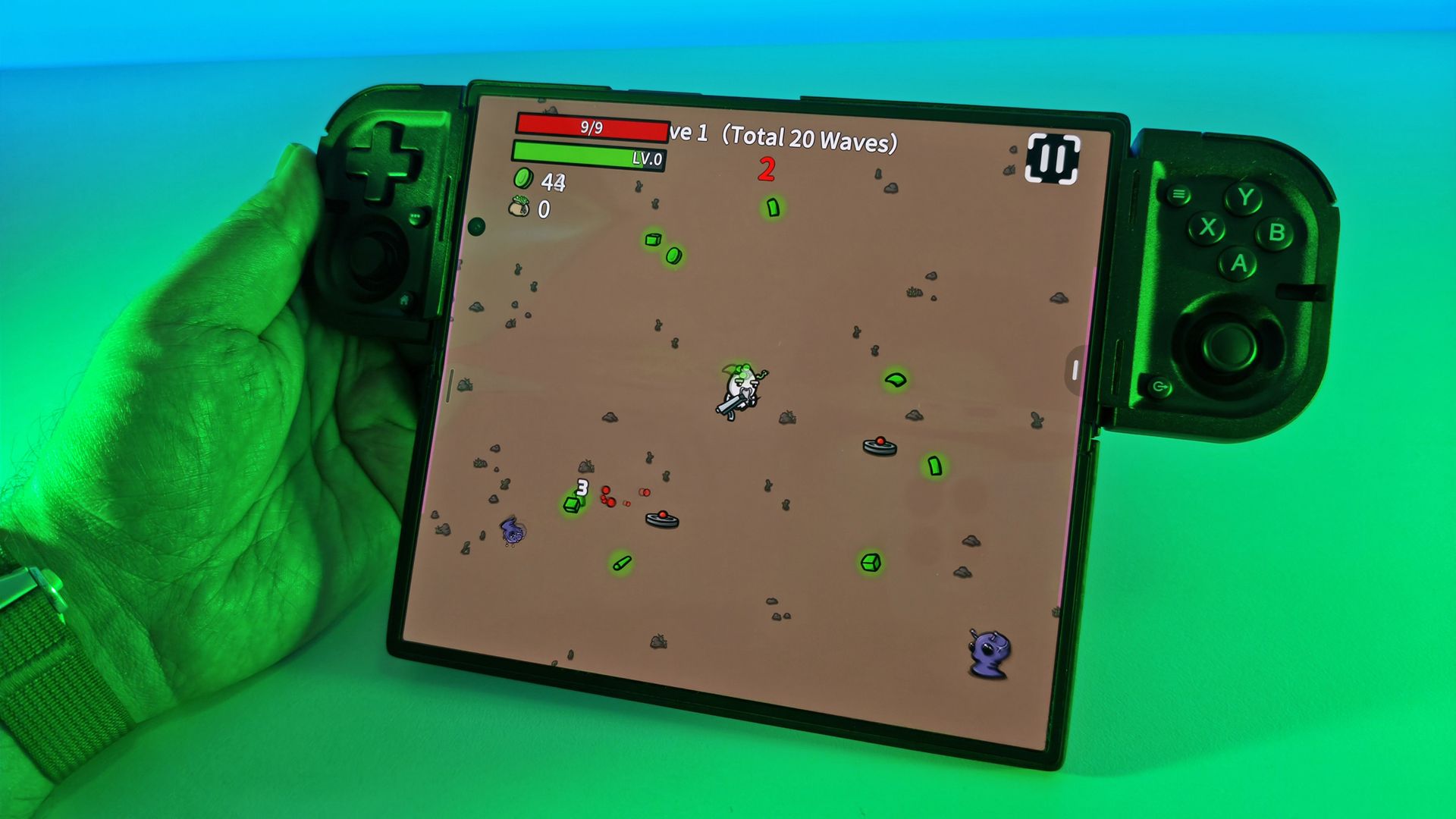
During testing with games like Brotato and Xbox Cloud Gaming titles, controls felt accurate and responsive. Because the Prio connects directly through USB-C rather than Bluetooth, I also never noticed any input lag, pairing issues, or connectivity problems.
No Bluetooth and USB-C also means the Prio itself never needs charging, which again adds to the convenience factor, as it's one less thing to think about if you want a quick gaming sesh at the doctor's office.
The triggers deserve a special mention. They're perfectly usable, but they're also one of the areas where the compact size makes itself known. The L2 and R2 triggers feel a little unusual compared to traditional controllers and are somewhat clickier than expected. They get the job done, but nobody is going to mistake them for premium full-sized controller triggers.
Better than touch controls, and that's what matters
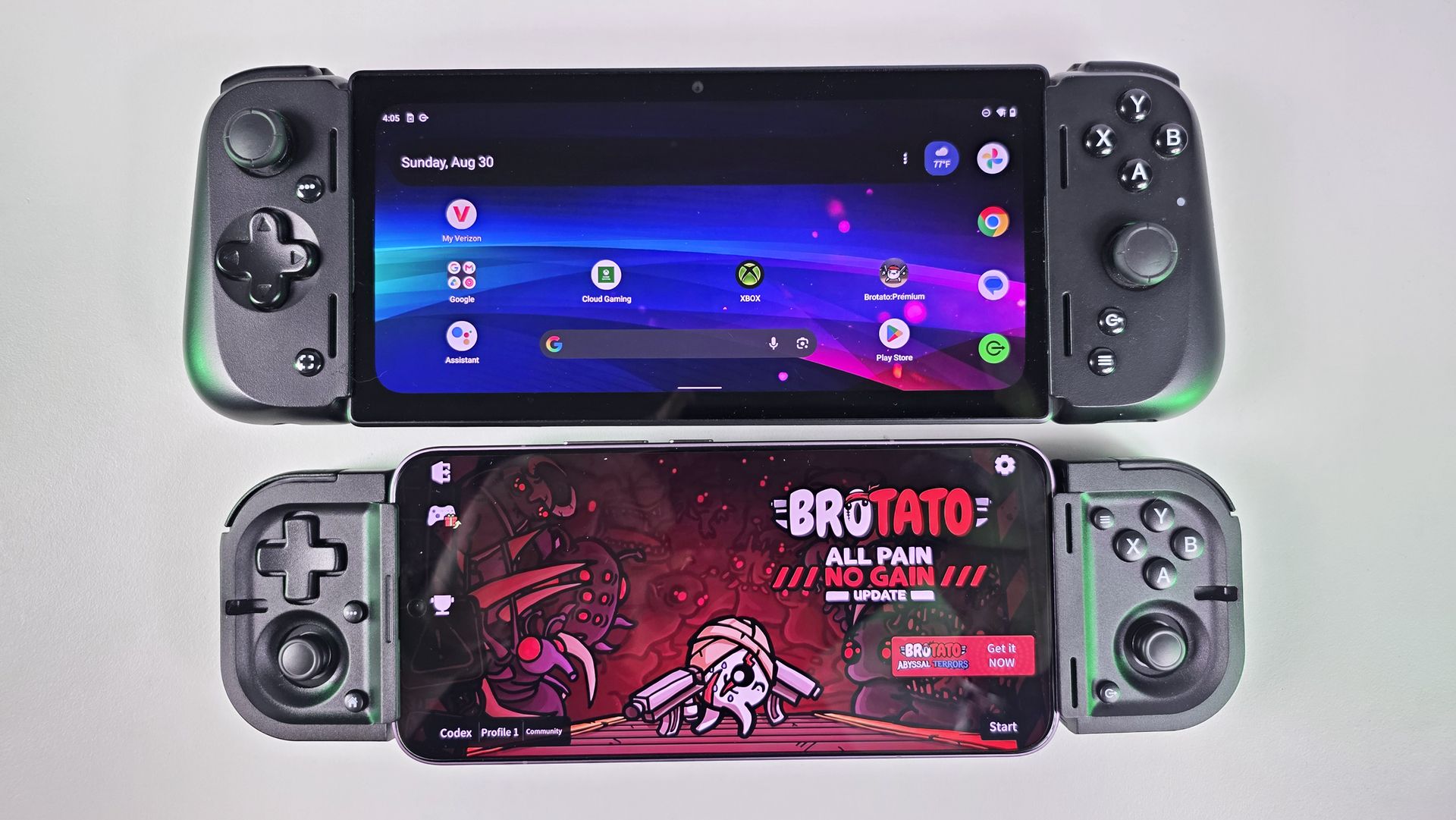
How the Prio (bottom) compares to the Razer Edge 5G (above). (Image credit: Daniel Rubino)
The Prio isn't designed to be the most ergonomic controller available. It's designed to be the controller you're willing to carry every day.
During longer gaming sessions of around an hour, the smaller controls do start to make their presence known. My hands were definitely more aware of the compact design than they would be with something like a Kishi V3 Pro.
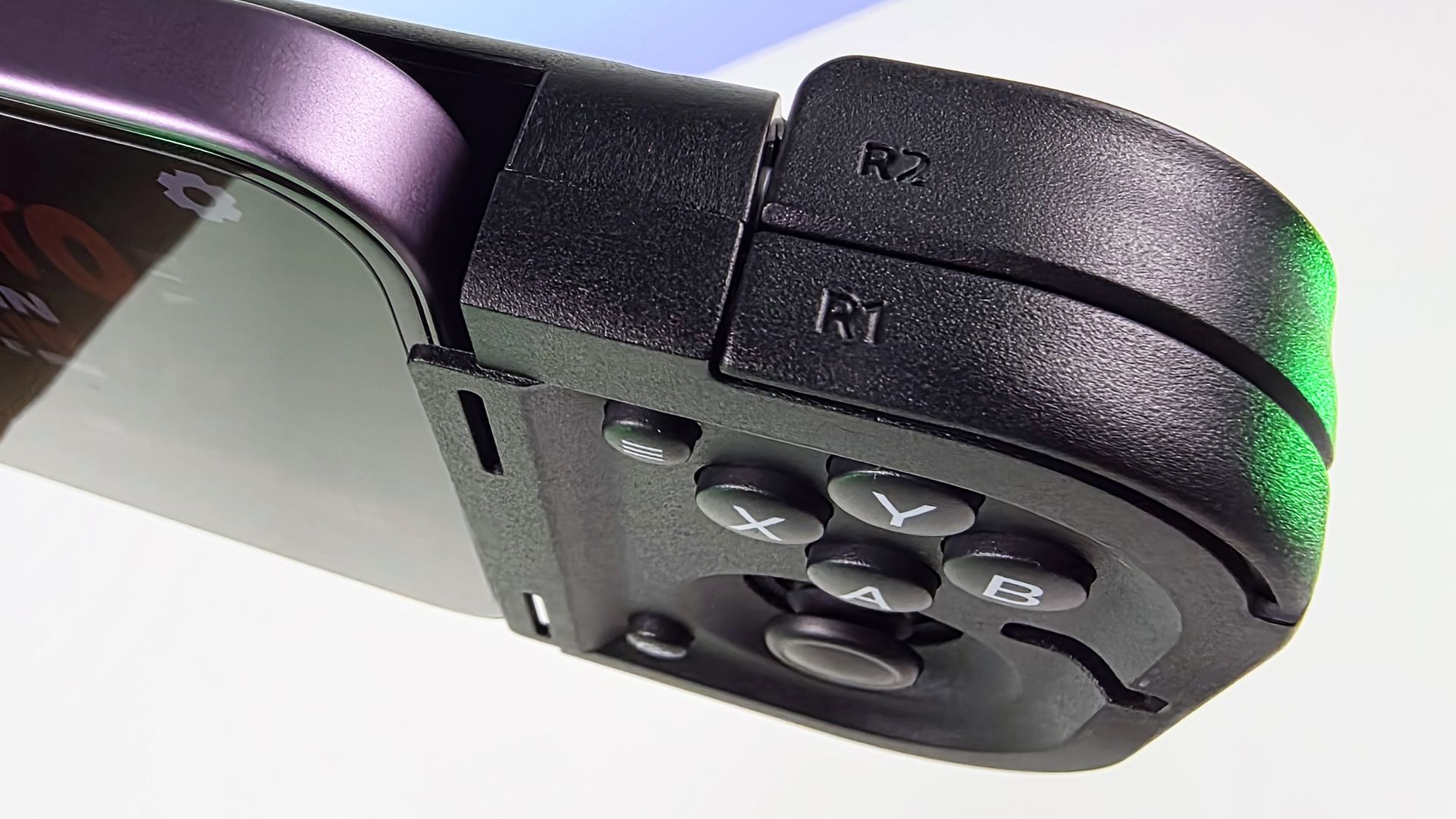
The top shoulder buttons are decent on the Razer Prio. (Image credit: Daniel Rubino)
But here's the thing: I'd still choose the Prio over touchscreen controls every single time.
In fact, that's the comparison that matters most.
Playing action games with virtual buttons often causes hand fatigue and cramping much faster than using the Prio. The tactile controls provide actual feedback, keep your thumbs off the display, and make games considerably more comfortable to play.
If you're already gaming primarily with on-screen controls, the Prio feels like a massive quality-of-life upgrade.
Wide compatibility and a surprisingly good software experience
The Prio technically works with the Samsung Galaxy Z Fold7, but you can only use it unfolded. It's a bit clunky, but super fun to use! (Image credit: Daniel Rubino)
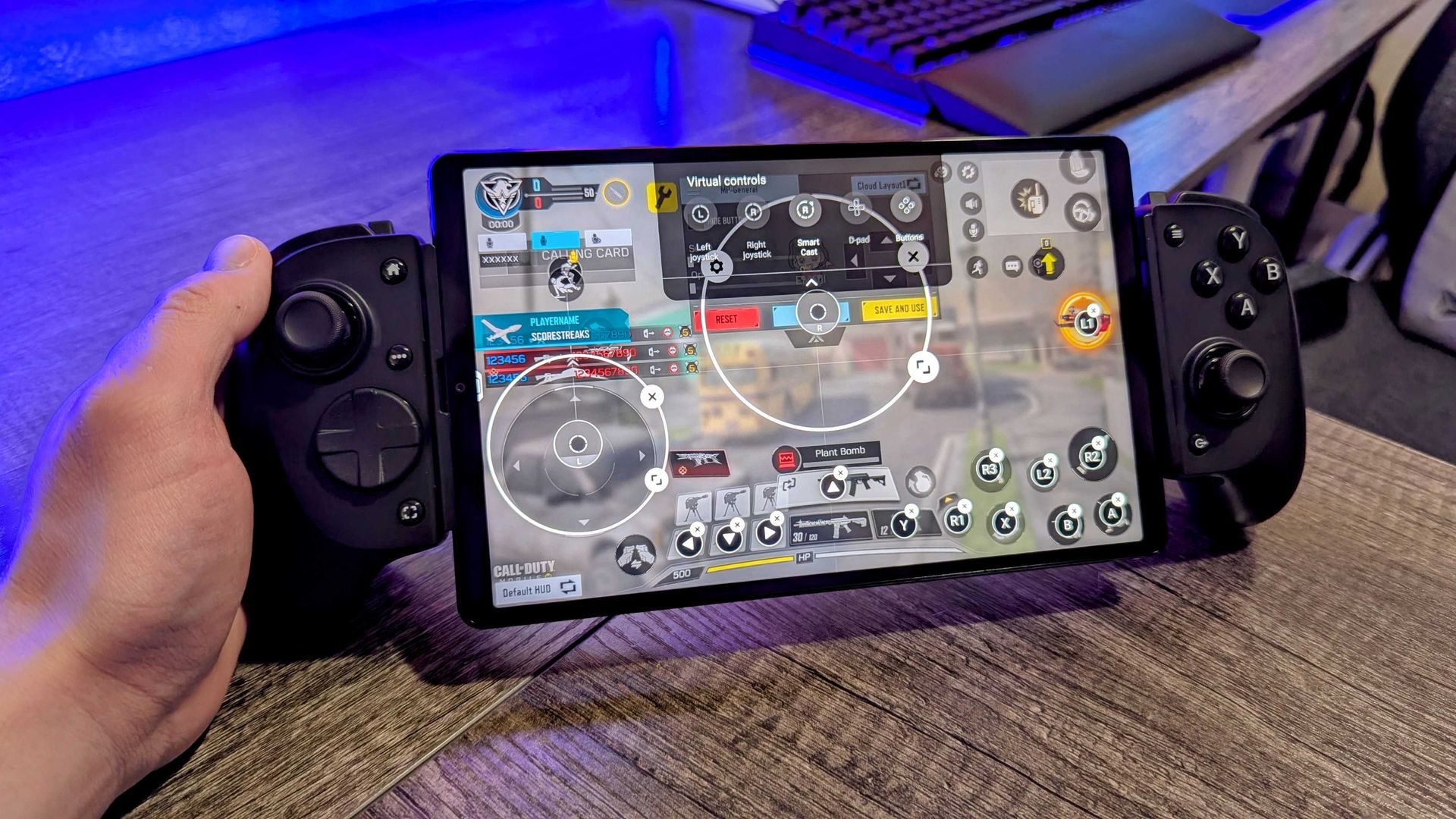
Razer says the Prio supports USB-C smartphones up to 188mm in length and cases up to 15mm thick. It also works with both Android phones and modern USB-C iPhones.
My foldable phones like the Samsung Galaxy Z Fold7 worked too, albeit with a caveat. Ironically, I found the best experience with my Fold devices was actually in their unfolded tablet mode. While that may seem counterintuitive for such a compact controller, gaming on a larger foldable display paired with the Prio was surprisingly enjoyable.
The included spacers and bumpers also make fitting phones straightforward, even when using cases. For instance, I had no issues using the Prio with my Samsung Galaxy S26 Ultra with a Pitaka case (you just have to swap out or remove the internal bumper/pads).
Then there's Razer Cortex.
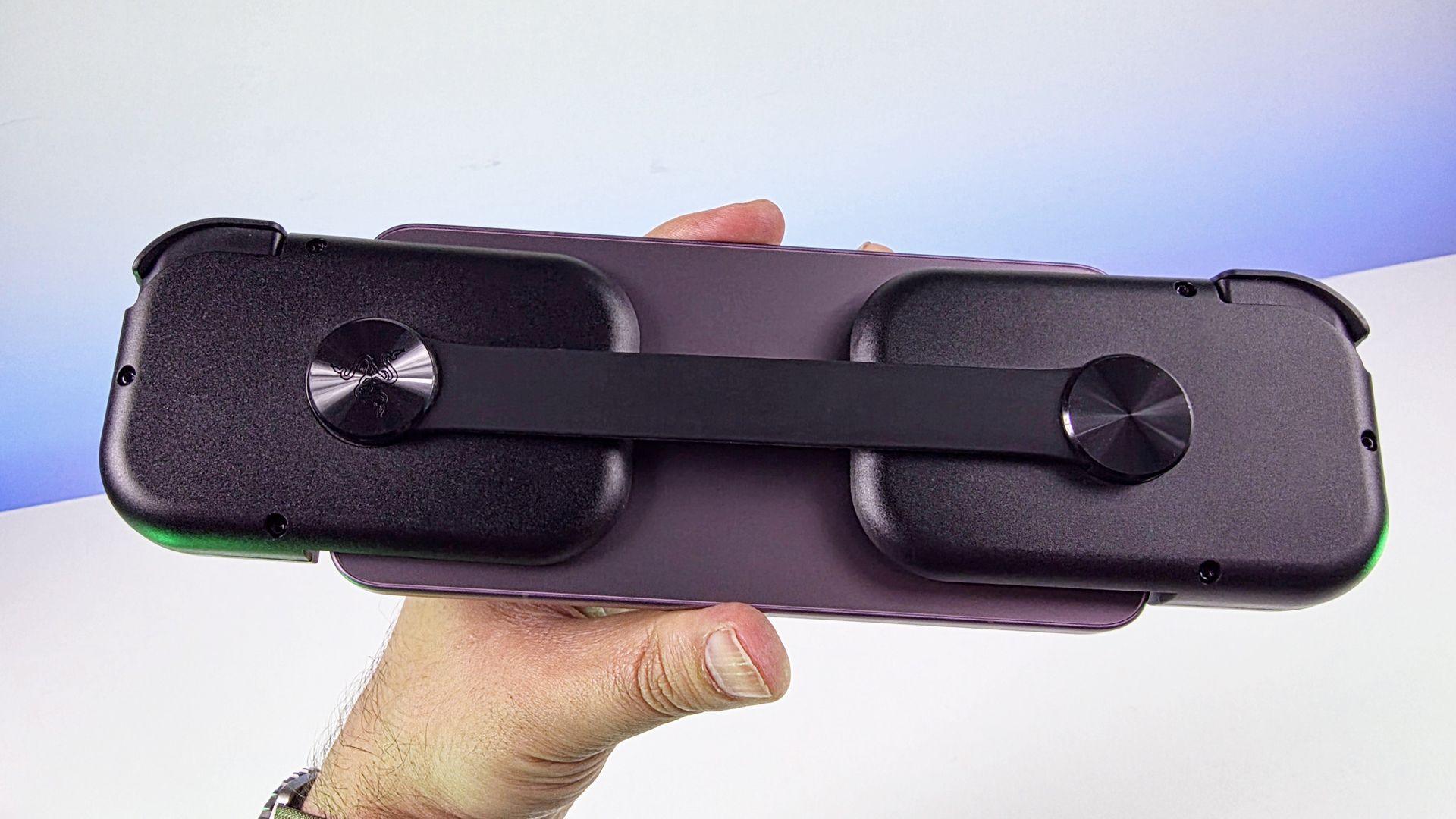
Rear of the Razer Prio on the Xioami 17T Pro smartphone with a 6.83 inche display. (Image credit: Daniel Rubino)
The dedicated Cortex button launches Razer's gaming software, which automatically gathers installed games into a centralized library. The experience feels somewhat similar to using a Steam Deck or handheld gaming PC launcher, making it easier to jump into games without digging through app drawers.
The controller supports not only mobile games but also cloud and remote streaming services, including Xbox Cloud Gaming, Steam Link, PlayStation Remote Play, and Razer PC Remote Play.
One limitation worth mentioning is that not every mobile game benefits from the Prio. Some popular titles remain locked to portrait orientation. Games like 1945 Air Force and Raiden Fighter simply aren't designed around horizontal controller gameplay, so the Prio doesn't add much value there.
For more console-style mobile games, however, it's an excellent fit.
Competition
The $149 Razer Kishi V3 Pro is bigger and more premium, but really not pocketable like the Razer Prio. (Image credit: Windows Central | Zachary Boddy)
The Prio's biggest competition may come from within Razer's own lineup.
The Razer Kishi V3 and Kishi V3 Pro offer larger controls, better ergonomics, and a more traditional controller experience. They're excellent options for couch gaming or tossing in a backpack.
The Prio takes a different approach.
Those controllers are portable. The Prio is pocketable. That distinction ends up making all the difference.
Sure, there are some other great options like the Backbone One Xbox Edition ($109), Abxylute S9 ($99), and even Razer's Razer Kishi Ultra, which all got excellent reviews from us and are great mobile controllers, but none of them are .... well, pocketable.
Should you buy it?
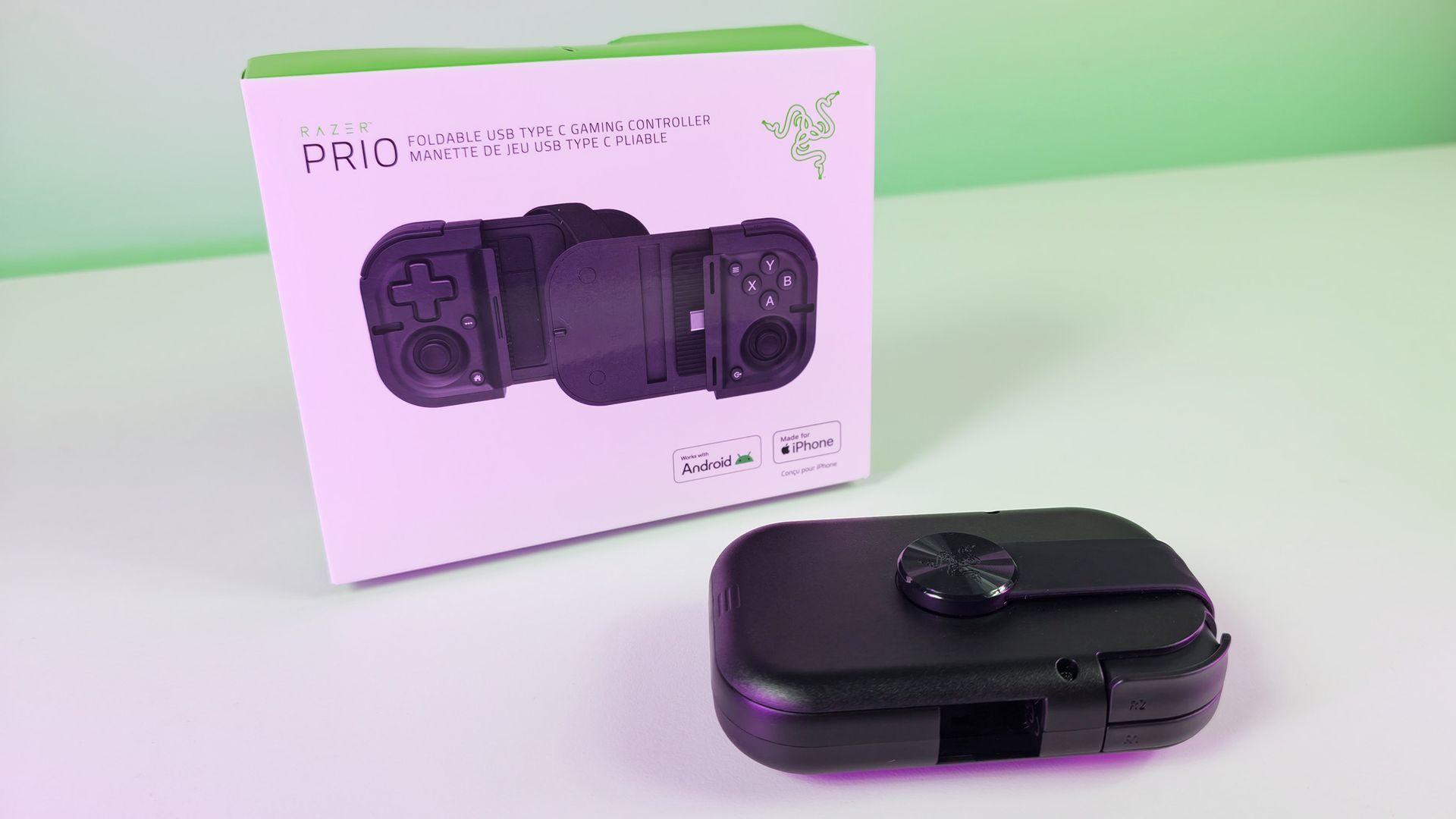
Folded black Razer Prio mobile controller resting in front of its white product box. It's a bit thick (and mostly hollow), but still easily fits into a pocket. (Image credit: Daniel Rubino)
✅You should buy this if...
You want a pocketable mobile controller
You want a step up from on-screen controls
You cloud game or play horizontally-formatted games
❌You shouldn't buy this if...
You have a foldable phone (maybe)
You prefer more comfort over portability
The Razer Prio succeeds because it understands the assignment.
Rather than trying to become another bulky mobile controller, it prioritizes portability without sacrificing too much functionality. The result is a controller that's more comfortable than touchscreen gaming, more practical than many competitors, and genuinely easy to keep with you every day.
At $99.99, it sits right on the edge of what feels reasonable. Personally, I think $79.99 would be the sweet spot. But Razer also made the smart decision not to push pricing too close to the far more premium Kishi V3 Pro ($149.99), and there are certainly more expensive mobile controllers on the market.
The controls are small. The setup is initially quirky. The all-black design could use a splash of classic Razer green.
None of those complaints change the fundamental reality: the Prio solves a real problem.
And if you've ever left a mobile controller at home because it was simply too big to carry around, the Razer Prio might be exactly what you've been waiting for.
Pocketable
Razer
Prio
The Razer Prio isn’t out to win any “biggest, cushiest controller” awards—it’s gunning for the gold in portability. With a clever foldable design that shrinks down to about the size of a credit card, it’s one of the rare mobile controllers you might actually slip into your pocket instead of leaving it to gather dust at home.
Join us on Reddit at r/WindowsCentral to share your insights and discuss our latest news, reviews, and more.
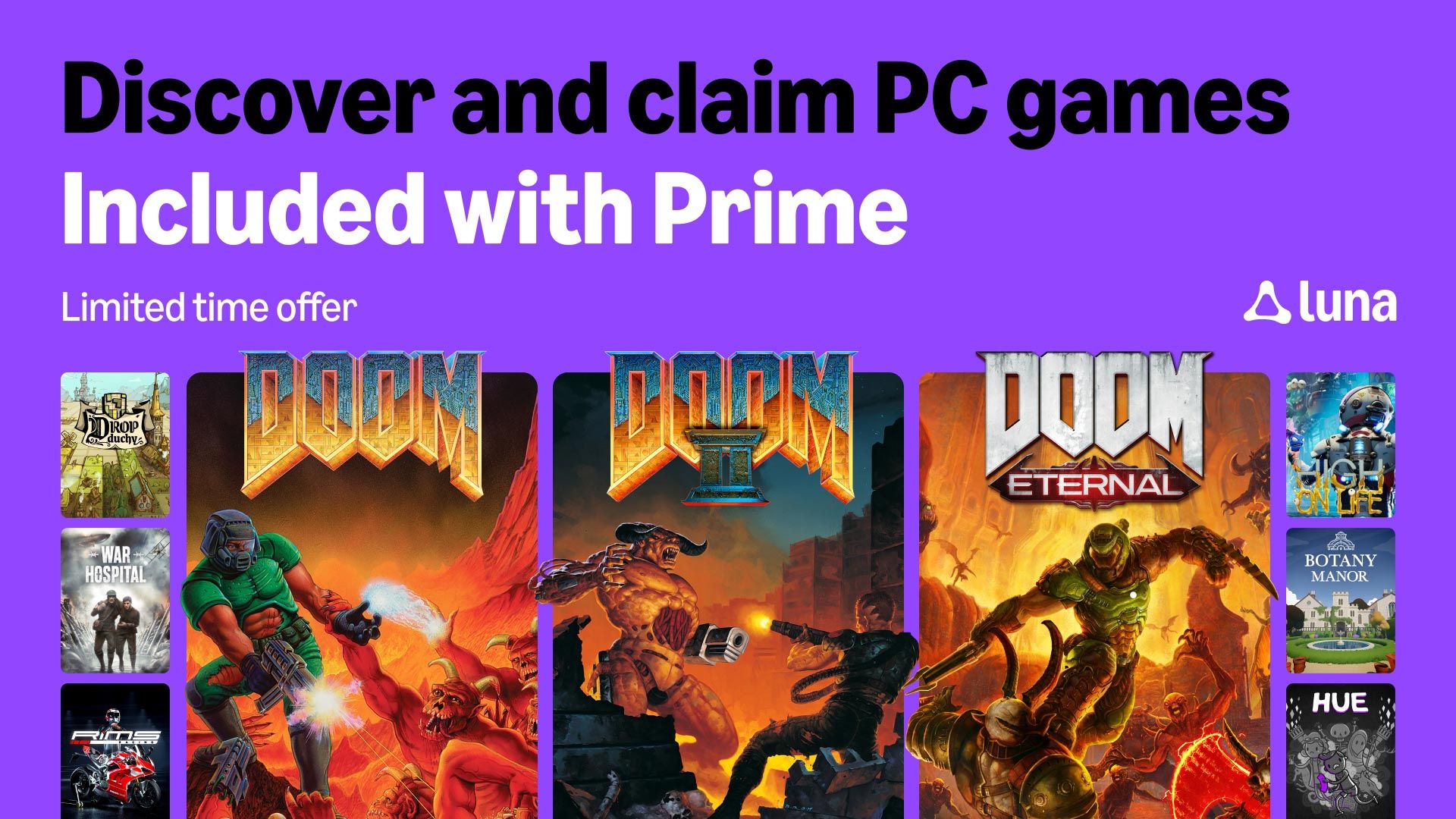
Amazon has announced 17 new games for Luna, its cloud gaming service packed within Prime that allows subscribers to stream video games on PCs, Amazon Fire TV Sticks, and mobile devices without the need for a home console (although you will still need a compatible controller).
This lineup for Amazon Prime Luna includes some heavy hitters like Doom: Eternal, Star Wars: Outlaws, High on Life, and Avatar: Frontiers of Pandora, to name a few.
Here's the full list of games coming to Amazon Prime Luna throughout September 2026, and when you can expect them to arrive.
War Hospital (September 3, 2026)
Just Die Already (September 3, 2026)
Avatar: Frontiers of Pandora (September 10, 2026)
Star Wars: Outlaws (September 10, 2026)
Drop Duchy (September 10, 2026)
DOOM + DOOM II (September 10, 2026)
Botany Manor (September 10, 2026)
King of Tokyo (September 10, 2026)
It’s Quiz Time: Guinness World Records (September 10, 2026)
DOOM Eternal (September 17, 2026)
Rims Racing (September 17, 2026)
Wall World 2 (September 17, 2026)
Hue (September 24, 2026)
The Da Vinci Cryptex (September 24, 2026)
High on Life (September 24, 2026)
Bowling Mayhem(coming soon)
Cranium Planet (coming soon)
We can play DOOM Eternal on the Cloud again for as long as we want, thanks to Amazon Luna
Ripe & tear until it is done. (Image credit: Windows Central)
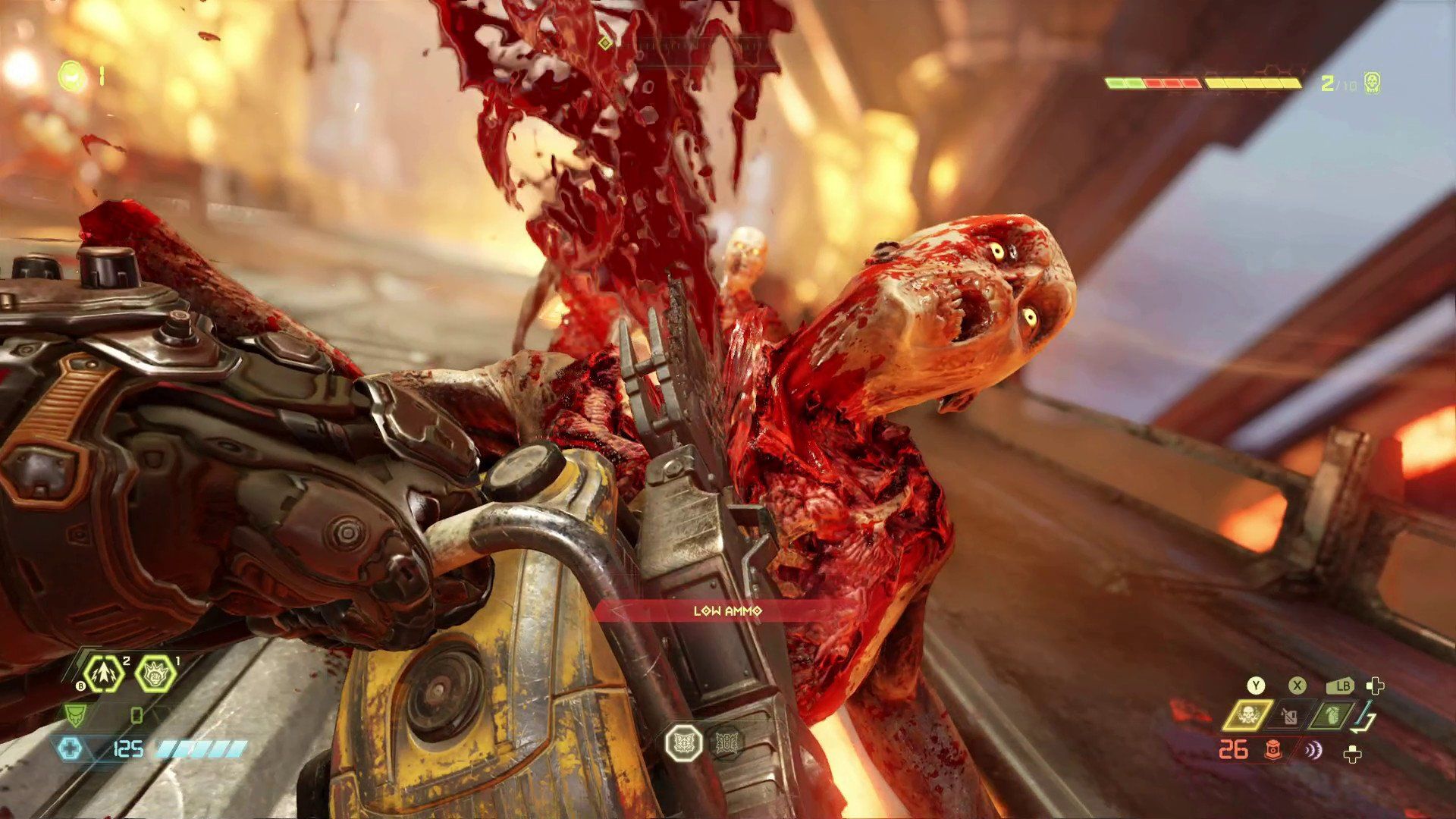
Out of all the games on this list, the best addition is without a doubt Doom Eternal. This game is one of the greatest first-person shooters ever for its adrenaline-pumping gunplay, challenging and deliciously evil boss fights, and wide variety of weapons that keep its ultra-violent gameplay fresh.
So, if you can't afford to play DOOM Eternal on Xbox Series X|S or PC these days due to these platforms being price-hiked by the RAM crisis, or you want to play it on the go without Xbox Cloud Gaming's newly imposed monthly limits, signing up for Amazon Luna with a Prime membership may be your next best Cloud Gaming option to experience the best DOOM game ever made.
Join us on Reddit at r/WindowsCentral to share your insights and discuss our latest news, reviews, and more.
L'équipe derrière
suyu
, l'émulateur Nintendo Switch né des cendres de
yuzu
, a publié le début septembre une dernière version de son logiciel, puis a fermé le
dépôt
sur un ultime commit intitulé "FINAL". Et cette version d'adieu embarque un truc que j'ai trouvé intéressant. C'est un mode baptisé Recompiler, qui change totalement la façon dont le code du jeu est "traduit".
D'habitude, un émulateur traduit les instructions ARM de la console en instructions x86 au fur et à mesure que le jeu tourne. C'est ce qu'on appelle un JIT. Alors que là, le mode Recompiler fait le boulot à l'avance en prenant le code ARM64 du jeu et en le convertissant en code C.
Le
code de suyu
ne cache pas d'où vient l'idée, puisqu'il se décrit lui-même comme un moteur produisant du C portable "à la manière de N64Recomp". Grâce à cette technique de recompilation, en bout de la chaîne, vous obtenez un vrai binaire .exe sous Windows, ELF sous Linux, ou Mach-O sous macOS.
Faut savoir qu'un jeu entier, ça fait des millions de blocs de code (oui, des millions !), et réunis dans un seul fichier C, ça pèserait des centaines de mégaoctets. Soit de quoi occuper un compilateur durant des heures avec beaucoup de mémoire consommée et éventuellement un abandon par K-O technique ^^... Alors qu'en le recompilant, on peut profiter de perfs natives sans éclater la machine.
Maintenant la réalité c'est que le programme obtenu grâce à cette recompilation, ne se débrouille pas tout seul. Le JIT n'a pas vraiment disparu, mais se construit à la demande, dès que l'exécution tombe sur une adresse que l'analyse statique n'avait pas repérée (un appel indirect, typiquement). Sans ce filet de sécurité, le jeu se figerait sur un écran noir. Je vois bien comment ça marche parce que c'est ce que j'ai exploré avec mon outil de recompilation Kompote.
Et ensuite, le jeu recompilé continue de passer par la couche d'émulation de suyu pour ses services système et son GPU. Bref, on est encore loin du jeu Switch qui tournerait tout seul sur votre PC, mais je n'ai aucun doute sur le fait que ça arrivera bientôt.
Notez que les binaires téléchargeables datent tous du 4 septembre, alors que les derniers correctifs ont été committés les 12 et 13. Il faudra donc compiler le code pour profiter de cette dernière version.
Quant à savoir pourquoi le projet s'arrête maintenant, l'équipe n'en dit pas un mot mais je sais juste qu'un
avis DMCA de Nintendo
avait déjà emporté son dépôt principal en juillet 2024, et qu'un
nouvel avis du 17 août dernier
avait fait tomber d'un coup 307 dépôts dont l'adresse contenait le mot suyu.
Mais rassurez-vous, ça ne veut pas dire que l'émulation Switch s'arrête pour autant puisqu'un
fork
a repris le code dans la foulée et enchaîne déjà les versions.
Et
Eden
, le projet dont suyu descend directement, continue tranquillement sa route sur son propre serveur, loin de GitHub, avec une version publiée en juin et un dépôt encore actif à la mi-septembre. C'est donc là qu'il faut regarder si vous cherchez un émulateur Switch encore suivi.
Source : le dépôt archivé de suyu et l'article de
Wccftech
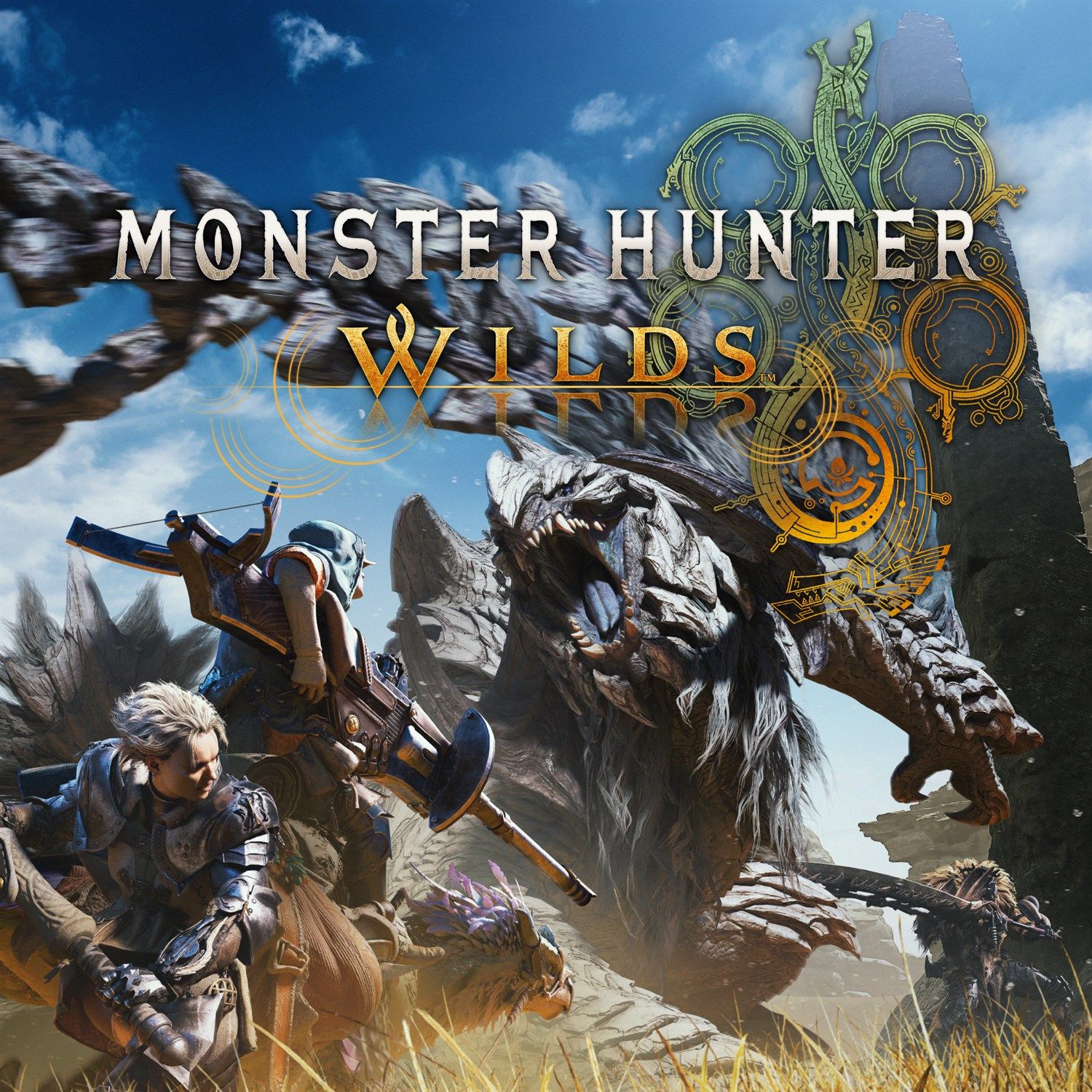
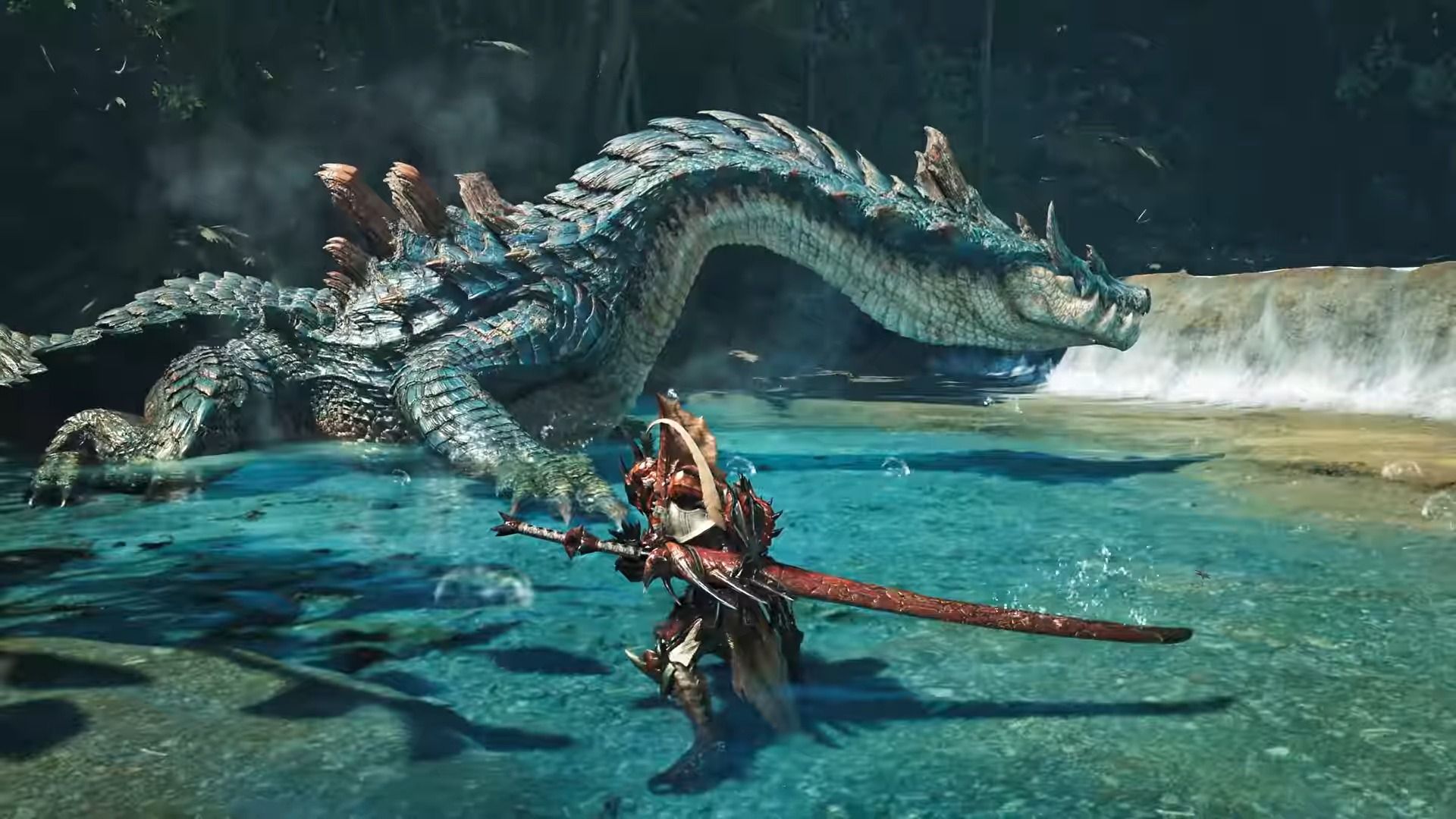
After two weeks, we've reached the end of Monster Hunter Wilds: Ascendance's weapon showcase series, and it's closing out with a new trailer for the Longsword.
Ever since Monster Hunter World, the Longsword has been one of the most popular and dominant weapon types in Monster Hunter games for its insane damage output and various counter moves that make fighting bosses a cakewalk.
In Monster Hunter Wilds: Ascendance, the Longsword is getting even crazier thanks to the new Boost Bracer, granting it a plethora of new moves, speed buffs, and more.
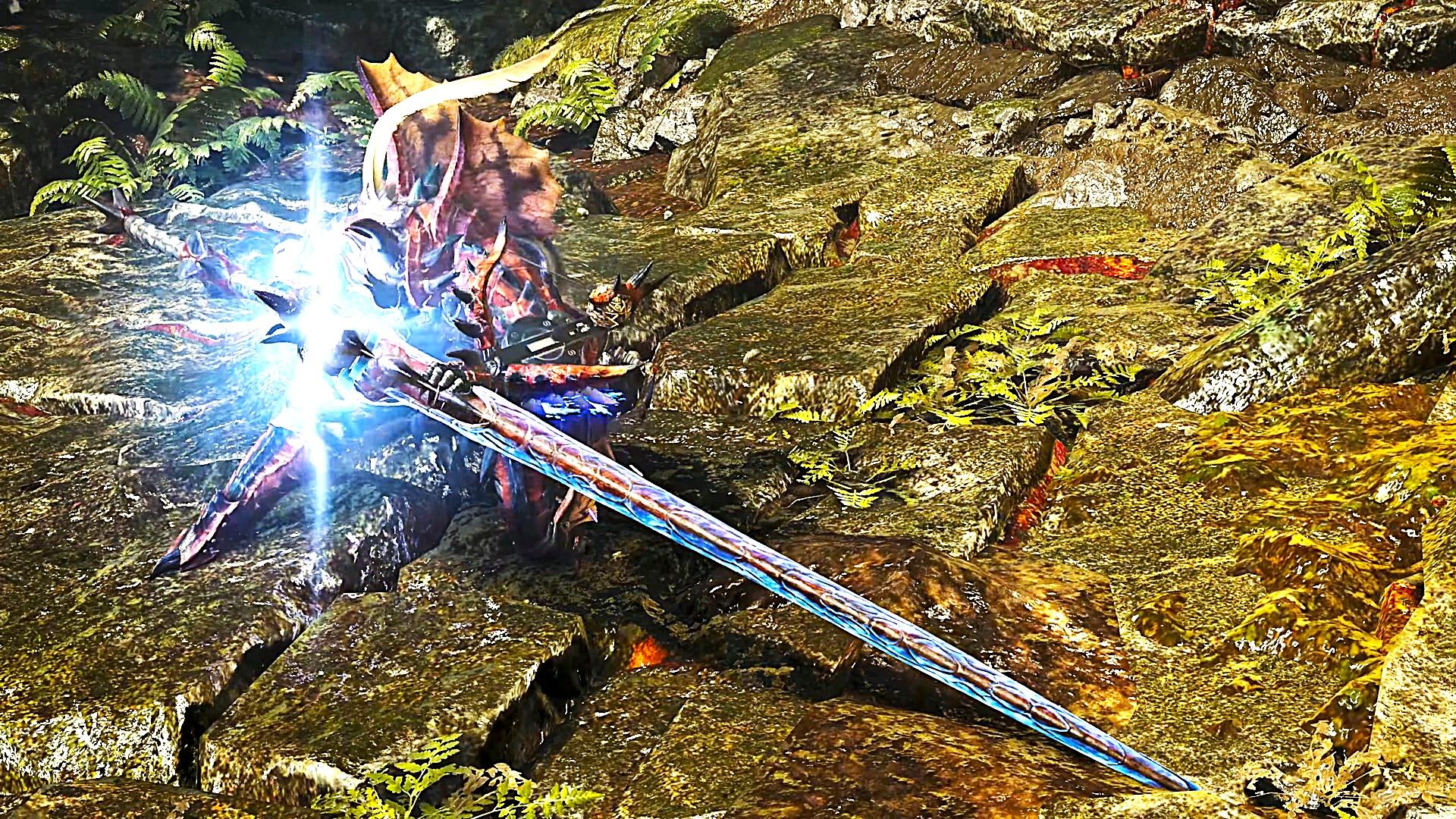
First of all, Longsword has a new Boost Driver attack that sheathes the weapon and lets you move about before unleashing an offset counterattack that can be followed by a literal, gut-wrenching slash attack when successfully toppling an attacking monster.
While Boost Gauge is active, the Longsword gets access to new combo attacks so quickly they're on par with Dual Blade attacks; you get a new combo ender where you dash back and forth in the blink of an eye to slice monsters, and you get access to the Sacred Sheath Stance from Monster Hunter Rise: Sunbreak that lets you pull off chargeable heavy attacks.
Additionally, while activating the Boost Gauge, the Longsword's Foresight Slash counter now deals additional damage.
Now we wait for the Monster Hunter Wilds: Ascendance Tokyo Game Show 2026 showcase
Embody your wildest samurai power fantasies with Monster Hunter Wilds: Ascendance's Longsword. (Image credit: Capcom)
While I am slightly annoyed at Capcom's blatant favoritism in making Longsword, objectively, the best weapon type for the third Monster Hunter game in a row, I do like the more aggressive attacks and faster combos it's getting in Monster Hunter Wilds: Ascendance, as they feel like they were ripped straight out of Onimusha: Way of the Sword.
Plus, these changes look like they're trying to make Longsword lean into a more berserker playstyle, which I prefer over its old, defensive playstyle of waiting for monsters to attack and countering them, as I'm getting burnt out on parry mechanics in games lately.
That being said, out of the newly improved weapons, I'll be maining Gunlance again in Monster Hunter Wilds: Ascendance because the changes it's receiving are cool and LONG overdue.
Though I'll also dabble in Sword & Shield, Hunting Horn, Hammer, and Dual Blades when Monster Hunter Wilds: Ascendance launches in 2027for Xbox Series X|S,PlayStation 5, and PC via Steam.
However, for all we know, Capcom could be hiding some new mechanics and secret balance changes for each weapon type not shown in these trailers. Will players discover these potential secret changes for each weapon type when they play Monster Hunter Wilds: Ascendance's first playable demo at the upcoming Tokyo Game Show 2026?
Tune in this week to find out when Tokyo Game Show 2026 commences onThursday, September 17, 2026.
Venture into Forbidden Lands to discover uncharted lands and hunt giant monsters alongside your friends in online co-op to protect nature and mankind in Monster Hunter Wilds.
Empower your weapons with the new Boost Bracer, explore a mysterious land floating in the sky, and hunt down ancient Elder Dragons in Monster Hunter Wilds' epic DLC expansion, Monster Hunter Wilds: Ascendance.
Si vous avez une petite console rétro portable qui traîne, du genre une Miyoo Mini, une TrimUI Brick, une
Anbernic RG35XX
, vous avez sans doute remarqué que l'interface livrée avec fait le job mais sans plus. Ça tombe bien, spruceOS est là pour ça ! Et malgré son nom, ce n'est pas vraiment un système d'exploitation. En réalité, il s'agit d'un frontend codé en Python qui vient se poser sur une base système déjà existante. Le code est public, sous une licence Creative Commons donc pour les plus capitalistes d'entre vous, ça veut dire pas d'usage commercial sans permission écrite de l'équipe.
Sur les Miyoo et les TrimUI, la base en question est le système d'origine de la console, celui du fabricant. Sur les Anbernic à puce H700 et sur la Powkiddy RGB30, il faut d'abord installer une base tierce sur la première carte mémoire, genre BaseOS pour les Anbernic, dArkMoss pour la Powkiddy. La carte spruce, elle, ira dans le second emplacement, le TF2, et elle restera librement échangeable d'un appareil supporté à l'autre. Rien de dramatique donc, mais ça fait une étape de plus et une carte en plus.
Ce que vous y gagnez si vous installez spruceOS, c'est surtout du confort au quotidien. Vous maintenez le bouton HOME pendant trois secondes et le Game Switcher vous laisse sauter d'un état de sauvegarde à l'autre sans quitter votre partie. Quand vous éteignez la console en plein jeu, elle sauvegarde même toute seule son état et vous remet exactement là où vous en êtiez au rallumage. Et si votre console a le Wi-Fi, vous ne repassez plus par le PC pour l'habiller puisque l'outil Theme Garden pioche dans plus de quatre-vingts thèmes communautaires dispo en ligne, le Game Nursery télécharge des portages gratuits / homebrew, et un scraper récupère même les jaquettes des jeux depuis la base libretro.
Le menu principal de spruceOS, avec les quatre icônes du thème SPRUCE par défaut
Ce qu'il vous faut avant de commencer
Il vous faut une carte microSD neuve, d'une vraie marque, achetée chez un revendeur sérieux ainsi qu'un bon lecteur de cartes. Et bien sûr un ordinateur sous Windows, macOS ou Linux avec une connexion Internet.
Et surtout, n'utilisez pas la carte livrée avec la console. C'est pas moi qui le dit mais le wiki du projet qui est catégorique là-dessus, en majuscules dans le texte : "DO NOT USE THAT STOCK SD CARD!", parce qu'elle est mauvaise, que les jeux dessus sont mauvais et que les BIOS le sont aussi. Donc gardez-la dans un tiroir, elle vous servira pour revenir en arrière en cas de foirage.
L'installation en un clic
L'équipe a sorti un installeur tout-en-un, qu'elle présente comme entièrement open source, disponible pour Windows, Linux et macOS. Il formate la carte, télécharge la version que vous choisissez et l'installe, en une seule opération. Une seule précaution, et le projet la signale lui-même : vérifiez bien que le lecteur que vous désignez est votre carte, parce que l'installeur écrit sur celui que vous lui montrez. C'est le chemin recommandé, et c'est aussi lui qui règle le cas des Anbernic et de la Powkiddy : BaseOS et dArkMoss ont chacun leur onglet dans l'application et se téléchargent puis s'installent automatiquement, sans que vous ayez à aller chercher une image ailleurs.
Un détail qui coince sur Mac, et qui n'est écrit nulle part ailleurs que dans le dépôt : macOS interdit aux applications d'écrire sur un disque amovible sans permission explicite, et l'installeur passe par le Terminal. Il faut donc aller dans Réglages Système, Confidentialité et sécurité, Accès complet au disque, ajouter Terminal, puis quitter et rouvrir le Terminal. Ce dernier point compte, la permission ne s'applique pas à une session déjà ouverte.
Sur Mac, Terminal doit figurer dans Accès complet au disque pour que l'installeur puisse écrire sur la carte (
Source
)
L'installation à la main
Si vous préférez faire ça vous-même, il vous faut un utilitaire de formatage et 7zip. Vous formatez la carte en FAT32, avec Rufus sous Windows ou l'Utilitaire de disque sous macOS en choisissant MS-DOS (FAT32). Vous récupérez l'archive spruce.vX.X.X.7z sur la page des versions du dépôt, vous l'extrayez sur votre ordinateur, puis vous copiez le contenu extrait sur la carte. Vous éjectez proprement, vous insérez la carte dans la console et vous allumez.
Et là, attention au piège, puisque le paquet contient un dossier caché nommé .tmp_update, et sans lui spruce ne fonctionnera tout simplement pas. Donc affichez les fichiers cachés avant de les copier : sur Mac c'est Commande + Majuscule + point, et sur Ubuntu le dossier est masqué par défaut lui aussi. Sur Mac, pensez aussi à nettoyer les fichiers .dot parasites avant d'éjecter la carte. Un utilitaire comme
CleanEject
fait ça très bien.
Vos jeux et vos BIOS
Les ROMs se rangent ensuite dans un dossier Roms, avec un sous-dossier par machine. La plupart des noms sont évidents, mais certains noms piègent tout le monde comme SFC ou FC. Hé oui, les jeux Super Nintendo vont dans SFC, pour Super Famicom, et pas SNES ; les jeux NES vont dans FC, pour Famicom, et pas NES. Les vidéos et la musique, elles, vont toujours dans MEDIA.
Les BIOS se posent dans un dossier BIOS à la racine de la carte, mais il faut les placer dans le sous-dossier qui va bien par machine et pas tout balancer en vrac. Le BIOS de la Dreamcast veut son sous-dossier, certains sont obligatoires pour que la machine tourne, d'autres pas. Donc je vous invite à vous renseigner en fonction de la machine que vous voulez émuler. Et comme d'hab, le BIOS de la NeoGeo ne va pas dans BIOS mais avec les jeux.
BIOS/dc/dc_boot.bin Dreamcast, obligatoire
BIOS/gba_bios.bin Game Boy Advance, facultatif
Roms/NEOGEO/neogeo.zip NeoGeo, obligatoire, et pas dans BIOS
Et évidemment, le projet ne fournit ni ROMs commerciales ni BIOS et ne vous dira pas où les trouver, donc c'est à vous de voir avec vos propres cartouches et vos propres disques.
Si l'écran reste noir
Maintenant, si c'est tout noir au lancement, vérifiez que le dossier .tmp_update est bien présent sur la carte. Remettez-la dans l'ordinateur, réaffichez les fichiers cachés, et regardez : si vous avez copié sans avoir activé l'affichage, il n'y est pas. L'autre suspect, c'est la carte elle-même. C'est peut-être parce que vous avez acheté une no-name de merde.
Le moment où vous ne pourrez plus revenir en arrière
Tant que vous ne touchez qu'à la carte, vous ne risquez rien de définitif. Sur la famille Anbernic RG35XX, les guides de référence le disent tous : ces firmwares vivent entièrement sur la microSD, et donc on peut passer de l'un à l'autre sans modification permanente de l'appareil. Ailleurs le principe est le même, et pour retrouver votre console en version d'usine il suffit donc de remettre la carte d'origine.
Sauf qu'il y a UNE exception !! spruce embarque un Firmware Updater qui apparaît tout seul dans vos applications si votre console tourne sur un firmware ancien. Celui-là n'écrit pas sur la carte mais dans la mémoire interne de la machine, et le wiki prévient sans détour : "Failure to follow the firmware updating instructions can lead to a bricked device.". En gros si vous le lancez pour faire la mise à jour du firmware, ça peut bricker votre console, donc pensez bien à la brancher sur le courant avant la mise à jour. Le projet documente d'ailleurs deux procédures de débriquage, dont une qui demande carrément d'ouvrir la Miyoo Flip et de débrancher sa batterie, ce qui vous dit assez bien à quel point on a quitté le terrain du réversible...
Et si spruceOS ne vous convient pas, vous ne serez pas coincé pour autant car sur ce même matériel,
le guide de référence de Retro Game Corps
recommande aussi
Knulli
pour son interface EmulationStation, ou encore
muOS
pour la performance d'émulation la plus avancée, à condition que le bricolage de configs customs ne vous rebute pas. Après voilà, chaque "OS" a sa carte et vous changez d'avis quand vous voulez.
Over the last couple of months, I've been salivating at the chance to play Final Fantasy Resonance, the first 'HD-2D' RPG in the Final Fantasy franchise.
It aims to bring back turn-based combat to the series after being absent for decades, while taking players on a grand adventure with gorgeous pixel-art graphics, lovable characters, and a fun story that pays tribute to the entire Final Fantasy legacy.
As someone who grew up playing turn-based Final Fantasy games ever since the original PlayStation One version of Final Fantasy VII, Final Fantasy Resonance wowed me with its nostalgic-yet-fresh presentation and gameplay.
Yet, I can't be worried. Square Enix hadn't made a home console Final Fantasy game with turn-based combat since Final Fantasy X-2 in 2003. It has spent many years trying to turn this series into an action-RPG franchise, which made me worry the developers had forgotten how to do turn-based combat for a Final Fantasy game.
Fortunately, after having played the recently released Final Fantasy Resonance demo on Xbox, my fears were crushed harder than a falling Meteor because this game is AWESOME so far.
Here's why I'm looking forward to playing Final Fantasy Resonance and why you should to if you're an old-school Final Fantasy fan or turn-based RPGs in general.
What is it?
The king of dragons, Bahamut, returns in Final Fantasy Resonance. (Image credit: Square Enix | Windows Central (Alex Cope))
Final Fantasy Resonance follows the story of Rain, a Knight of Grandshelt tasked with saving the world's life-giving Crystals from being destroyed by an evil group of dark knights known as the Sworn Six.
Along the way, you will meet heroic companions with intriguing backstories, explore a vibrant and colorful world rendered in nostalgic yet richly detailed pixel-art graphics, and call forth spiritual manifestations called 'Visions' to aid you in turn-based combat against deadly foes.
Story and Presentation
Veritas of the Sworn Six does battle with our heroes. (Image credit: Square Enix | Windows Central (Alex Cope))
What I like about the story so far is how simple yet effective and easy to follow it is.
After dealing with shoehorned alternate timelines and 'Plot Ghosts' in the Final Fantasy VII Remake series and Final Fantasy XVI's library's worth of exposition and introspection, it feels so nice to play a Final Fantasy game where the premise is "Evil knights want to burn the world because they felt it wronged them; go stop them."
What also helps elevate the story from what I've played so far is the myriad of side-quests that go into detail on the characters' backstories, the vibrant worldbuilding and charming characters, and the stunning way Square Enix presents it.
This game takes 'HD-2D' graphics (a graphical style that blends 2D-pixel art with 3D backgrounds and atmospheric lighting) and perfects it with gusto.
Call me an old goat but pixel art facial expressions will always be more charming to me than fully 3D graphics. (Image credit: Square Enix | Windows Central (Alex Cope))
The cinematic cutscenes, environments, and turn-based battles are so gorgeously animated and detailed that they make the world feel more alive than games rendered in Unreal Engine, and make something as mundane as fighting low-level goblins feel like the most epic battle in the world.
Not to mention, the pixel-art animation breathes so much life and personality into the characters through their facial expressions and actions that it makes me feel nostalgic for old PlayStation One JRPGs like the underrated classic, Grandia.
On a side note, the story has plenty of funny gags and heartwarming moments that will please long-time Final Fantasy fans while bringing levity after some pretty brutal moments.
Classic Final Fantasy turn-based combat returns with a modern twist
The optional battles of Final Fantasy Resonance will steam roll you if you're not prepared. (Image credit: Square Enix | Windows Central (Alex Cope))
Now, of course, Square Enix wastes no expense when it comes to their games' presentation, but what about gameplay?
Well, Final Fantasy Resonance follows the old-school Final Fantasy gameplay loop of exploring a world map to progress the plot, visiting towns to shop for equipment, and exploring dungeons filled with deadly enemies and bosses that must be defeated in turn-based combat.
Turn-based combat was my biggest draw to Final Fantasy Resonance, and I'm pleased to report that Square Enix still knows how to make it, and it feels SO GOOD.
At first, it plays the combat system seen in Final Fantasy X, where you take turns smacking each other with weapons and spells until one side is defeated. However, Final Fantasy Resonance quickly introduced me to new mechanics to spice things up.
These include breaking an enemy's Stagger gauge to stun them, like in Final Fantasy VII Remake, and gaining extra turns where you can unleash a storm of attacks to batter them while they're down.
Stagger enemies to trigger turns that can end with 'Resonance', where summon your party's Visions to unleash a devastating super attack or assist move to buff and heal allies. (Image credit: Square Enix | Windows Central (Alex Cope))
Combat takes things a step further with Visions. This mechanic allows your party to embody the traits and abilities of heroes from past Final Fantasy games or original heroes exclusive to this game.
These Visions can turn party members into tanks that draw aggro from enemies, healers to keep the party alive, damage dealers that focus on breaking an enemy's stagger meter, and much more. What's more is that these Visions can perform powerful super moves (with pre-rendered cinematics) when you manage to stagger all enemies on-screen at once.
The Warrior of Light Vision will turn one of your party members into an immovable wall that can protect allies from being slaughtered in battle and rain holy retribution on enemies. (Image credit: Square Enix | Windows Central (Alex Cope))
As you use and level up Visions, you can even permanently learn their passive traits and mix and match them to suit your playstyle to create the ultimate party of heroes. I got so hooked on the Visions system that I spent hours trying to learn the few abilities that were available from the demo just to see what kind of party members I could create.
It felt so rewarding when I managed to cobble a team together to take this game's brutal optional bosses and obtain some loot for my efforts, especially on Hard Mode when breaking Stagger meters became harder to do with just brute force alone.
On side note, thank goodness this game allows you to play the hardest difficulty immediately instead of making us beat the whole game on 'Normal/Easy' Mode first like many Final Fantasy games seem to these days. It makes the story's high notes feel more worth it when we're given the option to tackle it's hardest difficulty.
Here's hoping the full version of Final Fantasy Resonance lives up to its name and 'resonates' with gamers
Overall, I'm liking what I'm seeing in Final Fantasy Resonance so far after completing the demo.
It nailed the retro vibe of the early 2D-era Final Fantasy games while being fresh with its beautiful HD-2D art style. The combat system and Visions system are so addictive; there are hints of plenty of side content to partake in, and it's chock-full of fan service for Final Fantasy fans while being accessible enough for newcomers to enjoy without making them do homework.
Hopefully, if the full version of Final Fantasy Resonance is good and sells well enough with gamers, it will convince Square Enix to make more turn-based Final Fantasy games in the future once it's finished with Final Fantasy VII: Revelation.
Either way, I can't wait to play the full version of Final Fantasy Resonance when it launches on October 22, 2026, onXbox Series X|S (with Xbox Play Anywhere support), PlayStation 5, Nintendo Switch 1 & 2, and PC via Steam.
If you want to check out Final Fantasy Resonance for yourself before then, the playable demo is available to download on digital storefronts.
Join the young knight Rain on his quest to save the Kingdom of Grandshelt and the world from evil by banding together with powerful allies and embodying the spirits of past Final Fantasy heroes in Final Fantasy Resonance.
Call of Duty: Black Ops Cold War recently joined Xbox Game Pass, and as such, there's an influx of folks who haven't played before. That goes for me, too, having played only a small amount back in 2020 on the PS4.
If you're on console, it's mostly OK. But on PC there are some issues, one of which is a problem with textures not rendering properly. Sometimes it'll look blocky, others the sky won't render in at all, and when it happens, it looks like you're playing a PS1 game. Horrible.
It turns out this has been an issue pretty much always on PC, and given it's a six-year-old game, it's unlikely to get a patch to fix it. General consensus is that it suffers from a memory leak, and while I would expect Microsoft to make sure new arrivals on Game Pass aren't broken, let's face it, it's not happening.
It affects all game modes, so even if you only jump into the Campaign and Zombies, you're going to see it eventually.
Many attribute the issue to AMD graphics, but I've seen it on NVIDIA, too, and no amount of trying different drivers makes a difference. There is no fix, but there are some workarounds you can employ that can help it happen less often. You may not need all of them, but some of these have worked for me.
1. Reduce your settings to medium and don't use the high resolution textures
Trust me, you don't need the HD textures. Just turn them off, chances are it'll help. (Image credit: Future)
It's an older game, and it doesn't look as crisp as Black Ops 7 or the upcoming Modern Warfare 4. It's best to just accept this, and even though you may well be able to run it maxed out (I certainly can on an RTX 5090), dropping the settings is one way to help reduce the texture issue. Create less strain on the system.
The other thing to do is to make sure you're not trying to use the HD texture pack. In my experience it doesn't make that much difference, anyway. But having this enabled prompted texture issues in every single game for me; turning it off and going down to medium, it rarely happens now.
The HD texture pack can't be removed if you're playing on Game Pass (and is part of the reason the game is so ridiculously large in size), so just make sure you're not using it.
2. Tweak your targeted VRAM usage
You only have three options for VRAM usage targets on Black Ops Cold War, but it's worth playing with to see if it makes a difference. (Image credit: Windows Central)
In the graphics settings you have an option to tell the game what target to aim for regarding VRAM usage.
One step you can take to try and help with texture issues is dropping this down, especially if you don't have mountains of it to spare. I appreciate that while I'm using 32GB VRAM, most aren't, and it's a more precious commodity.
For most, 80% should be good. It's not a magic fix, but it's worth trying anyway.
3. Turn off upscaling
In my experience, DLSS being disabled can help reduce texture issues. (Image credit: Windows Central)
For me, it was the combination of turning off DLSS along with dropping the settings to medium that had the most impact. I didn't realise DLSS was even enabled at first, but I've had the least texture issues since turning it off.
It also means you have to turn off any ray tracing effects, which is fine; you don't need that anyway.
Black Ops Cold War isn't the most demanding game out there; after all, it is from 2020. If you have a GPU from the last decade, you should be fine without relying on upscaling.
If it does start to chug a little, you can play with the render resolution to try and overcome it. But turning off the upscaler seems to have been an important step for me, at least on NVIDIA.
I spent a good amount of time trying to see if anyone had a fix for the texture issues in Black Ops Cold War, and there's also talk out there regarding page files and other configuration changes that I didn't feel comfortable messing with unless it was a last resort.
Fortunately, the combination of dropping the graphics settings and turning off the upscaling has mitigated it to the point that where it once happened multiple times an hour, I can now play for multiple hours at a time and not see it happen once.
It's also worth making sure you're not using your GPU for anything else while playing. If you're watching video content on the side, make sure you turn off hardware acceleration (in Chrome and Edge this can be done in the flags), or just don't have anything else open to be safe.
It'd be nice for Microsoft/Activision to get a patch out since the game just got added to Game Pass and a bunch of people are experiencing it for the first time. The ancient version of Modern Warfare 2 on PC just got patched to fix exploits, so you never know. I think they have a duty of care to make sure games being offered are in a good place.
Join us on Reddit at r/WindowsCentral to share your insights and discuss our latest news, reviews, and more.

 Connexion