Connexion

This palm-sized robot dog has a Nokia battery and a customizable LEGO-compatible back
Petoi has been shrinking Boston Dynamics down to desk size for almost a decade now. Dr. Rongzhong Li started the company in his dorm lab in 2016, after a video of his open-source robot cat prototype went viral. That cat became Nybble, a laser-cut wooden kitty, and it was followed by Bittle, a palm-sized robot dog that ended up in classrooms, research labs, and a surprising number of home offices. Petoi says it has shipped more than 30,000 robots to over 60 countries, all running its open-source OpenCat framework. Each new model has gotten smaller, smarter, and easier to build, which brings us to the newest pup in the litter.
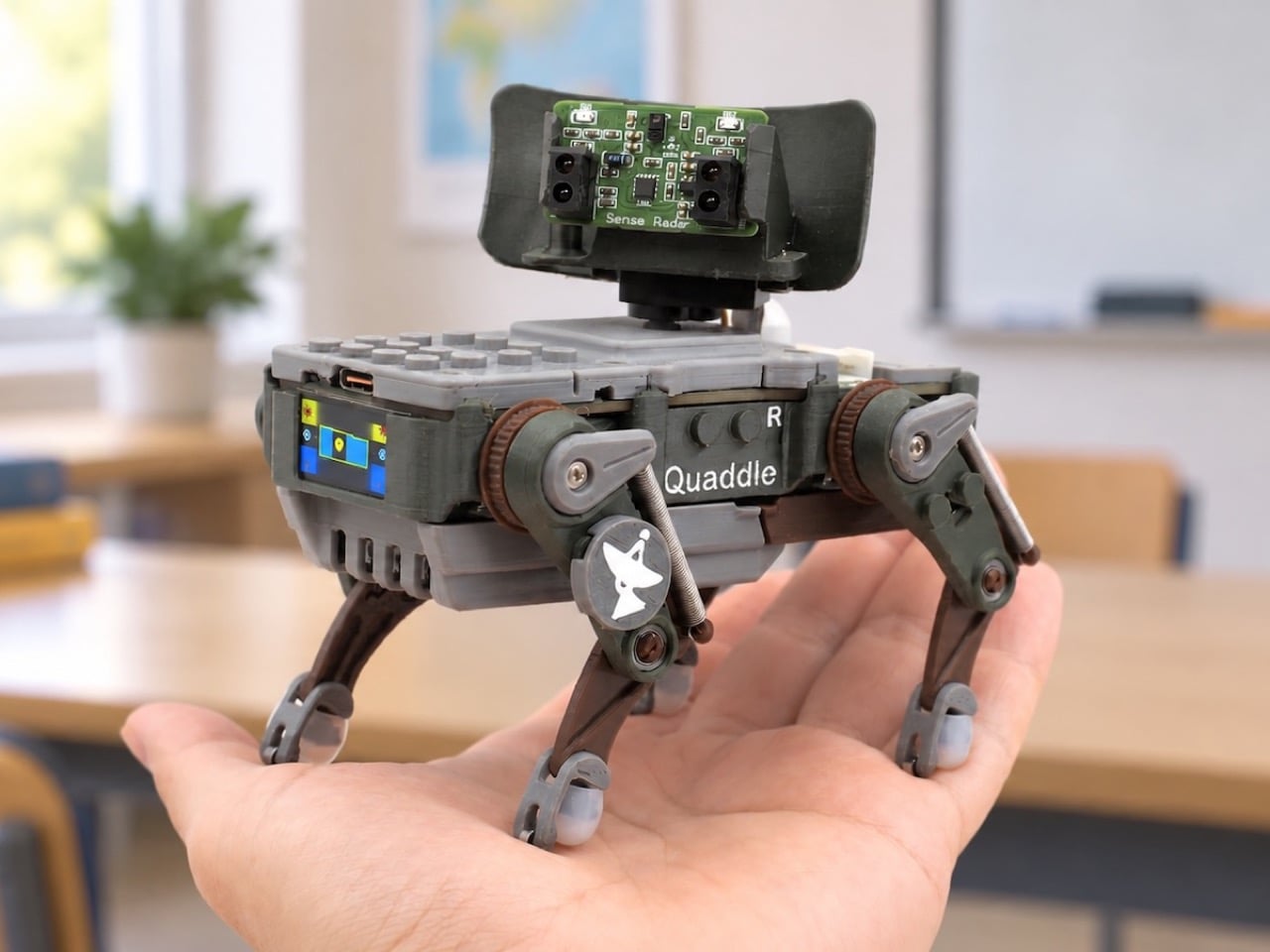
Meet Quaddle, a palm-sized robot dog that walks, glides, spins, and does backflips using just four servos. That’s half what Bittle uses in its legs and roughly a third of what most quadrupeds need, thanks to a spring-loaded linkage Petoi calls the MinDoF leg, which lets one motor drive both the shoulder and the knee. It weighs about 6 ounces, snaps together without screws, and takes LEGO bricks on its back. You can teach it tricks by physically moving its legs, chat with it, or code it in anything from beginner blocks to ROS. Prices start at $179, which is pretty reasonable for a dog that never needs walking.
Designer: Petoi
How one servo runs an entire leg
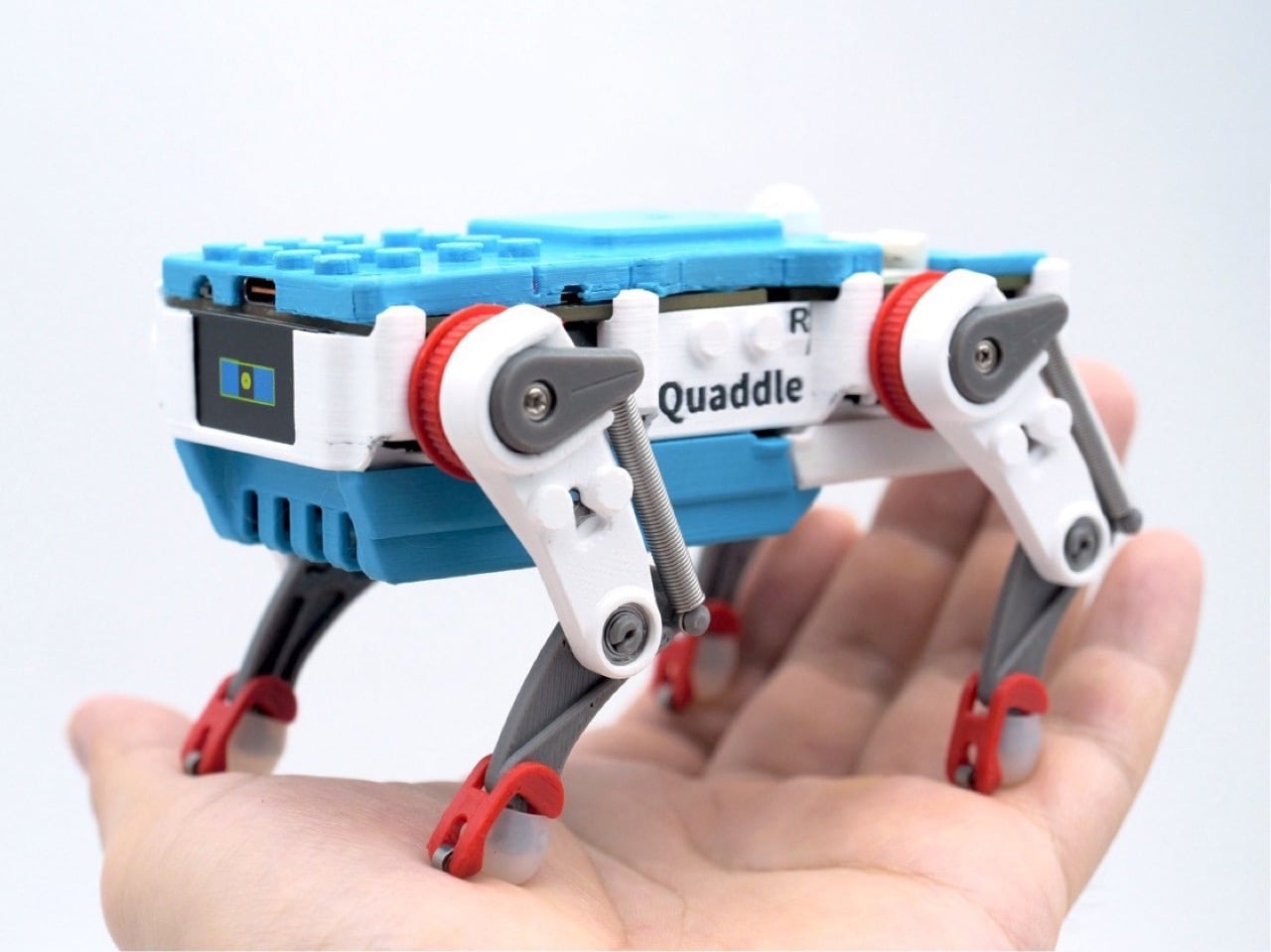
Each of Quaddle’s legs hangs off a single servo, with a spring and a four-bar linkage doing the job a second motor normally would. As the servo swings the upper leg, the linkage folds the knee up and straightens it again, turning one rotating shaft into a proper step. Petoi calls this the MinDoF leg, short for Minimal Degrees of Freedom, a degree of freedom being one independent way a joint can move. The spring clips onto different anchor points, changing how stiff or bouncy each leg feels. In Petoi’s tabletop tests, Quaddle walks about one body length per second, turns 90° in a single step cycle, and climbs onto a ledge as tall as its own knee.
Walking machines driven by a single crank go back to Pafnuty Chebyshev, the Russian mathematician whose 1870s linkage turned rotation into a surprisingly lifelike stride. Theo Jansen’s wind-powered Strandbeests on Dutch beaches run on the same basic idea, and Quaddle feels like their tiny, battery-powered cousin. Petoi added one more trick by fitting small bearings to the tips of the feet. Angle the legs just right and those bearings become wheels, letting Quaddle glide across a smooth desk at around three body lengths per second without a single extra motor. Fewer motors also means less weight, less cost, and less battery drain, which is how the whole dog comes in at roughly 6 ounces.
Teach it tricks by hand, then teach it in code
On the Buddy and Scout models, every leg servo reports its position back to the robot, so you can teach Quaddle a move by simply grabbing its legs. Tap to start recording, guide the legs through whatever silly dance you have in mind, and tap again to have it play the motion back. There’s no app or code involved, and Petoi says you can teach it a basic walk in about ten seconds. Recorded moves can be pulled into Petoi’s Skill Composer software for fine-tuning and shared with other Quaddle owners. For a kid, this is probably the fastest route from “I wonder if” to a robot actually doing the thing.
Buddy and Scout split their thinking across two ESP32-S3 chips, one for motion and balance and one for voice chat and smart home control. A physical slide switch cuts power to the AI chip entirely, which is great for privacy and for days when your robot dog gets a bit too chatty. Coding starts with drag-and-drop blocks, moves to Python or MicroPython, and eventually reaches the Arduino C++ firmware. Bigger projects can mount a Raspberry Pi Zero on its back or plug into ROS, the software framework most research robots run on. A browser-based simulator runs the same code as the real robot, so you can test ideas on a laptop or even a phone with no robot in sight.
LEGO bricks, a Nokia battery, and three Quaddles to pick from
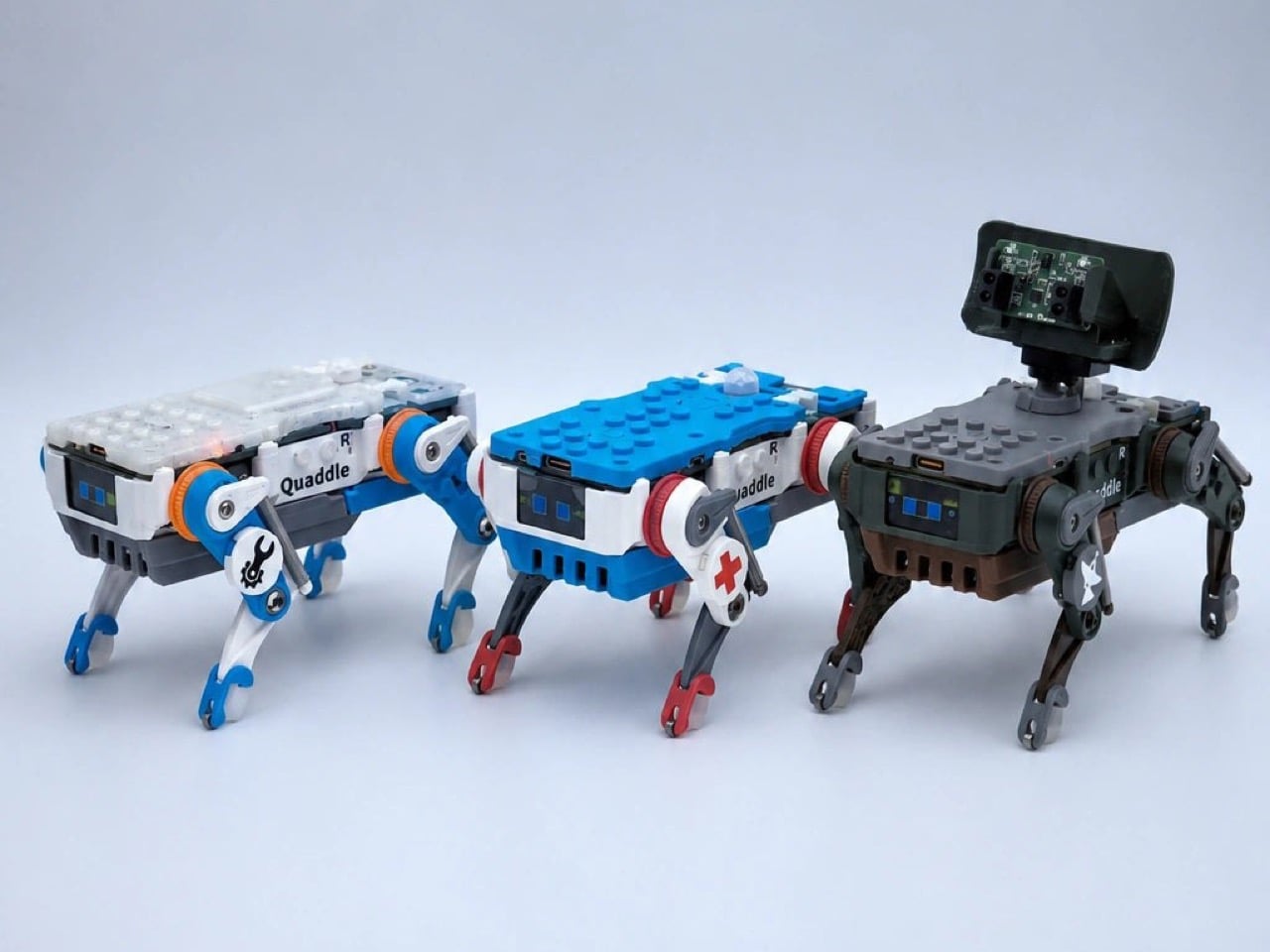
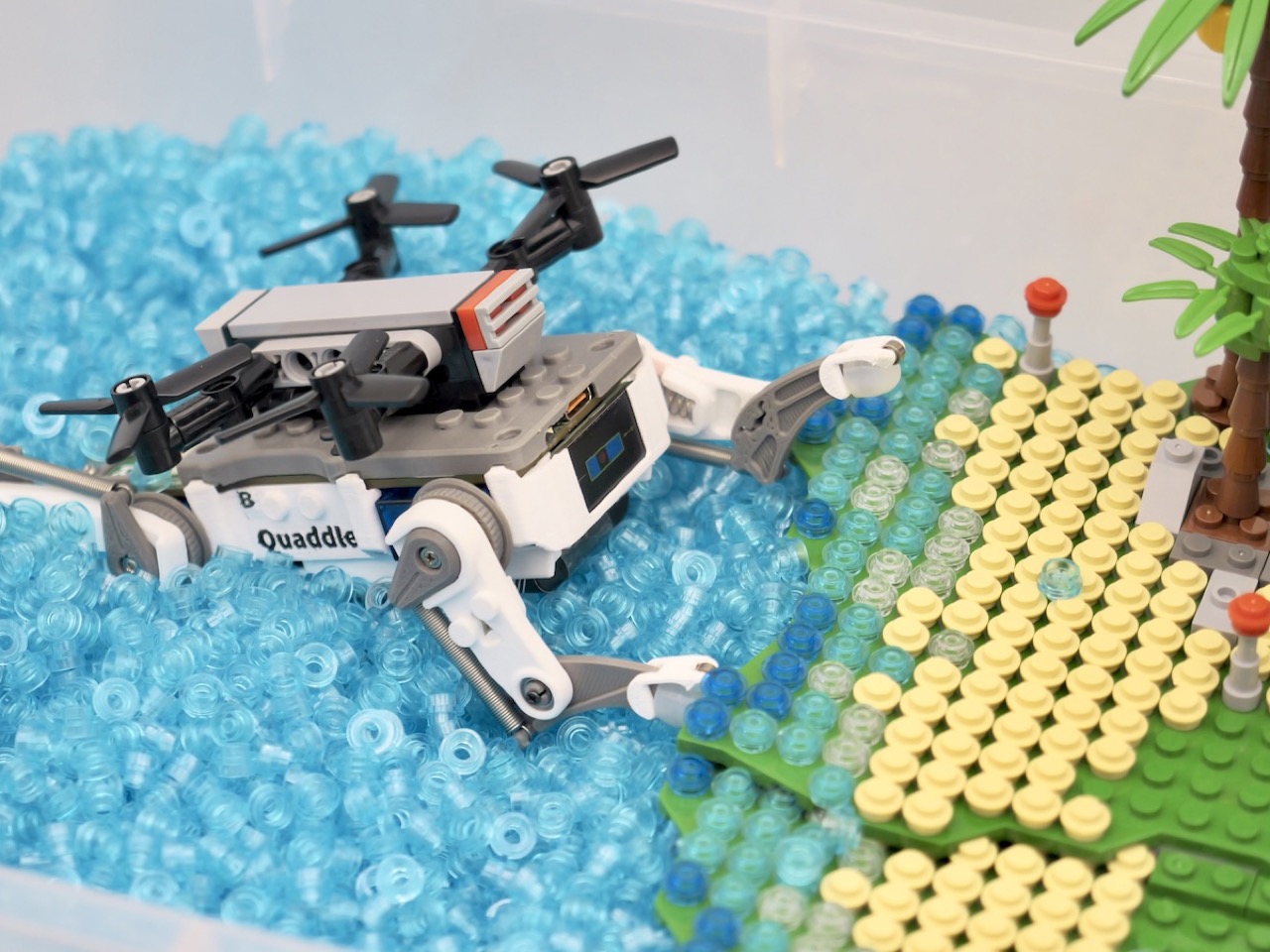
The top of Quaddle’s shell takes LEGO bricks, and Petoi will publish printable shells and mounts for anyone with a 3D printer. Petoi’s own demos have turned it into a walking LEGO AT-AT, a waddling biped called the NanoDuck, and a rover on Mecanum wheels, which use angled rollers to slide sideways. Power comes from a swappable Nokia-format phone battery, the same BL-5C shape that lived inside Nokia’s famously indestructible early-2000s handsets. Quaddle ships with the bigger 1,800 mAh BL-10C cell, good for roughly 1 to 1.5 hours of walking depending on the model. Plug it into USB-C while you code and it charges as it runs, so marathon debugging sessions are fair game.
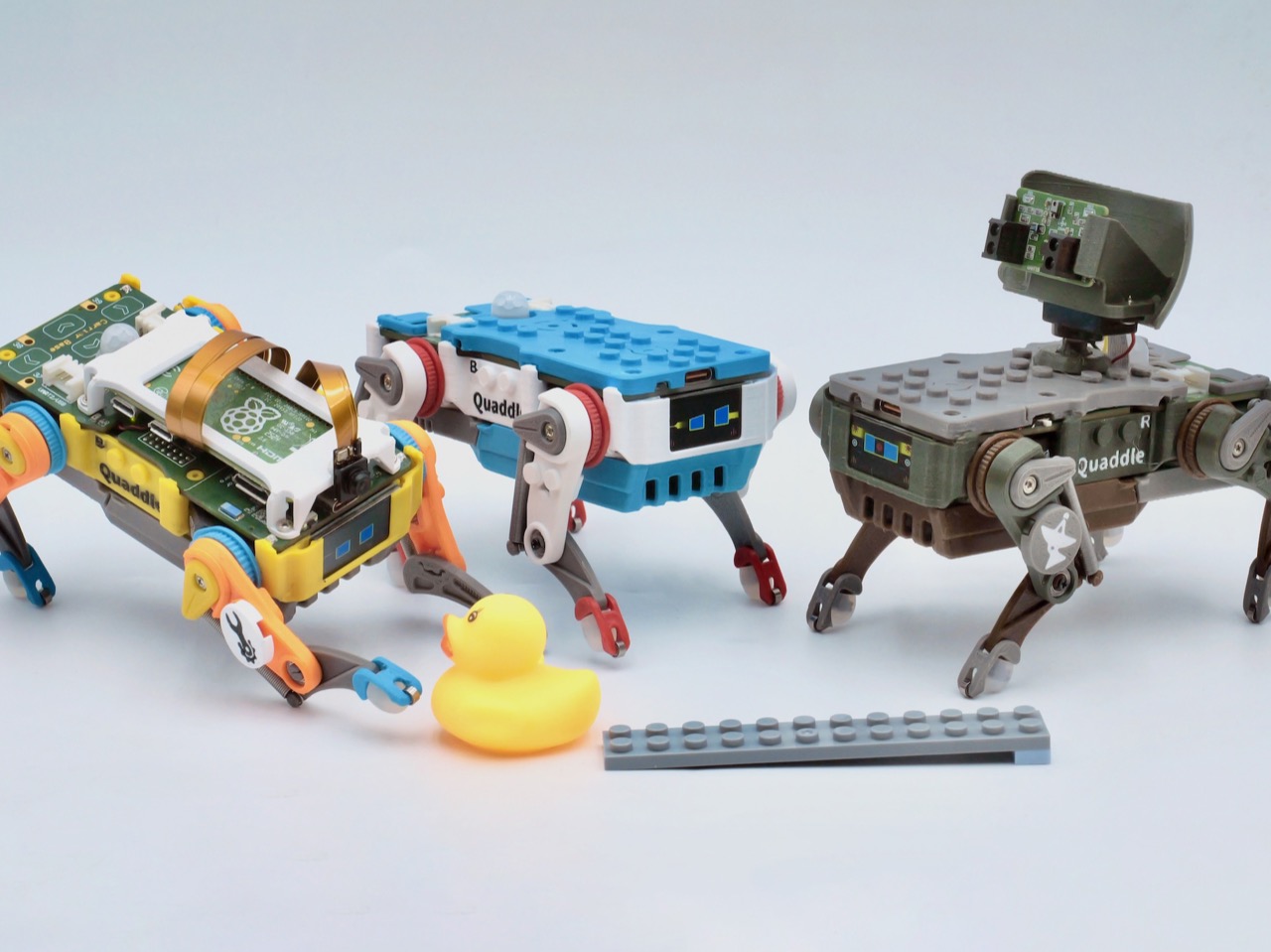
Builder PLUS ($179) handles walking and coding, Buddy ($219) adds AI chat and teach-by-hand, and Scout ($269) adds a sensor head that detects gestures, light, distance, and people. All three are priced at $144, $175, and $215, with deliveries starting in December. For context, Petoi’s own Bittle X lists at $279, Unitree’s Go2 starts around $1,600, and Sony’s Aibo launched in the US at $2,900. Petoi spent a decade shrinking big robots down to desk size, and Quaddle shows the smartest way to shrink one further is to give it fewer parts.
The post This palm-sized robot dog has a Nokia battery and a customizable LEGO-compatible back first appeared on Yanko Design.