It's official: NVIDIA's co-founderJensen Huanghas resigned as CEO this morning in the wake of personal scandals involving adultery and alleged espionage. Huang was NVIDIA's only CEO in the company's history, which began in 1993.
NVIDIA CFO Colette Kress is taking over the company as interim CEO while the board searches for a full-time replacement.
Yes, it's an interim position, but seeing a finance executive come in at a time when NVIDIA is already edging out its GeForce consumers is a tad worrisome.
The gaming share of NVIDIA's revenue has been on the decline for years, and data centers now make up the bulk. For example, NVIDIA's latest Q2 results showed $89 billion from data centers and just $7.2 billion from edge computing. That's not even close.
Will an interim CEO change anything? Probably not. Kress, after all, has been with NVIDIA since 2013, before any of the major AI rush came about. But what comes next after Huang and his interim replacement? Someone else who cares less about GeForce and more about AI?
This will not make GPUs any cheaper
Kremsi2711, r/pcmasterrace
It's hard to say. Plenty of people are already wondering the same thing: "Jensen was one of three of Nvidia's founders. Him leaving is kind of catastrophic for the leadership structure, since he never had an heir apparent for the position (allegedly intentional on his part)."
While we're all waiting to see what NVIDIA does next — New CEO? Canceled CES 2027 keynote? — I want to know how my Windows Central readers are feeling about the situation.
Do you think NVIDIA's consumer focus will narrow even more without Huang at the helm? What about the opposite? Do you think there's a lot more to this story that we're not yet hearing?
Let me know in the comments section below!
Join us on Reddit at r/WindowsCentral to share your insights and discuss our latest news, reviews, and more.
If one thing has become clear to me over the years, it's that most PC gamers are not using the latest hardware. Steam's most recent monthly hardware survey, for example, has NVIDIA's RTX 3060 as the most popular option, with the RTX 3050 only four places behind.
Heck, even 2019's GTX 1650 is still holding strong in the top ten most used cards, despite it not supporting the industry-leading DLSS upscaling. For those who (understandably) haven't upgraded to the latest hardware, there's a new hope on the horizon.
Apex Compute recently took to X to show off its Apex Neural Rendering (ANR) tech, which the company promises can deliver "up to 2.4x faster performance and higher quality rendering than NVIDIA DLSS."
Introducing Apex Neural Rendering (ANR), our cross-platform Super Resolution, Ray Reconstruction, and Frame Generation technology, delivering up to 2.4× faster performance and higher quality rendering than NVIDIA DLSS.ANR rebuilds neural rendering around a new architecture that outperforms current state of the art models.Works on all GPU vendors.- NVIDIA: GeForce RTX 20, 30, 40, and 50 series, plus GTX 16 series- AMD: Radeon RX 5000, 6000, 7000, and 9000 series, plus Steam Deck- Intel: Arc A and B seriesFrame Generation available now:https://t.co/kMGkNJzG6XOur Super Resolution and Ray Reconstruction models are currently in training. Coming soon!November 11, 2026
That's a massive claim, and I'll get to it in a moment.
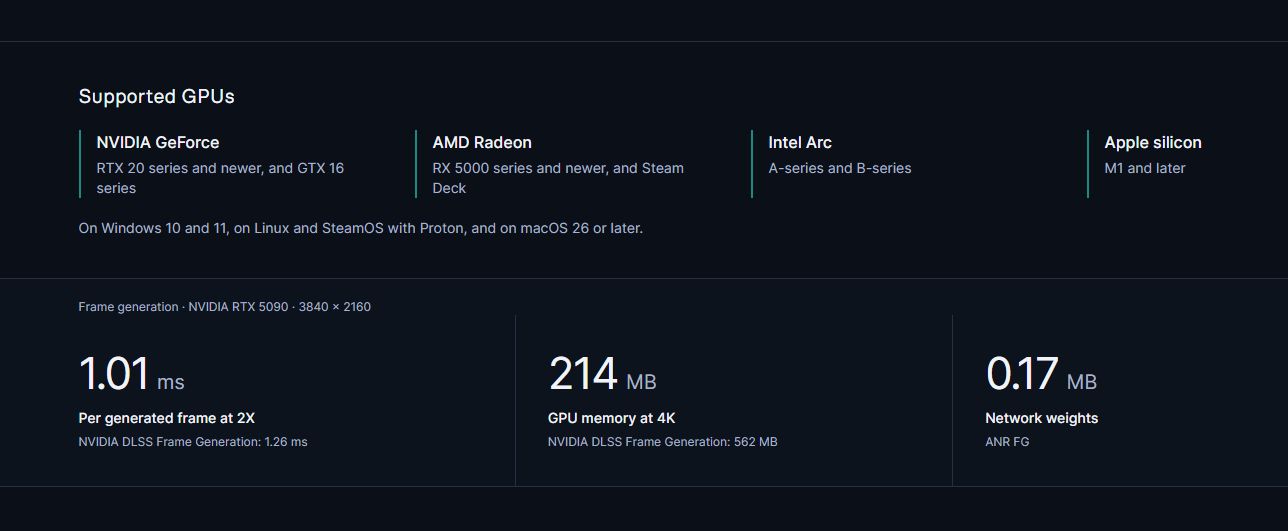
What's most exciting is that Apex has designed ANR to be practically GPU-agnostic. Apex says ANR runs on the NVIDIA RTX 20, 30, 40, and 50 series, with the added bonus of GTX 16-series cards.
Support for AMD Radeon cards includes RX 5000, 6000, 7000, and 9000, plus it works on the Steam Deck's custom AMD chip. And even Intel hasn't been left behind, with support for Arc A- and B-series cards.
Digging into Apex Compute's Apex Neural Rendering tech
A quick rundown of ANR's performance and compatibility. (Image credit: Apex Compute)
ANR is being billed as a three-pronged approach to upscaling, including frame generation, super resolution, and ray reconstruction. It's a project that's still in progress, and only frame generation is currently available. The other two features are "coming soon."
What we have so far from Apex indeed looks very promising. It claims that, when tested on an RTX 5090 at a 4K resolution, ANR can deliver frames faster and use less memory than DLSS.
According to Apex's testing, at 2X frame gen, ANR can pump out extra frames at 1.01ms, while DLSS takes 1.26ms. At 4X frame gen, ANR takes 0.61ms while DLSS takes 0.82ms. Overall memory usage falls from 562MB in DLSS to 214MB in ANR.
Why I'm a bit skeptical about ANR's abilities
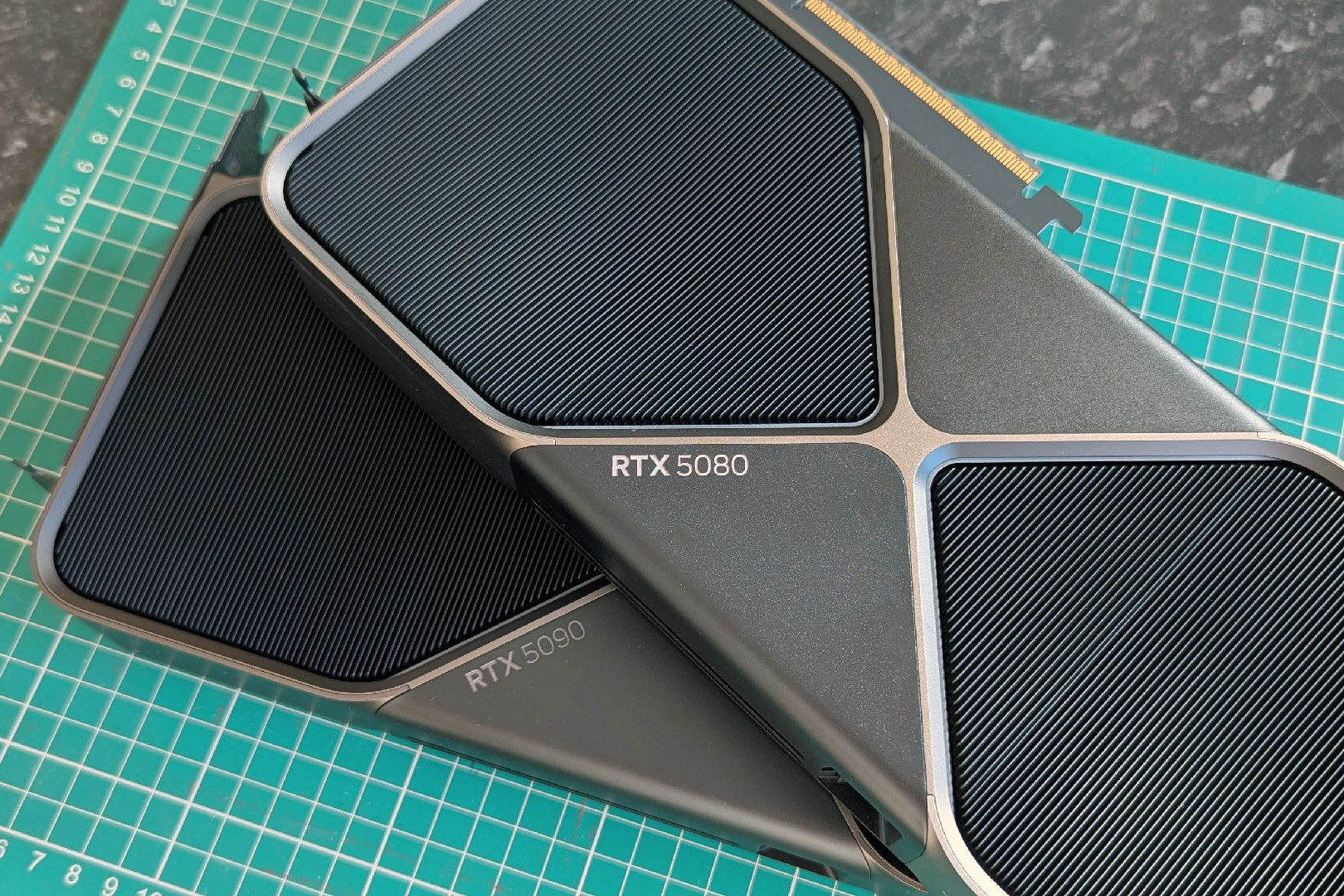
ANR's testing was performed on an RTX 5090. I want to see results from a GTX 1650. (Image credit: Windows Central | Ben Wilson)
I'm not entirely sure if Apex's claims of 2.4x faster performance compared to DLSS actually line up.
I haven't tested it yet on my own gaming PC, and Apex Compute's own data on its site doesn't quite line up. Perhaps the 2.4x claim is for one of the features arriving later.
There's also the matter of the NVIDIA tests being performed on an RTX 5090, a GPU that you can't buy anymore and that is reserved for a small group of enthusiasts and specialists. It would be a lot more impressive to see how ANR runs on, say, an RTX 3060.
What I can say is that the comparison samples for ANR vs. DLSS available on Apex Compute's site are impressive.
Sure, there might be some cherry-picking going on to create the sliding comparisons, but what's shown certainly suggests that ANR is delivering higher-quality results than DLSS. I see less ghosting, added sharpness, and overall more clarity.
Competition from Apex Compute's ANR is only a good thing
Apex Compute's ANR is available to download for free from GitHub. That means we'll probably soon see a lot of third-party tests of its actual abilities.
I'll be keeping an eye on how ANR performs on older hardware, how well it works with a wider range of games, and whether the upcoming ray reconstruction and super resolution features actually work as intended.
In any case, competition for the industry-leading DLSS is always nice to have, especially considering how NVIDIA likes to keep it walled off for its own hardware. The fact that it's coming to old GPUs at a time when no one wants to buy new hardware is also huge.
ANR looks very promising. Is it a DLSS killer? Maybe not, especially with how quickly NVIDIA is evolving the tech. But if you're still using an older GPU that doesn't natively get these features, ANR is definitely worth a look.
Join us on Reddit at r/WindowsCentral to share your insights and discuss our latest news, reviews, and more.

 Connexion