
Vue normale

Il y a de nouveaux articles disponibles, cliquez pour rafraîchir la page.
À partir d’avant-hierFlux principal

The Georgia Art Show Turning 9 Broken 3D Prints Into Music

Par : Ida Torres
17 août 2026 à 14:20

Every fabrication lab in the country is quietly accumulating a problem. Failed prints, test runs, leftover filament, the ghost of every prototype that didn’t make the cut. Most of it ends up in the bin. Architect Hyojin Kwon noticed this and, instead of moving on, asked a different question: what if all that discarded plastic could hold a note?

The result is Ninefold: A Distributed Resonant Field, a collaboration between Kwon’s design studio Pre- and Post-, percussionist and composer Jeremy Muller, and architect and material researcher Misri Patel. It’s currently on view at the Reeves House Visual Arts Center in Woodstock, Georgia, through September, and it is one of the more quietly radical things happening in design right now.

Designers: Hyojin Kwon × Jeremy Muller x Misri Patel

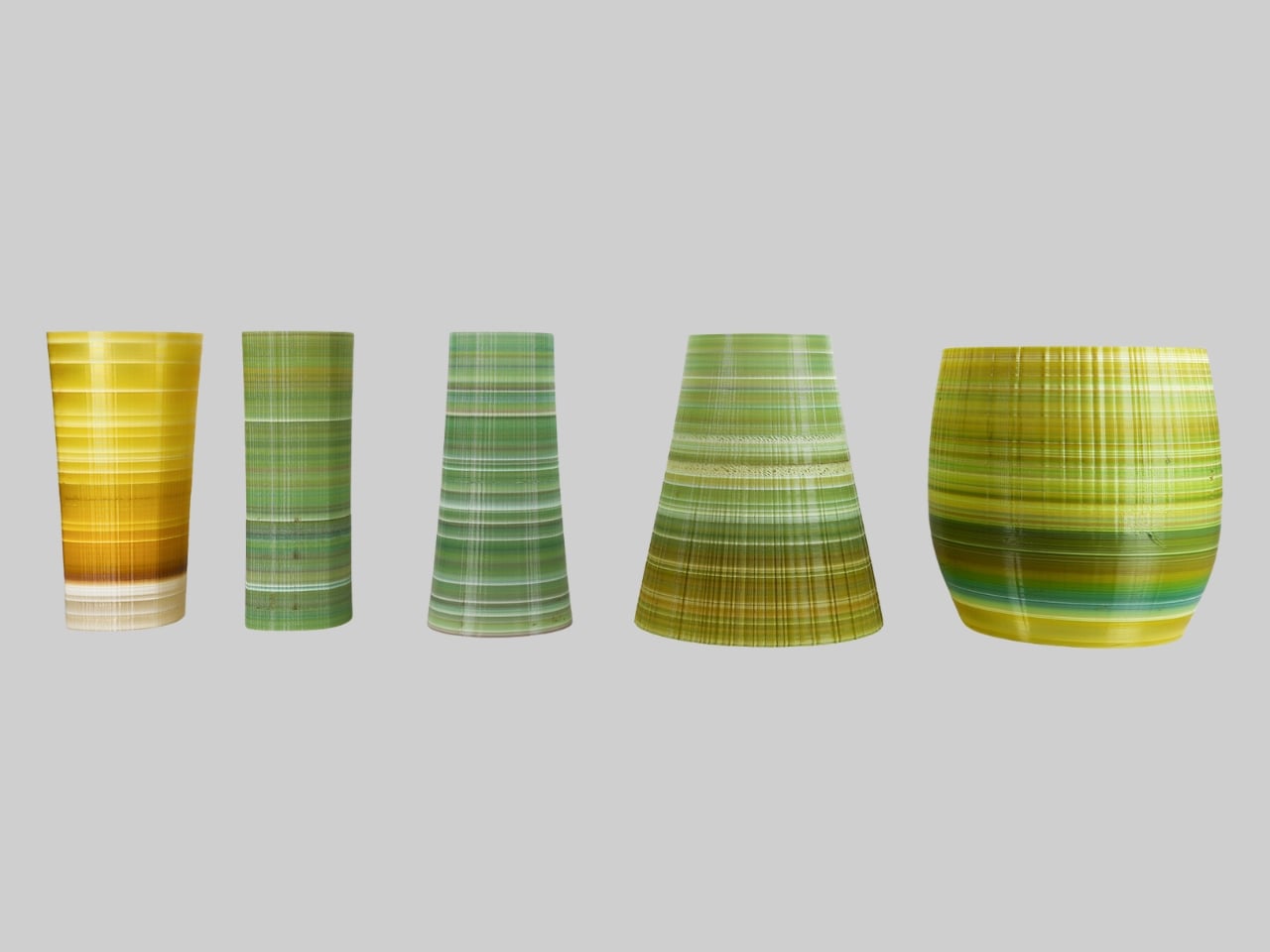
The installation is made up of nine large-scale forms, each one 3D-printed from discarded PLA collected from campus makerspaces and fabrication labs. The team shredded that waste into pellets, blended it with virgin material, and ran it through a pellet-based additive manufacturing process. The resulting objects are not identical. Some grow into tall, slender columns. Others widen into chambers or narrow toward their centers. Each carries its own texture, its own layered color variation from the mixed-batch sourcing, and its own distinct harmonic frequency. Together, they form a distributed sound field, meaning the sound is never coming from one place. It moves with you.

That last part is what makes this more than a sculpture show with a good concept. As you walk through the space, your position changes the acoustic picture entirely. Tones overlap, separate, recede. You’re not passively observing nine objects; you’re completing the field. The project draws on the thinking of composer Edgard Varèse, who called for “organized sound” as architecture, and on the spatial music systems of Iannis Xenakis and Le Corbusier. Those are not small reference points. They’re pointing at a lineage that treats space itself as a musical instrument, and Kwon, Muller, and Patel are building within that tradition using material that would have otherwise ended up as landfill.

The aspect of Ninefold that deserves real attention is how seriously it takes the material. The layered plastic isn’t hidden or smoothed over into something that looks deliberately “designed.” The texture is part of the expression. You can see the deposition, the color shifts, the history of what it was made from. The project doesn’t pretend the recycling didn’t happen; it foregrounds it. That honesty feels important at a moment when sustainability has become more of a marketing category than an actual practice.

The nine forms were also fabricated in modular sections, which means they can be transported, reconfigured, and reinstalled elsewhere. That might seem like a logistical footnote, but it matters: an installation about material longevity should probably have a long life. These objects weren’t made to be shown once and archived.

Ninefold is part of a dual exhibition that also includes Plastic Reimagined: Material Agency & Circular Design, developed with students from Georgia Tech’s graduate architecture program and curated by Carolina Cuevas. The full show runs through September at the Reeves House, and admission is free. If you’re near Woodstock, Georgia, it’s worth the trip. If you’re not, the images alone carry something worth sitting with. A lot of projects right now wear sustainability as a label. Ninefold actually earns it, and then manages to also be beautiful, which is rarer than it should be.

The post The Georgia Art Show Turning 9 Broken 3D Prints Into Music first appeared on Yanko Design.

PureMac - Faites un grand ménage sur votre Mac, gratuitement

Par : Korben ✨
17 août 2026 à 08:31

Vous glissez une app dans la corbeille du Mac, elle disparaît du dossier Applications, et vous pensez que c'est réglé ? Que vous êtes naïfs ! Hé oui, ce que vous ne savez pas, c'est que ses préférences, ses caches et son container restent bien présent dans votre ~/Library, parfois pendant des années, encombrant votre espace disque pour rien.

Hé bien s'occuper de tout ce merdier, c'est le job de PureMac , une app native codée en SwiftUI qui piste ces fichiers-là pour libérer des ressources sur votre mac. Elle croise l'identifiant du bundle, celui de l'équipe de développement, les entitlements et les métadonnées Spotlight, selon trois niveaux d'agressivité en fonction de ce que vous voulez ratisser.

Elle sait aussi prendre le problème dans l'autre sens puisque son chercheur de fichiers orphelins parcourt ~/Library pour retrouver les restes d'applications que vous avez virées il y a trois ans et dont plus rien ne vous rappelle l'existence.

Et si vous développez, il y a de quoi récupérer bien plus de place avec les DerivedData, les runtimes de simulateur Xcode, les couches Docker, les caches npm, yarn, pnpm et Homebrew. Bon, ça vous savez déjà le faire avec docker system prune, deux ou trois autres commandes, ou avec Mole en ligne de commande dont je vous ai déjà parlé. Mais l'intérêt ici, c'est de tout voir d'un coup avant d'arbitrer.

Côté données, il n'y a rien à surveiller puisque PureMac n'embarque aucune télémétrie ni appel réseau. Et la licence, c'est du 100% licence MIT, là où d'autres outils similaires comme Pearcleaner ajoute une Commons Clause qui en interdit la revente, que AppCleaner, lui, s'arrête à la désinstallation, ou encore que CleanMyMac nécessite d'acheter une licence.

Pour le faire tourner, il vous faut macOS 13 au minimum, et ça s'installe en une ligne avec brew install --cask puremac. Sinon, il y a un .dmg signé et notarisé à récupérer directement.

Par contre, sachez que ça réclame le l'accès complet au disque, soit la permission la plus large que macOS distribue, et il ne garde aucun journal des chemins qu'il a supprimés. Surtout que quand un fichier est supprimé, il l'est pour de bon, donc vérifiez bien les choses avant de les supprimer.

Le nettoyeur de caches, est également une opération sans retour. Alors pour un cache ça n'a pas d'importance, puisqu'il se régénèrera tout seul. Mais pour un reste dans ~/Library qui contenait, j'sais pas, par exemple une licence, un wallet crypto ou vos réglages, c'est une autre affaire.

Donc soyez TRÈS prudent et lisez bien les chemins d'accès vers les fichiers avant de cliquer pour les supprimer, histoire de pas faire de conneries.

A Bell-Powered Playground for Collective Listening

Par : Tanvi Joshi
29 juillet 2026 à 22:30

French artist Céleste Boursier-Mougenot is widely known for uncovering the musical potential of objects and materials that were never intended to function as instruments. Rather than composing music in a conventional sense, he creates situations in which sound emerges through movement, interaction, chance, and the surrounding environment. His exhibition points de suspension, presented at Frac Normandie in Caen as part of the Normandie Impressionniste Festival, extends this approach across the cloister and galleries of a former seventeenth-century convent.

At the center of the courtyard is envolée, a playable musical installation made from swings and antique church bells. A circular steel structure, reminiscent of the bandstands that once animated public gardens, supports eight wooden swings. Above each one hangs a bronze bell of a different size, allowing every swing to produce its own distinct tone when set in motion.

Designer: Céleste Boursier-Mougenot

Visitors are invited to sit, push away from the ground, and activate the installation through the familiar movement of swinging. As the wooden seats rise and fall, the bells respond with changing rhythms and overlapping tones. No two performances can be repeated precisely. The resulting composition depends on how many people participate, how quickly they move, and whether their rhythms align or interrupt one another.

Boursier-Mougenot does not prescribe a melody for the group to perform. Instead, he designs the conditions from which a collective composition can emerge. The work only becomes fully active through the gestures of its participants, temporarily transforming strangers into performers. Individual actions accumulate into a shared sonic environment, allowing visitors to influence one another without needing to speak or coordinate deliberately.

The swing itself introduces another cultural and emotional layer to the installation. Appearing across civilizations as an object of ritual and recreation, it has been associated with ancient Egypt, seasonal festivities, springtime renewal, and the ornamental gardens of seventeenth-century France. It has also been understood as an object marking transitions between childhood and adulthood.

Within envolée, this nostalgic object is reframed as a device for reconsidering how bodies inhabit a public space. Swinging no longer belongs exclusively to childhood. It becomes a method of synchronizing movement, sound, attention, and proximity. The participant is simultaneously a listener, a performer, and an active component within the installation.

Extending beneath the structure is plage, a 900-square-meter field of crushed glass. Its shimmering surface resembles a crystalline body of water, reflecting the architecture, changing light, and movements of the visitors above it. The material produces an intentionally ambiguous landscape: dry yet apparently fluid, solid yet visually unstable. The courtyard of the former convent is consequently transformed into a glittering garden or an abstract lake, where the church bells form an evolving open-air score.

The experience continues inside the galleries with cameraobscura. Here, Boursier-Mougenot enlarges the optical principle of the camera obscura to the scale of an exhibition room. The exterior courtyard and its moving installation are projected upside down across the interior space, creating an immersive, inverted landscape. Suspended swings encourage visitors to pause beneath this reversed horizon, observing the world outside from an unfamiliar perspective.

The ringing bells remain audible indoors, connecting the projected image with the actions taking place outside. Sound shapes the perception of the moving image, while the projected movement gives visual form to the composition being created in the courtyard. Seeing and listening can no longer be understood as separate experiences. Instead, the two installations operate together, collapsing the boundaries between image, sound, architecture, and bodily movement.

Throughout his practice, Boursier-Mougenot draws resonance from ordinary materials and situations. At Frac Normandie, however, the instrument expands beyond the swings and bells to include the convent’s architecture, the reflective glass landscape, the changing light, and the people who temporarily occupy the site.

Points de suspension does more than ask visitors to interact with an artwork. It proposes another way of inhabiting public space—one that values curiosity, play, unplanned encounters, and collective attention. Through a simple act of swinging, visitors are encouraged to remain in the space a little longer, listen to those around them, and participate in a composition that belongs to no single person.

The post A Bell-Powered Playground for Collective Listening first appeared on Yanko Design.

The Floating House Built From Strangers’ Wishes

Par : Ida Torres
18 juillet 2026 à 19:15

Most houses start with a blueprint. Jisoo Yoo’s Dream House started with a question: how do the dreams and desires we carry shape the landscape of the world we inhabit? The answer, it turns out, is a floating structure made of clothing.

Yoo, a Seoul-born artist who lives and works in France, has been quietly building one of the more compelling bodies of work in contemporary art, one that orbits around the domestic, the ephemeral, and the barely-visible structures that hold our lives together. Dream House, her latest installation presented at (F)ESTIVALES at Les Tanneries, Centre d’art contemporain, is exactly the kind of project that makes you stop and genuinely reconsider what a home actually is.

Designer: Jisoo Yoo

Here’s how it works. Participants are invited to contribute a garment, something personal, something worn, and mark it with handwritten texts and drawings. These pieces of clothing then become the literal building blocks of the structure, each one a personal archive, each one a load-bearing element. The result is a house that floats, literally and conceptually, held aloft not by concrete or steel, but by the private wishes of strangers.

That’s a beautiful idea, and I mean that without a trace of irony. We spend so much time thinking about homes in terms of square footage, property value, and interior aesthetics that we rarely stop to ask what a home is actually made of. Yoo forces the question. Her installation suggests that the answer has less to do with materials and more to do with desire, with the accumulated weight of what people want, need, and imagine for themselves and for each other.

Art that treats the domestic as a lens for examining social and cultural forces is nothing new. But Yoo brings something specific to it. Born in Seoul and trained in France, she operates between two very different cultural frameworks around the idea of home, and her practice reflects that quietly felt tension. Her works often feature spaces that feel familiar but refuse to stay solid. Rooms that waver. Houses that float. Structures that appear and then dissolve. It’s a recurring language across her portfolio, and with Dream House, it feels most fully realized.

Dream House is not trying to comfort you. It’s trying to make you notice something. The garments contributed by participants carry real personal weight: literal handwriting, actual drawings, the residue of real lives. And yet the house they form is temporary. It rises, exists briefly, and then it’s gone. Yoo describes the floating structure as embodying both the creative force of desire and the fleeting nature of existence. The house briefly emerges through people’s dreams, and that, apparently, is enough.

I think that’s the most honest thing any artist has said about housing in a long time. We build our ideas of home from desire, from inherited images of what shelter is supposed to look like, from what we were told to want, and from what we quietly imagine when no one is watching. And all of it is more temporary than we tend to admit. The average person moves multiple times in their life. Neighborhoods change. The house you grew up in gets renovated beyond recognition or torn down entirely. The physical structure of home has always been more fragile than we want it to be.

What Yoo does is make that fragility visible without making it tragic. The floating structure is genuinely striking to look at. The garments create a soft, almost organic texture that reads as intimate rather than architectural, which is exactly the point. You’re not looking at a building. You’re looking at a collective act of imagination, briefly held together by shared hope. Jisoo Yoo is an artist worth paying close attention to. Her work doesn’t announce itself loudly, but it asks questions that stick. Dream House is a reminder that the spaces we live in are not neutral. They are built, always, from something we wanted.

The post The Floating House Built From Strangers’ Wishes first appeared on Yanko Design.

These Steel Chairs Are Too Big to Sit In: Walk Through Them Instead

Par : JC Torres
6 avril 2026 à 16:20

Most public art earns its place on a pedestal and stays there. It asks you to look, maybe photograph it, and walk away. The relationship between viewer and work rarely extends beyond that brief transaction. That’s been the convention for a long time, but there’s a growing push for installations that don’t just occupy public space but actually do something within it.

Michael Jantzen has been exploring that tension for years. His Moving Furniture series applies a simple idea to ordinary chairs and tables: take each object’s form and repeat it in progressive intervals as if capturing it mid-movement, then connect those moments into a single piece. The result is something you can still sit in or set a drink on, even if it no longer looks quite built for that.

Designer: Michael Jantzen

Monumental Moving Furniture takes that same concept into architectural territory. Built from painted steel, the series consists of abstracted chair and table forms, each generated by moving the original object through space and time and locking its path into a chain of connected segments. At this scale, what started as a reference to everyday objects feels closer to a building than a piece of furniture.

The method behind each piece is consistent. A chair or table is set in motion through space and time, with each interval frozen and joined to the next. Some pieces move only part of the original form; others shift the whole thing. The result is a structure that stops belonging to any single discipline and starts reading as furniture, sculpture, and architecture at once.

Despite being too large to sit in, these sculptures aren’t purely decorative. Each is large enough to walk under and through, giving it a practical function as a pavilion and shelter. That’s not something most public art can claim. Instead of asking people to observe from a polite distance, these structures pull you in, turning a passive encounter into something more physical and immediate.

The series covers both chair forms and table forms, each treated with the same sequential abstraction. Individual pieces have also been grouped into configurations that suggest more complex structures, as if each were a building block for something larger. Painted in vivid, solid colors like white, orange, and yellow, each structure commands attention from a distance and rewards a closer look once you’re standing beneath it.

Public spaces deserve more than objects to look at. They deserve things to experience. Monumental Moving Furniture earns its place on both counts, offering structures large enough to shelter visitors while giving them something genuinely puzzling to engage with. These forms don’t demand reverence. They invite curiosity, exploration, and the kind of slow, circling attention that good public space has always been designed to encourage.

The post These Steel Chairs Are Too Big to Sit In: Walk Through Them Instead first appeared on Yanko Design.

Reinstall - Le script ultime pour réinstaller n'importe quel OS sur votre VPS (même Windows)

Par : Korben
6 février 2026 à 09:22

Aujourd'hui, on va aller un peu plus loin que les simples bidouilles habituelles car je vais vous présenter Reinstall , un outil qui va peut-être vous changer la vie si vous gérez des serveurs distants.

Vous connaissez la chanson... vous avez un VPS sous Debian et vous voulez passer sous Arch pour faire votre malin. Sauf que pour opérer ce changement, c'est la galère assurée !! Faut passer par l'interface web de l'hébergeur, booter sur une ISO via une console VNC qui rame sa maman, et prier pour que le réseau revienne après le reboot.

Eh bien ça c'est terminé grâce à ce script Reinstall. Vous lui balancez une commande, le script s'occupe de tout, et hop, votre serveur redémarre sur le nouvel OS de votre choix. Pas besoin d'accès IPMI, pas besoin de supplier le support technique, ça marche tout seul.

Et ça supporte pas mal d'OS... Côté Linux, y'a 19 distributions majeures : Alpine, Debian (de 9 à 13), Ubuntu (de 16.04 à 25.10), toute la famille Red Hat (AlmaLinux, Rocky, Oracle), Fedora, Arch, Gentoo, NixOS... Bref, y'a tout ce qu'il faut.

Et le truc qui va plaire à ceux qui font du cloud, c'est également le support de Windows. En effet, le script permet d'installer Windows Vista, 7, 8.1, 10, 11 et même Windows Server 2025.

Et rassurez-vous, il n'utilise pas des images bricolées par on ne sait qui, mais les ISO officielles de chez Microsoft. Lui se content d'injecter automatiquement les drivers VirtIO pour que ça tourne comme un charme sur n'importe quel cloud (AWS, GCP, Oracle Cloud...).

Aussi, le point le plus chiant quand on réinstalle un serveur distant, c'est la config réseau. Si on se loupe, on perd l'accès SSH et c'est fini. Reinstall gère ça intelligemment puisqu'il détecte votre IP (statique ou dynamique), gère l'IPv6, les passerelles exotiques et même les serveurs ARM.

Ce qu'il vous faut avant de tout casser

  • RAM : 256 Mo pour Alpine/Debian, 1 Go pour Windows.
  • Disque : 1 Go pour Linux, 25 Go minimum pour Windows.
  • Accès : Un accès root/admin sur la machine actuelle.
  • Temps estimé : Environ 5 à 15 minutes selon la vitesse de connexion de votre serveur.

Un petit avertissement quand même... Ce script ne gère pas les conteneurs type OpenVZ ou LXC. Faut que ce soit une vraie VM (KVM, VMware, Hyper-V) ou un serveur bare-metal.

Le tuto ! Le tuto !

C'est là que ça devient drôle. Pour installer un nouveau Linux (disons Debian 13) depuis votre système actuel, il suffit de faire un petit :

# Télécharger le script
curl -O https://raw.githubusercontent.com/bin456789/reinstall/main/reinstall.sh

# Lancer la réinstallation
bash reinstall.sh debian 13 --password "VotreMotDePasse"

Si vous voulez tenter l'aventure Windows :

bash reinstall.sh windows --image-name "Windows 11 Enterprise LTSC 2024" --lang fr-fr

Le script tourne même depuis Windows (via un .bat) si vous voulez faire l'inverse et repasser sous Linux.

Perso, je trouve ça quand même génial pour tester des trucs sans passer des plombes à configurer des ISO. Ça dépanne grave quand on veut repartir on une base saine en un clin d'œil. D'ailleurs, si vous avez besoin de sécuriser vos serveurs après l'install, j'avais parlé de Fail2Ban il y a quelques temps, et c'est toujours une bonne idée. Et si vous avez peur de perdre vos données, jetez un œil à Restic pour vos backups.

Bref, si vous gérez des VPS et que vous en avez marre des consoles web préhistoriques, foncez tester ce truc (sur une machine de test d'abord, hein, venez pas pleurer après).

Bon, je vous laisse… Je vais aller me faire un petit café !

MSIX - Le remplaçant du .exe qui renforce Windows

Par : Korben
18 juin 2025 à 12:27

Combien d’entre vous ont déjà installé un programme Windows qui a foutu le bordel dans leur système ? Moi je lève la main et je suis certain que je ne suis pas le seul ! Heureusement, Microsoft a peut-être enfin trouvé la solution avec MSIX, un format qui vient remplacer nos bons vieux .exe.

Arrêter de rigoler, je suis sérieux ^^!

Depuis que je suis dans la tech, j’ai vu passer tous les formats d’installation possibles et imaginables. MSI, NSIS, Inno Setup, et j’en passe. Mais ça ne change rien… On finit toujours par formater son PC parce qu’une désinstallation a laissé des traces partout dans le registre. Et c’est avec l’expérience, qu’on apprend bien sûr à méfier de ces programmes qui promettent monts et merveilles mais qui au final polluent votre système.

❌
❌