
Vue normale

Il y a de nouveaux articles disponibles, cliquez pour rafraîchir la page.
Aujourd’hui — 9 avril 2026Flux principal

Belgium’s Most Striking Concrete Villa Was Designed by the Dunes

Par : Ida Torres
8 avril 2026 à 23:30

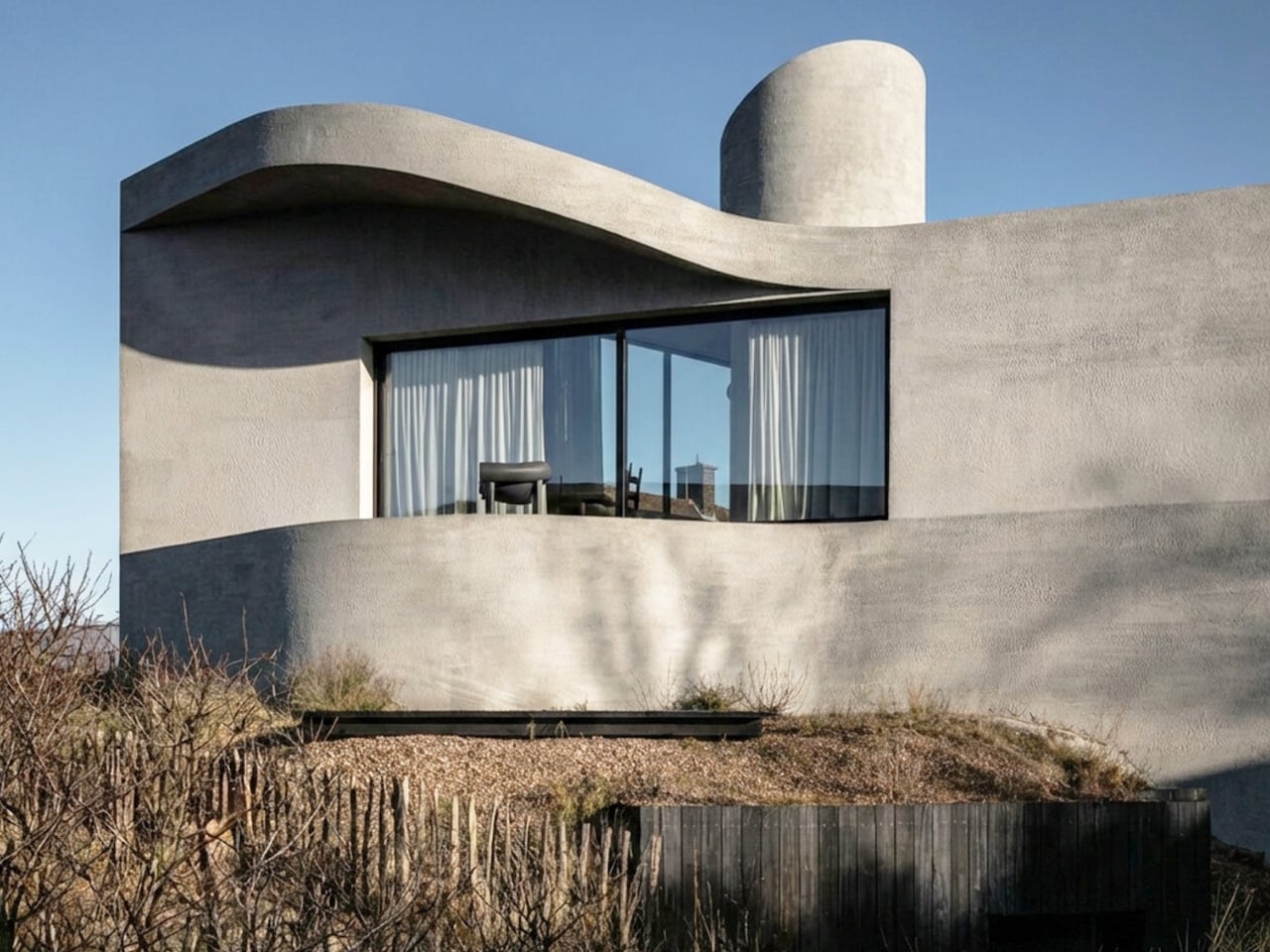
If you’ve ever stood on a beach and watched the tide pull back, you know that moment right before the water retreats completely, when it leaves those delicate horizontal lines etched across wet sand. That’s what the facade of Villa Nouvelle Vague looks like. Not metaphorically. Literally. Belgian architect Magalie Munters designed the concrete surface of this seaside villa in Oostduinkerke with a horizontal grain that mirrors the striations the North Sea leaves behind at low tide. The reference isn’t decorative, it’s structural. And that distinction matters.

The villa sits on a corner plot at the edge of a protected dune reserve in Oostduinkerke, a small coastal town already known for a few wonderfully eccentric things: a ship-shaped restaurant and fishermen who harvest shrimp on horseback. Into this landscape, Munters has introduced something that manages to be arresting without being loud. The form is sculptural and unmistakably modern, but it doesn’t shout. It settles.

Designer: Magalie Munters

The name “Nouvelle Vague” borrows from the French New Wave film movement, and the reference is apt in ways that go beyond the obvious nod to style. The French New Wave was defined by breaking conventional rules while remaining deeply committed to craft. Munters is working in a similar register. For years, her Ghent-based boutique studio has been developing residential architecture with organic geometries, pushing against the idea that construction methods should set the ceiling on what architecture can achieve. “Through that ongoing research, I developed a way of building in which construction and technology no longer act as a limitation to the architecture,” she explains. Villa Nouvelle Vague is where that research cashes out.

The concrete form is completely curved across the entire volume, not just as a surface treatment but as a governing logic, carried through every detail: the absent roof edges, the curved garage opening, even the way the house integrates into the ground. The bedrooms are half-buried in the dunes, which is both a functional and a conceptual move. The house doesn’t sit on the landscape. It’s anchored into it. Above those buried rooms, the living spaces rise toward the horizon, pulling in light and opening out to views of the dunes in a way that feels earned rather than forced.

The way you move through the house is where Munters’ admiration for Le Corbusier becomes most legible. She’s spoken about his influence, specifically in “the rooftop solarium, in the way spaces expand and contract, and in the vertical shafts that structure movement through the house.” You enter through a vertical shaft that climbs toward the roof before expanding into the main living space. The compression-then-release is theatrical in the best sense. The house is working on your nervous system before you’ve even sat down.

I keep coming back to that word: deliberate. Munters uses it herself: “What might appear as a free form is in fact the result of a very deliberate construction logic.” That’s the tension the villa lives in, and frankly, it’s what makes it interesting. Nothing here is freehand improvisation. The curves look fluid because the logic behind them is airtight. The concrete looks like it grew from the dunes because the architect studied the dunes before she touched a drawing. That’s different from a building that mimics nature for aesthetic points. It’s rarer, and harder.

Belgian architecture doesn’t always get the international visibility it deserves, and Magalie Munters is one of those names worth paying attention to even if residential architecture isn’t usually your thing. Villa Nouvelle Vague is the kind of project that earns its name. It has the confidence of something that knows exactly what it is, and the intelligence not to over-explain itself. Just like the best films of the movement it references.

The post Belgium’s Most Striking Concrete Villa Was Designed by the Dunes first appeared on Yanko Design.
À partir d’avant-hierFlux principal

This Red House Buried in a Czech Forest Is the Opposite of Every Forest Home You’ve Ever Seen

25 mars 2026 à 23:30

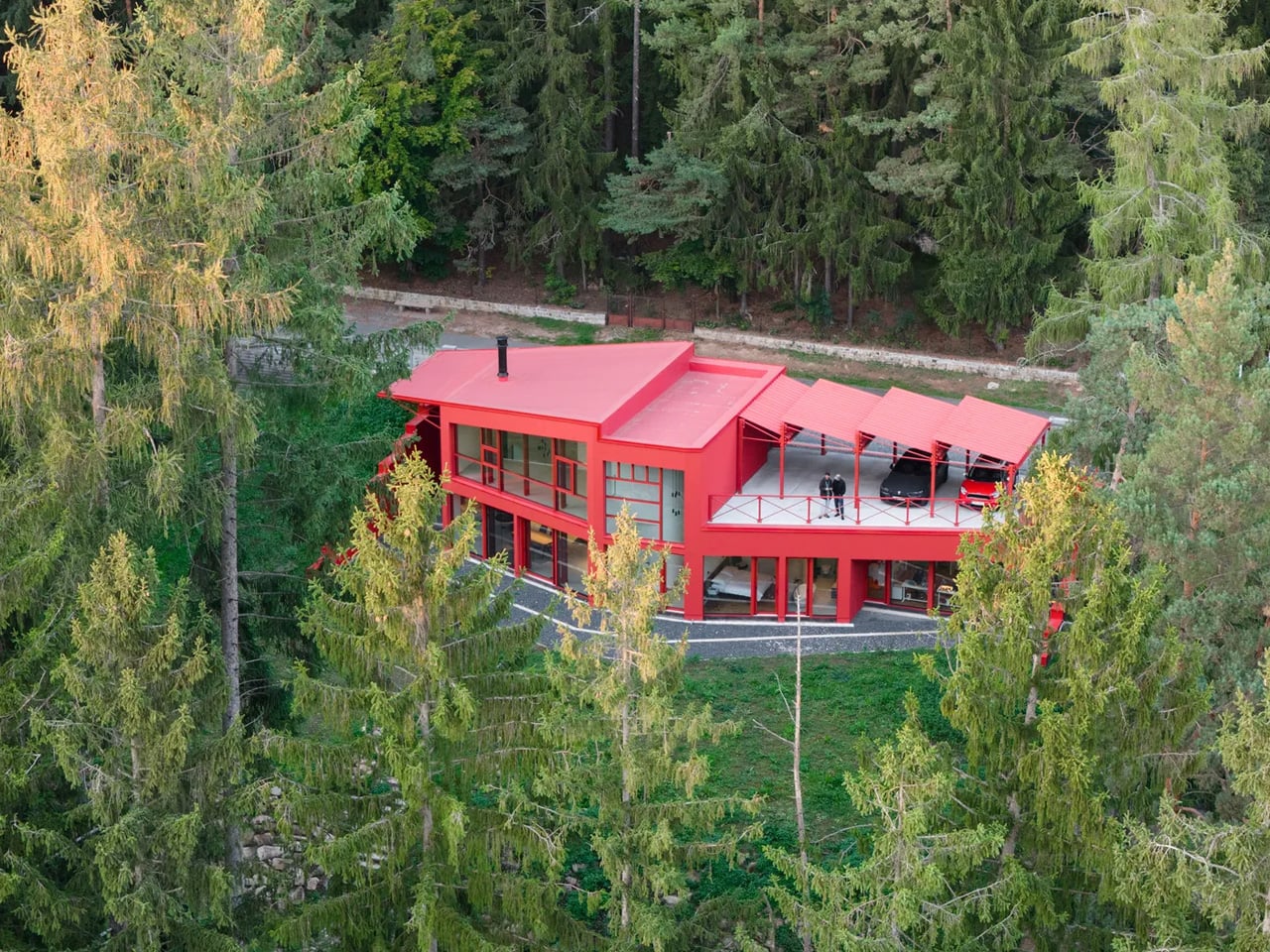
Deep in the spruce forests of Jevany, a municipality of barely 800 people in the Czech Republic’s Central Bohemian Region, a flash of cherry red cuts through the trees. This is Villa Jevany, a new residence by local studio Architektura, and it has absolutely no interest in blending in. Where most forest homes default to timber, stone, and muted tones, Architektura went the other way entirely, dressing the structure in saturated red steel and calling it exactly what it is: a deliberate, uncompromising act of contrast.

The site itself set the terms. The plot spans a generous 3,027 square meters on a steep southern slope, inhabited by deer, birds, and mature trees that tower up to ten meters above the building level. Architektura responded by carving the villa into the hillside rather than placing it on top, creating a structure the studio describes as an “organism” embedded in the earth. The red steel skeleton, visible in the sawtooth carport roof from the moment of arrival, signals that this is industrial thinking applied to domestic life, and it doesn’t apologize for it.

Designer: Architektura

The colour choice is rooted in theory as much as instinct. Architektura used green and red as complementary colors, a logic borrowed from the colour wheel and, more pointedly, from abstract art. The irregularly divided glazing across the façade draws a quiet reference to Mondrian, the rhythmic geometry of the windows creating a visual tension against the organic verticality of the trees behind them. From the road, the house reads almost like a painting hung in the forest. From the inside, the forest becomes the painting.

Internally, the layout unfolds across five distinct levels. The entrance opens into a hall with a 3.5-meter ceiling height, where a curved wall guides visitors into the main living space, or what the architects call the “day zone.” Here, industrial red steel windows frame the surrounding green; white walls meet black details; reddish stone counters anchor the kitchen alongside a floating steel fireplace. It’s a space of deliberate contrasts, domestic in function and raw in feeling.

The private quarters, reached through a long corridor lined with minimalist white cabinetry, are stripped of excess. The parents’ suite and children’s rooms are quiet and restrained, a counterpoint to the drama of the exterior. Terraces and balconies extend the living area into the canopy itself, turning the house into what Architektura intended all along: not just a place to live, but a place to look.

The post This Red House Buried in a Czech Forest Is the Opposite of Every Forest Home You’ve Ever Seen first appeared on Yanko Design.

This Costa Rican Home Chooses Air, Rhythm, and Silence Over Walls

Par : Tanvi Joshi
8 février 2026 à 23:30

Perched high above the Pacific coastline in Bahía Ballena, Costa Rica, Ojo de Nila is a house that feels less like an object placed on land and more like a continuation of it. Designed by Studio Saxe, with interiors by Atelier Sandra Richard, the home was created for a Swiss couple seeking a slower, more elemental way of living shaped by air, light, and landscape rather than mechanical systems and rigid enclosures.

A clear modular logic guides the architecture. A repeating series of structural bays follows the natural contours of the hillside, allowing the house to hover above the forest canopy instead of cutting into it. This decision preserves vegetation and natural water flow beneath the home while giving the structure a lightness that feels respectful of its setting. The modules do not read as repetition in the conventional sense. Instead, they become the framework for movement, rhythm, and flow.

Designer: Studio Saxe and Atelier Sandra Richard

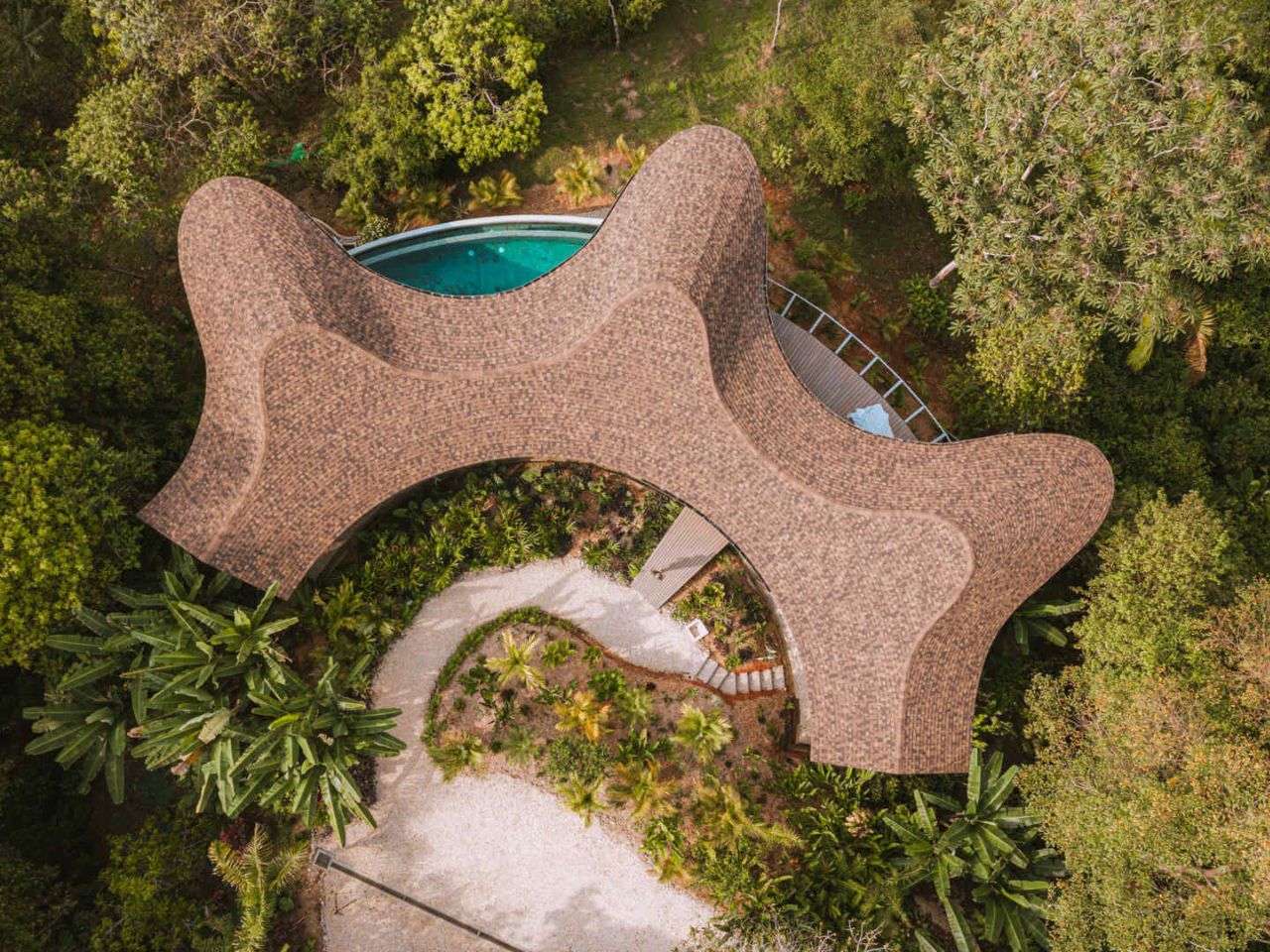
Above these modules, the roof undulates in soft waves, behaving almost like a newly formed landform. Rather than acting as a simple cover, it mirrors the rolling topography of the surrounding hills and establishes a calming visual cadence as one moves through the house. The roofline continuously frames the Pacific Ocean, ensuring that the horizon remains a constant presence, never a backdrop but always an active participant in daily life.

Arrival is defined by elevation and openness. As you enter, there is no dramatic reveal or enclosed threshold. Instead, the house immediately opens itself to the ocean. The absence of enclosure on the ocean-facing side dissolves any clear boundary between inside and outside. Movement through the home is accompanied by the sound of wind through the forest, shifting light, and the distant rhythm of waves below.

The dining area is fully open to the landscape, with no windows or doors separating it from the environment. Meals unfold in direct conversation with climate and view, reinforcing a lifestyle centered on natural comfort. Adjacent to this space, the kitchen sits within the same modular grid. A long island anchors the room, illuminated by three pendant lights, while additional storage is discreetly tucked behind folding doors to maintain visual calm.

The living room balances structure and softness. A solid wood frame sofa grounds the space, layered with neutral cushions and tactile throws that invite rest. Rich timber flooring adds warmth underfoot, tying the interior palette back to the surrounding forest.

The bedroom continues this dialogue with nature through a curved open-air form. The sweeping roof and angled supports frame uninterrupted views of both forest and ocean. A low timber bed and minimal furnishings ensure that attention remains on light, air, and the ever-changing landscape beyond.

In the bathroom, restraint becomes luxury. A floating timber vanity topped with stone sits at the center of the space, while slatted wood and soft curtains filter light and create privacy without full enclosure. The result is a room that feels tactile, quiet, and gently connected to its surroundings.

Outside, the pool extends toward the horizon, visually blending with the sky and ocean. From above, its circular form reads like an eye, like a reflection, inspiring the home’s name. This gesture reinforces the idea of the house as an observer, always in dialogue with the landscape it inhabits. The deck echoes the pool’s curves, creating shaded and open zones shaped by the modular structure and flowing roof.

Ojo de Nila ultimately demonstrates how modular construction can enable expressive architecture without overpowering its context. Through repetition that allows curvature and structure that guides airflow, the house achieves a quiet, deeply considered balance between design and environment, inviting its inhabitants to live with nature rather than against it.

The post This Costa Rican Home Chooses Air, Rhythm, and Silence Over Walls first appeared on Yanko Design.

❌
❌