❌

Vue normale

  • ✇Yanko Design
  • This fan-made LEGO McDonald’s combo comes with everything except the McFlurry
    In 1999, LEGO sold an official McDonald’s restaurant brickset through its Shop at Home catalog in the US, and it was adorably tiny. Set 3438 used 98 pieces to build a little drive-through window, a car, and an umbrella table, with stickers doing most of the branding work. The employee was basically a standard LEGO chef with the logo slapped on his chest. One collector paid $75 for a sealed copy back in 2011, for a set that cost around ten bucks new. Twenty-seven years later, a fan builder think
     

This fan-made LEGO McDonald’s combo comes with everything except the McFlurry

6 novembre 2026 à 18:30

In 1999, LEGO sold an official McDonald’s restaurant brickset through its Shop at Home catalog in the US, and it was adorably tiny. Set 3438 used 98 pieces to build a little drive-through window, a car, and an umbrella table, with stickers doing most of the branding work. The employee was basically a standard LEGO chef with the logo slapped on his chest. One collector paid $75 for a sealed copy back in 2011, for a set that cost around ten bucks new. Twenty-seven years later, a fan builder thinks the next LEGO McDonald’s should skip the building entirely and go straight for the food.

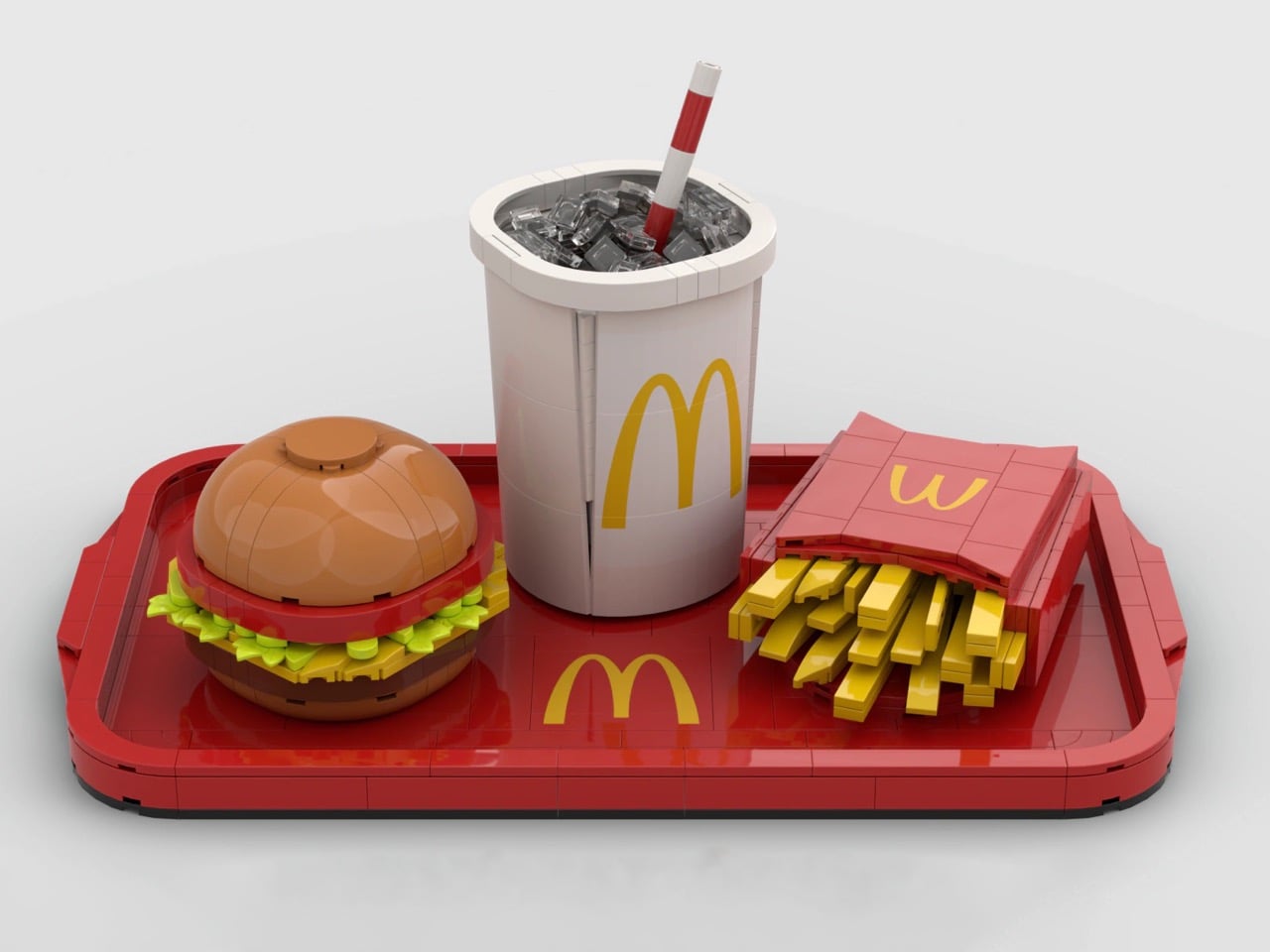
Called McDonald’s Menu, brickbybrick_’s LEGO Ideas submission rebuilds a classic combo big enough to hold its own on a shelf. There’s a red tray with giant Golden Arches in the middle, a cheeseburger, a red carton overflowing with fries, and a white cup loaded with transparent ice and a striped straw. Zero minifigures, zero drive-through, all lunch. The project went up on October 29 and is already sitting at 1,440 supporters, which tells me a lot of AFOLs (adult fans of LEGO) are hungry. I’m one of them, and I’m writing this before lunch.

Designer: brickbybrick_

Red plates form the tray, finished with a raised, rounded rim and a handle at each end, so it reads as molded plastic instead of a stack of bricks. A big yellow set of Golden Arches sits dead center, breaking up what would otherwise be a whole lot of red. The food is arranged in the classic triangle: burger front left, cup at the back, fries off to the right. It’s the exact layout you’d find on any table at your local McDonald’s around noon. That framing makes the build look like a meal someone just set down, which is half the fun of it.

The cheeseburger starts with a dome of tan curved elements, smooth on top like a plain hamburger bun. Under it sits a red layer that reads as tomato, then bright green leaf pieces fanning out as lettuce, a slice of yellow cheese, and a dark brown patty. Those leaves are a nice bit of NPU (nice part usage, for the uninitiated), taking foliage meant for LEGO gardens and jungles and turning it into a salad. Each layer sticks out at slightly uneven angles, giving the burger that freshly squished look of something just pulled from its wrapper. Real fast food never comes perfectly stacked, and this one looks like it survived a lunch rush.

A pile of yellow plates and bricks spills out of the red fry carton at every angle, some standing tall and some flopped over the edge the way the last few always are. The carton gets the real thing’s shape right, the one McDonald’s introduced in 1970 with a wide mouth for quick scooping and a profile that keeps the fries from falling out. The Golden Arches appear on its face in yellow, the same red-and-yellow combo that has been selling fries for over five decades. Building fries in LEGO is easy, but making them look casually messy takes real effort. My only complaint is that I can’t salt them.

My favorite detail, though, is the drink. The white cup’s top is left open, showing a load of transparent pieces packed in as ice, with a red-and-white striped straw sticking out at a jaunty angle. That straw does three jobs at once. It gives the composition its tallest point, adds a splash of red to an otherwise white element, and nods to a real McDonald’s quirk, since the chain says its straws are slightly wider than average so more Coke hits your taste buds. The ice tells its own story, because McDonald’s pre-chills its syrup and sets the ratio expecting the ice to melt. Leaving the lid off is what lets you see all of it.

Back in 2021, adammark’s McDonald’s Franchise 1955-1969, a walk-up burger stand with a Speedee System kitchen, hit 10,000 supporters and reached the Third 2021 Review. It was one of 36 projects in that round, and Hocus Pocus ended up as the only one approved. brickbybrick_ takes a different route, shrinking the subject from a restaurant down to a single meal sized for a shelf. The build is unlicensed, so those Golden Arches are a fan’s tribute, and any official version would need McDonald’s on board. The two companies have teamed up before, going back to LEGO’s first Happy Meal promotion in 1983, so the precedent exists.

McDonald’s Menu currently has 1,440 supporters and 599 days left to reach its next milestone of 5,000. LEGO Ideas runs on community momentum: fans submit their builds, supporters rally behind the ones they love, and projects that hit 10,000 get reviewed by LEGO for a shot at becoming real sets. It’s a long climb for a lunch order, but every Ideas set on store shelves started at zero votes. If you’d like to see this combo in a box, head to the LEGO Ideas page and give it your vote. Personally, I’m holding out for a Super Size edition, which McDonald’s retired in 2004 but LEGO is more than welcome to bring back.

The post This fan-made LEGO McDonald’s combo comes with everything except the McFlurry first appeared on Yanko Design.
  • ✇Yanko Design
  • Salvador Dalí’s melting clocks are now a 3D LEGO diorama, ants included
    MoMA owns The Starry Night, The Persistence of Memory, and a set of LEGO bricks designed by Godtfred Kirk Christiansen in the 1950s. The museum brought two of those together in 2022, when it partnered with LEGO on the Starry Night set that grew out of a LEGO Ideas submission. A new Ideas project wants to complete the triangle. BrickRelativity has rebuilt Salvador Dalí’s 1931 painting of melting clocks as a 3D brick diorama, complete with the dead tree, the ant-covered watch, and the weird sleep
     

Salvador Dalí’s melting clocks are now a 3D LEGO diorama, ants included

3 novembre 2026 à 19:30

MoMA owns The Starry Night, The Persistence of Memory, and a set of LEGO bricks designed by Godtfred Kirk Christiansen in the 1950s. The museum brought two of those together in 2022, when it partnered with LEGO on the Starry Night set that grew out of a LEGO Ideas submission. A new Ideas project wants to complete the triangle. BrickRelativity has rebuilt Salvador Dalí’s 1931 painting of melting clocks as a 3D brick diorama, complete with the dead tree, the ant-covered watch, and the weird sleeping figure sprawled across the beach. If MoMA wanted a sequel, it wouldn’t even need to leave the building.

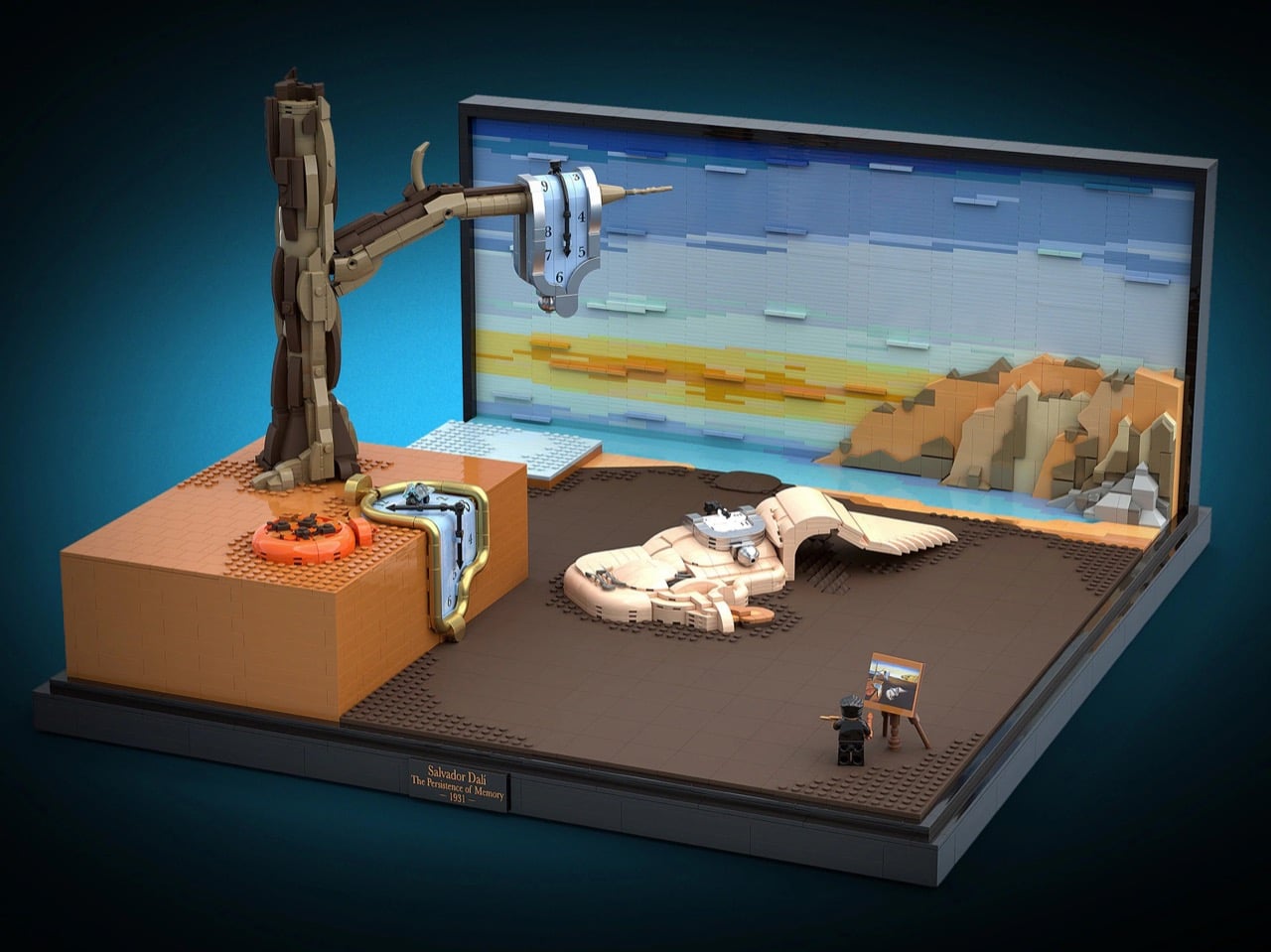
Dalí’s original is tiny, just 9.5 by 13 inches (24 by 33 cm), which catches plenty of first-time visitors off guard. The brick version spreads the scene across a black display base with a gallery plaque and a sky built from horizontal bands of blue, aqua, and sunset-yellow plates. BrickRelativity says the central blob was one of the toughest challenges, since soft, shapeless forms and rigid LEGO elements get along about as well as cats and bathtubs. The clocks came a close second, their faces rebuilt from tile grids that warp along with the melt. LEGO Art has already worked through Hokusai, Van Gogh, and Monet, so Surrealism feels overdue.

Designer: BrickRelativity

Three clocks melt across the scene, and each gets its own construction trick. The one hanging off the tree branch wears a pearl-silver bezel that folds over the wood, with a small silver ball at its lowest point standing in for the drip. The pocket watch sliding off the orange ledge swaps silver for pearl-gold tube elements that kink around corners, with a transparent fly perched on its face. The third clock drapes over the sleeping figure in the middle, following the curve of the body underneath it. Numerals were applied as decals directly to the curved surfaces, while every clock hand is built from LEGO elements.

My favorite detail, though, is the face of that gold pocket watch. BrickRelativity built it from a grid of light-blue tiles, and as the face slumps over the ledge, the seams between them bend with it. The result looks like graph paper caught in a heat wave. The grid also gives the numerals a place to sit and recalls the stud-by-stud mosaics of LEGO Art, now visibly coming apart. A warped coordinate system feels very Einstein, which is funny, because Dalí insisted his soft watches came from cheese rather than relativity.

Dalí reportedly based the sleeping figure on a rock formation at Cap de Creus, and it’s generally read as a squashed self-portrait. BrickRelativity layered curved slopes in tan and pale flesh tones until the blob looked properly boneless. Dark gray bars and curves form a closed eye with long lashes, and a wing-like membrane of stacked plates trails off behind it. Back on the ledge, the closed orange pocket watch is a ring of curved elements with a little crown nub. A cluster of tiny ants made from dark clip plates swarms its lid, turning Dalí’s recurring symbol of decay into a minifig-scale infestation.

The landscape skips a printed backdrop entirely. Horizontal bands of blue, aqua, pale yellow, and orange plates build up the sunset sky. The Cap de Creus cliffs on the right use stepped wedges and slopes in tan, dark tan, orange, and gray, placed at different depths to make the coastline recede. Dark brown tiles cover the beach, with patches of exposed studs breaking up the flat surface like scrubby ground. Viewed head-on, that depth collapses back into the painting’s flat composition. BrickRelativity has some practice with perspective tricks: previous Ideas projects turned M.C. Escher’s impossible staircases into bricks.

Down in the front corner, a tiny Dalí minifig with swept gray hair, a patterned tie, and that famous upturned mustache paints at an easel holding a miniature copy of the painting. It’s a direct callback to the Van Gogh minifig and easel that shipped with the Starry Night set. A black base and a small plaque bearing the artist’s name, the title, and the year finish the gallery look. Fan builders have been chasing this museum energy all year, from a 1,117-piece Picasso portrait to a Brick Dangerous melting clock that just qualified for LEGO’s third 2026 review. Dalí’s copyright is managed by the Fundació Gala-Salvador Dalí, so any official version would need the estate’s blessing.

The project currently sits at 1,849 supporters, with 602 days left to hit the next milestone of 5,000. LEGO Ideas lets fans submit builds and rack up supporters, and projects that reach 10,000 move on to LEGO’s official review for a shot at becoming a real set. You can head to the LEGO Ideas page and give BrickRelativity your vote, which costs nothing but a LEGO account. Dalí already turned this painting into floating bricks once, in his 1954 sequel The Disintegration of the Persistence of Memory. Seems only fair to let someone finish the job properly, with clutch power this time.

The post Salvador Dalí’s melting clocks are now a 3D LEGO diorama, ants included first appeared on Yanko Design.

  • ✇Yanko Design
  • LEGO Bauhaus Chess Concept Has Hidden Clues to Its Moves
    A knight’s horse-shaped head is easy to recognize, but it offers no clue about that peculiar L-shaped move. That’s a small frustration with learning chess: identifying the pieces and remembering what they do are two separate tasks. I like the idea of giving their shapes a little more responsibility, especially when the alternative is explaining the knight’s movement for the fifth time. Pinke Gans’s Bauhaus Chess Set, a LEGO Ideas fan concept, takes that possibility as its starting point. Accord
     

LEGO Bauhaus Chess Concept Has Hidden Clues to Its Moves

3 novembre 2026 à 04:15

A knight’s horse-shaped head is easy to recognize, but it offers no clue about that peculiar L-shaped move. That’s a small frustration with learning chess: identifying the pieces and remembering what they do are two separate tasks. I like the idea of giving their shapes a little more responsibility, especially when the alternative is explaining the knight’s movement for the fifth time.

Pinke Gans’s Bauhaus Chess Set, a LEGO Ideas fan concept, takes that possibility as its starting point. According to the designer, the idea emerged during a summer visit to the Bauhaus Museum in Weimar, Germany, where Josef Hartwig’s geometric chess pieces brought LEGO bricks to mind. It’s an appealing connection: a construction system built around basic shapes meets a chess set designed to make those shapes meaningful.

Designer: Pinke Gans

Hartwig designed his Bauhaus chess set in 1923, while working at the school in Weimar. Its abstraction wasn’t simply a matter of removing decorative details. The pieces used their forms to communicate their movement, replacing familiar figures with a geometric vocabulary. A minimalist chess set can still leave you memorizing arbitrary symbols; Hartwig’s approach gives some of those symbols a practical explanation.

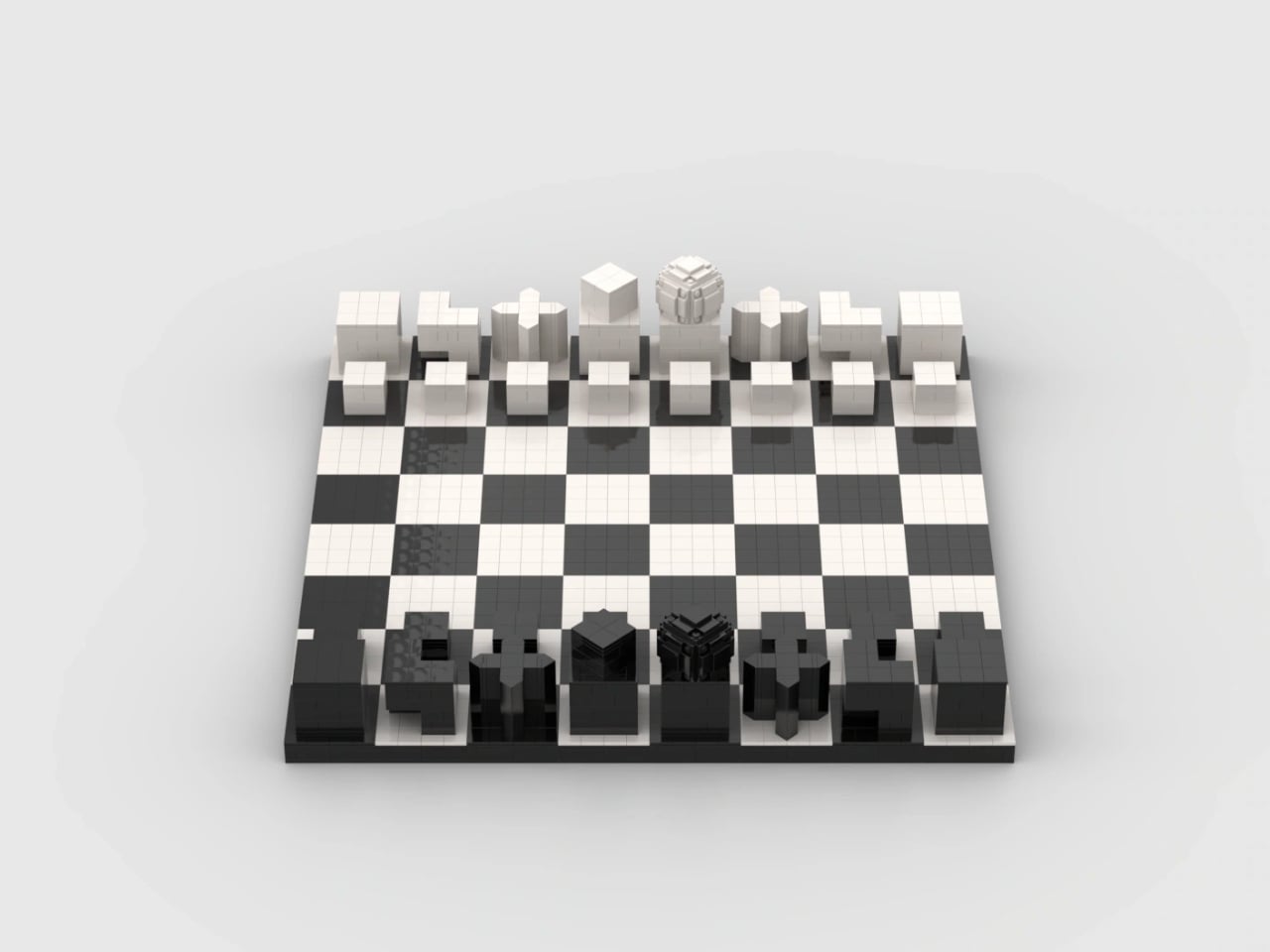
The knight is the clearest example. Its stepped shape echoes its L-shaped movement, while the bishop’s diagonal cross relates to its diagonal paths across the board. Pinke Gans’s version carries those recognizable forms into bricks. These are useful memory cues, not a complete substitute for learning the rules. Nobody should expect a small cube to explain every complication of a pawn’s first move or capture.

In the supplied images, the queen provides the most conspicuous departure from all those straight edges. Its rounded top becomes a faceted, layered construction, with individual elements visible around its surface. Nearby, the king has a smaller cube turned relative to its base. Together, they introduce enough variation to interrupt the rows of blocks. The brick-built approximation of a sphere gives the queen a texture of its own.

That translation is more interesting to me than a perfectly smooth replica would be. Historical examples of Hartwig’s set were made in wood, so rebuilding the forms in LEGO changes how their surfaces read. Here, joints and tile seams remain visible. They establish a second, finer grid within the larger chessboard pattern, making the construction legible even where exposed studs don’t dominate the design.

The board itself stays restrained: black and white squares, a dark perimeter, and no elaborate scenery competing with the pieces. From the lower viewing angles, the arrangement resembles a small collection of architectural models. I could see this earning its place on a living room table because the visual interest comes from proportion and repetition, rather than decoration.

There is a potential usability tradeoff, though. If you already recognize conventional chess silhouettes instantly, a geometric set asks you to learn a different identification system before its logic becomes helpful. A blocky king and a rounded queen might be clear once explained, but that doesn’t establish faster recognition during play. The images also can’t tell us how securely the pieces hold together when repeatedly picked up.

The project is presented as a LEGO Ideas proposal, rather than an announced retail set. That distinction deserves to stay attached to the enthusiasm. Fan product ideas that reach 10,000 supporters may be considered for production, but reaching that threshold doesn’t itself put a box on store shelves. This submission shouldn’t be treated as a confirmed release or given an imagined price.

For me, the strongest reason to want it is the opportunity to assemble the shapes before playing with them. Building a knight’s stepped form could make its design rationale more tangible than simply reading an explanation beside a finished piece. You’d still need to learn chess. But spending a little time constructing the thing that represents a move seems like a particularly appropriate introduction to Hartwig’s idea.

The post LEGO Bauhaus Chess Concept Has Hidden Clues to Its Moves first appeared on Yanko Design.

  • ✇Yanko Design
  • Gorgeous LEGO Book Nook Has a Steam Train Blasting Straight Through Its Snowy Pages
    Every kid who grew up with Chris Van Allsburg’s The Polar Express remembers that moment where the story stops behaving like a story. A train just shows up, chugging straight out of the snow and into a kid’s actual bedroom, and suddenly bedtime reading feels a little bit dangerous in the best way. That’s the exact energy LEGO builder CrazyInventor is chasing with Winter Express, and yes, I see what you did there with that title, very smart way to dodge a certain mouse-shaped legal team while sti
     

Gorgeous LEGO Book Nook Has a Steam Train Blasting Straight Through Its Snowy Pages

18 septembre 2026 à 14:20

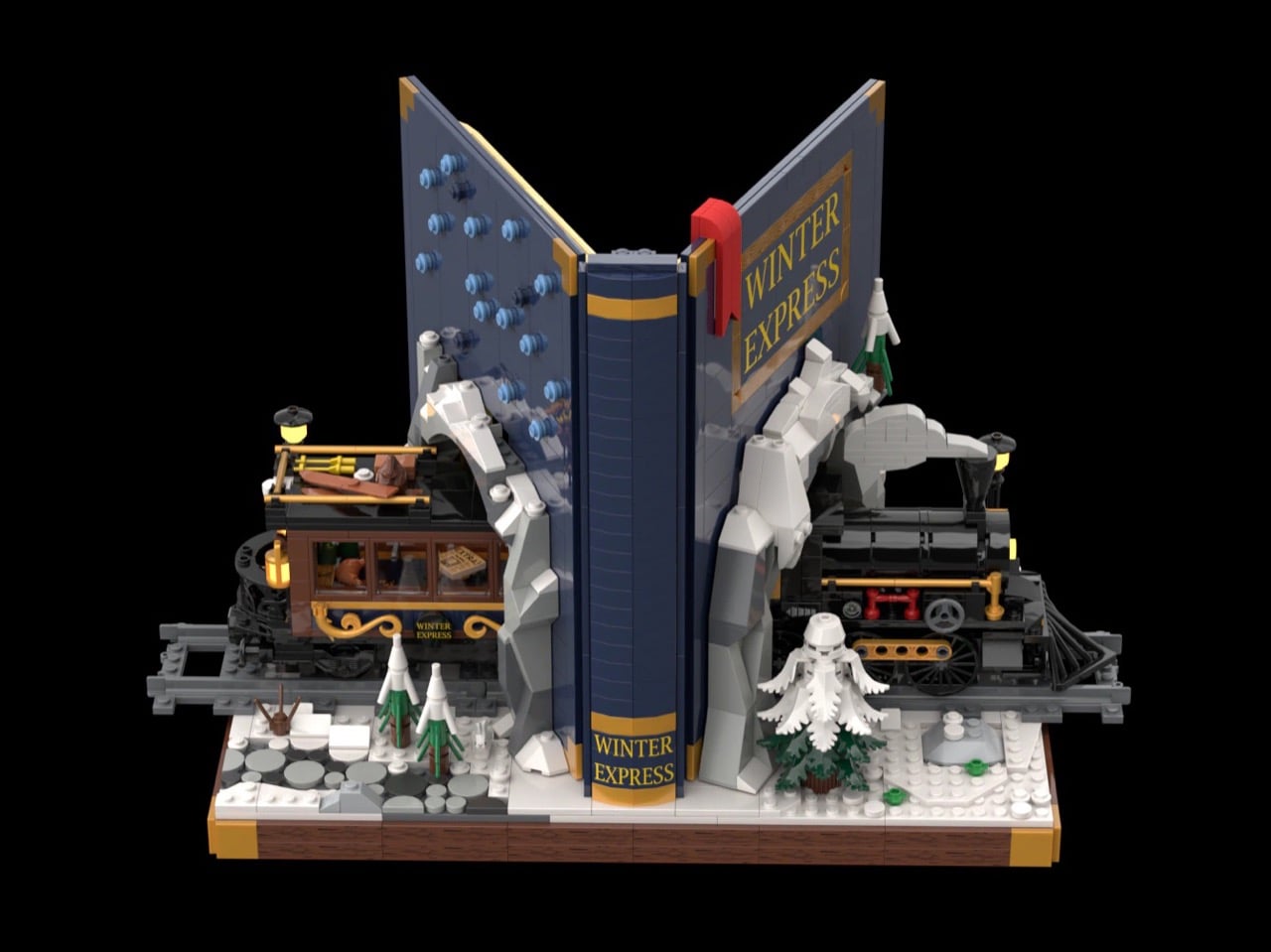
Every kid who grew up with Chris Van Allsburg’s The Polar Express remembers that moment where the story stops behaving like a story. A train just shows up, chugging straight out of the snow and into a kid’s actual bedroom, and suddenly bedtime reading feels a little bit dangerous in the best way. That’s the exact energy LEGO builder CrazyInventor is chasing with Winter Express, and yes, I see what you did there with that title, very smart way to dodge a certain mouse-shaped legal team while still getting the reference across loud and clear. Except here the train doesn’t stop at bursting out of the pages. It runs straight through the whole book, cover to cover, like the story just wasn’t big enough to hold it.

The result looks like someone left a hardback open on a shelf and a Victorian steam engine decided to use it as a shortcut. Gold trim, a red ribbon bookmark, snow dusted across the back cover like a sky full of stars, this thing reads more like a diorama that happens to be shaped like a book than a book that happens to have a train in it. And once you spot the tiny second train hiding inside the pages, you’ll understand why this project cracked 1,000 supporters in about three days flat.

Designer: CrazyInventor

The book itself steals the show before the train even enters the conversation. It’s a navy blue hardback with rounded gold corner guards and matching gold bands running down a curved spine, the kind of cover treatment you’d expect on a leather-bound classic rather than a pile of ABS plastic. A gold plaque on the front reads “Winter Express” in a wood-grain frame, and a red ribbon bookmark hangs off the top edge like someone set the book down mid-chapter and wandered off to make tea. Flip to the back cover and it’s scattered with pale blue round studs, doing double duty as either falling snow or a starry winter sky, depending on how you’re feeling that day.

A black and gold Victorian locomotive takes over from there, complete with a glowing headlamp, a cowcatcher up front, and Technic side rod detailing, coming straight out of a snow-capped rock tunnel carved into the front cover. A matching passenger coach trails out the other side through the spine, decked out in scrollwork trim with its own lit lanterns and a roof stacked with skis and sleds. Snowy pine trees, cobblestone tiles, and two working lampposts fill out the base, along with a frozen little pond built from trans-blue tiles.

My favorite detail is buried in the pages themselves. Look closely at the tan interior spread and there are cutout windows revealing a second, micro-scale train crossing a tiny stone viaduct, a whole miniature railway hiding inside the book that the big train is currently smashing its way through. It’s a small touch, but it’s the kind of layered thinking that separates a fun MOC from a genuinely great one.

Winter Express landed on LEGO Ideas on September 15 and has already pulled in 1,291 supporters, cruising well past the first 1,000-vote milestone toward the 5,000 mark it needs next. If cozy winter dioramas with a little bit of chaos baked in are your thing, go to the LEGO Ideas page and add your support and watch this one keep climbing.

The post Gorgeous LEGO Book Nook Has a Steam Train Blasting Straight Through Its Snowy Pages first appeared on Yanko Design.

❌