❌

Vue normale

  • ✇Yanko Design
  • Reolink’s OMVI 2i Ultra Wireless Security Camera can look in two directions at once: Hands-on at IFA 2026
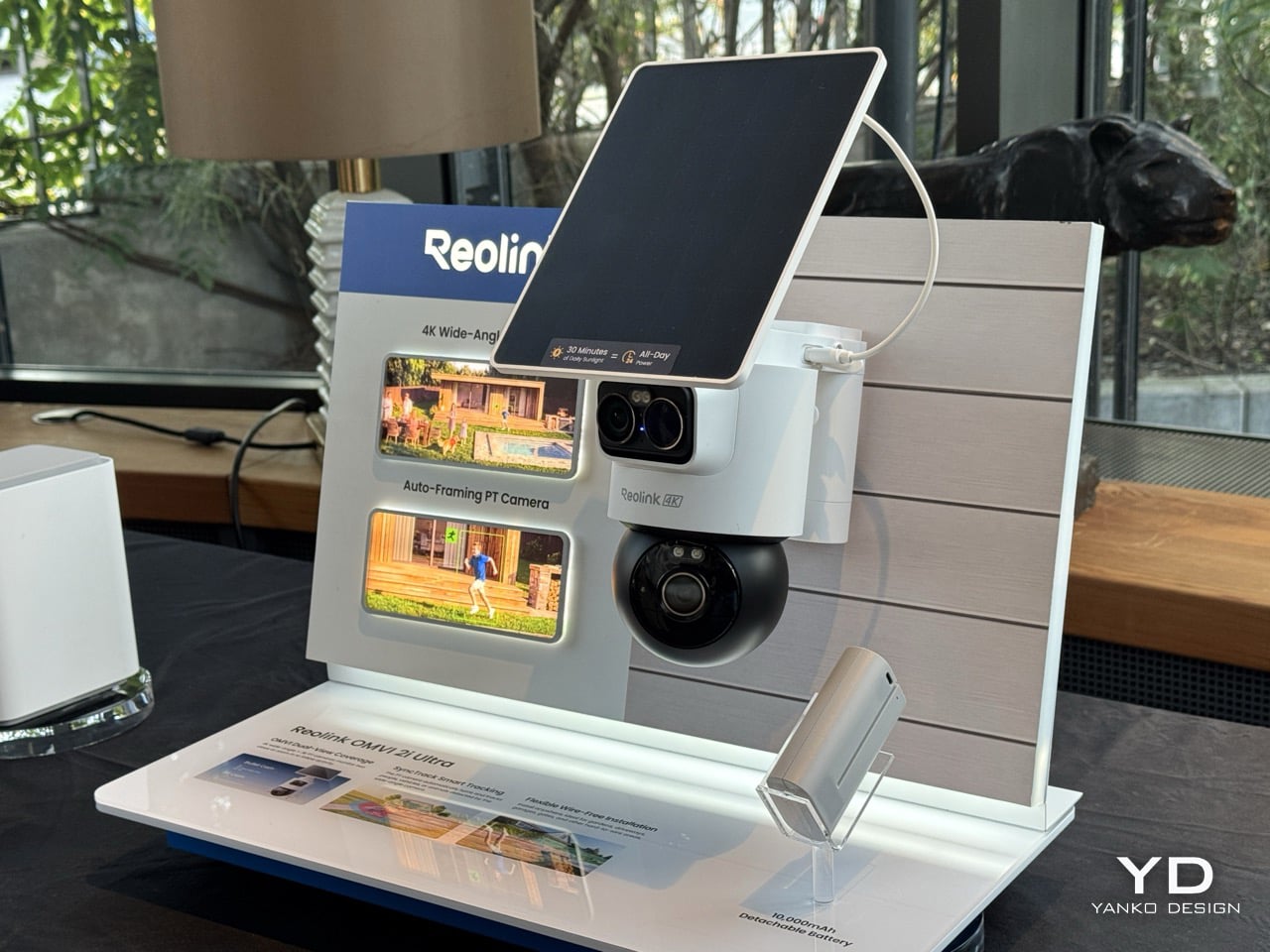
    Picture a courier walking up your driveway while someone else quietly tries your side gate. A normal pan-tilt camera picks one of them and forgets the other exists. Reolink’s OMVI 2i Ultra handles it by carrying two cameras at once: a fixed 4K wide lens on top that never stops watching the full scene, and a 5MP pan-tilt ball below that spins 355 degrees to lock onto whatever the wide lens flags. Both feeds record at the same time, and you can tap anywhere on the wide view to slew the turret str
     

Reolink’s OMVI 2i Ultra Wireless Security Camera can look in two directions at once: Hands-on at IFA 2026

4 septembre 2026 à 03:00

Picture a courier walking up your driveway while someone else quietly tries your side gate. A normal pan-tilt camera picks one of them and forgets the other exists. Reolink’s OMVI 2i Ultra handles it by carrying two cameras at once: a fixed 4K wide lens on top that never stops watching the full scene, and a 5MP pan-tilt ball below that spins 355 degrees to lock onto whatever the wide lens flags. Both feeds record at the same time, and you can tap anywhere on the wide view to slew the turret straight to that spot. It debuted at IFA 2026 in Berlin, ships late October, and costs between $200 and $250.

A detachable 10,000mAh pack claims six months per charge, and the 6W SolarEase panel says it needs about thirty minutes of daily sun to stay topped up, against the one to two hours Reolink quotes for rivals like Eufy’s S340 and the Tapo C675D. Those are Reolink’s own numbers, so hold them loosely until somebody leaves one on a north-facing wall through a British winter. The rest is easier to verify. Wi-Fi 6 across both bands, up to 512GB of local microSD with no subscription attached, colour night vision from twin spotlights, a siren, and IP65 sealing. At a kilogram with the bracket, it is a proper lump of hardware rather than something you tuck on a shelf.

Designer: Reolink

Pan-tilt cameras have quietly lied to buyers since the format existed. Sell someone a camera that turns to follow motion and you have also sold them a camera that stops watching everywhere else the instant it does. Reolink’s fix is embarrassingly simple once you see it. Stop asking one lens to be both the guard and the chaser, and give it a second lens that only guards. The wide 4K unit up top runs at 110 degrees horizontal and never rotates, so the scene it opened on is the scene it keeps recording no matter where the PT ball below it wanders off to. Reolink calls this SyncTrack, but the actual idea is closer to division of labour than any clever algorithm. One camera commits to context, the other commits to pursuit, and neither has to compromise for the sake of the other.

This is the third time Reolink has built this exact idea in 2026, and each version has been a slightly different argument about what matters most. The X16 landed at CES in January as a 24MP full metal flagship with 16x optical zoom, but it needs an ethernet run to function, which puts a hard ceiling on where it can live. The 3i followed in June with PoE and wired Wi-Fi options at $319.99, still asking for a nearby outlet even in its most flexible form. The 2i Ultra drops the combined resolution to 8MP plus 5MP and, in exchange, cuts the cord entirely. The trade-off is the clever bit, because being able to pop a camera on a fence or a backyard without worrying about wiring is much more convenient than haggling over megapixels.

A squared-off dual-lens head sits above a separate motorized ball, with a solar panel tilting on its own hinge overhead, and the whole assembly weighs a full kilogram once the bracket is attached. Compare that to Reolink’s own Argus MagiCam, a 108-gram cube you stick to a fridge with a magnet, and the difference in ambition is obvious at a glance. This is not a camera trying to disappear into a bookshelf. It reads more like a small piece of maritime equipment bolted under an eave, and that visible mechanical presence is doing some of the deterrence work before the siren ever gets involved.

That dual-lens design is quite literally baked into the name. OMVI reads like omni-vision, a camera built to watch in every direction at once instead of picking a lane. Arlo’s Ultra flagship still wants a wall plug or a proprietary base station to unlock its best tricks, and Nest’s outdoor cameras have quietly stayed wired-first for years now, which makes the 2i Ultra’s fully wire-free build feel like it is actually catching up to how people install things rather than how manufacturers wish they would. No drilled conduit, no hub tucked in a closet, just a battery, a solar panel, and a spot on the fence you actually wanted the camera to go.

That is the real flex against the flagships twice its price. You are not paying for a wall socket you have to plan your whole install around, and you are not paying for a bulky base station eating an outlet indoors either. You get two lenses doing genuinely different jobs, a battery that outlasts most of the category on paper, and a name that finally means something instead of just sounding techy. At $200 to $250, the OMVI 2i Ultra is the version of omni-vision security that shows up ready to mount anywhere the moment you take it out of the box.

The post Reolink’s OMVI 2i Ultra Wireless Security Camera can look in two directions at once: Hands-on at IFA 2026 first appeared on Yanko Design.
  • ✇Yanko Design
  • Reolink’s $65 Tiny Magnetic Security Camera Runs 9 Months on 2 AA Batteries: Hands-On at IFA 2026
    The worst part of owning a security camera has never been the camera. It is the ladder, the drill, the wall plug, and the moment you realize you aimed the thing eight degrees too far left. Reolink’s Argus MagiCam deletes all of that with a magnet. The 68mm  GoPro-looking cube slaps onto any metal surface in about two seconds, or onto an included magnetic puck with a swivel arm for everything else, turning any surface into a security surveillance monitor (you can even mount it in your car as a d
     

Reolink’s $65 Tiny Magnetic Security Camera Runs 9 Months on 2 AA Batteries: Hands-On at IFA 2026

4 septembre 2026 à 03:00

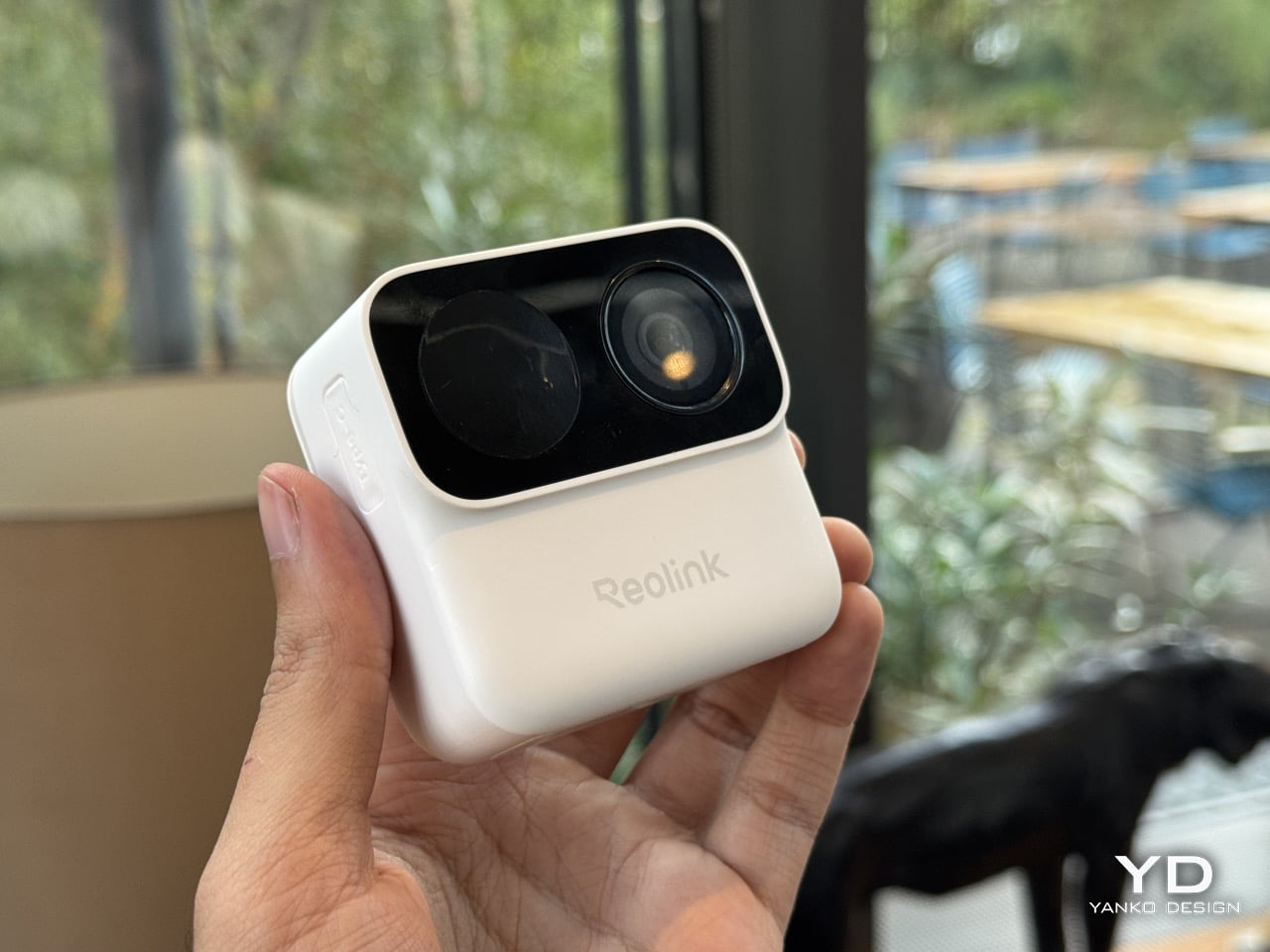
The worst part of owning a security camera has never been the camera. It is the ladder, the drill, the wall plug, and the moment you realize you aimed the thing eight degrees too far left. Reolink’s Argus MagiCam deletes all of that with a magnet. The 68mm  GoPro-looking cube slaps onto any metal surface in about two seconds, or onto an included magnetic puck with a swivel arm for everything else, turning any surface into a security surveillance monitor (you can even mount it in your car as a dashcam)… and here’s the kicker. It runs up to nine months on two AA lithium batteries. Nine. Whole. Months. I repositioned it three times in under a minute at IFA 2026, which is three more times than I have ever moved a camera bolted to a wall.

Sixty-five dollars buys 1080p, IP67 weatherproofing, dual-band Wi-Fi, on-device person detection, and local microSD storage with no monthly fee attached. Flip the cube over and the back panel detaches to a bay holding two ordinary AAs, the SD slot and the reset button, all serviceable with a coin and a spare hand. Reolink built it around Qualcomm’s QCC730 micro-power Wi-Fi chip for its Power Efficient Series, shown in Hall 1.2 next to the OMVI 2i Ultra. A USB-C port hides under a rubber flap for 24/7 recording when you want it wired. Three colours: black, white, and a mint green that has no business looking this good.

Designer: Reolink

A matte PIR dome sits on the left, a glossy ringed lens sits on the right, and a pinhole mic hides between them, the whole cluster raised on a squared-off black module that reads more like a GoPro’s lens housing than anything borrowed from traditional security hardware. Security cameras have spent two decades pretending they belong on a parking structure, all bullet housings and matte black anonymity. This one borrows its language from action cameras instead, small, chunky, built to be picked up and repositioned rather than mounted once and forgotten, which is exactly why the mint colorway makes sense sitting on a bookshelf instead of bolted above a garage. That GoPro reference is not incidental either. It signals a camera meant to be handled, not just installed.

The battery bay is the real argument here. Somewhere along the way, the smart home industry decided sealed rechargeable packs looked cleaner on a spec sheet, and quietly handed every camera, doorbell, and earbud an expiry date measured in a couple of years. Reolink went the other direction, and the QCC730 chip is what makes that reversal viable rather than nostalgic, since its whole job is sipping power in standby instead of gulping it. Blink has claimed two years off two AA lithiums since its Outdoor 4 launched, though independent testing has repeatedly landed closer to a few months once real motion traffic gets involved. Nine months against a heavier five minutes of daily recording, verified in Reolink’s own side by side tests, reads like the more honest number in the room.

What you give up for all that convenience is resolution, and it barely registers as a cost. This is a 1080p sensor at a moment when 4K battery cameras exist, sure, but 1080p is still plenty sharp for spotting a face at the door or a raccoon in the bin, and the fixed bitrate keeps file sizes sane on a modest microSD card. Night vision runs through a single mono IR LED instead of anything approaching colour, which is standard fare at this tier, not a shortfall specific to Reolink. For a camera this cheap, this easy to place, and this forgiving on power, trading a few thousand pixels feels like a fair swap rather than a compromise. The MagiCam was never trying to be the sharpest eye on your property. It is trying to be the one you actually keep charged, and on that specific promise, the AA drawer you have been ignoring for a decade just became a legitimate accessory again.

The post Reolink’s $65 Tiny Magnetic Security Camera Runs 9 Months on 2 AA Batteries: Hands-On at IFA 2026 first appeared on Yanko Design.

Apple Reportedly Preparing Second-Generation iPhone Air for Spring 2027

19 juin 2026 à 09:53

Apple’s next iPhone Air could arrive in spring 2027 with camera and battery upgrades as the company shifts toward staggered iPhone launches.

The post Apple Reportedly Preparing Second-Generation iPhone Air for Spring 2027 appeared first on TechRepublic.

  • ✇Korben
  • Tapo C675D KIT - 2 objectifs 4K et zéro angle mort
    -- Article en partenariat avec Tapo - Contient des liens affiliés -- La Tapo C675D KIT de TP-Link est une caméra de surveillance solaire qui vient de sortie, avec un truc qu'on voit rarement à ce tarif : 2 objectifs 4K. Un grand-angle fixe qui surveille toute la scène, et un second monté sur rotule qui zoome et suit l'action tout seul comme un grand. J'avais déjà testé sa petite sœur, la Tapo C665G , et là j'avoue que Tapo monte clairement d'un cran. Les deux objectifs, c'est malin parce que su
     

Tapo C675D KIT - 2 objectifs 4K et zéro angle mort

18 juin 2026 à 03:54
-- Article en partenariat avec Tapo - Contient des liens affiliés --

La Tapo C675D KIT de TP-Link est une caméra de surveillance solaire qui vient de sortie, avec un truc qu'on voit rarement à ce tarif : 2 objectifs 4K.

Un grand-angle fixe qui surveille toute la scène, et un second monté sur rotule qui zoome et suit l'action tout seul comme un grand. J'avais déjà testé sa petite sœur, la Tapo C665G , et là j'avoue que Tapo monte clairement d'un cran.

Les deux objectifs, c'est malin parce que sur une caméra motorisée classique, dès qu'elle pivote pour suivre quelqu'un, elle perd le reste du champ. Ainsi, pendant qu'elle zoome sur le mec qui crochète votre portail, votre bagnole sort du cadre et son complice peut se barrer avec... Alors qu'ici, non. Le grand-angle reste planté sur ses 169° et filme tout en permanence, tandis que le téléobjectif part chasser le mouvement en tournant sur 360°. Et tout ça est diffusé sur deux flux 4K séparés.

Et le mieux, c'est que les deux bossent ensemble puisque c'est le grand-angle qui fait le boulot de détection : il repère le mouvement et envoie le téléobjectif se verrouiller dessus pour le suivre en temps réel. Tapo appelle ça le suivi intelligent synchronisé, moi j'appelle ça "la caméra qui te colle aux cul". Les deux capteurs crachent du vrai 4K (3840 x 2160), le grand-angle ouvre à 169° et le téléscopique à 66° avec un zoom x5 pour aller lire une plaque ou reconnaitre un visage au fond du jardin.

Pour l'installation, rien de sorcier comme d'hab avec Tapo. Le panneau solaire doit être orienté plein sud sinon il prend pas assez de lumière, et la caméra se fixe avec des vis. Y'a 9 vis et 9 chevilles dans la boîte, plus un gabarit autocollant pour percer droit. La recharge passe également par un port USB-C planqué sous une trappe étanche, et comme le câble entre le panneau et la caméra fait 3,6 mètres, vous pouvez vraiment placer le panneau looooiiin si la caméra est à l'ombre. Et surtout, les ports et les boitiers sont étanches (IP65), donc y'a pas de flotte qui rentre.

Côté énergie, y'a une batterie de 10000 mAh et un panneau solaire de 4,5 W donc il faut environ 90 minutes de soleil direct par jour pour tenir la journée, et jusqu'à 3 mois d'autonomie sur une charge si jamais le ciel fait la gueule. Avec les longues journées d'été et la canicule permanente qu'on se prend, zéro souci donc de ce côté.

Reste à voir cet hiver ce que ça donne, comme d'hab avec le solaire.

Petite différence quand même avec la C665G, ici, pas de 4G. C'est uniquement du WiFi bi-bande 2.4 et 5 GHz. Donc faut avoir du réseau là où vous la posez. C'est donc un peu moins polyvalent pour le fond du jardin, mais pour surveiller une maison, une cour ou une allée, le WiFi suffit largement et ça vous évitera de bloquer un forfait data pour ça.

Et pour le mode nuit, vous avez le choix : infrarouge classique en 850 nm pour le noir total, ou la vision nocturne couleur grâce aux projecteurs intégrés. Comme ça, plus besoin de deviner si c'est un chat noir ou un tout petit cambrioleur en sweat à capuche. La détection IA distingue également les personnes, les animaux et les véhicules, et ces fonctionnalités sont gratuites et sans abonnement, puisque tout est traité directement en local sur la caméra. Vous pouvez aussi définir des zones d'activité, genre surveiller l'allée mais ignorer la rue pour pas vous faire alerter à chaque voiture qui passe (puis de toute façon, c'est illégal de filmer la rue).

Pour le stockage, vous pouvez y glisser soit une carte microSD jusqu'à 512 Go en local, soit opter pour le cloud Tapo Care si vous préférez. Le mode capture 24/7 permet aussi à la caméra d'enregistrer en continu par petits intervalles pour ne pas vider la batterie, mais dès qu'elle détecte un truc qui gigote, elle passe en mode film complet. Y'a aussi l'audio bidirectionnel pour engueuler le livreur à distance, une sirène et des lumières d'alarme rouge et bleu pour faire fuir les curieux et le tout encaisse de -20°C à 45°C. Ah et j'oubliais, c'est compatible Alexa et Google Home, et tout est piloté depuis l'appli Tapo.

Pour les bidouilleurs, sachez que comme souvent sur les Tapo sur batterie, y'aura pas de flux RTSP à récupérer. C'est vraiment dommage et je comprends pas pourquoi les constructeurs n'en proposent pas d'office (ah oui, leur abonnement, c'est vrai...). Donc si vous vouliez la brancher à un Frigate ou à Motion sous Linux pour la gérer avec vos autres caméras, bah c'est mort. Par contre sur vos caméras qui exposent du RTSP, Cameradar reste très pratique pour tester si vos flux sont bien sécurisés, je vous invite à tester !

Bref, la C675D KIT, c'est la version "je veux tout voir et tout savoir" de la caméra solaire avec un vrai double objectif qui règle enfin ce défaut des caméras motorisées. Sans parler du panneau solaire qui vous évitera de tirer des câbles partout comme un électricien qui aurait bu trop de café.

Vous pouvez la trouver ici si ça vous tente !

❌