
Vue normale

Il y a de nouveaux articles disponibles, cliquez pour rafraîchir la page.
À partir d’avant-hierFlux principal

These Steel Chairs Are Too Big to Sit In: Walk Through Them Instead

Par : JC Torres
6 avril 2026 à 16:20

Most public art earns its place on a pedestal and stays there. It asks you to look, maybe photograph it, and walk away. The relationship between viewer and work rarely extends beyond that brief transaction. That’s been the convention for a long time, but there’s a growing push for installations that don’t just occupy public space but actually do something within it.

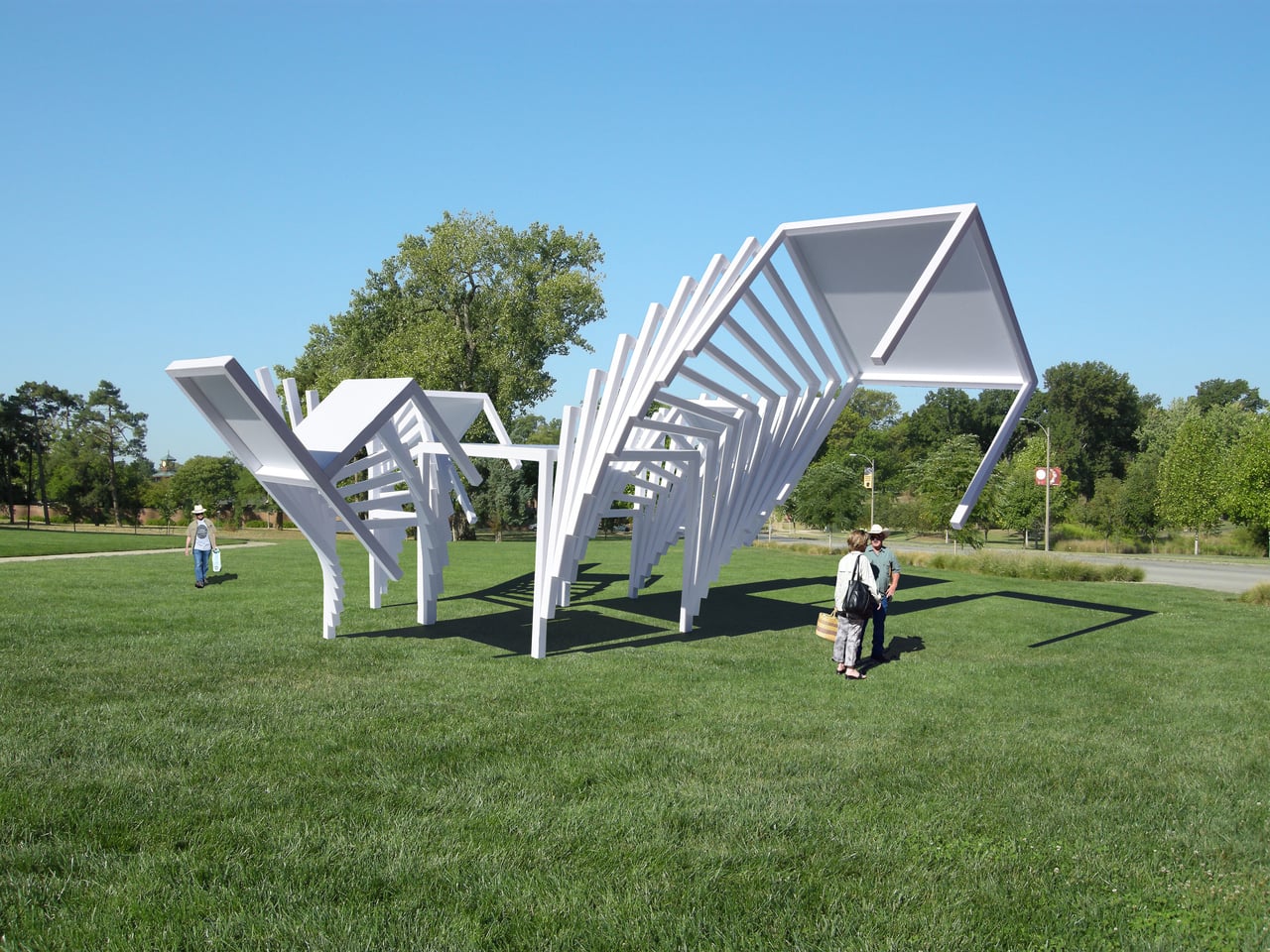
Michael Jantzen has been exploring that tension for years. His Moving Furniture series applies a simple idea to ordinary chairs and tables: take each object’s form and repeat it in progressive intervals as if capturing it mid-movement, then connect those moments into a single piece. The result is something you can still sit in or set a drink on, even if it no longer looks quite built for that.

Designer: Michael Jantzen

Monumental Moving Furniture takes that same concept into architectural territory. Built from painted steel, the series consists of abstracted chair and table forms, each generated by moving the original object through space and time and locking its path into a chain of connected segments. At this scale, what started as a reference to everyday objects feels closer to a building than a piece of furniture.

The method behind each piece is consistent. A chair or table is set in motion through space and time, with each interval frozen and joined to the next. Some pieces move only part of the original form; others shift the whole thing. The result is a structure that stops belonging to any single discipline and starts reading as furniture, sculpture, and architecture at once.

Despite being too large to sit in, these sculptures aren’t purely decorative. Each is large enough to walk under and through, giving it a practical function as a pavilion and shelter. That’s not something most public art can claim. Instead of asking people to observe from a polite distance, these structures pull you in, turning a passive encounter into something more physical and immediate.

The series covers both chair forms and table forms, each treated with the same sequential abstraction. Individual pieces have also been grouped into configurations that suggest more complex structures, as if each were a building block for something larger. Painted in vivid, solid colors like white, orange, and yellow, each structure commands attention from a distance and rewards a closer look once you’re standing beneath it.

Public spaces deserve more than objects to look at. They deserve things to experience. Monumental Moving Furniture earns its place on both counts, offering structures large enough to shelter visitors while giving them something genuinely puzzling to engage with. These forms don’t demand reverence. They invite curiosity, exploration, and the kind of slow, circling attention that good public space has always been designed to encourage.

The post These Steel Chairs Are Too Big to Sit In: Walk Through Them Instead first appeared on Yanko Design.
Step Inside this Giant Kaleidoscope That Feels Like it Descended From Krypton

Par : Sarang Sheth
20 septembre 2025 à 00:30

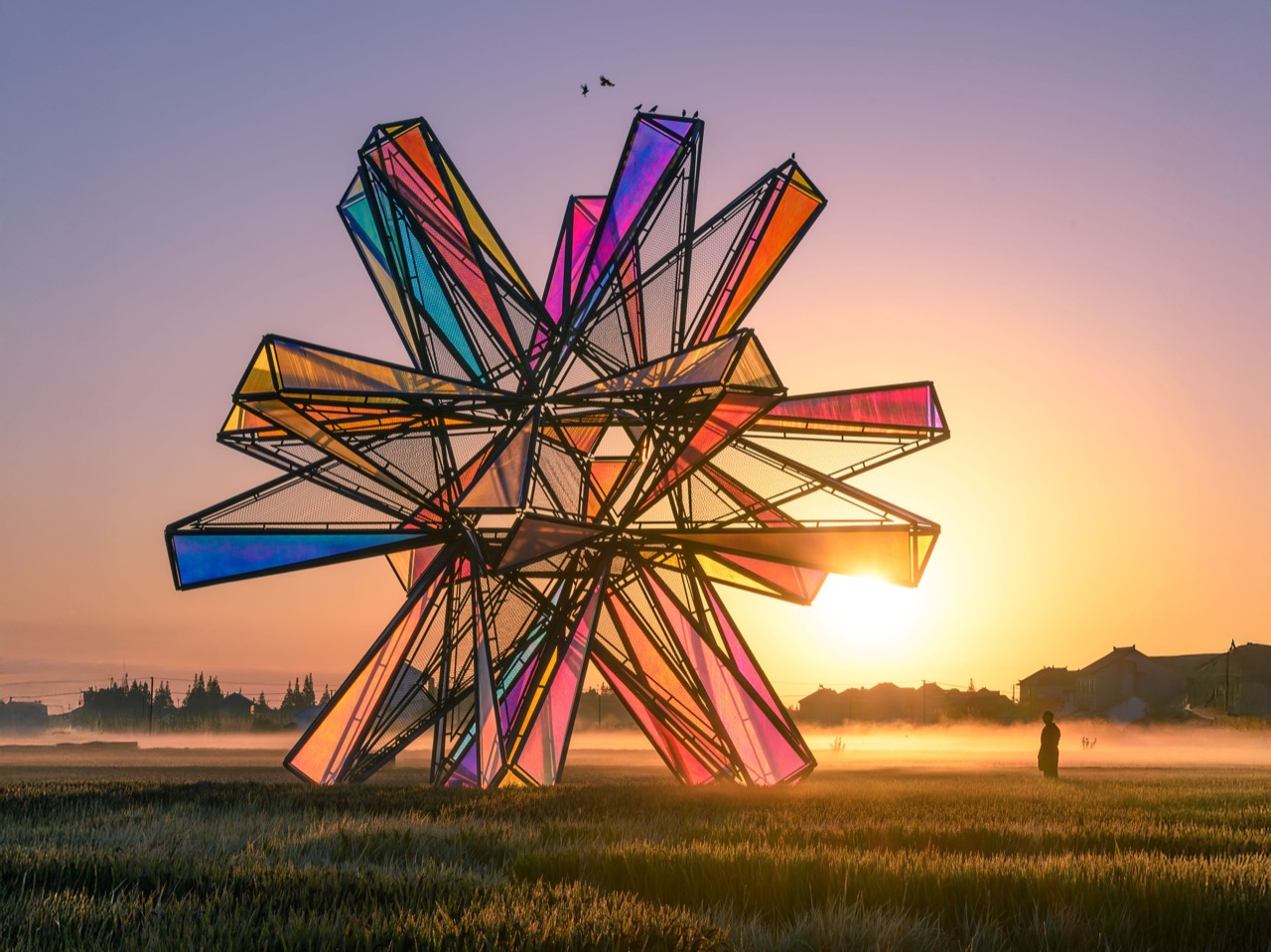
When Li Hao’s Pop Star View Platform first appeared in the landscape, it probably broke a few people’s brains. This isn’t your typical public art installation that politely sits in a corner being contemplative. Instead, it’s a massive crystalline beast that looks like it crash-landed from Krypton, all faceted surfaces and impossible geometry that shifts from alien fortress to disco ball depending on the light. The structure is based on an icosahedron, but Li Hao has exploded and reconstructed it into something that feels both mathematically precise and completely otherworldly. You’re looking at what happens when someone takes sacred geometry and runs it through a kaleidoscope filter.

The visual impact is absolutely bonkers in the best possible way. Those iridescent panels catch and fracture sunlight into a spectrum that would make a prism jealous, creating this constantly shifting light show that transforms throughout the day. At sunset, the thing becomes a beacon of pure color that radiates across the landscape like some kind of interdimensional lighthouse. The dichroic glass or film coating on each facet creates that oil-slick rainbow effect, where purples bleed into teals, oranges melt into magentas, and the whole structure seems to pulse with its own internal energy.

Designer: Li Hao

What’s brilliant about Pop Star is how it plays with scale and perception. From a distance, it reads as this monolithic alien artifact, but as you get closer, the complexity of the internal structure reveals itself. Those black steel frames create a secondary geometric pattern within each colored panel, adding depth and visual texture that keeps your eye engaged. The mesh or perforated elements in some sections let you see through the structure, creating layers of transparency that make the whole thing feel less solid and more like a hologram materializing in space.

Creating a structure this large with so many angled surfaces while maintaining structural integrity requires serious computational design work. Each joint has to handle complex load distributions, and the panel mounting system needs to accommodate thermal expansion while keeping those pristine edges aligned. The fact that it doubles as a viewing platform means the internal framework has to support human traffic, adding another layer of complexity to what could have been just a sculptural statement.

Pop Star View Platform earned its Golden A’ Design Award by doing something most public art fails at: it creates genuine wonder without being pretentious about it. Whether you’re a design nerd who appreciates the mathematical elegance or just someone walking by who stops dead because holy shit, what is that thing, the installation delivers. It’s Instagram-ready spectacle with serious conceptual depth, proving that sometimes the most effective way to make people think about space, light, and perception is to build something so visually arresting they can’t look away.

The post Step Inside this Giant Kaleidoscope That Feels Like it Descended From Krypton first appeared on Yanko Design.

Ruby Law’s Unfolding Cube Transforms Terence Lam’s “White Summer” Concert into a Live-Stage Narrative

Par : Ida Torres
12 septembre 2025 à 08:45

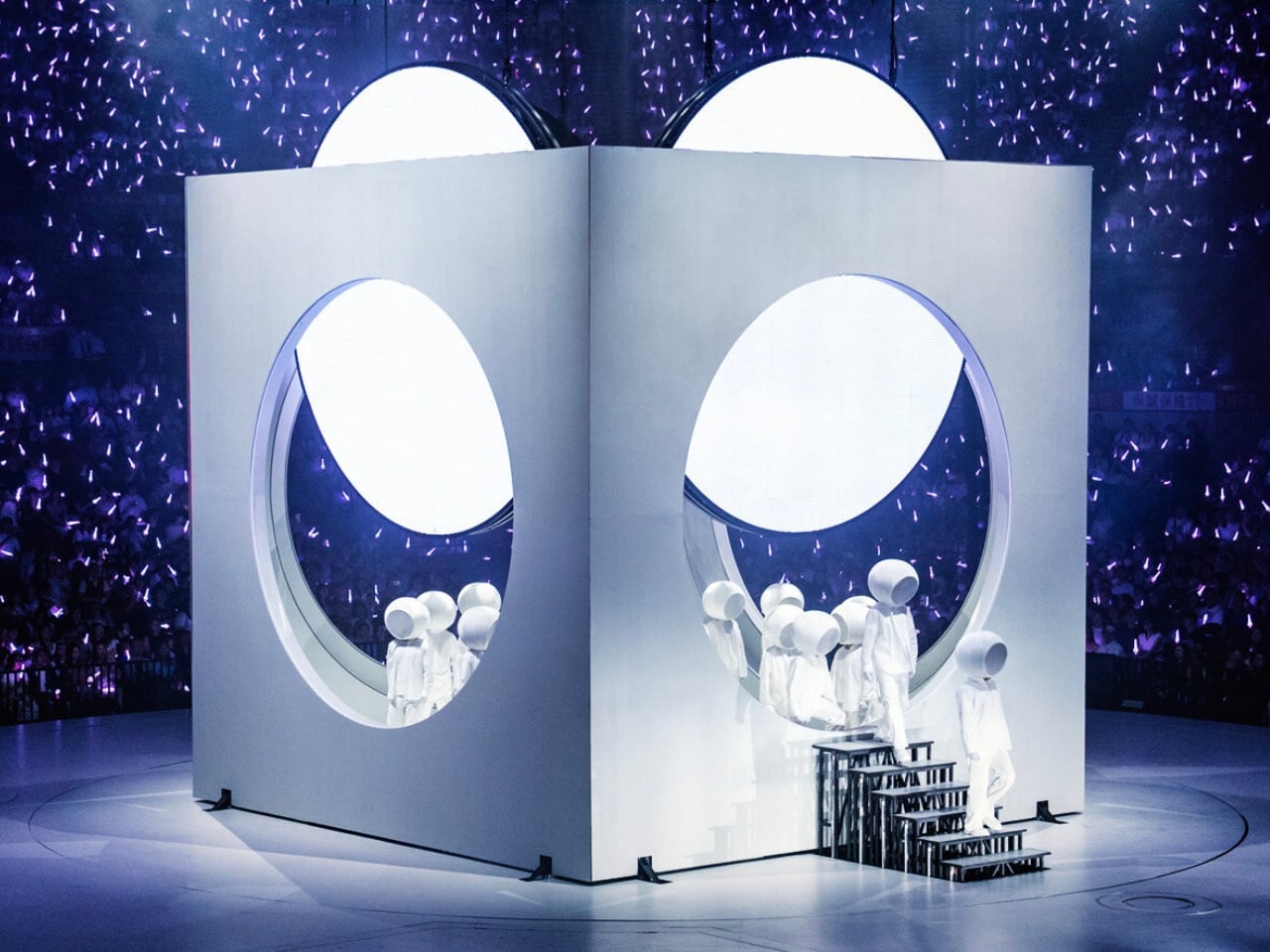
The Hong Kong Coliseum turned into a kinetic storytelling arena on September 10, 2025 when Ruby Law, founder of RULA Design Studio, unveiled a seven‑meter white cube that folds, glows and morphs throughout Terence Lam’s “White Summer” concert. The sculptural centerpiece sits beneath two circular LED screens, creating a striking contrast between the rigid square and the surrounding round light panels—a visual metaphor for the show’s theme of duality, where light and shadow, joy and melancholy intertwine .

From the opening act, the cube dominates the stage as a static, pristine block. Its stark white surface reflects the blinding summer sun projected from the overhead screens, casting deep shadows that echo the concert’s exploration of contrast. As the performance progresses, the cube begins to unfold, its panels swinging outward to reveal a glowing “+” symbol on the floor. This simple cross becomes a sign of unison, a visual cue that disparate elements are converging into a single narrative thread .

Designer: Ruby Law (photos by Right Eyeball Studio)

The circular LED screens above the stage act like abstract glasses, framing fragments of a love story that unfold in projected memories. Audiences watch tender moments turn bittersweet as Terence Lam, positioned outside the cube, observes past relationship scenes playing within the transparent interior. A backward‑running clock punctuates the segment, reminding viewers of the impossibility of reversing time with a loved one.

Colour gradually seeps into the scene, breaking the initial black‑and‑white palette. This shift mirrors the transition from memory to present emotion, while the audience’s light sticks synchronize with a smaller, 360‑degree flying prop—a miniature replica of the main cube—that changes hue in real time. The shared illumination blurs the line between performer and spectator, forging a moment of collective unity.

Aerial choreography defines the concert’s second half. Terence Lam lies on a bed as his “soul” lifts away, rising into a suspended space where his shadow drifts above him. The floating fragments of memory, rendered as weightless shapes, interact with the audience’s light, creating a sensation of gravity‑free movement. The design draws on Daoist ideas of transcendence, suggesting that letting go of past attachments can lead to a higher state of being .

Behind the spectacle, a dedicated engineering and construction crew rebuilt the flying mechanisms after a three‑year venue restriction. Their effort made possible the seamless transitions, rapid unfolding of the massive cube, and precise aerial lifts that kept the performance fluid and safe . The visual language of “White Summer” hinges on the interplay of geometric forms—square versus circle, static versus kinetic—and the emotional journey from recollection to renewal. Ruby Law’s modular cube not only serves as a stage prop but also as a narrative device, framing the concert’s story of love, loss and the hope of moving forward. The unfolding cube stands as a testament to innovative stage design, proving that a simple geometric shape, when engineered with imagination, can become a powerful conduit for storytelling.

The post Ruby Law’s Unfolding Cube Transforms Terence Lam’s “White Summer” Concert into a Live-Stage Narrative first appeared on Yanko Design.

❌
❌