
Vue normale

Il y a de nouveaux articles disponibles, cliquez pour rafraîchir la page.
À partir d’avant-hierFlux principal

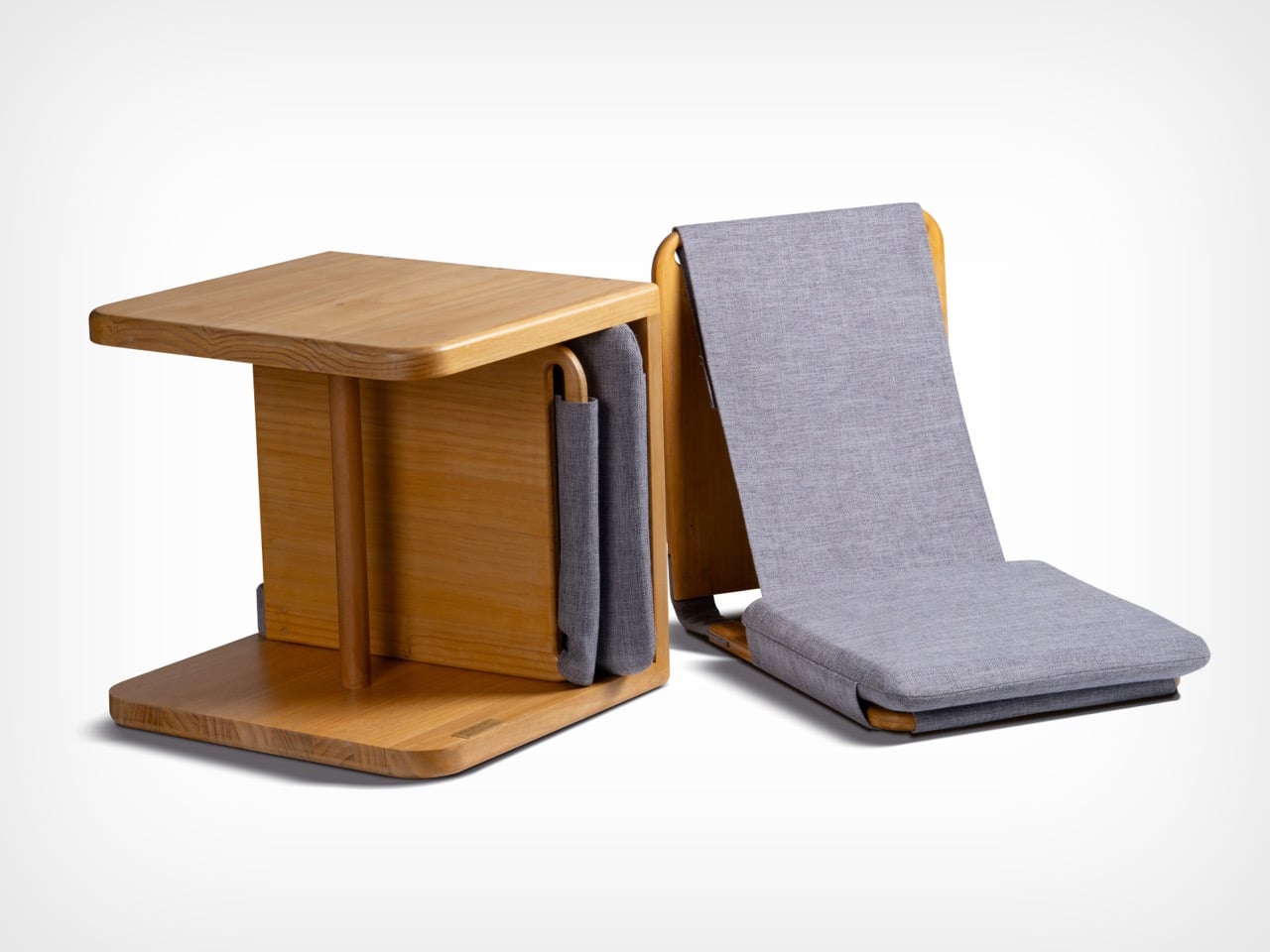
A Transforming Table-Chair That Turns Tradition into Space-Saving Intelligence

Par : Tanvi Joshi
6 avril 2026 à 22:30

At a time when living spaces are shrinking while expectations from them continue to expand, this design presents a thoughtful response that is both rooted in tradition and aligned with contemporary needs.

Emerging from the context of rising housing pressures in Taiwan, where compact homes are increasingly becoming the norm, the project addresses a fundamental question: how can furniture adapt to limited space without compromising comfort or experience? Rather than treating furniture as static, single-purpose objects, the designer reimagines them as dynamic systems capable of transformation.

Designer: Che-Chia Hsu

At the heart of this piece lies a deep engagement with traditional Chinese woodworking techniques, particularly the precision of tenon joints. These joints move beyond being structural solutions and become expressions of calculated craftsmanship, where geometry, material behavior, and human interaction converge. The result is a construction that feels both minimal and robust, relying on accuracy instead of excess.

The furniture set is designed to integrate storage and seating within a compact footprint. A chair is concealed within the table and can be pulled out, unfolded, and expanded into a functional seat. The process is intuitive: the chair is extracted, the seat and backrest are opened, and the backrest angle is adjusted using velcro. The transformation is smooth and unobtrusive, allowing the object to shift roles effortlessly.

What distinguishes this design is its reliance on the user’s own body as part of the structural system. Instead of depending entirely on rigid supports, the chair uses the tension generated by the sitter to stabilize the backrest. This introduces a subtle interaction between user and object, where the act of sitting becomes integral to how the design performs. The experience feels efficient, responsive, and quietly intelligent.

Material choices reinforce this balance between function and experience. Lightweight pine wood panels provide durability while ensuring ease of movement. Paired with gray cotton linen fabric, the design introduces a tactile softness that enhances comfort. The fabric is breathable and visually understated, complementing the natural warmth of the wood. Together, these materials create a calm, cohesive aesthetic suited to contemporary interiors.

The development of the project reflects a layered and rigorous process. The designer began by studying traditional joinery techniques through literature, followed by hands-on training under a woodcraft master. This immersion enabled a deeper understanding of the craft beyond theory. Building on this foundation, the designer explored ways to translate these techniques into a modern, functional context through research and experimentation.

What emerges is a design that treats constraint as a starting point rather than a limitation. The piece brings together traditional knowledge and contemporary living patterns, shaping an object that adapts, responds, and participates in everyday use. It reflects a way of designing where space, material, and human interaction are considered together, resulting in furniture that feels considered, purposeful, and in tune with the realities of modern living.

The post A Transforming Table-Chair That Turns Tradition into Space-Saving Intelligence first appeared on Yanko Design.

This Concept Smartwatch Detaches Into an AR Monocular, and It Solves a Problem Meta Can’t

Par : Sarang Sheth
15 mars 2026 à 20:45

Sailors used to carry pocket telescopes. Birdwatchers still carry monoculars. Geologists carry hand lenses. What these instruments share, beyond the obvious optical function, is a deliberate relationship to information: you raise the tool when you choose to engage with it, and the world stays unmediated the rest of the time. That’s actually a pretty sophisticated UX philosophy, and it’s one the entire wearable tech industry has quietly abandoned in favor of always-on overlays, persistent notifications, and the assumption that more access to information is axiomatically better. Yuxuan Hua’s Lens concept is a Silver A’ Design Award winner that makes the counterargument in hardware form.

The concept is a detachable AR smartwatch that splits into two objects: a wrist-worn puck for everyday use and a handheld monocular for AR-enhanced outdoor exploration. The back face of the module houses a dual-lens optical array, a wide camera and LiDAR sensor tucked into a vertical pill recess, while the face doubles as a circular display that overlays navigation prompts, species identification, and star charts over a live feed when held up like a field scope. The band itself is Alpine-loop textile, the lug system simple enough to suggest the module can swap across band styles, and the whole thing comes in at 48mm wide and 68g. The rendering detail is strong: the detached module has the cold, machined look of a quality compass or a classic light meter, the kind of object that rewards handling.

Designer: Yuxuan Hua

Hua interviewed hikers, foragers, and stargazers and found three consistent frustrations: devices were too bulky and fragile for rugged environments, and frequent screen interactions broke the rhythm of being outside. The phone-as-field-guide pattern, pull it out, unlock, navigate to the app, wait for it to load, try to hold it steady while pointing at something, is a sequence of six interruptions where you actually wanted zero. Smart glasses solve the unlock problem but introduce the far more annoying problem of a permanent digital scrim between you and whatever you came outdoors to look at. The monocular is the thing you raise when you want to know something and lower when you don’t, which is precisely how attention works when you’re actually engaged with a landscape.

Most AR concept hardware reaches for science fiction: translucent surfaces, glowing elements, the visual grammar of a prop department. Lens reaches instead for the instrument drawer: the detached module has the proportions and material honesty of a quality compass housing or a Leica light meter, machined aluminum with visible fasteners and a lens array that looks like it belongs in an optician’s toolkit. It doesn’t look like the future. It looks like a very well-made tool, which is a significantly harder design target to hit.

Hua began developing Lens in 2021, during the pandemic, which is useful context. Lockdown-era design projects often reveal what designers actually miss about the physical world when it’s taken away, and what Lens mourns, obliquely, is uninterrupted attention. The whole concept is an argument that the best AR device for outdoor use is one that disappears when you’re not using it, one that earns its presence by staying out of the way until the moment it’s needed, then delivers exactly what the moment requires. Whether the engineering can catch up to that vision, packing AR projection, LiDAR, and a wide-FOV camera into a 68g coin of aluminum, is another question entirely. As a design proposition, it’s already done its job.

The post This Concept Smartwatch Detaches Into an AR Monocular, and It Solves a Problem Meta Can’t first appeared on Yanko Design.

AI Earbuds Designed Like Fine Jewelry, Not Consumer Electronics

Par : Tanvi Joshi
15 mars 2026 à 19:15

In most cases, wearable technology still announces itself as technology. Plastic shells, visible sensors, and utilitarian forms often make devices feel separate from the way people dress or present themselves. The AI Smart Gemstone Earpiece takes a different path. Instead of asking users to accommodate technology, it integrates technology into the language of personal adornment. Designed specifically with female users in mind, the earpiece approaches wireless audio as something that can live comfortably within fashion, jewelry, and everyday styling.

At first glance, the device does not read as a pair of earbuds at all. It looks remarkably similar to earrings. The form, scale, and surface detailing borrow directly from fine jewelry traditions rather than consumer electronics. Each earpiece is constructed from a copper acoustic chamber plated with eighteen karat white gold and inlaid with rare celestial gemstones, including meteorite fragments, tiger’s eye, opal, zircon, and obsidian. These materials introduce depth, color, and subtle light reflections that shift as the wearer moves. The result is a small object that sits on the ear like an accessory rather than a gadget.

Designer: Of Hunger

This shift in visual language matters. For many users, particularly women, accessories are an intentional part of how an outfit comes together. Traditional earbuds often interrupt that balance. They can feel out of place with formal clothing, evening wear, or carefully styled looks. The gemstone earpiece approaches the problem from the opposite direction. Instead of trying to hide technology, it celebrates it through jewelry craftsmanship. The gemstones and polished metal surfaces allow the device to complement clothing choices, hairstyles, and other jewelry pieces. Worn on the ear, it reads as something chosen for style as much as for function.

The experience begins even before the earbuds are worn. The charging case is designed to resemble a jewelry box rather than an electronics case. Opening it feels less like accessing a gadget and more like opening a pair of earrings. The earbuds rest neatly inside the case, echoing the presentation of high jewelry. This small gesture transforms a technical action such as charging into a familiar ritual. It reinforces the idea that the device belongs in the same category as personal accessories, objects that people care for and keep close.

Behind this jewelry-like presence lies a sophisticated technological system. The device operates on Qualcomm Snapdragon Sound architecture and uses thirteen millimeter dual magnet dynamic drivers paired with a HiFi grade composite diaphragm. This combination produces clear, balanced audio with a sense of spatial depth. The system also uses Open Wearable Stereo technology and air conduction sound transmission, allowing users to remain aware of their surroundings while listening. A three-dimensional sound field tuned by a professional acoustic laboratory with more than twenty-five years of experience ensures that the listening experience feels expansive and natural.

Interaction with the device remains simple and discreet. A touch-sensitive back panel on each earbud allows users to control playback or activate artificial intelligence features. The earbuds connect instantly through Bluetooth five point three when removed from the charging case. A spring-loaded mechanical structure allows the device to be worn with a single smooth motion, balancing comfort with stability. Each earbud weighs between twelve and fifteen grams, making it light enough for extended wear.

Artificial intelligence is deeply embedded in the experience. The system integrates ChatGPT and DeepSeek as its neural core, enabling functions that go far beyond music. Through the companion application, users can access real-time translation, intelligent conversation assistance, and meeting transcription. The application also allows users to customize acoustic equalization and connect to larger AI computing systems that power these features.

Battery performance supports everyday use without demanding constant attention. The earbuds offer approximately six to eight hours of listening time, while the charging case extends the total usage to around twenty hours. A ten-minute quick charge provides about one hour of playback, making the device practical for fast-paced daily routines.

The product itself emerged through a foresight-driven design process that explored how women might interact with wearable technology in an increasingly AI-supported world. The development team combined expertise in materials science, industrial design, acoustic engineering, and artificial intelligence. Several technical challenges had to be solved along the way, including integrating precious metals and gemstones with miniature electronics, creating an ergonomic wearing structure, and embedding acoustic modules alongside AI chips within a compact form.

Seen through a design lens, the AI Smart Gemstone Earpiece represents a subtle but meaningful shift in wearable technology. It treats personal devices not simply as tools but as objects that participate in how people dress, move, and present themselves. In doing so, it blurs the boundary between jewelry and electronics, suggesting a future where technology becomes something we wear with the same care and intention as the rest of our style.

The post AI Earbuds Designed Like Fine Jewelry, Not Consumer Electronics first appeared on Yanko Design.

The Modular Cat Habitat That Turns Playful Curiosity Into Living Architecture

Par : Tanvi Joshi
18 février 2026 à 22:33

What if we designed homes the way cats would design them? Not human homes with a token scratching post in the corner but true spatial systems built around curiosity, vertical exploration, territorial comfort, and play. The N Plus Magic House begins precisely at that question, reframing pet furniture not as an accessory but as architecture scaled for feline psychology. Instead of treating a cat house as a static object, this project treats it as a living spatial framework, one that evolves alongside its inhabitant.

Today’s pet owners increasingly see their cats as emotional companions rather than animals that merely coexist in domestic space. That shift has quietly created a design problem. Traditional cat houses, even elaborate ones, tend to be fixed structures. They may be visually impressive, but they impose constraints on placement, adaptability, and long-term usability. The N Plus Magic House flips that paradigm by introducing modularity as its core philosophy. Rather than selling a finished form, it offers a system of standardized units that can be assembled, rearranged, expanded, or reduced as needed. The result is less like furniture and more like a customizable habitat kit.

Designer: Taizhou Hake Technology Co., Ltd

The genius of the design lies in its simplicity. Each module functions independently yet connects securely through precision-engineered connectors. Owners assemble structures by inserting panels into slots and stacking them like building blocks. No technical expertise, tools, or installation manuals are required. This intuitive construction method does something subtle but powerful. It turns pet care into participation. Instead of buying a finished object, users become co-designers of their cat’s environment. That interaction strengthens the emotional bond among the owner, the pet, and the space.

Material choices reinforce the system’s practicality. The structure combines impact-resistant PP resin, transparent PET panels for visibility, and carbon steel mesh for structural integrity. These materials balance durability with safety while allowing owners to monitor their pets without disturbing them. The manufacturing processes, such as injection molding and automatic wire welding, ensure consistency, precision, and reliability across units. Every element reflects careful alignment with feline behavior and safety requirements.

Behind the scenes, the development team approached the project with a research-driven mindset. They studied cats’ behavioral patterns, analyzed existing products on the market, and mapped owner expectations. One of the biggest technical challenges was maintaining structural stability while preserving modular flexibility. The solution was a custom connector engineered to withstand pressure and weight while preventing slippage. Its textured surface increases friction, ensuring modules remain firmly locked during use. This small component is arguably the system’s unsung hero. It transforms a playful concept into a reliable architectural structure.

Developed in Taizhou, Zhejiang Province, between July 2023 and November 2024 and later exhibited internationally, the N Plus Magic House represents a broader shift in product design thinking. It signals a move away from static ownership toward adaptive systems, objects that respond to changing needs over time. In a world where personalization defines modern consumer expectations, this approach feels less like a novelty and more like a glimpse into the future of domestic product design.

The post The Modular Cat Habitat That Turns Playful Curiosity Into Living Architecture first appeared on Yanko Design.

❌
❌