
Vue normale

  • ✇Yanko Design
  • This $119 Ultrasonic Cutter Sense Materials And Auto-Adjusts To Cut EVA Foam, Resin, PLA 3D Prints
    There are power tools, and then there are smart tools. A power tool gives you brute force; a smart tool gives you controlled, consistent results. Think of a simple drill that just spins versus one that manages its own torque to avoid stripping a screw. For delicate work like trimming EVA foam for a cosplay project or cleaning up support structures on a 3D print, you definitely want the smart one. The problem is, most handheld cutters are pretty basic, giving you one speed and just hoping for th
     

This $119 Ultrasonic Cutter Sense Materials And Auto-Adjusts To Cut EVA Foam, Resin, PLA 3D Prints

2 septembre 2026 à 21:45

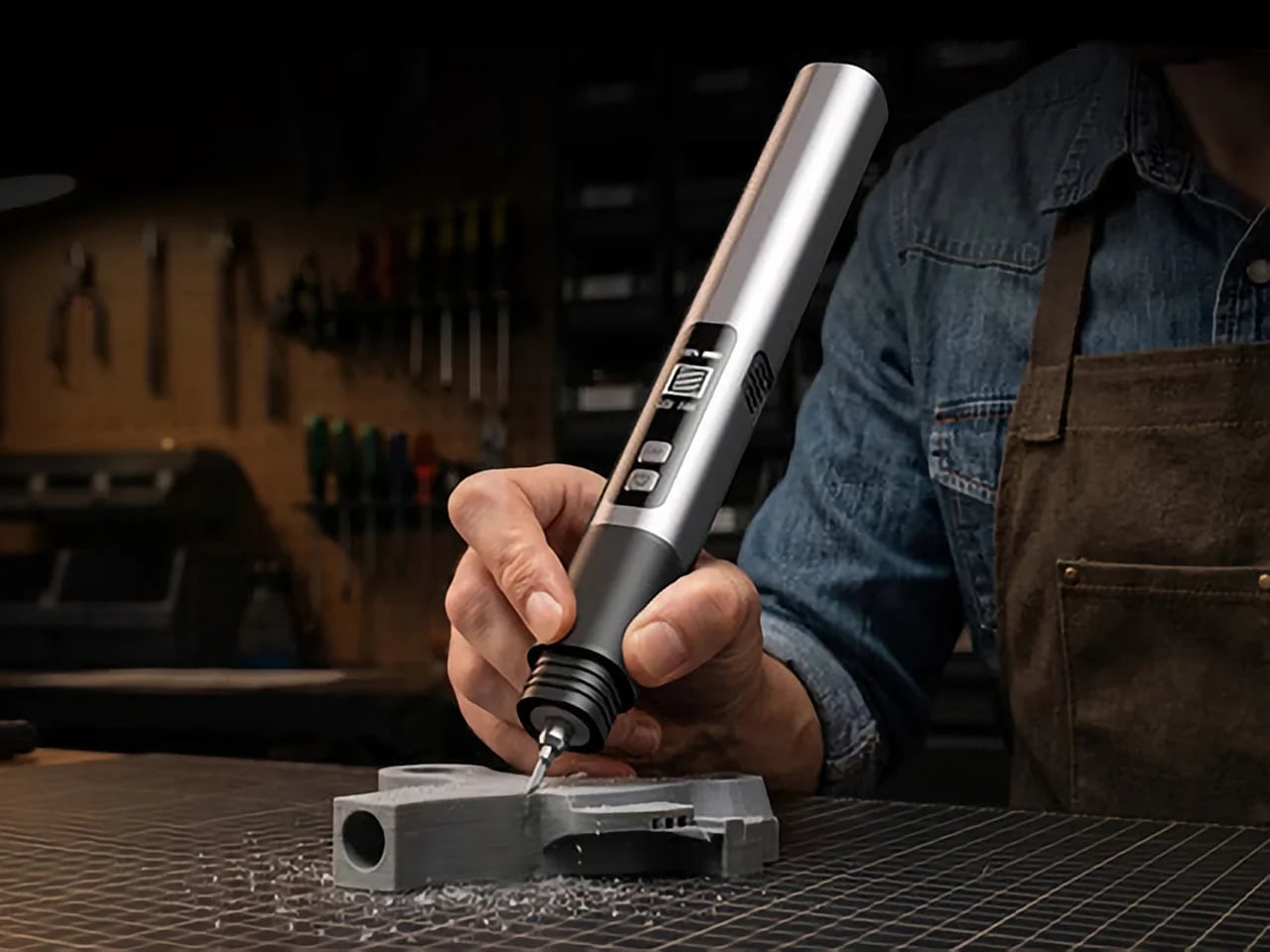
There are power tools, and then there are smart tools. A power tool gives you brute force; a smart tool gives you controlled, consistent results. Think of a simple drill that just spins versus one that manages its own torque to avoid stripping a screw. For delicate work like trimming EVA foam for a cosplay project or cleaning up support structures on a 3D print, you definitely want the smart one. The problem is, most handheld cutters are pretty basic, giving you one speed and just hoping for the best.

The SonicMax Slice 10 is aiming for that higher IQ. It’s a cordless ultrasonic cutter that senses the material you’re cutting and adjusts its own power output in real time. Slice through dense plastic and it pushes harder; trim the thin walls of a resin print and it eases back. This adaptive system, combined with cooling that prevents heat-related power drops, makes it feel like proper workshop equipment in the palm of your hand. It runs at 40kHz, delivers up to 50 watts of dynamic peak power, and does all of this without a single cable getting in your way.

Designer: SonicMax

Click Here to Buy Now: $119 $215 (45% off). Hurry, only 13/500 left! Raised over $124,000.

Most ultrasonic cutters on the market use transducers with a mechanical quality factor, or Qm, somewhere between 150 and 250. A higher Qm means the transducer converts electrical energy into vibration more efficiently, which directly translates to less heat generated during use. SonicMax claims a Qm of over 500 for the Slice 10, and lab data backs that up with a verified measurement of 541.1. That’s roughly two to three times higher than a typical competing tool, and it’s the foundational reason the Slice 10 can sustain longer sessions without thermal drama. That single transducer decision cascades into everything else, from runtime and cut quality to how comfortable the tool actually stays in your hand.

As the blade meets resistance, the Slice 10’s Smart Material Auto-Detection reads that feedback and adjusts power output and vibration frequency without you touching anything. Cutting through a stiff chunk of EVA foam feels different from trimming the thin walls of a resin print, and the tool responds to each material accordingly. You’re not locked into a fixed setting that works okay for most things but perfectly for nothing. The system also preserves cut quality across a long session, where material resistance can shift as the blade warms. The result is consistent cuts from the first pass to the last, regardless of what you’re running the blade through.

Heat is the reason most cordless ultrasonic cutters force you to stop every five to ten minutes, and the Slice 10 attacks that problem from two directions. Corded bench tools sidestep this issue by drawing steady power and dissipating heat more easily, but you give all of that up the moment you cut the cord. The high-efficiency transducer generates less heat from the start, and the built-in active cooling fan manages whatever thermal load does build up during a session. Overheat protection kicks in automatically at 80 degrees Celsius at the motherboard level, so the tool protects itself without you having to babysit it. You only appreciate how good this is after you’ve spent a session on a cutter that kept shutting itself off on you mid-cut.

A 5000mAh 21700 lithium-ion battery powers the Slice 10, and SonicMax made it user-replaceable, which you’ll end up appreciating far more than any spec sheet number. The 21700 is a high-performance cell format found in premium flashlights and power tools, so sourcing replacements from SonicMax or compatible third-party brands should never be a problem. SonicMax’s own branded replacement cell is rated for 500 charge cycles at 80% capacity retention, a reasonable lifespan for a tool you’re actually putting to work regularly. An 18W USB-C pass-through charging system brings it from zero to full in about 70 minutes, and the tool keeps running while plugged in. Claimed runtime sits at up to four hours, and when you run low mid-project, swapping in a spare takes seconds.

Blade choice gives the Slice 10 a lot of its bench-tool personality. SonicMax offers five blade styles that let the same handheld body take on very different jobs: a Standard Utility Blade for everyday trimming, a Precision Long Blade for tighter access and more delicate reach, a Fine Chisel Blade for careful cleanup work, a Heavy Duty Chisel Blade for more aggressive material removal, and a Wide Flat Scraper Blade for broader surface work. That range matters because it turns the Slice 10 into something closer to a compact cutting system than a one-trick knife. If you’re the kind of maker who bounces between foam, plastic, supports, edges, and surface cleanup in the same afternoon, this is where the tool starts looking properly versatile.

Lift-to-Activate sensing turns the tool on when you pick it up and off when you set it down, keeping your fingers away from controls mid-session and preventing accidental activation on the bench. A small OLED display shows real-time power output and battery level, so you’re never left guessing how much runtime remains. Built-in LED lighting illuminates the cut line, which sounds like a minor detail until you’re trying to trace a clean edge on a dark-colored print at your desk at some ungodly hour. Auto-shutdown kicks in after five minutes of idle, and low-battery protection activates before the cell drops to a damaging voltage. Together, these details make the Slice 10 feel like a tool that respects your workflow rather than constantly asking you to manage it.

The Slice 10 measures 260.5mm long and 28mm across, weighing 236 grams, keeping it firmly in single-hand, pen-grip territory across long sessions. Just the Slice 10 is available for a discounted $119, and ships with 10 replaceable Standard Utility blades. Upgrade to the Maker’s Bundle for $169 and you get the Slice 10 along with 50 blades spread across the five blade profiles (standard, precision long, fine chisel, heavy duty chisel, and flat scraper) as well as a 5000mAh replacement battery. If you’re looking for versatility and pushing your prints to the max, the $50 price bump does bring a fair share of value. You can also buy extra blades and batteries as add-ons. Shipping is expected to begin mid-October 2026 with worldwide delivery available, and SonicMax has not publicly confirmed warranty terms at the time of writing.

Click Here to Buy Now: $119 $215 (45% off). Hurry, only 13/500 left! Raised over $124,000.

The post This $119 Ultrasonic Cutter Sense Materials And Auto-Adjusts To Cut EVA Foam, Resin, PLA 3D Prints first appeared on Yanko Design.

TSMC’s $265B US Expansion: Four New Chip Fabs Planned

17 juillet 2026 à 04:13

TSMC plans four more Arizona fabs, bringing its total US investment to $265 billion and expanding chip capacity amid surging AI demand and geopolitical risk.

The post TSMC’s $265B US Expansion: Four New Chip Fabs Planned appeared first on TechRepublic.

Apple to Work With Intel on US Chip Production, Trump Says

19 juin 2026 à 14:58

Trump says Apple will work with Intel on US chip production, a potential foundry win that could shift Apple’s supply chain options and US chip strategy.

The post Apple to Work With Intel on US Chip Production, Trump Says appeared first on TechRepublic.

Apple, Intel Reportedly Near Chip Deal That Could Reduce TSMC Reliance

11 mai 2026 à 11:10

Apple and Intel reportedly reached an early chip manufacturing agreement that could reduce Apple’s TSMC reliance and boost Intel’s foundry ambitions.

The post Apple, Intel Reportedly Near Chip Deal That Could Reduce TSMC Reliance appeared first on TechRepublic.

  • ✇Korben
  • Comment Boston Dynamics compte construire un cerveau pour Atlas
    Boston Dynamics que vous connaissez tous pour ses chiens robots tueurs de la mort, vient de sortir une vidéo de 40 minutes. Pas de saltos arrière ou de robots qui dansent mais plutôt une loooongue session où ça parle stratégie IA et vision à long terme. Et comme j'ai trouvé que c'était intéressant, je partage ça avec vous ! Zach Jacowski, le responsable d'Atlas (15 ans de boîte, il dirigeait Spot avant), discute donc avec Alberto Rodriguez, un ancien prof du MIT qui a lâché sa chaire pour rejoin
     

Comment Boston Dynamics compte construire un cerveau pour Atlas

Par : Korben
20 décembre 2025 à 02:38

Boston Dynamics que vous connaissez tous pour ses chiens robots tueurs de la mort, vient de sortir une vidéo de 40 minutes. Pas de saltos arrière ou de robots qui dansent mais plutôt une loooongue session où ça parle stratégie IA et vision à long terme. Et comme j'ai trouvé que c'était intéressant, je partage ça avec vous !

Zach Jacowski, le responsable d'Atlas (15 ans de boîte, il dirigeait Spot avant), discute donc avec Alberto Rodriguez, un ancien prof du MIT qui a lâché sa chaire pour rejoindre l'aventure et ce qu'ils racontent, c'est ni plus ni moins comment ils comptent construire un "cerveau robot" capable d'apprendre à faire n'importe quelle tâche. Je m'imagine déjà avec un robot korben , clone de ma modeste personne capable de faire tout le boulot domestique à ma place aussi bien que moi... Ce serait fou.

Leur objectif à Boston Dynamics, c'est donc de créer le premier robot humanoïde commercialement viable au monde et pour ça, ils ont choisi de commencer par l'industrie, notamment les usines du groupe Hyundai (qui possède Boston Dynamics).

Alors pourquoi ? Hé bien parce que même dans les usines les plus modernes et automatisées, y'a encore des dizaines de milliers de tâches qui sont faites à la main. C'est fou hein ? Automatiser ça c'est un cauchemar, car pour automatiser UNE seule tâche (genre visser une roue sur une voiture), il faudrait environ un an de développement et plus d'un million de dollars.

Ça demande des ingénieurs qui conçoivent une machine spécialisée, un embout sur mesure, un système d'alimentation des vis... Bref, multiplié par les dizaines de milliers de tâches différentes dans une usine, on serait encore en train de bosser sur cette automatisation dans 100 ans...

L'idée de Boston Dynamics, c'est donc de construire un robot polyvalent avec un cerveau généraliste. Comme ça au lieu de programmer chaque tâche à la main, on apprend au robot comment faire. Et tout comme le font les grands modèles de langage type ChatGPT, ils utilisent une approche en deux phases : le pre-training (où le robot accumule du "bon sens" physique) et le post-training (où on l'affine pour une tâche spécifique en une journée au lieu d'un an).

Mais le gros défi, c'est clairement les données. ChatGPT a été entraîné sur à peu près toute la connaissance humaine disponible sur Internet mais pour un robot qui doit apprendre à manipuler des objets physiques, y'a pas d'équivalent qui traîne quelque part.

Du coup, ils utilisent trois sources de data.

La première, c'est la téléopération. Des opérateurs portent un casque VR, voient à travers les yeux du robot et le contrôlent avec leur corps. Après quelques semaines d'entraînement, ils deviennent alors capables de faire faire à peu près n'importe quoi au robot. C'est la donnée la plus précieuse, car il n'y a aucun écart entre ce qui est démontré et ce que le robot peut reproduire. Par contre, ça ne se scale pas des masses.

La deuxième source, c'est l'apprentissage par renforcement en simulation. On laisse le robot explorer par lui-même, essayer, échouer, optimiser ses comportements. L'avantage c'est qu'on peut le faire tourner sur des milliers de GPU en parallèle et générer des données à une échelle impossible en conditions réelles. Et contrairement à la téléopération, le robot peut apprendre des mouvements ultra-rapides et précis qu'un humain aurait du mal à démontrer, du genre faire une roue ou insérer une pièce avec une précision millimétrique.

La troisième source, c'est le pari le plus ambitieux, je trouve. Il s'agit d'apprendre directement en observant des humains.

Alors est-ce qu'on peut entraîner un robot à réparer un vélo en lui montrant des vidéos YouTube de gens qui réparent des vélos ? Pas encore... pour l'instant c'est plus de la recherche que de la production, mais l'idée c'est d'équiper des humains de capteurs (caméras sur la tête, gants tactiles) et de leur faire faire leur boulot normalement pendant que le système apprend.

Et ils ne cherchent pas à tout faire avec un seul réseau neuronal de bout en bout. Ils gardent une séparation entre le "système 1" (les réflexes rapides, l'équilibre, la coordination motrice, un peu comme notre cervelet) et le "système 2" (la réflexion, la compréhension de la scène, la prise de décision). Le modèle de comportement génère des commandes pour les mains, les pieds et le torse, et un contrôleur bas niveau s'occupe de réaliser tout ça physiquement sur le robot.

C'est bien pensé je trouve. Et dans tout ce bordel ambiant autour de la robotique actuelle, eux semblent avoir trouver leur voie. Ils veulent transformer l'industrie, les usines...etc. Leur plan est clair et ils savent exactement ce qu'ils doivent réussir avant de passer à la suite (livraison à domicile, robots domestiques...).

Voilà, je pense que ça peut vous intéresser, même si c'est full english...

❌