❌

Vue normale

  • ✇Yanko Design
  • RHYTHM Is the Walkman the Smartphone Era Forgot to Build
    Smartphones turned music into just another notification competing for attention, a song interrupted by a text, an album broken up by a calendar alert. RHYTHM exists to undo that arrangement entirely, building a dedicated listening device from real audio components instead of borrowing a phone’s guts and bolting on a headphone jack. It’s a from-scratch digital audio player designed around one job: playing music properly, without a screen demanding anything else from you. That commitment starts w
     

RHYTHM Is the Walkman the Smartphone Era Forgot to Build

Par : JC Torres
12 septembre 2026 à 06:30

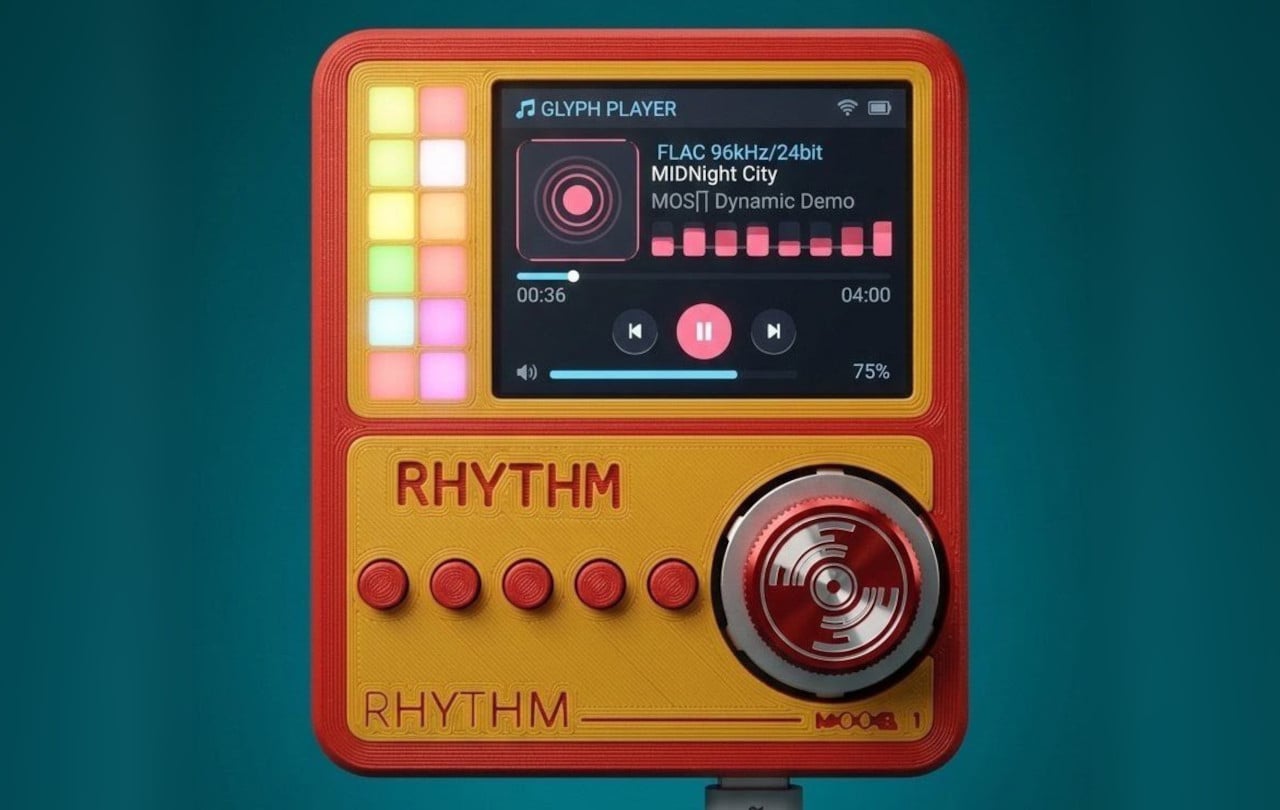
Smartphones turned music into just another notification competing for attention, a song interrupted by a text, an album broken up by a calendar alert. RHYTHM exists to undo that arrangement entirely, building a dedicated listening device from real audio components instead of borrowing a phone’s guts and bolting on a headphone jack. It’s a from-scratch digital audio player designed around one job: playing music properly, without a screen demanding anything else from you.

That commitment starts with what’s actually driving the sound. Rather than leaning on an all-in-one audio codec chip the way most budget players do, RHYTHM routes music through a genuine ESS SABRE DAC, the same category of chip found in dedicated hi-fi gear, paired with a discrete amplifier stage rather than a shortcut solution. An ESP32-S3 handles the file parsing and processing, but the actual sound reproduction runs through hardware built specifically for that job alone.

Designer: Mithilesh Gupta Konda

The headphone output makes the clearest case for why any of this matters. Instead of splitting one internal signal across a single jack, RHYTHM runs two completely independent, actively buffered 3.5mm outputs, each driven by its own dedicated amplifier chip. Two people can plug in two entirely different pairs of headphones, and each gets a full, uncompromised signal, no shared circuit quietly degrading whichever connection came second.

Keeping that signal clean required rethinking the power supply as much as the audio path. RHYTHM physically separates its digital logic and high-frequency switching lines from the analog circuitry that actually shapes the sound, regulating each side through its own dedicated, ultra-low-noise power regulator. It’s an unglamorous decision that never shows up in a spec sheet screenshot, but it’s exactly the kind of choice that determines whether quiet passages in a recording stay quiet.

Physical control gets the same attention. A precision mechanical rotary encoder handles navigation alongside a set of tactile buttons, giving the whole interface a hands-on quality that a touchscreen simply can’t replicate. Paired with a compact 2-inch color display, the device reads less like a shrunken phone and more like a purpose-built instrument, something meant to be operated by feel in a pocket or a bag without needing to look at it.

A microSD slot rounds out the practical side, storing lossless files locally rather than depending on a streaming connection or app ecosystem. That local-first approach extends the project’s entire philosophy: RHYTHM isn’t trying to replace a phone’s convenience. Instead, it’s opting out of that convenience on purpose, trading constant connectivity for a listening experience built around a single, uninterrupted task.

The post RHYTHM Is the Walkman the Smartphone Era Forgot to Build first appeared on Yanko Design.

Trump on AI Extinction: Beating China Is the Bigger Concern

11 septembre 2026 à 15:23

Trump dismisses AI extinction warnings and says beating China is the priority as researchers and lawmakers call for stronger safeguards on advanced systems.

The post Trump on AI Extinction: Beating China Is the Bigger Concern appeared first on TechRepublic.

Anthropic Says Claude Used in Possible Bioweapon Research

11 septembre 2026 à 12:11

Anthropic says researchers used Claude for biological work that could support weapons development, exposing new challenges for AI safeguards.

The post Anthropic Says Claude Used in Possible Bioweapon Research appeared first on TechRepublic.

EU Gets Access to Anthropic Cyber AI — But Not Its Newest Model

11 septembre 2026 à 10:28

ENISA has gained access to Anthropic’s Mythos 5, giving EU officials a chance to independently test the cyber AI after months of negotiations.

The post EU Gets Access to Anthropic Cyber AI — But Not Its Newest Model appeared first on TechRepublic.

Thailand’s Cloud Security Standard Is Now in Force: What Providers and CII Operators Must Review

11 septembre 2026 à 09:20

Thailand’s Cloud Security Standard took effect Sept. 10, 2026, raising compliance requirements for government, CII organizations, and cloud providers.

The post Thailand’s Cloud Security Standard Is Now in Force: What Providers and CII Operators Must Review appeared first on TechRepublic.

  • ✇Korben
  • Super Mario 64 tourne sur un processeur ARM (avec ReactOS)
    Une vidéo postée sur X montre Super Mario 64 qui tourne sur une machine ARM, sous un système qui n'est ni Windows ni Linux. Oui, c'est bien ReactOS, le clone libre de Windows, et le jeu est un exécutable x64 tout ce qu'il y a de plus banal ! Et n'allez pas croire que c'est un émulateur qu'on aurait posé sur un OS libre. Que nenni ! Pour exécuter du x64 sur de l'ARM, il faut deux trucs qui n'ont rien à voir l'un avec l'autre : un moteur qui traduit les instructions du processeur, et un système ca
     

Super Mario 64 tourne sur un processeur ARM (avec ReactOS)

11 septembre 2026 à 00:59

Une vidéo postée sur X montre Super Mario 64 qui tourne sur une machine ARM, sous un système qui n'est ni Windows ni Linux. Oui, c'est bien ReactOS, le clone libre de Windows, et le jeu est un exécutable x64 tout ce qu'il y a de plus banal !

Et n'allez pas croire que c'est un émulateur qu'on aurait posé sur un OS libre. Que nenni ! Pour exécuter du x64 sur de l'ARM, il faut deux trucs qui n'ont rien à voir l'un avec l'autre : un moteur qui traduit les instructions du processeur, et un système capable de faire cohabiter du code natif et du code traduit dans un même programme.

La première moitié, c'est FEX, l'émulateur financé par Valve dont je vous parlais en décembre. Sauf que côté Windows, FEX se limite au processeur : sa propre documentation précise que la traduction des appels système revient soit à Wine, soit à l'ABI du système. Tout le reste est alors à la charge de l'hôte.

Cette seconde moitié porte un nom, ARM64EC, et c'est une invention de Microsoft pour Windows 11 sur ARM (oui, la boîte que ReactOS passe justement son temps à recopier). Le principe consiste à compiler les bibliothèques du système en ARM64 avec une interface appelable depuis du code x64 recompilé. Du coup, un même programme mélange des morceaux natifs et des morceaux émulés, et seul ce qui doit vraiment l'être passe par l'émulateur. L'intérêt de faire comme ça, c'est surtout la vitesse !

Jusqu'ici, deux entités avaient bâti cet "étage" : Microsoft dans Windows, et Wine depuis sa version 10 . ReactOS est donc la troisième. Son développeur Ahmed Arif a ainsi écrit son propre runtime hybride dans le ntdll du système, avec le chargeur d'images, les ponts qui rendent les fonctions natives appelables en x64, et le déroulement de pile.

Ensuite, pour vérifier que tout se tient, il fait tourner le même binaire des deux côtés, sur son ReactOS et sur un vrai Windows 11 ARM64, puis il compare.

Screenshot

Alors, est-ce que vous pouvez l'installer ?

Et bien malheureusement, non !

Tout ce boulot n'existe que dans une branche d'un fork personnel, et le dépôt officiel de ReactOS n'en contient pas la moindre ligne. Et c'est mieux pour l'instant car, comme Ahmed le dit lui-même, son fork est encore plus expérimental que ReactOS lui-même ! C'est donc à réserver aux machines virtuelles, aux cartes de développement ou aux bécanes sans données sensibles. Bref, venant d'un projet qui se présente déjà lui-même comme un système de qualité alpha, ça vous situe l'ambiance...

Bref, rien à télécharger mais pour un projet qui se battait encore il y a trois mois pour lancer Half-Life , voir un jeu x64 démarrer sur de l'ARM, ça envoie quand même du pâté.

Source : Phoronix

❌