❌

Vue normale

  • ✇Yanko Design
  • This Self-Driving Hospital Chair Wants to Retire Hollywood’s Dramatic Gurney Sprint
    You know the shot. Double doors bang open, a gurney comes flying down the hallway, and five people in scrubs jog alongside it yelling numbers at each other. Someone’s holding an IV bag over their head like a trophy. Someone else shouts “We’re losing him!” and the camera shakes for extra drama. Every medical show from ER to Grey’s Anatomy has filmed some version of this scene, probably a dozen times a season. It’s great television. It’s also a lot of very expensive people pushing one bed. Seoul-
     

This Self-Driving Hospital Chair Wants to Retire Hollywood’s Dramatic Gurney Sprint

10 novembre 2026 à 18:30

You know the shot. Double doors bang open, a gurney comes flying down the hallway, and five people in scrubs jog alongside it yelling numbers at each other. Someone’s holding an IV bag over their head like a trophy. Someone else shouts “We’re losing him!” and the camera shakes for extra drama. Every medical show from ER to Grey’s Anatomy has filmed some version of this scene, probably a dozen times a season. It’s great television. It’s also a lot of very expensive people pushing one bed.

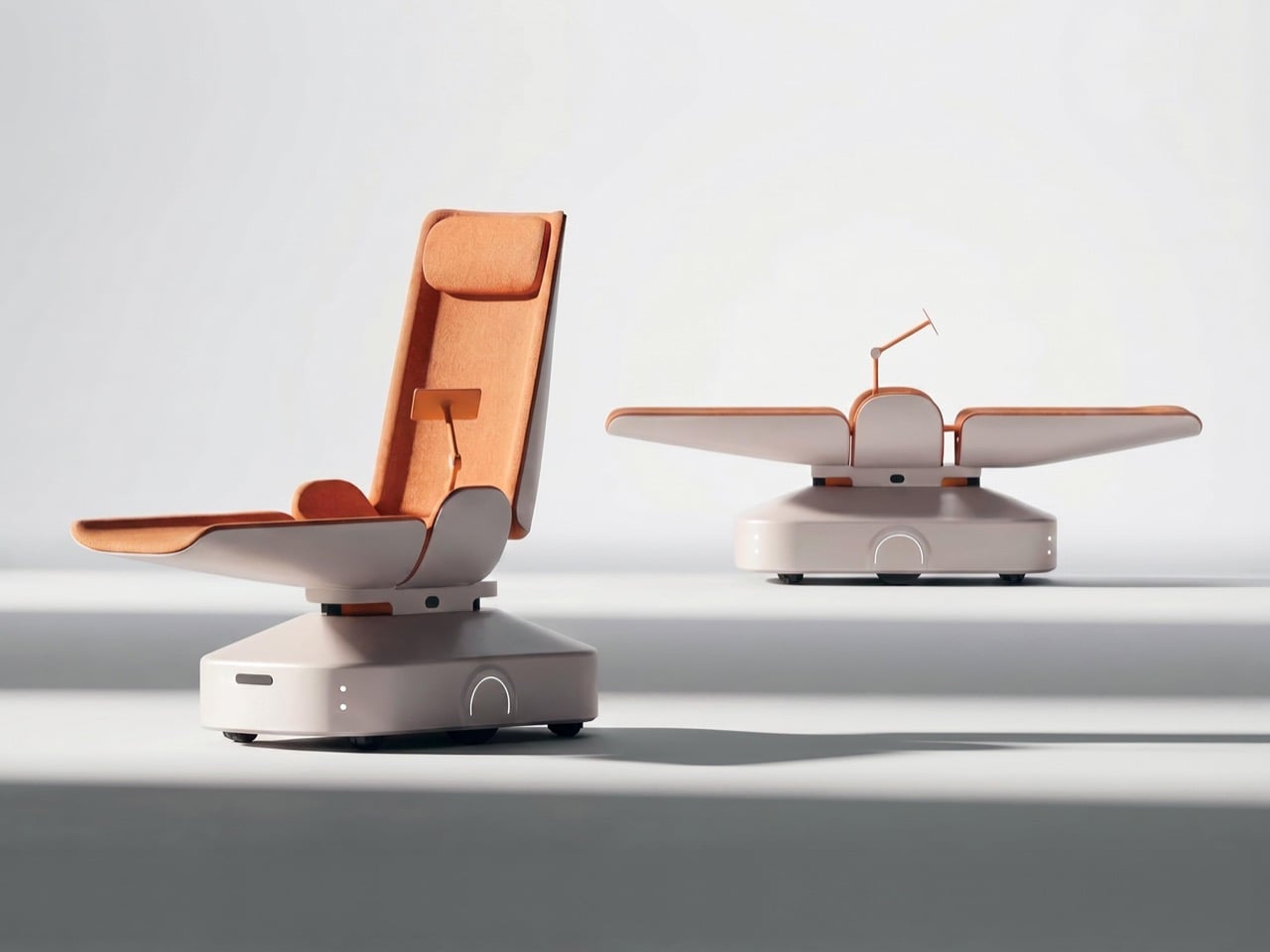
Seoul-based studio BDCI looked at that scene and apparently thought, what if the bed just drove itself? Their Autonomous Clinical Mobility concept, a 2026 Red Dot Design Concept winner, is a self-navigating hospital chair that ferries patients between diagnostic rooms, then reclines flat into a bed so you can get scanned, poked and checked without climbing off. It’s built for routine outpatient visits, so nobody’s yelling “Stat!” here. The idea still holds, though. The staff stay put, and the patient comes to them.

Designer: BDCI (Team Leads: Lee Seomin, Lee Gwongak)

Visually, this thing lives a world away from the squeaky beige gurney you’re picturing right now. The base is a soft, rounded pod in warm greige with tiny LED dots and a glowing arch on its flank, a bit like a friendly robot vacuum that started going to the gym. On top sits a seat built from curved shell panels, with little wings that hug your hips like flower petals. Everything is wrapped in a textured burnt orange fabric that feels closer to a boutique hotel lounge than a hospital ward. BDCI says the textile is antibacterial and the cushions are modular, so they can be swapped and cleaned between patients.

The cleverest trick happens when it’s exam time. The backrest drops, the legrest rises, and those hip petals fan outward until the whole chair lies completely flat, looking a lot like a tiny airplane seen head-on. That means no awkward shuffle from wheelchair to exam table, which anyone who has helped an elderly parent through a clinic visit knows is the hardest part of the day. Panasonic tackled a similar headache years ago with Resyone, a care bed that splits in half to become a reclining wheelchair, and it became the first product to earn the ISO 13482 safety certification for personal care robots. BDCI takes that same thinking and puts it on wheels that steer themselves.

Steering is where the AI comes in. The concept plugs into the hospital’s clinical workflow, figures out which tests you need, and plots a route that keeps you out of the longest queues. An orange articulated arm holds a tablet showing your next stop, a live floor map, a progress bar for your entire visit, and a big red SOS button for when you’d like a human, please. Self-driving wheelchairs already roam a few real buildings, too. WHILL brought its autonomous chairs to Keio University Hospital in Tokyo back in 2020 to help patients who found walking a giant hospital difficult or stressful.

Okay, the elephant in the hallway. Patients in matching gowns, reclining on rolling loungers with screens at face level, gliding along glowing lanes… BDCI’s renders look an awful lot like the Axiom from WALL-E. Pixar meant that as a warning about humans who stopped moving, though a sick person in a hospital gown has fairly earned the right to be chauffeured. There are practical wrinkles to sort out, like the fact that a battery-packed robot can’t roll into an MRI scanner room, and that hospitals usually favor wipeable surfaces over fabric. Still, given the choice, I’d take a calm orange chair over a sprinting crowd of extras any day.

The post This Self-Driving Hospital Chair Wants to Retire Hollywood’s Dramatic Gurney Sprint first appeared on Yanko Design.
EU Accuses TikTok of DSA Breach Over Mental Health Risks

9 novembre 2026 à 10:54

The EU says TikTok’s For You feed risks harming mental health. Explore its preliminary DSA findings, proposed algorithm changes, and implications for users.

The post EU Accuses TikTok of DSA Breach Over Mental Health Risks appeared first on TechRepublic.

Google, Meta and TikTok Sue to Block California’s Teen Social Media Law

9 novembre 2026 à 10:36

Google, Meta and TikTok are suing to block California’s teen social media law. Explore the feature restrictions, penalties, and implications for developers.

The post Google, Meta and TikTok Sue to Block California’s Teen Social Media Law appeared first on TechRepublic.

Apple and Google Face Scrutiny Over 400 Apps and Websites Linked to AI Deepfakes

4 novembre 2026 à 13:17

A WIRED investigation links more than 400 apps and websites to AI deepfake abuse, raising questions about Apple, Google, and app-store security reviews.

The post Apple and Google Face Scrutiny Over 400 Apps and Websites Linked to AI Deepfakes appeared first on TechRepublic.

  • ✇Yanko Design
  • Flying Traffic Cone concept transforms into a Drone to auto-assemble itself on roads
    The traffic cone is basically a Rorschach test for the internet generation. Construction workers see a long night shift, college kids see dorm decor, and anyone who’s ever downloaded a movie sees VLC. I mostly see something to swerve around. Xinhao Guo saw a robot. Guo led a student team at the Beijing Institute of Technology that developed SkyCone, a drone concept designed to fly to a highway incident, land in position, and fold itself into a traffic cone. Guo’s teammates were Songyan Pan, Zix
     

Flying Traffic Cone concept transforms into a Drone to auto-assemble itself on roads

2 novembre 2026 à 15:20

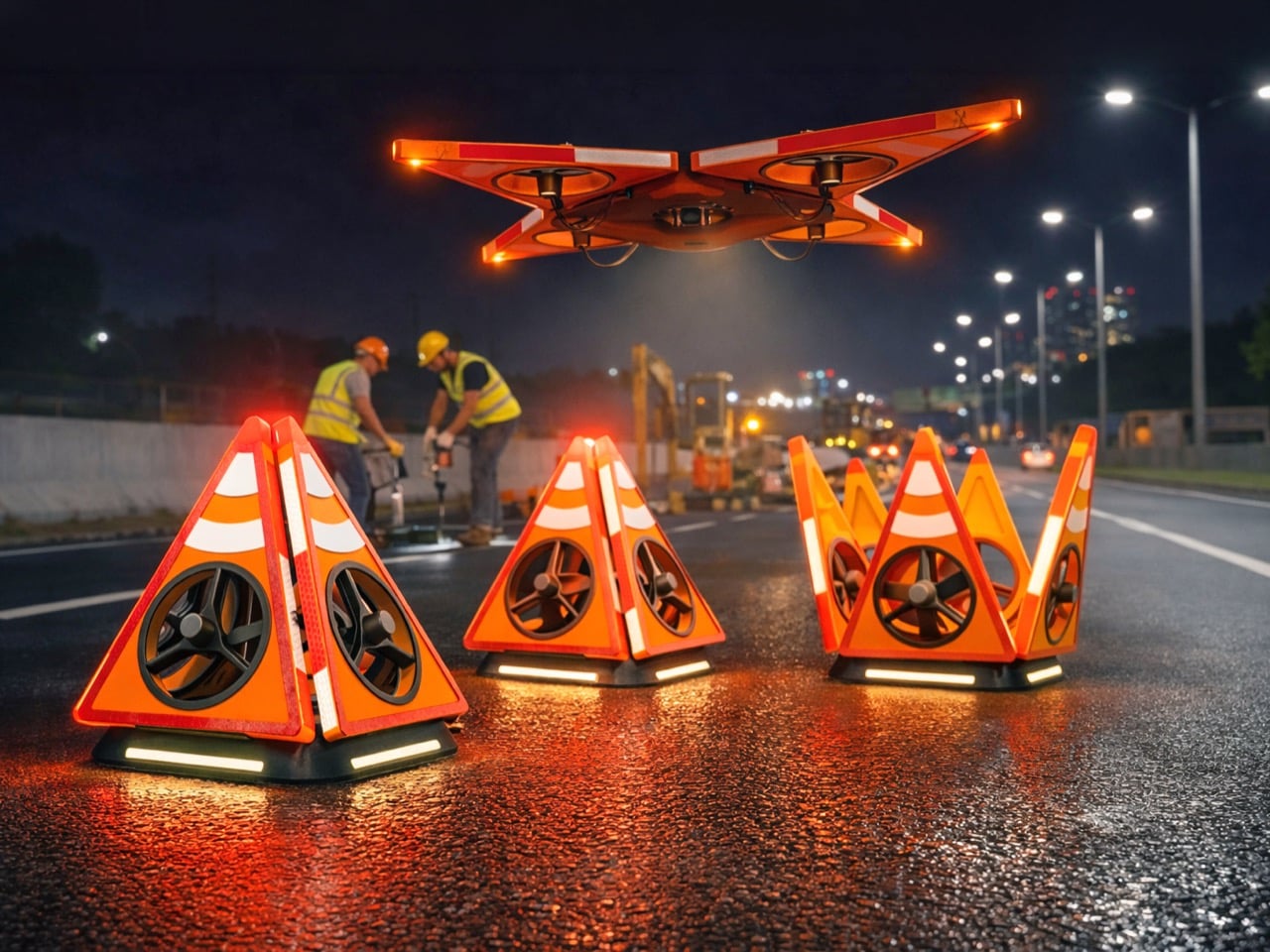
The traffic cone is basically a Rorschach test for the internet generation. Construction workers see a long night shift, college kids see dorm decor, and anyone who’s ever downloaded a movie sees VLC. I mostly see something to swerve around. Xinhao Guo saw a robot. Guo led a student team at the Beijing Institute of Technology that developed SkyCone, a drone concept designed to fly to a highway incident, land in position, and fold itself into a traffic cone.

Guo’s teammates were Songyan Pan, Zixu Zhang, and Wanzheng Liu, and their concept won in the Conceptual Industrial Product Design category at the 2026 European Product Design Award. SkyCone is designed to fly as an X-shaped quadcopter, with each of its four triangular arms housing a ducted propeller. After landing, the arms would tilt up and lock together at magnetic tips, forming a four-sided pyramid with the familiar orange and white stripes. The goal is to keep workers out of live lanes. The team cites a figure that 57% of frontline highway personnel consider manual cone placement their most dangerous task.

Designers: Xinhao Guo, Songyan Pan, Zixu Zhang & Wanzheng Liu

A square central hub anchors SkyCone, carrying a downward-facing camera on a gimbal, with an LED strip and a non-slip mat built into its underside. The four arms are what the team calls Triangular Prism Buckets, hollow orange wedges that each surround a ducted propeller. Red magnetic locks with integrated indicator lights cap the arm tips, which meet at the cone’s apex when everything folds shut. Reflective strips trace the arm edges to improve visibility. My favorite detail is graphic: the white cone bands sit on the faces that point outward after folding, so the drone only looks like a cone once it actually is one.

Charles D. Scanlon, a Los Angeles street painter, designed the modern traffic cone to keep cars away from his wet paint, building it from rubber and fabric salvaged from old tires. His patent was granted in November 1943, and Interstate Rubber Products began manufacturing the design in 1947. The cone eventually made it into the Manual on Uniform Traffic Control Devices, the federal traffic-control manual. Materials and reflective collars have evolved over eight decades, yet the silhouette has barely budged. SkyCone largely keeps that familiar shape while changing how it gets into position, a sensible approach for an object drivers need to recognize quickly.

Placing those cones is still mostly manual work, with crews riding the back of a slow-moving truck or walking beside it and setting cones down a few feet from passing traffic. The US recorded 850 work zone deaths in 2024, an average of more than two a day. In March 2023, a single crash on I-695 outside Baltimore killed six roadway workers. The SkyCone team describes the first few minutes of an emergency or maintenance call as the most critical stretch, when crews are particularly exposed. A fleet of drones that could position cones before anyone steps out of the truck might reduce that initial exposure.

Brisbane-based Arrowes has already built an Automated Cone Truck that drops a cone every five seconds. On Melbourne’s Eastern Freeway, it handled 65,000 cones while cutting worker exposure to live traffic by roughly 500 hours. Caltrans and UC Davis developed a cab-operated cone machine back in the 2000s, and Spain’s Sacyr and GMV set out to prototype a self-driving trailer with an AI-guided robotic arm. Each system relies on a truck or trailer. SkyCone proposes making each cone responsible for its own delivery. Chris Chang’s Apiece showed in 2022 that a cone could be assembled from flat triangles, and SkyCone basically gives those triangles propellers.

The team’s renders place SkyCone at a nighttime highway repair, an incident scene behind an arrow-board truck, a rockfall on a mountain road, a snowed-over highway, and the crumbling edge of an open-pit mine. The mine scenario sold me, since walking a crumbling pit edge to place cones sounds like a genuinely terrible afternoon. SkyCone joins a line of highway concepts that propose sending machines into hazardous places. The Highway Patrol Drone was designed to wait on light towers and fly to crash scenes ahead of responders, while the Median AMB proposed riding the road divider like a monorail to skip traffic. SkyCone’s role would be marking off the scene so responders can work.

The European Product Design Award is a global, open-entry program run by Farmani Group. SkyCone won in its conceptual tier as a student project, so the award recognizes a design proposal rather than proven roadside performance. Guo and his team want the cone to get into position on its own; whether it can do that reliably beside live traffic remains to be demonstrated. My brain will probably keep saying VLC whenever I see a cone, but now it’s going to add “robot” right after.


The post Flying Traffic Cone concept transforms into a Drone to auto-assemble itself on roads first appeared on Yanko Design.

Greece Passes Under-15 Social Media Ban Starting January

26 octobre 2026 à 10:39

Greece’s under-15 social media ban starts Jan. 1, 2027. Learn who is affected, how age checks will work, and what users should know about privacy.

The post Greece Passes Under-15 Social Media Ban Starting January appeared first on TechRepublic.

Australia Prepares to Sue Meta, TikTok Over Under-16 Social Media Ban

21 octobre 2026 à 09:53

Australia is preparing legal action against Meta, TikTok, Snap, and Google over alleged breaches of its under-16 social media ban. Here's what could happen next.

The post Australia Prepares to Sue Meta, TikTok Over Under-16 Social Media Ban appeared first on TechRepublic.

White House Begins 120-Day AI Safety Review Amid Growing Security Concerns

20 octobre 2026 à 07:52

The White House AI task force has begun a 120-day review of cybersecurity, biosecurity and oversight, with potential implications for businesses and developers.

The post White House Begins 120-Day AI Safety Review Amid Growing Security Concerns appeared first on TechRepublic.

German Police Seize Robot After Alleged Groping of 16-Year-Old Girl

15 octobre 2026 à 10:37

German police seized a humanoid robot after it allegedly groped a teenage girl in Cologne, raising questions about human control and criminal responsibility.

The post German Police Seize Robot After Alleged Groping of 16-Year-Old Girl appeared first on TechRepublic.

❌