❌

Vue normale

  • ✇Yanko Design
  • SlashVibe Gives AI Work a Dedicated Screen and a Detachable Voice Controller
    AI tools can help draft a proposal, gather references, and tackle the little jobs that eat into your day. Keeping track of all that activity, however, can become a job of its own. SlashVibe gives those tasks a dedicated spot beside your computer, pairing a small display with a detachable voice controller so checking progress doesn’t always mean opening another conversation. SlashVibe takes a familiar shape, with a hinged, 3.96-inch LCD above a compact base. There’s no tiny keyboard demanding th
     

SlashVibe Gives AI Work a Dedicated Screen and a Detachable Voice Controller

Par : JC Torres
11 novembre 2026 à 19:30

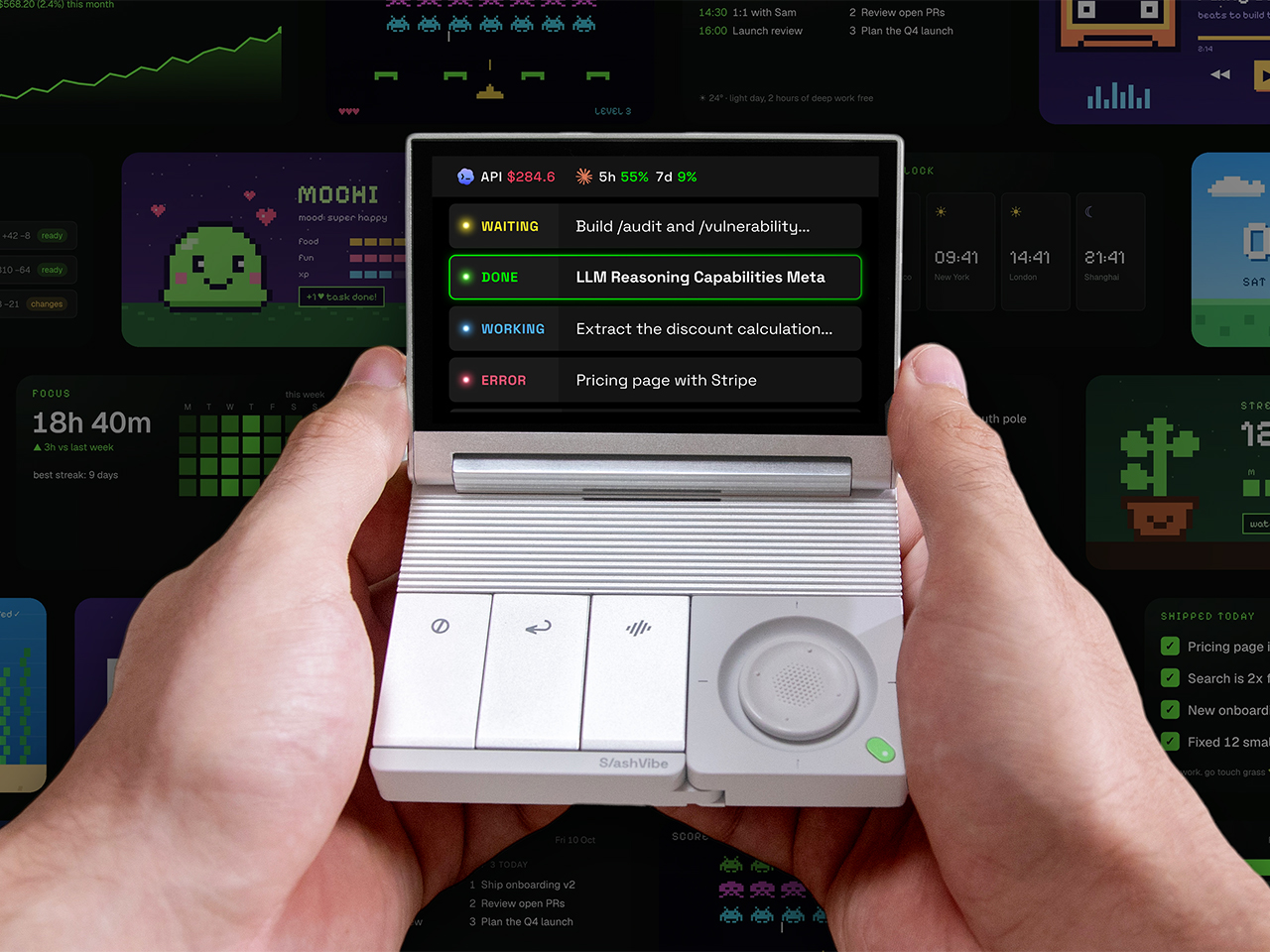
AI tools can help draft a proposal, gather references, and tackle the little jobs that eat into your day. Keeping track of all that activity, however, can become a job of its own. SlashVibe gives those tasks a dedicated spot beside your computer, pairing a small display with a detachable voice controller so checking progress doesn’t always mean opening another conversation.

SlashVibe takes a familiar shape, with a hinged, 3.96-inch LCD above a compact base. There’s no tiny keyboard demanding that you relearn typing with your thumbs. Instead, three action keys and a two-axis joystick handle the shorter interactions. Your computer remains the place for full documents and detailed edits, while SlashVibe is designed around checking, selecting, and responding.

Designers: Changliang Liu, Yitian Wu, Shijun Xu (dooo design)

Click Here to Buy Now: $169 $249 ($80 off). Hurry, only a few left! Raised over $68,000.

Take that client proposal, for example. Gathering references and preparing a first draft are related jobs, but they’re still separate pieces of work. Instead, SlashVibe organizes supporting AI tasks under the responsibility they belong to. That gives the screen a purpose beyond showing a collection of busy agents, keeping the project you’re responsible for connected to the work you’ve handed off.

As those agents work, the display shows which sessions are running, finished, or waiting for you. Selecting one can bring its associated window to the front on your computer, while supported permission requests can be handled directly on SlashVibe. The small screen helps you find the thing that needs attention, rather than pretending it should contain your entire working day.

When the draft needs a different emphasis, the next instruction can be spoken instead of typed. Built-in dictation turns that explanation into editable text, with cleanup and formatting designed to make it easier to read. Separate Send and Cancel controls keep speaking and submitting from becoming the same action. After all, thinking out loud shouldn’t have to mean sending every unfinished thought.

The detachable controller makes that voice interaction more interesting than another microphone sitting on a desk. You can bring it closer to speak softly or lean back while composing an instruction, leaving the display where it’s easiest to see. It connects wirelessly to the display, which stays linked to the computer through USB-C. Viewing and speaking don’t have to happen in the same spot.

That split also gives the materials different roles. Sandblasted, anodized aluminum forms the display housing, base, and action keycaps, while the controller uses a plastic housing with soft-touch upper surfaces. Kailh ultra-low-profile mechanical switches sit beneath the keys. Those raised controls give the interface physical landmarks, a deliberate change from another layer of tiny icons competing for attention across your computer screen.

A meeting adds another layer to the same project. Physical recording controls, live notes, and contextual prompts extend SlashVibe beyond supervising agents. You could catch up on a missed point or find a follow-up question without turning your attention to an entirely different window. The joystick provides a way to move through those prompts while the conversation continues.

Afterward, action items become to-dos, with related work available to delegate to AI and full meeting notes available on the computer. A request for another comparison can become the next supporting task for the proposal. SlashVibe’s companion app supports macOS and Windows, and the company lists more than 20 compatible AI agents and tools, including Claude Code and Cursor. The proposal remains the thread connecting those separate sessions and decisions.

The software development kit (SDK) would let developers create dashboards or connect additional agents. A project-specific display could keep the proposal’s supporting work visible while the document itself stays open on the main screen. When another change comes to mind, the controller is already beside the keyboard. A spoken instruction can handle the adjustment while the larger screen stays devoted to the document.

Click Here to Buy Now: $169 $249 ($80 off). Hurry, only a few left! Raised over $68,000.

The post SlashVibe Gives AI Work a Dedicated Screen and a Detachable Voice Controller first appeared on Yanko Design.
  • ✇Yanko Design
  • Abxylute’s $65 smartphone gamepad packs Hall Effect triggers, clickable sticks, and gyro aiming
    Valve raised the price of the 512GB Steam Deck OLED to $789 this May, a number that makes anyone want to close the browser tab out of spite. Blame the AI boom, which has data centers swallowing memory chips faster than factories can make them, leaving handhelds to fight over the scraps. Now look at the phone in your hand. It runs native console ports like Resident Evil, streams entire Xbox and PlayStation libraries, and emulates most of the consoles a millennial grew up with. All it lacks is a
     

Abxylute’s $65 smartphone gamepad packs Hall Effect triggers, clickable sticks, and gyro aiming

23 octobre 2026 à 19:30

Valve raised the price of the 512GB Steam Deck OLED to $789 this May, a number that makes anyone want to close the browser tab out of spite. Blame the AI boom, which has data centers swallowing memory chips faster than factories can make them, leaving handhelds to fight over the scraps. Now look at the phone in your hand. It runs native console ports like Resident Evil, streams entire Xbox and PlayStation libraries, and emulates most of the consoles a millennial grew up with. All it lacks is a pair of real thumbsticks and triggers, which is a far cheaper problem to solve.

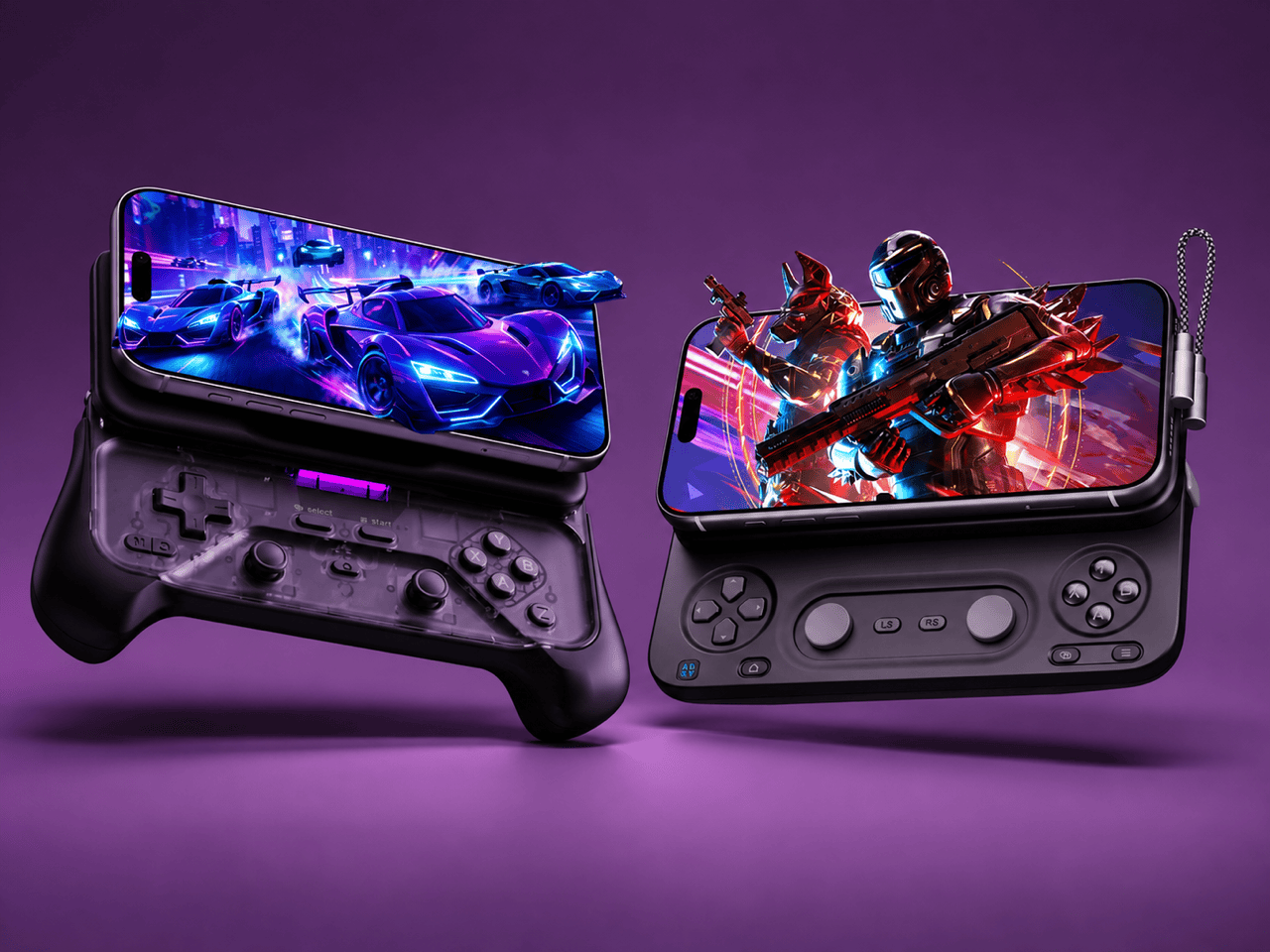
Hong Kong-based abxylute solves that problem with the M5 and M6, two sliding controllers that magnetically snap to the back of your phone. Closed, they sit behind it like a chunky case. Slide the phone up and a full gamepad appears underneath, Xperia Play style, with sticks, triggers, and rumble. The M5 is the slim one, plugging in over USB-C with zero pairing and pass-through charging. The M6 goes wireless over Bluetooth, adding clickable capacitive sticks, Hall Effect triggers, gyro aiming, and a 10-hour battery. Both retail under $90, roughly one-ninth of a Steam Deck these days, and for anyone whose gaming happens on commutes and couches, that math is hard to argue with.

Designer: abxylute

Click Here to Buy Now: $65 $84.99 (24% off) Hurry! Only limited units available.

A slider rail from the Nokia era, rebuilt for modern phones

Sliding rails nearly went extinct when touchscreen slabs replaced slider phones, and so did most of the factories that made them. abxylute eventually tracked down a manufacturer that once built rails for Nokia and Sony, then asked it to do something those phones never needed. A slider from 2010 only had to carry a lightweight screen half, while the M5 and M6 have to hold a phone and case weighing up to around 10.6 ounces (300g). The resulting bidirectional damped rail glides smoothly both ways, with magnets snapping it into the fully open and closed positions. That makes for a calmer motion than the spring-loaded slide on the OhSnap MCON, which fires the phone open at a button press.

The phone attaches through an adjustable magnetic mount rated at 4,098 gf, roughly 9 pounds of pull and comfortably above the 2,500 to 3,500 gf abxylute quotes for Apple’s MagSafe. Both mounts clear camera bumps up to 0.28 inches (7mm), and the plate shifts to suit different phone sizes. Supported phones include the iPhone 18 series, Galaxy S26, Pixel 11, OnePlus 15, and Xiaomi 17, with a magnetic adhesive ring in the box for anything lacking MagSafe. Thick cases will sap some of that grip, so slimmer cases make the safer pairing. Lightning iPhones sit out the M5 entirely, since that model needs a USB-C port to work.

The M5 goes wired and thin for pocket duty

The M5 began life as a DIY build by Jinjiang, an independent maker who handled the 3D modeling, PCB design, and programming himself before abxylute partnered with him to engineer it for mass production. Its connection is wired USB-C, which means no Bluetooth pairing, no battery to charge, and pass-through charging so your phone can top up mid-session. The sticks are low-profile carbon-film sliders modeled on the PSP, PSP Go, and Nintendo 3DS, recessed nearly flat to keep the controller slim. Because sliders can’t click, abxylute added dedicated LS and RS buttons that double as programmable macro keys. Micro-switch triggers with short travel and a crisp click round out the inputs.

Those choices produce a controller that weighs about 6 ounces (170g) and measures 0.91 inches (23mm) thick with the mount, thinning to 0.45 inches (11.5mm) at the grip area. It spans 5.9 inches (149.5mm) wide, about the width of a large phone, so it slips into a jacket pocket easily. I appreciate a product that commits this fully to one idea, and the M5 commits to portability. Slider sticks offer less throw than full-size ones, so they favor retro titles and platformers over twitchy shooters. A limited M5 Founder’s Edition, capped at 1,000 units, comes in translucent retro green with a customizable two-letter badge replacing the abxylute logo.

The M6 packs full-size controller features into the slide

The M6 took nearly three years to develop, long enough to earn the internal nickname “little Nezha,” and most of that effort went into the controls. Its capacitive sticks, developed with component maker K-Silver, tilt 20 degrees against the roughly 23 degrees of a full-size controller stick, and they click for L3 and R3. abxylute also built them to resist magnetic interference, a smart call given the strong magnet array sliding a few millimeters above them. Instead of sinking the sticks into deep wells, a stepped surface around each one frees up room for your thumbs. Stick output switches between circular and square modes, handy for racing games and emulators.

Hall Effect linear triggers with 0.22 inches (5.5mm) of travel handle racing games, and a Fast Trigger Mode shortens actuation for shooters. A face-mounted Z button takes remaps and multi-button macros, so a fighting game special move or a jump-and-shoot combo fits under one thumb. There’s also a 6-axis gyroscope for motion aiming, and Bluetooth 5.3 backed by a 500mAh battery rated for up to 10 hours. The lighting is diffused, bouncing off the controller’s surface instead of shining at your eyes, and its color changes with each mode. All this comes in at 6.7 ounces (191g) and 1.02 inches (26mm) thick, a modest premium over the M5.

Shared features, the abxy app, and what each model costs

Both controllers share a physical mode switch that flips between NS, XInput, and PS layouts, covering Switch emulators, Android and cloud gaming, and iPhone titles respectively. Each gets dual Z-axis linear vibration motors with four intensity levels, plus a Turbo function paired to the M button. The free abxy Game App doubles as a launcher for emulators and cloud services, and it handles remapping, dead zones, macros, lighting, and vibration. Virtual touch mapping lets you assign on-screen controls to physical buttons for games that never bothered with controller support. Detachable magnetic grips, held by magnets plus a mechanical shear lock, add full-size handles for longer sessions, though they aren’t listed among the box contents.

Kickstarter pricing currently sits at $65 for the M5 and $69 for the M6, against retail prices of $84.99 and $89.99, both well under the $169.99 Backbone Pro. A bundle with one of each costs $119, down from $174.98. The M6 is estimated to ship in November 2026 and the M5 in December 2026, with worldwide delivery. The M5 box adds a USB-C cable to the controller, adhesive ring, and manual that both models share. Valve wants $789 for a handheld. abxylute wants $69 to upgrade the one you already own.

Click Here to Buy Now: $65 $84.99 (24% off) Hurry! Only limited units available.

The post Abxylute’s $65 smartphone gamepad packs Hall Effect triggers, clickable sticks, and gyro aiming first appeared on Yanko Design.

❌