❌

Vue normale

Apple’s New $200 Indoor Camera Turns Away When You’re Home — for Privacy

14 octobre 2026 à 07:26

Apple's new $200 indoor camera automatically turns away when residents return home. Here's how its privacy feature works and what remains unconfirmed.

The post Apple’s New $200 Indoor Camera Turns Away When You’re Home — for Privacy appeared first on TechRepublic.

Best Smart Home Security Cameras for 2026: Ring, Nest, Arlo and Eufy

7 octobre 2026 à 14:18

We compare current Ring, Nest, Arlo, and Eufy outdoor security cameras by video quality, AI features, storage, subscriptions, and long-term cost.

The post Best Smart Home Security Cameras for 2026: Ring, Nest, Arlo and Eufy appeared first on TechRepublic.

Apple and LG Reportedly Develop Smart Home Locks, Cameras and More

7 octobre 2026 à 13:26

Apple and LG are reportedly developing smart home locks, cameras and other accessories. Here’s what buyers should know about compatibility and timing.

The post Apple and LG Reportedly Develop Smart Home Locks, Cameras and More appeared first on TechRepublic.

Hackers Crack Flock Camera, Expose 1.6M Images in 21 Days

18 septembre 2026 à 17:48

Hackers physically compromised a Flock camera and found an encryption key, 27,000 clips, and 1.6 million images generated in 21 days.

The post Hackers Crack Flock Camera, Expose 1.6M Images in 21 Days appeared first on TechRepublic.

  • ✇Yanko Design
  • Camp Snap’s 110D Looks Like 1973 and Still Skips the Screen on Purpose
    Camera design spent the last two decades chasing thinner phones and bigger screens, so a company deciding to revive a boxy, finger-length shape from the 1970s sounds like a step backward. The Camp Snap 110D proves otherwise. It borrows its elongated, pocketable body from the old 110 film format, then strips out the one feature every digital camera has trained us to expect: a screen for checking the shot you just took. That missing screen isn’t a cost-cutting shortcut. It’s the entire point. Sma
     

Camp Snap’s 110D Looks Like 1973 and Still Skips the Screen on Purpose

Par : JC Torres
18 septembre 2026 à 09:20

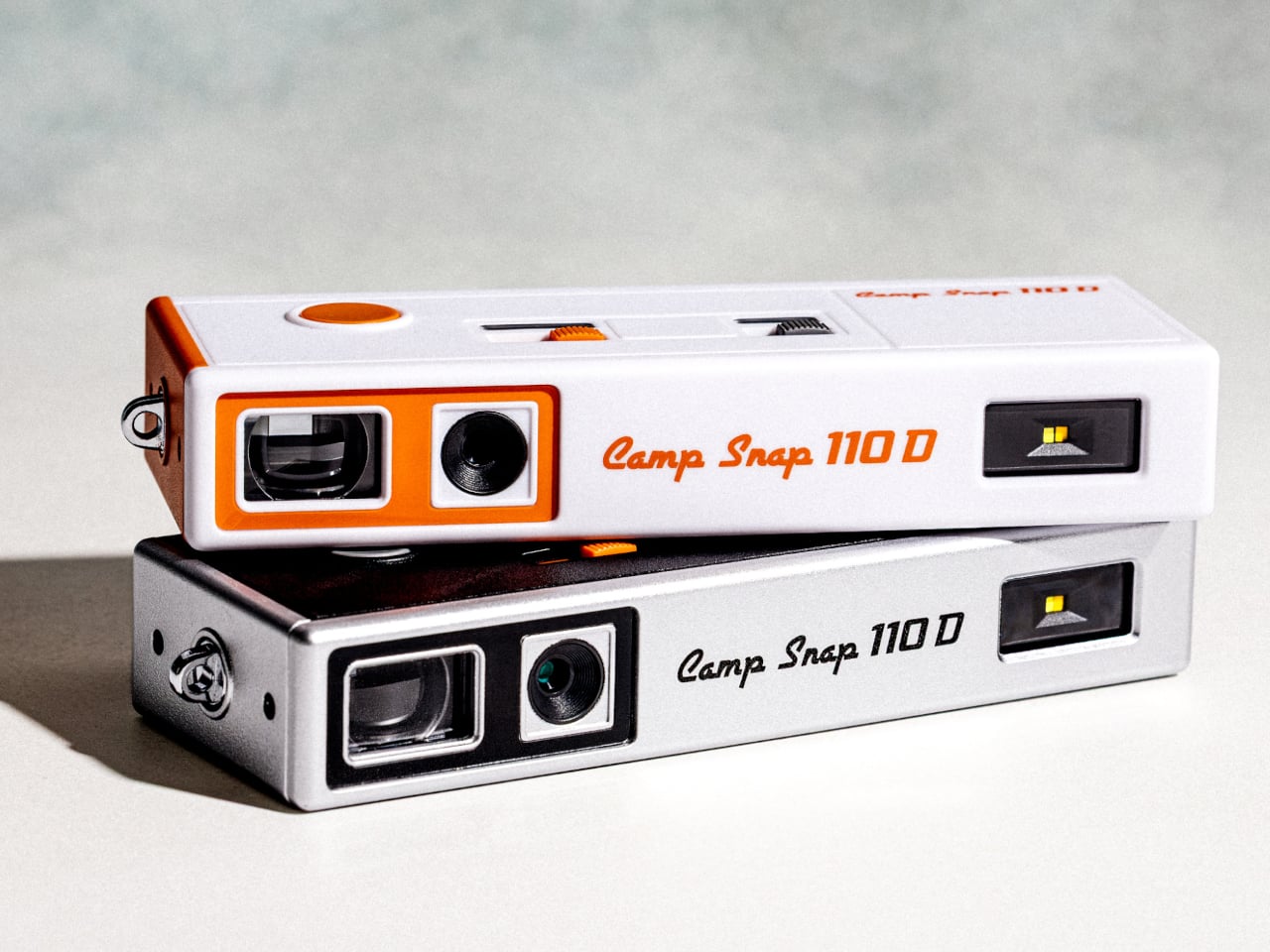
Camera design spent the last two decades chasing thinner phones and bigger screens, so a company deciding to revive a boxy, finger-length shape from the 1970s sounds like a step backward. The Camp Snap 110D proves otherwise. It borrows its elongated, pocketable body from the old 110 film format, then strips out the one feature every digital camera has trained us to expect: a screen for checking the shot you just took.

That missing screen isn’t a cost-cutting shortcut. It’s the entire point. Smartphone photography turns every outing into a loop of shooting, reviewing, deleting, and reshooting until a moment gets buried under a dozen nearly identical takes. The 110D breaks that loop by design, letting a photo exist the instant it’s taken and staying invisible until you plug the camera in later and actually look at what you captured.

Designer: Camp Snap

Living without a review screen also solves a problem the original 110 format never had to think about: battery life. Screens are usually the single biggest power drain in a compact camera, so removing one frees up room for improvements elsewhere. The 110D pairs that saved power with QuickDraw sleep and wake functionality, letting the camera snap awake fast enough to catch a moment instead of fumbling through a slow startup.

Inside that slim shell sits an 8-megapixel sensor, modest by phone camera standards on purpose, since chasing sharper resolution would work against the whole idea of embracing a lower-fidelity, more film-like result. Five built-in filters let a shooter pick a mood before pressing the shutter rather than fixing it afterward in an app, pushing the entire editing decision to before the photo exists instead of after.

Storage runs on a microSD card, and images transfer out through a USB-C port, a small detail that keeps the retro shape from turning into an actual hassle to use. Charging works the same way, so nobody’s hunting for a proprietary cable or a dead battery with no replacement in sight. The vintage silhouette stays purely visual, while the internals stay entirely current.

Two colorways round out the release: a black variant and a cream-and-orange combination that leans harder into the ’70s reference than the shape alone already does. Both ship with a wrist lanyard and a small carrying pouch, treating the camera less like a serious tool tucked into a bag and more like something meant to hang off a wrist at a party or a weekend trip without a second thought.

At $74.99, the 110D undercuts most instant cameras and plenty of higher-end toy cameras while offering something neither fully provides: a shape borrowed from actual photographic history rather than a generic plastic body built to look vaguely retro. That’s a specific kind of nostalgia, aimed at people who remember what a 110 camera looked like even if they never touched the film it used.

The post Camp Snap’s 110D Looks Like 1973 and Still Skips the Screen on Purpose first appeared on Yanko Design.

  • ✇Yanko Design
  • Reolink’s OMVI 2i Ultra Wireless Security Camera can look in two directions at once: Hands-on at IFA 2026
    Picture a courier walking up your driveway while someone else quietly tries your side gate. A normal pan-tilt camera picks one of them and forgets the other exists. Reolink’s OMVI 2i Ultra handles it by carrying two cameras at once: a fixed 4K wide lens on top that never stops watching the full scene, and a 5MP pan-tilt ball below that spins 355 degrees to lock onto whatever the wide lens flags. Both feeds record at the same time, and you can tap anywhere on the wide view to slew the turret str
     

Reolink’s OMVI 2i Ultra Wireless Security Camera can look in two directions at once: Hands-on at IFA 2026

4 septembre 2026 à 03:00

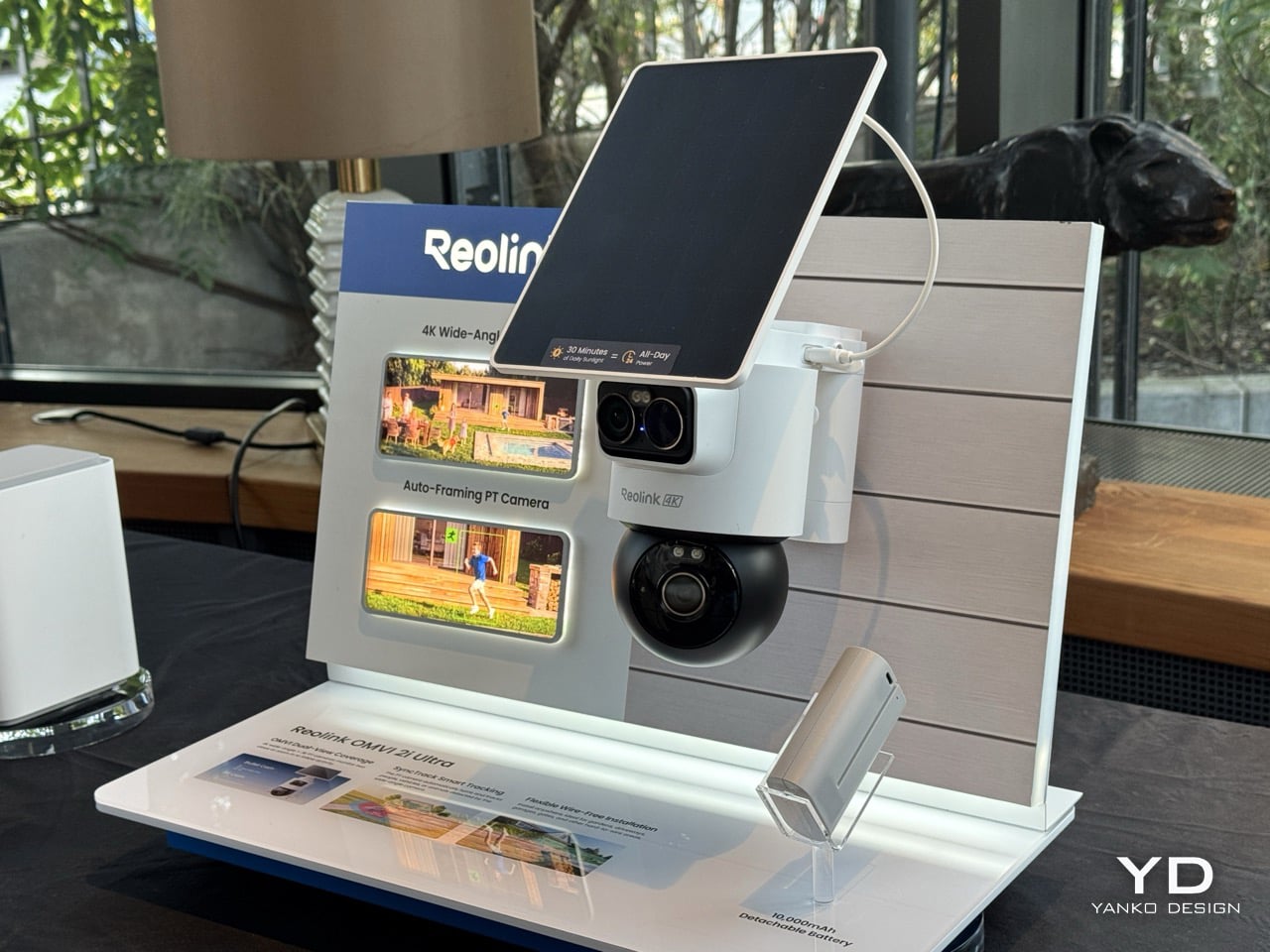
Picture a courier walking up your driveway while someone else quietly tries your side gate. A normal pan-tilt camera picks one of them and forgets the other exists. Reolink’s OMVI 2i Ultra handles it by carrying two cameras at once: a fixed 4K wide lens on top that never stops watching the full scene, and a 5MP pan-tilt ball below that spins 355 degrees to lock onto whatever the wide lens flags. Both feeds record at the same time, and you can tap anywhere on the wide view to slew the turret straight to that spot. It debuted at IFA 2026 in Berlin, ships late October, and costs between $200 and $250.

A detachable 10,000mAh pack claims six months per charge, and the 6W SolarEase panel says it needs about thirty minutes of daily sun to stay topped up, against the one to two hours Reolink quotes for rivals like Eufy’s S340 and the Tapo C675D. Those are Reolink’s own numbers, so hold them loosely until somebody leaves one on a north-facing wall through a British winter. The rest is easier to verify. Wi-Fi 6 across both bands, up to 512GB of local microSD with no subscription attached, colour night vision from twin spotlights, a siren, and IP65 sealing. At a kilogram with the bracket, it is a proper lump of hardware rather than something you tuck on a shelf.

Designer: Reolink

Pan-tilt cameras have quietly lied to buyers since the format existed. Sell someone a camera that turns to follow motion and you have also sold them a camera that stops watching everywhere else the instant it does. Reolink’s fix is embarrassingly simple once you see it. Stop asking one lens to be both the guard and the chaser, and give it a second lens that only guards. The wide 4K unit up top runs at 110 degrees horizontal and never rotates, so the scene it opened on is the scene it keeps recording no matter where the PT ball below it wanders off to. Reolink calls this SyncTrack, but the actual idea is closer to division of labour than any clever algorithm. One camera commits to context, the other commits to pursuit, and neither has to compromise for the sake of the other.

This is the third time Reolink has built this exact idea in 2026, and each version has been a slightly different argument about what matters most. The X16 landed at CES in January as a 24MP full metal flagship with 16x optical zoom, but it needs an ethernet run to function, which puts a hard ceiling on where it can live. The 3i followed in June with PoE and wired Wi-Fi options at $319.99, still asking for a nearby outlet even in its most flexible form. The 2i Ultra drops the combined resolution to 8MP plus 5MP and, in exchange, cuts the cord entirely. The trade-off is the clever bit, because being able to pop a camera on a fence or a backyard without worrying about wiring is much more convenient than haggling over megapixels.

A squared-off dual-lens head sits above a separate motorized ball, with a solar panel tilting on its own hinge overhead, and the whole assembly weighs a full kilogram once the bracket is attached. Compare that to Reolink’s own Argus MagiCam, a 108-gram cube you stick to a fridge with a magnet, and the difference in ambition is obvious at a glance. This is not a camera trying to disappear into a bookshelf. It reads more like a small piece of maritime equipment bolted under an eave, and that visible mechanical presence is doing some of the deterrence work before the siren ever gets involved.

That dual-lens design is quite literally baked into the name. OMVI reads like omni-vision, a camera built to watch in every direction at once instead of picking a lane. Arlo’s Ultra flagship still wants a wall plug or a proprietary base station to unlock its best tricks, and Nest’s outdoor cameras have quietly stayed wired-first for years now, which makes the 2i Ultra’s fully wire-free build feel like it is actually catching up to how people install things rather than how manufacturers wish they would. No drilled conduit, no hub tucked in a closet, just a battery, a solar panel, and a spot on the fence you actually wanted the camera to go.

That is the real flex against the flagships twice its price. You are not paying for a wall socket you have to plan your whole install around, and you are not paying for a bulky base station eating an outlet indoors either. You get two lenses doing genuinely different jobs, a battery that outlasts most of the category on paper, and a name that finally means something instead of just sounding techy. At $200 to $250, the OMVI 2i Ultra is the version of omni-vision security that shows up ready to mount anywhere the moment you take it out of the box.

The post Reolink’s OMVI 2i Ultra Wireless Security Camera can look in two directions at once: Hands-on at IFA 2026 first appeared on Yanko Design.

  • ✇Yanko Design
  • Reolink’s $65 Tiny Magnetic Security Camera Runs 9 Months on 2 AA Batteries: Hands-On at IFA 2026
    The worst part of owning a security camera has never been the camera. It is the ladder, the drill, the wall plug, and the moment you realize you aimed the thing eight degrees too far left. Reolink’s Argus MagiCam deletes all of that with a magnet. The 68mm  GoPro-looking cube slaps onto any metal surface in about two seconds, or onto an included magnetic puck with a swivel arm for everything else, turning any surface into a security surveillance monitor (you can even mount it in your car as a d
     

Reolink’s $65 Tiny Magnetic Security Camera Runs 9 Months on 2 AA Batteries: Hands-On at IFA 2026

4 septembre 2026 à 03:00

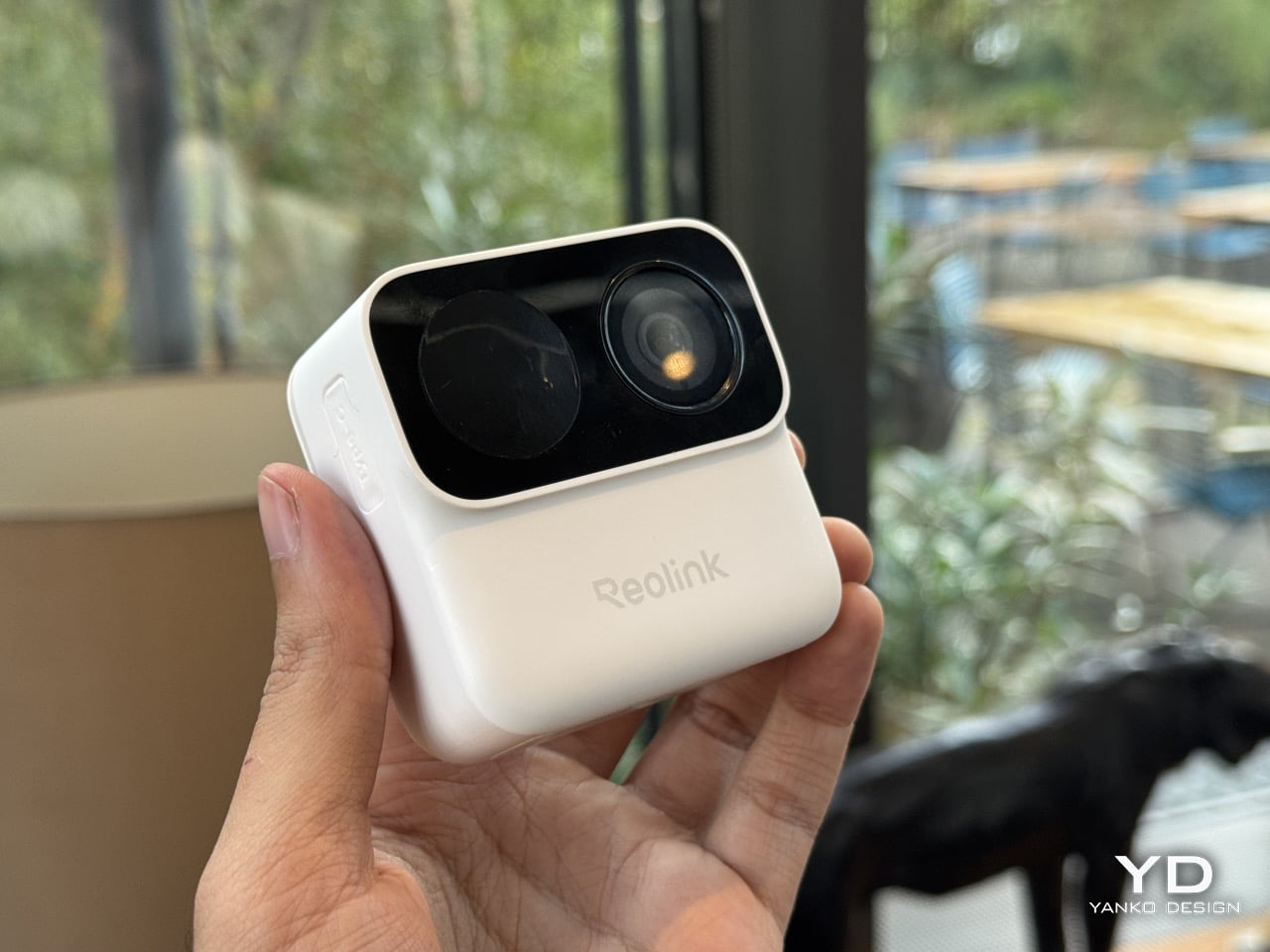
The worst part of owning a security camera has never been the camera. It is the ladder, the drill, the wall plug, and the moment you realize you aimed the thing eight degrees too far left. Reolink’s Argus MagiCam deletes all of that with a magnet. The 68mm  GoPro-looking cube slaps onto any metal surface in about two seconds, or onto an included magnetic puck with a swivel arm for everything else, turning any surface into a security surveillance monitor (you can even mount it in your car as a dashcam)… and here’s the kicker. It runs up to nine months on two AA lithium batteries. Nine. Whole. Months. I repositioned it three times in under a minute at IFA 2026, which is three more times than I have ever moved a camera bolted to a wall.

Sixty-five dollars buys 1080p, IP67 weatherproofing, dual-band Wi-Fi, on-device person detection, and local microSD storage with no monthly fee attached. Flip the cube over and the back panel detaches to a bay holding two ordinary AAs, the SD slot and the reset button, all serviceable with a coin and a spare hand. Reolink built it around Qualcomm’s QCC730 micro-power Wi-Fi chip for its Power Efficient Series, shown in Hall 1.2 next to the OMVI 2i Ultra. A USB-C port hides under a rubber flap for 24/7 recording when you want it wired. Three colours: black, white, and a mint green that has no business looking this good.

Designer: Reolink

A matte PIR dome sits on the left, a glossy ringed lens sits on the right, and a pinhole mic hides between them, the whole cluster raised on a squared-off black module that reads more like a GoPro’s lens housing than anything borrowed from traditional security hardware. Security cameras have spent two decades pretending they belong on a parking structure, all bullet housings and matte black anonymity. This one borrows its language from action cameras instead, small, chunky, built to be picked up and repositioned rather than mounted once and forgotten, which is exactly why the mint colorway makes sense sitting on a bookshelf instead of bolted above a garage. That GoPro reference is not incidental either. It signals a camera meant to be handled, not just installed.

The battery bay is the real argument here. Somewhere along the way, the smart home industry decided sealed rechargeable packs looked cleaner on a spec sheet, and quietly handed every camera, doorbell, and earbud an expiry date measured in a couple of years. Reolink went the other direction, and the QCC730 chip is what makes that reversal viable rather than nostalgic, since its whole job is sipping power in standby instead of gulping it. Blink has claimed two years off two AA lithiums since its Outdoor 4 launched, though independent testing has repeatedly landed closer to a few months once real motion traffic gets involved. Nine months against a heavier five minutes of daily recording, verified in Reolink’s own side by side tests, reads like the more honest number in the room.

What you give up for all that convenience is resolution, and it barely registers as a cost. This is a 1080p sensor at a moment when 4K battery cameras exist, sure, but 1080p is still plenty sharp for spotting a face at the door or a raccoon in the bin, and the fixed bitrate keeps file sizes sane on a modest microSD card. Night vision runs through a single mono IR LED instead of anything approaching colour, which is standard fare at this tier, not a shortfall specific to Reolink. For a camera this cheap, this easy to place, and this forgiving on power, trading a few thousand pixels feels like a fair swap rather than a compromise. The MagiCam was never trying to be the sharpest eye on your property. It is trying to be the one you actually keep charged, and on that specific promise, the AA drawer you have been ignoring for a decade just became a legitimate accessory again.

The post Reolink’s $65 Tiny Magnetic Security Camera Runs 9 Months on 2 AA Batteries: Hands-On at IFA 2026 first appeared on Yanko Design.

Honor Robot Phone Cheat Sheet: Specs, Price and Who Should Buy It

3 septembre 2026 à 18:11

Explore the Honor Robot Phone’s 200MP gimbal camera, flagship specs, China pricing, key trade-offs, and whether this experimental phone is worth buying.

The post Honor Robot Phone Cheat Sheet: Specs, Price and Who Should Buy It appeared first on TechRepublic.

OnePlus 16 Camera Leak Reveals 200MP Main Sensor and New 3x Telephoto

3 septembre 2026 à 08:03

OnePlus 16 camera leaks point to a 200MP main sensor, larger 50MP 3x telephoto and new ultrawide, but global availability remains unclear.

The post OnePlus 16 Camera Leak Reveals 200MP Main Sensor and New 3x Telephoto appeared first on TechRepublic.

Honor Robot Phone Specs Leak Ahead of Aug. 12 Debut: What Users Can Expect

6 août 2026 à 08:54

A new leak claims Honor’s Robot Phone will feature two 200MP cameras, a motorized gimbal, a 7,060mAh battery, and 120W charging.

The post Honor Robot Phone Specs Leak Ahead of Aug. 12 Debut: What Users Can Expect appeared first on TechRepublic.

Samsung Galaxy S27 Pro May Not Be the Smaller Ultra Buyers Expect

5 août 2026 à 12:54

Samsung’s rumored Galaxy S27 Pro may share several premium features with the S27 Ultra, but new leaks suggest clear differences in zoom cameras, display size, S Pen support, batteries, and regional processors.

The post Samsung Galaxy S27 Pro May Not Be the Smaller Ultra Buyers Expect appeared first on TechRepublic.

❌